
Category: Complex Business Litigation

  • Cracking the College Sports “Cartel”: Good for Athletes, Competition, and the Games by Joy Sidhwa and Tim LaComb

    Cracking the College Sports “Cartel”: Good for Athletes, Competition, and the Games by Joy Sidhwa and Tim LaComb

    The Authors

    Joy M. Sidhwa

    Joy M. SidhwaMoginRubin, LLP

    Ms. Sidhwa concentrates on antitrust and other complex litigation for MoginRubin and leads the document discovery team. She is involved in many facets of litigation, including creative discovery strategy and expert and trial preparation. Based on her expertise and results, Ms. Sidhwa was named to the Best of the Bar by the San Diego Business Journal and received the 2018, 2019 and 2021 International Advisory Experts Award for Complex Litigation in California. She also received the Pan Asian Lawyers of San Diego’s President’s Award for Outstanding Service in 2009 and 2010 for her service to the Board of Directors and regularly volunteers in various community services. She continues to volunteer her time to the Filipino-American Lawyers of San Diego (Director), the University of Michigan Club of San Diego (Board of Governor), and the Lawyers Club North County Committee. In 2020, she was appointed to serve as Board of Director for the Women of Color in Law, she recently stepped down from that role and is currently serving as an Advisory Board member.

    Ms. Sidhwa obtained her law degree from California Western School of Law and her Bachelor of Science degree from the University of Michigan. Prior to joining MoginRubin, Ms. Sidhwa provided expertise to national law firms in electronic document discovery and trial preparation in patent infringement, trademark, complex securities litigation, and intellectual property.

    Timothy Z. LaComb

    Timothy Z. LaCombMoginRubin, LLP

    Mr. LaComb is an Associate in MoginRubin LLP’s San Diego office and his practice focuses on antitrust, unfair competition, and complex business litigation, particularly as they relate to mergers and acquisitions.

    Prior to joining MoginRubin LLP, Mr. LaComb was an Associate at Robbins Geller Rudman & Dowd LLP where he helped secure several multi-million-dollar recoveries for shareholders in merger-related class action litigation. Through his extensive experience in complex litigation, he has developed an expertise and proficiency in electronic and other discovery-related issues. Mr. LaComb also worked as a Transaction Associate at David F. Grams & Associates, S.C. immediately after law school. He is admitted in both California and Wisconsin.

    Tim earned his J.D. from the University of Wisconsin School of Law, where he was on the Dean’s List and a member of the UW Law Moot Court Board, and earned his B.A. in Economics from the University of San Diego.

    The Journal on Emerging Issues in Litigation

    Emerging Litigation Podcast

    Emerging Litigation PodcastProduced by HB Litigation and Law Street Media

    Interviews with leading attorneys and other subject matter experts on new twists in the law and how the law is responding to new twists in the world.

    Cracking the College Sports “Cartel”:

    Good for Athletes, Competition, and the Games

    Time will show that amateurism is not what fills stadiums.


    Editor’s Note: This article will appear in the spring issue of the Journal on Emerging Issues in Litigation, published by Fastcase Full Court Press. Download a pre-publication copy now. Thanks to California Sports Lawyer Jeremy Evans for his valuable contributions to this article.

    Alston Opinion Changed Everything

    In NCAA v. Alston, 141 S. Ct. 2141 (2021), the Supreme Court upheld a district court and subsequent affirmation by the Ninth Circuit Court of Appeals in favor of players. The National Collegiate Athletic Association (NCAA) rules limiting education-related compensation violated Section 1 of the Sherman Act, the high court affirmed. Just days later, the NCAA announced interim measures allowing name, image, and likeness (NIL)–related benefits. It continued to restrict non-educational compensation, however. Left intact were bans on pay-for-play arrangements and inducements to influence a student’s choice of schools. The athletes did not challenge the remaining rules, but the Supreme Court’s decision, combined with the principles of antitrust law, opened the door to further efforts to overturn bans on compensation unrelated to education, which we are seeing.

    Before Alston, there was a string of NCAA cases before California federal courts challenging its long-standing amateurism rules. Most had reached some form of the following conclusions:

    1. If compensation distorts the amateur-professional distinction, then the NCAA has a procompetitive justification in restricting it because demand for NCAA sports is based on the amateur status of the players.
    2. If compensation is tied to the cost of attending school or an education-related benefit, then it does not threaten the amateur-professional distinction and the NCAA lacks a pro-competitive justification for restricting it.

    The Ninth Circuit found in its Alston ruling that the student athletes established that the NCAA rules produced significant anticompetitive effects within the relevant market for their labor. It then considered the NCAA’s procompetitive justification for the rules—that demand for college sports is based on the amateur status of the athletes and the rules preserve that tradition. Relying on market-demand experts, consumer survey evidence, and testimony from NCAA officials, the panel held the NCAA had a procompetitive justification to prohibit unfettered student athlete compensation but not non-cash education-related benefits. The court permitted the latter category because it would not alter the amateur-professional distinction of the student athletes. Alston v. NCAA (In re NCAA Ath. Grant-In-Aid Cap Antitrust Litig.), 958 F.3d 1239 (9th Cir. 2020)

    “Cartel of Buyers Acting in Concert”

    In a concurring opinion, Judge Milan Smith described the NCAA as a “cartel of buyers acting in concert to artificially depress the price that sellers could otherwise receive for their services.” The NCAA’s rules, the judge commented, deprived young athletes “the fundamental protections that our antitrust laws were meant to provide them.”

    The Supreme Court affirmed. Writing for the court, Justice Neil Gorsuch agreed with the district judge that the NCAA and its member schools are commercial enterprises governed by the Sherman Act. In applying the rule of reason test, he agreed with the NCAA that “antitrust law does not require businesses to use anything like the least restrictive means of achieving legitimate business purposes.” However, Gorsuch found the district court’s analysis in line with antitrust law.

    Justice Brett Kavanaugh concurred, saying the NCAA’s restrictions on non-education-related compensation left serious antitrust questions unanswered. “Businesses like the NCAA cannot avoid the consequences of price-fixing labor by incorporating price-fixed labor into the definition of the product,” he wrote, adding, “Nowhere else in America can businesses get away with agreeing not to pay their workers a fair market rate on the theory that their product is defined by not paying their workers a fair market rate.”

    From Nil to NIL: Does Amateurism Really Drive Demand for NCAA Sports?

    Opponents to NIL deals claim amateurism is what fills seats; people cram themselves into stadiums not because players earn financial rewards, but because of their passion for competition.

    As in O’Bannon v. NCAA (O’Bannon II), 802 F.3d 1049 (9th Cir. 2015), the Ninth Circuit in Alston v. NCAA focused on whether different forms of compensation impair the amateur-professional distinction. Critics challenge the notion that this distinction drives demand for college sports, and they have a point. In fact, games often become more popular after amateurs go pro. The Olympic Games, once hailed as the apotheosis of amateur competition, requires only wrestlers to compete without compensation. The popularity of the Games surged after professionals were permitted to compete. Golf followed a similar transformation.

    NIL proponents also argue that the quality of NCAA sports (i.e., the product) would improve if student-athletes were compensated. Top players often leave college early to turn professional; many would rather stay in school if they could afford it. At least some players, if compensated, would play additional seasons in college and delay advancing to the NBA. This is particularly true in college basketball, where top recruits increasingly skip college to get paid overseas or in the NBA’s developmental league.

    In its review of Alston v. NCAA, the Supreme Court noted the NCAA’s advocacy for amateurism as it describes the term. But, as the district court found in its opinion—In re NCAA Ath. Grant-In- Aid Cap Antitrust Litig., 375 F. Supp. 3d 1058 (N.D. Cal. 2019)—the NCAA never had a consistent definition of the concept; in fact, it shifted “markedly” over time. Nor did the NCAA refer to “considerations of consumer demand” in defining the word. “None of this is product redesign;” Justice Gorsuch wrote, “it is a straightforward application of the rule of reason.”

    The ultimate test of whether amateurism drives demand will come after new state laws allow compensation unrelated to education. If compensation doesn’t trigger a drop in demand, the NCAA will lose its procompetitive justification for the restriction and likely bring an end to amateurism rules.

    Momentum is clearly swinging in favor of college players in general, as additional guidance comes from states about implementing NIL policies and from judges as they encounter new arguments from athletes.

    Antitrust Class Action Certified in California

    On Nov. 3, 2023, U.S. District Judge Claudia Wilken of the Northern District of California, certified three classes of college athletes in their suit for antitrust damages (In Re College Athlete NIL Litigation, N.D. Calif.) In addition to being required to end its restraints, NCAA could face monetary damages based on payments college athletes would have received from broadcasts, video games, and other sources had they not be restricted. The plaintiffs demonstrated that issues of antitrust injury and damages could be resolved with common proof via class action, the judge determined. Further, she wrote that there is no dispute that the central question of whether the challenged rules violate Section 1 can also be resolved on a class-wide basis. With that, the court found the players showed that the predominance requirement of Rule 23(b)(3) was met with respect to the proposed damages classes.

    In their unsuccessful request for an interlocutory appeal to the Ninth Circuit, the NCAA and the “Power Five” college conferences said that if the players were to win the case, the organizations would suffer catastrophic damages – a “death knell” – for denying players a share of revenues and opportunities. They said they would be forced to settle even if they believe the players are wrong.

    Interestingly, the NCCA and the Power Five cited comments made by a leading beneficiary of NIL deals, University of Southern California quarterback Caleb Williams. The 2022 Heisman Trophy winner questioned why video game giant Electronic Arts was going to pay football players all the same flat $500 fee to appear in one of its games. Williams told Yahoo Sports: “It’s like if you go to school and you are a straight-A student and there’s another kid whose strong suit isn’t school, and he gets B’s or B-minuses. How fair would it be if you get the same grade as him? That never works in school, and it doesn’t make sense.”

    The NCCA used Williams’ remarks to support their position that star athletes would suffer if lumped into a class with average players, as opposed to allowing them to pursue individual litigation. The appeals court denied review on Jan. 18.

    On one hand, the chasm in compensation between stars and non-stars is nothing new in sports, or any field for that matter; on the other hand, it’s easy for a top-level quarterback to say, and downplays the contributions his teammates have made to his success.

    Antitrust Class Action Filed in Colorado

    Totaling the many billions of dollars generated by television broadcasts, the named plaintiff – former University of Colorado football player Alex Fontenot – says athletes “get nothing” even though they are “the most significant driver of that revenue.” To claim that amateurism is the main attraction is a “sham argument,” he says in a proposed class action filed against the NCAA and five conferences in federal court in Denver (Alex Fontenot v. NCAA, et al., No. 1:23-cv-03076, D. Colo.).

    “Defendants are operating a cartel that fixes wages—a classic antitrust violation,” the complaint reads. “The NCAA’s members (which includes its schools and conferences) are horizontal competitors. In a competitive market, they would compete for players by providing them with salaries commensurate with the true value of their labor. That competition would lead to the athletes receiving a significant share of revenue, including the television revenue from these media agreements. Athletes in other leagues (such as in European soccer leagues, the National Football League, and the National Basketball Association) regularly receive 50-60% of revenue.”

    “Many of these athletes are from disadvantaged backgrounds,” the complaint explains. “They have only a limited window to earn money based on their athletic talents, and they risk serious injury to compete in the sports that they, and fans, love. Only a small percentage of the athletes in the labor market at issue will ever play in the NFL, NBA, or WNBA, so for many of these athletes, college is their only chance to be compensated for their athletics skills. The NCAA’s rules have inflicted very serious and very great harm on the thousands of athletes that work so hard to make the NCAA’s product possible.”

    Filed Nov. 20, 2023, the complaint cites violations of Sections 1 and 2 of the Sherman Act. It seeks treble damages and a jury trial.

    Legislation

    Since NIL was unleashed on a sports-loving nation, more than half the states enacted NIL laws, fencing in the practice to varying degrees to avoid potentially unfavorable consequences. Other states and Congress are considering the issue, as well.

    Florida

    Florida was among the first NIL states and just two years later had already changed the law. The Sunshine State’s HB 7-B was enacted on Feb. 16, 2023, repealing and replacing its 2021 law which required NIL deals with student athletes to be facilitated by third parties – not universities. Now, Florida school officials may introduce and help broker NIL opportunities for players and prospects with third-party sponsors, boosters, and collectives. HB 7-B also requires universities and colleges to conduct financial literacy, life skills, and entrepreneurship workshops for players as part of receiving NIL-generated profits.

    One provision that remains in effect in Florida, however, is that universities may not use NIL as a recruitment or inducement tool, something that concerns the NCAA, universities, and college athletes. To mitigate the risk of abuse, NCAA leadership must develop anti-corruption policies and procedures, and address compliance, monitoring, education, conference parity, and fairness concerns.

    In the category of unexpected consequences, potential harm could come to those who lead NIL college teams on the playing field. Coaches make various decisions about their players. They determine how much athletes play and whether to bench or suspend them – decisions that could adversely impact their financial prospects. The new Florida law protects coaches from potential liability claims. This is sound policy, but it raises a question about NIL deals when connected to performance and pay-for-play. A traditional NIL pulls from three buckets: (1) money, (2) product, and/or (3) equity for the services of social media posting, advertising, endorsing, or consulting, or some similar activity or job. However, there have been questions raised during the anything-goes era of NIL contracts, in which they can be connected to performance, playing time, or whether a college athlete is playing for a certain university. As long as NIL deals are allowed, these issues will have to be addressed by the NCAA, universities, and legislatures.

    California

    In the first state to author NIL legislation, the California legislature is considering whether to pay college athletes more money unrelated to free market NIL payments from university television revenue or an athletic department surplus (e.g., 50% into a college fund). In addition, any payments would have to be made according to Title IX rules (e.g., equal payments to all student athletes regardless of sport profit or gender). There is also a proposed college athlete “bill of rights” and one provision that supports graduation and education. If the legislation passes (such measures have failed before) universities may look for ways to spend the money to avoid a surplus. As we’ve made clear, the surpluses can be enormous. UCLA and USC left the Pac-12 for the Big Ten to gain $40-60 million in additional television revenue each year.

    The draft legislation in California also states that employment is not to be assumed by any guaranteed payments. However, guaranteed payments in legislation for college athletes would support an argument that an employee-employment relationship exists, especially given California’s definition of independent contractors and when compared to professional athletes. An employment misclassification dispute could lead to expensive litigation against universities.

    National Solution?

    Federal legislators are also paying attention to the issue. In the summer of 2023, Sen. Richard Blumenthal co-sponsored a bill that would create a national NIL standard, as did Sens. Joe Manchin and Tommy Tuberville, and Rep. Gus Bilirakis. Sen. Chris Murphy and Rep. Lori Trahan (a former Division I volleyball player) proposed a bill that would allow international student-athletes to engage in NIL activity without losing their student visa status. That bill is also designed to encourage negotiation between athletes and their colleges for the use of athletes’ NIL for promotion and media rights deals, and ensure colleges and collectives do not discriminate based on gender, race, or participating sports when facilitating NIL deals.

    The NCAA and colleges have called for a federal standard. But, after a hearing this month on Bilirakis’ proposals, Rep. Trahan told Steve Berkowitz of USA Today, “It’s hard to imagine in this Congress, getting to an agreement on an antitrust exemption — on employment … That’s not going to pass both chambers and … Democrats and Republicans won’t come together on that one.”

    The Competition Cash Cow

    Looking back, we find it interesting that the only amateurs in the “college sports industry” – which generates billions of dollars in revenue and pays many thousands of salaries – seemed to be the players themselves. Everyone from coaches to broadcasters to hotdog vendors are compensated. Even cheerleaders and marching band musicians have been free to negotiate NIL deals.

    It seems odd to refer to college sports as an industry, but the label is warranted. According to the NCAA, Division I athletics generated $15.8 billion in 2019 from ticket sales, media rights, licensing, and donations. The Knight Commission on Intercollegiate Athletics estimates that in 2020, Division I and Division II athletics generated $21 billion. The industry also supports employment, raises tax revenue, and boosts local economies. The Knight Commission estimates that college sports generated more than 700,000 jobs and contributed $74 billion to the 2020 U.S. economy, which is about $230 per American.

    Lifting the ban is something pro-NIL groups advocated for years, just as fervently as anti-NIL forces feared it would ruin the concept of amateurism.

    Those arguing in favor of allowing players to profit from NIL have done so on the basis of fairness, empowerment, and economic opportunity for students. They asked: Why shouldn’t college athletes be rewarded for the value of their images? Why shouldn’t they have more control over their own finances and career opportunities? Permitting NIL deals offers them new economic opportunities, which are particularly meaningful to lower-income students. Of course, NIL deals help schools attract and retain top athletic talent, which further fuels the competition cash cow.

    In addition to claiming amateurism has always been the main attraction of college sports, opponents argue that allowing NIL deals will further commercialize the events, give an unfair advantage to wealthier schools, and lead to the exploitation of college athletes. While commercialization isn’t inherently a bad thing, the latter two concerns will have to be addressed.

    Contributing to this article was Jeremy Evans (jeremy@csllegal.com), CEO, Founder, and Managing Attorney of California Sports Lawyer®. Evans writes a weekly column and hosts the California Sports Lawyer® Podcast with Jeremy Evans.

    Download the abstract now!

  • Massive Mass Tort Settlements and Liability Forecasting

    Massive Mass Tort Settlements and Liability Forecasting

    Massive Mass Tort Settlements and Liability Forecasting

    Concepts: Mass Tort Litigation, Mass Tort Settlements, Liability Forecasting

    Today we talk about liability forecasting and the role it plays in the administration of massive, sometimes multi-billion-dollar mass tort settlement trusts. These mechanisms were built to fairly and judiciously compensate current and future claimants for their injuries. 

    Mass tort litigation is a complicated beast as is the administration of these trusts.

    • Exposures, injuries, and the discovery of injuries can occur over decades. In the meantime, companies come and go. They are are bought and sold. They declare bankruptcy.
    • People are exposed to new elements or conditions in the environment and the workplace.
    • On the financial side, market fluctuations and interest rates impact the value of the funds.
    • On the medical side, advancements in diagnostics can affect the number of claimants and the timing of their claims.
    • New technologies can be a factor, too, like the ability to create deep-fake evidence or even claimants.
    • Then there are the unpredictable events. The Covid-19 pandemic offered another confounding factor when many Americans suddenly had virus-related respiratory issues, perhaps joining injuries they may have suffered, or were quietly developing, from a toxic exposure.

    In other words,  there are many overlapping, interlocking, intersecting, and dynamic layers involved with people, companies, diseases, certain financial externalities, and “black swans” that complicate the oversight of settlement funds.

    Listen to my conversation with Mark Eveland and Ed Silverman, both with Verus LLC, which provides litigation support services to law firms working on mass torts, such as case management and medical review services, settlement administration, business and advisory services, and analytics. They explain that liability forecasting is a practice best understood through the three areas it analyzes: (i) the risks and injuries created by a product and its use, (ii) claims filed and approved, and (iii) finances. Liability forecasting is both a science and an art, they say, with plenty of risks.

    Eveland, founder, CSO, and chairman of the board, is an expert in building settlement and claims management programs for mass torts, class actions, and insurance runoffs. Throughout his career, Mark has provided research, discovery, analytics, settlement administration, and expert witness support litigators around the country.

    Trained in molecular biology, genetics and epigenetics, and biochemistry, Silverman is an analytics executive, a life science expert, and biomedical communications specialist. Ed assists with data analytics, scientific collaboration networks, patient based medical claims, and more.

    I hope you enjoy the episode. If so, give us a rating!

    Bonus: I left in a little introductory jazz in the beginning, then  encouraged Ed to discuss his background and research, which I was thrilled to find included how fruit flies (Drosophila melanogaster) form memories. I can’t tell you how glad I was I asked. Yes I can. Very glad.

    This podcast is the audio companion to the Journal on Emerging Issues in Litigation. The Journal is a collaborative project between HB Litigation Conferences and the vLex Fastcaselegal research family, which includes Full Court Press, Law Street Media, and Docket Alarm.

    If you have comments, ideas, or wish to participate, please drop me a note at Editor@LitigationConferences.com.

    Tom Hagy
    Litigation Enthusiast and
    Host of the Emerging Litigation Podcast
    Home Page
    LinkedIn

    Tags

    Emerging Litigation & Risk Compliance Litigation & appeals Cybersecurity Data Privacy Artificial Intelligence (AI) Insurance Companies Risk Management Corporate & Securities Insurance Claims Recovery Regulations Data Breach Toxic Torts Antitrust Legal Tech Product Liability Settlements Trial Personal Injury Privacy Healthcare Per- and Polyfluoroalkyl Substances (PFAS) Data Analytics Arbitration Constitutional Law Climate Change Cannabis Labor Law Insurance Fraud Liability Claims COVID Alternative Dispute Resolution (ADR) Mediation Diversity Equity Inclusion (DEI) Claims management Professional Liability Legal Research & Writing Business Interruption Law Practice Management Trial Skills Property and Casualty Drug Laws Copyright Law Catastrophic Loss

    Mark Eveland

    Mark EvelandFounder, Verus LLC

    Mark is a seasoned executive with over two decades of experience developing and leading strong teams. A visionary, change leader, creative problem solver, and early adopter of technological solutions, he is an expert in building effective settlement and claims management programs for mass torts, class actions, and insurance runoffs. Mark began his career with a large consulting firm, assisting clients involved in asbestos, breast implant, and other large-scale product liability cases.

    Before founding Verus in 2003, he served as operations manager of the largest asbestos claims facility in the country and went on from there to launch a firm that specialized in third party administration of securities fraud class actions. Throughout his career, Mark has had the pleasure of providing research, discovery, analytics, settlement administration and expert witness support to many of the best litigators in the country working to resolve issues with wide-ranging societal effects. Taking a lesson from the strong mentors he has encountered over the years, he and his partners built Verus by hiring intelligent, creative people with a shared commitment to doing impactful work.

    Ed Silverman

    Ed SilvermanAnalytics Manager, Verus LLC

    Ed grew up in Southern California before attending Johns Hopkins University in Baltimore, Maryland, where he received a B.A. in Biology. Following a move back to California, Ed earned a Ph.D. in Molecular Biology at the City of Hope, a leading independent biomedical, treatment, and education center. Ed continued his work at the California Institute of Technology with a post-doctorate fellowship, where he researched the topic of in-memory and related data analysis.

    Although Ed enjoys teaching, he knew he did not want to be a full-time research professor. This motivated him to pursue a career focusing on his interest in applying data science to solving complex problems. Ed worked for Within3 (formerly Voxx) for nine years and helped build insight platforms for life science companies. As Vice President of Analytics and Chief Analytical Officer at Within3, Ed supported clients through innovative analytical tools to segment doctor and patient populations to identify treatment patterns, monitor complications, and orchestrate clinical trials to improve patient outcomes.

    As Analytics Manager at Verus, Ed applies his deep knowledge and experience in data science to improve access to and outcomes of the civil justice system. He brings a unique ability to identify populations exposed to harm, supporting efforts to improve reach to these populations and improve predictive models for estimating damages.

    Want to appear on the Emerging Litigation Podcast?

    Send us your idea! 

  • Navigating International Discovery

    Navigating International Discovery

    Clearing International Discovery Hurdles

    Concepts: International Law, International Discovery, International Litigation

    There are no borders when it comes to commerce.

    That means there are no borders when it comes to business disputes and litigation, either. 

    In addition to evidence and witnesses being spread across continents — from Chicago to Shanghai to Sumatra — nations’  various rules and traditions governing discovery is another substantial complicating factor.  Navigating these complexities requires specialized tools, a thorough understanding of how they do things from jurisdiction to jurisdiction, and how to get your case over hurdles not seen in the U.S.

    Listen to my interview with Benjamin Daniels of Robinson+Cole, an experienced litigator and advisor to financial institutions and global corporations. As a member of the firm’s Business Litigation Group, Ben provides creative and ardent advocacy during litigation, enforcement actions, investigations, crisis management, and white-collar defense matters.  He received his J.D.  from Washington University School of Law in St. Louis. Also, and this is important, Ben had very nice things to say about Switzerland.

    I hope you enjoy the episode. If so, give us a rating!

    *******

    This podcast is the audio companion to the Journal on Emerging Issues in Litigation. The Journal is a collaborative project between HB Litigation Conferences and the Fastcaselegal research family, which includes Full Court Press, Law Street Media, and Docket Alarm. The podcast itself is a joint effort between HB and our friends at Law Street Media. If you have comments or wish to participate in one our projects please drop me a note at Editor@LitigationConferences.com.

    Tom Hagy

    Tom Hagy
    Litigation Enthusiast and
    Host of the Emerging Litigation Podcast
    Home Page
    LinkedIn

    Enjoyed listening to Ben’s podcast?

    Read the Journal article Ben co-authored with Jenna Scoville!

    JEIL: International Discovery Tool Kit Aims to Facilitate Discovery in Both Domestic and Foreign Litigation. Co-authors Benjamin Daniels, Jenna Scoville

    Tags

    Emerging Litigation & Risk Compliance Litigation & appeals Cybersecurity Data Privacy Artificial Intelligence (AI) Insurance Companies Risk Management Corporate & Securities Insurance Claims Recovery Regulations Data Breach Toxic Torts Antitrust Legal Tech Product Liability Settlements Trial Personal Injury Privacy Healthcare Per- and Polyfluoroalkyl Substances (PFAS) Data Analytics Arbitration Constitutional Law Climate Change Cannabis Labor Law Insurance Fraud Liability Claims COVID Alternative Dispute Resolution (ADR) Mediation Diversity Equity Inclusion (DEI) Claims management Professional Liability Legal Research & Writing Business Interruption Law Practice Management Trial Skills Property and Casualty Drug Laws Copyright Law Catastrophic Loss

    Benjamin Daniels

    Benjamin DanielsRobinson+Cole

    Benjamin Daniels advises financial institutions and global corporations about litigation and dispute resolution. As a member of the Business Litigation Group, Ben provides creative and ardent advocacy during litigation, enforcement actions, investigations, crisis management, and white-collar defense matters.

    Ben’s clients often face complex, cross-border disputes. He has deep experience with the interplay between domestic and international courts, including discovery disputes and Hague convention proceedings. He also represents clients in international arbitrations and mediations.

    Recent highlights include representing U.S. aerospace companies in international arbitration; representing an industry-leading video game developer in international discovery; representing creditors in a multi-billion-dollar bankruptcy in international discovery; representing a former head-of-state in U.S. litigation; and representing a foreign sovereign in the U.S. Supreme Court.

  • Expert Depositions and Trial Disclosures: What Every Litigator Needs to Know

    Expert Depositions and Trial Disclosures: What Every Litigator Needs to Know

    The Author

    Ethan Minkin

    Ethan MinkinHarris Sliwoski LLP

    Ethan Minkin is a seasoned attorney and has counseled clients on a wide variety of matters. His expertise includes complex transactions, healthcare regulatory matters, corporate bankruptcies and complex litigation. Ethan has handled hundreds of closings, from mergers and acquisitions to finance deals and securitizations. He has also litigated hundreds of matters in his career, having been involved in many high profile cases. Ethan has also counseled clients for cannabis related matters, including acquisitions, litigation and regulatory advice. He is currently assisting clients with cannabis regulatory issues.

    During Ethan’s career, he started the Phoenix bankruptcy practice for a AmLaw 100 law firm. He has represented clients in bankruptcy proceedings across the United States, and has been admitted pro hac vice in many jurisdictions, including the Southern District of New York, the Central District of Florida, the Central and Southern Districts of California, the District of Nevada, and several other jurisdictions. Ethan has represented some of the world’s largest banks, financial institutions and special servicers in various bankruptcy, insolvency and other civil matters, as well as many regional and local banks.

    Prior to returning to private practice in 2018, Ethan was the CEO and de facto General Counsel of a Phoenix-based biotech company. Prior to his CEO experience, Ethan has substantial experience as both a private practice attorney and an in-house attorney.

    In addition to working with the Phoenix-based biotech company, Ethan was in-house with one of the world’s largest financial institutions and a national Medicaid HMO that was purchased by Aetna. Ethan began his career with the largest Phoenix-based law firm, and went on to become a partner at two large national law firms (AmLaw 100 and 200 firms).

    Ethan received his undergraduate degree in Political Science from Washington University in St. Louis. He then received a Masters in Public Health, with a concentration in health policy, from the University of North Carolina at Chapel Hill. Ethan attended the University of Baltimore School of Law, where he graduated cum laude.

    The Journal on Emerging Issues in Litigation

    Emerging Litigation Podcast

    Emerging Litigation PodcastProduced by HB Litigation and Law Street Media

    Interviews with leading attorneys and other subject matter experts on new twists in the law and how the law is responding to new twists in the world.

    Expert Depositions and Trial Disclosures:

    What Every Litigator Needs to Know

    The consequences of failing to understand disclosure issues for experts are severe. In federal cases, counsel needs to be aware of the supplementation requirements. Failure to timely supplement an expert report can lead to inadmissible testimony by the expert. 

    The pretrial process requires an eye toward the future. Trial work is not limited to just knowing the applicable Rules of Evidence. The applicable Rules of Civil Procedure play an equally important, if not greater, role in helping to define what will happen at trial.

    Abstract:

    Expert disclosures in litigation are vitally important for trial testimony and planning for trial. Arizona law permits expert deposition testimony to expand on the topics and/ or opinions set forth in a disclosure statement. Conversely, supplementation for an expert’s report in federal court is more limited for deposition testimony, and likewise requires a timely written disclosure based on the deposition testimony. Failure to appreciate these issues can lead to unanticipated surprises at trial.

    Download the article now!

  • The Awesome Potential of Advanced Dispute Resolution

    The Awesome Potential of Advanced Dispute Resolution

    The Awesome Potential of Advanced Dispute Resolution with Rich Lee

    Concepts: Advanced Dispute Resolution, ADR, Cross-Border Litigation, Access to Justice, Mediation, Arbitration, New Era

    Annual U.S. litigation cost estimates vary wildly.  Some say $250 billion, others say $430 billion. When you consider indirect costs, such as lost productivity or economic damages, some put the costs as high as  $1.5 trillion.

    According to Statista, more than $5 billion is spent on employment litigation alone, and another $4.5 billion on commercial litigation. Litigation surrounding intellectual property, product liability, and real estate disputes, cost more than $3 billion each.

    Time is also a factor. As any litigator knows, resolution of a lawsuit can take three to five years on average. Some cases drag on for more than a decade.

    Alternative Dispute Resolution (ADR) is increasingly attractive. Its benefits were  on full display during Covid lockdowns. It’s more convenient for almost everyone involved, especially in cross-country or cross-border disputes.

    An important and dangerous side effect of litigation expense is access to justice. Everyone will have disputes and conflicts in their lives, but not everyone can afford to go to court.

    More ADR is moving from mediation to arbitration partly because of the perceived finality of going to a panel. The American Arbitration Association says there were 25,000 ADR cases filed in 2020. Meanwhile, there are more than 400,000 federal suits and as many as 60 million state suits filed each year.

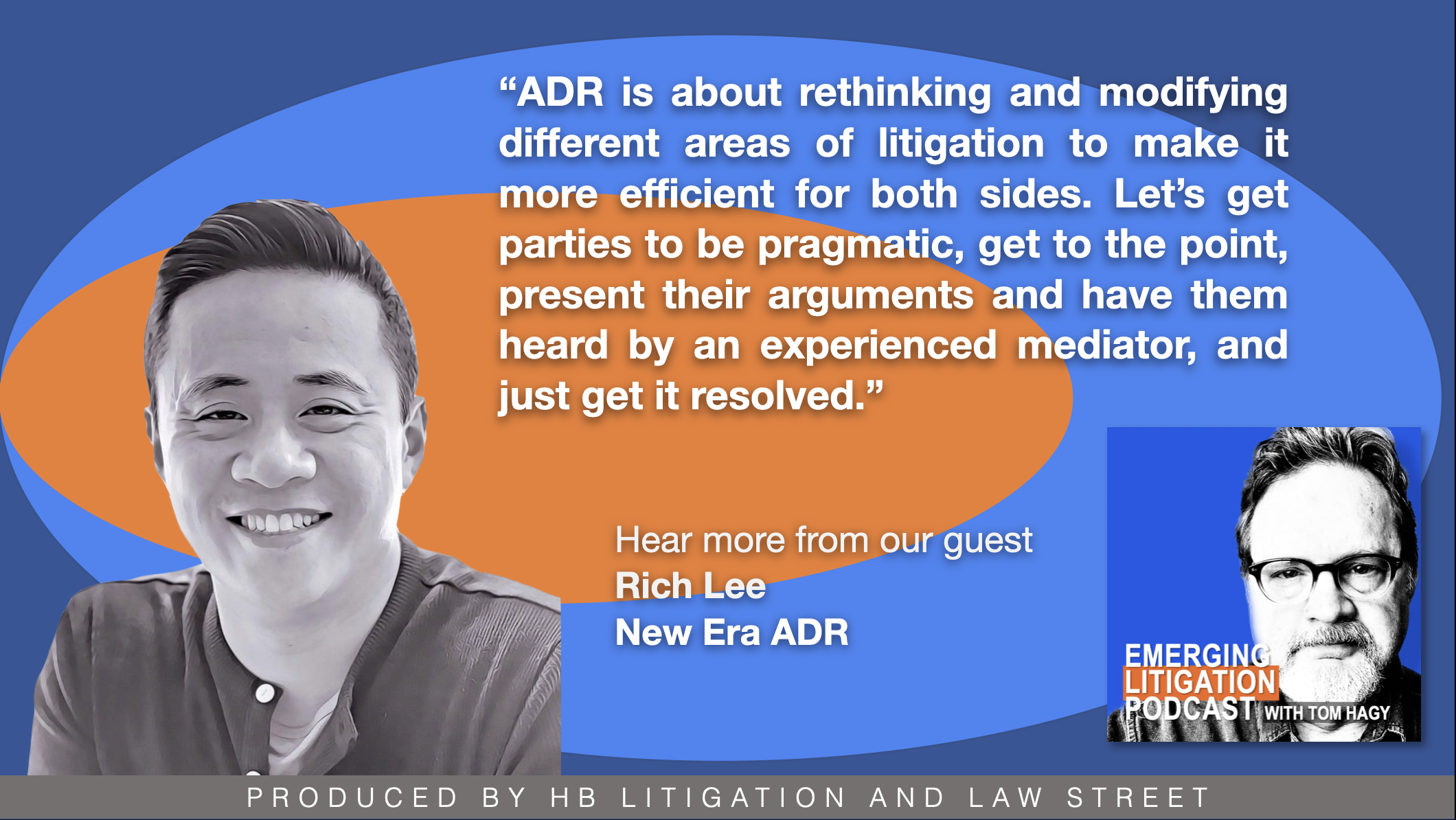
    Listen to my interview with Rich Lee, CEO and Co-Founder, New Era/ADR as we discuss hot topics and issues involving what is referred to here as “Advanced Dispute Resolution.”

    I hope you enjoy the episode. If so, give us a rating!

    This podcast is the audio companion to the Journal on Emerging Issues in Litigation. The Journal is a collaborative project between HB Litigation Conferences and the vLex Fastcaselegal research family, which includes Full Court Press, Law Street Media, and Docket Alarm.
    If you have comments, ideas, or wish to participate, please drop me a note at Editor@LitigationConferences.com.

    Tom Hagy
    Litigation Enthusiast and
    Host of the Emerging Litigation Podcast
    Home Page
    LinkedIn

    Rich Lee

    Rich LeeCEO and Co-Founder, New Era ADR

    Prior to starting New Era, Rich was the General Counsel at Civis Analytics, a fast-growing, venture-backed data science technology company born out of President Barack Obama’s 2012 re-election campaign. He served on the executive team, led legal, cybersecurity, and compliance, and helped lead and evolve the company through rapid growth (600%+ in his tenure) and over $50M in funding.

    Prior to Civis, Rich was SVP, General Counsel and Corporate Secretary at Livevol, a financial technology company that he helped to build, grow, and sell to CBOE Holdings (BATS: CBOE). Rich also serves as an advisor, board member, and investor in technology startups and venture funds and in a leadership role in the Economic Club of Chicago.

    Passionate about solving the access to justice gap in the United States, Rich also serves on the national Leader’s Council of the Legal Services Corporation (a U.S. Senate-funded 501c3) and on the board of Illinois Legal Aid Online. He holds a J.D. from Loyola University Chicago School of Law and a B.S. in Bioengineering from the University of Illinois at Urbana-Champaign.

    Want to appear on the Emerging Litigation Podcast?

    Send us your idea! 

  • Applying Business Strategy to Your Law Firm

    Applying Business Strategy to Your Law Firm

    Applying Business Strategy to Your Law Firm with James Grant

    Concepts: Business Strategy, Law Firms, Strategic Business Thinking, New and Unique Approaches

    This isn’t going to be another theoretical sermon on the business of law, but how two partners  – with the help of a business expert – re-envisioned their practice, throwing out traditional models and transforming their firm into something unique.

    First, we talk about looking at your law firm strategically, as you would any business. Have you thought about tweaking or refocusing your practice in a way that has the most bottom line impact?

    Then we talk about one litigation firm’s journey through that process, where they metaphorically dismantled their practice, examined each piece, and put it back together. The new version of the firm was built based on their strengths as attorneys and on activities that were most profitable.

    My guest is James M. Grant, an attorneywho has embraced the idea of applying strategic business thinking to the practice of law.  In that spirit, we talk about how and why he and his partner, Mark Kirchen, tried such an exercise and what he learned from it. Then James talks about a pretty profound transformation of his firm, developing a unique offering that is demonstrably different, as you will see.

    James is co-founding partner of Georgia Trial Attorneys at Kirchen & Grant LLC.  He’s an experienced personal injury litigator and trial attorney, whose list of defendants include insurance companies. James started off as a state prosecutor before getting into personal injury law. He has a B.S. from Georgia Institute of Technology, and received his J.D. from Faulkner University.

    I hope you enjoy the episode. If so, give us a rating!

    This podcast is the audio companion to the Journal on Emerging Issues in Litigation. The Journal is a collaborative project between HB Litigation Conferences and the vLex Fastcaselegal research family, which includes Full Court Press, Law Street Media, and Docket Alarm.

    If you have comments, ideas, or wish to participate, please drop me a note at Editor@LitigationConferences.com.

    Tom Hagy
    Litigation Enthusiast and
    Host of the Emerging Litigation Podcast
    Home Page
    LinkedIn

    Want to appear on the
    Emerging Litigation Podcast?

    Send us your idea! 

    James Grant

    James GrantGeorgia Trial Attorneys at Kirchen & Grant LLC

    James Grant isn’t just an attorney; he’s a game-changer. As the co-founding partner of Georgia Trial Attorneys, he’s revolutionized the field of personal injury law in Georgia. He has created a powerhouse law firm that serves as the outsourced litigation arm for other personal injury firms. Gone are the days of personal injury lawyers juggling pre-litigation and courtroom battles. James’ mantra says it all: “We litigate, so you don’t have to!”

    Not just a powerhouse litigator, James is a tactical businessman. His dual expertise proves that you can win in the courtroom while maintaining a well-balanced life. A seasoned veteran in the courtroom, his prior roles include stints as an Assistant Solicitor-General and Senior Associate Attorney, where he honed his skills in both criminal and civil litigation. His diverse experiences make him the ultimate weapon against insurance companies and their greed, leveling the playing field for every client he represents.

  • FTC v. Amazon: Market Definitions and Section 5 of the FTC Act

    FTC v. Amazon: Market Definitions and Section 5 of the FTC Act

    The Author

    Jonathan Rubin

    Jonathan RubinMoginRubin LLP

    For more than two decades Rubin has focused his legal practice exclusively on antitrust and competition law and policy. As a litigator, he has led trial teams in major antitrust cases in courts throughout the country. As a thought-leader in competition law, he has published in influential academic journals and has spoken to numerous professional groups, including the Directorate General for Competition of the European Commission, the Antitrust Section of the American Bar Association, the University of Wisconsin, and the American Antitrust Institute. Rubin has also made several appearances before Congressional committees.

    Rubin received his J.D. from University of Florida, Levin College of Law. Mogin also holds a PhD in Economics from the University of Copenhagen, an MA in Economics from Florida Atlantic University, and a BS in Biological Sciences from the University of Wisconsin at Madison.

    The Journal on Emerging Issues in Litigation

    Emerging Litigation Podcast

    Emerging Litigation PodcastProduced by HB Litigation and Law Street Media

    Interviews with leading attorneys and other subject matter experts on new twists in the law and how the law is responding to new twists in the world.

    FTC v. Amazon:

    Market Definitions and Section 5 of the FTC Act

    Traditional antitrust economics faces significant challenges grappling with the new economy industrial environment, and the Amazon case is likely to be a crucial test for antitrust and the usefulness of Section 5 of the FTC Act.

    The key issue is whether a price increase on Amazon could drive online shoppers to Google Shopping, Walmart, Target, Costco, eBay, Home Depot, Best Buy, Wayfair, or any number of other online retail destinations that are potential substitute outlets for products sold on Amazon.

    Abstract:

    The Federal Trade Commission’s (FTC) challenge to Amazon.com’s practices relating to its participation on its own platform—competing with the many merchants who rely on the powerful commercial hub to make sales—violate the Federal Trade Commission Act. The court’s analysis is likely to depend heavily on the FTC’s definition of the relevant antitrust markets in which it claims Amazon possesses market power and harms competition. Traditional antitrust economics face significant challenges grappling with the relatively new digital economy. The author examines these and other issues raised in the case, which he anticipates will be a crucial test for antitrust and the FTC Act.

    Download the article now!

    Get additional insights from Jonathan Rubin at the MoginRubin Blog.

    Explore more from MoginRubin LLP!

    Blog: Emboldened by New Resources and Expanded Authority, Feds Continue 10-Year Look Back at Chinese Investment. By Dan Mogin, Jonathan Rubin, Jennifer Oliver, and Timothy LaComb. List

    OnDemand CLE Webinar: The Antitrust Case Against Google. Dan Mogin, Jonathan Rubin, Jennifer Oliver, Timothy LaComb, John Newman, Dr. Alan Grant

    Blog: FTC’s Case Against Facebook Will Test the Flexibility of U.S. Antitrust Law.Authors: Jonathan Rubin and Jennifer Oliver, MoginRubin LLP

    Blog: Full Ninth Circuit Removes Unwarranted Hurdles to Class Certification.

    Journal: Policy Derailed: Can U.S. Antitrust Policy Toward Standard Essential Patents Get Back on Track by Jonathan Rubin

    Webinar: Class Certification After Olean v. Bumble Bee with Jonathan Rubin, James Bogan lll, Jonathan Cohn, Bradley Hamburger.

    Journal: FTC v. Amazon: Market Definitions and Section 5 of the FTC Act

    Podcast: Algorithmic Software Facilitated Price Fixing with Jonathan Rubin

  • Natural Gas Bans and Bans on Bans

    Natural Gas Bans and Bans on Bans

    Natural Gas Bans, Bans on Bans, and the Ninth Circuit

    Concepts:  Natural Gas, EPCA, Climate Change, Energy Efficiency Regulation

    The Ninth Circuit Court of Appeals recently struck down Berkeley, California’s ban on natural gas infrastructure in new buildings. The court ruled unanimously that the ban violates federal law. This subject is important as we will likely see more natural gas bans in the future and the Berkeley case has set a precedent for how similar cases may be treated. 

    Brought by the California Restaurant Association, the National Restaurant Association, and the American Gas Association, the crux of the case was that Berkeley’s ban was preempted by the Energy Policy and Conservation Act (EPCA) which gives the federal government exclusive authority to regulate energy efficiency standards for appliances. Agreeing with the plaintiffs, the Ninth Circuit that Berkeley’s ban was “a direct regulation of energy efficiency standards for appliances.” New York has implemented a natural gas ban starting in 2026.

    Listen to my interview with Gary Toman, Partner at Weinberg, Wheeler, Hudgins, Gunn & Dial LLC, as we discuss this seminal case and the impact of the court’s ruling on consumers and businesses across the country.

    Gary  has extensive experience representing corporations, banks and professionals in complex litigation and arbitration matters and business disputes. Gary has substantial experience defending corporations in a wide variety of class actions.  Gary received his J.D. from Harvard Law School.

    I hope you enjoy the episode. If so, give us a rating!

    *******

    This podcast is the audio companion to the Journal on Emerging Issues in Litigation. The Journal is a collaborative project between HB Litigation Conferences, and the vLex Fastcaselegal research family, which includes Full Court Press, Law Street Media, and Docket Alarm — all now part of vLex. If you have comments or wish to participate in one our projects please drop me a note at Editor@LitigationConferences.com. I’m often polite.
    podcast logo face

    Actual size.

    Tom Hagy
    Litigation Enthusiast and
    Host of the Emerging Litigation Podcast
    Home Page
    LinkedIn

    Gary Toman

    Gary TomanWeinberg Wheeler Hudgins Gunn & Dial

    Gary Toman has extensive experience representing corporations, banks and professionals in complex litigation and arbitration matters and business disputes. Gary has substantial experience defending corporations in a wide variety of class actions. His practice includes litigation involving business and financial transactions, product liability, business torts, contract matters including participation agreements, shareholder agreements, and non-competition agreements, and environmental, real estate and intellectual property matters. Gary has also handled cases and counseled clients in the healthcare field regarding antitrust issues, practice disputes, employment law matters and other disputes. An experienced appellate advocate, Gary began his career as a law clerk to the Honorable R. Lanier Anderson, III of the United States Court of Appeals for the Fifth and Eleventh Circuits. He has briefed and argued cases in federal and state appellate courts across the country. Gary often serves as appellate counsel at trials to frame the record for possible appeal. Gary received his J.D. from Harvard Law School.

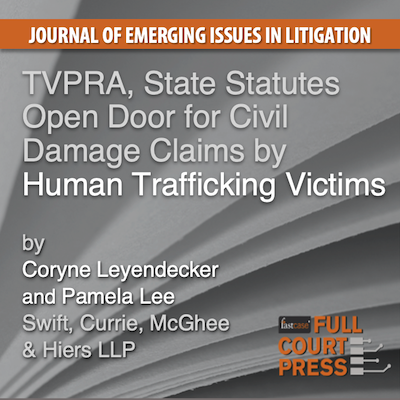
  • TVPRA, State Statutes Open Door for Civil Damage Claims by Human-Trafficking Victims

    TVPRA, State Statutes Open Door for Civil Damage Claims by Human-Trafficking Victims

    The Authors

    Coryne Leyendecker

    Coryne Leyendecker Swift, Currie, McGhee & Hiers LLP

    Coryne Leyendecker is an attorney practicing in Swift Currie’s litigation section, defending businesses and insurers against claims related to commercial litigation, sexual abuse, governmental liability, premises liability, automobile litigation and construction law.

    Pamela Lee

    Pamela LeeSwift, Currie, McGhee & Hiers LLP

    Pamela N. Lee is a partner at Swift Currie with more than 15 years of experience practicing in the firm’s litigation section. Pamela devotes her entire practice to litigation, including various tort liability litigation, insurance coverage disputes and the defense of insurance bad faith matters. Her liability practice is wide and varied, encompassing premises liability, product liability, escalator and elevator liability, automobile liability and general personal injury law. She represents companies in the food, automobile and retail industries.

    The Journal on Emerging Issues in Litigation

    Emerging Litigation Podcast

    Emerging Litigation PodcastProduced by HB Litigation and Law Street Media

    Interviews with leading attorneys and other subject matter experts on new twists in the law and how the law is responding to new twists in the world.

    TVPRA, State Statutes Open Door for Civil Damage Claims by Human-Trafficking Victims

    “A plethora of nonprofit organizations and government agencies have collectively produced hundreds of available resources on how to help prevent human trafficking. Overwhelmingly, groups across the board agree that bringing awareness to human trafficking is the most foundational method to stopping human trafficking. By implementing intentional training and internal policies, businesses can not only insulate themselves from third-party claims but they can be a force for good in the fight against human trafficking. “

    Abstract: There is not a person alive with a soul that would believe sex trafficking and other variants of modern slavery is a good thing. The individuals that perpetrate those heinous acts should be punished accordingly. In 2003, Congress opened the door for human-trafficking victims to sue for civil damages under the Trafficking Victims Protection Act of 2000 (TVPRA). Since then the TVPRA and similarly drafted state statutes have allowed for human-trafficking victims to seek civil damages against any party that has benefited from their trafficking. Given this expansive inclusion of third-party liability, more and more businesses, especially those in the hospitality industry, are ultimately the ones left to pay for the criminal acts of human traffickers. This article discusses the evolving litigation around human-trafficking claims, beginning with a broad overview of human trafficking, followed by a discussion of the legal standard behind human-trafficking civil suits and recent guidance from U.S. courts on these types of claims. The article concludes with guidance of its own on how businesses can build a foundation for their own defense while simultaneously helping prevent human-trafficking crimes from ever occurring.

    Download the article now!

    Have an idea for an article?

    If you would like to propose an article for publication in the Journal on Emerging Issues in Litigation please review our specifications and benefits, then send us a summary, outline, or draft. If you also would like to discuss the topic on the Emerging Litigation Podcast, please note that.

  • Spotting the Risk, Reaping Rewards: Avoiding Increased Antitrust Scrutiny

    Spotting the Risk, Reaping Rewards: Avoiding Increased Antitrust Scrutiny

    The Authors

    Katie Reilly

    Katie ReillyWheeler Trigg O’Donnell LLP

    Katie has favorably represented antitrust clients in matters involving monopolization, conspiracy, price fixing, exclusive dealing, and other competition-related disputes, including trade secrets and non-compete actions. She has extensive knowledge of the regulatory hurdles and obligations her clients face. Katie earned her J.D. from the New York University School of Law, cum laude.

    Natalie West

    Natalie WestWheeler Trigg O’Donnell LLP

    Natalie West represents sophisticated clients in complex commercial disputes. She regularly serves as the lead brief writer in antitrust cases, employment and consumer class actions, and appellate matters. Natalie graduated with high honors from the University of Texas School of Law, where she served as a member of the Texas Law Review and was elected to the Order of the Coif.

    The Journal on Emerging Issues in Litigation

    Emerging Litigation Podcast

    Emerging Litigation PodcastProduced by HB Litigation and Law Street Media

    Interviews with leading attorneys and other subject matter experts on new twists in the law and how the law is responding to new twists in the world.

    Avoiding Antitrust Scrutiny

    Spotting the Risk, Reaping Rewards

    The increase in aggressive antitrust enforcement has certainly received significant attention. For the moment, juries are not rewarding the prosecutors. That said, even an unsuccessful government investigation is itself costly and can motivate plaintiffs’ lawyers. Best practices involve not only following the law but also maintaining solid optics to avoid the need for an expensive, if ultimately successful, defense.

    Abstract: 

    A decade ago, few lawyers across the country spent significant time thinking about antitrust law. But, since then, there has been an onslaught of antitrust attacks on businesses and executives across all sectors of the economy. Enforcement efforts have skyrocketed following President Biden’s July 2021 executive order directing a “whole of government” crackdown on competition abuses—and the trend shows no sign of letting up.

    Today, no matter the industry or the size of the business, everyone needs to understand these risks and have strategies to minimize them.

    This article will walk through the top antitrust risks of the moment and conclude with strategies on how to avoid not only violations but also bad optics that increase exposure.

    Download the article now!