Category: Complex Business Litigation

  • Biometric Privacy Litigation and Coverage Disputes with John Leonard and Cort Malone

    Biometric Privacy Litigation and Coverage Disputes with John Leonard and Cort Malone

    Biometric Privacy Litigation and Coverage Disputes with John Leonard and Cort Malone

    Concepts: Biometric Privacy Litigation, Biometric Privacy Violations, Coverage Disputes

    Biometric data is big business. It many cases it even helps make our lives better.  It also presents  significant risks for a variety of parties, in addition to those of us who surrender our data. Companies collecting,  storing, utilizing, and monetizing the data face penalties and litigation bolstered by the increasing number of states enacting biometric information privacy acts, or BIPAs, the first of which was in Illinois.

    Biometric information —  fingerprints, facial and retinal scans, and DNA — it’s all used in many ways we don’t even think about, like building security, banking access and online payments, smartphone access, patient identification in healthcare, employee tracking, law enforcement, air travel security and hotel check-ins, consumer tracking and customer experience analysis, border security, validating recipients of government welfare benefits, identifying students taking exams, and more.

    I just finished hosting a webinar titled “Litigation After Biometric Privacy Law Violations” with attorneys John M. Leonard and Cort T. Malone of Anderson Kill. They spoke extensively about the state of biometric privacy litigation, the regulatory landscape,  insurance coverage considerations, and recent rulings. They’re both shareholders at Anderson Kill and they are both graduates of the Fordham University School of Law.

    John M. Leonard is co-chair of the firm’s biometric liability group. He has recovered millions of dollars for policyholders in a full spectrum of insurance coverage matters, including disputes over business interruption, D&O and E&O, defense and indemnity, general liability losses, and environmental liability.

    Cort T. Malone, chair of the firm’s Biometric Liability Insurance Recovery Group, is an experienced litigator who focuses on insurance coverage litigation and dispute resolution, with an emphasis on commercial general liability insurance, cyber insurance, employment practices insurance, advertising injury, D&O, E&O, and property insurance. He’s also a member of the firm’s practice groups relating to restaurant, retail and hospitality; environmental law; cyber insurance recovery; and COVID litigation.

    Following the webinar (coming soon to the West LegalEdcenter), Cort and John stuck around to answer some of my questions about a couple of recent cases I thought illustrated the types of underlying and coverage matters we’re seeing out there.

    I hope you enjoy the episode. If so, give us a rating!

    This podcast is the audio companion to the Journal on Emerging Issues in Litigation. The Journal is a collaborative project between HB Litigation Conferences and the vLex Fastcaselegal research family, which includes Full Court Press, Law Street Media, and Docket Alarm.

    If you have comments, ideas, or wish to participate, please drop me a note at Editor@LitigationConferences.com.

    Tom Hagy
    Litigation Enthusiast and
    Host of the Emerging Litigation Podcast
    Home Page
    LinkedIn

    Explore More from Anderson Kill!

    Podcast 1 of 2 series: Insurance Coverage with Dr. Jaana Pietari and Jim Fenstermacher and Litigation with Bob Chesler.

    Podcast 2 of 2 series: PFAS Insurance Coverage with Robert D. Chesler of Anderson Kill.

    Sister article to podcast 1 of 2 series: Remediating, Insuring, and Litigating PFAS Claims. Authors: Dr. Jaana Pietari, PhD, MBA, PE, Jim Fenstermacher, PE, Dr. Michael Bock, PhD, MS, Robert D. Chesler and Nicholas M. Insua, Sheila Mulrennan, Robin Kelliher, Jason R. Waters

    Podcast: Autonomous Vehicles: The New Technology Driving the Litigation Conversation with Cort Malone and John LeonardJoshua

    Podcast: Violations of Biometric Privacy Laws: Policyholders’ Victories and the Implications Going Forward with John Leonard and Cort Malone

    Asymmetrical Combat: Bad Faith Liability in Insurance Recovery Cases. By William Passannante

    Climate Change, ESG, and D&O Insurance: Collision or Cooperation? Authors: Robert Chesler, Dennis J. Artese, and Joseph Villa

    JEIL: Litigation After Biometric Privacy Law Violations: Policyholder Victories and Their Implications with Cort Malone and Abigal Damsky

    JEIL: Autonomous Vehicles: The New Technology Driving the LitigationConversation with Cort Malone, John Leonard, Zelen

    JEIL: Biometric Privacy Laws: Companies Will Need Insurance as Protection From New and Expanding Liability with Cort Malone and Jade Sobh

    Protecting Policyholders as AI Is Developed for Insurance Claims Handling – Ensuring “Decency and Humanity” in the Digital Age. Authors: Marshall Gilinsky, Madison Marlow

    Police–The Environmental, Social, and Governance Police Have Arrived: Is your Insurance Ready. Authors: Dennis Artese, Bob Chesler

    How Insurance Companies Defraud Their Policyholders, and What Courts and Legislators Should Do About It. Authors: Robert Chesler, Amy Weiss, and Jade Sobh

    The Promise and Peril of Quantum Computing and Its Implications for Cyber Insurance. By Cameron R. Argetsinger

    The Use and Abuse of the Pollution Exclusion. Authors: Dennis Artese, Jamie O’Neil, Robert Chesler

    Property Insurance Coverage for Emerging Risk: Underground Climate Change. Authors: Dennis J. Artese, Ethan W. Middlebrooks, Thomas Dupont

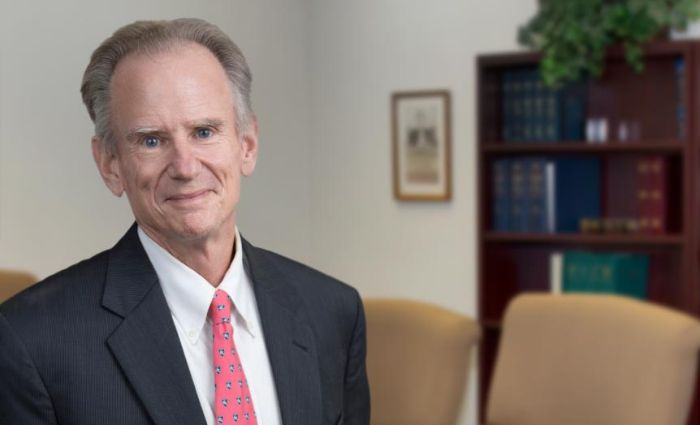
    John M. Leonard
    Shareholder | Anderson Kill P.C.

    John Leonard is a shareholder in Anderson Kill’s New York, NY office and co-chair of the firm’s Biometric Liability Group. He has recovered millions of dollars for policyholders in a full spectrum of insurance coverage matters, including disputes over business interruption losses, D&O and E&O defense and indemnity, general liability losses, and environmental liability. He is also a member of the firm’s Corporate and Commercial Litigation Group and COVID Task Group.
    Cort T. Malone
    Shareholder | Anderson Kill P.C.

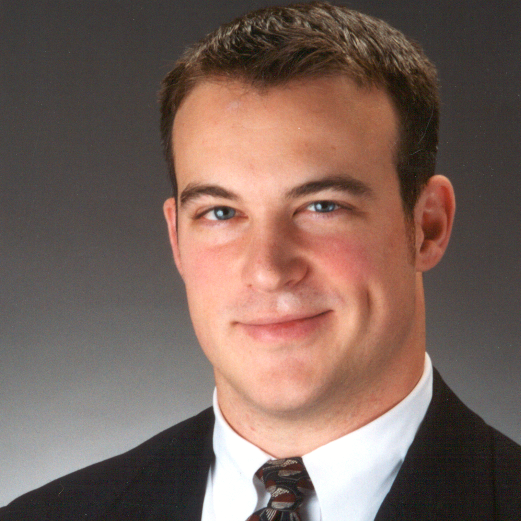
    Cort T. Malone is a shareholder in the New York and Stamford offices of Anderson Kill and is the Chair of the firm’s Biometric Liability Insurance Recovery Group. Cort is an experienced litigator, focusing on insurance coverage litigation and dispute resolution, with an emphasis on commercial general liability insurance, cyber insurance, employment practices liability insurance, advertising injury insurance, directors and officers insurance, and property insurance issues. He is also a member of the firm’s Restaurant, Retail & Hospitality, Environmental Law, Cyber Insurance Recovery, and COVID Task Force groups.

    Cort also possesses extensive commercial litigation experience, including arbitration and alternative dispute resolution relating to a variety of tort, contract, and regulatory disputes. While attending the Fordham University School of Law, Cort was a member of the Fordham Moot Court Board and garnered several awards for both oral argument and brief writing skills at various inter- and intra-school competitions. He spent five years teaching a first-year Legal Writing course as an adjunct professor at Fordham Law.

    Want to appear on the Emerging Litigation Podcast?

    Send us your idea! 

    Tags

  • Automation Comes to Our Litigation Nation with James Lee

    Automation Comes to Our Litigation Nation with James Lee

    Automation Comes to Our Litigation Nation with James Lee

    Concepts: Litigation Automation, Generative Artificial Intelligence, Generative AI, Legal Tech

    In this episode we talk about litigation automation, and another case in which innovators are using artificial intelligence to transform legal operations.

    We also speak with our guest about his transformation from a litigator to a tech entrepreneur, and how the company he co-founded is using modern tools to do in minutes what used to take hours. These tasks include responding to demand letters, complaints, and discovery requests, and executing matter profiling and data analytics, all of which are traditionally rote and repetitive and time-consuming undertakings.

    He is James M. Lee, co-founder and CEO of LegalMation. James conceived the idea behind LegalMation — which is to leverage the power of generative artificial intelligence to transform litigation and dispute resolution — while managing a litigation boutique.  An experienced and recognized litigator and trial attorney, James received his J.D. from Stanford Law School.

    Also joining me, I’m pleased to say, is the ever-inquisitive and always attentive Sara Lord, legal analytics professional extraordinaire, who raised questions from the litigator’s perspective.

    I hope you enjoy the conversation! If so, give us a rating!

    This podcast is the audio companion to the Journal on Emerging Issues in Litigation. The Journal is a collaborative project between HB Litigation Conferences and the vLex Fastcaselegal research family, which includes Full Court Press, Law Street Media, and Docket Alarm.

    If you have comments, ideas, or wish to participate, please drop me a note at Editor@LitigationConferences.com.

    Tom Hagy
    Litigation Enthusiast and
    Host of the Emerging Litigation Podcast
    Home Page
    LinkedIn

    Tags

    Emerging Litigation & Risk Compliance Litigation & appeals Cybersecurity Data Privacy Artificial Intelligence (AI) Insurance Companies Risk Management Corporate & Securities Insurance Claims Recovery Regulations Data Breach Toxic Torts Antitrust Legal Tech Product Liability Settlements Trial Personal Injury Privacy Healthcare Per- and Polyfluoroalkyl Substances (PFAS) Data Analytics Arbitration Constitutional Law Climate Change Cannabis Labor Law Insurance Fraud Liability Claims COVID Alternative Dispute Resolution (ADR) Mediation Diversity Equity Inclusion (DEI) Claims management Professional Liability Legal Research & Writing Business Interruption Law Practice Management Trial Skills Property and Casualty Drug Laws Copyright Law Catastrophic Loss

    James M. Lee | CEO

    James M. Lee | CEOLegalMation

    As the CEO of LegalMation, James is the key driver of the company’s vision and strategy. He devised the idea for LegalMation while managing LTL Attorneys LLP, a nationally-recognized litigation boutique he co-founded, as the first spin-off of Quinn Emanuel. As an experienced litigator, James has tried numerous cases in federal and state courts. He has been recognized as a top business litigator by various legal publications including the National Law Journal. He is a frequent and noted speaker and commentator in the field of AI and innovations in the legal industry. James received his J.D. from Stanford Law School.

    Want to appear on the Emerging Litigation Podcast?

    Send us your idea! 

  • The Medical Monitoring Tort Remedy

    The Medical Monitoring Tort Remedy

    The Medical Monitoring Tort Remedy

    Test tube with chemicals being poured into it, representing toxic exposure and laboratory analysis

    Better understand the medical monitoring tort remedy, which states recognize it, how it evolved, and how courts are treating it.

    The medical monitoring tort remedy – allowing for medical monitoring without physical injury – is recognized in 14 states and not allowed in 23. The law is divided in two states while the rest have not specifically addressed the issue.

    States that allow medical monitoring to do so when a group of claimants is at increased risk of disease or injury due to exposure to a known hazardous substance or a dangerous product as the result of a defendant’s conduct. Under this tort remedy, claimants are tested periodically, for an agreed or decided period, usually between 10 and 40 years.

    Medical monitoring recognizes the long-term harmful nature of toxins and man-made products, thereby matching a remedy with the malady.

    In this webinar the speakers will discuss the evolution of the tort, related cases, tests to determine whether the tort should be applied, types of monitoring, and the arguments for an against medical monitoring.

    You will learn about: 

    • The elements of the medical monitoring tort remedy and which states recognize it.
    • The evolution of the medical monitoring tort remedy and relevant court decisions addressing it.
    • A “classic case” to understand how a program was implemented and what it found.
    • Cases studies demonstrating claimant participation rates.
    • Different types of medical monitoring programs.
    • Elements necessary to establish a case for medical monitoring.
    • Legal background and typical implementation.
    • Arguments for and against medical monitoring from the plaintiff and defense perspectives.
    • A possible cure for the requirement of physical damage prior to having medical monitoring: sub-cellular damage proof.

    Loved watching Ed & Kip’s webinar?

    Explore Ed’s additional content on the subject matter.

    Podcast: Medical Monitoring for Modern Times with Ed Gentle

     JEIL: The Medical Monitoring Tort Remedy: Its Nationwide Status, Rationale, and Practical Application (A Possible Dynamic Tort Remedy for Long-Term Tort Maladies)

    HB on-demand CLE at

    the West LegalEdcenter

    TAKE IT NOW

    PREVIEW

    Included in subscriptions. Also available for individual purchase.

    Speakers

    Edgar C. Gentle III

    Edgar C. Gentle IIIGentle Turner & Benson LLC

    Edgar (“Ed”) C. Gentle III is founder and managing partner of Gentle, Turner, Sexton & Harbison, LLC, in Birmingham, Alabama. Largely focusing his practice on complex commercial litigation and mass tort/class action litigation, he often works for the courts as a neutral special master and settlement administrator. He is an experienced special master and claims administrator in mass tort litigation, providing claims administration and financial and business advice to courts, settling parties, and mass tort settlements. He has helped create and administer more than $6 billion in settlements during the past 20 years. He earned his J.D. from the University of Alabama School of Law as a Hugo Black Scholar.

    Katherine (“Kip”) A. Benson

    Katherine (“Kip”) A. Benson Attorney, Gentle Turner & Benson LLC

    Katherine (“Kip”) A. Benson is a partner at Gentle, Turner, & Benson, LLC and has experience in mass tort/class action settlement administration, probate law, general corporate practice, real estate, and telecommunications law. She specializes in Medicare/Medicaid lien resolution and other aspects of settlement administration. She has assisted with the administration of several multi-million-dollar class action settlements, including a $300 million PCB settlement involving 18,000 claimants. Benson earned her J.D. from the University of Alabama School of Law.

  • Mental Wellbeing and Fulfillment for Litigators: Sara Lord Interviews Gary Miles

    Mental Wellbeing and Fulfillment for Litigators: Sara Lord Interviews Gary Miles

    Mental Wellbeing and Fulfillment for Litigators: Sara Lord Interviews Gary Miles

    Concepts: Mental Health Awareness, Lawyer Wellbeing, Coping Strategies, Stress Management, Litigator Fulfillment

    This episode is dedicated to Mental Health Awareness Month — May 2024 — in which we explore some of the keys to achieving wellbeing as a human litigator.

    Lawyers contemplate suicide at “an exceedingly high rate.” Whereas 4.2% of adults have reported contemplating suicide, that figure is 10-12% among lawyers. According to a study published by MDPI, lawyers are prone to mental health issues, including anxiety, depression, and substance abuse. “[O]ur findings suggest the profile of a lawyer with the highest risk for suicide is a lonely or socially isolated male with a high level of unmanageable stress, who is overly committed to their work, and may have a history of mental health problems.” Released in 2023, the authors of the study — Stressed, Lonely, and Overcommitted: Predictors of Lawyer Suicide Risk (Krill, Thomas, Kramer, Degeneffe, and Anker) — say there is a need for interventions to address these risks, including “education, resources, and support for lawyers to better manage their workload, modifying work demands and expectations, and promoting a culture of openness and support within law firms.”

    With that as a backdrop, guest host and legal analytics professional Sara Lord interviews success coach and former litigator Gary Miles about the professional dissatisfaction litigators experience when the pursuit of fulfillment clashes with high-stress demands — from burnout to depression to imposter syndrome. Explore practical strategies for managing anxiety and embracing mindfulness, like reframing your thoughts, celebrating even small achievements, identifying trusted colleagues and mentors, the importance of rest, and reaching out for help. Learn some of the wisdom Gary imparts via his counseling services.

    Feeling emotionally crisp? “There is always a solution. Always,” Gary says.

    *******
    Need Immediate Help? If you are in the U.S. and experiencing thoughts of suicide, call or text the 988 Suicide and Crisis Lifeline at 988 or IMAlive at 1-800-784-2433. In the UK and Ireland – Call Samaritans UK at 116 123; in Australia – Call Lifeline Australia at 13 11 14; in other countries – Visit IASP or Suicide.org to find a helpline in your country.

    *******

    This podcast is the audio companion to the Journal on Emerging Issues in Litigation. The Journal is a collaborative project between HB Litigation Conferences and the vLex Fastcaselegal research family, which includes Full Court Press, Law Street Media, and Docket Alarm.

    If you have comments, ideas, or wish to participate, please drop me a note at Editor@LitigationConferences.com.

    Tom Hagy
    Litigation Enthusiast and
    Host of the Emerging Litigation Podcast
    Home Page
    LinkedIn

    Loved listening to Sara’s interview with Gary Miles?

    Listen to Sara’s other podcast interviews!

    Podcast: Technology-Assisted Review: Sara Lord Interviews Data Scientist Lenora Gray

    Podcast: Transforming Legal Workflows with AI: Sara Lord Interviews Tara Emory and Wilzette Louis

    Guest Host

    Sara Lord

    Sara LordManaging Director of Legal Metrics

    Sara Lord is a former practicing attorney with a decade of experience in data analytics. Sara applies her talents in large and small law firms and businesses to explore and address the cultural and practical barriers to diversity in law, and client-first business-oriented practices. As Managing Director of Legal Metrics, she leads a team of experts focused on providing the tools to support data-driven decision making in legal operations and closer collaboration between law firms and their clients through automation and standardization of industry metrics.

    Sara earned her J.D. from New York University School of Law.

    Guest

    Gary Miles

    Gary MilesSuccess Coach and Former Litigator

    Gary Miles has been a high-level trial attorney for over 40 years in a variety of areas including transportation law, serious personal injury, family law, and estate disputes. He presently focuses on family law and loves to lift and support his clients when they are in a very difficult place.

    He has been the managing partner of Huesman, Jones, and Miles for over 3 decades. He has been an active member of many professional associations including the American Bar Association.

    He is a trained mediator with over 120 hours in mediation training. He has participated in over 1000 mediations and settlement conferences both as counsel for one of the parties and as the facilitator. His studies featured specialized training for divorce mediation, including a focused course on child access, property, and financial issues, and commercial litigation mediation. He delights in helping clients solve their challenging issues.

    Gary brings over four decades of experience as a problem solver to his coaching business. He has an incredible passion for helping his clients discover the blocks that are holding them back and freeing them to better achieve their dreams. He has helped clients and parties resolve thousands of issues and disputes over the years. He is blessed with a calm demeanor and is an empathetic listener.

    Want to appear on the Emerging Litigation Podcast?

    Send us your idea! 

    Tags

    Emerging Litigation & Risk Compliance Litigation & appeals Cybersecurity Data Privacy Artificial Intelligence (AI) Insurance Companies Risk Management Corporate & Securities Insurance Claims Recovery Regulations Data Breach Toxic Torts Antitrust Legal Tech Product Liability Settlements Trial Personal Injury Privacy Healthcare Per- and Polyfluoroalkyl Substances (PFAS) Data Analytics Arbitration Constitutional Law Climate Change Cannabis Labor Law Insurance Fraud Liability Claims COVID Alternative Dispute Resolution (ADR) Mediation Diversity Equity Inclusion (DEI) Claims management Professional Liability Legal Research & Writing Business Interruption Law Practice Management Trial Skills Property and Casualty Drug Laws Copyright Law Catastrophic Loss

  • Litigation Prognostication with Dan Rabinowitz

    Litigation Prognostication with Dan Rabinowitz

    Litigation Prognostication with Dan Rabinowitz

    Concepts: Litigation Forecasting, Litigation Prediction, Technology, Data Analysis

    The art and science of forecasting litigation outcomes just got a lot more sciencey.

    Years of immersion in complex business disputes is bound to shine a light on problems begging for solutions. In this case, our guest observed the laborious and ineffective slog that is trying to forecast how long a case will take, how much it might cost, which jurisdiction will treat it with kindness, or how a judge might rule on a motion for summary judgment.

    These are some of the critical questions our guest set out to address through the use of technology and assessment of massive data sets. He is Dan Rabinowitz, Co-Founder and CEO of  Pre/Dicta, a six-year-old company that provides litigation prediction and forecasting services.  Before Pre/Dicta, Dan was an attorney in Sidley Austin LLP’s Supreme Court and Appellate Group and the firm’s Mass Tort Litigation Group. Later, he served as trial attorney in the U.S. Department of Justice, general counsel to a data science company, and associate general counsel, chief privacy officer, and  director of fraud analytics for WellPoint Military Care.

    Listen to what Dan has to say about how the power of technology is going to make predicting litigation as commonplace as predicting the weather. He also shares insights into a study Pre/Dicta conducted that tested assumptions about judges based on their political affiliations.

    I hope you enjoy the episode. If so, give us a rating!

    *******

    This podcast is the audio companion to the Journal on Emerging Issues in Litigation. The Journal is a collaborative project between HB Litigation Conferences and the vLex Fastcaselegal research family, which includes Full Court Press, Law Street Media, and Docket Alarm.

    If you have comments, ideas, or wish to participate, please drop me a note at Editor@LitigationConferences.com.

    Tom Hagy
    Litigation Enthusiast and
    Host of the Emerging Litigation Podcast
    Home Page
    LinkedIn

    Dan Rabinowitz

    Dan RabinowitzCo-Founder and CEO of Pre/Dicta

    Dan Rabinowitz practiced as an associate in Sidley Austin LLP’s Supreme Court & Appellate and Mass Tort Litigation groups before co-founding Pre/Dicta, which aims to provide law firms with a monumental advantage in the ability to strategize for risk exposure, litigation likelihoods, settlement strategy, and more.

    Following his work at Sidley Austin LLP, he served as a trial attorney for the U.S. Department of Justice and the general counsel to a Washington, D.C.-based data science company, and associate general counsel, chief privacy officer, and the director of fraud analytics for WellPoint Military Care.

    Dan earned his J.D. from Georgetown University Law Center.

    Want to appear on the Emerging Litigation Podcast?

    Send us your idea! 

  • Jury Selection in the Age of Conspiracy Theories and Distrust with Tara Trask

    Jury Selection in the Age of Conspiracy Theories and Distrust with Tara Trask

    Jury Selection in the Age of Conspiracy Theories and Distrust with Tara Trask

    Concepts: Jury Selection, Misinformation, Bias, Juror Psychology

    In this episode we ask: How does what some have called a Cold Civil War affect our ability to listen and decide objectively when presented with arguments and evidence in court? How much increased bias, skepticism, and hostility for institutions — from courts to corporations to witnesses — do people carry into the jury box?

    Tom Hagy interviews jury and trial expert Tara Trask about picking juries in an age of misinformation, general distrust, tribalism, unleashed social media warriors, flamers, and propagandists, and unorthodox legal strategies that seem to unfold on a daily basis. All of these conditions began to accelerate in the lead-up to the 2016 presidential election in which Donald Trump prevailed over Hillary Clinton, continued to heat up in Trump’s race against then-candidate Joe Biden, culminated in the Jan. 6 attack on the Capital, and continues to blot out the sun amid civil and criminal actions against the former president and some of his supporters and colleagues as the 2024 election roars at us like a freight train.

    Tara Trask is a nationally recognized author and lecturer on juror psychology and other trial science topics. As President of Trask Consulting, a boutique litigation strategy, jury research and trial consulting firm with offices in San Francisco, Houston and New York, Tara focuses on civil litigation with an emphasis on complex commercial litigation, including intellectual property, antitrust, securities, breach of contract, and fraud. She has assisted plaintiffs and defendants in products liability, insurance, and oil and gas matters, and has extensive experience assisting institutions and individuals in matters involving regulatory enforcement and white-collar defense.

    I hope you enjoy the episode. If so, give us a rating!

    *******

    This podcast is the audio companion to the Journal on Emerging Issues in Litigation. The Journal is a collaborative project between HB Litigation Conferences and the vLex Fastcaselegal research family, which includes Full Court Press, Law Street Media, and Docket Alarm.

    If you have comments, ideas, or wish to participate, please drop me a note at Editor@LitigationConferences.com.

    Tom Hagy
    Litigation Enthusiast and
    Host of the Emerging Litigation Podcast
    Home Page
    LinkedIn

    Loved listening to Tara and what she had to say about Jury selection?

    Explore more content on the subject with Tara!

    Podcast: Intellectual Property Trial Team Diversity with Tara Trask

    Podcast: Lawyers for Good with Tara Trask and Jason Flom

    Tara Trask

    Tara TraskJury and Trial Expert

    Tara Trask is the President of Trask Consulting, a boutique litigation strategy, jury research and trial consulting firm with offices in San Francisco, Houston and New York. Ms. Trask’s practice focuses on civil litigation with an emphasis on complex commercial litigation; including intellectual property, (patent and trademark infringement, trade secret misappropriation) antitrust, securities, breach of contract and fraud. She has also assisted both plaintiffs and defendants in cases involving products liability, insurance, and oil and gas. Ms. Trask also has extensive experience in assisting institutions and individuals in matters involving regulatory enforcement and white-collar defense.

    Ms. Trask is a nationally recognized author and lecturer on juror psychology and other trial science topics. She is a member of the American Bar Association, The Bar Association of San Francisco, and the APA Psychology-Law Society. She serves as Trial Consultant Advisor to the Trial Consultant Advisors to the Civil Jury Project at NYU Law School.

    She has been a member of the American Society of Trial Consultants since 1994. She served on the board of directors from 2005-2012; as Treasurer, President-Elect and President. Ms. Trask currently serves as the Chair of the ASTC/CJP join working group and liaison to the Civil Jury Project at NYU Law School.

    Ms. Trask is an avid fundraiser, previously serving on the board for Raphael House, San Francisco’s first family shelter. She has competed in over 125 triathlons, including Ironman New Zealand in 2002.

    Want to appear on the Emerging Litigation Podcast?

    Send us your idea! 

  • Transforming Legal Workflows with AI: Sara Lord Interviews Tara Emory and Wilzette Louis

    Transforming Legal Workflows with AI: Sara Lord Interviews Tara Emory and Wilzette Louis

    Transforming Legal Workflows with AI

    Concepts: Emerging Technologies, Legal Workflows, Artificial Intelligence, AI, Robotic Process Automation, Data

    “Of all the opportunities legal operations teams might identify to save time, money, and resources while potentially improving quality, Robotic Process Automation may currently offer the biggest and most immediate opportunities.”

    That is from the forthcoming book, “Legal Operations in the Age of AI and Data,” specifically the “Automation in Legal Departments” chapter written by Tara Emory, Wilzette Louis and Adam Poeppelmeier of Redgrave Data, and Kassie Burns of King & Spalding.  (Available for pre-order now from Globe Law & Business.)

    Automating repetitive tasks and workflows required to effectively advance litigation frees litigators and support teams to focus on “strategic, analytical, and high-value work,” say the authors. Boosted by AI technology, like natural language processing, these tools can conduct data extraction and analysis from volumes of documents, create new documents, summarize documents, or initiate document drafting.

    How can litigators best leverage these capabilities? 

    Listen as our first-time guest host Sara Lord interviews Redgrave Data’s Tara Emory, SVP, Legal AI Strategy, and Wilzette Louis, Director of Client Solutions.

    Tara is a highly regarded legal industry executive and recognized expert in legal AI, ediscovery,  information governance operations, and consulting. She plays a leadership role in The Sedona Conference and was contracted to serve as eDiscovery Lead on the House of Representatives Select Committee to Investigate the Jan. 6th Attack on the U.S. Capitol. Tara holds a JD and LLM in International and Comparative Law from Duke University School of Law.

    Wilzette is an ediscovery expert and advisor focused on approaches for using technology and workflows to  maximize effectiveness, efficiency, and overall client satisfaction. Wilzette has a BS in computer science from the New York Institute of Technology.

    I welcome as guest host for the podcast Sara Lord, a former practicing attorney with a decade of experience in data analytics. Sara applies her talents in large and small law firms and businesses to explore and address the cultural and practical barriers to diversity in law, and client-first business-oriented practices. As Managing Director of Legal Metrics, she leads a team of experts focused on providing the tools to support data-driven decision making in legal operations and closer collaboration between law firms and their clients through automation and standardization of industry metrics. Sara earned her J.D. from New York University School of Law.

    Listen as Sara speaks with Tara and Wilzette about the game-changing potential of robotic process automation and AI, and how these are not just futuristic concepts but practical solutions to today’s legal challenges.

    I hope you enjoy the episode. If so, give us a rating!

    *******

    This podcast is the audio companion to the Journal on Emerging Issues in Litigation. The Journal is a collaborative project between HB Litigation Conferences and the vLex Fastcaselegal research family, which includes Full Court Press, Law Street Media, and Docket Alarm.

    If you have comments, ideas, or wish to participate, please drop me a note at Editor@LitigationConferences.com.

    Tom Hagy
    Litigation Enthusiast and
    Host of the Emerging Litigation Podcast
    Home Page
    LinkedIn

    Loved listening to Sara’s interview with Tara & Wilzette?

    Listen to more of Sara’s interviews!

    Podcast: Mental Wellbeing and Fulfillment for Litigators: Sara Lord Interviews Gary Miles

    Podcast: Technology-Assisted Review: Sara Lord Interviews Data Scientist Lenora Gray

    Guest Host

    Sara Lord

    Sara LordManaging Director of Legal Metrics

    Sara Lord is a former practicing attorney with a decade of experience in data analytics. Sara applies her talents in large and small law firms and businesses to explore and address the cultural and practical barriers to diversity in law, and client-first business-oriented practices. As Managing Director of Legal Metrics, she leads a team of experts focused on providing the tools to support data-driven decision making in legal operations and closer collaboration between law firms and their clients through automation and standardization of industry metrics.

    Sara earned her J.D. from New York University School of Law.

    Guests

    Tara Emory

    Tara EmorySenior Vice President of AI Legal Strategy

    Tara is Senior Vice President of Legal AI Strategy at Redgrave Data. She is an experienced legal technology consultant and lawyer, with a focus on guiding legal teams on efficient and compliant uses of Artificial Intelligence. Her expertise bridges the areas of law, data compliance, and technical aspects of data and software.

    Tara’s experience includes consulting in eDiscovery and InfoGov, including serving as an expert witness and court-appointed expert for eDiscovery issues. In litigation, she is an expert on search methodologies, technology assisted review (TAR/machine learning), data preservation and collection approaches, discovery protocols, and strategies for resolving discovery issues with litigation adversaries, government regulators, and the courts.

    Prior to joining Redgrave Data, Tara spearheaded an expert consulting team on eDiscovery and InfoGov. She has also practiced as an antitrust attorney at Skadden, Arps, Slate, Meagher & Flom; Cadwalader, Wickersham & Taft; and Clifford Chance. Tara is nationally ranked in Band 1/Top Tier by Chambers Litigation Support Guide.

    Tara received her J.D. and LL.M. in International and Comparative Law from Duke University School of Law.

    Wilzette Louis

    Wilzette LouisDirector of Client Solutions

    Wilzette is a skilled eDiscovery leader with a deep technology background and significant experience managing complex eDiscovery projects. With over two decades of experience in the field, she leverages her extensive knowledge surrounding eDiscovery analytical and review tools, including Relativity and Brainspace, to address issues related to complex data sources.

    As Director of Client Solutions at Redgrave Data, Wilzette advises client teams on approaches for using technology and advanced workflows to maximize effectiveness, efficiency, and overall client satisfaction.

    Prior to joining Redgrave Data, Wilzette held project manager roles at Patterson Belknap Webb and Tyler, Paul, Weiss, Rifkind, Wharton & Garrison LLP, and Hogan Lovells US LLP, where she served as Team Lead for the Advanced Client Data Solutions department and was instrumental in transitioning the department from litigation support to advanced technology consulting.

    Wilzette received her B.S. from the New York Institute of Technology. She is a Certified E-Discovery Specialist (CEDS), Relativity Certified Administrator, Relativity Management Specialist, Relativity Analytics Specialist, Brainspace Certified Analyst, Brainspace Certified Administrator, and Brainspace Certified Specialist, and holds certifications in Reveal AI and Reveal Reviewer.

    Want to appear on the Emerging Litigation Podcast?

    Send us your idea! 

    Tags

    Emerging Litigation & Risk Compliance Litigation & appeals Cybersecurity Data Privacy Artificial Intelligence (AI) Insurance Companies Risk Management Corporate & Securities Insurance Claims Recovery Regulations Data Breach Toxic Torts Antitrust Legal Tech Product Liability Settlements Trial Personal Injury Privacy Healthcare Per- and Polyfluoroalkyl Substances (PFAS) Data Analytics Arbitration Constitutional Law Climate Change Cannabis Labor Law Insurance Fraud Liability Claims COVID Alternative Dispute Resolution (ADR) Mediation Diversity Equity Inclusion (DEI) Claims management Professional Liability Legal Research & Writing Business Interruption Law Practice Management Trial Skills Property and Casualty Drug Laws Copyright Law Catastrophic Loss

  • The Intersection of Generative AI and the Legal Profession with Niki Black

    The Intersection of Generative AI and the Legal Profession with Niki Black

    The Intersection of Generative AI and the Legal Profession with Niki Black

    Concepts: Generative AI, Emerging Technologies, Legal Profession, Artificial Intelligence, AI, Technology Competence

    Surveys abound on artificial intelligence and the law – many of them by companies bringing the technology into their products for attorneys. 

    One survey says three quarters of lawyers expect AI to be integrated into their legal practices in the near term. Half say they expect it will boost productivity, half feel it will be transformative, while  nine out of ten attorneys expressed concerns about artificial intelligence applications and attendant ethical issues.

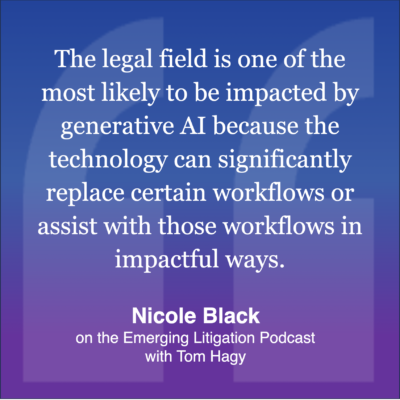
    In an article she wrote for Above the Law, you’re going to hear even more about generative artificial intelligence in the coming months, “especially” she says, “as legal technology companies ramp up their generative ai releases.” She forecasts “a rapid, exponential uptick in the number of new GAI tools for legal professionals.” And, as she reminded me, litigators have an ethical duty of technology competence.

    Nicole “Niki” Black is a Rochester, New York-based attorney, author and journalist, and is senior director of subject matter expertise and external education at MyCase, a company that offers legal practice management software for small firms. She is the nationally recognized author of cloud computing for lawyers and is co-author of social media for lawyers: the next frontier, both published by the American Bar Association. She writes regular columns for abajournal.com and Above the Law; has authored hundreds of articles for other publications; and regularly speaks at conferences regarding the intersection of law and emerging technologies. Nicole earned her J.D. from Albany Law School.

    Listen as I interview, first, Google Gemini fka Bard, for fun, then our real-life human attorney guest, about the current state and future of generative artificial intelligence and the practice of law.

    I hope you enjoy the episode. If so, give us a rating!

    *******

    This podcast is the audio companion to the Journal on Emerging Issues in Litigation. The Journal is a collaborative project between HB Litigation Conferences and the vLex Fastcaselegal research family, which includes Full Court Press, Law Street Media, and Docket Alarm.

    If you have comments, ideas, or wish to participate, please drop me a note at Editor@LitigationConferences.com.

    Tom Hagy
    Litigation Enthusiast and
    Host of the Emerging Litigation Podcast
    Home Page
    LinkedIn

    Nicole Black

    Nicole BlackLawyer, Legal Tech Journalist, Author

    Nicole Black is a Rochester, New York-based attorney, author and journalist, and she is senior director of subject matter expertise and external education at MyCase, a company that offers legal practice management software for small firms.

    She is the nationally recognized author of Cloud Computing for Lawyers and is co-author of Social Media for Lawyers: The Next Frontier, both published by the American Bar Association. She writes regular columns for ABAJournal.com and Above the Law; has authored hundreds of articles for other publications; and regularly speaks at conferences regarding the intersection of law and emerging technologies.

    Nicole earned her J.D. from Albany Law School.

    Want to appear on the Emerging Litigation Podcast?

    Send us your idea! 

  • The Corporate Transparency Act: A New Effort to Fight Money Laundering with Lori Smith

    The Corporate Transparency Act: A New Effort to Fight Money Laundering with Lori Smith

    The Corporate Transparency Act: A New Attempt to Fight Money Laundering

    Concepts: Drug Trade, Proliferation Financing, Money Laundering, Corporate Transparency Act, CTA

    Editor’s Note: Scroll down for an important update about the CTA.

    The United Nations Office on Drugs and Crime estimates that between $800 billion to $2 trillion in drug money is laundered annually. So, too, is money intended to support terrorism. The International Monetary Fund warns about about terrorism financing and proliferation financing, i.e., providing funds for nuclear, chemical, or biological weapons. And for the embezzlers and criminal enterprises out there, your money has to be cleaned, too. But you already know that. 

    As of Jan. 1, 2024, in an effort to combat money laundering and related activities, domestic and foreign entities registered to do business in the United States must comply with new “beneficial ownership reporting requirements” imposed under the Corporate Transparency Act.

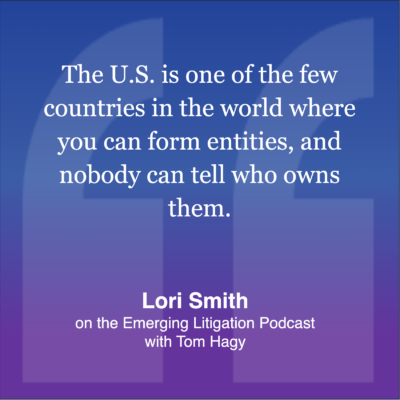
    Listen to what veteran attorney Lori Smith of Stradley Ronon has to say about the Act, something 30 million companies will have to follow in the Act’s first year. Lori provides insights for business executives and attorneys on key facets of the requirements, potential penalties, and chances for litigation.

    I hope you enjoy the episode. If so, give us a rating!

    *******

    This podcast is the audio companion to the Journal on Emerging Issues in Litigation. The Journal is a collaborative project between HB Litigation Conferences and the vLex Fastcaselegal research family, which includes Full Court Press, Law Street Media, and Docket Alarm.

    If you have comments, ideas, or wish to participate, please drop me a note at Editor@LitigationConferences.com.

    Tom Hagy
    Litigation Enthusiast and
    Host of the Emerging Litigation Podcast
    Home Page
    LinkedIn

    Update: CTA Held Unconstitutional in Alabama

    Lori Smith wrote on LinkedIn:

    “It remains to be seen what this really means as the decision is likely to be appealed and for now by its terms, the injunction imposed by the judge only applies to the plaintiffs in the Alabama case. It will be interesting to see if additional cases are filed. There was one case filed already in Ohio but the real test will be if there are significant challenges around the country especially on behalf of large trade associations or other groups representing small businesses.”

    The decision was handed down on Friday, March 1, by Judge Liles C. Burke.

    Lori Smith

    Lori SmithStradley Ronon LLP

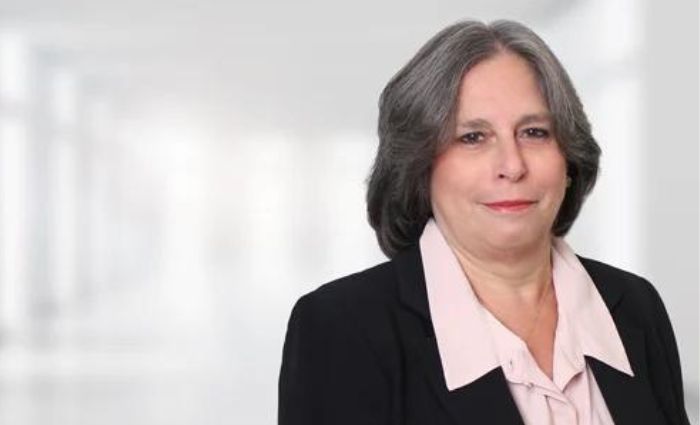
    Lori Smith is chair of the emerging companies & venture capital practice and is an active participant in the firm’s health law and mergers and acquisitions groups. Lori has been a trusted adviser to foreign and domestic companies for over 30 years, ranging from startups to large corporations, including entrepreneurs and angel, venture capital, and private equity investors. She represents public and private companies in the negotiation of mergers and acquisitions, leveraged buyouts, equity and debt financings, private placements, strategic alliances, partnerships and joint ventures.

    Lori combines her transactional experience with her traditional health care, technology and financial services industry knowledge and a deep understanding of the nuances of the digital age. She has extensive experience representing companies from formation and growth stage through exit in a wide range of industries, including technology, media and communications, fashion and textiles, financial services, food and beverage, sports, gaming, specialty chemicals, insurance, healthcare and digital health.

    Lori earned her J.D., with high honors, from Duke University School of Law and her B.A., magna cum laude, from the University of Rochester.

    Want to appear on the Emerging Litigation Podcast?

    Send us your idea! 

  • Litigators, YES Litigators: One Attorney’s Journey Within and Without the Legal Industry

    Litigators, YES Litigators: One Attorney’s Journey Within and Without the Legal Industry

    Litigators, YES Litigators: One Attorney’s Journey Within and Without the Legal Industry

    Concepts: Litigation, Litigation Career, Legal Technology

    Litigators who do other things besides litigate.  You probably even know some. 

    Some perform comedy, some act on stage or in film, and some are gifted musicians or drummers. (Drummer joke, if that’s not too edgy.)  One highly acclaimed San Francisco class action litigator is talented on the drum kit and owns her own drum company. Another Los Angeles-based litigator started his own record label. Another San Francisco litigator left the profession, moved to South Africa, and led people on safari. Others write books, or develop technology solutions. Still others launch businesses, teach, or back important causes.

    Litigators do many things. One job closer to home is when he or she moves from private practice to a corporate legal department. But what about when the company is on the smaller size with a modest legal department whose members are expected to handle an assortment of matters? Hiring is an important decision for any company, but when it’s a smaller organization selecting in-house counsel it is arguably even more critical. When a company isn’t engaged in litigation, one might think a litigator wouldn’t be the first choice to add to the team.

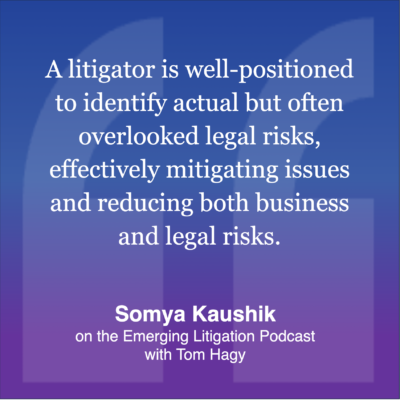
    In this episode we talk about all the things one litigator has done, and the advantages she feel such professionals can bring to small companies – one that isn’t embroiled in litigation, and would like to keep it that way.

    She is Somya Kaushik, former litigator, current in-house counsel, entrepreneur, adjunct law professor, writer, leader, and children’s book author.

    I hope you enjoy the episode. If so, give us a rating!

    *******

    This podcast is the audio companion to the Journal on Emerging Issues in Litigation. The Journal is a collaborative project between HB Litigation Conferences and the vLex Fastcaselegal research family, which includes Full Court Press, Law Street Media, and Docket Alarm.

    If you have comments, ideas, or wish to participate, please drop me a note at Editor@LitigationConferences.com.

    Tom Hagy
    Litigation Enthusiast and
    Host of the Emerging Litigation Podcast
    Home Page
    LinkedIn

    Somya Kaushik

    Somya KaushikSenior Corporate Counsel, Mineral

    Somya Kaushik, is a former litigator, entrepreneur, adjunct law professor, writer, leader, and author of a children’s book titled “You, YES You! Yolki’s Journey Within,” illustrated by Annie Hagy* (available on Amazon and other fine platforms).

    She is senior corporate counsel for Mineral, an HR and corporate compliance company which was recently acquired by Miratech, a tech solutions company for legal, HR, and governance, risk and compliance.

    In 2013 she founded EsqMe, Inc., a sharing platform where lawyers can exchange legal documents, templates, motions, and forms, where she served as general counsel.

    She is also an adjunct professor at Lewis & Clark Law School, speaks around the country on legal technology, IP, privacy and technology matters, and has been a guest lecturer at MIT, The George Washington University, New York Law School, and Claremont Colleges.

    Newly relocated to Chicago from Portland, Ore., where she practiced intellectual property and privacy law, for nearly five years Somya was president of the South Asian Bar Association of Oregon.

    Before moving to Portland, Kaushik practiced litigation in New York where she represented clients in healthcare, technology, commercial and IP cases.

    Kaushik has also represented clients in notable pro-bono matters including a criminal defense client in a 75-count superseding indictment in federal court in Brooklyn, and a large USPTO trademark infringement matter brought against her client by Under Armour Inc.

    Kaushik founded EsqMe, Inc., a legal technology company aimed at helping lawyers practice law more efficiently and cost effectively. Her firsthand experience as CEO gives her a unique perspective and advantage when representing clients in the innovation, IP, technology and entrepreneurial space.

    Somya is on the Fastcase 50, a list that honors innovators and leaders in the legal industry.

    Education: New York Law School, J.D.; George Washington University, B.A., Psychology and Political Science; London School of Economics; and Harvard Business School.

    ——-

    *Ms. Hagy is the younger daughter of the host of this podcast, which, now that I think about it, could use some illustrations to brighten up the place.

    Want to appear on the Emerging Litigation Podcast?

    Send us your idea!