
Tag: Regulations

  • How Companies Seeking to Leave China for Mexico Can Mitigate Their Legal Risks and Protect Against New Ones

    How Companies Seeking to Leave China for Mexico Can Mitigate Their Legal Risks and Protect Against New Ones

    The Author

    Dan Harris

    Dan HarrisHarris Bricken

    Dan Harris (dan@harrisbricken.com) is co-founder of Harris Bricken where he focuses his practice on international law and protecting businesses in their foreign operations. A leading authority on the subject, he is also editor of the highly regarded China Law Blog, and a valued member of the Editorial Board of Advisors for the Journal of
    Emerging Issues in Litigation.

    The Journal on Emerging Issues in Litigation

    Emerging Litigation Podcast

    Emerging Litigation PodcastProduced by HB Litigation and Law Street Media

    Interviews with leading attorneys and other subject matter experts on new twists in the law and how the law is responding to new twists in the world.

    How Companies Seeking to Leave China for Mexico Can Mitigate Their Legal Risks and Protect Against New Ones

    “Chinese manufacturers commonly seek retaliation against foreign buyers that cease buying product from them. For this reason, it is critical that you line up your new suppliers (preferably in a country other than China) and have them ready to go before you even hint to anyone in China that you might cease or reduce production with an existing China supplier.”

    Abstract: The author, one of the leading authorities on the legal issues related to international manufacturing, discusses the risks companies will face if they move their manufacturing out of China, what they should do to mitigate those risks, and what new risks they will face in a new country, such as Mexico. He comments on a variety of concepts, including manufacturing agreements, protection of intellectual property, strategies for a safe departure, potential retaliation tactics, and even personal security matters.


    Download the article now!

  • Climate Change, Property Rights, and Conservation: Highlights from a Decade of Environmental Law (2013–2023)

    Climate Change, Property Rights, and Conservation: Highlights from a Decade of Environmental Law (2013–2023)

    The Author

    Victoria Kline

    Victoria Kline2023 J.D. and Incoming Associate at Reed Smith

    Victoria Kline (linkedin.com/in/victoria-kline) just graduated from the University of Miami School of Law, and is an incoming associate at Jones Day. She focused her studies on environmental law, which also will be her area of practice. (Congratulations to Victoria on her graduation and getting her start at Reed Smith!)

    The Journal on Emerging Issues in Litigation

    Emerging Litigation Podcast

    Emerging Litigation PodcastProduced by HB Litigation and Law Street Media

    Interviews with leading attorneys and other subject matter experts on new twists in the law and how the law is responding to new twists in the world.

    Climate Change, Property Rights, and Conservation:
    Highlights from a Decade of Environmental Law (2013–2023)

    Abstract: The author discusses nine recent decisions—all but one handed down by the Supreme Court—that demonstrate the ongoing debate over responsibility for the effects of climate change, how the courts are essentially asked to strike a balance between environmental protection and economic development, the intersection of property rights and conservation, and how litigants fared with their arguments over different aspects of this important and, many would say, existential dilemma. The author concludes with an update from the United Nations Framework Convention on Climate Change and the establishment of a loss and damage fund for countries harmed by climate change.

    “The past decade has seen numerous legal challenges and landmark rulings in environmental law, reflecting the growing recognition of the critical importance of protecting the environment for current and future generations. From the Supreme Court’s decision in Michigan v. EPA to the recent Juliana v. United States case, the judicial branch has dramatically changed the way litigation can be used to protect the interests of the earth and its inhabitants.”

    Download the article now!

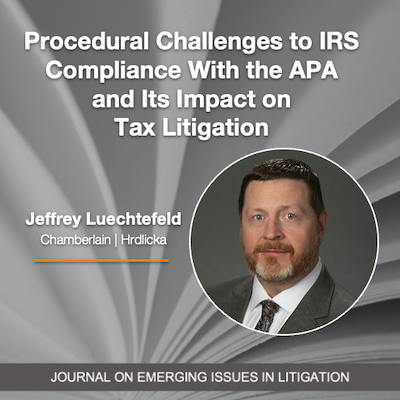
  • Procedural Challenges to the IRS’s Compliance With the APA and Its Impact on Tax Litigation

    Procedural Challenges to the IRS’s Compliance With the APA and Its Impact on Tax Litigation

    The Author

    Jeffrey S. Luechtefeld

    Jeffrey S. LuechtefeldChamberlain | Hrdlicka

    Jeffrey S. Luechtefeld (jeff.luechtefeld@chamberlainlaw.com) is a tax controversy and litigation attorney with Chamberlain, Hrdlicka, White, Williams, and Aughtry (Atlanta, Georgia) where he focuses his practice on resolving tax disputes with the Internal Revenue Service, administratively or through litigation. Jeff previously was a Special Trial Attorney for the IRS Office of Chief Counsel as well as a director in the tax controversy practice of a big four accounting firm.

    The Journal on Emerging Issues in Litigation

    Emerging Litigation Podcast

    Emerging Litigation PodcastProduced by HB Litigation and Law Street Media

    Interviews with leading attorneys and other subject matter experts on new twists in the law and how the law is responding to new twists in the world.

    Procedural Challenges to IRS Compliance With the APA and Its Impact on Tax Litigation

    Abstract: The Administrative Procedure Act (APA) places specific requirements on agencies of the federal government when engaged in a “rule making” that has the force and effect  of law. Recently, the APA has become a focal point in tax litigation, due in large part to the IRS’s history of refusing to comply with the process mandated by the APA. This article focuses on procedural challenges to the IRS’s compliance with the APA based on the IRS’s history of non-compliance with the APA’s notice-and-comment requirement. It highlights recent trends in tax litigation and considers the future of APA challenges in this area.

    “IRS’s level of APA non-compliance matters significantly …

    “APA challenges predicated on the IRS’s failure to adequately follow the APA’s notice-and-comment process are inherently fact-intensive endeavors …

    “The challenging party should gauge the usefulness of the relief requested and balance that against the cost required to prevail …

    “Ultimately, APA challenges are important, and may be necessary for a taxpayer to get to argue the merits of their case, but they do not often end the dispute with the IRS.”

    Download the article now!

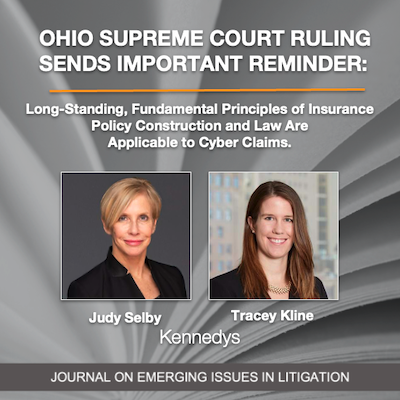
  • Ohio Supreme Court Ruling Sends Important Reminder: Long-Standing, Fundamental Principles of Insurance Policy Construction and Law Are Applicable to Cyber Claims

    Ohio Supreme Court Ruling Sends Important Reminder: Long-Standing, Fundamental Principles of Insurance Policy Construction and Law Are Applicable to Cyber Claims

    The Authors

    Judy Selby

    Judy SelbyKennedys

    Judy Selby (judy.selby@kennedyslaw.com) is a Partner at Kennedys (New York) where she focuses her practice primarily on insurance coverage matters with a concentration in coverage for exposures arising out of emerging technology, digital, and compliance risks.

    Tracey Kline

    Tracey KlineKennedys

    Tracey M.Kline (tracey.kline@kennedyslaw.com) is an Associate at Kennedys (Philadelphia) where she focuses her practice primarily on insurance coverage litigation and cyber matters.

    The Journal on Emerging Issues in Litigation

    Emerging Litigation Podcast

    Emerging Litigation PodcastProduced by HB Litigation and Law Street Media

    Interviews with leading attorneys and other subject matter experts on new twists in the law and how the law is responding to new twists in the world.

    Ohio Supreme Court Ruling Sends Important Reminder:

    Long-Standing, Fundamental Principles of Insurance Policy Construction and Law Are Applicable to Cyber Claims

    Abstract: On December 27, 2022, the Ohio Supreme Court unanimously ruled that a business owner’s property insurance policy issued by Owners Insurance Co. to EMOI Services, LLC did not afford coverage for losses sustained in a ransomware attack because computer software is “entirely intangible” and “cannot experience ‘direct physical loss or physical damage.’” EMOI Servs., LLC. v. Owners Ins. Co., 2022-Ohio-4649 (Ohio 2022). In doing so, the court reversed an attention-getting split decision by the lower appellate court. This article takes an in-depth look at the case and discusses its significant implications.

    The Ohio Supreme Court’s decision was based on its commonsense conclusions that software (as intangible property) cannot suffer physical damage, and that coverage for restoration of information under the Electronic Equipment Endorsement could not be triggered absent the threshold requirement of “direct physical loss or damage” to the media on which the information was stored. Although claims involving cyber events may be relatively new, this decision is an important reminder that long-standing, fundamental principles of insurance policy construction and law are applicable to cyber claims.

    Download the article now!

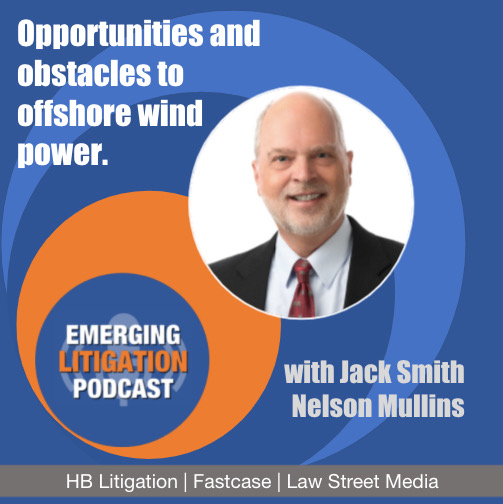
  • Offshore Wind Power Initiatives with Jack Smith

    Offshore Wind Power Initiatives with Jack Smith

    Offshore Wind Power Initiatives with Jack Smith

    Joining me to discuss this important subject is Jack Smith, a partner with Nelson Mullins in Charleston, South Carolina. Jack’s practice includes hazardous waste site management and remediation, contaminated property liability negotiation, litigation, redevelopment and related regulatory counseling. He has also worked for several state and federal government environmental agencies. Jack earned his JD from the University of South Carolina School of Law and a BS in Psychology, also from the University of South Carolina.

    This podcast is the audio companion to the Journal on Emerging Issues in Litigation, a collaborative project between HB Litigation Conferences and the Fastcase legal research family, which includes Full Court Press, Law Street Media, Docket Alarm and, most recently, Judicata. If you have comments or wish to participate in one our projects, or want to tell me how insightful and informative Jack is, please drop me a note at Editor@LitigationConferences.com. This interview is based in part on an article Jack is writing for the Journal.

    I hope you enjoy the interview, and especially my solution for preventing birds from flying into windmills. I’m going to be rich. –Tom Hagy

    President Biden  has called for the doubling of offshore wind energy capacity by 2030.

    To say the process for getting such projects up and running is complex is an understatement. There will be plenty of obstacles to the administration’s lofty goal.

    Where will these impediments to development arise?

    What role will states play?

    How will NGOs react to this ambitious ramp-up?

  • Psychedelics Decriminalization and Regulation with Griffen Thorne

    Psychedelics Decriminalization and Regulation with Griffen Thorne

    Psychedelics Decriminalization and Regulation with Griffen Thorne

    Thorne on Psychedelics

    Listen to my interview with Griffen Thorne, an attorney in the Los Angeles office of Harris Bricken LLP.  He focuses on corporate, transactional, intellectual property, data security, regulatory, and litigation matters across a wide variety of domestic and international industries.

    As part of Harris Bricken’s corporate cannabis team, he works closely with cannabis and hemp clients, whom he advises on obtaining licenses and permits, regulatory compliance, entity formation and structuring, mergers and acquisitions, corporate governance issues, contract drafting and negotiation, obtaining and protecting intellectual property rights, and administrative appeals and litigation.

    He also represents clients throughout a wide range of industries regarding compliance with United States, European, and Asian Internet, technology, and data security laws and regulations.

    We hope you enjoy the interview.

    Tom Hagy

    Send questions or comments to Editor@LitigationConferences.com.

    What does the future hold for psychedelics in America?

    How are states approaching the ownership and use of these drugs, either for recreational or their controlled therapeutic use?

  • Organizational Values & Coronavirus Business Risks | Join Our Webinar June 18

    Organizational Values & Coronavirus Business Risks | Join Our Webinar June 18

    Webinar:
    June 18, 2020
    2:00 pm ET
    60 mins.
    CLE: 1+
    Complimentary with registration.

    Get:
    +CLE
    +Materials
    +Recording
    +Answers!

    Also available to subscribers of the West LegalEdcenter.
    Register there!

    Email us your:
    Speaker questions
    CLE questions

    Speaker:

    Professor Edward L. Queen Ph.D. , J.D.
    Director Ethics and Servant Leadership: Emory Center for Ethics
    Emory University

    Organizational Values & Coronavirus Business Risks
    Properly Balancing Stakeholder Concerns

    Thursday, June 18, 2020 | 2pm ET | 1pm CT | 12pm MT | 11am PT 

    The pandemic brings with it complex liability concerns, stakeholder demands and legal duties.  We will take a closer look. 

    The current pandemic confronts businesses, nonprofit organizations, governments, and the legal profession with innumerable ethical challenges.  Management issues and liability concerns, stakeholder demands and legal duties become even more complex in an environment of uncertainty and one where the consequences could result in serious illness or even death.  This program seeks to engage the participants in thinking through these challenges and developing processes of ethical response to them.  Managers must acknowledge and address the framework of fear associated with the pandemic, ranging from fear of contagion and death to fears of unemployment, child care, and the duties of home-schooling.  Additionally, as the economy reopens there must be serious attention to the processes of doing so, including:

    We will address:   

    • Appropriate accommodation for high-risk employees or employees with family members who are at a heightened risk;

    • Attention to means of mitigating transmission and infection;

    • Contact tracing and management of data collected, including health data, as well as responses to employees who refuse to report;

    • Duty to avoid discrimination and stigmatization;

    • Developing plans to address possibility of re-occurrence in the fall and managing possible outbreaks in company’s offices.

  • Canna Law Blog Reviews Hemp-CBD Regulations State-by-State, Week-by-Week

    “When it comes to hemp, few states have embraced it like Colorado,” writes Harris Bricken attorney Daniel Shortt. “If you buy a product containing hemp, in any state across the country, it likely came from Colorado.” The state has allocated more than 12,000 acres of outdoor space and 2.35 million square feet of indoor space to hemp cultivation, according to Marijuana Business Daily.

    Shortt and his colleagues are working their way through a state-by-state series on the Canna Law Blog™, titled Hemp-CBD Across State Lines. The Harris Bricken team has covered Alabama, Alaska, Arizona, Arkansas and California, and added Colorado to the list yesterday, July 21.

    The firm’s series covers state regulatory activity following the enactment of the federal Agriculture Improvement Act of 2018, aka “The Farm Bill,” which removed hemp and its derivatives from the definition of marijuana under the Controlled Substances Act. The bill gave the USDA regulatory authority over hemp cultivation at the federal level, but states may maintain primary regulatory authority over the crop cultivated within their borders by submitting a plan to the USDA, Shortt explains.

    Read the Canna Law Blog’s Colorado post and follow this series, updated weekly.

    Related Webinar This Week

    The Harris Bricken law firm has been on the forefront of the law regarding cannabis and related products for years. Three Harris Bricken attorneys, Daniel Shortt, Nathalie Bougenies, and Griffen Thorne — plus Anastasia Gilmartin, General Counsel at CBD product maker OLEO Inc. — will discuss how the legal landscape of hemp-derived CBD is affecting various stakeholders.

    They will:

    + Discuss both the 2014 and 2018 Farm Bills
    + Analyze the FDA’s position on products containing hemp and/or CBD (including food, beverages, cosmetics, dietary supplements, drugs, and smokeable products)
    + Provide an overview of state laws
    + Share insights on where this industry is headed
    + Answer your questions via live chat

    Learn more

  • Nevada to try limited banking for cash-heavy pot industry — ElkoDaily.com

    Most marijuana dispensaries are forced to handle massive amounts of cash. Business owners are paying their employees with envelopes full of dollar bills, and bringing duffle bags full of money to government buildings to pay their taxes.

    That could all change with the new Nevada state law that allows dispensaries to offer a cashless option. This program will be tested for three years before being considered as a permanent feature. State Treasurer Zach Conine likened the system to gift cards or digital apps such as Venmo and said the program would not include broader banking services like loans. Since marijuana is still not legal federally, states are on their own with coming up with a cashless option. Hawaii took similar steps and included a debit payment app, which has spread to other states as well. California lawmakers are also devising a cashless system by creating a class of banks specifically for the industry. This temporary law is set to take place by July 1, 2020 with the hopes of easing transactions and lessen cash handling for customers and businesses

    Read the complete post by Michelle L. Price on ElkoDaily.com here! 

  • The New York Privacy Act Would Allow Direct Action

    The New York Privacy Act,  introduced last month by state Sen. Kevin Thomas, advocates for consumer agency over their personal data and would give New Yorkers the right to sue companies directly for privacy violations. Thomas wants companies to put customer data protection ahead of their budgetary and business goals.  

    The bill summary reads: “Enacts the NY privacy act to require companies to disclose their methods of de-identifying personal information, to place special safeguards around data sharing and to allow consumers to obtain the names of all entities with whom their information is shared; creates a special account to fund a new office of privacy and data protection.”

    “Fiduciaries, like an attorney or a doctor, hold onto your information. They don’t share it, unless there is a need for the purpose for which they collected it,” Thomas said. “That’s not what’s going on here with these data companies and these data brokers. They’re sharing it, and we’re getting targeted.”

    Pushback from the tech industry has been swift. John Olsen, Director of the Internet Association, said, “The NY Privacy Act, in its current form, is unworkable for businesses that want to comply and fails to provide New York residents meaningful control over how their data is collected, used, and protected.” Facebook also chimed in saying they would have to shut down Facebook access to New York users if the bill becomes law.

    Read the NY Senate Bill S5642.