Tag: Liability Claims

  • Cyber Risk Management & Insurance Part 2: Advanced Level Webinar

    Cyber Risk Management & Insurance Part 2: Advanced Level Webinar

    Cyber Risk Management & Insurance

    Part 2: Advanced Level Webinar

    Description: Cyber risk is dynamic, and so are the cybersecurity measures and insurance products designed to respond to it. As cyber threats evolve, insurers have continually revised both traditional commercial policies and stand‑alone cyber insurance products. Some of these changes expand coverage, while others create traps for the unwary—through application representations, sub‑limits, and exclusions embedded in defined terms. At the same time, the claims environment has grown markedly more adversarial. Disputes that once rarely surfaced are now common, requiring policyholders to fight harder to secure the coverage they believed they purchased.

    Compounding these challenges, the widespread adoption of artificial intelligence and the proliferation of state privacy laws modeled in part on the GDPR have significantly expanded obligations related to data protection, privacy, and disclosure. Insurance remains a critical component of any cyber risk management strategy, but the cyber insurance marketplace lacks uniformity, and policy quality varies widely. Policyholders must therefore be sophisticated consumers at both placement and renewal, while continuing to devote substantial resources to preventing and responding to cyber incidents.

    This webinar will examine emerging cyber risk exposures—including AI-related liabilities, pixel‑tracking claims, system damage, and business interruption—and the insurance coverage disputes arising from those risks. The program will address both first‑party and third‑party coverage issues, as well as enforcement and regulatory developments involving state attorneys general and federal agencies, including the FTC, SEC, HHS, the Department of the Treasury, and the New York Department of Financial Services. Attendees will gain practical insight into how these regulatory actions intersect with cyber and traditional commercial insurance policies, and how policyholders can better position themselves to protect coverage in an increasingly contested landscape.

    Agenda:

    • Understand new and developing risk vectors.
    • Understand underwriting challenges, including the purchase and renewal processes for dedicated cyber insurance products.
    • Understand developments with 3rd party insurance products, including wrongful tracking and privacy claims.
    • Understand developments with 1st party insurance products, including system damage and business interruption losses.
    • Understand challenges in navigating the claims handling process and ADR issues that can arise.

    As always, if you have comments or wish to participate in one our projects please drop us a note at Editor@LitigationConferences.com.

    TAKE IT NOW

    Available now to CeriFi LegalEdge subscribers. Don’t subscribe? Don’t despair. Use code HB20 for 20% off. Or, HBSub20 for 20% off a full solo subscription. While supplies last.

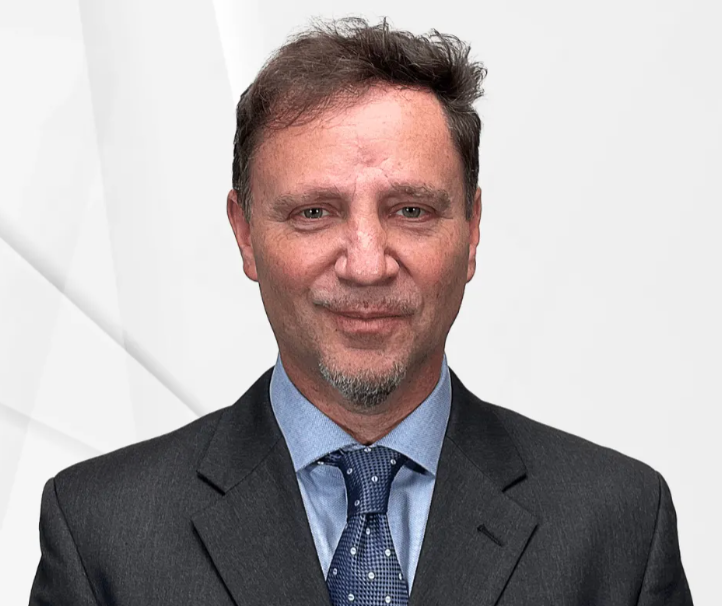
    Miranda Jannuzzi

    Miranda JannuzziSenior Vice President, Aon

    Miranda Jannuzzi is Senior Vice President on Aon’s Cyber Solutions E&O/Cyber Product team, where she focuses on cyber insurance product innovation and risk transfer solutions for clients. Previously counsel at an Am Law 50 firm, she spent more than a decade representing corporate policyholders in insurance coverage disputes and recovery matters across multiple industries. Miranda earned her J.D. from Temple University Beasley School of Law and is licensed in Pennsylvania and New Jersey.

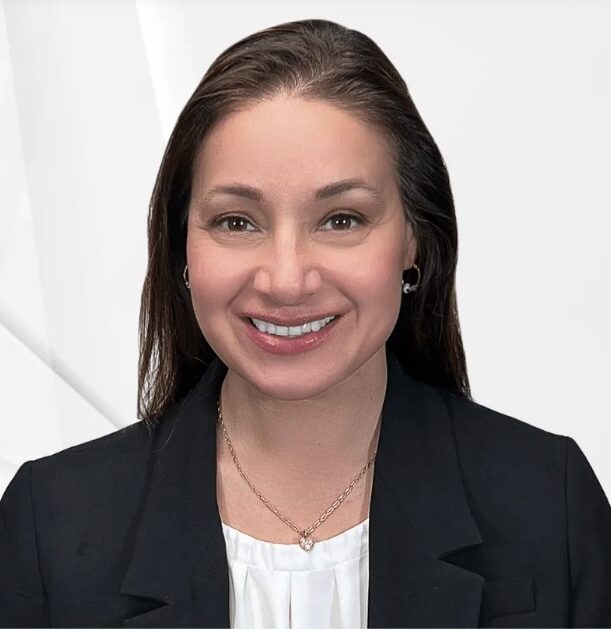
    Joshua Gold

    Joshua GoldShareholder, Anderson Kill

    Joshua Gold is a shareholder in Anderson Kill’s New York office representing corporate and nonprofit policyholders in insurance recovery matters. He has secured more than $1.5 billion in recoveries for clients and writes regularly on insurance issues, including a column in Risk Management Magazine. Josh is an adjunct professor of insurance law at Brooklyn Law School and president of Interleges, an international alliance of independent law firms.

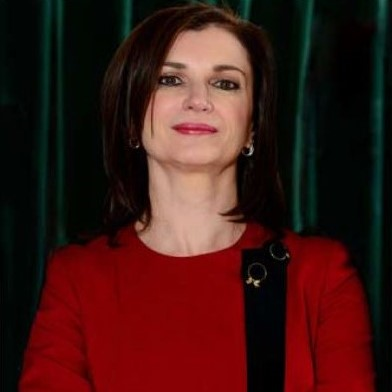
    Luma S. Al-Shibib

    Luma S. Al-ShibibShareholder, Anderson Kill

    Luma S. Al-Shibib is a shareholder in Anderson Kill’s New York office and co-chair of the firm’s Cybersecurity and Cyber Insurance Recovery Groups. She focuses on insurance recovery for corporate policyholders, including cyber liability, crime, and D&O coverage, and has secured more than $100 million in recoveries for clients. Luma earned her J.D. from Brooklyn Law School and her B.A., cum laude, from Connecticut College.

  • Agentic AI on Trial: You Be The Judge Part 1 – Medical Diagnostics | Featuring An AI Expert, a Google Cloud Exec, and a Florida Circuit Judge

    Agentic AI on Trial: You Be The Judge Part 1 – Medical Diagnostics | Featuring An AI Expert, a Google Cloud Exec, and a Florida Circuit Judge

    Agentic AI on Trial: You Be The Judge

    Part 1 – Medical Diagnostics

    Concepts: Artiticial Intelligence; Liability Claims; Life Sciences

    In this three-part series our guests reprise their panel discussion at the Executive Women’s Forum DSG Global conference titled “You Be The Judge,” during which they explored scenarios involving harms potentially caused by Agentic AI.

    In Episode 1 they discuss an Agentic AI mammography triage system designed to flag positives for a radiologist, auto-send “all clear” letters for negatives, and operate with minimal human oversight.

    They answer this difficult question: When the machine gets it wrong, who is accountable? Developers, hospitals, clinicians, and/or data providers? What role do contracts, warnings, and intended-use labels play in establishing liability? What safeguards would balance speed and safety? Random audits? Documentation? Will a new standard of care develop for machine decision-making?

    I take the back seat in this series as the panelists moderate the discussion. They are:

    Galina Datskovsky, PhD, CRM, FAI
    Board of Directors, FIT and OpenAxes
    Information Governance and AI expert

    Marina Kaganovich
    AMERS Financial Services Executive Trust Lead
    Office of the CISO, Google Cloud

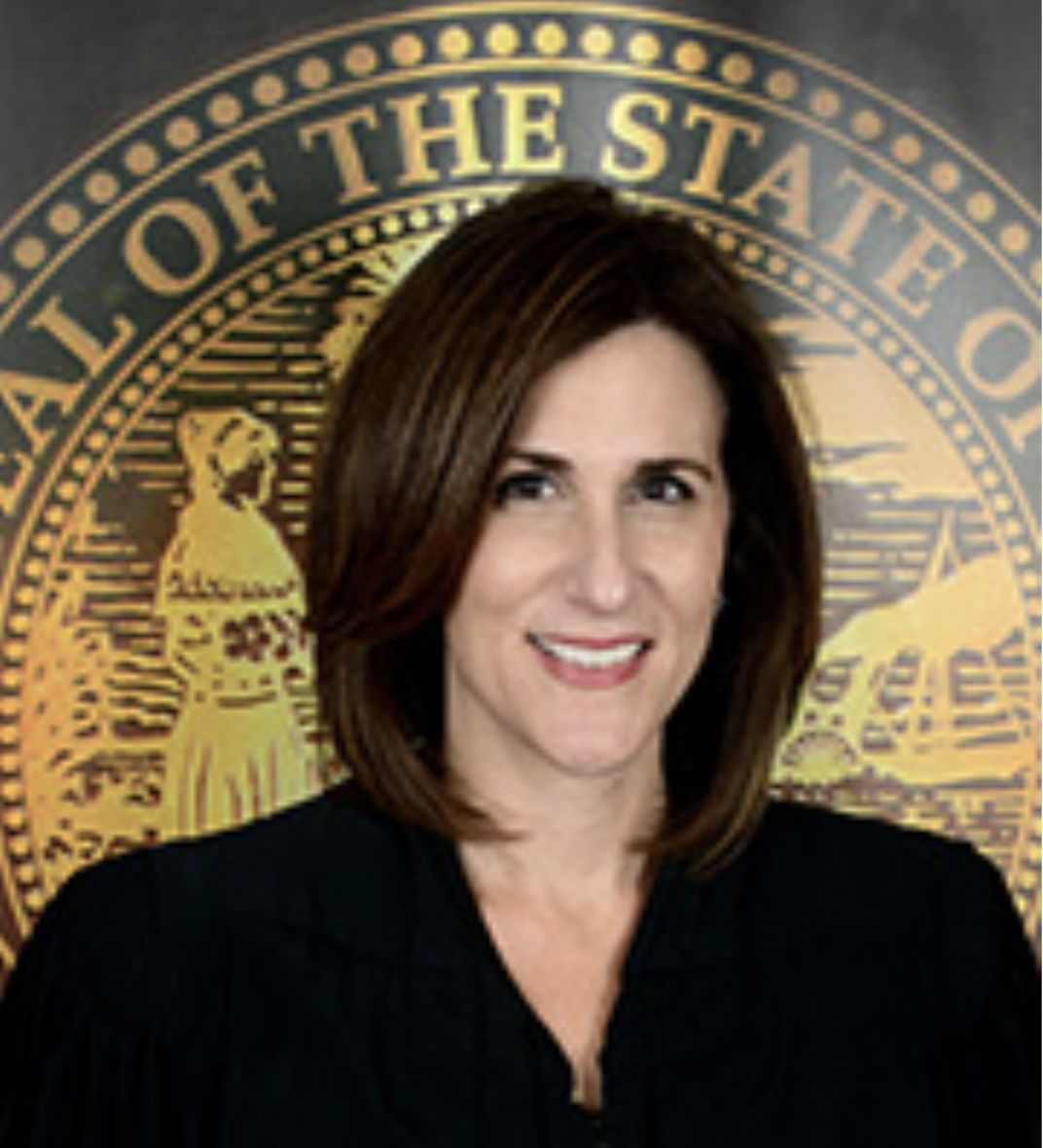
    Hon. Lisa Walsh
    Florida Circuit Judge
    11th Judicial Circuit, Miami-Dade County

    Special thanks to Kathryn M. Rattigan, Partner, Data Privacy + Cybersecurity with Robinson+Cole for bringing this team to the Emerging Litigation Podcast.

    If you work in health tech, compliance, or hospital operations — or you advise these professionals — this conversation offers a clear-eyed guide to deploying autonomous agents responsibly—without sleepwalking into preventable harm. If you like what you hear, watch for Episodes 2 and 3.

    Thanks for listening!

    If you like what you hear please give us a rating. You’d be amazed at how much that helps.

    If you have questions for Tom or would like to participate, you can reach him at Editor@LitigationConferences.com.

    Ask him about creating this kind of content for your firm — podcasts, webinars, blogs, articles, papers, and more.

    Galina Datskovsky

    Galina DatskovskyBoard of Directors, FIT and OpenAxes, Information Governance and AI expert

    Dr. Galina Datskovsky, CRM, FAI, is an internationally recognized expert in privacy, compliance, and security, and is a serial entrepreneur. She has served as CEO of multiple technology companies. In senior executive roles she has led information governance, architecture, product development, and cybersecurity initiatives, helping to scale innovative businesses and governance programs. She holds a doctorate, master’s, and bachelor’s degree in Computer Science from Columbia University. She has taught at Columbia University and Fordham University’s graduate programs.

    Marina Kaganovich

    Marina KaganovichAMERS Financial Services Executive Trust Lead, Office of the CISO, Google Cloud

    Marina Kaganovich supports Google Cloud’s financial services customers across the Americas by partnering with CISOs and senior executives throughout their digital transformation journeys. She provides strategic guidance on cybersecurity, regulatory compliance, risk management, governance, and oversight, helping organizations navigate complex cloud adoption challenges in regulated environments. Prior to Google Cloud, she held senior legal and compliance roles at leading global institutions, including Goldman Sachs, BNP Paribas, Thomson Reuters (Refinitiv), and Wall Street firms, where she advised on emerging technologies. A licensed attorney, Marina is a frequent speaker and author on AI‑related security, governance, and compliance topics, and holds multiple FINRA licenses as well as the Cloud Security Alliance’s Certificate of Cloud Security Knowledge.

    Hon. Lisa Walsh

    Hon. Lisa WalshFlorida Circuit Judge, 11th Judicial Circuit, Miami-Dade County

    Judge Lisa Walsh was appointed to the Circuit Court for the 11th Judicial Circuit in Miami‑Dade County, Florida in 2011 and serves in the Complex Business Litigation and International Commercial Arbitration divisions. She previously served as a County Court Judge and has presided over approximately 200 jury trials, authored 80 published appellate opinions, and written decisions while sitting by designation on Florida’s Fourth District Court of Appeal. Before taking the bench, Judge Walsh spent 16 years as a trial and appellate lawyer. She holds national and international leadership roles with women judges’ organizations, including representing the United States with the International Association of Women Judges, and leads a mentoring program for Afghan women judges in the United States. Judge Walsh is a graduate of Northwestern University and the University of Miami School of Law.

    podcast logo face


    Want to appear on the Emerging Litigation Podcast?


    Send us your idea! 

    It might even make this man smile. “But I am smiling here.”

    No. No he’s not.

  • Subway Surfing Suit Against Meta and TikTok: Setting the Stage for Social Media Liability

    Subway Surfing Suit Against Meta and TikTok: Setting the Stage for Social Media Liability

    Emerging Litigation Podcast

    Emerging Litigation PodcastProduced by HB Litigation

    Interviews with leading attorneys and other subject matter experts on new twists in the law and how the law is responding to new twists in the world.

    Interested in contributing an article? Email us at Editor@LitigationConferences.com.

     Subway Surfing Suit Against Meta and TikTok: Setting the Stage for Social Media Liability 

    The Legal Battle Over Algorithmic Targeting and Dangerous Challenges 

    By Tom Hagy*

    I will confirm it, not that I will be the first. Without much prompting, teenage boys will do really stupid, really high-risk things. Or, in the minds of teenage boys, really exciting, really entertaining things.  

    I have stories I can only share now that my parents are no longer alive. I regularly surfed on top of a moving station wagon that my other friend was driving speedily up a pedestrian pathway. I rode my bike at top speed down a hill into a ditch, hoping it would swallow and lock my front wheel, just to see how far over the handlebars I would fly. On my first day ever on skis I jetted straight down an icy hill meant for experts, going as fast as I could – a trip cut short by a collision with a half-ton snow gun that snapped my ski in half. In each case, I suffered not a scratch. At least that I can remember. And I wasn’t one to journal.  

    Blame it on an undeveloped prefrontal cortex and/or the sweet rush of adrenaline. Either way, the outcome was the same. But with prompting, I would do even more. Now I think, what if I could have shared my feats with thousands or potentially millions of people around the world? Many of them girls! “Has anyone strapped themselves to a rocket recently?” I would have wondered.  

    Thanks to social media, that is what teenagers have at their disposal today. And that is what inspired a New York teenager to attempt what would end up being his last shot at social media attention and his last act. The lawsuit brought by his mother recently withstood a motion to dismiss, but with some paring. Below are details of that case, the arguments made by the parties, and some notes on other similar cases.  

    The Subway Surfing Case  

    On June 27, 2025, the New York County Supreme Court issued a decision in Nazario v. ByteDance Ltd., allowing a wrongful death lawsuit to proceed against social media giants Meta (Instagram) and TikTok’s parent company ByteDance. The case centers on the tragic death of 15-year-old Zackery Nazario, who died while “subway surfing” in Brooklyn—a risky act allegedly fueled by dangerous viral content promoted through algorithmic targeting on these platforms. 

    Justice Paul A. Goetz’s decision rejected the defendants’ attempt to dismiss the case on several grounds, signaling a potential shift in the landscape of platform liability. Norma Nazario, Zackery’s mother, contends that Meta and TikTok intentionally designed their products to addict young users and promoted hazardous “subway surfing” challenges to Zackery, encouraging participation in deadly trends. The court found these claims plausible, especially given allegations that the companies’ algorithms actively pushed such content to minors who had not even solicited it, potentially exceeding the protections afforded by Section 230 of the Communications Decency Act. 

    The ruling held that Section 230 immunity, often a powerful shield for social media companies, does not necessarily cover claims where platforms are alleged to have played an active role in targeting and promoting dangerous content. The court cited recent precedents, including Anderson v. TikTok, Inc. (3rd Cir. 2024), which recognized that algorithmic amplification of harmful challenges could fall outside Section 230’s scope. 

    Additionally, the court ruled that the plaintiff’s claims for strict product liability (design defect and failure to warn), negligence, wrongful death, and loss of services could proceed. Claims against the Metropolitan Transportation Authority and New York City Transit Authority were dismissed, with the judge finding that Zackery’s own conduct was the superseding cause and that transit agencies had no further duty to warn of the obvious dangers of subway surfing. 

    Part of a Broader Legal Trend 

    While the Nazario case has garnered attention for its focus on algorithmic promotion of dangerous challenges, it is not an isolated event. Across the United States and internationally, social media platforms face increasing litigation over their role in allegedly encouraging minors to participate in risky, and sometimes deadly, viral trends. 

    Other high-profile cases include lawsuits surrounding the so-called “Blackout Challenge,” where children lost their lives or suffered severe injury after participating in asphyxiation games promoted or popularized on social media. In Anderson v. TikTok, Inc., the Third Circuit Court of Appeals allowed claims to proceed, drawing similar lines between passive hosting of content and active algorithmic promotion to vulnerable users.  

    Families in multiple jurisdictions have brought wrongful death and product liability actions against platforms for challenges ranging from dangerous stunts to pharmaceutical misuse, with courts increasingly scrutinizing the underlying design and function of recommendation algorithms. 

    Many cases, like Nazario’s, allege that companies not only failed to curb the spread of hazardous content but also engineered their platforms to maximize engagement among minors, amplifying the reach and appeal of dangerous trends. Plaintiffs have also pointed to internal documents and whistleblower revelations that, they claim, demonstrate the companies’ awareness of the risks to young users. 

    Arguments in the Motion to Dismiss and Plaintiffs’ Response 

    In their motion to dismiss, Meta and TikTok argued: 

    • Section 230 Immunity: The companies argued that the Communications Decency Act shields them from liability because the content at issue was user-generated, and platforms are protected from claims arising from third-party content.
    • No Duty Owed Under Product Liability: They asserted that social media platforms are not “products” under New York law and thus not subject to strict product liability theories.
    • First Amendment Protection: The defendants claimed the suit sought to regulate protected speech, which would violate their First Amendment rights.
    • Dismissal of All Claims: They requested dismissal of all tort and statutory claims, including those for personal injury, unjust enrichment, and emotional distress.

    The plaintiffs countered:

    • Active Role and Algorithmic Promotion: Plaintiffs argued that the platforms went beyond mere hosting and played an active, targeted role by using algorithms to push dangerous content to minors. This, they contended, was not protected by Section 230.
    • Products Liability Applies: They asserted that, under New York law, digital platforms can constitute “products” when their design and function foreseeably lead to user harm. The court agreed, noting the plausibility of this legal theory.
    • First Amendment Not Absolute: Plaintiffs maintained that the lawsuit sought to regulate tortious conduct and negligent product design, not protected speech. The court concurred, holding that whether the companies’ actions were protected or actionable would require further factual development.
    • Survival of Key Claims: While some claims (including personal injury and certain statutory violations) were dismissed, the core allegations of strict product liability, negligence, wrongful death, and loss of services survived, ensuring the main case would proceed to discovery.

    Zooming Out 

    As I’ve said, there have been numerous lawsuits against social media companies alleging that their platforms encourage or amplify dangerous behavior, especially among children and teens. Here are some of the most notable examples and trends:

    1. Social Media Addiction and Harm MDL
    • Thousands of lawsuits have been filed against Meta (Facebook/Instagram), TikTok, Snapchat, YouTube, and Discord, alleging that these platforms are intentionally designed to be addictive to children and teens, causing mental health issues, self-harm, eating disorders, and even suicide.
    • These cases are consolidated in a multi-district litigation (MDL) in the Northern District of California, with bellwether trials set to begin in 2026.
    • Plaintiffs include families of affected children and school districts, arguing that platforms “prioritize engagement and growth over user safety” and “amplify dangerous content that prioritizes engagement over safety.”
    1. Viral Challenge Lawsuits
    • Subway Surfing Challenge (discussed in this article): The wrongful death lawsuit against Meta and TikTok for promoting subway surfing is part of a broader trend. Multiple lawsuits have been filed after children died or were injured participating in dangerous stunts seen on social media.
    • Blackout Challenge: TikTok faces lawsuits after children died participating in the “blackout challenge,” which encourages users to choke themselves until they lose consciousness. A federal appeals court recently ruled that TikTok can be sued for allegedly promoting this challenge through its algorithm.
    • Other Challenges: Lawsuits have also been filed over the “hot water challenge,” “Benadryl challenge,” and other dangerous viral trends.
    1. Product Liability Theory
    • Plaintiffs are increasingly using product liability claims to bypass Section 230 immunity, arguing that social media platforms are “defective products” because their design and algorithms addict users and promote harmful behavior.
    • Courts have begun to allow some claims to proceed, especially those focused on platform design rather than specific user content.
    1. Government and School District Lawsuits
    • Attorneys general in over 40 states have sued Meta, TikTok, and other platforms, alleging they misled the public about the dangers of social media and failed to protect children.
    • School districts are suing social media companies for contributing to the youth mental health crisis and increased disciplinary problems.
    1. Notable Cases and Rulings
    • Snapchat Speed Filter Case: A federal appeals court found that Snapchat could not invoke Section 230 to shield itself from a lawsuit claiming its speedometer filter encouraged speeding, resulting in a fatal crash.
    • Buffalo Shooting Case: The estates of victims of the 2022 Buffalo supermarket shooting sued social media platforms, arguing that their algorithms radicalized the shooter.

    Conclusion 

    The Subway Surfing case not only highlights the tragic consequences of dangerous viral challenges but also signals a shift in judicial willingness to scrutinize the design and operation of social media platforms. As courts allow more claims to proceed past the motion to dismiss stage, discovery will shed further light on algorithmic targeting and the responsibilities of tech companies to protect vulnerable users. The outcome of Nazario v. ByteDance Ltd., alongside similar cases nationwide, will start to shape the future of online safety, platform liability, and regulatory frameworks for years to come.


    *Tom Hagy has produced content for litigators in a variety of formats — news reporting services, conferences, webinars, podcasts, papers, and online research services — for more than 40 years. Wow. That’s longer than is probably healthy. He is founder of HB Litigation™, which is now a brand owned by Critical Legal Content LLC, provider of legal content for clients, which he founded in 2012. Tom can be reached at editor@litigationconferences.com. 

  • Wildfire Litigation: Building a Case and Establishing Liability with Ed Diab

    Wildfire Litigation: Building a Case and Establishing Liability with Ed Diab

    Wildfire Litigation: Building a Case and Establishing Liability with Ed Diab

    Concepts: Environmental Law; Mass Torts; Wildfire Litigation

    Southern California’s wildfire season has turned into a year-round crisis, and with it comes a surge in litigation. On this episode of the Emerging Litigation Podcast, we explore the aftermath of the devastating January 2025 wildfires, including the high-profile Eaton and Palisades fires, and the complex legal battles now unfolding.

    My guest, Ed Diab, is a founding partner of Diab Chambers LLP, a boutique law firm with a sharp focus on wildfire litigation. Ed and his team have worked alongside national firm Baron & Budd to represent over 100 public entities in wildfire cases dating back to 2015. His deep experience in this area, combined with an insider’s perspective on utility liability, makes him uniquely qualified to discuss the challenges and strategies involved in these high-stakes cases.

    As of early 2025, more than 100 cases have been filed against utilities like Southern California Edison, with public entities, individuals, and insurance carriers seeking damages for widespread destruction. In this conversation, Ed breaks down the causes of these fires, the legal strategies in play, and the uphill battle plaintiffs face when going up against major power utilities.

    Ed walks us through California’s unique inverse condemnation doctrine, negligence claims, and how utility companies defend themselves—challenging liability, infrastructure management, and fire prevention efforts. We also discuss the challenges of evidence preservation, particularly when transmission towers remain critical to the state’s power grid.

    From the legal wrangling over the Eaton Fire to the complexities of the Palisades rekindle, Ed shares the latest developments and what litigators should expect moving forward. His insight into the coordination between local and national firms and how they’ve successfully pursued wildfire claims makes this a must-listen episode for anyone following disaster-related litigation.

     Tune in for insights on:
    ✅ Common causes of wildfire litigation and liability determination
    ✅ How plaintiffs build cases against utilities through expert investigations
    ✅ Strategic use of inverse condemnation and negligence claims
    ✅ Key defenses raised by utilities and how plaintiffs respond
    ✅ The current status of major wildfire cases and emerging litigation trends

    If you have comments or wish to participate in one our projects please drop me a note at Editor@LitigationConferences.com.

    Tom Hagy
    Litigation Enthusiast and
    Host of the Emerging Litigation Podcast
    Home Page
    LinkedIn

    Ed Diab

    Ed DiabFounder, Diab Chambers LLP

    Ed Diab is a Founding Partner of Diab Chambers and leads the firm’s wildfire and mass tort practice. His practice centers on the representation of public entities that sustained damages as a result of utility or third-party caused wildfires. Ed has recovered over $1.65 billion on behalf of his wildfire clients. In 2020, the Daily Journal awarded him the prestigious California Lawyer Attorney of the Year (“CLAY”) Award for the $360 million settlement recovered on behalf of 20 public entities represented by him that sustained damages in the 2017 Thomas Fire and Montecito Mudslides and the 2018 Woolsey Fire. The Daily Journal also named Ed to the Top Plaintiffs Lawyers list for 2024. Ed received his undergraduate degree in Economics from University of California Davis, and his law degree from California Western School of Law.

    podcast logo face


    Want to appear on the Emerging Litigation Podcast?


    Send us your idea! 

    It might even make this man smile. “But I am smiling here.”

    No. No he’s not.

  • Massive Mass Tort Settlements and Liability Forecasting

    Massive Mass Tort Settlements and Liability Forecasting

    Massive Mass Tort Settlements and Liability Forecasting

    Concepts: Mass Tort Litigation, Mass Tort Settlements, Liability Forecasting

    Today we talk about liability forecasting and the role it plays in the administration of massive, sometimes multi-billion-dollar mass tort settlement trusts. These mechanisms were built to fairly and judiciously compensate current and future claimants for their injuries. 

    Mass tort litigation is a complicated beast as is the administration of these trusts.

    • Exposures, injuries, and the discovery of injuries can occur over decades. In the meantime, companies come and go. They are are bought and sold. They declare bankruptcy.
    • People are exposed to new elements or conditions in the environment and the workplace.
    • On the financial side, market fluctuations and interest rates impact the value of the funds.
    • On the medical side, advancements in diagnostics can affect the number of claimants and the timing of their claims.
    • New technologies can be a factor, too, like the ability to create deep-fake evidence or even claimants.
    • Then there are the unpredictable events. The Covid-19 pandemic offered another confounding factor when many Americans suddenly had virus-related respiratory issues, perhaps joining injuries they may have suffered, or were quietly developing, from a toxic exposure.

    In other words,  there are many overlapping, interlocking, intersecting, and dynamic layers involved with people, companies, diseases, certain financial externalities, and “black swans” that complicate the oversight of settlement funds.

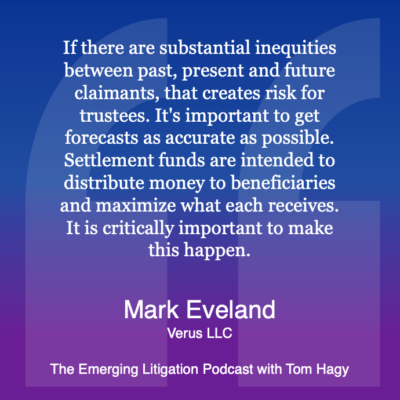
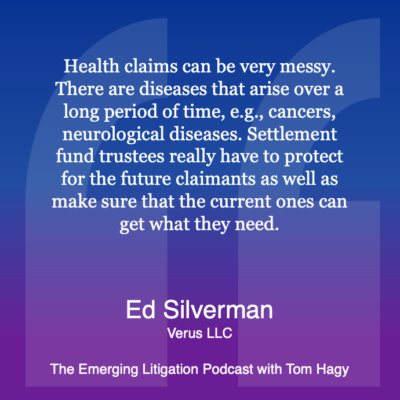
    Listen to my conversation with Mark Eveland and Ed Silverman, both with Verus LLC, which provides litigation support services to law firms working on mass torts, such as case management and medical review services, settlement administration, business and advisory services, and analytics. They explain that liability forecasting is a practice best understood through the three areas it analyzes: (i) the risks and injuries created by a product and its use, (ii) claims filed and approved, and (iii) finances. Liability forecasting is both a science and an art, they say, with plenty of risks.

    Eveland, founder, CSO, and chairman of the board, is an expert in building settlement and claims management programs for mass torts, class actions, and insurance runoffs. Throughout his career, Mark has provided research, discovery, analytics, settlement administration, and expert witness support litigators around the country.

    Trained in molecular biology, genetics and epigenetics, and biochemistry, Silverman is an analytics executive, a life science expert, and biomedical communications specialist. Ed assists with data analytics, scientific collaboration networks, patient based medical claims, and more.

    I hope you enjoy the episode. If so, give us a rating!

    Bonus: I left in a little introductory jazz in the beginning, then  encouraged Ed to discuss his background and research, which I was thrilled to find included how fruit flies (Drosophila melanogaster) form memories. I can’t tell you how glad I was I asked. Yes I can. Very glad.

    This podcast is the audio companion to the Journal on Emerging Issues in Litigation. The Journal is a collaborative project between HB Litigation Conferences and the vLex Fastcaselegal research family, which includes Full Court Press, Law Street Media, and Docket Alarm.

    If you have comments, ideas, or wish to participate, please drop me a note at Editor@LitigationConferences.com.

    Tom Hagy
    Litigation Enthusiast and
    Host of the Emerging Litigation Podcast
    Home Page
    LinkedIn

    Tags

    Emerging Litigation & Risk Compliance Litigation & appeals Cybersecurity Data Privacy Artificial Intelligence (AI) Insurance Companies Risk Management Corporate & Securities Insurance Claims Recovery Regulations Data Breach Toxic Torts Antitrust Legal Tech Product Liability Settlements Trial Personal Injury Privacy Healthcare Per- and Polyfluoroalkyl Substances (PFAS) Data Analytics Arbitration Constitutional Law Climate Change Cannabis Labor Law Insurance Fraud Liability Claims COVID Alternative Dispute Resolution (ADR) Mediation Diversity Equity Inclusion (DEI) Claims management Professional Liability Legal Research & Writing Business Interruption Law Practice Management Trial Skills Property and Casualty Drug Laws Copyright Law Catastrophic Loss

    Mark Eveland

    Mark EvelandFounder, Verus LLC

    Mark is a seasoned executive with over two decades of experience developing and leading strong teams. A visionary, change leader, creative problem solver, and early adopter of technological solutions, he is an expert in building effective settlement and claims management programs for mass torts, class actions, and insurance runoffs. Mark began his career with a large consulting firm, assisting clients involved in asbestos, breast implant, and other large-scale product liability cases.

    Before founding Verus in 2003, he served as operations manager of the largest asbestos claims facility in the country and went on from there to launch a firm that specialized in third party administration of securities fraud class actions. Throughout his career, Mark has had the pleasure of providing research, discovery, analytics, settlement administration and expert witness support to many of the best litigators in the country working to resolve issues with wide-ranging societal effects. Taking a lesson from the strong mentors he has encountered over the years, he and his partners built Verus by hiring intelligent, creative people with a shared commitment to doing impactful work.

    Ed Silverman

    Ed SilvermanAnalytics Manager, Verus LLC

    Ed grew up in Southern California before attending Johns Hopkins University in Baltimore, Maryland, where he received a B.A. in Biology. Following a move back to California, Ed earned a Ph.D. in Molecular Biology at the City of Hope, a leading independent biomedical, treatment, and education center. Ed continued his work at the California Institute of Technology with a post-doctorate fellowship, where he researched the topic of in-memory and related data analysis.

    Although Ed enjoys teaching, he knew he did not want to be a full-time research professor. This motivated him to pursue a career focusing on his interest in applying data science to solving complex problems. Ed worked for Within3 (formerly Voxx) for nine years and helped build insight platforms for life science companies. As Vice President of Analytics and Chief Analytical Officer at Within3, Ed supported clients through innovative analytical tools to segment doctor and patient populations to identify treatment patterns, monitor complications, and orchestrate clinical trials to improve patient outcomes.

    As Analytics Manager at Verus, Ed applies his deep knowledge and experience in data science to improve access to and outcomes of the civil justice system. He brings a unique ability to identify populations exposed to harm, supporting efforts to improve reach to these populations and improve predictive models for estimating damages.

    Want to appear on the Emerging Litigation Podcast?

    Send us your idea! 

  • TVPRA, State Statutes Open Door for Civil Damage Claims by Human-Trafficking Victims

    TVPRA, State Statutes Open Door for Civil Damage Claims by Human-Trafficking Victims

    The Authors

    Coryne Leyendecker

    Coryne Leyendecker Swift, Currie, McGhee & Hiers LLP

    Coryne Leyendecker is an attorney practicing in Swift Currie’s litigation section, defending businesses and insurers against claims related to commercial litigation, sexual abuse, governmental liability, premises liability, automobile litigation and construction law.

    Pamela Lee

    Pamela LeeSwift, Currie, McGhee & Hiers LLP

    Pamela N. Lee is a partner at Swift Currie with more than 15 years of experience practicing in the firm’s litigation section. Pamela devotes her entire practice to litigation, including various tort liability litigation, insurance coverage disputes and the defense of insurance bad faith matters. Her liability practice is wide and varied, encompassing premises liability, product liability, escalator and elevator liability, automobile liability and general personal injury law. She represents companies in the food, automobile and retail industries.

    The Journal on Emerging Issues in Litigation

    Emerging Litigation Podcast

    Emerging Litigation PodcastProduced by HB Litigation and Law Street Media

    Interviews with leading attorneys and other subject matter experts on new twists in the law and how the law is responding to new twists in the world.

    TVPRA, State Statutes Open Door for Civil Damage Claims by Human-Trafficking Victims

    “A plethora of nonprofit organizations and government agencies have collectively produced hundreds of available resources on how to help prevent human trafficking. Overwhelmingly, groups across the board agree that bringing awareness to human trafficking is the most foundational method to stopping human trafficking. By implementing intentional training and internal policies, businesses can not only insulate themselves from third-party claims but they can be a force for good in the fight against human trafficking. “

    Abstract: There is not a person alive with a soul that would believe sex trafficking and other variants of modern slavery is a good thing. The individuals that perpetrate those heinous acts should be punished accordingly. In 2003, Congress opened the door for human-trafficking victims to sue for civil damages under the Trafficking Victims Protection Act of 2000 (TVPRA). Since then the TVPRA and similarly drafted state statutes have allowed for human-trafficking victims to seek civil damages against any party that has benefited from their trafficking. Given this expansive inclusion of third-party liability, more and more businesses, especially those in the hospitality industry, are ultimately the ones left to pay for the criminal acts of human traffickers. This article discusses the evolving litigation around human-trafficking claims, beginning with a broad overview of human trafficking, followed by a discussion of the legal standard behind human-trafficking civil suits and recent guidance from U.S. courts on these types of claims. The article concludes with guidance of its own on how businesses can build a foundation for their own defense while simultaneously helping prevent human-trafficking crimes from ever occurring.

    Download the article now!

    Have an idea for an article?

    If you would like to propose an article for publication in the Journal on Emerging Issues in Litigation please review our specifications and benefits, then send us a summary, outline, or draft. If you also would like to discuss the topic on the Emerging Litigation Podcast, please note that.

  • Does the European Union Commission’s Proposal on AI Liability Act as a Game Changer for Fault-Based Liability Regimes in the EU?

    Does the European Union Commission’s Proposal on AI Liability Act as a Game Changer for Fault-Based Liability Regimes in the EU?

    Guest Writer

    Nils Lölfing

    Nils LölfingBird & Bird LLP

    Does the European Union Commission’s Proposal on AI Liability Act as a Game Changer for Fault-Based Liability Regimes in the EU?

    By Nils Lölfing

    Photo by Christian Lue on Unsplash

    Abstract: In this article, the author discusses increasing risks that artificial intelligence system providers, developers, and users will face from a liability directive proposed by the European Union Commission.

    The AI Liability Directive proposed by the European Union Commission puts additional liability risks on providers, developers and users of specifically high-risk artificial intelligence (AI)  systems. If enacted, it could become a game changer for fault-based liability regimes in the European Union, as it introduces a presumption of causality to prove fault and a right of access to evidence from companies and suppliers regarding high-risk AI systems. This will help victims enforce non-contractual civil law claims for damages caused by an AI system.

    What this is about and how it increases the liability risk exposure of actors in the AI systems supply chain will be discussed in this article.

    Background

    On September 28, 2022, the EU Commission published its  proposal for a Directive to establish new fault-based liability  rules for AI systems (AI Liability Directive), along with a reform for the existing rules on the strict liability of manufacturers for defective products. The current article focuses on the draft AI Liability Directive, which complements the AI Act by facilitating fault-based civil liability claims for damages, which the AI Act as specific product safety Regulation does not offer.

    On June 30, 2021, the EU Commission published an inception impact assessment road map on adapting civil liability rules to the digital age, in particular considering AI (based on the EU Commission’s White Paper on AI of February 19, 2020). With respect to AI in particular, the AI liability proposal is part of the approach by the EU Commission to develop an ecosystem of trust for AI (together with the proposed AI Act and the revised Product Safety and Machinery Directive).

    The proposal addresses the peculiarities tied to AI such as autonomous behavior and limited predictability, when applying fault-based liability rules. According to the EU Commission, the peculiarities of AI create legal uncertainties for businesses and make it difficult for consumers and other injured parties to receive compensation. In fact, in a representative survey of 2021, liability ranked among the top three barriers to the use of AI by European companies that are planning to but have not yet adopted AI.

    These new requirements, such as a presumption of the burden of proof, have the potential to fundamentally change the EU’s liability regime and will increase the exposure to liability risks for businesses who are involved in manufacturing, distributing, or using AI.

    What Is It All About and Why Is It a Potential Game Changer?

    The AI Liability Directive proposal intends to enable consumers and businesses injured by AI-based products like robots, drones, or smart-home systems to claim compensation more easily by way of non-contractual civil law claims for damages caused by such AI systems. The proposal generally covers any type of AI system (although, like the AI Act, it seems to predominantly intend to cover highrisk AI) and obliges providers, developers, and users of AI systems to compensate any type of damage covered by national law (life, health, property, privacy, discrimination, etc.) and for any type of victim (individuals, companies, organizations, etc.). This requires errors made by someone from within the supply chain, such as a provider, developer, or user of an AI system who caused the damages. Because of the peculiarities mentioned in AI systems, it will typically be difficult to prove a wrongful action or omission by a provider, developer, or user of an AI system.

    Therefore, the AI Liability Directive proposal recommends two groundbreaking changes, which will modify common liability rules, as we currently know them across most of the European Union:

    • Presumption of causality to prove fault. The proposed AI Liability Directive establishes a rebuttable presumption of causality, to enable claimants to be able to demonstrate a  causal link between a failure of an AI system (e.g., in the form of flawed output) and any damage caused to the claimant as the individual or business using the AI system. For example, where certain obligations under the AI Act are not complied with, fault of the relevant person that developed, provided, or used the AI system will be presumed. The presumed fault occurs only if it is reasonably likely, from the circumstances in which the damage occurred, that such fault has influenced the output produced by the AI system or the failure of the AI system to produce an output that gave rise to the damage. Such a fault can also be presumed
    by a court of law, on the basis of non-compliance, which would lead to a court order for disclosure or preservation of evidence (detailed in the next point). The presumption of causality generally applies to all AI systems, but in the case of non-high-risk AI systems it only applies where a court determines that it is excessively difficult for the claimant to prove the causal link. If the presumption is triggered, the burden is on the defendant to show that its system is not the cause of the harm suffered.
    • Right to access evidence from companies and suppliers regarding high-risk AI. When claiming damages from a high-risk AI system provider, developer, or user, claimants have disclosure powers and may ask the court to order the disclosure of relevant evidence about specific high-risk AI systems that are suspected of having caused damage. For this to happen, the claimant must make its claim plausible and show to a court that the damages were potentially caused by a high-risk AI system. The right to access evidence will ease the proving of claims and identify non-responsible actors in the supply chain much faster. However, commercially sensitive information (like trade secrets) is still protected. The access right does not pertain to AI systems that are not considered high-risk under the AI Act.

    What Are the Resulting Risks for Providers, Developers, and Users of AI Systems and How to Protect Against Them?

    The proposed AI Liability Directive significantly helps victims that suffered damages through AI systems with the presumption of causality and the right to access evidence, specifically with regard to high-risk AI systems.

    Risks for providers, developers, and users of (specifically highrisk) AI systems are not negligible in this regard. Claims brought by the AI Liability Directive can be very broad and far-reaching, as they include any type of damage covered by national law, and therefore typically also include non-material damages, such as for discrimination or potentially even privacy harms resulting from, for example, ad targeting. With the prospect of mass claims, providers, developers, and users of AI systems may see big obstacles in the future.

    If the proposed AI Liability Directive is enacted, it will be much more difficult for providers, developers, and users of AI to adequately protect themselves against damage claims due to acts or omissions of their AI systems. Nevertheless, providers, developers, and users of AI systems should find strategies to protect themselves
    against the presumption of causality by showing that a fault of their specific AI system could not have caused the damage. Additionally, strategies on how their information can be protected from being disclosed to claimants are sensible to mitigate disproportionate liability risk exposure.

    Outlook

    Specifically, developers of high-risk AI systems will face additional burden going forward. They not only have to comply with the complementary future AI Act, which is likely to put in place a couple of onerous obligations before their AI systems can be brought on the EU market. Under the AI Liability Directive, developers will also have to find strategies to defend themselves against potential claims as another layer of AI-related legal burdens on top of the AI Act.

    However, there is still enough time for providers, developers, and users of AI systems to influence the AI Liability Directive proposal. The European Parliament and the Council will soon start discussing and negotiating the Commission’s proposal. This may still not be the end of the road, at all. For now, the EU Commission has refrained from proposing strict liability regimes for AI systems, although the public consultations have highlighted a preference for such a regime among its respondents (whether with or without insurance).

    However, the EU Commission also highlighted that if AI systems could affect the public at large, namely putting a risk to important legal rights, such as the right to life, health, and property, then such strict liability regime will be reconsidered. To monitor developments, the EU Commission put in place a program to obtain information of incidents involving AI systems.

    With this information the EU Commission intends to assess whether additional measures would be needed, such as introducing a strict liability regime and/or mandatory insurance. This space must be closely watched!


  • Lien Resolution: Government & Private Plans Get Aggressive (Against Attorneys)

    Lien Resolution: Government & Private Plans Get Aggressive (Against Attorneys)

    On-Demand Webinar

    Includes

    • Nearly 75 minutes of insights from experienced professionals.
    • CLE credit: 1+ (subject to bar rules).
    • For CLE questions: CLE@LitigationConference.com
    • The complete Power Point presentation.
    • Continued access to the complete recording for later use.
    • Answers to your questions via email to the presenters or write to HB and we will be sure to contact the speakers.

    KEY POINTS

    • What can you do to settle personal injury suits cleanly and avoid costly litigation and penalties?
    • What recent cases can inform you about protecting your settlements and, as attorneys, yourselves, from post-settlement federal lawsuits?
    • How can your firm set itself up to meet government expectations?
    • What role might experts play in navigating these pitfalls?

    Statutes Discussed

    Medicare Advantage (42 USC § 1395w-22)

    Federal Medical Care Recovery Act (FMCRA) (42 USC § 2651)

    Armed Forces Act (10 USC §1095)

    Veterans’ Benefits (38 USC §1729)

    Third-Party Collection Rules (32 CFR 537.24; 38 CFR 17.101, etc.)

    Set-Asides under the Medicare Secondary Payer Act (42 USC § 1395y(b)(2)]

    On Demand Registration

    Lien Resolution
    Government & Private Plans Get Aggressive (Against Attorneys!)

    On Demand | Recorded September 2020

    It is increasingly common these days. Personal injury attorneys settle a case, only to find themselves sued by a U.S. Attorney for failing to reimburse Medicare for conditional payments as required by the Medicare Secondary Payer Act. In some cases the attorney may be required to pay fines in addition to the reimbursements and interest, a costly proposition. Are you up to speed on issues surrounding Medicare Advantage, TRICARE, veterans’ claims, and Medicare set-asides? Join nationally recognized healthcare lien and resolution expert Franklin P. Solomon and go-to lien resolution provider Brett Newman as they offer a practical, in-depth CLE presentation.

    Franklin P. Solomon, Esq.
    Attorney & Founder, Solomon Law Firm 

    A graduate of Rutgers University School of Law at Camden, Franklin Solomon is based in Cherry Hill, NJ, with a practice focused on evaluation, litigation and resolution of healthcare “liens” and reimbursement claims. Mr. Solomon represents personal injury victims and their attorneys in defending against claims by health plans and government benefits programs seeking payment out of tort recoveries. Among his significant cases in the field, Mr. Solomon argued before the New Jersey Supreme Court in Perreira v. Rediger, 169 N.J. 399 (2001), obtaining a decision which prohibited health insurers’ reimbursement claims against their insureds’ tort recoveries. He was plaintiffs’ counsel in Levine v. United Healthcare, 402 F.3d 156 (3d Cir. 2005), a federal class action challenging reimbursement claims of ERISA-governed health plans. He was also appellate counsel in Wurtz v. The Rawlings Company, 761 F.3d (2d Cir. 2014), a class action challenging New York insurers’ reimbursement claims against their insureds, and was plaintiffs’ counsel in Taransky v. Sebelius, 760 F.3d 307 (3d Cir. 2014), a class action challenging Medicare’s claims for reimbursement out of tort recoveries. More recently Mr. Solomon was appellate counsel in Arnone v. Aetna, 860 F.3d 97 (2d Cir. 2017), a decision which subjected ERISA plan disability insurers to state anti-subrogation law. Prior to opening his own firm, Mr. Solomon’s practice included 20 years of litigating mass tort and individual personal injury claims on behalf of plaintiffs.

    Brett Newman
    Founder, Newman Settlement Services Group

    Brett Newman is known nationally by plaintiff attorneys for his expertise on claims avoidance and reduction. Recognizing the ever-growing nature of lien resolution and the ever-increasing associated liability, Brett established Newman Settlement Services Group to assist both individual claimants of personal injury lawsuits and mass tort claimants in the protection of their proceeds and government benefits. 

  • Charlie Kingdollar on Sexual Abuse Claims

    Charlie Kingdollar on Sexual Abuse Claims

    Charlie Kingdollar on Sexual Abuse Claims and Litigation: Their Impact on the Insurance Industry

    Abstract
    The statistics surrounding childhood sexual abuse and molestation are staggering. Many make headlines such as the cases brought against clergy, athletic coaches, Boy Scout leaders, and actors and movie producers. This article attempts to size the impact of these cases on the insurance industry, and what measures are being taken that will allow more lawsuits to be filed on behalf of victims years after they were abused or molested.

    Author
    Charlie Kingdollar recently retired after 40 years with General Reinsurance Corp., where he was Vice President and Emerging Issues Officer. He is widely considered to be among the best resources for new liability risks, even called by one colleague as a “prescient and gifted industry futurist.” I recommend you follow him on LinkedIn. –Tom Hagy

    About
    The Journal on Emerging Issues in Litigation is a co-production of HB, Fastcase, and Law Street Media. You can also hear the complementary (and complimentary) Emerging Litigation Podcast wherever podcasts appear. For questions, contact Tom Hagy, Editor in Chief, at Editor@LitigationConferences.com.

    Loading Viewer…

  • Vince Vitkowsky on Insurance Coverage for Civil Unrest

    Vince Vitkowsky on Insurance Coverage for Civil Unrest

    Civil unrest. Peaceful protests. Massive marches. Riots. Looting.  Which of these things are not like the other? Recent social outrage over police shootings of Black people — these events in particular — have sent people to the streets by hundreds of thousands. In some cases these constitutionally protected activities are followed by property damage, injury and death. Observers continue to debate who is responsible for the violence.  Whatever the answer, as a very practical matter, someone has to pay for the property damage.

    Join me for my conversation with Vince Vitkowsky of Gfeller Laurie LLP.  Vince  possesses deep knowledge of insurance coverage matters, representing carriers in a variety of areas, e.g. cyber risk, data privacy, general liability, directors and officers liability, health, and more. He combines his experience as a veteran insurance and reinsurance lawyer with a strong background in terrorism and national security law.

    This podcast is the audio companion to the Journal on Emerging Issues in Litigation, a collaborative project between HB Litigation Conferences and the Fastcase legal research family, which includes Full Court Press, Law Street Media, Docket Alarm and, most recently, Judicata. If you have comments or wish to participate in one our projects, or want to tell me how insightful and informative Vince is , please drop me a note at Editor@LitigationConferences.com.
    I hope you enjoy the interview, and how deftly we obscured the fact that Vince lives in New York City.

    Safeguarding Against Financial Exploitation

    An on-demand CLE-eligible webinar Safeguarding Against Financial Exploitation   America’s senior population is growing. Nearly one in five U.S. residents will be 65 or older in 2030. Which means the average age of U.S. investors is climbing too. With that comes the risk that they will be exploited by people with access – or gain access through nefarious methods – to their investment portfolio. Seniors and vulnerable persons lose billions of dollars each year. Remarkably, 90% of the people to take advantage of senior investors are members of their own family. Attorneys who represent senior clients need to know the signs of vulnerability, red flags that their clients are being exploited, what laws apply, and rules lawyers must follow in these matters.   Questions our speakers answer: What is senior / vulnerable investor exploitation?   Who is protected by state and federal laws?   How prevalent is senior financial exploitation? What do the numbers tell us?  What is the pace of financial abuse SAR filings by securities firms?  What are the most popular scams?   What is diminished capacity?  What are the red flags indicating possible exploitation?  What are the laws, rules, and regulations governing law firms?  What are some best practices for law firms?  How can firms best protect their senior clients?   On Demand CLE Webinar What You Get PowerPoint and supplemental materials. Complete recording for later review. Answers to your questions via email. Invitation to contact speakers. 1.5 CLE credits (for licensed attorneys). CLE assistance.* *Subject to state bar rules. For licensed attorneys.  Register Meet the Speakers Joseph Calabrese Bressler, Amery & Ross, P.C. A 1991 Graduate of St. John’s University Law School, Mr. Calabrese brings 30 years of practice and 18 years of Securities Litigation/Regulatory experience to his role as principal in the New York office of  Bressler, Amery & Ross’s Financial Institutions Group. He began his career as a Wall Street litigator as an associate general counsel for Citigroup’s Smith Barney and […]

    Lien Resolution: Government & Private Plans Get Aggressive (Against Attorneys)

    Includes Nearly 75 minutes of insights from experienced professionals. CLE credit: 1+ (subject to bar rules). For CLE questions: CLE@LitigationConference.com The complete Power Point presentation. Continued access to the complete recording for later use. Answers to your questions via email to the presenters or write to HB and we will be sure to contact the speakers. What can you do to settle personal injury suits cleanly and avoid costly litigation and penalties? What recent cases can inform you about protecting your settlements and, as attorneys, yourselves, from post-settlement federal lawsuits? How can your firm set itself up to meet government expectations? What role might experts play in navigating these pitfalls? Medicare Advantage (42 USC § 1395w-22) Federal Medical Care Recovery Act (FMCRA) (42 USC § 2651) Armed Forces Act (10 USC §1095) Veterans’ Benefits (38 USC §1729) Third-Party Collection Rules (32 CFR 537.24; 38 CFR 17.101, etc.) Set-Asides under the Medicare Secondary Payer Act (42 USC § 1395y(b)(2)] On Demand Registration Lien Resolution Government & Private Plans Get Aggressive (Against Attorneys!) On Demand | Recorded September 2020 It is increasingly common these days. Personal injury attorneys settle a case, only to find themselves sued by a U.S. Attorney for failing to reimburse Medicare for conditional payments as required by the Medicare Secondary Payer Act. In some cases the attorney may be required to pay fines in addition to the reimbursements and interest, a costly proposition. Are you up to speed on issues surrounding Medicare Advantage, TRICARE, veterans’ claims, and Medicare set-asides? Join nationally recognized healthcare lien and resolution expert Franklin P. Solomon and go-to lien resolution provider Brett Newman as they offer a practical, in-depth CLE presentation. Franklin P. Solomon, Esq. Attorney & Founder, Solomon Law Firm  A graduate of Rutgers University School of Law at Camden, Franklin Solomon is based in Cherry Hill, NJ, with a practice focused on evaluation, litigation and resolution of healthcare “liens” and reimbursement claims. Mr. Solomon represents personal injury victims and their attorneys […]

    Telepsychiatry: Mitigating the Risks

    REGISTER Registration Includes Nearly 90 minutes of insights from experienced professionals. CLE credit: 1+ (subject to bar rules). For CLE questions: CLE@LitigationConference.com The complete Power Point presentation. Continued access to the complete recording for later use. Answers to your questions via email to the presenters or write to HB and we will be sure to contact the speakers. Understand the risks associated with telepsychiatry and how to manage them.  Telemedicine has emerged as an important solution for healthcare in general and psychiatric medicine specifically during the current global pandemic. Remote access for sub-practices including addiction counseling have been commonly used. Our panel of psychiatric professionals who have served as expert witnesses and attorneys who counsel and represent physicians have prepared a 90-minute session to share insights with attorneys, physicians, healthcare providers, risk professionals, and more. Agenda Examining procedures and best practices that exist for ensuring confidentiality in a telemedicine practice How do you draft a telepsychiatric consent form? What is the emerging standard of care for telemedicine? Will the standard of care for telemedicine become a national standard? (Should it?) Review the case law addressing telemedicine or telepsychiatry How do the HIPAA regulations and HITECH privacy laws impact telemedicine? How have the HIPAA regulations and HITECH privacy laws been relaxed during the pandemic? Will the relaxed HIPAA and HITECH regulations impacting telemedicine continue past the pandemic? Which technical platforms are preferred? Which ones to avoid? Panelists Mark Levy, M.D., Medical Director at fpamed David Kan, M.D., UCSF Psychiatry Department and the California Society for Substance Abuse Medicine Ayesha Ashai, M.D., associated with fpamed Stephen M. Fatum, J.D., Partner, Barnes & Thornburg LLP Angela W. Russell, J.D., Partner, Wilson Elser Moskowitz Edelman & Dicker LLP Meet our physician and attorney panelists. Mark Levy MD Medical Director fpamed Dr. Levy is a graduate of Columbia College (A.B. 1967) and the Columbia University College of Physicians and Surgeons (M.D. 1971) in New York. He is a Physician […]

    The Commercial Drone Industry: Privacy, Security, Threats, and Mitigation of Risk

    HB presents a CLE-eligible webinar Now on-demand at the West LegalEdcenter THE COMMERCIAL DRONE INDUSTRY Privacy, Security, Threats, and Mitigation of Risk Drones have become an increasingly valuable tool for businesses of all types and sizes. Drones are already being used in many applications, but more will certainly arise as the technology advances. This means that certain risks, like cyber threats, will also continue to present themselves. Protecting the transmission and storage of data collected through drones is critical. Unfortunately, security usually comes as an afterthought. The drone industry is part of the aviation industry, which, based on its knowledge, keeps safety as a number one concern. Part of that safety is having proper protection for your systems, including security as a fundamental design principle. Take this webinar to gain insights on the topics listed below, and shared by an attorney who practices on the cutting-edge of this evolving technology. Topics: Defining drones. Current and future applications. FAA Modernization and Reform Act of 2012. FAA Part 107 Regulations and waivers. Resources, e.g. the FAA Drone Zone and LAANC Portal. Penalties for violations. Privacy implications. Drones as weapons. Vulnerability to cyber attacks. Take it now! What you get: 1+ CLE credits (subject to bar rules). Insights from an experienced professional who specializes in this area of the law. The complete PowerPoint presentation. Continued access to the complete recording for later use. Answers to your questions. Fee: No additional charge to subscribers to the West LegalEdcenter. Non-subscribers may take the course for $170. Meet the Speaker Kathryn Rattigan Robinson & Cole LLP Kathryn Rattigan is a member of the firm’s Business Litigation Group and Data Privacy + Cybersecurity Team. She advises clients on data privacy and security, cybersecurity, and compliance with related state and federal laws. She assists clients in assessing risks related to technology and software contracts, as well as with compliance-related issues with outsourcing and […]

    The Intersection of Privacy and Antitrust Webinar Now Available On-Demand on the West LegalEdcenter

    Available as part of your subscription to The Thomson Reuters West LegalEdcenter®. Don’t subscribe to the West LegalEdcenter? This webinar is still available directly from HB. Take it now! Questions for speakers Questions@LitigationConferences.com CLE questions CLE@LitigationConferences.com Check out the MoginRubin blog for more insights on antitrust and privacy law. What attorneys and companies need to know about the increasing interplay between these critical areas of the law.  Highly publicized cases and investigations in the U.S. and Europe of big technology, e-commerce, and social media companies demonstrate how anti-competition laws are being used to scrutinize and challenge not only how these corporations conduct themselves in the marketplace, but the very core of their colossal success: the mass collection and utilization of user data. Are the privacy and antitrust worlds beginning to cross over? Or do they simply run parallel while addressing entirely different types of conduct? Whatever the answer, data is the raw material that drives the likes of Google, Facebook, Apple and Amazon, so how it is handled is a critical question when counseling clients on mergers and acquisitions. Moderator Daniel J.  Mogin | Managing Partner, MoginRubin LLP Speakers Jennifer M. Oliver, CIPP/US | Partner, MoginRubin LLP Thomas N. Dahdouh | Director, Western Region, Federal Trade Commission Franklin M. Rubinstein | Partner, Wilson Sonsini Goodrich & Rosati Randi W. Singer, CIPP/US, CIPT | Partner, Weil, Gotshal & Manges Contributor Dina Srinivasan | Independent Researcher & Author of The Antitrust Case Against Facebook Dina was unable to present but we thank her for her content contributions.  Agenda Who should regulate privacy violations in the U.S.? Which antitrust issues implicate privacy concerns? What role does machine learning play on the competitive landscape? What is big data really? How is it different from “data”? What are the elements of effective merger reviews? What are the appropriate remedies? What are “notice-and-choice” versus “harms-based” approaches? Plus answers to your questions. Send them to Questions@LitigationConferences.com.