Tag: Professional Liability

  • Government Involvement in Medical Decisions During Outbreaks with Bryce McColskey and Sandra Cianflone

    Government Involvement in Medical Decisions During Outbreaks with Bryce McColskey and Sandra Cianflone

    Government Involvement in Medical Decisions During Outbreaks 

    It’s apparently (and hopefully) on its last legs. The Covid-19 pandemic was the most recent health issue to raise questions around government’s involvement (or interference) in an individual’s control over their own medical treatment.

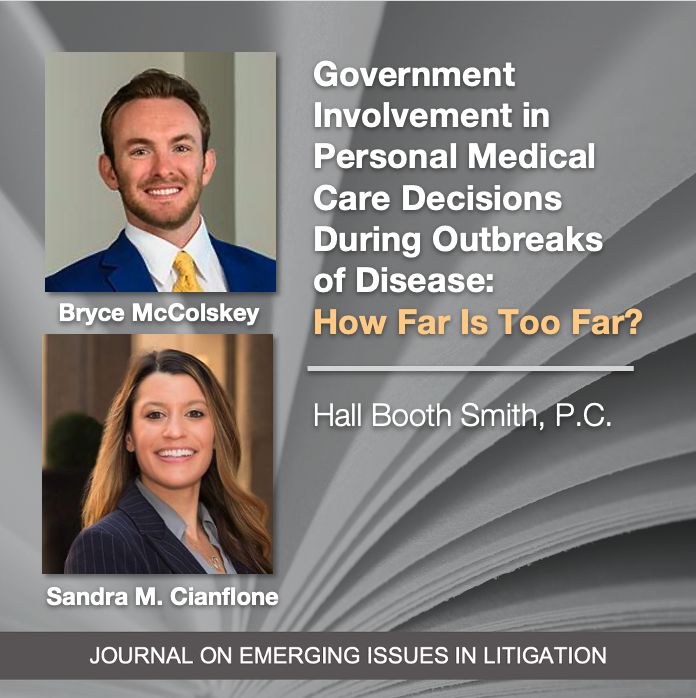
    In their article – Government Involvement in Medical Care Decisions During Outbreaks of Disease: How Far is Too Far? – our guests wrote about the intersection of law and medicine. They reviewed medical mandates, implications brought about by the impact of advances in science and medicine, and where role of government to protect public health intersects (or collides) with personal healthcare choices. They focused is on governmental responses to the pandemic, that is, what the government can mandate in the spirit of public health, and not on the separate issue of abortion, which is a “choice” subject for another day.

    How much authority do government agencies or even the courts have over a person’s healthcare decisions? People often assume the practice of medicine and the enactment and enforcement of laws are separate and independent enterprises; that they remain fixed in their respective corners. However, they wrote, after a deeper  dive  into  history and precedent, it’s evident that the tension between individual rights and health-related mandates has existed for some time.

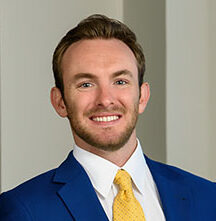
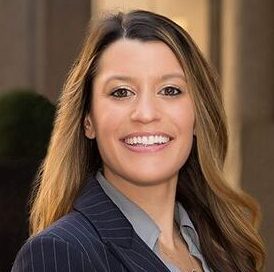
    Listen to my interview with the authors, Bryce McCloskey and  Sandra M. Cianflone with Hall Booth Smith, P.C. Bryce is based in Jacksonville, Fla., where he focuses on medical malpractice and professional liability law. Sandie is a partner in the firm’s Atlanta office where she concentrates on a variety of aspects of healthcare defense She chairs the firm’s Coronavirus Task Force and is a member of the firm’s National Trial Counsel team. She is also a valued member of the Editorial Board of Advisors of the Journal on Emerging Issues in Litigation.

    ***********

    This podcast is the audio companion to the Journal on Emerging Issues in Litigation. The Journal is a collaborative project between HB Litigation Conferences and the Fastcase legal research family, which includes Full Court Press, Law Street Media, and Docket Alarm. The podcast itself is a joint effort between HB and our friends at Law Street Media. If you have comments or wish to participate in one our projects please drop me a note at Editor@LitigationConferences.com.

    Tom Hagy

    (actual size)

    Tom Hagy
    Litigation Enthusiast and
    Host of the Emerging Litigation Podcast
    Home Page
    LinkedIn

    Bryce McColskey

    Bryce McColskeyHall Booth Smith P.C.

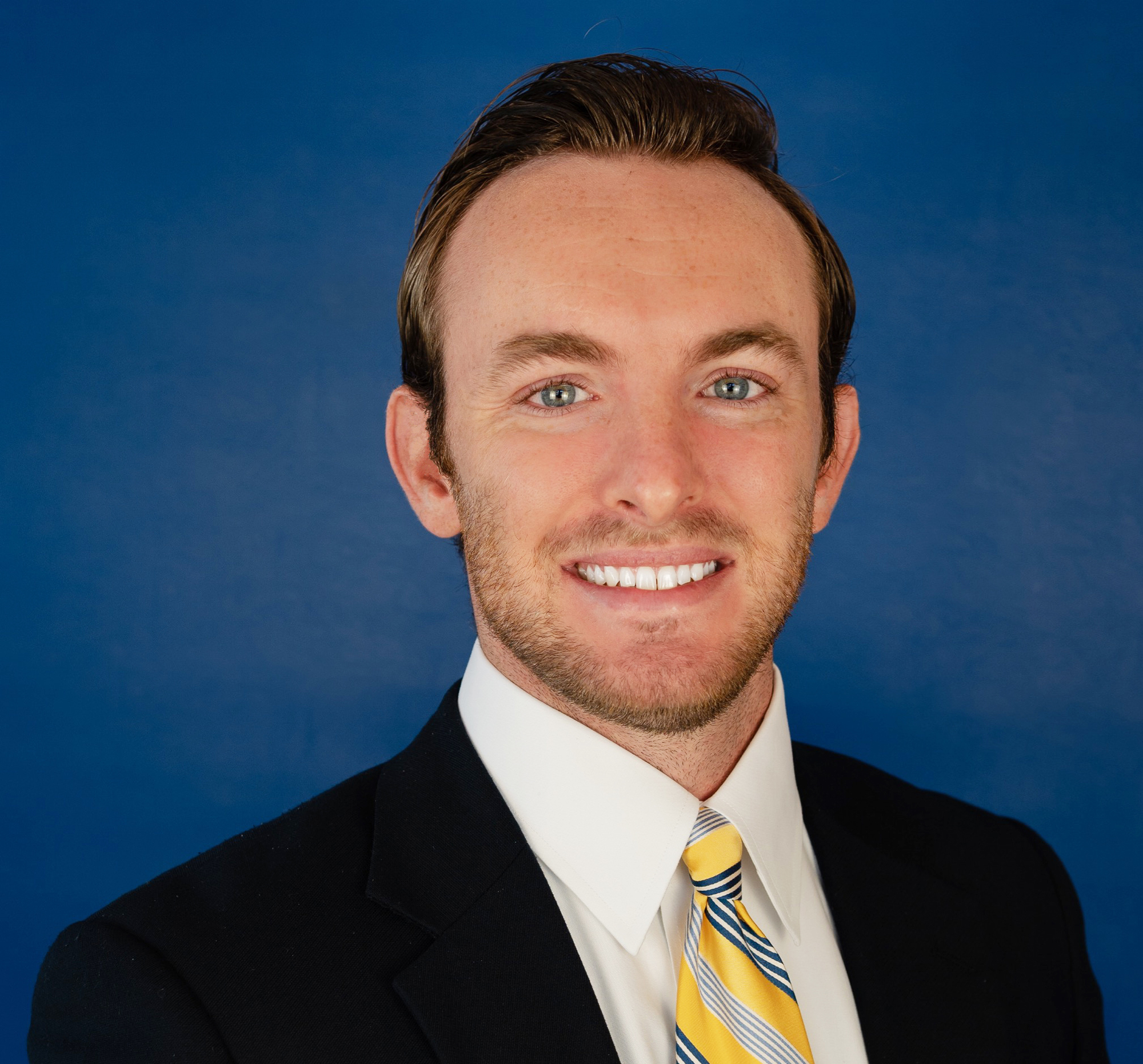
    Bryce McColskey focuses his practice on medical malpractice, professional liability, and general liability matters.

    Prior to joining Hall Booth Smith, Bryce was an Associate with another firm in Jacksonville where he focused his practice on workers’ compensation defense. Earlier in his career, he worked as a summer clerk for the University of North Florida’s Office of General Counsel and a local firm in Jacksonville.

    Bryce earned a Juris Doctorate from the University of Florida Levin College of Law where he was a member of the University of Florida Association of Law and Business and the Chester Bedell Inn of Court. Bryce earned his Bachelor of Science degree in Business Administration from the University of North Florida.

    Sandra Cianflone

    Sandra CianfloneHall Booth Smith P.C.

    Sandra Cianflone is a Partner in the Atlanta office of Hall Booth Smith. Her practice primarily focuses on medical malpractice on defending hospitals, healthcare institutions, physicians, nurses and institutional employees in medical malpractice actions from inception through trial. She is part of Hall Booth Smith’s National Trial Counsel team and has litigated cases across the country.

    Sandra also provides national risk management and crisis management services across the healthcare industry. These services have guided clients through tumultuous regulatory and statutory schemes by providing efficient approaches which assist with public/community relations, litigation preparation, defense alternatives, and effective case management. Ms. Cianflone is also the Chair of our Coronavirus Taskforce.

    Sandra received her Juris Doctorate from Pace University School of Law and her undergraduate degree from Fairleigh Dickinson University.

  • Government Involvement in Personal Medical Care Decisions During Outbreaks of Disease: How Far Is Too Far? by Bryce McColskey and Sandra M. Cianflone

    Government Involvement in Personal Medical Care Decisions During Outbreaks of Disease: How Far Is Too Far? by Bryce McColskey and Sandra M. Cianflone

    The Authors

    Bryce McColskey

    Bryce McColskeyHall Booth Smith

    Bryce McColskey (bmccolskey@hallboothsmith.com) is an attorney with Hall Booth Smith, P.C., based in Jacksonville, Florida, where he focuses on medical malpractice and professional liability law.

    Sandra Cianflone

    Sandra CianfloneHall Booth Smith

    Sandra M. Cianflone (scianflone@hallboothsmith.com) is a partner in the Atlanta office of Hall Booth Smith, where she concentrates on a variety of aspects of healthcare defense and chairs the firm’s Coronavirus Task Force. She is also a member of the Editorial Board of Advisors of the Journal of Emerging Issues in Litigation.

    The Journal on Emerging Issues in Litigation

    Emerging Litigation Podcast

    Emerging Litigation PodcastProduced by HB Litigation and Law Street Media

    Interviews with leading attorneys and other subject matter experts on new twists in the law and how the law is responding to new twists in the world.

    Government Involvement in Personal Medical Care Decisions During Outbreaks of Disease: 

    How Far Is Too Far?

    “Breakthroughs in technologies, our knowledge of diseases and mutations, and advances in treatment options have been remarkable and have drastically reduced fatality rates from disease outbreaks. However, regardless of medical achievements, rapid changes in any field open the door to renewed debates over different laws and individual rights.”

    Abstract: The coronavirus pandemic is the latest health issue to raise the question of government’s involvement (or interference) with an individual’s control over their own healthcare and medical treatment. In this article, the authors, two health care and professional liability attorneys, discuss the intersection of law and medicine with a review of medical mandates, the impact of advances in science and medicine, and where role of government to protect public health intersects (or collides) with personal healthcare choices. Their focus is on governmental response to the coronavirus pandemic, and not the recent landmark case dealing with choice. But add to the equation the Supreme Court’s ruling on abortion in Dobbs v. Jackson Women’s Health, the “government as healthcare decision maker” is an issue that will be on the front burner for courts, policymakers, healthcare providers, patients, and attorneys for years to come.

    How much authority do government agencies or even the judiciary have over the healthcare decisions of individuals? This question has been hotly contested in recent years, specifically with the emergence of COVID-19. Individuals often assume the practice of medicine and the enactment and enforcement of laws are separate and independent enterprises; that they remain fixed in their respective corners.

    However, when we dive deeper into this issue and look at history and precedent, it is evident that the rights of individuals versus mandates of government in respect to healthcare has been going on for some time, and will continue for years to come.

    Download the article now!

  • Insurance Coverage for Digital Assets: Mitigating Losses in Cryptocurrency and Non‐Fungible Token Markets by Scott DeVries, Jessica Cohen-Nowak and Adriana Perez of Hunton Andrews Kurth

    Insurance Coverage for Digital Assets: Mitigating Losses in Cryptocurrency and Non‐Fungible Token Markets by Scott DeVries, Jessica Cohen-Nowak and Adriana Perez of Hunton Andrews Kurth

    Journal on Emerging Issues in LitigationCompanies and individuals are riding the ups and downs of cryptocurrency and NFTs—with losses and swings in the billions of dollars—but digital assets are not going away.

    Abstract: The risk of loss in certain categories may be mitigated by insurance, whether provided by tailored policies and/or under policies designed specifically for digital asset owners. Those with exposure to the digital asset sector should be attuned to the emerging marketplace for such insurance products. While it is early days for NFT-specific coverage, the rise of cryptocurrency has created a substantial marketplace for crypto coverage. Insurers are becoming increasingly able to model and assess risk, so more products are coming to market. That said, digital asset holders need to be able to select coverage that best suits their needs. In this article, the authors discuss the history and status of coverage for digital assets to assist readers in exploring how they might use insurance to mitigate risk in this emerging and rocky sector of global finance.

    “Over the course of a decade, the marketplace for cryptocurrency has increased from zero to an estimated $250 billion. However, only $6 billion in insurance coverage is currently available. It would be a gross understatement to say that there is a truly remarkable imbalance between market value and insurance capacity.”

    Introduction

    Crypto markets are experiencing the greatest crash in their history to date.  The value of a Bitcoin (BTC) has plummeted 70% from its peak and Ethereum (ETH) has fallen 77%.  Since last November, the value of cryptocurrency tokens has lost $2 billion in value. As noted financial publication Barron’s put it: “Crypto is having a ‘Lehman moment,’ a shattering of confidence triggered by plunging asset prices, liquidity freezing up, and billions of dollars wiped out in a few scary weeks.” Cryptocurrency companies are halting withdrawals and transfers, platforms are seizing up, and regulators are circling.

    Nor has the devastation been limited to the coins themselves.  Non-fungible token (NFT) sales have reduced by 90% since September 2021.  The New York Times reported that Opensea.io (OpenSea) an NFT marketplace that receives 2.5% share of the proceeds for each NFT sale, has been plagued by “a surge of plagiarism, as sellers convert traditional artwork into NFTs and then list the images for sale without compensating the original creator.”  For example, DeviantArt, an artist collective that scans OpenSea for copyright infringement of the work of its artists, found 290,000 instances of unauthorized NFTs copying its artists’ works. While infringing listings can be deleted in response to take down requests filed by the artist, buyers of counterfeit NFTs are rarely given a refund.

    Against this backdrop, the issue of whether there may be claims associated with cryptocurrency and NFTs is far from a theoretical or esoteric thought exercise.  It is very real.  And when there are claims, businesses and investors doubtless will look to their insurers.

    A business or home is devastated by a wildfire.  Property insurance is available up to limits.  A home is broken into, and art and jewelry are stolen.  Crime/specie insurance is available.

    But what about new age assets?  What about cryptocurrency?  What about NFTs?  These obviously are not immune from theft by hackers.  In 2021, hackers stole at least $3.2 billion in cryptocurrency with schemes short of outright theft accounting for another $7.8 billion. In the first four months of 2022, NFT hacks accounted for $52 million in losses, an almost eight-fold increase from 2021.

    There typically is a significant time lag between the development of a product and the availability of product-specific insurance.  This general proposition applies with equal force here.  Over the course of a decade, the marketplace for cryptocurrency has increased from zero to an estimated $250 billion.  However, only $6 billion in insurance coverage is currently available.  It would be a gross understatement to say that there is a truly remarkable imbalance between market value and insurance capacity.

    Although NFTs have been around for the better part of a decade, it was only during the last two years that the marketplace has grown to upwards of $41 billion. In addition to its newness, NFTs pose additional risks for insurers, including questions of ownership, authenticity and the valuation of a truly “unique” asset.  Consequently, availability of insurance coverage for NFTs is even further behind.

    Given the rapid rate at which the digital asset field is developing, and claims are emerging, and the insurance industry’s attempts to specifically address coverage for these losses and claims, anything written on this topic will, at least in part, be outdated by the time it is published.  The objective of this article is to educate the reader on the history and status of the field, enabling them to ask the questions they need to ask, and to procure the coverage they need if available now or in coming months. 

    Download the article now!

    Insurance Coverage for Digital Assets:

    Mitigating Losses in Crypto and NFT Markets

    Scott DeVries

    Scott DeVriesHunton Andrews Kurth

    Scott DeVries (sdevries@huntonak.com) is Special Counsel at Hunton Andrews Kurth and long-time insurance coverage attorney for policyholders in a range of complex disputes as well as mass torts, class action, product liability, and complex business litigation.

    Jessica Cohen-Nowak

    Jessica Cohen-NowakHunton Andrews Kurth

    Jessica Cohen-Nowak (jcohen-nowak@huntonak.com) is an associate in Hunton Andrew Kurth LLP’s Intellectual Property group in the firm’s New York office. Jessica focuses her counseling and litigation practice on intellectual property matters in the fashion, fitness, entertainment, hospitality, and gaming industries as well as in technology and digital assets.

    Adriana Perez

    Adriana PerezHunton Andrews Kurth

    Adriana Perez (pereza@huntonak.com) is an associate in the firm’s Miami office where she focuses on insurance, reinsurance, and other business litigation.

  • Lien Resolution: Government & Private Plans Get Aggressive (Against Attorneys)

    Lien Resolution: Government & Private Plans Get Aggressive (Against Attorneys)

    On-Demand Webinar

    Includes

    • Nearly 75 minutes of insights from experienced professionals.
    • CLE credit: 1+ (subject to bar rules).
    • For CLE questions: CLE@LitigationConference.com
    • The complete Power Point presentation.
    • Continued access to the complete recording for later use.
    • Answers to your questions via email to the presenters or write to HB and we will be sure to contact the speakers.

    KEY POINTS

    • What can you do to settle personal injury suits cleanly and avoid costly litigation and penalties?
    • What recent cases can inform you about protecting your settlements and, as attorneys, yourselves, from post-settlement federal lawsuits?
    • How can your firm set itself up to meet government expectations?
    • What role might experts play in navigating these pitfalls?

    Statutes Discussed

    Medicare Advantage (42 USC § 1395w-22)

    Federal Medical Care Recovery Act (FMCRA) (42 USC § 2651)

    Armed Forces Act (10 USC §1095)

    Veterans’ Benefits (38 USC §1729)

    Third-Party Collection Rules (32 CFR 537.24; 38 CFR 17.101, etc.)

    Set-Asides under the Medicare Secondary Payer Act (42 USC § 1395y(b)(2)]

    On Demand Registration

    Lien Resolution
    Government & Private Plans Get Aggressive (Against Attorneys!)

    On Demand | Recorded September 2020

    It is increasingly common these days. Personal injury attorneys settle a case, only to find themselves sued by a U.S. Attorney for failing to reimburse Medicare for conditional payments as required by the Medicare Secondary Payer Act. In some cases the attorney may be required to pay fines in addition to the reimbursements and interest, a costly proposition. Are you up to speed on issues surrounding Medicare Advantage, TRICARE, veterans’ claims, and Medicare set-asides? Join nationally recognized healthcare lien and resolution expert Franklin P. Solomon and go-to lien resolution provider Brett Newman as they offer a practical, in-depth CLE presentation.

    Franklin P. Solomon, Esq.
    Attorney & Founder, Solomon Law Firm 

    A graduate of Rutgers University School of Law at Camden, Franklin Solomon is based in Cherry Hill, NJ, with a practice focused on evaluation, litigation and resolution of healthcare “liens” and reimbursement claims. Mr. Solomon represents personal injury victims and their attorneys in defending against claims by health plans and government benefits programs seeking payment out of tort recoveries. Among his significant cases in the field, Mr. Solomon argued before the New Jersey Supreme Court in Perreira v. Rediger, 169 N.J. 399 (2001), obtaining a decision which prohibited health insurers’ reimbursement claims against their insureds’ tort recoveries. He was plaintiffs’ counsel in Levine v. United Healthcare, 402 F.3d 156 (3d Cir. 2005), a federal class action challenging reimbursement claims of ERISA-governed health plans. He was also appellate counsel in Wurtz v. The Rawlings Company, 761 F.3d (2d Cir. 2014), a class action challenging New York insurers’ reimbursement claims against their insureds, and was plaintiffs’ counsel in Taransky v. Sebelius, 760 F.3d 307 (3d Cir. 2014), a class action challenging Medicare’s claims for reimbursement out of tort recoveries. More recently Mr. Solomon was appellate counsel in Arnone v. Aetna, 860 F.3d 97 (2d Cir. 2017), a decision which subjected ERISA plan disability insurers to state anti-subrogation law. Prior to opening his own firm, Mr. Solomon’s practice included 20 years of litigating mass tort and individual personal injury claims on behalf of plaintiffs.

    Brett Newman
    Founder, Newman Settlement Services Group

    Brett Newman is known nationally by plaintiff attorneys for his expertise on claims avoidance and reduction. Recognizing the ever-growing nature of lien resolution and the ever-increasing associated liability, Brett established Newman Settlement Services Group to assist both individual claimants of personal injury lawsuits and mass tort claimants in the protection of their proceeds and government benefits. 

  • Telepsychiatry: Mitigating the Risks

    Telepsychiatry: Mitigating the Risks

    REGISTER

    Registration Includes

    • Nearly 90 minutes of insights from experienced professionals.
    • CLE credit: 1+ (subject to bar rules).
    • For CLE questions: CLE@LitigationConference.com
    • The complete Power Point presentation.
    • Continued access to the complete recording for later use.
    • Answers to your questions via email to the presenters or write to HB and we will be sure to contact the speakers.

    Understand the risks associated with telepsychiatry and how to manage them. 

    Telemedicine has emerged as an important solution for healthcare in general and psychiatric medicine specifically during the current global pandemic. Remote access for sub-practices including addiction counseling have been commonly used. Our panel of psychiatric professionals who have served as expert witnesses and attorneys who counsel and represent physicians have prepared a 90-minute session to share insights with attorneys, physicians, healthcare providers, risk professionals, and more.

    Agenda

    • Examining procedures and best practices that exist for ensuring confidentiality in a telemedicine practice
    • How do you draft a telepsychiatric consent form?
    • What is the emerging standard of care for telemedicine?
    • Will the standard of care for telemedicine become a national standard? (Should it?)
    • Review the case law addressing telemedicine or telepsychiatry
    • How do the HIPAA regulations and HITECH privacy laws impact telemedicine?
    • How have the HIPAA regulations and HITECH privacy laws been relaxed during the pandemic?
    • Will the relaxed HIPAA and HITECH regulations impacting telemedicine continue past the pandemic?
    • Which technical platforms are preferred? Which ones to avoid?

    Panelists

    • Mark Levy, M.D., Medical Director at fpamed
    • David Kan, M.D., UCSF Psychiatry Department and the California Society for Substance Abuse Medicine
    • Ayesha Ashai, M.D., associated with fpamed
    • Stephen M. Fatum, J.D., Partner, Barnes & Thornburg LLP
    • Angela W. Russell, J.D., Partner, Wilson Elser Moskowitz Edelman & Dicker LLP

    Meet our physician and attorney panelists.

    Mark Levy MD
    Medical Director
    fpamed

    Dr. Levy is a graduate of Columbia College (A.B. 1967) and the Columbia University College of Physicians and Surgeons (M.D. 1971) in New York. He is a Physician and Surgeon licensed since 1972 by the State of California and the State of Hawaii since 2004.

    He is certified in Adult Psychiatry (1981) and Forensic Psychiatry (1999, 2009) by the American Board of Psychiatry and Neurology. In the past he has served as a Qualified Medical Examiner (“QME”) for the State of California (active status 1993-96, currently “inactive”). He is also a Psychoanalyst and a graduate of the San Francisco Psychoanalytic Institute.

    He is Assistant Clinical Professor, Psychiatry, School of Medicine, University of California, San Francisco where has been on the faculty since 1977 and , among other teaching activities, he lectures in the Law and Psychiatry Fellowship. He is also on the Faculty of the San Francisco Psychoanalytic Institute and is the Founder and former Chairman and President of the San Francisco Foundation for Psychoanalysis, a community service outreach organization.

    In January 2006 Dr. Levy established Forensic Psychiatric Associates Medical Corporation (fpamed.com) of which he is the medical director. In addition to consulting on a broad range of civil (and criminal) matters in which there are behavioral questions to be addressed by a forensic psychiatric expert, fpamed as a group specializes in assessing psychological injury claims of populations of litigants in mass tort or multi-plaintiff litigation.

    Mark Levy founded fpamed in 2006.

    More about Dr. Levy here …

    David Kan MD
    UCSF Psychiatry Dept. &
    Calif. Society for Substance Abuse Medicine

    Dr. Kan graduated from Northwestern University Medical School. He finished his General Psychiatry Residency and Forensic Psychiatry Fellowship at the University of California, San Francisco (UCSF). He is Board-certified by the American Board of Psychiatry and Neurology in General and Forensic Psychiatry and he is Board-Certified by the American Board of Addiction Medicine in Addiction Medicine. He is a member of the faculty at the UCSF Department of Psychiatry.

    Dr. Kan enjoys teaching, in addition to his direct work with patients. He has won multiple awards for teaching and clinical care delivery. Dr. Kan teaches and supervises psychiatrists-in-training in his role as faculty member at UCSF. Throughout the year, he speaks at professional conferences on topics including treatment of addictive disorder.

    Dr. Kan offers forensic consulting services to courts and attorneys in civil, criminal, and administrative matters. He has testified in multiple states, counties and federal court as an expert witness. He is a member of the American Academy of Psychiatry and the Law.

    Dr. Kan is an active member of the California Society of Addiction Medicine (CSAM). CSAM is a physician organization dedicated to improving the treatment of substance use disorders. Dr. Kan has planned conferences and spoken to many physician and non-physician groups. Dr. Kan is the current President of CSAM. Dr. Kan is a Distinguished Fellow of the American Society of Addiction Medicine (D.F.A.S.A.M.).  Dr. Kan has testified numerous times before the California Assembly and Senate on addiction treatment. Dr. Kan has testified before Congress advocating for expanding access to addiction treatment.

    More about Dr. Kan here …

    Ayesha Ashai MD
    Associated with
    fpamed

    Dr. Ayesha Ashai received her BA in Psychology and Spanish from University of Michigan in Ann Arbor. She went on to attend medical school at Wright State University Boonshoft School of Medicine in Dayton, Ohio. She completed her adult psychiatry residency at University of Maryland and Sheppard Enoch Pratt Hospital in Baltimore, Maryland, where she later served as the executive chief resident. After, she completed her forensic psychiatry fellowship under the leadership of Dr. Charles Scott at University of California, Davis in Sacramento, California.

    She is certified by the American Board of Psychiatry and Neurology in Psychiatry with added qualifications in Forensic Psychiatry. She has years of experience in the diagnosis and treatment of a broad range of psychiatric disorders in various settings including civil and forensic hospitals, emergency rooms, outpatient clinics, and jails.  She has specialized experience in working with patients who are Muslim, those with an Indian or Pakistani background, as well as Hispanic patients. She is licensed to practice medicine in California, Ohio, Pennsylvania, Illinois and Texas.

    Currently, Dr. Ashai works as a telepsychiatrist in two outpatient mental health clinics in Ohio and Illinois. She also provides treatment for offenders incarcerated at the Winnebago County Jail and offenders with a serious mental illness that are released from incarceration as part of a therapeutic intervention program. In 2013, she was awarded the Dr. George U. Balis Award for Excellence in Medical Student Education for her work with medical students. She will soon be joining University of Illinois- Chicago as a volunteer clinical faculty member.

    Dr. Ashai has been an independent contractor with fpamed since 2020.

    More about Ayesha Ashai M.D. here …

    Stephen M. Fatum
    Partner
    Barnes & Thornburg LLP

    Stephen Fatum advises on healthcare industry-related matters for physicians, physician organizations and nonprofit entities. Stephen’s decade of in-house experience for large organizations helps him counsel clients about practical strategies to achieve their goals. His style of negotiation relies upon listening, understanding, respect, identifying common ground, appealing to collective self-interests, collaboration and creativity.

    Stephen has counseled senior management and members of the boards of directors of medical groups, associations, hospitals, and health systems regarding governance structures, bylaws, operating agreements, mergers and acquisitions, reimbursement, compensation plans, joint ventures and federal and state regulatory compliance. Notably, Stephen is the former general counsel of Advocate Medical Group, S.C., which at the time was a multispecialty medical group of 270 physicians practicing in the suburbs of Chicago. Before holding this position, he served as general counsel of the Lutheran General Medical Group, S.C. He also acted as assistant general counsel of Lutheran General HealthSystem when it combined with another health system to form Advocate Health Care.

    Having worked in-house as general counsel for healthcare organizations and volunteered for five years as the board chair of a large mental health agency, Stephen has worked closely with board chairs, CEOs, COOs, CFOs, CSOs, CMOs, and numerous other chief executives. He understands the business perspective and multidimensional challenges and financial pressures facing physicians and executives who lead health systems, medical groups, not for profit organizations and physician organizations.

    Read more about Stephen Fatum here …

    On Demand Registration
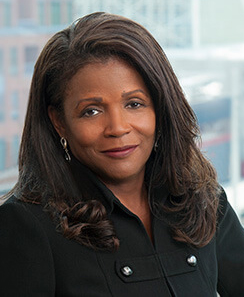
    Angela Russell Telepsychiatry Standards & Practices COVID 19

    Angela W. Russell
    Partner
    Wilson Elser Moskowitz Edelman & Dicker LLP

    Angela Russell is the regional managing partner of the Baltimore office and chair of the firm’s Diversity Committee. She has significant trial experience and has tried cases in the District of Columbia and across the state of Maryland. Her practice encompasses the defense of professional liability matters, including medical malpractice and legal malpractice actions in addition to claims against agents, brokers and other professionals. Angela regularly handles and supervises general casualty matters for insurers and self-insured entities on premises liability claims, security matters, hospitality cases and recreational defense claims. Angela is also frequently called on to handle toxic tort matters.

    Angela possesses an innate ability to connect with her clients, identify their needs and communicate effectively throughout the litigation cycle. Her rapport in the courtroom is equally impressive. An aggressive litigator, Angela is adept at tapping the persistence, preparation and training she gained early on in a variety of public speaking engagements and tackling two marathons. Angela worked at prominent defense firms in Minnesota and Washington, DC, prior to joining Wilson Elser.

    Professional Distinctions
    Angela is the former co-chairperson of the Civil Jury Instructions Committee for the Bar Association for the District of Columbia as well as a former adjunct professor at William Mitchell College of Law in St. Paul, MN.

    Read more about Angela Russell here …
  • Attorney Fees and Settlement Funds with Sam Dolce

    Attorney Fees and Settlement Funds with Sam Dolce

    Our Guest

    Sam Dolce

    Sam DolceAttorney

    As an attorney at Milestone, Sam Dolce provides in-depth, comprehensive consultations with attorneys about qualified settlement funds, fee deferral, and settlement planning. He also oversees the establishment of QSFs.

    Sam received a Bachelor of Arts in History from Macalester College, followed by a Juris Doctor from SUNY Buffalo Law School. He served as a participant in the New York State Pro Bono Scholar Program and has received multiple acknowledgements and awards for his dedication to pro bono service and social justice. As a subject matter expert, Sam is a regular speaker and presenter at academic and legal conferences regarding post-settlement strategies.

    Attorney Fees and Settlement Funds with Sam Dolce

    Uncle Sam has created a way for you keep more of your hard-won settlement or award, but there is much to consider and new information to weigh.

    When a contingency fee case reaches a verdict or settlement, it’s a big day for a plaintiff attorney. You have worked hard and shouldered litigation costs — often for years without compensation — to achieve the best outcome for your client.

    In this episode I get to speak with a financial management professional who specializes in advising trial attorneys how they can take full advantage of attorney fee structures. The concept of fee deferral arrangements may be familiar to you, but the landscape continues to evolve.

    My guest is Sam Dolce, an attorney with Milestone, a financial firm that optimizes settlement funds for trial attorneys and plaintiffs.  Sam consults with legal professionals about about Qualified Settlement Funds, fee deferrals, and settlement planning. Sam received his B.A. from Macalester College and his J.D. from SUNY Buffalo Law School. Thanks to Sam for sharing his insights.

    On a previous episode you can hear Sam’s colleague, Erin Waas, who heads up the Milestone Foundation, a non-profit organization that provides low-cost funding to injured individuals in need of cash as their personal injury cases wind their way through court.

    This podcast is the audio companion to the Journal on Emerging Issues in Litigation. The Journal is a collaborative project between HB Litigation Conferences and the Fastcase legal research family, which includes Full Court Press, Law Street Media, and Docket Alarm. The podcast itself is a joint effort between HB and our friends at Law Street Media. If you have comments or wish to participate in one our projects please drop me a note at Editor@LitigationConferences.com.

  • Overconfidence: A Risky but Pervasive Phenomenon in Litigated Disputes

    Overconfidence: A Risky but Pervasive Phenomenon in Litigated Disputes

    The Author

    Jeff Trueman

    Jeff TruemanMediator / Arbitrator

    Jeff Trueman (jt@jefftrueman.com) is an experienced, full-time mediator and arbitrator. He helps parties resolve a wide variety of litigated and pre-suit disputes and interpersonal problems concerning catastrophic injuries, wrongful death, professional malpractice, employment, business dissolution, real property, and domestic relations. Jeff is a past Director of Dispute Resolution for the Circuit Court for Baltimore City where he oversaw over 70 retired judges and senior attorneys conducting over 1,500 mediations, settlement conferences, and neutral evaluations per year. He is a Distinguished Fellow of the International Academy of Mediators, an invitation-only membership organization consisting of some of the most successful commercial mediators in the world.

    The Journal on Emerging Issues in Litigation

    Emerging Litigation Podcast

    Emerging Litigation PodcastProduced by HB Litigation and Law Street Media

    Interviews with leading attorneys and other subject matter experts on new twists in the law and how the law is responding to new twists in the world.

    Overconfidence: A Risky but Pervasive Phenomenon in Litigated Disputes

    “Lady Justice symbolizes fairness and impartiality as she oversees the adjudication process. Although she may hold the scales of justice in one hand, she also carries a large sword in her other hand. And she’s blindfolded. Knowing that, how confident should you be?” 

    Abstract: “Overconfidence” may have negative connotations, but it can be beneficial in competitive situations like litigation where parties compete for resources. Nonetheless, posturing and overconfidence of opposing parties and counsel are common frustrations felt by lawyers and claims professionals. Most litigants fail to see themselves as overconfident even though that can result in miscalculations and erroneous risk assessments. Litigants can employ techniques to improve decision making but sometimes going to trial is considered the right decision for reasons that are considered more important than whether the result is better than the last settlement demand or offer. In addition to focusing on legal and financial threats that are external to themselves, litigants might also consider threats of their own making; namely, how they think about risk amid uncertainty. Download the complete article for more insights from the author. 

    Download the article now!

  • The Shifting Gun Liability Landscape: Plaintiffs Say Companies are Marketing Illegally, Insurers End Up Paying

    The Shifting Gun Liability Landscape: Plaintiffs Say Companies are Marketing Illegally, Insurers End Up Paying

    The Author

    Charlie Kingdollar

    Charlie KingdollarInsurance Industry Expert

    Charlie spent more than four decades with General Reinsurance, three-quarters of which as the company’s Emerging Issues Officer. One colleague described him as “one of the most prescient and gifted industry futurists I have met in my 36 year professional career within the insurance industry. Entertaining and insightful, his ability to digest and communicate complex issues, many before they are readily apparent, is both a gift and a talent.” Charlie is also a member of the Editorial Board of Advisors for the Journal on Emerging Issues in Litigation.

    The Shifting Gun Liability Landscape: Plaintiffs Say Companies are Marketing Illegally, Insurers End Up Paying

    By Charlie Kingdollar

    On Feb. 15, 2022, Remington Arms, manufacturer of the Bushmaster AR15-style rifle agreed to pay $73 million to settle a lawsuit filed by the families of nine of the victims of the Dec. 14, 2012, Sandy Hook Elementary School shooting. The $73 million will be paid by four of Remington’s insurers (and likely their reinsurers).[i]

    Why is this a big deal? Insurers and reinsurers providing liability coverage for gun manufacturers did so believing that federal law protected gun manufacturers from liability arising from shootings under the federal Protection of Lawful Commerce in Arms Act (PLCAA). It seems likely that policy terms and conditions as well as pricing of the risk reflected that perceived liability protection.

    Things have changed. The Connecticut plaintiffs filed their suit under the Connecticut Fair Trade Practices Act. The plaintiffs alleged that the Bushmaster was a combat weapon and that Remington improperly marketed it to civilians – particularly trying to reach young men. In 2019, the Connecticut Supreme Court ruled that the federal PLCAA did have some carve-outs for state laws and subsequently declined Remington’s request to dismiss the lawsuit. It seems a safe bet that the families of other Connecticut gun violence victims will file similar suits over past and/or future incidents.

    Okay, so this is Connecticut. But it seems likely that this lawsuit will be used as a template by plaintiffs in other states that have similar statutes – and many do. This lawsuit and settlement could result in burgeoning litigation against gun manufacturers.

    Presumably, even a single victim shot with a Bushmaster, or any gun that could be argued is a combat weapon, could file a similar suit under a state’s Fair Trade Practices Act.

    Which other guns could be deemed “combat weapons” and therefore unfit for civilian populations? Only time and future litigation will tell. One possible example is the WEE1 Tactical, the manufacturer of the AR-15, which is similar to the Bushmaster, may find itself facing litigation. A look at AR-15-style guns on Wikipedia results in a list of 27 guns by 26 manufacturers – and I doubt this is a comprehensive list.[ii] Would a machine pistol be considered a “combat weapon”? How many other types of firearms might be deemed “combat weapons”?

    WEE1 Tactical has recently begun advertising the JR-15 – a smaller, lighter version of the AR-15 that fires smaller .22 caliber rounds for use by children. WEE1’s website states: “The JR-15 is the first in a line of shooting platforms that will safely help adults introduce children to the shooting sports.”[iii] Given that the plaintiffs in the Sandy hook case stressed the firm was specifically marketing the Bushmaster to young men it will be interesting to see how this marketing strategy will play out in any future similar litigation.

    There’s been another crack in the perceived liability protection afforded to gun manufacturers in the U.S.  Last year the State of New York enacted a law that “would classify the illegal or improper marketing or sale of guns as a nuisance…that supporters said would bolster litigation against gun companies.”[iv]

    Will other states follow? If even a few enact similar statutes, the defense and indemnity costs could be significant to the gun manufacturers and their insurers and reinsurers.

    Bushmaster has settled once before with the families of victims shot by one of its guns. In 2004, the company agreed to pay $2.5 million to settle with the families of victims shot by the D.C. sniper.[v] Not much changed after that settlement. It may be different this time.

    What about other entities in the gun liability chain? If the gun manufacturer can be held libel for marketing a combat weapon to civilians, can wholesalers and retailers also be found liable?  Could courts find that these companies also played a role in putting “combat weapons” into the hands of civilians?  If so, the costs to the Property/Casualty insurance industry will be greater.

    Unfortunately, mass shootings and gun violence are on the rise in the United States. The number of mass shootings (defined as 4 or more people shot – killed or wounded) have increased every year except one from 2014 to 2021. In 2014 there were 269 mass shootings in the U.S.  By 2021, this increased to 691 mass shootings. There have been 2,402 mass shootings in the U.S. in the past five years. And we’ve only mentioned mass shootings incidents.[vi]

    Gun violence generally continues to rise. “Guns were involved in 75% of all homicides and 91% of homicides involving youths between 2018 and 2019 … those new numbers represent a significant and troubling uptick from a decade before.”[vii]

    I suspect insurers and reinsurers providing liability for companies that manufacture and sell guns find themselves as defendants in an increasing number of lawsuits.

    [i] https://www.washingtonpost.com/nation/2022/02/15/remington-sandy-hook-settlement/

    [ii] https://en.wikipedia.org/wiki/AR-15_style_rifle

    [iii] https://en.wikipedia.org/wiki/AR-15_style_rifle

    [iv] https://www.nytimes.com/2022/02/15/nyregion/sandy-hook-families-settlement.html?referringSource=articleShare

    [v] https://www.washingtonpost.com/nation/2022/02/15/remington-sandy-hook-settlement/

    [vi]   https://www.gunviolencearchive.org/

    [vii]   “Gun Deaths Continue to Rise In American Cities,” U.S. News, 1/10/22

  • The New Lloyd’s Market Association War, Cyber War and Cyber Operation Exclusions for Cyber Insurance Policies | By Vincent J. Vitkowsky | Gfeller Laurie LLP

    The New Lloyd’s Market Association War, Cyber War and Cyber Operation Exclusions for Cyber Insurance Policies | By Vincent J. Vitkowsky | Gfeller Laurie LLP

    The Author

    Vincent J. Vitkowsky

    Vincent J. VitkowskyPartner | Gfeller Laurie LLP

    Vince Vitkowsky is a partner in Gfeller Laurie LLP, resident in New York. He focuses on cyber risks, liabilities, insurance, and litigation. Vince assists insurers and reinsurers in product development, and in all aspects of coverage evaluation and dispute resolution in many lines of business, including cyber, CGL, property, and professional liability. He also assists in complex claim evaluations, and if necessary, the defense of insureds in complex matters.

    Vince is also a member of the Editorial Advisory Board for the Journal on Emerging Issues in Litigation.

    Contact: vvitkowsky@gllawgroup.com

    More from Vince and his colleagues.

    Melicent Thompson

    The New LMA War, Cyber War and Cyber Operation Exclusions for Cyber Insurance Policies

    By Vincent J. Vitkowsky

    On November 25, 2021, the Lloyd’s Market Association released four War, Cyber War and Cyber Operation Exclusions (“Exclusions”). The LMA Cyber Business Panel spent well over two years drafting the Exclusions, which are models for use in standalone cyber insurance policies.  Lloyd’s has agreed that they meet the requirement that all insurance and reinsurance policies written at Lloyd’s must, except in very limited circumstances, contain a clause which excludes all losses caused by war.  The Exclusions address some difficult issues troubling the cyber insurance market for several years, following cyberattacks by nation-states (“states”) and threat actors associated with them.  They attempt to reduce uncertainty for both insurers and policyholders.

    Five interrelated issues.

    • The treatment of collateral damage (borrowing a concept from the traditional Law of Armed Conflict). Some state-sponsored attacks had significant effects on many entities that were not the intended targets.
    • How attribution is to be determined, and whether the insurers have an obligation to make payments while attribution is being determined.
    • The extent to which attacks by non-state actors associated with a state are excluded.
    • The treatment of state and state-sponsored cyberattacks directed at essential services, most notably those disrupting financial institutions and the financial markets infrastructure.
    • As in war exclusions in all lines of business, attempting to limit the aggregation risk.

    The Exclusions.

    The principal innovations in the Exclusions are to introduce the concept of “cyber operation” to insurance, to set processes for determining attribution, to partially clarify the scope of essential service, and to set a structure that de facto mitigates the aggregation risk.

    The key concepts and terms are as follows.

    War.  All four Exclusions contain an identical definition of War, largely based on traditional insurance policy language dating back to the Spanish Civil War.  It is “the use of physical force by a state against another state, or as part of a civil war, rebellion, revolution, insurrection, and/or military or usurped power or confiscation or nationalisation or requisition or destruction or damage to property by or under the order of any government or public or local authority, whether war be declared or not.”  (Emphasis is added, throughout this note.)  In the context of cyber war, this would include a cyberattack with kinetic effects.

    Cyber operation.  All four Exclusions also have an identical and innovative definition of cyber operation.  It is “the use of a computer system by or on behalf of a state to disrupt, deny, degrade, manipulate or destroy information in a computer system of or in another state.”

    Attribution.  All four Exclusions also contain an identical and innovative provision on “Attribution of a cyber operation to a state.”  It provides that the “primary but not exclusive factor” in attribution “shall be whether the government of the state (including its intelligence and security services) in which the computer system affected by the cyber operation is physically located attributes the cyber operation to another state or those acting on its behalf.”  Pending attribution by a state, “the insurer may rely upon an inference which is objectively reasonable as to attribution,” and no loss shall be paid.  If the affected state “takes an unreasonable length of time to, or does not, or declares it is unable to attribute the cyber operation to another state or those acting on its behalf,” the insurer, bearing the burden of proof, must “prove attribution by reference to such other evidence as is available.”

    Specified States.  This term appears in some of the Exclusions.  The specified states are China, France, Germany, Japan, Russia, UK or USA.

    The four exclusions treat cyber operations differently.

    The first Exclusion simply provides a blanket denial of coverage for loss “directly or indirectly occasioned by, happening through or in consequence of war or a cyber operation.”

    The other three Exclusions deny coverage for loss “directly or indirectly occasioned by, happening through or in consequence of war or a cyber operation that is carried out in the course of war.”

    The second Exclusion has additional provisions denying coverage for “retaliatory cyber operations between any specified states; and/or a cyber operation that has a major detrimental impact on the functioning of a state due to the direct or indirect effect of the cyber operation on the availability, integrity, or delivery of an essential service in that state; and/or the security or defense of a state.”  Although these are excluded, the policy may grant coverage for “any other cyber operations,” with a separately negotiated limit and aggregate.

    Significantly, essential service is defined as “a service that is essential for the maintenance or vital functions of a state including without limitation: financial institutions and associated financial market infrastructure, health services or utility services.”

    The third Exclusion is identical to the second, except it does not grant coverage for “any other cyber operations,” i.e., those not carried out in the course of war, retaliatory cyber operations between specified states, or those having a major detrimental impact.

    The fourth Exclusion is identical to the third, except it introduces the concept of “impacted state,” defined as “any state where a cyber operation has had a major detrimental impact on the functioning of that state [as defined in the third Exclusion], and/or security or defense of that state.”  Moreover, it limits the Exclusion for retaliatory cyber operations to those “leading to two or more specified states becoming impacted states.”  It also provides an exception to the Exclusion for loss from a cyber operation that has a major detrimental impact, so the Exclusion “shall not apply to the direct or indirect effect of a cyber operation on a bystanding cyber asset.”  That term is defined as “a computer system used by an insured or its third party service providers that is not physically located in an impacted state but is affected by a cyber operation.”

    The complete Exclusions can be found here.

    A serious attempt to reduce uncertainty.

    These Exclusions are not perfect.  Nothing is.  There is scope for dispute about the terms “an inference which is objectively reasonable,” “reference to such other evidence as is available,” “major detrimental impact,” and “essential service,” among others, as applied to specific facts.  But the Exclusions reflect a well-reasoned, serious attempt to reduce some of the uncertainties over the scope of coverage for state and state-sponsored attacks.

    Written Dec. 9, 2021 and posted with permission with minor formatting changes. Copyright 2021 by Vincent J. Vitkowsky.  All rights reserved.

  • Podcast: Charlie Kingdollar on Social Disparagement

    Podcast: Charlie Kingdollar on Social Disparagement

    HBLC · HBPC Charlie Kingdollar Social Disparagement – 10:8:20, 7.57 PM

    Charlie Kingdollar

    Charlie KingdollarEmerging Issues Professional

    Charlie Kingdollar spent more than four decades with General Reinsurance, three-quarters of which as the company’s Emerging Issues Officer. One colleague described him as “one of the most prescient and gifted industry futurists I have met in my 36 year professional career within the insurance industry. Entertaining and insightful, his ability to digest and communicate complex issues, many before they are readily apparent, is both a gift and a talent.” Follow him on LinkedIn.

    Charlie Kingdollar on Social Media Disparagement

    Are the risks posed by social media — which has added jet fuel to one person’s ability to smear another — adequately addressed by the insurance market?

    It was my pleasure to interview Charlie for our first emerging issues podcast. It’s based on his article on social disparagement which will be featured in the inaugural issue of the Journal on Emerging Issues in Litigation (JEIL), which will release in January 2021. JEIL is a collaborative project between HB and the Fastcase legal research family, which includes Full Court Press, Law Street Media, Docket Alarm and, most recently, Judicata. If you have comments or wish to participate in one our projects, or want to tell me how awesome Charlie is, drop me a note at Question@LitigationConferences.com.

    We hope you enjoy the interview.

    Tom Hagy
    Founder & Managing Director
    HB Litigation Conferences

    Download Charlie’s article as a preview of the Journal of Emerging Issues in Litigation.

    Journal on Emerging Issues in Litigation