Category: Complex Business Litigation

  • Right to Try Act: Commentary Roundup


    A Life Saver, Political Grandstand, or Harmful Scam?

    Depends on Who You Ask. And When.
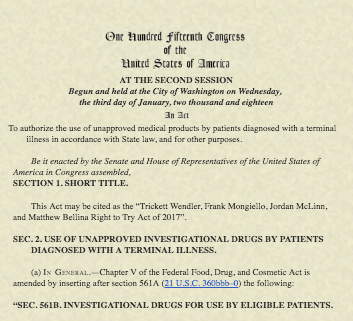
    It’s been two months since President Donald J. Trump signed into law the Right to Try Act which allows terminally ill patients access to experimental drugs not yet approved by the FDA. Like many things in America in 2018, opinions on the efficacy of this new law vary along party or ideological lines. Will it give hope and precious life-extending solutions for patients fighting terminal disease? Or is it a money-driven scheme intended to enrich corporations and the super rich? Signed into law on May 24, 2018, is it something that can be implemented effectively? Here are a few quotes that explain the controversy.

    Additional commentary or insights welcome.
    Send yours to Editor@LitigationConferences.com.

    “Timely access to promising treatments in … devastating circumstances.”

    “This new law amends the Federal Food, Drug, and Cosmetic Act to establish a new pathway aimed at increasing access to unapproved, investigational treatments for patients diagnosed with life-threatening diseases or conditions who have exhausted approved treatment options and who are unable to participate in a clinical trial. Our implementation of the Right to Try Act will build on our long-standing efforts to help patients and families who are facing life-threatening diseases or conditions, in a way that seeks to protect their autonomy, their safety, and the safety of others following in their paths.”

    “The decisions we reach related to products that can serve as an effective treatment for a terminal illness, or that can arrest a devastating and debilitating condition, are among the most important and carefully considered judgments that we make. We recognize the important balance between making sure patients have the assurances Congress intends, while enabling timely access to promising treatments in these devastating circumstances. And we’ll implement this new law consistent with these longstanding values.”

    FDA Commissioner Scott Gottlieb

    “GOP senator reveals the truth: Right-to-try bill was a scam tailored to harm public health”

    “Anyone with a smidgen of knowledge about healthcare understood that the right-to-try legislation signed by President Trump on Wednesday was a scam, perpetrated by the Koch brothers and their henchmen.”

    “Masquerading as a “compassionate” measure aimed at providing victims of terminal diseases with a last bit of hope that an experimental treatment might save them, it really was aimed at undermining the authority of the Food and Drug Administration to make sure our drugs are safe and effective.”

    Read the full article in the Los Angeles Times.

    “We remain skeptical about whether right-to-try statutes actually help anyone …

    … as opposed to being political grandstanding.  That said, from the perspective of attorneys representing pharmaceutical companies, this bill is about as good as it could be, and – to the extent that it extends preemption to the compassionate use program – it even marginally improves current law.”

    Read the full commentary written by James M. Beck of Reed Smith on the Drug & Device Law Blog. 

    Note: Beck’s commentary was written in March 2018.

    “Very little change for most patients …”

    “Despite these state gains and the policy’s growing popularity among states, ethical questions remain about the tangible impact of a federal right to try law on Americans with terminal illnesses. Most notably, a growing body of evidence from policy analysts argues that the legislation would unfortunately accomplish very little change for most patients, and it could actually make it harder to get new drugs approved in the future.”

    Written for CBS.com by Morten Wendelbo, a lecturer at the Bush School of Government and Public Service and a research fellow at the Scowcroft Institute of International Affairs at Texas A&M University, and Timothy Callaghan, assistant professor at Texas A&M University Health Science Center. Read the complete commentary. 


    Additional commentary or insights welcome.

    Send yours to Editor@LitigationConferences.com.

    This controversial topic will be on the agenda at the Drug & Device Defense Forum in New York Oct. 15, 2018.

  • Crowell & Moring on Insurance for Autonomous Vehicles Accidents

    “As responsibility for accidents shifts away from drivers and towards the companies that design, manufacture, and maintain autonomous vehicles, the pool of companies potentially liable for accidents will deepen.Companies need to consider potential liability risk when designing autonomous vehicle-related systems and partnering with other companies.”

    Another good piece from the team Crowell & Moring LLP 

  • Crowell & Moring on D&O Corporate Liability for Cyber Claims

    “Although many commentators have noted the potential exposure for cyber claims in the form of shareholder actions under D&O coverage, little attention has been given to the risks of cyber exposure under Side C [D&O corporate liability] coverage,” write Laura A. Foggan and Thomas Kinney of Crowell & Moring LLP. “D&O policies contain many exclusions and coverage limitations that should protect against undue, unintended expansion of such policies to encompass cyber risks. However, as this case illustrates, courts may not always agree that those coverage limitations fully address cyber breach exposures.”

  • CBD: Confusing Regulations May Soon Find at Least Some Clarity — But Proceed With Caution

    By Tom Hagy
    July 16, 2018

    Proponents say the medical benefits are many and magnificent.

    You can feel better without feeling stoned.  While that will be disappointing to some, people enduring a variety of ailments may find relief, proponents and some studies say. From inflammation to pain to anxiety. From arthritis to alcoholism to diabetes. From psychoses to seizures. Cannabidiol may cure what ails you. And in many cases the science is there, even studies sponsored by the government, say the folks at Project CBD.

    While the regulations vary from state to state, and the definitions can be confusing, clarity is coming for at least the hemp-derived variety of products – as opposed to its sister cannabis plant, marijuana – with the likely passage of Senate Majority Leader Mitch McConnell’s Hemp Farm Bill. The measure is also noteworthy because it has drawn rare bipartisan support.

    CBD can be found in just about anything, from skin care products to pain medications to anti-seizure drugs—even beer. Companies, including large retailers, like Target, have tried to sell or are selling products containing CBD online or across state lines.

    While small compared to the marijuana industry, CBD is on a serious growth trajectory.

    “Spending on legal cannabis worldwide is expected to hit $57 billion by 2027,” according to an article at Forbes.com, written by Thomas Pellechia, citing the research of Arcview Market Research and BDS Analytics. “The largest group of cannabis buyers will be in North America, going from $9.2 billion in 2017 to $47.3 billion a decade later.”

    In a release from MarketNewsUpdates.com, “A new report by cannabis/legal marijuana market analysts firm Hemp Business Journal projects that the U.S. CBD market will grow to $2.1 billion by 2020, an astronomical jump in value compared to last year’s CBD market of $202 million. As the market continues to swell, it is expected the space will reach the billion-dollar status as product diversification and global demand drive revenue levels. One of the major drivers for the CBD market is the growing list of health benefits of CBD oil.”

    Proceed with Caution

    In his post for the Canna Law Blog – a must-follow for any attorney or company interested in the legal aspects of cannabis – attorney Daniel Shortt of Harris Bricken tells businesses they must know the rules.

    “It is no secret that CBD is having a moment right now. Unlike its cousin tetrahydrocannabinol (THC), which is another cannabinoid found in the cannabis plant, CBD is not psychoactive. It has been growing in popularity for years for medical and other applications, but has really taken off lately.”

    Shortt offered five questions businesses must ask before diving in. Here is a truncated version of that list:

    1. What is the source of the CBD? Is it coming from a licensed source? Is it derived from industrial hemp?

    2. What do the lab tests say? You must be sure the products do not contain THC (or more than .3%).

    3. Where is the CBD going to be sold? State laws vary and if you violate them you could face criminal sanctions. Read more here: https://www.cannalawblog.com/industrial-hemp-dont-forget-about-state-law/

    4. What claims are you making about CBD? Are you claiming the product treats disease? You don’t want to make health claims or allow others to make them via testimonials on your website, for example.

    5. Has the law changed? You must keep up with federal and state laws.

    Read more.

    Writing for the online news service CBD Origin, Aaron Cadena echoes Shortt’s first point, saying legality of CBD has to do with its origin. Does it come from hemp or does it come from marijuana?  “[B]oth are members of the cannabis family,” Cadena writes, “so they do share a lot of characteristics. There is, however, a crucial difference between the two–the amount of psychoactive THC each plant produces …. In other words, marijuana can get you really high, while hemp has such a low amount of THC, that it would be impossible to get high off it.”

    “Botanically speaking, there’s not a shred of difference between the two plants: Both are cannabis Sativa under the Linnean definition*,” writes Chris Roberts for Leafly.com. “Legally speaking, the two do indeed have a binary difference: One is federally legal, and the other is not.” (* Named for Swedish botanist Carolus Linnaeus or his modern system of botany and zoology. Who knew.)

    It is because of these psychoactive differences that CBD taken from hemp – with no such effects – is legal almost everywhere in the U.S., while the legality of marijuana-derived products is a mixed bag.

    Cadena’s article includes a survey of the various state laws regulating both forms of CBD. Read the full article to see which 46 states have legalized CBD with a prescription, the 17 that have specific legislation for THC levels and which conditions it’s to be used for, and the 29 states that have fully legalized medical use of both forms of CBD.

    ProCon.org offered another survey, current as of May 8, 2018, providing summaries of the law in each state. The organization commented that “we do not consider passing a CBD-specific law to be the equivalent of making medical marijuana legal because these laws do not recognize the use of marijuana plant for medical purposes.” (For their survey of medical marijuana states, go here: https://medicalmarijuana.procon.org/view.resource.php?resourceID=000881.)

    The Hoosiers Take the Lead

    Right now, Indiana has “the most robust regulations of hemp-derived CBD products.”  In his post for the Canna Law Blog, Shortt wrote that, as of March 21, 2018, the state allows the distribution and retail sale of “low-THC hemp extract,” defined as a product “(1) derived from Cannabis sativa L. that meets the definition of industrial hemp; (2) that contains not more than 0.3% delta-9-THC (including precursors); and (3) that contains no other controlled substances.”

    This is interesting, Shortt says, because it shows that Indiana is officially aware of CBD products and decided to allow their sale. “The catch is that those sales are restricted to a certain class of CBD products, and they are heavily regulated,” he says.

    The list of labeling requirements will be a challenge for companies distributing across state lines. Some will not be selling in Indiana and others will comply, Shortt predicts.

    “Indiana is unique in the sense that it allows CBD and also regulates its sale so robustly. Let’s hope for more positive cannabis developments in the Hoosier State,” Shortt writes.

    Shortly after the Ninth Circuit’s CBD ruling, on May 22, 2018, the DEA issued an internal directive regarding products derived from cannabis but are not marijuana. They referenced an earlier Ninth Circuit ruling from 2004 which enjoined the DEA from enforcing certain THC regulations  (See Hemp Industries Ass’n v. DEA, 357 F.3d 1012 (9th Cir. 2004)).”

    Responding to various inquires, the DEA issued the following to agency personnel:  

    “Products and materials that are made from the cannabis plant and which fall outside the CSA definition of marijuana (such as sterilized seeds, oil or cake made from the seeds, and mature stalks) are not controlled under the CSA. Such products may accordingly be sold and otherwise distributed throughout the United States without restriction under the CSA or its implementing regulations. The mere presence of cannabinoids is not itself dispositive as to whether a substance is within the scope of the CSA; the dispositive question is whether the substance falls within the CSA definition of marijuana.”

    “[A]ny product that the U.S. Customs and Border Protection determines to be made from the cannabis plant but which falls outside the CSA definition of marijuana may be imported into the United States without restriction under the Controlled Substances Import and Export Act. The same considerations apply to exports of such products from the United States, provided further that it is lawful to import such products under the laws of the country of destination.”

    The DEA explained, though, that its statements regarding the drug code for marijuana extract and regarding resin remain the same. “[T]he drug code for marijuana extract extends no further than the CSA does, and it thus does not apply to materials outside the CSA definition of marijuana.”

    Mona Zhang, writing for Forbes.com, said there are CBD producers who source their hemp from cultivators that operate under the Farm Bill. “But given how widespread these products are, it’s unlikely that all of them were sourced from research hemp. And state laws on CBD and hemp vary widely. Colorado, which legalized adult-use marijuana in 2012, has a robust industrial hemp program and is home to the first U.S.-bred certified hemp seed. But in Massachusetts, where you can now grow marijuana at home, it’s still a crime to grow hemp without a state license …”

    If only someone would do something at the federal level.

    Clarity on the Horizon?

    Harris Bricken attorney Shortt notes that U.S. Senate Majority Leader Mitch McConnell – in an attempt to settle the CBD matter – introduced a bill to legalize hemp on the federal level, an initiative that is getting rare bipartisan support: the Hemp Farming Act of 2018 or S.2667.

    Shortt said that, while subject to change, hemp would be defined as: “the plant Cannabis sativa L. and any part of that plant, including the seeds thereof and all derivatives, extracts, cannabinoids, isomers, acids, salts, and salts of isomers, whether growing or not, with a delta-0 [THC] concentration of not more than 0.3 percent on a dry weight basis.”

    “This proposed definition is significant,” Shortt writes, “because it specifically includes the term ‘extracts,’ thereby undermining the DEA’s much-maligned ‘marihuana extract’ rule, which broadly defines any extract from the cannabis plant as ‘marijuana’ and not hemp. The proposed ‘hemp’ definition also includes ‘cannabinoids’ contained in hemp which could add much needed legal certainty to the already booming CBD market. The Act would also explicitly remove hemp from the Controlled Substances Act’s definition of marijuana.”

    Jason Amatucci, co-founder of CBD producer Anavii Market, said the Hemp Farming Act has bi-partisan support and has a “decent chance of actually getting signed into law this year.”

    “It’s time the federal government changes the way it looks at hemp,” Sen. McConnell said when he announced the measure, adding, it will “modernize federal law in this area and empower American farmers to explore this promising new market.”

    “The future of the legal American hemp derived CBD oil industry looks very bright even though some folks are still confused about the legality nuances. This new law will even further solidify the legality and legitimacy of the hemp derived CBD industry,” Amatucci says.

    Sidebar: Marihuana?

    For the etymology nerds out there, like me, Washington Post writer Christopher Ingraham wrote a piece on the DEA’s insistence on spelling marijuana with an “h” instead of a “j” – something this one-time Spanish student found jarring. I imagine actual Spanish-speaking people would say something like, “Yeah, we have bigger things to worry about,” except in Spanish. Ingraham uncovers some surprising theories but little hope for change. Read it now.

    It’s ironic, I suppose, that the only letter the government is avoiding is the letter “j,” as in “jay” for joint.  Maybe that’s the real reason for their spelling.

  • Complex Post-Settlement Liens | Webinar | July 26, 2018 | 2pm


    [two-fifths-first]

    Date: July 26, 2018

    Time: 2pm-3:30pm

    Fee: $125

    Register and pay online or contact
    Kathleen.McFadden@LitigationConferences.com
    (484) 324-2755 x2000


    Speakers

    Franklin Solomon
    Solomon Law Firm

    Brett Newman
    Lien Resolution Group

    [/two-fifths-first] [three-fifths]

    Complex Post-Settlement Liens

    Join us for a highly practical session with two deeply experienced practitioners who will share their insights and answer your questions on issues that impact the cases on your desk today.

    Learn about the newest case law, agency positions and litigation tactics affecting health and disability plan reimbursement claims, including how to protect your clients and your practice in this rapidly developing area.

    Our speakers will discuss:

    Medicare Advantage Plans

    Federal Employees Health Benefits Act (FEHBA) Plans

    Employee Retirement Income Security Act (ERISA) Claims

    Medicare set-asides

    TRICARE

    Veterans Administration Claims


    Speaker Bios

    Franklin P. Solomon | Solomon Law Firm

    Franklin Solomon has a nationwide practice focused on evaluation, litigation and resolution of healthcare lien/reimbursement claims. He represents personal injury victims and their attorneys in defending against claims by health plans and government benefits programs seeking payment out of tort recoveries. Most recently, he was plaintiffs’ counsel in two federal appellate court cases decided last summer: Wurtz v. The Rawlings Company, ___ F.3d ___, (2d Cir. 2014), a class action challenging New York insurers’ reimbursement claims against their insureds, and Taransky v. Sec. U.S. Dept. of Health & Human Svcs., ___ F.3d ___ (3d Cir. 2014), a class action challenging Medicare’s claims for reimbursement out of New Jersey tort recoveries.

    Brett Newman | The Lien Resolution Group

    Brett Newman is known nationally by plaintiff attorneys for his expertise on claims avoidance and reduction. Recognizing the ever-growing nature of lien resolution and the ever-increasing associated liability, Brett established The Lien Resolution Group and The Newman Structured Settlement Group to assist both individual claimants of personal injury lawsuits and mass tort claimants in the protection of their proceeds and government benefits.

    [/three-fifths]

  • Congressional Cannabis Proposal Would Can Criminalization

    Could this be the thing that brings the parties together?

    Here is a quote from an article written for Forbes.com by freelance writer Janet Burns.

    [Jolene Forman, staff attorney at the nonprofit Drug Policy Alliance] called the bill a “first step,” and noted, “This bipartisan proposal clears the way for states to develop their own marijuana policies without fear of federal intervention. This will give states more opportunity to restore communities that have borne the brunt of the drug war and mass criminalization.”

    So far, 30 states, Washington, DC and the U.S. territories of Guam and Puerto Rico have enacted medical marijuana legislation, while estimates suggest that 63 million Americans reside in areas where anyone over 21 may now legally possess the plant.

  • Miller Friel: Opioid Suppliers Are Right to Expect Insurance Coverage

    An excerpt from a post by Bernard Bell of Miller Friel PLLC

    “Because insurers are facing a difficult time evading coverage for opioid claims, they are raising all sorts of non-contractual defenses to avoid coverage, including a ‘social insurance’ argument they have raised in the past.

    “If past public health crises are prologue, these arguments will run something like this: Holding insurers responsible to pay for the costs of public services, including health care, will transform private party liability insurance into social insurance to underwrite public health epidemics caused by all manner of ills.  According to insurers, this will, at a minimum, increase the cost of liability insurance, and financially harm liability insurers, who have not priced this risk into their premiums.  Moreover, holding insurers liable to pay will shift costs away from those best equipped to address the social problem; the companies that supply the opioid products.

    “These arguments are inconsistent with insurance law, which permits parties to freely contract to cover risks, and which place the burden on insurers to pay for insured risk, even if they made an error in underwriting.  Courts interpret insurance contracts according to their language and construe them against insurers if they are ambiguous, and in favor of an insureds’ reasonable expectations of coverage.

    “Moreover, to the extent courts are inclined to look past contract language when construing insurance policies, the social arguments cut in favor of coverage, not against it, because  liability insurance is designed to perform risk management, and deterrence and compensation functions of insurance are important to the social functioning and ordering of society. … These social purposes are especially easy to grasp in the context of pharmaceutical companies that develop and bring to market countless products, including opioid pain medicine, that can relieve human pain and suffering. These companies bought and paid for liability insurance to manage the risks inherent in their business. They are entitled to enforce the promises made to them by those insurance companies that accepted their risks and their premiums.”