Tag: Data Analytics

  • Data-Driven Legal Guidance with Ed Walters

    Data-Driven Legal Guidance with Ed Walters

    Today we’re going to talk about the weather. But only for a minute. Mostly we’re going to talk about the use of big data in the practice of law.

    There is a reason IBM acquired the digital assets of The Weather Channel, and it’s not because they are climate nerds. They bought it to put weather data to work to “operationalize [the] understanding of the impact of weather on business outcomes.” Think about the economic impact of snowstorms, hurricanes, and even less dramatic weather conditions, or the impact on the durability of manufacturing or building materials as temperatures rise or fall outside the norm.

    While we all crave meteorological precision, we also crave precision when making legal and business decisions.

    Clients ask questions like these all the time: What is our case worth? What size award will we get? Where should I file? Will the judge grant summary judgment? Should I even bring this suit?  Lawyers will draw on experience to offer their best advice, providing ranges followed by caveats and usually preceded by the most lawyerly of lawyer answers: “It depends.”  As my guest points out, lawyers also get business-related questions. Business-related answers may begin with “it depends,” but must end with a number. When a CEO asks how much revenue your project will generate, “more” is not the answer they’re looking for. I know. I’ve tried.

    Lawyers who seek greater precision in their predictions can take comfort in the increasing sophistication of analytical tools that can evaluate massive troves of data and account for myriad variables. Not only are we seeing advances in machine learning, artificial intelligence, and language processing, but there is greater access to important litigation-related data – BIG DATA – than ever before. Using new technologies to comb through millions of records – combined with an attorney’s insights – cannot only sharpen their predictive capabilities, but it can help them build, defend, and resolve cases.

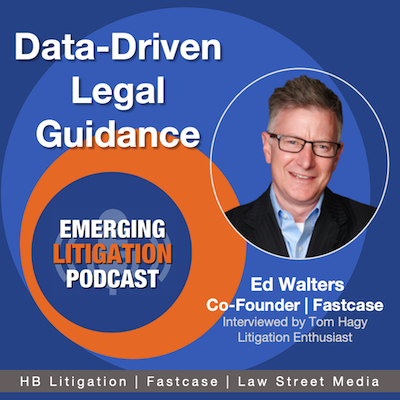
    For insights on the past, present and future of legal guidance and analysis, listen to my interview with Ed Walters, co-founder and CEO of our partners on this podcast, Fastcase, the legal research and software company whose divisions include Fastcase Full Court Press (publishing), Law Street Media (legal news), Docket Alarm (docket tools), and NextChapter (software).  An entrepreneur, writer and professor, Ed brings his experience advising global Fortune 500 tech and pharma companies and sports leagues, serving in the White House on media affairs and speechwriting, and contributing to several major newspapers and journals. Ed is an adjunct law professor at Georgetown and Cornell universities. He is also a self-described “weather nerd,” which explains my tortured introduction.

    This podcast is the audio companion to the Journal on Emerging Issues in Litigation. The Journal is a collaborative project between HB Litigation Conferences and the Fastcase legal research family, which includes Full Court Press, Law Street Media, and Docket Alarm. The podcast itself is a joint effort between HB and our friends at Law Street Media. If you have comments or wish to participate in one our projects please drop me a note at Editor@LitigationConferences.com.

    Tom Hagy

    (actual size)

    Tom Hagy
    Litigation Enthusiast and
    Host of the Emerging Litigation Podcast
    Home Page
    LinkedIn

    Data-Driven Legal Guidance

    Ed Walters

    Ed WaltersFastcase

    Ed Walters is the CEO and co-founder of Fastcase, an online legal research software company based in Washington, D.C. Under Professor Walters’s leadership, Fastcase has grown to one of the world’s largest legal publishers, serving more than 1.1 million subscribers from around the world.

    Before founding Fastcase, Professor Walters worked at Covington & Burling, in Washington D.C. and Brussels, where he advised Microsoft, Merck, SmithKline, the Business Software Alliance, the National Football League, and the National Hockey League. His practice focused on corporate advisory work for software companies and sports leagues, and intellectual property litigation.

  • Does Data Sharing and Zoombombing Cause Actual Harm?

    Does Data Sharing and Zoombombing Cause Actual Harm?

    By Kirsten Errick

    Legal Writer
    Law Street Media

    FTC Settles Health Data Sharing and Privacy Suit With Fertility App Flo Health

    Nothing in this life is free. Or cheap. Free and low-cost apps. Free internet searches. Free email. Free iPhones. Yeah. We’re paying for it one way or the other. In this case, once again, it’s private health information some folks are paying with.  Here is an excerpt of a post shared with the permission of Fastcase and Law Street Media. —Tom Hagy, HB Litigation Conferences

    WASHINGTON, DC — Jan. 13, 2021 — The Federal Trade Commission (FTC)  announced that that it has reached a  proposed settlement with Flo Health, Inc., the “developer of a period and fertility-tracking app used by more than 100 million consumers,” over claims that the company shared user health information with third-party data analytics providers despite promising that this information would remain private.

    In the complaint, the FTC alleged that Flo promised users that it would keep their health data, which includes menstrual cycle tracking and a PMS symptom log, as well as ovulation, fertility, and pregnancy information, private because it would only use this information to provide the app’s services to users. However, the FTC averred that Flo disclosed millions of users’ health data from its Flo Period & Ovulation Tracker app to third-parties “that provided marketing and analytics services to the app, including Facebook’s analytics division, Google’s analytics division, Google’s Fabric service, AppsFlyer, and Flurry.”

    Read the complete story and more at LawStreetMedia.com.

    Safeguarding Against Financial Exploitation

    An on-demand CLE-eligible webinar Safeguarding Against Financial Exploitation   America’s senior population is growing. Nearly one in five U.S. residents will be 65 or older in 2030. Which means the average age of U.S. investors is climbing too. With that comes the risk that they will be exploited by people with access – or gain access through nefarious methods – to their investment portfolio. Seniors and vulnerable persons lose billions of dollars each year. Remarkably, 90% of the people to take advantage of senior investors are members of their own family. Attorneys who represent senior clients need to know the signs of vulnerability, red flags that their clients are being exploited, what laws apply, and rules lawyers must follow in these matters.   Questions our speakers answer: What is senior / vulnerable investor exploitation?   Who is protected by state and federal laws?   How prevalent is senior financial exploitation? What do the numbers tell us?  What is the pace of financial abuse SAR filings by securities firms?  What are the most popular scams?   What is diminished capacity?  What are the red flags indicating possible exploitation?  What are the laws, rules, and regulations governing law firms?  What are some best practices for law firms?  How can firms best protect their senior clients?   On Demand CLE Webinar What You Get PowerPoint and supplemental materials. Complete recording for later review. Answers to your questions via email. Invitation to contact speakers. 1.5 CLE credits (for licensed attorneys). CLE assistance.* *Subject to state bar rules. For licensed attorneys.  Register Meet the Speakers Joseph Calabrese Bressler, Amery & Ross, P.C. A 1991 Graduate of St. John’s University Law School, Mr. Calabrese brings 30 years of practice and 18 years of Securities Litigation/Regulatory experience to his role as principal in the New York office of  Bressler, Amery & Ross’s Financial Institutions Group. He began his career as a Wall Street litigator as an associate general counsel for Citigroup’s Smith Barney and […]

    Lien Resolution: Government & Private Plans Get Aggressive (Against Attorneys)

    Includes Nearly 75 minutes of insights from experienced professionals. CLE credit: 1+ (subject to bar rules). For CLE questions: CLE@LitigationConference.com The complete Power Point presentation. Continued access to the complete recording for later use. Answers to your questions via email to the presenters or write to HB and we will be sure to contact the speakers. What can you do to settle personal injury suits cleanly and avoid costly litigation and penalties? What recent cases can inform you about protecting your settlements and, as attorneys, yourselves, from post-settlement federal lawsuits? How can your firm set itself up to meet government expectations? What role might experts play in navigating these pitfalls? Medicare Advantage (42 USC § 1395w-22) Federal Medical Care Recovery Act (FMCRA) (42 USC § 2651) Armed Forces Act (10 USC §1095) Veterans’ Benefits (38 USC §1729) Third-Party Collection Rules (32 CFR 537.24; 38 CFR 17.101, etc.) Set-Asides under the Medicare Secondary Payer Act (42 USC § 1395y(b)(2)] On Demand Registration Lien Resolution Government & Private Plans Get Aggressive (Against Attorneys!) On Demand | Recorded September 2020 It is increasingly common these days. Personal injury attorneys settle a case, only to find themselves sued by a U.S. Attorney for failing to reimburse Medicare for conditional payments as required by the Medicare Secondary Payer Act. In some cases the attorney may be required to pay fines in addition to the reimbursements and interest, a costly proposition. Are you up to speed on issues surrounding Medicare Advantage, TRICARE, veterans’ claims, and Medicare set-asides? Join nationally recognized healthcare lien and resolution expert Franklin P. Solomon and go-to lien resolution provider Brett Newman as they offer a practical, in-depth CLE presentation. Franklin P. Solomon, Esq. Attorney & Founder, Solomon Law Firm  A graduate of Rutgers University School of Law at Camden, Franklin Solomon is based in Cherry Hill, NJ, with a practice focused on evaluation, litigation and resolution of healthcare “liens” and reimbursement claims. Mr. Solomon represents personal injury victims and their attorneys […]

    Telepsychiatry: Mitigating the Risks

    REGISTER Registration Includes Nearly 90 minutes of insights from experienced professionals. CLE credit: 1+ (subject to bar rules). For CLE questions: CLE@LitigationConference.com The complete Power Point presentation. Continued access to the complete recording for later use. Answers to your questions via email to the presenters or write to HB and we will be sure to contact the speakers. Understand the risks associated with telepsychiatry and how to manage them.  Telemedicine has emerged as an important solution for healthcare in general and psychiatric medicine specifically during the current global pandemic. Remote access for sub-practices including addiction counseling have been commonly used. Our panel of psychiatric professionals who have served as expert witnesses and attorneys who counsel and represent physicians have prepared a 90-minute session to share insights with attorneys, physicians, healthcare providers, risk professionals, and more. Agenda Examining procedures and best practices that exist for ensuring confidentiality in a telemedicine practice How do you draft a telepsychiatric consent form? What is the emerging standard of care for telemedicine? Will the standard of care for telemedicine become a national standard? (Should it?) Review the case law addressing telemedicine or telepsychiatry How do the HIPAA regulations and HITECH privacy laws impact telemedicine? How have the HIPAA regulations and HITECH privacy laws been relaxed during the pandemic? Will the relaxed HIPAA and HITECH regulations impacting telemedicine continue past the pandemic? Which technical platforms are preferred? Which ones to avoid? Panelists Mark Levy, M.D., Medical Director at fpamed David Kan, M.D., UCSF Psychiatry Department and the California Society for Substance Abuse Medicine Ayesha Ashai, M.D., associated with fpamed Stephen M. Fatum, J.D., Partner, Barnes & Thornburg LLP Angela W. Russell, J.D., Partner, Wilson Elser Moskowitz Edelman & Dicker LLP Meet our physician and attorney panelists. Mark Levy MD Medical Director fpamed Dr. Levy is a graduate of Columbia College (A.B. 1967) and the Columbia University College of Physicians and Surgeons (M.D. 1971) in New York. He is a Physician […]

    The Commercial Drone Industry: Privacy, Security, Threats, and Mitigation of Risk

    HB presents a CLE-eligible webinar Now on-demand at the West LegalEdcenter THE COMMERCIAL DRONE INDUSTRY Privacy, Security, Threats, and Mitigation of Risk Drones have become an increasingly valuable tool for businesses of all types and sizes. Drones are already being used in many applications, but more will certainly arise as the technology advances. This means that certain risks, like cyber threats, will also continue to present themselves. Protecting the transmission and storage of data collected through drones is critical. Unfortunately, security usually comes as an afterthought. The drone industry is part of the aviation industry, which, based on its knowledge, keeps safety as a number one concern. Part of that safety is having proper protection for your systems, including security as a fundamental design principle. Take this webinar to gain insights on the topics listed below, and shared by an attorney who practices on the cutting-edge of this evolving technology. Topics: Defining drones. Current and future applications. FAA Modernization and Reform Act of 2012. FAA Part 107 Regulations and waivers. Resources, e.g. the FAA Drone Zone and LAANC Portal. Penalties for violations. Privacy implications. Drones as weapons. Vulnerability to cyber attacks. Take it now! What you get: 1+ CLE credits (subject to bar rules). Insights from an experienced professional who specializes in this area of the law. The complete PowerPoint presentation. Continued access to the complete recording for later use. Answers to your questions. Fee: No additional charge to subscribers to the West LegalEdcenter. Non-subscribers may take the course for $170. Meet the Speaker Kathryn Rattigan Robinson & Cole LLP Kathryn Rattigan is a member of the firm’s Business Litigation Group and Data Privacy + Cybersecurity Team. She advises clients on data privacy and security, cybersecurity, and compliance with related state and federal laws. She assists clients in assessing risks related to technology and software contracts, as well as with compliance-related issues with outsourcing and […]

    The Intersection of Privacy and Antitrust Webinar Now Available On-Demand on the West LegalEdcenter

    Available as part of your subscription to The Thomson Reuters West LegalEdcenter®. Don’t subscribe to the West LegalEdcenter? This webinar is still available directly from HB. Take it now! Questions for speakers Questions@LitigationConferences.com CLE questions CLE@LitigationConferences.com Check out the MoginRubin blog for more insights on antitrust and privacy law. What attorneys and companies need to know about the increasing interplay between these critical areas of the law.  Highly publicized cases and investigations in the U.S. and Europe of big technology, e-commerce, and social media companies demonstrate how anti-competition laws are being used to scrutinize and challenge not only how these corporations conduct themselves in the marketplace, but the very core of their colossal success: the mass collection and utilization of user data. Are the privacy and antitrust worlds beginning to cross over? Or do they simply run parallel while addressing entirely different types of conduct? Whatever the answer, data is the raw material that drives the likes of Google, Facebook, Apple and Amazon, so how it is handled is a critical question when counseling clients on mergers and acquisitions. Moderator Daniel J.  Mogin | Managing Partner, MoginRubin LLP Speakers Jennifer M. Oliver, CIPP/US | Partner, MoginRubin LLP Thomas N. Dahdouh | Director, Western Region, Federal Trade Commission Franklin M. Rubinstein | Partner, Wilson Sonsini Goodrich & Rosati Randi W. Singer, CIPP/US, CIPT | Partner, Weil, Gotshal & Manges Contributor Dina Srinivasan | Independent Researcher & Author of The Antitrust Case Against Facebook Dina was unable to present but we thank her for her content contributions.  Agenda Who should regulate privacy violations in the U.S.? Which antitrust issues implicate privacy concerns? What role does machine learning play on the competitive landscape? What is big data really? How is it different from “data”? What are the elements of effective merger reviews? What are the appropriate remedies? What are “notice-and-choice” versus “harms-based” approaches? Plus answers to your questions. Send them to Questions@LitigationConferences.com.

  • The Dark Net:  Anonymity, Infrastructure, and the Future

    The Dark Net: Anonymity, Infrastructure, and the Future

    Register

    Webinar Info

    Wednesday, Aug. 5, 2020

    United States
    8am PT | 10am CT | 11am ET

    United Kingdom
    4pm BST

    Get CLE or CPE, a complete set of materials, and answers to your questions!

    Email us your:
    Speaker questions
    CLE questions

    Topics Covered

    Physical and Logical Topology and Method of Data Transmission

    Using the Dark Net for Threat Hunting

    Hacking Groups and Malicious Hackers  

    The Future of The Dark Net and Anonymity

    The Dark Net: Anonymity, Infrastructure, and the Future
    Is the Dark Web Getting Darker? 

    Wed., Aug. 5, 2020 | Produced for Access Data by HB Litigation Conferences

    The web, however singular it may seem from behind an everyday user’s computer or smartphone screen, comprises three distinctive parts: the public net (or web), the deep net, and the dark net. Though the dark net contains some innocuous content and is used for legitimate purposes, it also operates as a platform for illegal marketplaces. These offer almost anything a criminal or cybercriminal might want to buy or sell like malware, exploits, hackers-for-hire, information lifted from data breaches, censored content, and goods like drugs, guns, and other contraband.

    Observers report that the dark web is getting darker, meaning hardcore criminals make up a greater percentage of its user base. Exploits and other hacking tools and techniques used to disrupt business, critical infrastructure, and misappropriate confidential information are continually diversifying and becoming more complex. According to Cyber Defense Magazine, the annual cost of cybercrime damages to users, online businesses, and nations is expected to hit $5 trillion this year, with some estimates ranging as high as $10 trillion.

    Join two highly experienced data security professionals – Mary T. Frantz of Enterprise Knowledge Partners and Frank Krahn of Burdock Consulting – as they discuss how cybercrime fighters must overcome a variety of challenges as they threat-hunt on the dark net: detecting, monitoring, and gathering intelligence on cybercrimes and the actors behind them. Frantz and Krahn will discuss how the cybersecurity community will address emerging threats, what changes the web may undergo as a result, and more. The session will be moderated by the head of international training at AccessData, Sarah Hargreaves, who brings her own experience in forensics to the discussion.

    Meet our panelists.


    Frank Krahn
    Co-Founder, Burdock Consulting, LLC

    Before co-founding Burdock Consulting, Frank had a long tenure with the Mayo Clinic, where he served as the Director of Operational Risk Management. He holds various specialist certificates in information security and computer crime investigation and forensics. Frank has taught classes and consulted for law enforcement agencies on computer crime-related matters, and has worked with the FBI. He is also an e-discovery specialist.


    Mary T. Frantz

    Founder & Managing Partner, Enterprise Knowledge Partners, LLC

    Mary is a technology and strategy professional with more than 25 years’ experience as a corporate and consulting firm executive. Her expertise includes IT strategy, e-discovery, compliance, enterprise risk, information security, and enterprise architecture. Mary has served as a legal expert on a variety of cyber security topics. She is also an author, keynote speaker, and adjunct professor.


    moderator

    Sarah Hargreaves ACI, ACE
    Director of Training – International
    AccessData, United Kingdom

    Sarah started her career in digital forensics in 2003.  Previously working in a criminal law practice, Sarah moved over to forensics after working on a number of investigations which inspired her to change career path.  Her journey continued with a number of roles in Digital Forensic Laboratories, primarily supporting law enforcement in Child Sexual Exploitation investigation and general crime.  Sarah progressed to Laboratory Management and later into Training Management.

    Sarah is experienced in digital investigation, laboratory management, ISO17025 and evidential process.

    Sarah lives in the North West of England and is a mum to two young children.  She enjoys days out with her family and traveling.

  • Dr. Babyl: Artificial Intelligence Could Save Lives, Time and Money — TheDailyBeast.com

    Itchy throat? Headache? Upset stomach? There’s an app for that. There is a new AI healthcare system called Babylon UK’s National Health Service which features an AI-driven app that is reportedly able to separate “run-of-the-mill” illnesses from more life-threatening ones, while saving time, money, and anxiety for patients and doctors alike.

    Babylon offers more than diagnostic assistance; it is accessible to people in remote areas. “For example, Babyl, the Rwandan version of Babylon, offers remote appointments with clinicians, fills prescriptions, orders lab tests, and issues referrals.”

    Babyl enables affordable, personalized healthcare, combined with “the brains of thousands of doctors at once” to reach patients who cannot get to a doctor’s officer.

    In addition to assisting doctors with everyday check-ups and treating the common cold, the AI’s abilities extend to clinical trials. “In 2018 the Mayo Clinic partnered with IBM’s Watson to match patients with breast cancer to accessible clinical trials covered by their health plans. The matching program increased the enrollment of breast cancer sufferers in Mayo Clinic’s own clinical trials by 80%.”

    Questions are being raised, however, about how to mitigate risks posed by hacking or by nefarious manipulation of the system. Read about this and more in the complete post by Joelle Renstrom on TheDailyBeast.com. 

  • Artificial Intelligence: DeepMind on Debugging Learned Predictive Models

    DeepMind, an artificial intelligence research company, in a recent blog post discusses three ways to eliminate bugs in learned predictive models. The company was founded in London in 2010. Google acquired it in 2014. In addition to London they have research centers in Edmonton and Montreal, Canada, and a DeepMind Applied team in Mountain View, California.

    “Bugs and software have gone hand in hand since the beginning of computer programming,” the post reads. “Over time, software developers have established a set of best practices for testing and debugging before deployment, but these practices are not suited for modern deep learning systems. Today, the prevailing practice in machine learning is to train a system on a training data set, and then test it on another set. While this reveals the average-case performance of models, it is also crucial to ensure robustness, or acceptably high performance even in the worst case. In this article, we describe three approaches for rigorously identifying and eliminating bugs in learned predictive models: adversarial testing, robust learning, and formal verification.”

    Read the complete post here! 

  • Financial Institutions Struggle to Keep Up with ‘Changing Business Needs’ Such as Social Mobile Apps, and Getting Risk Data Quickly, Deloitte Report Suggests

    Deloitte’s report is based on a survey of 94 financial institutions around the world that operate in a range of financial sectors and with aggregate assets of $29.1 trillion.

    Deloitte’s Edward Hida  — financial risk community of practice global leader and a partner in Deloitte Risk and Financial Advisory — posted his executive summary the latest Global Risk Management Survey which is the organization’s eleventh. The report is a detailed one and Deloitte draws quite a few conclusions around the continued focus on cyber security, engagement of boards of directors, increase attention to non-financial risks, the potential of digital risk management, enterprise risk management, the proliferation of Chief Risk Officers, an increased reliance on stress testing and more.

    A couple figures jumped out at me which show at least two challenges to financial institutions.

    Hear this Deloitte professional at ICRMC in Toronto April 15-16!

    Respondents are finding “extremely challenging” the need to keep up with changing business operational needs, such as deployment of social mobile applications, data analytics and cloud-based risks. Also in the “extremely challenging” category, not surprisingly, are threats from “sophisticated actors,” like foreign governments and crackerjack hacktivists.

    Other issues categorized as “extremely high priority “revolve around getting quality risk data quickly. Given the average length of time other studies show that a hacker can poke around in your network before you realize it — and how much damage they can do when they have all that time — it’s easy to see why this is a major concern for financial institutions.

    You can read the rest of his executive summary here. You can also download the full report as well as all of Deloitte’s past editions.


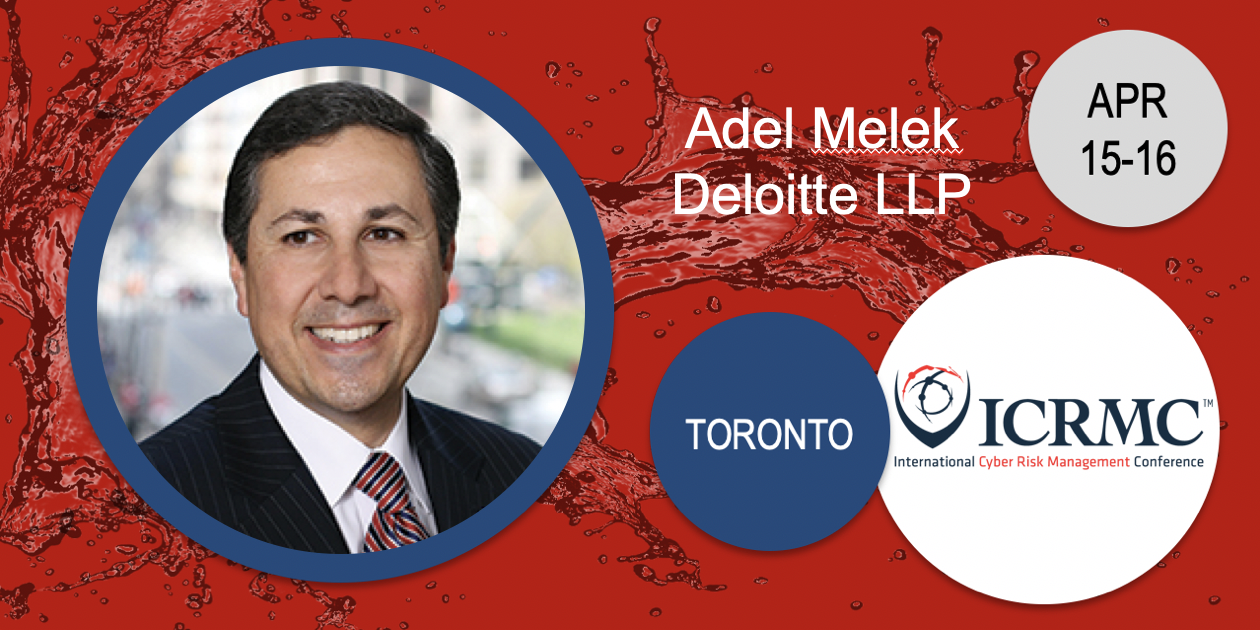
    Two of Edward Hida’s Deloitte colleagues — Beth Dewitt and Adel Melek — are speaking at the International Cyber Risk Management Conference April 15-16, 2019, in Toronto. They are addressing the global regulatory landscape.

    Here is the session description:

    “Large-scale data breaches are increasingly in the public eye; consumer trust in brands is faltering, creating a surge in data and privacy protection discussions from the Boardroom to the front lines. While the European Union’s General Data Protection Regulation (GDPR) has occupied much of the spotlight since coming into effect in May, globally there has been a barrage of privacy laws like the California Consumer Privacy Act that was passed in June and the breach-reporting amendments to PIPEDA came into force on November 1st. What do these and the plethora of other privacy regulations mean for your organization when it comes to protecting an individual’s personal data?”

     .   

  • Mitigating Operational Cyber Risk: As Business Technology Changes, So Does Your Risk Profile

    By Tom Hagy

    The various risks of doing business in our digitally connected world continue to evolve.  So must the approach organizations take in confronting those risks, for failing to do so in the current risk landscape can be far more dangerous than in prior years.

    I spoke with Nick Galletto, Global Cyber Risk Leader at Deloitte, who traced the evolution of the dangers of doing business in a digitally connected world. Early on, our focus in the cyber risk management space was on how to protect websites from being defaced, he explained. Organizations had to make sure websites were functioning properly, that data was secure, and the integrity was maintained.

    Galletto went on to say that we’ve moved from an era of compliance and risk management to an era of complexity.  From an organization’s perspective, their focus was on making sure the company was compliant with new and evolving regulations, and risk management meant having policies, procedures and effective controls in place.

    “While compliance is a necessity, it is not the silver bullet that’s going to protect us from any potential breaches,” Galletto said. “So organizations must look at conducting their business in this connected world not merely from a compliance perspective but from a risk perspective. A clear example of this is the number of PCI-compliant companies that were still getting breached.”

    “Now as organizations move into an era of complexity, they need to be proactive in detecting anomalies and suspicious behavior and be prepared so their teams have a playbook that allows for seamless response. Effective organizations will play back possible breach scenarios – whether they involved data breaches or denial of service — to  prevent and prepare for similar attacks. They also focus on understanding what their crown jewels are and where they reside and how to best protect them.  Much of this also has to do with data,” Galletto said.

    “Organizations are increasingly reliant on the cloud and they must understand the associated risks and the individuals responsible for managing those risks,” he said. “They need to be sure they have the right coverage as well.”

    “This era of complexity – automation, machine learning, artificial intelligence and the internet of things, along with the tremendous advantages, like the cloud – also bring new risks,” Galletto continued. “As consumers we see use of these technologies more and more in our daily lives. But organizations are increasingly integrating them into their operations. When something goes wrong here there can be actual safety implications, such as with autonomous vehicles or industrial controls in the mining and manufacturing sectors, as examples. In the financial sector these technologies bring great advantages to customers in terms of accessing their information more efficiently or providing better customer support. But as machine learning and AI become more prevalent in the world of FinTech, decisions are being made without human cognitive capabilities to know right from wrong. These new technologies bring more complexity.”

    “As organizations take advantage of these innovative new technologies, they also have to know that their risk profile is changing right along with them. Smart companies will be proactive in understanding the risks associated with cyber everywhere, understanding where their cyber posture is and make adjustments along the way to better manage complexity.”

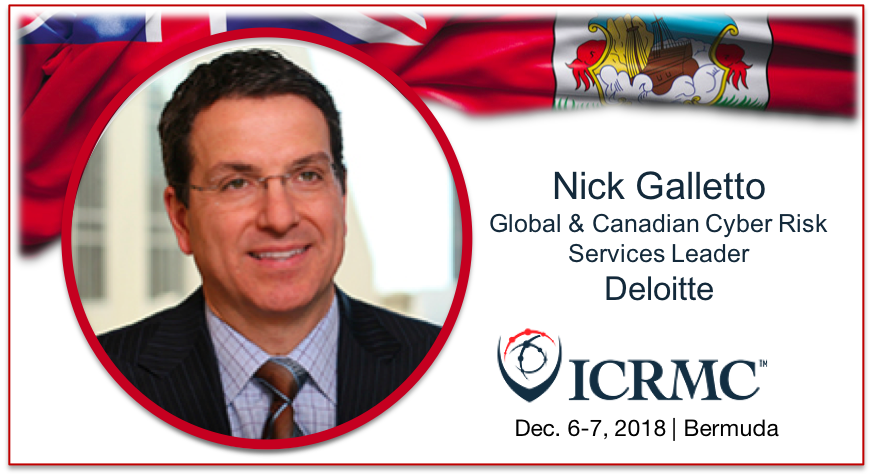
    Galletto is one of the speakers at this week’s International Cyber Risk Management Conference in Bermuda, which just kicked off this afternoon with more than 200 professionals in this center of global cyber risk.  

  • Protecting Intangible Assets: Risk Transfer Market Yet to Catch Up

    Intrinsically Intangible.                        

    by Giles Harlow, Senior Vice President, Aon (Bermuda) Ltd.

    In the early 1980’s, tangible assets made up around 80% of the value of the S&P 500. Fast forward to today and nearly 85% of the value of the S&P 500 is attributable to intangible assets.

    However, the risk transfer market has not caught up. According to the Aon/Ponemon report of last year, whilst around 60% of tangible assets (property, plant and equipment) are currently being insured, only 12% of informational assets are.

    So what gives?

    If the vast majority of companies’ values in 2018 are attributable to intangibles, why are they not transferring those risks? Is it a lack of education on the client side? A lack of innovation in the brokerage community? A lack of understanding or willingness to accept these new risks on the carrier end? Or is it that whilst the marine and property markets have had centuries to evolve, the newer intangible insurance markets are just gearing up to size as they collate the data they need to properly price and model these risks?

    Likely, it is some combination of all of these factors. We have seen great strides in the cyber market, with double-digit premium growth over the last four-to-five years. The market has evolved from being focused on large data holders, to providing products which contemplate the cyber perils affecting manufacturers, the transportation industry and other non-data holders.  “Business interruption” has quickly morphed into “system failure coverage.” “Contingent business interruption” now looks more akin to full supply chain risk, not just for IT service providers but now contemplating all vendors. “Bodily injury” and “property damage” stemming from non-physical threats complete the circle back into tangible loss being covered under cyber policies.

    Intellectual property — hands down — makes up the largest dollar percentage of the intangible asset value of the S&P 500.  This has long been a conundrum for the industry as a whole – both in terms of how to value the asset and, more so, how to value the loss. Again, we have seen great momentum here with much larger limits than were historically available now obtainable from the markets both as a theft product as well as being offered for IP infringement. Even now carriers are contemplating supporting the multi-trillion dollar asset class of intellectual property when used as collateral. This could dramatically impact both the equity financing model and asset backed lending world we know today.

    Clearly the will to innovate is alive and well within the industry. It is tough to price emerging risk when the models that our industry are built on rely on historical data, data that is often out of date or irrelevant in these rapidly evolving intangible classes of business. New ways to price and structure these insurance purchases have to be found in order to maintain the industry’s relevance in today’s world.


    Bermuda is at the forefront of many of these initiatives and its underwriters and brokers are constantly seeking to raise the bar to address evolving client need. The panel titled “Evolution of Product and Buyer” will be tackling these and more topics in detail at the Dec. 6-7, 2018, International Cyber Risk Management Conference, or ICRMC, in Bermuda from the perspective of brokers, underwriters and insurance purchasers.

    Get 10% off the registration fee with promotion code HB2018. 

    http://www.aon.com/risk-services/cyber.jsp

    http://www.aon.com/risk-services/amats/intellectual-property-solutions.jsp

  • Oracle Health Sciences on Pharmacovigilance and Artificial Intelligence

    “The potential to use artificial intelligence methods increasingly for the analysis of the increasing amounts of pharmacovigilance data is well understood and many companies are moving (or planning to move) there, and we can predict that routine tasks in pharmacovigilance will in the future be increasingly automated. It will be crucial, however, for regulatory authorities to very clearly provide a position about the use of AI as well as the acceptable level of quality from AI applications. But in parallel with the shaping of those definitions, given the massive increase in their AE case workloads that most companies are currently experiencing, the industry will out of necessity proceed swiftly with the adoption of AI and cloud technologies to reduce their costs and increase their efficiencies.

    “Like other industries, the pharmaceutical business and in particular the pharmacovigilance field will see a massive change in their processes in the near future, away from tedious, repetitive manual tasks towards a better utilization of scarce resources, in particular medical and scientific knowledge, for value-adding tasks. It is imperative for all stakeholders – industry, service providers and regulators – to provide an environment in which such a transformation can take place without ever compromising public health or the safety of the individual patient, and ideally providing additional benefit for patients.”

    A quote from
    Addressing the Data Challenges of Pharmacovigilance

    Download the paper from Oracle Health Sciences


    We are covering this subject at:

    Drug & Device Defense Forum | Oct. 15, 2018 | New York

  • Artificial Intelligence in the Drug and Device Industries

    Are Data Divers and Miners Going to Lead Innovation?

    The big tech companies are into it. Apple, IBM and Google. Roche is into it. Medtronic, as well. Artificial intelligence has been a big part of innovation in the healthcare space for several years, and its impact is only going to get bigger.

    “Artificial intelligence-based healthcare technologies have contributed to improved drug discoveries, tumor identification, diagnosis, risk assessments, electronic health records (EHR), and mental health tools, among others,” writes Blank Rome attorney Brian Higgins in his Artificial Intelligence and the Law Blog (it’s excellent, by the way).  [1]

    Daniel Faggella of TechEmergence.com writes that machine learning healthcare applications are getting a lot of attention in the press and from the investment community. He adds to the list of machine learning’s impact things like treatment queries and suggestions, and even robotic surgery.

    But optimism for AI’s application to drug discovery seems greater than that inspired by other healthcare sectors. One reason for that, Faggella writes, is that compared to other segments where various laws and stakeholder incentives may not align, “drug discovery stands out as a relatively straightforward economic value for machine learning healthcare application creators.” He adds that this application also involves “one relatively clear customer who happens to generally have deep pockets: drug companies.” [2]

    Also writing for TechEmergence.com, Kumba Sennaa says doctors may feel threatened at the idea of competing with artificial intelligence tools. Not so in the case of drug makers.  “Unlike doctors, pharma companies have every reason in the world to adopt the most cutting-edge technologies in the expensive and lengthy process of drug discovery,” Sennaa writes. “Unlike other applications within healthcare facilities, drug discovery seems to have a clearer path to adoption.” [3]

    AI-fueled innovation is, in turn, fueled by data. Lots and lots of data. “And there is no better place to find big data sets than in the healthcare sector,” Higgins says. “According to an article last year in the New England Journal of Medicine, by 2012 as much as 30% of the world’s stored data was being generated in the healthcare industry.”

    “Thanks in large part to AI and the availability of health-related data,” Higgins says, “health tech is one of the fastest growing segments of healthcare and one of the reasons why the sector ranks highest on many lists.”

    “To be successful,” Higgins predicts, “tomorrow’s healthcare leaders may be those who have access to data that drives innovation in the health tech segment. This may explain why, according to a recent survey, healthcare CIOs whose companies plan spending increases in 2018 indicated that their investments will likely be directed first toward AI and related technologies.”


    Related

    Given the investment and tremendous opportunity AI provides for the drug and device industries, the chairs of our Fifth Annual Drug & Device Forum are developing a session on the subject. Join us for this and discussion of other important topics on Oct. 15, 2018 in New York.

    If you have ideas please reach out to one of our chairs directly or via Ideas@LitigationConferences.com. They are Megan Grossman of Segal McCambridge Singer & Mahoney, Michelle Hart Yeary of Dechert, and Jim Frederick of Goodell DeVries Leech & Dann. Learn more. 

    Also, on Sept. 27 we are co-producing a webinar titled A.I. Best Practices: Rules and Policies for Using Artificial Intelligence in Your Business. The webinar features John Weaver of the McClane Middleton law firm and contributing author to the Journal of Robotics, Artificial Intelligence & Law. We are producing this in collaboration with growing legal research company Fastcase. Learn more.


    Links to the articles cited in this post:

    #1. http://aitechnologylaw.com/2018/03/data-driven-health-tech-innovation/

    #2.  https://www.techemergence.com/machine-learning-healthcare-applications/

    #3. https://www.techemergence.com/ai-in-pharma-and-biomedicine/