Author: Tom Hagy

  • Antiracism and Antitrust with Eric Cramer

    Antiracism and Antitrust with Eric Cramer

    Our Guest

    Eric L. Cramer

    Eric L. CramerBerger | Montague

    Eric Cramer is Chairman of the Firm and Co-Chair of the Firm’s antitrust department. He has a national practice in the field of complex litigation, primarily in the area of antitrust class actions. He is currently co-lead counsel in multiple significant antitrust class actions across the country in a variety of industries and is responsible for winning numerous significant settlements for his clients totaling well over $3 billion.

    Mr. Cramer is also a frequent speaker at antitrust and litigation related conferences and a leader of multiple non-profit advocacy groups. He was the only Plaintiffs’ lawyer selected to serve on the American Bar Association’s Antitrust Section Transition Report Task Force delivered to the incoming Obama Administration in 2012.

    Antiracism and Antitrust with Eric Cramer

    Among the legal and regulatory avenues one might follow to mitigate the impact of racism, most of us would look to various manifestations of discrimination law in  employment, lending, real estate, education, healthcare, voting rights, and other categories. When presented in those contexts, the anti-racism objectives are clear. 

    There are several federal laws and many state laws that prohibit anticompetitive behavior.  At the top of the heap is the Sherman Antirust Act of 1890, which outlaws illegal monopolies and anticompetitive tactics, conspiracies to restrain trade, cartels and syndicates.  But what do wages, including those paid to minorities, have to do with antitrust? What about no-poach agreements, whereby groups of companies agree not to hire employees away from each other?  The answer is “quite a lot.”

    Listen to my interview with Eric Cramer, Chairman of Berger Montague and co-chair of the firm’s antitrust department, a team that handles antitrust class actions across the country involving a variety of industries.  Eric and the firm are responsible for winning numerous significant settlements for clients — a total value that now exceeds $3 billion. His recent focus has been representing workers who allege their employers’ anticompetitive practices  suppressed their pay. Recipient of numerous accolades and awards that include terms like titan, elite, thought leader, visionary, and lawyer of the year, Eric is a summa cum laude graduate of Princeton University where he earned membership in Phi Beta Kappa, and a cum laude graduate of Harvard Law School. Listen to what he had to say about this important subject.

    This podcast is the audio companion to the Journal on Emerging Issues in Litigation. The Journal is a collaborative project between HB Litigation Conferences and the Fastcase legal research family, which includes Full Court Press, Law Street Media, and Docket Alarm. The podcast itself is a joint effort between HB and our friends at Law Street Media. If you have comments or wish to participate in one our projects please drop me a note at Editor@LitigationConferences.com.

    Tom Hagy
    Litigation Enthusiast and
    Host of the Emerging Litigation Podcast

  • Wildfire Claims and Coverage

    Wildfire Claims and Coverage

    The Authors

    Scott DeVries

    Scott DeVriesHunton Andrews Kurth LLP

    Scott P. DeVries (sdevries@huntonak.com) is a special counsel
    in the Hunton Andrews Kurth LLP’s Insurance Coverage group in the
    firm’s San Francisco office where he exclusively represents policyholder
    clients. An experienced trial and appellate lawyer who has served as lead
    counsel in landmark appeals in the field of insurance coverage in the
    California Supreme Court, the Ninth Circuit, and the California Court
    of Appeal, as well as high-value jury trials, Scott routinely represents
    clients throughout the country seeking recovery from their insurers
    on a wide range of insurance issues arising under first-party property
    policies, comprehensive general liability policies, directors and officers
    policies, EPLI policies, crime policies, crypto and digital asset policies,
    and cyber policies.

    Yosef Itkin

    Yosef ItkinHunton Andrews Kurth LLP

    Yosef Itkin is an associate in Hunton Andrews Kurth LLP’s Insurance Coverage group in the firm’s Los Angeles office. His practice focuses on representing and advising
    corporate policyholders in complex insurance coverage matters.

    The Journal on Emerging Issues in Litigation

    Emerging Litigation Podcast

    Emerging Litigation PodcastProduced by HB Litigation and Law Street Media

    Interviews with leading attorneys and other subject matter experts on new twists in the law and how the law is responding to new twists in the world.

    Wildfire Claims and Coverage

    “The wildfires are causing enormous losses for innumerable businesses on the West Coast. Often, you should be able to work with your adjuster to reach a satisfactory resolution. But where needed, you may wish to reach out to policyholder-side lawyers—whether to test what you may be entitled to or to help maximize recovery.”

    Abstract: Wildfires destroy millions of acres a year in the United States, spewing smoke across much of the nation. The cost of damage alone over the past several years soars into the hundreds of billions. When policyholders turn to their insurers many benefit from the coverage they wisely secured. But not all policyholders get the coverage they believe they paid for. When and how they present their claims is a critical factor. In this article, the authors strive to provide a comprehensive understanding of coverage risks, the regulatory landscape, and navigating the all-important claims process. 

    Sparked by lightning storms, devastating wildfires claimed more than 10 million acres in 2020, releasing substantial amounts of smoke above the western United States. Accuweather founder and CEO Dr. Joel N. Myers called 2020 “the worst fire season in history,” and estimated that the total damage and economic loss would be between $130 billion and $150 billion. And 2021 was not any better. According to the Insurance Information Institute, in 2021, while the hottest temperatures on record were recorded in California, Nevada, Oregon, Washington, and Arizona, and drought conditions reached an all-time high, the number of wildfires remained approximately the same (58,900) although the number of acres destroyed reduced to 7.1 million acres from the year before. Some of the wildfires were among the largest on record with the Bootleg Fire in Oregon destroying 400,000 acres and the Marshall Fire in Colorado causing an estimated $1 billion in losses.

    Fortunately, many individuals and businesses are fully insured, and most insurance companies work with policyholders to process claims and help them rebuild and get them back up and running. However, it does not always work that way for every insured. While property insurance may cover much of the losses from wildfires and other catastrophic events, not every policyholder is made whole or anything approaching this. And even for those that are fully insured, when and how to present a claim can materially affect how much they recover and when. This can be extraordinarily difficult at any time, but especially when a fire has destroyed everything.

    Download the article now!

  • Biometric Privacy Laws: Companies Will Need Insurance as Protection From New and Expanding Liability

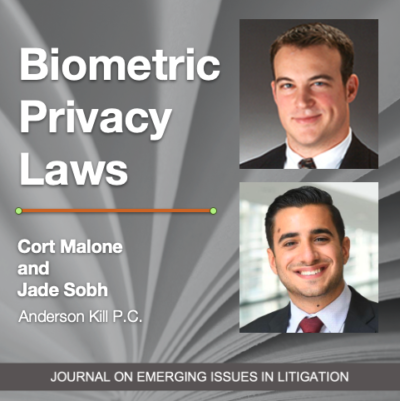
    Biometric Privacy Laws: Companies Will Need Insurance as Protection From New and Expanding Liability

    The Authors

    Cort T. Malone

    Cort T. MaloneAnderson Kill P.C.

    * Cort T. Malone (cmalone@andersonkill.com) is a shareholder
    in the New York and Stamford offices of Anderson Kill and practices
    in the Insurance Recovery and the Corporate and Commercial Litigation Departments. He represents policyholders in insurance coverage litigation and dispute resolution, with an emphasis on commercia general liability insurance, directors and officers insurance, employment practices liability insurance, advertising injury insurance, and property insurance issues.

    Jade Sobh

    Jade SobhAnderson Kill P.C.

    Jade W. Sobh (jsobh@andersonkill.com) is an attorney in Anderson Kill’s New York office. Jade focuses his practice on insurance recovery, exclusively on behalf of policyholders, as well as regulatory and complex commercial litigation matters.

    The Journal on Emerging Issues in Litigation

    Emerging Litigation Podcast

    Emerging Litigation PodcastProduced by HB Litigation and Law Street Media

    Interviews with leading attorneys and other subject matter experts on new twists in the law and how the law is responding to new twists in the world.

    Biometric Privacy Laws:  

    Companies Will Need Insurance as Protection From New and Expanding Liability

    “Businesses may look to various types of insurance policies for protection from the sudden and ever-increasing liability under present and soon to pass biometric data privacy laws, including commercial general liability insurance, employment practices liability insurance, cyber insurance, and directors & officers (D&O) insurance.”

    Abstract: As more states follow Illinois in enacting biometric privacy laws, the risk that companies will be hit with lawsuits and extensive damages awards increases. Employers are among the most active collectors of this type of data, collecting fingerprints and deploying facial recognition for timekeeping and security purposes. Several multi-million-dollar settlements have been reported for violations of biometric privacy laws. Meta, formerly Facebook, paid $650 million to resolve claims that it improperly stored face scans of its users. When companies turn to their insurance carriers, policyholders have a good track record of receiving coverage. Now that these claims are becoming more prevalent, will the insurance industry work to limit its exposure in this space? What should policyholders do in the event the industry is successful? In this article, the authors provide background on these emerging privacy laws, how they have played out in court, and what
    types of policies companies should consider to be sure they have the necessary protection.

    At least seven states have passed biometric privacy laws specifically intended to protect individuals from the collection, use, and sale of their personal biometric identifiable information. Several of these laws allow for extensive damages awards regardless of whether individuals suffered any actual harm as a result of the nonconsensual collection of biometric data. The companies facing class action lawsuits as a result should look to insurance to cover such claims, as the initial litigation with insurance companies has provided favorable results to policyholders. But insurance companies surely will seek to limit future exposure related to biometric privacy law violations, and companies either using biometrics or potentially doing so in the future would be wise to seek and maintain the broadest possible coverage.

    Biometric Identifiable Information (BII) is generally defined as any physiological or biological characteristic that is used by or on behalf of a commercial establishment to identify an individual. BII may take the form of a retina scan, a fingerprint, a voiceprint, a scan of hand or face geometry, or any other identifying characteristic.

    Download the article now!

    Read, listen, explore more content on the subject!

    Podcast: Biometric Privacy Litigation and Coverage Disputes with John Leonard and Cort Malone 

    Podcast: Autonomous Vehicles: The New Technology Driving the Litigation Conversation with Cort Malone and John Leonard

    JEIL: Litigation After Biometric Privacy Law Violations: Policyholder Victories and Their Implications with Cort Malone and Abigal Damsky

    JEIL: Autonomous Vehicles: The New Technology Driving the Litigation Conversation with Cort Malone, John Leonard, Joshua Zelen

    Tags

    Emerging Litigation & Risk Compliance Litigation & appeals Cybersecurity Data Privacy Artificial Intelligence (AI) Insurance Companies Risk Management Corporate & Securities Insurance Claims Recovery Regulations Data Breach Toxic Torts Antitrust Legal Tech Product Liability Settlements Trial Personal Injury Privacy Healthcare Per- and Polyfluoroalkyl Substances (PFAS) Data Analytics Arbitration Constitutional Law Climate Change Cannabis Labor Law Insurance Fraud Liability Claims COVID Alternative Dispute Resolution (ADR) Mediation Diversity Equity Inclusion (DEI) Claims management Professional Liability Legal Research & Writing Business Interruption Law Practice Management Trial Skills Property and Casualty Drug Laws Copyright Law Catastrophic Loss

  • Asymmetrical Combat: Bad Faith Liability in Insurance Recovery Cases

    Asymmetrical Combat: Bad Faith Liability in Insurance Recovery Cases

    The Author

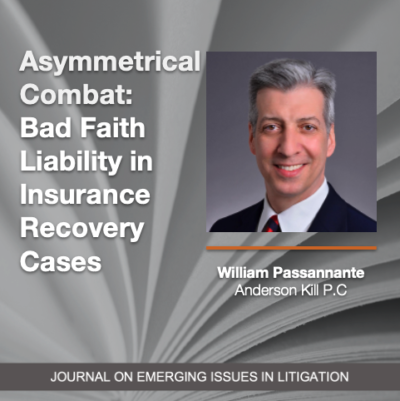
    William Passannante

    William PassannanteAnderson Kill P.C.

    William G. Passannante is co-chair of Anderson Kill’s Insurance Recovery Group and is a nationally recognized authority on policyholder insurance recovery in D&O, E&O, asbestos, environmental, property, food-borne illness, and other insurance disputes, with an emphasis on insurance recovery for corporate policyholders and educational and governmental institutions.

    The Journal on Emerging Issues in Litigation

    Emerging Litigation Podcast

    Emerging Litigation PodcastProduced by HB Litigation and Law Street Media

    Interviews with leading attorneys and other subject matter experts on new twists in the law and how the law is responding to new twists in the world.

    Asymmetrical Combat: Bad Faith Liability in Insurance Recovery Cases

    “Insurance policies are a unique product that requires the policyholder perform first—by paying insurance premiums—while the insurance company’s performance—the payment of the claim amount—is delayed until the insurance company determines to do so.”

    Abstract: Policyholder counsel see claims that an insurer violated its duty of good faith and fair dealing is an essential tool in leveling the playing field in policyholder–insurer disputes, especially in high-stakes litigation. Insurance companies write the policies, employ lobbyists, exchange information with each other, and, of course, have more experience handling claims. So, the author writes, bad faith allegations bring more balance to the relationship and provide a disincentive to “the profitable breach of the insurance promise.” He discusses above-policy limits risks for insurers, as well as attorneys’ fees, interest on unpaid claims, punitive damages, and more.

    Introduction: Bad faith insurance litigation presents high-stakes risks for insurance companies in the unbalanced battle between insurance companies and their policyholders. The asymmetric nature of the insurance claims process—insurance companies draft the insurance policies, lobby legislatures as an industry repeat litigant, exchange superior information among themselves, and have more experience with claims than any policyholder—means that policyholders need a counterbalance. Insurance company liability for bad faith and related above-policy limits liabilities can act as that counterbalance. Insurance company bad faith and related doctrines prove useful because of the claims-handling calculus used to attempt to avoid coverage for a claim.

    Without more an insurance company denying a claim faces what it did at the outset—the amount of the covered claim. Insurance companies thus engage in the profitable breach of the insurance promise. Most purchasers of the insurance product would think of their insurance company as a fiduciary or trustee from whom one can expect scrupulous candor. At claims time many policyholders do not receive what they expect. Still, hornbook contract law tells policyholders that every insurance policy contains within it a duty of good faith and fair dealing enforcing that duty of good faith and fair dealing helps level the insurance claim playing field . . . .

    Download the article now!

  • Episode Three: Karla Gilbride Tells Her Story Behind the Unanimous Pro-Employee Win at the Supreme Court

    Episode Three: Karla Gilbride Tells Her Story Behind the Unanimous Pro-Employee Win at the Supreme Court

    DietaFit: Lose weight and stay fit – Page 6 | Diet, Fitness and Wellbeing | Page 6 dianabol pills gina fitness nude hentai clips

    Karla Gilbride Tells Her Story Behind the Unanimous Pro-Employee Win at the Supreme Court

    The Federal Arbitration Act is clear, Supreme Court Justice Elena Kagan wrote: “[C]ourts are not to create arbitration-specific procedural rules …. Or put conversely, it is a bar on using custom-made rules, to tilt the playing field in favor of (or against) arbitration.”

    With the support of all eight of her colleagues, Justice Kagan’s opinion in Morgan v. Sundance  put an end to the long-running tilt of justice toward employers in the form of  judge-made rules that favor arbitration. This important holding clears the way for more workers, consumers, and other individuals harmed by corporate misconduct to pursue their rights in open court.

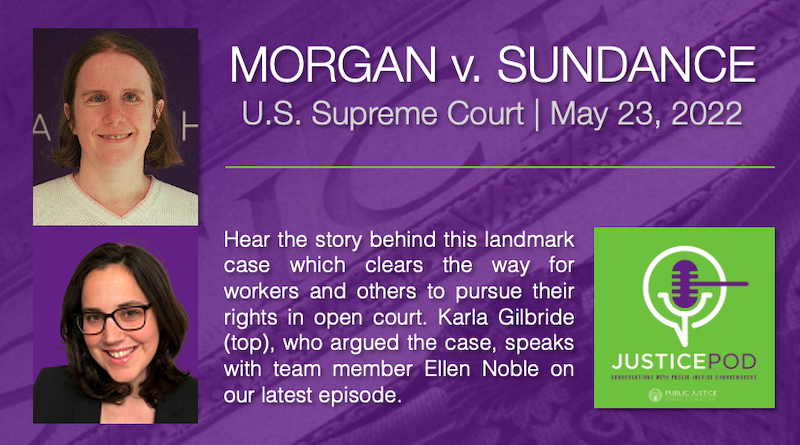
    Karla Gilbride, Senior Attorney at Public Justice, argued the case to the high court on behalf of the plaintiff, Robyn Morgan, an hourly employee at a Taco Bell franchise owned by Sundance, Inc.  It was not only Gilbride’s first Supreme Court argument, but she was the first blind attorney to do so in the court’s history.

    Listen to Public Justice’s Ellen Noble — who assisted in the case — as she interviews Gilbride about her remarkable experience. This is a must listen not only for attorneys who represent workers, but for anyone interested in Supreme Court history, or the ongoing need for accommodations for the disabled, or anyone preparing for oral arguments at any level. Gilbride shares the thrill of arguing in the same spot — and directly in front of! — some of her heroes and inspirations. She also shares that, like a music fan who camps out in front of a box office to get tickets for their favorite band, a young Gilbride did just that in order to secure a seat to observe her first Supreme Court argument.

    After you listen to the podcast, you can hear Gilbride’s argument and read the complete transcript of the hearing. You can also read and watch more about the case on the Public Justice Blog.

    I hope you find this the episode inspiring and informative! We are all so very proud of Karla, Ellen and the whole team, and are thrilled with the important, decisive, and unanimous outcome they achieved.

    Susan Gombert
    Host
    Justice Pod: Conversations with Public Justice Change Makers

    Listen Now!

    The Supreme Court has finally “put an end to the arbitration exceptionalism that many corporations have been seeking, and that many courts have been giving them.”

    Karla Gilbride

  • Taking the High Ground: Where Cannabis Insurance Litigation Is Trending (and Why)

    Taking the High Ground: Where Cannabis Insurance Litigation Is Trending (and Why)

    The Authors

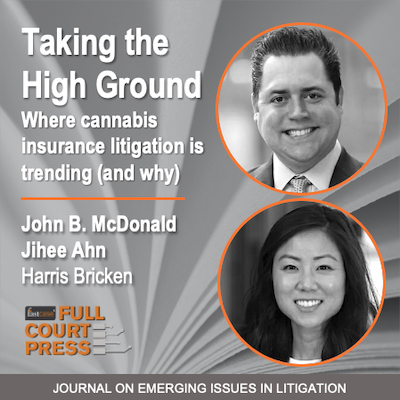
    John B. McDonald

    John B. McDonaldHarris Bricken

    John B. McDonald is an experienced litigator practicing in the Seattle and New York offices of Harris Bricken, where he represents clients in complex commercial, insurance, and partnership matters.

    Jihee Ahn

    Jihee AhnHarris Bricken

    Jihee Ahn is an experienced complex commercial litigator with Harris Bricken. She also chairs the firm’s Dispute Resolution/Litigation practice.

    The Journal on Emerging Issues in Litigation

    Emerging Litigation Podcast

    Emerging Litigation PodcastProduced by HB Litigation and Law Street Media

    Interviews with leading attorneys and other subject matter experts on new twists in the law and how the law is responding to new twists in the world.

    Taking the High Ground: 

    Where Cannabis Insurance Litigation Is Trending (and Why)

    “Absent a choice of law provision, the location where most of the insured activity took place will likely dictate which law applies. But how have federal courts reacted to applying cannabis-friendly state law in a forum where federal law arguably addresses underlying state concerns? The answer is: inconsistently.”

    Abstract: The use and possession of cannabis remains illegal under the federal Controlled Substances Act. But a patchwork of state laws is bringing the country closer to some form of legalization. Some states allow its use for medical purposes, others have made it legal for recreational purposes, and others have decriminalized it. But when cannabis is involved in disputes that lead to litigation, and that litigation leads to policyholder–insurer disputes, that state law patchwork and the illegality of cannabis under federal law is when things get complicated. This tension plays out in several other aspects of running a cannabis business, such as banking and interstate transportation of goods. In this article, the authors discuss how it is up to litigators to frame their cases in ways that will determine the outcome of important disputes over insurance coverage.

    Introduction: Like several other litigation issues presented by the (legal) emerging cannabis market in the United States, insurance disputes between cannabis policyholders and their insurers remain in their infancy, as far as reported decisions go. Although generally many insurance disputes (coverage actions) have a tried-and-true litigation playbook (on both sides), policyholders and their insurers in this particular space have been jostling for position in a battle to gain the high ground from the beginning—a matter as simple as selecting the forum when there is no clear direction on whether state or federal law should apply. To no one’s surprise, policyholders have been angling for the application of friendly state laws, whil insurers have been arguing that Schedule I is dispositive (preemptive) in federal court.

    This is not a new concept for long-time players in the industry. The “Illegality Doctrine” is a centuries-old concept that can be summed up by dicta from the Holman v. Johnson decision from 1775: “No court will lend its aid to a man who founds his cause of action upon an immoral or an illegal act.” The doctrine is based on the public policy that a person should not be able to benefit from his or her own wrongdoing, and the courts should not enforce claims that harm the integrity of the legal system. The Illegality Doctrine has formed the basis for federal courts’ past unwillingness to enforce the entire gamut of cannabis business practices—from enforcing intellectual property rights to providing bankruptcy options, and so much in between that ultimately operated broadly to the industry’s detriment ….

    Download the article now!

    Cannabis Coverage LitigationFor more insights listen to my interview with John McDonald and Jihee Ann on the Emerging Litigation Podcast. If you like it (and I know you will) give us a rating! 

    –Tom Hagy  

  • Cannabis Coverage Litigation with John McDonald and Jihee Ahn

    Cannabis Coverage Litigation with John McDonald and Jihee Ahn

    Our Guests

    John B. McDonald

    John B. McDonaldHarris Bricken

    John B. McDonald is an experienced litigator practicing in the Seattle and New York offices of Harris Bricken, where he represents clients in complex commercial, insurance, and partnership matters.

    Prior to joining Harris Bricken, John spent two years in Seattle with the Office of Chief Counsel, U.S. Customs and Border Protection (a component agency of the Department of Homeland Security), and five years in New York City at O’Melveny & Myers LLP, where he managed several cases. John graduated from the University of Miami School of Law, where he was an editorial member of the University of Miami Law Review. He also served as a research assistant for Professor Charlton Copeland on civil procedure and constitutional issues.

    Jihee Ahn

    Jihee AhnHarris Bricken

    Jihee is an experienced complex commercial litigator and chair of Harris Bricken’s Dispute Resolution/Litigation practice. She primarily represents clients in business, intellectual property, and real estate matters for both domestic and international clients. Having worked extensively in both federal and state courts, Jihee advises her clients from case intake through arbitration and trial. Over the course of her career, she has successfully prepared and argued numerous procedural and substantive motions, regularly conducted and defended depositions, and mediated disputes when appropriate for her clients.

    Prior to joining Harris Bricken, Jihee worked at Baker & Hostetler in Los Angeles, where she served as the lead attorney on several cases and mentored junior associates. Jihee graduated from the UCLA School of Law with a Business Law and Policy Specialization, and she served as a research assistant to Professor Sung Hui Kim on securities regulation issues throughout her third year of law school.
    Prior to relocating to Buffalo, Erin spent the bulk of her career to-date in Boston, where she worked in stewardship at Harvard University and as a consultant for nonprofits of all sizes.

    Cannabis Coverage Litigation: Where’s it Going? 

    While we may be in the final days, months, or years of it, the use and possession of cannabis remains illegal under the federal Controlled Substances Act.  So do the complications.

    Some states allow its use for medical purposes, others have made it legal for recreational purposes, and others have decriminalized it. But when cannabis is involved in disputes that lead to litigation, and that litigation leads to policyholder vs. insurer disputes, that state law patchwork and the illegality of cannabis under federal law is when things get complicated. This tension plays out in several other aspects of running a cannabis business, such as banking and interstate transportation of goods.

    My guests co-wrote an article for the Journal on Emerging Issues in Litigation, titled “Taking the High Ground: Where Cannabis Insurance Litigation Is Trending (and Why).” They write that it is up to litigators to frame their cases in ways that will determine the outcome of important disputes over insurance coverage. Read the article. 

    They are John B. McDonald an experienced litigator practicing in the Seattle and New York offices of Harris Bricken, where he represents clients in complex commercial, insurance, and partnership matters. And, Jihee Ahn, also an experienced complex commercial litigator with Harris Bricken, and chair of the firm’s Dispute Resolution/Litigation practice group. Their partner, Hilary Bricken, years ago founded the outstanding Canna Law Blog, a tremendous resource. Hilary and Harris Bricken co-founder Dan Harris are on the Editorial Board of Advisors for the Journal on Emerging Issues in Litigation and this podcast.

    Speaking of which, this podcast is the audio companion to the Journal on Emerging Issues in Litigation. The Journal  is a collaborative project produced by HB Litigation Conferences and the Fastcase legal research family, which includes Full Court Press, Law Street Media, and Docket Alarm. The podcast itself is a joint effort between HB and our friends at Law Street Media. If you have comments or wish to participate in one our projects, or want to tell me how much you learned today – or if you’d like a copy of John’s and Jihee’s article — please drop me a note at Editor@LitigationConferences.com.

    p.s. If you know why we call it “recreational” cannabis use but “social” drinking, please write to me. It’s literally keeping me up at night. So is my uncontrolled sarcasm.
    Psykogene faktorer er enten situationsbestemte, dvs. relateret til partnerens egenskaber, skyld eller angst, eller kan være forbundet med neuroser. For eksempel med fobier besøg denne hjemmeside, angstlidelser eller virkningerne af stoffer.

  • Takeaways from the SEC’s $100M Fine Against FinTech Lender BlockFi

    Takeaways from the SEC’s $100M Fine Against FinTech Lender BlockFi

    Our Guest

    Brad Rustin

    Brad RustinNelson Mullins

    Brad is a partner in the Greenville, South Carolina, office of Nelson Mullins Riley and Scarborough where he chairs the firm’s Financial Services Regulatory Practice, leading a team of attorneys in a national practice representing clients in financial regulatory and FinTech matters.

    He is a valued member of the Editorial Board of Advisors for the Journal on Emerging Issues in Litigation, a companion to this podcast.

    Takeaways from the SEC’s $100M Fine Against FinTech Lender BlockFi

    So, apparently this is true:  Running a lending operation without registering with the SEC makes them crabby.

    Spoiler Alert: On Valentine’s Day this year the SEC announced a $100 million fine against retail crypto lender BlockFi Lending. Nothing says “will you be mine?” like a nine-figure bill — for  that special someone who has everything. The company agreed to put an end to some of its offers and sales, and to get to work bringing itself into compliance with, you know, the law, like the Securities Act of 1933 and the Investment Company Act of 1940. So, what does the SEC want companies to do?  What remedies does the SEC have for unregistered securities offerings?  What impact will this have on private litigation? Is there a risk that BlockFi Interest Account investors will have claims against BlockFi? Want to find out?

    Listen to my interview with attorney Brad Rustin. Brad is a partner in the Greenville, South Carolina, office of Nelson Mullins Riley and Scarborough where he chairs the firm’s Financial Services Regulatory Practice, leading a team of attorneys in a national practice representing clients in financial regulatory and FinTech matters. This is Brad’s third appearance on the podcast! He spoke on one episode about the Impact of the Russia Sanctions on Global Financial Markets, and on another popular episode on the Gamification of Stock Trading. Brad is a valued member of the Editorial Board of Advisors for the Journal on Emerging Issues in Litigation, a companion to this podcast. Want a sample copy? Let me send you one. Write to me at Editor@LitigationConferences.com.

    This podcast is the audio companion to the Journal on Emerging Issues in Litigation. The Journal is a collaborative project between HB Litigation Conferences and the Fastcase legal research family, which includes Full Court Press, Law Street Media, and Docket Alarm. The podcast itself is a joint effort between HB and our friends at Law Street Media. If you have comments or wish to participate in one our projects, or want to tell me how much  you learned from Brad,  please drop me a note at Editor@LitigationConferences.com.

    Bonus! For those of you who struggle to understand cryptocurrency, like a certain member of my family, listen for the bonus segment after the outro when Brad politely and patiently helps me in my quest to explain crypto to my mother-in-law. And, if I’m being honest, to me, too.

  • Workplace Investigations: Proactive Assessments Mitigate the Risk of Costly Litigation in a Newly Remote Environment

    Workplace Investigations: Proactive Assessments Mitigate the Risk of Costly Litigation in a Newly Remote Environment

    The Author

    Stefani Schwartz

    Stefani SchwartzHatfield Schwartz Law Group

    Stefani C Schwartz is Senior Managing Partner at the Hatfield Schwartz Law Group LLC. She has devoted her career to representing and advising employers in the complete spectrum of employment law, including discrimination, harassment, retaliation, and wrongful termination. Stefani is a member of the Editorial Advisory Board of the Journal of Emerging Issues in Litigation.

    The Journal on Emerging Issues in Litigation

    Emerging Litigation Podcast

    Emerging Litigation PodcastProduced by HB Litigation and Law Street Media

    Interviews with leading attorneys and other subject matter experts on new twists in the law and how the law is responding to new twists in the world.

    Workplace Investigations: 

    Proactive Assessments Mitigate the Risk of Costly Litigation in a Newly Remote Environment

    “Investigations are a straightforward, efficient, and effective way to combat the risk of litigation because they reflect the best aspects of the employer–employee relationship: understanding, respect, communication, and shared goals.”

    Abstract: “Bullying, discrimination, sexual harassment and other forms of workplace misconduct can create a crisis for any company—and trying to ignore or cover it up will make a bad situation worse.” That’s the warning from a December 2021 article for Forbes, which goes on to say that in addition the damage to an employer’s reputation, a study by workplace misconduct reporting service Vault Platform found that workplace misconduct cost U.S. businesses more than $20 billion in 2021. In this article, the author discusses how proactively conducting workplace investigations can reduce an employer’s risk of winding up in court and paying the considerable tangible and intangible costs of misconduct, a risk further complicated by an increasingly home-based workforce. 

    Excerpt: During the past two years, the COVID-19 pandemic has introduced new factors in the ever-shifting area of employer liability: large-scale layoffs and furloughs, the introduction and/or expansion of possibilities for remote work, the drive for a safe return to the physical workplace, and the dual needs for vaccination and accommodation of religious objectors to vaccines to name a few. These issues predate the current public health crisis but have been pushed to the forefront of employer concerns as a result of the virus. Yet this new arena provides opportunities for cultural, scientific, and legal progress. Many employers may benefit from the familiarity their employees now have with remote work, and the development of successful mRNA vaccines has wide-ranging implications. The changing legal landscape, however, introduces uncertainty for employers concerned about the risks associated with any particular action.

    Consider, for instance, the decisions many employers have had to make about transitioning to a remote work environment, later transitioning back to in-person operations, and possibly having t revert to remote work as the COVID-19 situation changes. Those decisions are loaded with legal questions beyond the expected skillset of a business owner: Are you liable if one of your employees catches COVID-19 at your workplace? How do you deal with employees who do not want to be vaccinated? How are employees with different family situations, commuting concerns, and medical histories going to respond to your decision?

    Download the article now!

  • Analysis of Target Decision that Loss-of-Use Damages Included Card Replacement Costs Post-Data Breach | By Joshua Mooney, Judy Selby, and Tracey Kline | Kennedys Law

    Analysis of Target Decision that Loss-of-Use Damages Included Card Replacement Costs Post-Data Breach | By Joshua Mooney, Judy Selby, and Tracey Kline | Kennedys Law

    A Significant Deviation:
    Target v. Ace Finds Loss-of-Use Damages Included Post-Breach Card Replacement

    Analysis

    On March 22, 2022, the United States District Court for the District of Minnesota ruled that two ACE insurers were obligated to indemnify Target Corporation (“Target”) for the amounts it paid to settle claims related to replacement of payment cards impacted in a data breach, vacating an earlier decision in which the court found that Target was not entitled to coverage. Target Corp. v. ACE Am. Ins. Co., No. 19-CV-2916 (WMW/DTS), 2022 WL 848095 (D. Minn. Mar. 22, 2022), vacating 517 F. Supp. 3d 798 (D. Minn. 2021). The new decision deviates from how other courts have evaluated general liability coverage for damages because of “loss of use of tangible property that is not physically injured.” Insurers would do well to take notice.

    Background

    In 2013, Target was the victim of a massive data breach that occurred after hackers installed malicious software on its computer network, which enabled them to steal the payment card data and personal contact information of an estimated 110 million individuals with Target payment cards (the “Data Breach”). Multiple lawsuits were brought against Target, including suits by financial institutions (the “Issuing Banks”) that had issued debit and credit cards (the “Payment Cards”) affected by the Data Breach. The Issuing Banks filed class action lawsuits against Target, which were consolidated, along with various consumer suits, in the United States District Court for the District of Minnesota, in In re: Target Corporation Customer Data Security Breach Litigation, All Financial Institutions Cases, MDL No. 14-2522 (the “Issuing Banks Litigation”). In their Consolidated Class Action Complaint, the Issuing Banks asserted various causes of action against Target, including a claim for negligence by which they alleged that Target breached its duty to implement adequate technical systems or security practices that could have prevented the loss of customers’ sensitive personal and financial information. The Issuing Banks alleged that, because of Target’s failures, they incurred various losses, including costs associated with cancelling and reissuing Payment Cards that were compromised in the Data Breach. In May 2016, Target reached a settlement in the Issuing Banks Litigation for approximately $58 million, which the district court approved.

    In addition to settling the Issuing Bank Litigation, Target reached confidential settlements with the major card issuers, including Visa, MasterCard, American Express, and Discover, as well as numerous individual Issuing Banks. In total, Target settled all of the claims for approximately $138 million. Of that amount, according to Target, at least $74 million was paid to settle the Issuing Banks’ claims for the costs associated with replacing Payment Cards that they alleged had been compromised as a result of the Data Breach (the “Payment Card Claims”).

    Target gave notice of the Data Breach to its commercial general liability (“CGL”) insurers, including ACE American Insurance Company and ACE Property & Casualty Insurance Company (collectively, “ACE”), which had issued two CGL policies to Target that were in effect at the time of the Data Breach (the “ACE Policies”). In relevant part, the ACE Policies provided coverage for “‘ultimate net loss’ . . . because of ‘property damage’.” The policies defined “occurrence” as an “accident, including continuous or repeated exposure to substantially the same general harmful conditions.” They defined “property damage” to include “[l]oss of use of tangible property that is not physically injured,” and provided that “[a]ll such loss of use shall be deemed to occur at the time of the ‘occurrence’ that caused it.” The policies expressly stated that “electronic data” was “not tangible property.”

    ACE denied coverage. Subsequently, Target sued ACE, seeking indemnification exclusively for the payments Target made to settle the Payment Card Claims. Target and ACE agreed that the duty to defend was not at issue. At their Rule 26(f) conference, the parties agreed that they would file cross-motions for summary judgment on the sole issue of coverage and, if the court found coverage, the issue of the amount of damages would be resolved at trial.

    The Motions for Summary Judgment

    Target moved for partial summary judgment, seeking a declaration that the ACE Policies covered the costs Target incurred settling the Payment Card Claims. ACE cross-moved for summary judgment, arguing that Target had failed to satisfy its burden of establishing the elements required to trigger coverage under the ACE Policies—namely, that its settlement satisfied a legal obligation to pay “damages because of loss of use of tangible property” caused by an “occurrence.”

    In their motions, Target and ACE disputed a number of issues related to the question of whether the Issuing Banks claimed “damages because of loss of use of tangible property.” Among other things, the parties proffered contrasting explanations of what was compromised by the Data Breach. Target contended that the physical Payment Cards were compromised. By contrast, ACE argued that it was the intangible data embedded in the Payment Cards, not the Payment Cards themselves, that was compromised in the Data Breach.

    Relatedly, the parties disputed whether the Payment Cards lost their use as a result of the Data Breach. Relying heavily on the Eighth Circuit’s decision in Eyeblaster, Inc. v. Federal Insurance Co., 613 F.3d 797 (8th Cir. 2010),[1] Target argued that the Data Breach caused a loss of use of the Payment Cards because it resulted in the cards’ inability to function as intended. In particular, Target contended that an essential function of the Payment Cards was that each card applied exclusively to the cardholder’s own debts (i.e., the charges the cardholder made) and not to the fraudulent charges of some third person. When the data connected to accounts was compromised in the Data Breach, Target maintained, the physical Payment Cards associated with those compromised accounts could no longer be safely used without the risk of fraud. Accordingly, Target argued that the Payment Cards associated with the hacked accounts immediately lost their ability to function as intended—i.e., to provide secure access only to the cardholder.

    ACE disputed that the Data Breach resulted in loss of use of the Payment Cards. Among other things, ACE disagreed with Target’s contention that the function of the Payment Cards was to make payment transactions “safe and secure.” ACE argued that such a security function was the function not of the Payment Cards but, rather, of the merchant’s computer system. ACE maintained that the function of the Payment Cards was only to facilitate efficient point-of-sale purchases by carrying data and permitting that data to be transmitted to a merchant’s computer network via a “swipe” or “insert.” ACE then contended that the Payment Cards continued to have the ability to perform their function of carrying and transmitting data after the Data Breach. Because of this, and because the Data Breach did not result in the Payment Cards being physically removed from any cardholder’s possession, ACE argued that there was no loss of use of the cards.

    The parties also disputed whether there was a relevant distinction between “loss of use” and “loss of value.” ACE argued that the Supreme Court of Minnesota’s decision in Federated Mutual Insurance Co. v. Concrete Units, Inc., 363 N.W.2d 751 (Minn. 1985) created a distinction between “loss of use” and “loss of value,” holding that “diminution in value” was not “property damage” when the latter was defined as either “physical injury to . . . tangible property” or as “loss of use of tangible property.” Concrete Units, 363 N.W.2d at 756. Relying on Concrete Units, ACE contended that the Data Breach caused the Payment Cards to lose their value, not their use, and therefore Target’s settlement liability arising from the Issuing Banks’ replacement of the Payment Cards did not constitute loss-of-use damages.

    Target countered that Concrete Units did not draw the distinction between losses that ACE claimed it did. Target further asserted that the Issuing Banks did not allege that the Payment Cards merely became less valuable—and did not seek to recoup the economic loss they suffered because the cards’ market value decreased—as a result of the Data Breach. Instead, Target claimed, the Issuing Banks were forced to cancel and reissue the Payment Cards because the cards could no longer effectively or safely be used to perform their intended function.

    The parties further disputed whether the ACE Policies’ loss-of-use coverage applied only to time-based damages. ACE contended that was the case, and argued that loss-of-use damages under the policies should be measured by the losses a claimant incurred because of, and during, the tangible property’s temporary down time. Target countered that no such temporal limitation appeared in the policies or was recognized by, or consistent with, Minnesota case law.

    In addition, the parties disputed whether Target’s liability for the Payment Cards’ replacement costs was caused by a covered “occurrence” (which, as noted above, the ACE Policies defined, in part, as an “accident”). The parties’ dispute in this regard concerned, among other things, from whose perspective an “accident” was determined. Targeted maintained that an accident was determined from the perspective of the policyholder (i.e., Target). Target then argued that, because the Data Breach was an unexpected and unintended happening from its standpoint, its losses stemmed from an accidental “occurrence.”

    ACE counter-argued that an accident had to be determined from the standpoint of the actor who caused the “property damage.” ACE then contended that the relevant actors for purposes of the accident inquiry were the Issuing Banks that deactivated and replaced the Payment Cards. In addition, ACE maintained that the Issuing Banks knowingly, intentionally, and purposefully deactivated and replaced the Payment Cards so as to mitigate future economic losses incurred through fraudulent transactions. ACE argued that, as a result, Target’s liability did not arise out of an accidental “occurrence.”

    The February 8, 2021 Decision

    On February 8, 2021, the Minnesota federal district court, applying Minnesota law, denied Target’s motion for partial summary judgment and granted ACE’s motion for summary judgment, holding that Target had not met its burden of establishing that its settlement liability arising out of the Payment Card Claims was covered under the ACE Policies. Target, 517 F. Supp. 3d at 806 (the “2021 Decision”) Specifically, the court determined that there was an insufficient causal connection between Target’s claimed damages arising out of the Payment Card Claims and the alleged loss of use of the Payment Cards to trigger coverage. Id.

    In arriving at that conclusion, the court initially observed that Target’s theory appeared to be that, because the Payment Cards allegedly lost their use and Target resolved the Payment Card Claims by paying a settlement, the settlement of that liability necessarily constituted damages because of a loss of use. Id. at 804. The court stated that this was, “in essence, a but-for theory of loss-of-use damages.” Id. at 804-05. The court then cited—and seemingly agreed with—several decisions wherein courts rejected a “but-for” test for loss-of-use damages. Id. at 805 (citing Vicor Corp. v. Vigilant Ins. Co., 674 F.3d 1, 13 (1st Cir. 2012); Atmel Corp. v. St. Paul Fire & Marine Ins. Co., 430 F. Supp. 2d 989, 994 (N.D. Cal. 2006)). The court determined that, for loss-of-use damages to be “based on” alleged loss of use under Minnesota law, the damages had to “have some connection to the value of the use of the now-damaged property when it previously was unimpaired.” Id. The court explained that “[a] ‘commonly used measure of loss-of-use’ damages—reasonable rental value—illustrates this point.” Id. (quoting Jacobs v. Rosemount Dodge-Winnebago South, 310 N.W.2d 71, 78 (Minn. 1981)). “Renting a vehicle,” the court added, “allows for use of a vehicle when another vehicle has been rendered unusable and, as such, vehicle-rental costs typically are recognized as loss-of-use damages.” Id. (italics in original, underline added) (citing Barbarossa & Sons, Inc. v. Iten Chevrolet, Inc., 265 N.W.2d 655, 662-63 (Minn. 1978)).

    The court then observed that “the record [was] devoid of any allegation or evidence as to what the value of the use of the payment cards [was], either to Target’s customers or to the payment card companies.” Id. (emphasis in original). Because “the value of the use [was] not established or even approximated,” the court determined that “damages [could not] . . . be ‘based on’ the loss of use because there [was] no nexus between the damages and the loss of use.” Id. (emphasis in original) (citations omitted). The court concluded that Target had “not established a connection between the damages incurred for settling claims related to replacing the payment cards and the value of the use of those cards, either to the payment-card holders or issuers.” Id. For that reason, the court found that “the connection between the damages claimed and the loss of use of the payment cards [was] insufficiently direct and, therefore, the damages claimed [were] not loss-of-use damages covered under the [ACE] Policies.” Id. at 806.

    Before arriving at this conclusion, the court stated that Target’s reliance on the Eighth Circuit’s decision in Eyeblaster was “misplaced” because Eyeblaster involved the duty to defend, which was “distinct” from and “broader” than the duty to indemnify that was at issue. Id. at 803. The court explained:

    “Because the duty to defend is broader in scope than the duty to indemnify, some losses covered under a duty to defend fall outside of the narrower duty to indemnify. As such, it is not necessarily so that the loss covered under the insurer’s duty to defend in Eyeblaster is covered under ACE’s duty to indemnify in this case. For this reason, Eyeblaster does not confirm that coverage is available for Target’s loss.”

    Target filed a motion to alter or amend the court’s 2021 Decision pursuant to Federal Rule of Civil Procedure 59(e). In its motion, Target argued that the court’s decision was in error for two reasons.

    First, Target argued that ACE never raised the legal theory on which the court resolved the summary judgment motions—i.e., that Target had not established “a connection between the damages incurred for settling [the Payment Card Claims] . . . and the value of the use of those cards.” Target contended that the court likewise did not raise that argument at the hearing on the motions. Target claimed that, as a result, it did not have notice of and a reasonable time to respond to the argument, which constituted a violation of Federal Rule of Civil Procedure 56(f)(2).

    Second, Target argued that the 2021 Decision represented a “manifest error of the law” justifying alteration or amendment under Rule 59(e). Target contended that, to obtain coverage under a CGL policy for damages because of “loss of use,” Minnesota law requires the policyholder to demonstrate only that the damages be “causally related” to the loss of use. Target argued that the court “went further and imposed an additional requirement on Target to establish a connection between such damages and the value of the use of the property when it was unimpaired.” Target argued that this additional requirement had never been imposed by a Minnesota court and, furthermore, was incompatible with the Eighth Circuit’s decision in Eyeblaster.

    Target asked the court to (1) vacate its 2021 Decision and entry of judgment to permit additional briefing, evidentiary submissions, and (potentially) discovery; or, in the alternative, (2) alter or amend the judgment to grant summary judgment for Target; or, in the alternative, (3) alter or amend the judgment to deny both Target’s and ACE’s motions for summary judgment, which would permit the case to move forward into discovery and, ultimately, to trial.

    The March 22, 2022 Decision

    On March 22, 2022, the district court granted Target’s motion to alter or amend the 2021 Decision, vacated the court’s 2021 Decision, denied ACE’s motion for summary judgment, and granted Target’s motion for partial summary judgment. Target, 2022 WL 848095, at *4-5 (the “2022 Decision”). The court determined that the expenses Target incurred in settling the Issuing Banks’ Payment Card Claims were covered under the terms of the ACE Policies and that ACE was obligated to indemnify. Id. at *4. The court stated that it had “erred in its prior judgment” when it found that Target’s claim was not covered. Id.

    The court began by explaining that, to establish coverage under the ACE Policies for the costs it incurred settling the Payment Card Claims, Target needed to establish: (1) that its losses were the result of an “occurrence”; (2) that the “occurrence” resulted in the “loss of use” of property; and (3) that the property lacking use was “tangible property that [was] not physically injured.” Id. at *2. The court addressed each requirement and concluded that each was satisfied. Id. at *2-4.

    The court first found that Target satisfied its burden of demonstrating that its losses resulted from an “occurrence.” Id. at *2-3. The court reasoned:

    “The parties do not dispute that Target neither expected nor intended the Data Breach. The Data Breach was an accident, which is an “occurrence” within the terms of the Policies. Under Minnesota law, an accident includes the acts of the insured and “the consequences of the insured’s acts.” [Am. Fam. Ins. Co. v. Walser, 628 N.W.2d 605, 609 (Minn. 2001).] . . . The cancellation and resulting inoperability of the payment cards were the consequences of Target’s discovery of the accident, the Data Breach. For this reason, the Court concludes that the inoperability of the payment cards—necessitated by the Data Breach—is an “occurrence” within the terms of the Policies.”

    Id. at *3.

    Next, the court determined that Target met its burden of establishing that the Data Breach resulted in “loss of use” of the Payment Cards. Id. In doing so, the court favorably cited the Eight Circuit’s decision in Eyeblaster, which the court described as presenting a “factually analogous loss of use” issue—without discussing its previous determination that Target’s reliance on Eyeblaster was “misplaced” or explaining why the court no longer found that to be the case. See id. The court reasoned:

    “Here, the Data Breach compromised Target’s payment cards. By compromising the payment information listed on and associated with the payment cards, the Data Breach caused the Issuing Banks to cancel the compromised payment cards and issue replacement payment cards. Cancellation of the compromised payment cards rendered the payment cards inoperable. The payment cards lost their use. Although the compromised payment cards still existed, like the consumer’s computer in Eyeblaster, they could no longer serve their function. . . . The expense that Target incurred to settle claims brought by the Issuing Banks for the costs of replacing the compromised payment cards was a cost incurred due to the loss of use of the payment cards. As such, Target meets the second requirement for establishing coverage pursuant to the Policies.”

    Id. (citation and footnote omitted).

    The court briefly discussed, in a footnote, the causation issue that formed the basis for the 2021 Decision, stating:

    The parties and this Court’s prior order discuss the connection that must exist between the loss of use of the payment cards and the settlement of the Issuing Banks’ claims against Target. The Court need not repeat that analysis here as Minnesota case law clearly states that the insured’s claims “must be causally related to . . . the lost use.” Federated Mut. Ins. Co. v. Concrete Units, Inc., 363 N.W.2d 751, 757 (Minn. 1985). Target’s insurance claim is for the expense Target incurred settling the Issuing Banks’ legal claims demanding compensation for the cost of replacing the payment cards that lost their use following the Data Breach. There is a sufficient causal connection between Target’s claim for coverage and the payment cards’ loss of use so as to satisfy the causation requirement of Minnesota law.

    Id. at *3 n.3.

    Finally, the court concluded that Target satisfied its burden of showing that its claim was for property damage to “tangible property that [was] not physically injured.” Id. at *4. The court reasoned:

    ACE contends that Target is actually seeking compensation for the missing data, not the payment cards. But the parties do not dispute that the payment cards, the damaged property for which Target seeks coverage, are “tangible property that is not physically injured.” And it is the use of the payment cards, not the use of electronic data, that was lost. Because the payment cards are tangible property and the payment cards are not physically injured, Target has met the third requirement to establish a basis for its claim for coverage.

    Id. (emphasis in original).

    For those reasons, the court concluded that the costs of replacing the Payment Cards affected by the Data Breach were covered under the ACE Policies. Id. Subsequently, the court held that ACE was obligated to indemnify Target for Target’s settlement with the Issuing Banks for those costs. Id.

    The 2022 Decision represents a significant deviation from how other courts have viewed CGL coverage for damages because of “loss of use of tangible property that is not physically injured.” Of particular note is the court’s unexplained change in opinion with respect to whether Target’s claimed damages were sufficiently tied to the alleged loss of use of the Target Payment Cards.

    Courts have often couched loss-of-use damages in terms of consequential damages. See, e.g., J & D Towing, LLC v. Am. Alternative Ins. Corp., 478 S.W.3d 649, 655 (Tex. 2016); see also generally IRMI, Loss of Use as Property Damage, https://www.irmi.com/articles/expert-commentary/loss-of-use-as-property-damage (last visited Apr. 20, 2022). In doing so, courts have determined that, to constitute damages because of “loss of use of tangible property,” the claimed loss-of-use damages must be directly traceable to the loss of use of the tangible property. See, e.g., J & D Towing, 478 S.W.3d at 677.

    Consistent with the foregoing, many courts have determined that loss-of-use damages are not replacement costs. See, e.g., Advanced Network, Inc. v. Peerless Ins. Co., 119 Cal. Rptr. 3d 17, 25 (Cal. Ct. App. 2010) (“Coverage for ‘loss of use’ does not apply to an underlying action in which the claimant seeks only the replacement value of converted property.”). Atmel Corp. v. St. Paul Fire & Marine Insurance Co., 430 F. Supp. 2d 989, supra is illustrative. There, the insured, Atmel, manufactured and sold to Seagate electronic chips, which Seagate incorporated into disk drives that it later sold to its customers. Atmel, 430 F. Supp. 2d at 991. The Atmel chips were allegedly defective and caused Seagate’s disk drives to fail. Id. As a result, Seagate had to repair or replace the defective disk drives. Id. Seagate subsequently sued Atmel, and Atmel ultimately settled the lawsuit by agreeing to pay Seagate millions of dollars. Id. at 991-92.

    In ensuing coverage litigation between Atmel and its CGL insurers, the United States District Court for the Northern District of California held that Atmel’s settlement liability in the Seagate action did not trigger the at-issue CGL policies’ coverage for “loss of use of tangible property of others that isn’t physically damaged.” Id. at 994. The court reasoned:

    Seagate’s damages primarily consisted of costs associated with repairing and replacing the Atmel chips. Although Atmel is correct that these damages would not have been incurred but for the failure of the Atmel chips, that does not compel a finding that these damages are “loss of use” damages. Atmel’s expansive definition of “loss of use” damages includes any and all damages related to the failure of the Atmel chips in the Seagate drives, and does not require a nexus with Seagate’s (or its customers’) inability to use the drives. The Court does not hold . . . that loss of use damages can only consist of rental value or its equivalent. However, the Court holds that the damages alleged by Seagate at the time of the settlement were too attenuated from a “loss of use,” and there must be a more direct connection between the damages claimed and the loss of use of the property in order to establish coverage under the CGL policies.

    The 2021 Decision was largely in accord with Atmel and other decisions finding that costs to repair or replace property are too remote from a loss of use of the property to constitute loss-of-use damages. See Target, 517 F. Supp. 3d at 805. But in its 2022 Decision, the court reversed course, concluding that there was “a sufficient causal connection between Target’s claim for coverage and the payment cards’ loss of use so as to satisfy the causation requirement of Minnesota law.” Target, 2022 WL 848095, at *3 n.2. It is unclear what led to this change in heart by the court. In particular, it is unclear if the court was accepting the but-for theory of loss-of-use damages the court had seemingly rejected in its 2021 Decision.

    The 2022 Decision also raises questions concerning the court’s change of position as to the import of the Eight Circuit’s Eyeblaster decision. It is also unclear to what extent, if at all, the court’s decision was informed by the “loss of use” versus “loss of value” distinction urged by ACE.

    In light of the issues left unresolved by the 2022 Decision, it remains to be seen how the decision will impact courts’ evaluation of similar claims going forward. It will be particularly interesting to see how Target factors into the Home Depot, Inc. v. Steadfast Insurance Co. case, which is currently pending in the United States District Court for the Southern District of Ohio, under docket number 1:21-cv-00242.

    Home Depot involves facts that, at least as alleged by Home Depot, appear to be materially identical to those in Target—with the exception that Home Depot involves alleged breaches of both the duty to indemnify and the duty to defend (whereas Target involved just the former). Specifically, Home Depot was the victim of a data breach that allegedly compromised the payment cards of millions of Home Depot customers. Subsequent to the data breach, credit card issuers that were allegedly forced to cancel the compromised cards and issue replacement cards to customers sued Home Depot, seeking to recover, among other things, the costs they incurred in replacing the cards. Home Depot ultimately reached a settlement with the card issuers. It then sued its CGL insurers, alleging that they wrongfully denied coverage under policies that provided coverage for, in relevant part, “property damage” caused by an “occurrence.”

    Like the policies at issue in Target, the policies at issue in Home Depot define “property damage” to include “[l]oss of use of tangible property that is not physically injured,” and define “occurrence” to mean “an accident, including continuous or repeated exposure to substantially the same general harmful conditions.” Unlike the policies at issue in Target, however, the policies at issue in Home Depot—according to Home Depot, at least—are governed by Georgia law.

    We expect that Home Depot will point to the Target court’s 2022 Decision in an attempt to support an argument that it is entitled to coverage.[2] It is uncertain how the Home Depot court would in that instance evaluate the merits or persuasiveness of the Target decision, which we would expect to be appealed at the appropriate time. We are actively monitoring both the Target and Home Depot cases and will report on any developments.

    [1] In Eyeblaster, the insured, Eyeblaster, was an online marketing campaign management company. Eyeblaster, 613 F.3d at 799. A computer user sued Eyeblaster, alleging that Eyeblaster injured his computer, software, and data after he visited an Eyeblaster website. Id. Specifically, the plaintiff alleged, in pertinent part, that his computer was infected with a spyware program from Eyeblaster, which caused his computer to immediately freeze up and to operate so slowly that it essentially became inoperable. Id. at 799, 802. The plaintiff also alleged that he experienced “a hijacked browser” and “slowed computer performance, sometimes resulting in crashes.” Id. at 802. Additionally, he asserted that his computer had three years of client tax returns that he could not transfer because he believed the spyware files would also be transferred, and he therefore had to reconstruct those records on a new computer. Id. The plaintiff argued that his computer was no longer usable, and claimed among his losses “the cost of his existing computer.” Id.

    In coverage litigation between Eyeblaster and its insurers concerning whether the insurers breached their duties to defend and indemnify Eyeblaster in the underlying action, one of the issues was whether the allegations in the underlying action triggered coverage under a general liability policy that defined “property damage” to include “loss of use of tangible property that is not physically injured.” See id. at 802-03. The Eighth Circuit, applying Minnesota law, held that the allegations triggered coverage, reasoning that “[t]he plain meaning of tangible property include[d] computers, and the [underlying] complaint allege[d] repeatedly the ‘loss of use’ of [the plaintiff’s] computer.” Id. at 802.

    [2] No doubt cognizant of the Target court’s 2021 Decision, Home Depot appeared to craft the allegations in its complaint (which it filed two months after that decision was rendered) to address the standards articulated in the 2021 Decision. For instance, Home Depot alleged in its complaint that the ability to use the payment cards “had significant value” to the card issuers. Complaint ¶ 39, Home Depot, Inc. v. Steadfast Ins. Co., No. 1:21-cv-00242 (S.D. Ohio filed April 8, 2021). Home Depot further alleged that, as a result of the data breach, the card issuers “incurred costs including the cost to replace the compromised plastic payment cards as well as lost interest and transaction fees due to reduced card usage.” Id. ¶ 46. “Alternatively,” Home Depot asserted, “the cost to replace the compromised plastic payment cards approximates the value to the Issuing Banks of the loss of use of these cards.” Id.

    Id. at 994-95 (emphasis in original) (footnote omitted).

    The Authors

    Joshua Mooney

    Joshua MooneyKennedys

    Josh is a partner and head of the firm’s U.S. Cyber and Data Privacy practice. Based in Philadelphia, he advises clients on a wide array of data privacy and security issues, including breach response, compliance under such laws as CCPA, HIPAA, New York’s DFS Cyber Regulation and the SHIELD Act, and BIPA, and big data usage and licensing. Josh also advises on cross-border data transfers and implementation of privacy and security protocols. In addition, Josh represents insurers in media and cyber liability coverage matters.

    Judy Selby

    Judy SelbyKennedys

    Judith Selby is a partner in the firm’s New York office where she focuses on insurance coverage matters. Judy represents clients in all phases of large scale, complex first- and third-party insurance issues. She has extensive experience handling insurance coverage trials in the U.S. and international arbitrations in London. In addition to cyber security and privacy coverage, her experience includes matters involving underlying claims relating to environmental damage, toxic torts, TCPA, business interruption, bad faith, pharmaceutical products, and COVID-19 exposures. She also provides insurance due diligence advice in connection with mergers and acquisitions, run offs, and adverse development cover transactions.

    Judy is also a member of the Editorial Board of Advisors for the Journal on Emerging Issues in Litigation.

    Tracey Kline

    Tracey KlineKennedys

    Tracey is an associate in the firm’s Philadelphia office. Her practice focuses primarily on insurance coverage litigation and cyber matters. Tracey represents and advises clients with respect to a variety of complex insurance coverage matters involving a variety of insurance policies, including general liability, directors and officers liability, cyber, and first-party property policies, among others. She has experience conducting depositions, leading arbitrations, and drafting pleadings and motions at all stages of litigation, and has worked on cases in courts throughout the United States.

    More about the firm.