Author: Tom Hagy

  • Flying Cameras: Gaps in Drone Regulation and How Courts Can Fill Them … at Least for Now

    Flying Cameras: Gaps in Drone Regulation and How Courts Can Fill Them … at Least for Now

    Authors

    Kathryn Rattigan

    Kathryn RattiganRobinson+Cole

    With deep experience in the law and regulation of unmanned aerial vehicles, Kathryn practices in the Providence, R.I., offices of Robinson+Cole. She is a member of the firm’s groups that focus on business litigation, data privacy and security, and drone compliance. Kathryn is also a member of the Editorial Board of Advisors for the Journal on Emerging Issues in Litigation and the Emerging Litigation Podcast.

    Blair Robinson

    Blair RobinsonLaw Student

    Blair Robinson is a cybersecurity intern at Robinson+Cole. She will graduate in 2023 with a J.D. from the Roger Williams University School of Law to complement her Masters of Science degree in Cybersecurity also from Roger Williams University.

    Get CLE

    Drone Litigation

    Flying Cameras: Gaps in Drone Regulation and How Courts Can Fill Them … at Least for Now

    Drones have rapidly transformed dozens of industries since hitting the commercial market. International aid groups use medical drones to deliver life-saving medications and vaccines to remote areas. Agricultural drones have revolutionized how farmers tend their fields. Film and television producers embrace drones for their ability to capture once prohibitively expensive or outright impossible camera shots. Hobbyists love the technology for a variety of recreational purposes. 

    However, as drones have become increasingly commonplace, lawmakers and policymakers have struggled with effectively regulating this emerging domain.

    In addition, no federal law, state law, or industry best practice adequately addresses the unique privacy and cybersecurity risks drone operations pose. Until federal regulation catches up with the technology, lawyers could move courts to mitigate the issue by arguing for strict liability for drone operators and manufacturers.

    Although drones may seem like traditional aircraft, they actually pose unique privacy concerns. Drone systems rely on real-time and simultaneous data exchanges between the operator, GPS positioning, cloud-based processing and telemetry, and the drone itself. Each facet in such a complex system presents a new opportunity for attackers. Besides the vulnerability of data traveling between the drone and its control systems, drones are also physically vulnerable. Researchers at the University of Texas Austin successfully hijacked a drone using commercially available equipment. The researchers used a local GPS transmitter to send the drone false GPS coordinates, causing it to fly off its preprogrammed path. The criminal and terror applications are evident – terror groups could use this technique to hijack drones and cause them to fly into buildings, thieves could intercept consumer drone deliveries, and militant groups could capture and ransom critical medical deliveries. Before they can enjoy widespread use, drone operators (and manufacturers) must adequately secure their devices.

    Courts and policymakers have sought to address the obvious and highly publicized issues associated with drone flight, such as irresponsible pilots harassing pedestrians and disrupting airports, while neglecting the novel threat that drones pose to personal privacy.

    Unlike crewed aircraft, drones often use remote cameras and other sensory inputs to guide their operators. In this way, drones are more akin to flying smartphones than traditional crewed aircraft. Additionally, drones can collect visual and other sensory data at a great distance and without alerting the data subject. As a result, individuals whose privacy is infringed will likely never know (or identify) the drone operator, regardless of whether they see the offending device. In addition, the growing ubiquity of drones, such as deliveries to consumers, may further obfuscate a voyeur’s identity.  Was that drone looking through my window or just delivering the neighbor’s package? 

    Surprisingly, the FAA doesn’t have authority to regulate data flow from drones; the Administration considers it outside of its congressional mandate. And while other federal statutes address specific drone data flows, no complete regulatory scheme exists. State-level regulations are similarly lacking. While some states regulate drone use by law enforcement and many smaller localities have piecemeal ordinances regulating drone activity, no state law entirely protects the privacy and security of data flowing to and from civilian drones. While the states have theoretical regulatory authority over drones, they are ultimately ill-suited to address the industry and, in most cases, lack the resources to meet the task. Finally …

    … common tort law falls short here as well. It may address intentional voyeurs, but there’s no common law “negligent invasion of privacy” cause of action to cover accidental disclosures. 

    The courts are the last body that may step in to regulate drone operations in the absence of effective bureaucratic, legislative, or industrial authority. While Supreme Court Associate Justice Samuel A. Alito, Jr. has indicated that legislative action is needed to handle changing technology effectively, the courts have a history of reining in maverick industries. For example, Judge Benjamin N. Cardozo, who would go on to serve on the Supreme Court, famously developed the concept of strict products liability to address unsafe practices in the burgeoning automotive sector. That industry shared many critical elements with today’s drone industry: the emergence of a disruptive new technology promised to both revolutionize human productivity while upsetting traditional notions of public safety. In case before Judge Cardoza, a manufacturer purchased a defective wheel from a third-party supplier. The injured driver had no legal recourse: the automotive manufacturer pointed the finger at their supplier, and the supplier owed no contractual duty to the consumer. Judge Cardozo came up with the legal innovation that underpins modern products liability law: he determined that a manufacturer that enters a product into the stream of commerce must reasonably foresee injury to the ultimate consumer. 

    Faced with another disruptive technology, courts today will likely develop case law that: 1) redefines the duty of care for drone operators for the audio or visual data that they collect in-flight which infringe on the seclusion of others, and 2) imposes strict liability on drone manufacturers for compromises in drone cybersecurity. Under this proposed liability theory, the law would expect drone operators to consider the entire data chain generated by their activities. A bird watcher using a drone to film into a lofty nest, for example, would be held responsible for the content of their video stream if it accidentally spied someone through their bedroom window. This would encourage drone operators to take reasonable care with their flying cameras. While accidental peeks into a neighbor’s home may not be highly offensive, drone-mounted cameras are risky enough to justify a heightened standard of care. This system would also draw attention to the current regulatory gaps and provide a stopgap measure until Congress broadens the FAA’s mandate or enables another regulatory authority. Similarly …

    … this type of strict liability scheme would compel drone manufacturers to consider the possible collateral damage caused by their products.

    For example, the manufacturer of a drone hijacked in a terror plot would be held responsible for failing to protect their product from hackers. Manufacturers are already liable for foreseeable injuries caused by their products, but this proposed modification to products liability law would broaden the definition of reasonably foreseeable injury to include widely publicized exploits such as UT Austin’s GPS spoofing. Again, this burden isn’t unreasonable – manufacturers are in the best position to implement some of the necessary protections and safeguards for widespread drone use. 

    Drones will inevitably become integral to our society; however, without proper regulation the novel legal issues that they raise will stunt the industry’s growth and dampen the many benefits it promises. 

    Congress will need to give the final word on drone use, but the courts – urged by persuasive attorneys – may offer stopgaps to foster sustainable growth in the meantime. Such a model would likely force every participant in the drone data chain to enter privity with the ultimate consumer and give injured individuals a temporary recovery mechanism until Congress empowers the FAA or another agency to regulate drone activity adequately. 
    Download the PDF

  • What Businesses and Lawyers Should Know About the U.S./China Relationship

    What Businesses and Lawyers Should Know About the U.S./China Relationship

    Our Guest

    Dan Harris

    Dan HarrisHarris Bricken

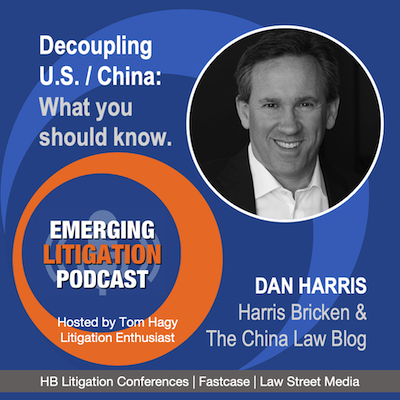
    Dan Harris is a leading authority on the legal and strategic aspects of conducting business in emerging markets. He is co-founder of the international practice of Seattle-based HarrisBricken, which has offices across the U.S., as well as in China, Spain, Mexico, and Brazil. His China Law Blog was named, and with good reason, to the ABA Journal’s “Blawg Hall of Fame.” Forbes, Business Week, Fortune, The BBC, The Wall Street Journal, The Washington Post, The Economist, CNBC, The New York Times, and many other major media players have looked to him for his perspective on international law issues. Dan writes and speaks extensively on international law with a focus on protecting businesses in their foreign operations and he has had the rare honor of being designated a “Super Lawyer.” He is also a member of the Editorial Board of Advisors for the Journal on Emerging Issues in Litigation and the Emerging Litigation Podcast.

    What Businesses and Lawyers Should Know About the U.S. / China Relationship

    “Americans mistakenly believe that China operates as a rational economic actor and that economics is their highest priority. It’s not and it never has been. Their highest priority is whatever is good for the Chinese Communist Party.”

    “Chinese companies view American and EU companies as very risky, in large part because so many American and EU companies are looking to move their manufacturing out of China.” 

    A major potential avalanche of risks are those that would shake the business world  should – as some expect it will –  trade relations between China, and America and EU, come to an end.

    China is America’s largest trading partner, a relationship responsible for $600B a year in commerce, according to the Office of the U.S. Trade Representative. By comparison, U.S. / European Union trade exceeds $1T. The trade deficit with China for goods is more than $300 billion, while the U.S. has a trade surplus for services of $25B. China is America’s largest supplier of imported goods, while China is America’s third largest export market. U.S. invests roughly $125B in China, compared to China’s investment of $38B in the U.S. The figures vary wildly depending on who you ask, but the Trade Representative puts the U.S. GDP at $21B and China’s at more than $14B.

    In case you missed it, U.S./China relations have been strained. President Trump cast a spotlight on the downsides of the relationship for the U.S., and China’s response to the sanctions imposed on Russia by President Biden and the West for invading Ukraine have made the relationship even rockier. The U.S./China marriage needs some serious counseling. Eventually, experts say, the couple is headed for divorce. How that breakup plays out, especially if or when China takes custody of Taiwan – peacefully or otherwise – is something the business world needs to brace for.  No; seriously. For example, should the West impose sanctions on China similar to those on Russia, the shift in the business world would be tectonic.

    Joining me on this episode is Dan Harris, a leading authority on the legal and strategic aspects of conducting business in emerging markets. Dan is co-founder of the international practice of Seattle-based HarrisBricken, which has offices across the U.S., as well as in China, Spain, Mexico, and Brazil. His China Law Blog was named, and with good reason, to the ABA Journal’s “Blawg Hall of Fame.”

    This podcast is the audio companion to the Journal on Emerging Issues in Litigation. The Journal is a collaborative project between HB Litigation Conferences and the Fastcase legal research family, which includes Full Court Press, Law Street Media, and Docket Alarm. The podcast itself is a joint effort between HB and our friends at Law Street Media. If you have comments or wish to participate in one our projects, or want to tell me how much  you learned from Dan,  please drop me a note at Editor@LitigationConferences.com.

    Tom Hagy
    Host and Litigation Enthusiast

    P.S. It’s possible I should stay away from forcing metaphors on my guests. The U.S. / China relationship is nothing like a marriage. We do, however, always forget our anniversary. We’re more like neighbors who have to deal with each other. Our “good mornings” and “have a nice days” are, at best, phony. There are lingering hurt feelings (“You always park in front of my house,” “You never invite us to parties”) and suspicions (“I’m pretty sure it’s you who doesn’t pick up after their dog”), but civility is a must when you share friends and a fence. Oh, man, and now our kids are playing together.

  • Full Ninth Circuit Removes Unwarranted Hurdles to Class Certification

    Full Ninth Circuit Removes Unwarranted Hurdles to Class Certification

    The Authors

    Jonathan Rubin

    Jonathan RubinPartner | MoginRubin LLP

    Co-founding partner at MoginRubin LLP, Jonathan Rubin focuses his legal practice exclusively on antitrust and competition law and policy. Based in Washington, DC, he has litigated and led trial teams in major antitrust cases throughout the country. He has published in influential academic journals and has spoken to numerous professional groups, including the Directorate General for Competition of the European Commission, the Antitrust Section of the American Bar Association, and the American Antitrust Institute.

    Dan Mogin

    Dan MoginManaging Partner | MoginRubin LLP

    Dan Mogin, founding and managing partner of MoginRubin LLP, concentrates his practice on antitrust, unfair competition and complex business litigation. He has served as lead counsel in numerous large antitrust cases, chaired the Antitrust Section of the California Bar, taught antitrust law and was editor-in-chief of a leading competition law treatise.

    Explore more from MoginRubin LLP!

    Blog: Emboldened by New Resources and Expanded Authority, Feds Continue 10-Year Look Back at Chinese Investment. By Dan Mogin, Jonathan Rubin, Jennifer Oliver, and Timothy LaComb. List

    OnDemand CLE Webinar: The Antitrust Case Against Google. Dan Mogin, Jonathan Rubin, Jennifer Oliver, Timothy LaComb, John Newman, Dr. Alan Grant

    Blog: FTC’s Case Against Facebook Will Test the Flexibility of U.S. Antitrust Law.Authors: Jonathan Rubin and Jennifer Oliver, MoginRubin LLP

    Blog: Full Ninth Circuit Removes Unwarranted Hurdles to Class Certification. Jonathan Rubin, Dan Mogin.

    Journal: Policy Derailed: Can U.S. Antitrust Policy Toward Standard Essential Patents Get Back on Track by Jonathan Rubin

    Webinar: Class Certification After Olean v. Bumble Bee with Jonathan Rubin, James Bogan lll, Jonathan Cohn, Bradley Hamburger.

    Journal: FTC v. Amazon: Market Definitions and Section 5 of the FTC Act

    Podcast: Algorithmic Software Facilitated Price Fixing with Jonathan Rubin

    Plus, additional insights from the MoginRubin Blog.

    Full Ninth Circuit Removes Unwarranted Hurdles to Class Certification

    “Nothing in Rule 23 suggests that the presence of more than a de minimis number of uninjured class members affects whether questions affecting only individual class members predominate. The Ninth Circuit’s en banc decision is a model of clear thinking and a welcome course correction in the law of class certification.”

    Excerpt:

    There was reason for optimism in August 2021, when the Ninth Circuit Court of Appeals granted rehearing en banc of a 2-1 decision that would have made it more difficult for antitrust claimants to secure class certification. The three-judge panel in Olean Wholesale Grocery Coop., Inc. v. Bumble Bee Foods LLC, 993 F.3d 774 (9th Cir. 2021) had determined that Federal Rule of Civil Procedure 23(b)(3) required a district court to find that no more than a de minimis number of class members are uninjured before a class may be certified. Having announced this de minimis rule in its opinion, the court then took the unusual step of inviting the parties to argue whether the full court should rehear the issue en banc.

    As we wrote last year when en banc rehearing was granted, with its de minimis rule, “the panel really jumped the median strip.” We argued that the rule conflated the question of whether issues common to the class predominate over issues unique to individual class members with the question of how the class is defined and that the Ninth Circuit’s new and unrealistic de minimis requirement erected an unnecessary procedural hurdle to class certification. Other commentators and amici argued that requiring proof that all but a de minimis number of class members are injured requires a determination on the merits, impermissible at the class certification stage.

    In welcome news for claimants and attorneys who bring antitrust class actions, the Ninth Circuit sitting en banc decided against the de minimis rule, for all of the foregoing reasons, in Olean Wholesale Grocery Coop., Inc. v. Bumble Bee Foods LLC, No. 19-56514, 2022 U.S. App. LEXIS 9455 (9th Cir. Apr. 8, 2022).

    In a thorough review of the requirements for class certification under Rule 23, the Ninth Circuit held that the movant’s burden is to prove the prerequisites of Rule 23 by a preponderance of the evidence, bringing the Ninth Circuit in line with the law in the First, Second, Third, Fifth, and Seventh Circuits …

    Read the full article on the MoginRubin Blog

  • Overconfidence: A Risky but Pervasive Phenomenon in Litigated Disputes

    Overconfidence: A Risky but Pervasive Phenomenon in Litigated Disputes

    The Author

    Jeff Trueman

    Jeff TruemanMediator / Arbitrator

    Jeff Trueman (jt@jefftrueman.com) is an experienced, full-time mediator and arbitrator. He helps parties resolve a wide variety of litigated and pre-suit disputes and interpersonal problems concerning catastrophic injuries, wrongful death, professional malpractice, employment, business dissolution, real property, and domestic relations. Jeff is a past Director of Dispute Resolution for the Circuit Court for Baltimore City where he oversaw over 70 retired judges and senior attorneys conducting over 1,500 mediations, settlement conferences, and neutral evaluations per year. He is a Distinguished Fellow of the International Academy of Mediators, an invitation-only membership organization consisting of some of the most successful commercial mediators in the world.

    The Journal on Emerging Issues in Litigation

    Emerging Litigation Podcast

    Emerging Litigation PodcastProduced by HB Litigation and Law Street Media

    Interviews with leading attorneys and other subject matter experts on new twists in the law and how the law is responding to new twists in the world.

    Overconfidence: A Risky but Pervasive Phenomenon in Litigated Disputes

    “Lady Justice symbolizes fairness and impartiality as she oversees the adjudication process. Although she may hold the scales of justice in one hand, she also carries a large sword in her other hand. And she’s blindfolded. Knowing that, how confident should you be?” 

    Abstract: “Overconfidence” may have negative connotations, but it can be beneficial in competitive situations like litigation where parties compete for resources. Nonetheless, posturing and overconfidence of opposing parties and counsel are common frustrations felt by lawyers and claims professionals. Most litigants fail to see themselves as overconfident even though that can result in miscalculations and erroneous risk assessments. Litigants can employ techniques to improve decision making but sometimes going to trial is considered the right decision for reasons that are considered more important than whether the result is better than the last settlement demand or offer. In addition to focusing on legal and financial threats that are external to themselves, litigants might also consider threats of their own making; namely, how they think about risk amid uncertainty. Download the complete article for more insights from the author. 

    Download the article now!

  • Insurance Coverage for PFAS Claims

    Insurance Coverage for PFAS Claims

    PFAS Insurance Coverage with Robert D. Chesler of Anderson Kill

    Robert CheslerListen to my interview with Anderson Kill’s Robert D. Chesler, a preeminent expert on insurance coverage law especially in the context of highly complex long-tail claims scenarios involving multiple parties and events that can span decades and always cost many millions of dollars.  Considered by many to be an insurance guru on these cases — as well as on D&O, cyber and privacy, and intellectual property insurance — Bob holds a Ph.D. and masters degree from Princeton University, and a J.D. (cum laude) from Harvard Law School.

    This podcast is the audio companion to the Journal on Emerging Issues in Litigation, and Bob is one of our most valued editorial advisors. The Journal is a collaborative project between HB Litigation Conferences and the Fastcase legal research family, which includes Full Court Press, Law Street Media, and Docket Alarm. The podcast itself is a joint effort between HB and our friends at Law Street Media. If you have comments or wish to participate in one our projects, or want to tell me how much  you learned from Bob,  please drop me a note at Editor@LitigationConferences.com.

    Tom Hagy
    Host and Litigation Enthusiast

    P.S. The fact that I make myself laugh during these interviews probably has less to do with the subject matter (most definitely, is more precise) or my sense of humor, and more to do with cabin fever.  Or I’m just nuts.

    The PFAS  family of chemicals is one stubborn bunch. They are a class of man-made products dubbed “forever chemicals,” because of the difficulty of removing them from the environment, humans, and other animals.  They are also at the center of sprawling litigation around the country involving alleged property damage, water contamination, and bodily injury. More than 1,500 cases are consolidated in closely-watched multi-district litigation in federal court in South Carolina.


    Listen to our previous episodes, including one featuring two scientists on PFAS and another on microplastics.

    Explore more from Anderson Kill!

    OnDemand CLE Webinar: Insurance Coverage for Sexual Abuse Claims. Panel: Marshall Gilinsky, Dan Schorr, Brian Della Torre, Pamela Hans, Dennis J. Artese

    Podcast 1 of 2 series: Insurance Coverage with Dr. Jaana Pietari and Jim Fenstermacher and Litigation with Bob Chesler.

    Podcast 2 of 2 series: PFAS Insurance Coverage with Robert D. Chesler of Anderson Kill.

    Sister article to podcast 1 of 2 series: Remediating, Insuring, and Litigating PFAS Claims. Authors: Dr. Jaana Pietari, PhD, MBA, PE, Jim Fenstermacher, PE, Dr. Michael Bock, PhD, MS, Robert D. Chesler and Nicholas M. Insua, Sheila Mulrennan, Robin Kelliher, Jason R. Waters
    Podcast: Autonomous Vehicles: The New Technology Driving the Litigation Conversation Podcast with Cort Malone, John Leonard, Joshua Zelen

    Podcast: Violations of Biometric Privacy Laws: Policyholders’ Victories and the Implications Going Forward with John Leonard and Cort Malone

    Journal on Emerging Issues, Editorial Board of Advisors: Dennis Artese, Robert D. Chesler

    Asymmetrical Combat: Bad Faith Liability in Insurance Recovery Cases. By William Passannante

    Climate Change, ESG, and D&O Insurance: Collision or Cooperation? Authors: Robert Chesler, Dennis J. Artese, and Joseph Villa

    Litigation After Biometric Privacy Law Violations: Policyholder Victories and Their Implications. Authors: Cort T. Malone, Abigail Damsky

    Protecting Policyholders as AI Is Developed for Insurance Claims Handling – Ensuring “Decency and Humanity” in the Digital Age. Authors: Marshall Gilinsky, Madison Marlow

    Police–The Environmental, Social, and Governance Police Have Arrived: Is your Insurance Ready. Authors: Dennis Artese, Bob Chesler

    How Insurance Companies Defraud Their Policyholders, and What Courts and Legislators Should Do About It. Authors: Robert Chesler, Amy Weiss, and Jade Sobh

    The Promise and Peril of Quantum Computing and Its Implications for Cyber Insurance. By Cameron R. Argetsinger

    The Use and Abuse of the Pollution Exclusion. Authors: Dennis Artese, Jamie O’Neil, Robert Chesler

    Property Insurance Coverage for Emerging Risk: Underground Climate Change. Authors: Dennis J. Artese, Ethan W. Middlebrooks, Thomas Dupont

    Autonomous Vehicles: The New Technology Driving the Litigation Conversation. Authors: Cort Malone, John Leonard, and Joshua Zelen

  • Despite Relative Inactivity on the Virtual Front in Ukraine, Russia’s Global Cyber-Attacks are Coming

    Despite Relative Inactivity on the Virtual Front in Ukraine, Russia’s Global Cyber-Attacks are Coming

    Editor

    Tom Hagy

    Tom HagyHB Founder

    Tom is HB’s Founder and Managing Director. His career in litigation content spans four decades during which he was editor, managing editor, and finally publisher at Mealey’s Litigation Reports. After Mealey’s was acquired by LexisNexis Tom became a vice president involved in creating new content and services at the legal research and services giant. He has always overseen or directly created articles, blogs, conferences, webinars, data collections, and now podcasts — all on litigation. Tom founded HB in 2008, and four years later he founded Custom Legal Content, a boutique content creation shop serving boutique and specialized legal practices and litigation services. In addition to his work at HB and CLC, Tom is Editor in Chief of the Journal on Emerging Issues in Litigation, and host of the Emerging Litigation Podcast. For years he was a leader in an international specialized publishing association, frequently speaking and writing about publishing, and is now active in an open community of content and event producers called Renewd. Sometime during the last millennium Tom proudly graduated with a B.A. in Communications from Bethany College in West Virginia.

    The Journal on Emerging Issues in Litigation

    Emerging Litigation Podcast

    Emerging Litigation PodcastProduced by HB Litigation and Law Street Media

    Interviews with leading attorneys and other subject matter experts on new twists in the law and how the law is responding to new twists in the world.

    Despite Relative Inactivity on the Virtual Front in Ukraine, Russia’s Global Cyber-Attacks are Coming

    Cyber WarSince his cyber-war capabilities seem to have worked well for him, why isn’t Vladimir Putin launching more cyber-attacks against Ukraine and its allies? Reports suggest he didn’t think he’d need them, plus they take time to execute. Other reports suggest he is trying to get some cyber damage on the scoreboard. Maybe the actual disruption to Ukraine from tanks and bombs, even though the Ukrainians aren’t giving him the satisfaction of a clean and easy parade-style invasion, could be redundant.

    But many experts did think that much of Russia’s invasion – and Ukraine’s defense –  would take place in cyberspace. Some of that is happening, but there are reasons Russia hasn’t launched large-scale attacks. Kyle Fendorf and Jessie Miller wrote for the Council on Foreign Relations on March 24, 2022, that reasons include “the higher efficacy of kinetic attacks and difficulties in planning and executing massive cyberattacks in a short timeline.” Ukraine, meanwhile, has taken a novel approach: “attempting to mobilize international sentiment” to “create an army of cybersecurity professionals to attack military and critical infrastructure targets in Russia.” Fendorf and Miller list several Russian efforts, including DDoS attacks on Ukrainian banking and defense websites. And hackers like Anonymous have “declared war” on Russia. The group has taken credit for several successes, including interrupting television broadcasts with clips from the war and leaking thousands of confidential government files.

    According to Reuters, the pro-Ukraine cyber assaults are hitting their targets, saying Russian government websites are facing “unprecedented cyber-attacks.” Relying on the Russian news agency TASS, websites for the Aeroflot airline, the Sberbank bank, and the Kremlin itself have experienced “outages and temporary access.” The Kremlin, facing greater isolation from global financial systems and supply chains, is taking steps to bolster its IT sector, such as tax breaks and easier access to lending, Reuters reports.

    President Biden has warned U.S. organizations to “lock their digital doors” for fear of a Russian cyber-attack, adding that “evolving intelligence” indicates attacks are coming.

    As quoted in Politico, Jen Easterly, director of the Cybersecurity and Infrastructure Security Agency, told 13,000 participants on a recent call that we should “assume that disruptive cyber activity will occur: and “we should consider every sector vulnerable.”

    On March 24, the Department of Justice Department unsealed two indictments charging four Russian nationals working for the Kremlin with “attempting, supporting and conducting” cyber-attacks on the global energy sector between 2012 and 2018. The targets were hundreds of organizations in 135 countries, including the U.S. Nuclear Regulatory Commission and a Kansas power plant.  “The potential of cyberattacks to disrupt, if not paralyze, the delivery of critical energy services to hospitals, homes, businesses and other locations essential to sustaining our communities is a reality in today’s world,” said U.S. Attorney Duston Slinkard for the District of Kansas.

    BBC News reported that Ukraine “has remained relatively untroubled” by Russia’s cyber weapons, but “experts now fear that Russia may go on a cyber-offensive against Ukraine’s allies. The BBC News article reminds us of the three types of Russian cyber-attacks “the West fears most,” detailing Russia’s takedown of Ukraine’s electricity grid in 2015 in an attack called BlackEnergy; the “most costly” attack in cyber history called NotPetya, a worldwide computer killer that caused $10 billion in damage, followed by WannaCry which scrambled data in 150 countries; and the one executed by a Russian criminal organization called DarkSide which caused a state of emergency in the U.S. in May 2021 when their ransomware strike shut down the vital Colonial Pipeline.

    The insurance industry, which is always impacted by any global calamity, man-made or natural, is also worried about a parallel cyberwar. Ben Dyson, a reporter for S&P Global Market Intelligence, wrote on March 28, 2022, that while the industry’s direct exposures to Russian and Ukrainian cyberrisk “is likely small,” the larger risk is the “potential for spillover” to networks in other countries. “The insurance industry can look back to at least one precedent for a cyberattack related to the wider conflict between Ukraine and Russia having global implications: the 2017 NotPetya malware attack. NotPetya spread to thousands of companies globally, handing the insurance industry a $3 billion claims bill and its first taste of a cyber catastrophe. NotPetya occurred in relative peacetime and was largely covered by cyber-specific policies.”

    Attorney Vincent Vitkowsky, in an article for the Insurance Journal posted on March 25, 2022, agreed that Russia may try to turn up the stress of other countries if the war drags on. “After the conflict ends, however it ends, Russia will be the object of extreme resentment and suspicion. It may launch cyberattacks to increase disorder, believing that an environment of disorder would be serve its position as a significant power.” Vitkowsky said new cyber weapons will only make the threats worse, such as “zero click vulnerabilities” which don’t even need the help of an unsuspecting employee to click on a link, and the so-called HermeticWizard, “a new strain of software designed to autonomously spread another strain, HermeticWipe, to computers in a network.”  He writes that carriers face exposure to losses from direct or indirect cyberattacks against their insureds globally, but says the so-called War Exclusions “may mitigate that exposure,” then goes on to explain how in his article. [Vince is a member of the Editorial Board of Advisors for the Journal on Emerging Issues in Litigation.]

    FT technology correspondent Hannah Murphy asked Kevin Mandia, the founder of cyber security company Mandiant (which was just acquired by Google for $5.4 billion) about the current state of the cyber conflict between nations.

    The current state feels like, Mandia said, “braced for impact.”

    The cybersecurity expert noted operation “Shields Up” by the Cybersecurity and Infrastructure Security Agency, plus all of the private and public players in the West and NATO, “all watching the cyber domain waiting for what happens.” He sees the war in Ukraine as “an opportunity for us to figure out what is the new normal because we’re used to conflict being air, land, sea, maybe a little bit of space . . . but a cyber domain is part of that conflict, too.” He went on to say, however, he’s “not sure everyone’s got fully fleshed-out strategies for how to do warfare in the cyber domain, and when to bring it to bear.”

    He predicted that if Russia wants to retaliate against sanctions and embargoes, a cyber-attack is “probably the first tool that might be chosen.”

    What do you think?

  • Tanks and Banks: What Fintechs Must Know About Sanctions on Russia

    Tanks and Banks: What Fintechs Must Know About Sanctions on Russia

    The Guest

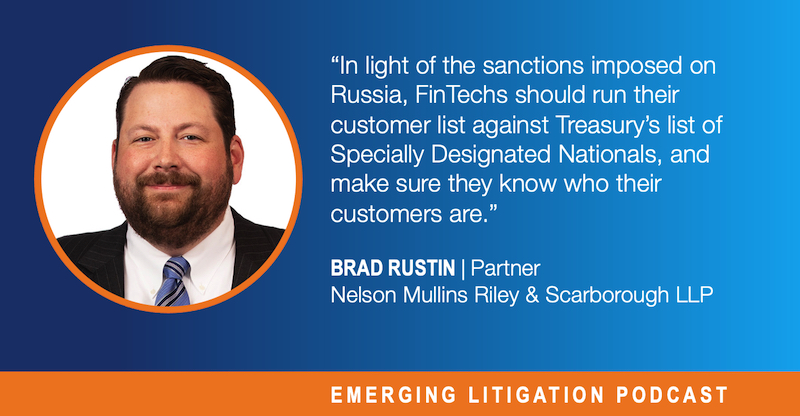
    Brad Rustin

    Brad RustinPartner | Nelson Mullins Riley & Scarborough

    A highly regarded attorney and much-sought-after speaker for his expertise on the laws and operations of the technology-driven global financial system. Also a member of the Editorial Board of Advisors for the Journal on Emerging Issues in Litigation.

    Emerging Litigation Podcast

    Emerging Litigation PodcastProduced by HB Litigation and Law Street Media

    Interviews with leading attorneys and other subject matter experts on new twists in the law and how the law is responding to new twists in the world.

    The Journal on Emerging Issues in Litigation

    Tanks and Banks: What Fintechs Must Know About Sanctions on Russia

    Tom Hagy Interviews Brad Rustin of Nelson, Mullins, Riley & Scarborough

    Click below to get the complete article.

    Tanks and Banks: an interview with Brad Rustin on Russian Sanctions and Fintechs

  • Cybersecurity and Data Privacy Year in Review 2021

    Cybersecurity and Data Privacy Year in Review 2021

    The Authors

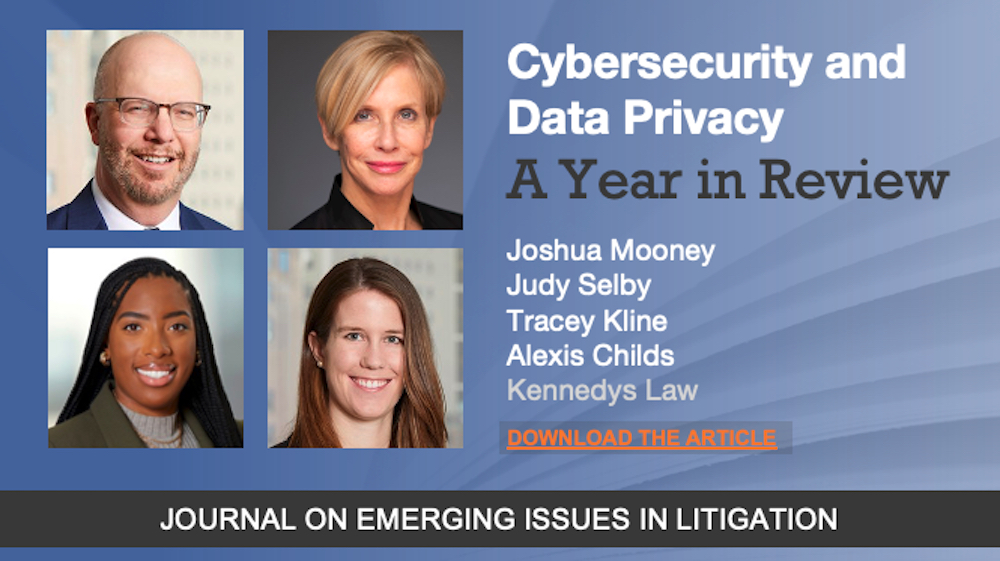
    The authors are all attorneys with the Kennedys law firm (kennedyslaw.com). Joshua Mooney (joshua.mooney@kennedyslaw) and Judy Selby (judy.selby@kennedyslaw.com) are partners. Tracey Kline (tracey.kline@kennedyslaw.com) and Alexis Childs (alexis.childs@kennedyslaw.com) are associates. Bridget Mead, associate, and Javier Vijil, senior associate, also contributed to this article.

    Judy Selby is also a member of the Editorial Board of Advisors for the Journal on Emerging Issues in Litigation.

    The Journal on Emerging Issues in Litigation

    Cybersecurity and Data Privacy 2021 in Review

    By Joshua Mooney, Judy Selby, Tracey Kline, and Alexis Childs

    Abstract:

    As the world emerged from lockdown, it should come as no surprise that cybersecurity and data privacy remained dominant topics in the media and legal industry. Some of 2021 was much like 2020—ransomware attacks continued to fill the headlines, and in the aggregate, constituted significant loss paid under cyber insurance policies. OFAC reminded victim companies and incident response firms (and cyber carriers) that it remains unlawful to pay ransom payments to designated organizations. Comprehensive federal legislation addressing cyber defenses and notification requirements never materialized. Yet in 2021, we saw new and significant developments. U.S. law continued its drift toward comprehensive privacy regulation with two new significant pieces of privacy legislation and California’s enforcement of the California Consumer Privacy Act. In the absence of federal legislation, federal agencies either stepped up enforcement actions or signaled that they intend to do so within their realms of governance. Litigation under the Illinois Biometric Information Privacy Act continued its surge while the Illinois high courts rendered two impactful decisions and a circuit court punted to Illinois’s highest court. This review provides a brief synopsis of many events and developments that made the authors’ list.  

    Perhaps one of the most significant developments in U.S. privacy law for 2021 was the enactment of comprehensive data privacy laws in Virginia and Colorado. Both pieces of legislation, which go into effect in 2023, adopt frameworks resembling those in the EU General Data Protection Regulation 2016/679 (GDPR) and the California Consumer Privacy Act (CCPA). Both laws also grant consumers significant rights with respect to their personal data, but neither contains a private right of action. 

    Get the article now!

  • Climate Change, ESG, and D&O Insurance: Collision or Cooperation?

    Climate Change, ESG, and D&O Insurance: Collision or Cooperation?

    The Authors

    Robert D. Chesler (rchesler@andersonkill.com) is a shareholder in Anderson Kill’s New Jersey office and is a member of the firm’s Cyber Insurance Recovery Group. Bob represents policyholders in a broad variety of coverage claims against their insurers and advises companies with respect to their insurance programs. Dennis J. Artese (dartese@andersonkill.com) is a shareholder in Anderson Kill’s New York office and chairs the firm’s Climate Change and Disaster Recovery Group. Joseph Vila (jvila@andersonkill.com) is an insurance recovery attorney in Anderson Kill’s New Jersey office.

    Journal on Emerging Issues in Litigation

    Climate Change, ESG, and D&O Insurance: Collision or Cooperation?

    By Robert D. Chesler, Dennis J. Artese, and Joseph Villa

    Abstract:
    Climate change has been tied to the recent increase in catastrophic weather events. Insurance coverage for often billions of dollars in damage becomes a source of argument between insurers, who want to limit their exposure, and policyholders, who want the coverage they argue the carriers are contractually obligated to pay. The authors discuss the nature of the underlying suits and the potential coverage issues; the types of policies implicated; cases that have addressed these issues; the rising societal concern over climate change that have played a role in the new corporate emphasis on environmental, social, and governance, or ESG, and the insurance industry’s response to this trend.

    Excerpts:
    Directors and Officers (D&O) policies [are] directly affected by climate change. Two types of suits are already happening. First, there are at least 1,375 climate change–related suits pending in the United States, about two dozen of which have been filed by local municipalities and states seeking damages because of climate change. For example, the attorneys general of New York, Massachusetts, and the U.S. Virgin Islands launched investigations to determine whether Exxon Mobil Corporation misrepresented to investors the risks of how climate change might impact its business. Although the U.S. Virgin Islands attorney general terminated its investigation, the New York and Massachusetts attorneys general filed separate suits against Exxon.

    In the seminal case People of the State of New York, By Letitia James v. Exxon Mobil Corporation, 119 N.Y.S.3d 829 (N.Y. Sup. Ct. 2019), the State of New York sued Exxon, alleging that it violated the state’s securities act by making materially false and misleading statements to the public and investors about how the company manages risks of climate change and the cost of carbon in assessing demand for its products. The state dropped its common law fraud claims prior to trial, but proceeded with a claim under New York’s Martin Act, which permits the attorney general to sue for fraud in connection with the marketing of securities without requiring proof of scienter, reliance, and damages, as well as under New York’s Executive Law, which prohibits persistent fraudulent acts. After a trial, the New York Supreme Court held that the state failed to demonstrate by a preponderance of the evidence that Exxon made any material misrepresentations to investors ….

    As regulatory activity and private litigation activity surrounding climate change issues continue to increase, liabilities likely will follow. D&O insurance companies will be called on to address those liabilities with increasing frequency.

    Those claims will present complex coverage issues of first impression, and policyholders can expect a fight. Policyholders also should be on the lookout for more restrictive coverage terms on D&O renewals. Policyholders should work with their brokers to obtain the broadest coverage available, and consult with sophisticated coverage counsel in the event that they are faced with climate change–related claims. 

    Get the article now!

    Explore more from Bob Chesler and contributing specialists!

    Journal on Emerging Issues, Editorial Board of Advisors

    The Use and Abuse of the Pollution Exclusion. By Dennis Artese, Jamie O’Neil, Robert Chesler

    The Environmental, Social, and Governance Police Have Arrived: Is your Insurance Ready. Authors: Dennis Artese, Bob Chesler.

    PFAS Insurance Coverage with Jaana Pietari and Jim Fenstermacher and Litigation with Bob Chesler: Part 1 of 2 Podcasts

    PFAS Insurance Coverage with Robert D. Chesler of Anderson Kill. Part 2 of 2 Podcasts

    How Insurance Companies Defraud Their Policyholders, and What Courts and Legislators Should Do About It

    Climate Change, ESG, D&O Insurance: Collision or Cooperation? By Robert D. Chesler, Dennis J. Artese and Joseph Villa

    Remediating, Insuring, and Litigating PFAS Claims. By Dr. Jaana Pietari, PhD, MBA, PE, Jim Fenstermacher, PE, Dr. Michael Bock, PhD, MS, Robert D. Chesler and Nicholas M. Insua, Sheila Mulrennan, Robin Kelliher, Jason R. Waters