Author: Tom Hagy

  • The Impact of Sanctions on Russia on Global Financial Markets with Brad Rustin

    The Impact of Sanctions on Russia on Global Financial Markets with Brad Rustin

    The Impact on Global Financial Systems of U.S. Sanctions on Russia with Brad Rustin

    Brad Rustin on FinTechBut what risks do American corporations and financial institutions face in light of these measures? What difficult reverberations will companies feel across the world? What should global businesses and FinTechs be doing right now to avoid, among other things, violating the restrictions imposed by the U.S. Treasury Department’s Office of Foreign Assets Control (OFAC)? What role will cryptocurrency play in all of this? Also, do institutions whose data are stored in Russia and Ukraine face an additional risk as a parallel (albeit less horrific) battle rages on in cyberspace?

    Listen to my interview with Brad Rustin, a partner with Nelson Mullins Riley & Scarborough LLP and chair of the firm’s Financial Services Regulatory Practice. Brad is a highly regarded FinTech law and industry expert. This will be apparent when you listen. Brad is also on the Editorial Advisory Board of the Journal on Emerging Issues in Litigation. This is a special rapid-release episode given we feel the insights Brad shares are insights business and FinTech’s — and their attorneys — urgently need to hear.

    This podcast is the audio companion to the Journal on Emerging Issues in Litigation, a collaborative project between HB Litigation Conferences and the Fastcase legal research family, which includes Full Court Press, Law Street Media, and Docket Alarm. The podcast itself is a joint effort between HB and our friends at Law Street Media. If you have comments or wish to participate in one our projects, or want to tell me how much  you learned from Brad,  please drop me a note at Editor@LitigationConferences.com.

    Tom Hagy
    Host and Litigation Enthusiast

    P.S. We did not get to discuss Russia’s retaliatory sanctions against President Biden, his son, Hunter, and Hillary Clinton. No word on sanctions against the Biden dogs. Oh! This just in from People magazine: “Hillary Clinton Thanks Russia for ‘Lifetime Achievement Award’ After Country Issues Sanction Against Her.” That’s just good comedy.

    Economic sanctions leveled against Russia, its leaders, and selected oligarchs by the United States and many other countries for its invasion of Ukraine are arguably the most aggressive in history. Their impact on the Russian economy has been severe and immediate, pushing the nation to the brink of economic collapse.


    But, as they must, the gears of global business and finance must keep turning.

  • Social Inflation’s Impact on Jury Verdicts

    Social Inflation’s Impact on Jury Verdicts

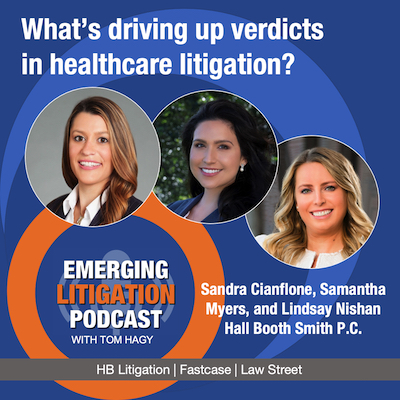
    Social Inflation’s Impact on Jury Verdicts in Healthcare Litigation

    Our guests wrote in the Journal on Emerging Issues in Litigation: “These outsize awards are often driven by myriad factors including sympathetic jurors, societal conceptions about income and wealth of corporations, the use of emotion-driven ‘Reptile Theory’ tactics by plaintiff attorneys, the media spotlight on ‘bad apple’ physicians, and numerous other social factors. A new factor that influences elevated jury verdicts is the increasing volume of information—whether true or false—that is exchanged on social media platforms.”

    Podcast on jury verdictsListen to my interview with Hall Booth Smith P.C. attorneys Sandra Cianflone, Samantha Myers, and Lindsay Nishan, each of whom represents members of the healthcare industry, as they discuss what drives large verdict and what attorneys should consider in mitigating the effects of this phenomenon.

    In keeping with tradition, we may have strayed a bit from the topic. One guest’s Aunt Lulu made an appearance. It turns out Covid lockdowns may have produced more enthusiastic jurors. And I added another reason why writing and podcasting, and not the practice of law, was a better career path for me. (Apparently lawyers aren’t supposed to laugh in people’s faces. Noted.)

    This podcast is the audio companion to the Journal on Emerging Issues in Litigation, a collaborative project between HB Litigation Conferences and the Fastcase legal research family, which includes Full Court Press, Law Street Media, and Docket Alarm. The podcast itself is a joint effort between HB and our friends at Law Street Media. If you have comments or wish to participate in one our projects, or want to tell me how much  you learned from Sandie, Sam, Lindsay, or Aunt Lulu,  please drop me a note at Editor@LitigationConferences.com.

    Tom Hagy
    Litigation Enthusiast
    Host of the Emerging Litigation Podcast

    Jurors’ perceptions of big corporations, insurance companies, drug companies, physicians and other healthcare providers is increasingly colored by TV and social media. 


    The same is true for people’s understanding of the practice law or medicine, which may be as wrong as it is immovable. “Social inflation” refers to rising litigation costs and the resulting higher insurance payouts which drive up the cost of insurance. The phrase has taken on new meanings as it is used in the general press. To some it means tort reform rollbacks, litigation funding, and is most often seen in references to so-called “nuclear” jury verdicts, i.e., awards that exceed $10 million.

    What factors contribute to these jury awards?

  • The Shifting Gun Liability Landscape: Plaintiffs Say Companies are Marketing Illegally, Insurers End Up Paying

    The Shifting Gun Liability Landscape: Plaintiffs Say Companies are Marketing Illegally, Insurers End Up Paying

    The Author

    Charlie Kingdollar

    Charlie KingdollarInsurance Industry Expert

    Charlie spent more than four decades with General Reinsurance, three-quarters of which as the company’s Emerging Issues Officer. One colleague described him as “one of the most prescient and gifted industry futurists I have met in my 36 year professional career within the insurance industry. Entertaining and insightful, his ability to digest and communicate complex issues, many before they are readily apparent, is both a gift and a talent.” Charlie is also a member of the Editorial Board of Advisors for the Journal on Emerging Issues in Litigation.

    The Shifting Gun Liability Landscape: Plaintiffs Say Companies are Marketing Illegally, Insurers End Up Paying

    By Charlie Kingdollar

    On Feb. 15, 2022, Remington Arms, manufacturer of the Bushmaster AR15-style rifle agreed to pay $73 million to settle a lawsuit filed by the families of nine of the victims of the Dec. 14, 2012, Sandy Hook Elementary School shooting. The $73 million will be paid by four of Remington’s insurers (and likely their reinsurers).[i]

    Why is this a big deal? Insurers and reinsurers providing liability coverage for gun manufacturers did so believing that federal law protected gun manufacturers from liability arising from shootings under the federal Protection of Lawful Commerce in Arms Act (PLCAA). It seems likely that policy terms and conditions as well as pricing of the risk reflected that perceived liability protection.

    Things have changed. The Connecticut plaintiffs filed their suit under the Connecticut Fair Trade Practices Act. The plaintiffs alleged that the Bushmaster was a combat weapon and that Remington improperly marketed it to civilians – particularly trying to reach young men. In 2019, the Connecticut Supreme Court ruled that the federal PLCAA did have some carve-outs for state laws and subsequently declined Remington’s request to dismiss the lawsuit. It seems a safe bet that the families of other Connecticut gun violence victims will file similar suits over past and/or future incidents.

    Okay, so this is Connecticut. But it seems likely that this lawsuit will be used as a template by plaintiffs in other states that have similar statutes – and many do. This lawsuit and settlement could result in burgeoning litigation against gun manufacturers.

    Presumably, even a single victim shot with a Bushmaster, or any gun that could be argued is a combat weapon, could file a similar suit under a state’s Fair Trade Practices Act.

    Which other guns could be deemed “combat weapons” and therefore unfit for civilian populations? Only time and future litigation will tell. One possible example is the WEE1 Tactical, the manufacturer of the AR-15, which is similar to the Bushmaster, may find itself facing litigation. A look at AR-15-style guns on Wikipedia results in a list of 27 guns by 26 manufacturers – and I doubt this is a comprehensive list.[ii] Would a machine pistol be considered a “combat weapon”? How many other types of firearms might be deemed “combat weapons”?

    WEE1 Tactical has recently begun advertising the JR-15 – a smaller, lighter version of the AR-15 that fires smaller .22 caliber rounds for use by children. WEE1’s website states: “The JR-15 is the first in a line of shooting platforms that will safely help adults introduce children to the shooting sports.”[iii] Given that the plaintiffs in the Sandy hook case stressed the firm was specifically marketing the Bushmaster to young men it will be interesting to see how this marketing strategy will play out in any future similar litigation.

    There’s been another crack in the perceived liability protection afforded to gun manufacturers in the U.S.  Last year the State of New York enacted a law that “would classify the illegal or improper marketing or sale of guns as a nuisance…that supporters said would bolster litigation against gun companies.”[iv]

    Will other states follow? If even a few enact similar statutes, the defense and indemnity costs could be significant to the gun manufacturers and their insurers and reinsurers.

    Bushmaster has settled once before with the families of victims shot by one of its guns. In 2004, the company agreed to pay $2.5 million to settle with the families of victims shot by the D.C. sniper.[v] Not much changed after that settlement. It may be different this time.

    What about other entities in the gun liability chain? If the gun manufacturer can be held libel for marketing a combat weapon to civilians, can wholesalers and retailers also be found liable?  Could courts find that these companies also played a role in putting “combat weapons” into the hands of civilians?  If so, the costs to the Property/Casualty insurance industry will be greater.

    Unfortunately, mass shootings and gun violence are on the rise in the United States. The number of mass shootings (defined as 4 or more people shot – killed or wounded) have increased every year except one from 2014 to 2021. In 2014 there were 269 mass shootings in the U.S.  By 2021, this increased to 691 mass shootings. There have been 2,402 mass shootings in the U.S. in the past five years. And we’ve only mentioned mass shootings incidents.[vi]

    Gun violence generally continues to rise. “Guns were involved in 75% of all homicides and 91% of homicides involving youths between 2018 and 2019 … those new numbers represent a significant and troubling uptick from a decade before.”[vii]

    I suspect insurers and reinsurers providing liability for companies that manufacture and sell guns find themselves as defendants in an increasing number of lawsuits.

    [i] https://www.washingtonpost.com/nation/2022/02/15/remington-sandy-hook-settlement/

    [ii] https://en.wikipedia.org/wiki/AR-15_style_rifle

    [iii] https://en.wikipedia.org/wiki/AR-15_style_rifle

    [iv] https://www.nytimes.com/2022/02/15/nyregion/sandy-hook-families-settlement.html?referringSource=articleShare

    [v] https://www.washingtonpost.com/nation/2022/02/15/remington-sandy-hook-settlement/

    [vi]   https://www.gunviolencearchive.org/

    [vii]   “Gun Deaths Continue to Rise In American Cities,” U.S. News, 1/10/22

  • Robojudges: If Machines Could Make Judicial Decisions, Should They?

    Robojudges: If Machines Could Make Judicial Decisions, Should They?

    The Author

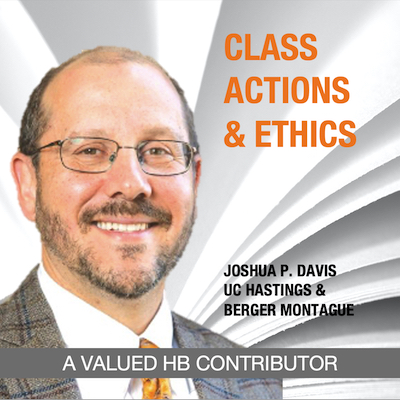
    Joshua P. Davis

    Joshua P. DavisProfessor & Practicing Attorney

    A leading academic and practitioner, Joshua P. Davis (davisj@usfca.edu) is a nationally recognized expert on legal ethics and class actions, as well as on artificial intelligence in the law, antitrust, civil procedure, free speech, and jurisprudence. He has published more than 30 scholarly articles and book chapters on these subjects and is currently writing a book on AI titled Unnatural Law, which will be published by Cambridge University Press. He is Research Professor of Law at the University of California Hastings College of Law, and a Shareholder of the Berger Montague PC law firm and Manager of its new San Francisco Bay Area Office. Before taking these posts, for more than 20 years Davis was a tenured Professor of Law at University of San Francisco Law School, where he also served as the Director of the Center for Law and Ethics.

    Davis is also a member of the Editorial Board of Advisors for the Journal on Emerging Issues in Litigation, published by Fastcase Full Court Press. Tom Hagy, Editor in Chief.

    You can also listen to Josh on the Emerging Litigation Podcast!

    Robojudges: If Machines Could Make Judicial Decisions, Should They?

    By Joshua P. Davis

    Abstract: As artificial intelligence makes its way into every aspect of our daily lives—including the practice of law—humans have some decisions to make. Do we wish for AI to replace human judges? What are the risks and how might they be mitigated? What breakthroughs need to occur? How might robotic judges, or “robojudges,” perform better than human jurists? What surprises might be in store? Read on for the author’s perspectives on these important questions. After all, as he points out, AI is already being used by the judiciary, albeit to a limited extent. 

    Some of the most exciting, vexing, and terrifying issues at the intersection of artificial intelligence (AI) and law involve robojudges. Can we build a robojudiciary that replaces human judiciaries? Should we? These are no small questions given such a shift would massively disrupt how our legal systems operate and transform democratic self-government. 

    Part of the challenge in thinking about robojudges is technical. There are all sorts of practical technological advances that would be necessary to build an effective robojudge. We are not there yet and we likely won’t be for a while. Some of the steps would likely require increasing the power of computers, designing programs for natural language, and possibly mastering quantum computing. 

    More general and accessible, however, are a series of conceptual issues. We might frame them as questions. 

    1. What breakthroughs are necessary for AI to think the way we do? 
    2. Will AI be able to simulate human instrumental reasoning; that is, reasoning about how best to achieve prescribed objectives? 
    3. Will AI be able to simulate human purposive reasoning; that is, reasoning about which objectives to pursue? 
    4. What role does consciousness play in answering these questions? 
    5. Could we program AI to have conscious experiences similar enough to ours for it to make reliable instrumental and purposive judgments? 
    6. Do human judges engage in instrumental or purposive reasoning?

    Answering these questions can serve a few major purposes.

    First, it can help us deal with the present and immediate future. Reliance on AI in judging may soon be commonplace. To some extent, it already occurs. AI has become a judicial tool in setting bail and deciding which children should be removed from their families to protect their well-being.

    Second, the answers can help us prepare for far greater disruptions in the future. We should think carefully now about the outer limits of AI, lest we are caught off guard and allow changes that we regret and cannot undo. In times of great and rapid change, foresight is necessary to steer societies toward improvements and away from pitfalls.

    Third, AI offers a grand experiment that may tell us a great deal about ourselves. It may shed light on how our brains and minds work, how the two relate, how the law works, and what role consciousness plays in it all. With these purposes in mind, below is an analysis that offers some preliminary and admittedly speculative answers to the above questions. 

    See what else the author has to say about robojudges and get the complete article. 

    Get the article now!

  • Going Viral or Going Nuclear: Social Inflation’s Impact on Jury Verdicts …

    Going Viral or Going Nuclear: Social Inflation’s Impact on Jury Verdicts …

    The Authors

    All three authors are with the law firm of Hall Booth Smith, P.C., and concentrate on various aspects of healthcare defense.  Lindsay A. Nishan (lnishan@hallboothsmith.com) is an Associate in the HBS Charleston office. Samantha Bowen Myers (smyers@hallboothsmith.com) is an Associate in their West Palm Beach, Florida, office. Sandra Mekita Cianflone (scianflone@hallboothsmith.com) is a Partner in the firm’s Atlanta office. She is also a member of the Editorial Board of Advisors for the Journal on Emerging Issues in Litigation, and a frequent contributor to the Emerging Litigation Podcast.

    Going Viral or Going Nuclear:

    Social Inflation’s Impact on Jury Verdicts and How to Safeguard Against It

    By Lindsay A. Nishan, Samantha B. Myers
    and Sandra M. Cianflone

    A juror’s perception of companies and healthcare providers is increasingly colored by TV and social media. The same is true for their understanding of the practice law or medicine, which may be as wrong as it is immovable. “Social inflation” refers to rising litigation costs and the resulting higher insurance payouts which drive up the cost of insurance. In this article the authors, each of whom represents parties in the healthcare industry, discuss the evolving social trends that lead jurors to render “nuclear verdicts,” and what attorneys should consider in mitigating the effects of this phenomenon.

    Social media feeds today are crammed with flashy advertisements from lawyers promising big-dollar settlements against “rich insurance companies.” The number of these commercials has spiked since the 1970s as the phenomenon known as “social inflation” has taken root in the legal system.

    Social inflation is a term of art that refers to rising litigation costs, the impact those costs have on insurance claim payouts, and how much the average policyholder is expected to pay for basic coverage. Recently, the term social inflation has taken on a new meaning as it has become more widely used in the general press. The phrase has come to be associated with tort reform rollbacks, litigation funding, and is most seen in references to so-called “nuclear” jury verdicts, i.e., a jury award that exceeds $10 million.

    But the question remains: What factors contribute to these exorbitantly high jury verdicts?  These outsize awards are often driven by myriad factors including sympathetic jurors, societal conceptions about income and wealth of corporations, the use of emotion-driven “Reptile Theory” tactics by plaintiff attorneys, the media spotlight on “bad apple” physicians, and numerous other social factors. A new factor that influences elevated jury verdicts is the increasing volume of information—whether true or false—that is exchanged on social media platforms.

    One of the lines most affected by this form of social inflation is the healthcare industry and the soaring costs of medical malpractice litigation. This includes lawsuits involving hospital systems, pharmaceutical companies, and their insurers.

    See what the authors have to say about mitigating the impact of social inflation. 

    Get the article now!

  • Persuasion Science for Trial Lawyers with John Blumberg

    Persuasion Science for Trial Lawyers with John Blumberg

    Persuasion Science for Trial Lawyers with John Blumberg

    John joins me to discuss his study of the science behind persuasion. He examines a number of important concepts for trial attorneys, such as how emotions overcome rational thought, and how mental fatigue interferes with how we receive information, leading us to take mental shortcuts rather than doing the hard work of critical thinking. He also writes about understanding the differences between liberal and conservative brains.

    In addition to being an author, John is a board-certified trial attorney based in Long Beach, California. He handles both legal and medical malpractice litigation and is on American Board of Trial Advocates.

    You will especially want to hear my contributions, such as what I know about the rule of threes. For example, a joke about a doctor, a lawyer, and a duck is much funnier than one about just a doctor and a lawyer. Unless, of course, at least one of them is a duck.

    This podcast is the audio companion to the Journal on Emerging Issues in Litigation, a collaborative project between HB Litigation Conferences and the Fastcase legal research family, which includes Full Court Press, Law Street Media, and Docket Alarm. The podcast itself is a joint effort between HB and Law Street Media. If you have comments or wish to participate in one our projects, or want to tell me how much  you learned from John,  please drop me a note at Editor@LitigationConferences.com.

    Tom Hagy
    Litigation Enthusiast and Host of the Emerging Litigation Podcast

    “Your proposition may be good, but let’s have one thing understood: Whatever it is, I’m against it. And even when you’ve changed it or condensed it—I’m against it!”

    —Professor Wagstaff (Groucho Marx) in the 1932 movie Horse Feathers


    Attorney John P. Blumberg’s new book, Persuasion Science for Trial Lawyers, published by Fastcase Full Court Press, “takes a fascinating new approach to examining why certain advocacy techniques do and don’t work to persuade trial juries,” writes Susan G. Poehls. Director of Trial Advocacy Programs and William C. Hobbs Professor of Trial Advocacy at Loyola Law School, Poehls calls it an eye-opening read, one that will run “counter to what many of us have been taught for decades.”

  • Can we rely on shareholders to compel corporations to meaningfully act on ESG issues? | By Rebecca Boon and John Rizio-Hamilton | Bernstein Litowitz Berger & Grossmann

    Can we rely on shareholders to compel corporations to meaningfully act on ESG issues? | By Rebecca Boon and John Rizio-Hamilton | Bernstein Litowitz Berger & Grossmann

    The Authors

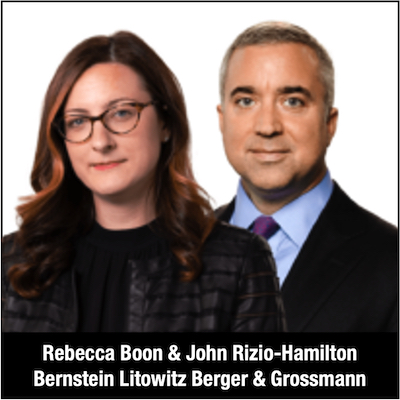
    Rebecca Boon

    Rebecca BoonPartner | Bernstein Litowitz Berger & Grossmann

    Rebecca Boon has been litigating securities fraud and shareholder rights actions for over a decade, recovering more than $1.5 billion for the firm’s institutional investor clients. Her work at the firm expands beyond litigation. Rebecca has advanced equality in the workplace by co-founding the Beyond #MeToo working group and leading landmark recoveries that have resulted in hundreds of millions of dollars back to investors and important social change among industries.

    Contact: rebecca.Boon@blbglaw.com

    John Rizio-Hamilton

    John Rizio-HamiltonPartner | Bernstein Litowitz Berger & Grossmann

    John Rizio-Hamilton is one of America’s top shareholder litigators. He works on the most complex and high-stakes securities class action cases, and has recovered billions of dollars on behalf of institutional investor clients.

    John led the trial team that recovered $240 million for investors in In re Signet Jewelers Limited Securities Litigation, a precedent-setting case that marks the first successful resolution of a securities fraud class action based on allegations of sexual harassment.

    Contact: johnr@blbglaw.com

    Can we rely on shareholders to compel corporations to meaningfully act on ESG issues?

    By Rebecca Boon and John Rizio-Hamilton

    This article was first published in the Responsible Investor, Aug., 10th, 2021. Posted with permission of the authors. Copyright 2021 by Rebecca Boon & John Rizio-Hamilton.  All rights reserved.

    There is an ongoing debate about the role that regulators should take regarding corporate obligations and accountability for ESG issues. Earlier this year, the Ontario Capital Markets Modernization Taskforce weighed in with its long-anticipated recommendation on diversity quotas for corporate boards. After receiving significant industry feedback, the Ontario Taskforce changed its initial recommendation from a requirement that public companies meet specific diversity targets, to allowing companies to set their own targets, report them, and develop a timeline for implementation. This ‘market-based’ framework for diversity would rely on investors to push corporations and hold them accountable.

    There was significant backlash when the Ontario Taskforce changed its initial recommendation. It was accused of not going far enough and caving to corporate pressure. However, it decided that allowing corporations to set their own quotas would avoid a ‘one size fits all’ approach, prevent corporations from simply complying with a minimum target, and limit instances of tokenism. The reporting requirement would force companies to implement material quotas and stand by them because they would be too afraid of investor reactions to do anything less than meaningful.

    In crafting governance reforms in some of the most significant derivative litigation in history, we spend considerable time thinking about how to enact meaningful and lasting social change at corporations. One key component is to get insider buy-in – because if the change is simply imposed from above, there could be internal resistance, a lack of commitment and a tendency to make only superficial progress. But the question is: can we rely on shareholders to compel corporations to meaningfully act on ESG issues? Recent history says yes. A market-based approach that incentivises good ESG practices could make a significant difference, when coupled with smart regulation.

    A recent study found that for every additional 8% of a company’s stock owned by the Big Three, the number of new women board members increased by 76%.

    For example, UK regulators just announced that London-listed companies should have at least 40% women and one non-white director on their boards. Similar to the Ontario Taskforce, the goals are not binding but if companies do not meet them, they must explain why. In the US, the Securities and Exchange Commission’s Advisory Panel also recently offered ESG and Diversity & Inclusion disclosure recommendations, designed to allow investors to understand what terms like ‘sustainable’ or ‘green’ actually mean.

    According to Chairman Gary Gensler, “investors should be able to drill down to see what’s under the hoods” at the companies and investment funds making these claims.

    The ‘Big Three’ asset management firms – BlackRock, Vanguard and State Street Global Advisors – recently made headlines when they supported Engine No.1, the Exxon activist investor that led a successful campaign to secure three board seats for its chosen candidates, in a bid to push Exxon to address long-term climate risk and move to clean energy, among other things. Exxon Director Ursula Burns acknowledged that the campaign’s success is part of a “tidal wave” of investor concerns on ESG issues. This victory would not have been possible without the support of three of the biggest investors in the US.

    In addition, big investors have committed to vote against firms that do not appoint more women directors to their boards. In January, State Street announced that it will now vote against the Chair of the Nominating & Governance Committee at companies in the S&P 500 and FTSE 100 that do not disclose the racial and ethnic composition of their boards; and in 2022, it will vote against them if they do not have at least one director from an underrepresented community.

    Similarly, Goldman Sachs will no longer take a company public without two diverse board members, one of whom must be a woman.

    The SEC has just approved a proposal by US marketplace Nasdaq for all its listed companies to disclose board-level diversity statistics and either meet the objective of 1 or 2 ‘diverse’ directors (depending on size) or explain why they have not. Some criticised the Ontario Taskforce – and others heralded it – for not taking Nasdaq’s “extreme position”.

    Are any of these initiatives enough? No. But investor pressure works. A recent study from the Kellogg School of Management at Northwestern University found that for every additional 8% of a company’s stock owned by the Big Three, the number of new women board members increased by 76%. Critically, the same study found that in response to investor pressure, women on boards get “power positions” on audit and nominating committees at even higher numbers than companies complying with mandatory quotas.

    Investors have also taken direct action by filing lawsuits alleging toxic workplace cultures of discrimination and retaliation against female executives, and racial and gender bias. And investors are no less active on environmental issues. For example, investors are currently prosecuting a securities fraud class action in Ohio against Energy Transfer, arising from the explosion of a natural gas pipeline that wreaked environmental havoc in Pennsylvania. These lawsuits are in early stages, but the pressure is on. Corporations have to address social issues because investors are demanding it.

    We have already seen what investor demands for accountability can do in US securities cases involving #MeToo issues and sexual harassment allegations. As the #MeToo movement went mainstream, we saw the first successful securities case addressing sexual harassment allegations – in a shareholder derivative lawsuit involving Fox News parent Twenty-First Century Fox. Investors were listening.

    Following a year of litigation, the lawsuit uncovered allegedly systemic problems at the network involving multiple senior executives, multiple types of discrimination and harassment, and a toxic workplace characterised by surveillance, retaliation and fear.

    Ultimately, as part of a $90m settlement, the plaintiff and the company unveiled a series of governance reforms designed to fix the broken sexual harassment culture at Fox News. The resulting Fox News Workplace Professionalism and Inclusion Council is majority-independent, but also has company participation, along with broad powers and a mandate to identify and solve the problems at the company. A critical component is investor accountability – the Council has the power to issue minority reports that Fox is mandated to post publicly for investors and the world to see. It also has a mandatory five-year term and if Fox determines to dissolve the Council, it must publicly state the reasons why. This approach set the stage for the recent high-profile settlement of a securities case against L Brands, which also settled for $90m. The firm committed to invest a further $45m over at least five years in a Diversity, Equity & Inclusion Council, and take other measures to protect employees from harassment and discrimination, requiring accountability when misconduct occurs.

    We also recently saw the first successful direct securities action certified as a class action involving allegations of sexual harassment against Signet Jewelers. When the market learned that hundreds of women had submitted declarations describing alleged sexual harassment reaching to the company’s highest levels, Signet was forced to halt trading to address them; and when trading resumed, the company’s stock price declined 13%. Again, investors were listening.  The Signet case settled for $240m in late 2020.

    It is too soon to know whether the newer cases will be successful, or whether the new regulations will have any teeth. But pressure from the Big Three and the corresponding dramatic increase in the number of women on corporate boards confirms that when investors demand diversity, companies respond. Investors have shown that they are willing and ready to compel corporations to act on important social issues. And recent securities cases involving #MeToo issues have demonstrated to the corporate world that investors can use their significant power to demand change and hold corporations accountable when they fail to act.

  • PFAS Science with Jaana Pietari and Jim Fenstermacher and Litigation with Bob Chesler

    PFAS Science with Jaana Pietari and Jim Fenstermacher and Litigation with Bob Chesler

    PFAS Science with Jaana Pietari and Jim Fenstermacher and Litigation with Bob Chesler

    In Part 1 of the episode, we discussed the PFAS from the scientific and environmental engineering perspective. And to do that I was fortunate to have  Jim Fenstermacher and Dr. Jaana Pietari from the global engineering firm Ramboll.  Jim and Jaana have deep experience in environmental remediation involving a variety of contaminants, including PFAS.

    In Part 2, I am joined by Robert Chesler of Anderson Kill. Bob is a long-time expert on insurance coverage for long-tail and other claims. He’s considered a guru in the field, and has represented policyholders in disputes over coverage with insurers for as long as I’ve known him.

    It’s a serious subject and these are seriously qualified folks. I did my part to make a mockery of scientific terms as I struggled to say the name of this family of chemicals. Fortunately for you my guests were much more linguistically nimble and it is their voices you will hear more of.

    This podcast is the audio companion to the Journal on Emerging Issues in Litigation, a collaborative project between HB Litigation Conferences and the Fastcase legal research family, which includes Full Court Press, Law Street Media, and Docket Alarm. The podcast itself is a joint effort between HB and Law Street Media. If you have comments or wish to participate in one our projects, or want to tell me how much  you learned from Jaana, Jim and Bob,  please drop me a note at Editor@LitigationConferences.com.

    Tom Hagy
    Litigation Enthusiast and Host of the Emerging Litigation Podcast

    p.s. Here’s a bonus for you. Write to me and I will send you the latest issue of the Journal on Emerging Issues in Litigation with my compliments.  That’s some serious value right there.

    In our first two-part episode, we dive into the troubling existence of a group of chemicals referred to as PFAS, with the nickname “Forever Chemicals,” because they stubbornly hang around in water, air, fish, soil, people, and animals.  

    PFAS — which stands for per- and polyfluoroalkyl  chemicals — are man-made creations that have been used in industry and consumer products worldwide since the 1950s. There are more than 4,000 of them, so it’s a big family. They can be found in non-stick cookware, water-repellent clothing, stain-resistant fabrics and carpets,  cosmetics,  firefighting foams, and products that resist grease, water, and oil. Studies have shown that exposure to some PFAS in the environment may be harmful to humans and animals.

    PFAS contamination has sparked some major litigation, with some cases involving hundreds or thousands of individuals that have settled for hundreds of millions of dollars. The PFAS issue is significant enough that  — despite so many other pressing issues — the White House made it a top priority, kicking eight federal departments into gear to tackle the situation.  It’s a hot topic that’s going to be with us for many years.

    Explore More from Anderson Kill!

    Journal on Emerging Issues, Editorial Board of Advisors

    The Use and Abuse of the Pollution Exclusion. By Dennis Artese, Jamie O’Neil, Robert Chesler

    The Environmental, Social, and Governance Police Have Arrived: Is your Insurance Ready. Authors: Dennis Artese, Bob Chesler.

    Podcast 1 of 2: PFAS Insurance Coverage with Jaana Pietari and Jim Fenstermacher and Litigation with Bob Chesler

    Sister to Podcast 1 of 2 Article. Remediating, Insuring, and Litigating PFAS Claims. Authors: Dr. Jaana Pietari, PhD, MBA, PE, Jim Fenstermacher, PE, Dr. Michael Bock, PhD, MS, Robert D. Chesler and Nicholas M. Insua, Sheila Mulrennan, Robin Kelliher, Jason R. Waters

    Podcast 2 of 2: Insurance Coverage for PFAS Claims with Robert Chesler

    Podcast: Autonomous Vehicles: The New Technology Driving the Litigation Conversation Podcast with Cort Malone, John Leonard, Joshua Zelen

    Podcast: Violations of Biometric Privacy Laws: Policyholders’ Victories and the Implications Going Forward with John Leonard and Cort Malone

    Journal on Emerging Issues, Editorial Board of Advisors: Dennis Artese, Robert D. Chesler

    How Insurance Companies Defraud Their Policyholders, and What Courts and Legislators Should Do About It. Authors: Robert Chesler, Dennis J. Artese, and Joseph Villa

    Asymmetrical Combat: Bad Faith Liability in Insurance Recovery Cases. By William Passannante

    Litigation After Biometric Privacy Law Violations: Policyholder Victories and Their Implications. Authors: Cort T. Malone, Abigail Damsky

    Climate Change, ESG, D&O Insurance: Collision or Cooperation? By Robert D. Chesler, Dennis J. Artese and Joseph Villa

    Protecting Policyholders as AI Is Developed for Insurance Claims Handling – Ensuring “Decency and Humanity” in the Digital Age. Authors: Marshall Gilinsky, Madison Marlow

    Police–The Environmental, Social, and Governance Police Have Arrived: Is your Insurance Ready. Authors: Dennis Artese, Bob Chesler

    How Insurance Companies Defraud Their Policyholders, and What Courts and Legislators Should Do About It. Authors: Robert Chesler, Amy Weiss, and Jade Sobh

    The Promise and Peril of Quantum Computing and Its Implications for Cyber Insurance. By Cameron R. Argetsinger

    The Use and Abuse of the Pollution Exclusion. Authors: Dennis Artese, Jamie O’Neil, Robert Chesler

    Property Insurance Coverage for Emerging Risk: Underground Climate Change. Authors: Dennis J. Artese, Ethan W. Middlebrooks, Thomas Dupont

    Autonomous Vehicles: The New Technology Driving the Litigation Conversation. Authors: Cort Malone, John Leonard, and Joshua Zelen

  • The Humble Beginnings and Wild Evolution of the TCPA with Joe Apatov

    The Humble Beginnings and Wild Evolution of the TCPA with Joe Apatov

    The Humble Beginnings and Wild Evolution of the TCPA with Joe Apatov

    Only $32 million!  I mean, why bother even getting out of bed? Joining me to discuss the evolution of the TCPA is Joseph A. Apatov (japatov@mcglinchey.com), a member of the McGlinchey Stafford law firm’s Consumer Financial Services Litigation practice group. Based in their Fort Lauderdale office, Joe litigates on behalf of financial services clients in both state and federal courts, with an emphasis on defending banks, mortgage lenders and servicers, private-label card issuers, and automobile finance companies. 

    Apologies for my trip down memory lane. Bear with me as I regale you with stories from the newsroom at Mealey’s Litigation Reports and the team’s anxious reliance on the “latest” technology: the facsimile machine.

    This podcast is the audio companion to the Journal on Emerging Issues in Litigation, a collaborative project between HB Litigation Conferences and the Fastcase legal research family, which includes Full Court Press, Law Street Media, and Docket Alarm. The podcast itself is a joint effort between HB and Law Street Media. If you have comments or wish to participate in one our projects, or want to tell me how much Joe enlightened you, please drop me a note at Editor@LitigationConferences.com.
     
    Tom Hagy
    Litigation Enthusiast and Host of the Emerging Litigation Podcast

    “The Telephone Consumer Protection Act had humble beginnings,” our guest writes, “with the bill’s sponsor explaining that the statute would permit consumers to bring small claims cases ‘without an attorney,’ and provides for an ‘amount of damages … fair to both the consumer and the telemarketer.’ Twenty-eight years after its enactment in 1991, the Eighth Circuit Court of Appeals affirmed a District Court’s decision to reduce a $1.6 billion jury award in a TCPA class action to only $32 million because the former was ‘shockingly large’ and ‘oppressive,’ in violation of the Due Process Clause …..”

  • Where’s Your Head? Managing the Mind in Mediation with Jeff Trueman

    Where’s Your Head? Managing the Mind in Mediation with Jeff Trueman

    Where’s Your Head? Managing the Mind in Mediation with Jeff Trueman

    Joining me to discuss this is  Jeff Trueman, an experienced, full-time mediator and arbitrator. Jeff helps parties resolve a wide variety of litigated and pre-suit disputes and interpersonal problems concerning catastrophic injuries, professional malpractice, wrongful death, employment, family business dissolution, real property, estate, and domestic relations. He is a panel mediator for the American Arbitration Association; a  panel arbitrator for the Financial Industry Regulatory Authority; a Distinguished Fellow of the International Academy of Mediators; a recipient of the Paul A. Dorf Alternative Dispute Resolution Memorial Award by the Bar Association of Baltimore City; and will soon hold an LLM from the Straus Institute for Dispute Resolution at the prestigious Pepperdine School of Law. 

    Finally, did I really suggest that having a mediator with a bad hip could help achieve a faster resolution? Did I really give a review of the HBO original movie Oslo, which I consider a must-see for anyone interested in conflict resolution? Did I really compare married couples during Covid-19 lockdowns to angry bees in a jar? Listen and find out. Spoiler alert: Yes. Yes I did. 

    This podcast is the audio companion to the Journal on Emerging Issues in Litigation, a collaborative project between HB Litigation Conferences and the Fastcase legal research family, which includes Full Court Press, Law Street Media, and Docket Alarm. The podcast itself is a joint effort between HB and Law Street Media. If you have comments or wish to participate in one our projects, or want to tell me how Jeff really got you thinking, please drop me a note at Editor@LitigationConferences.com.

    Tom Hagy
    Litigation Enthusiast and Host of the Emerging Litigation Podcast

    “Attorneys possess many of the same characteristics as their human cousins.” Someone said that. Probably me. They often bring to their jobs cognitive barriers that get in the way of negotiating resolutions to conflicts. Same for their human clients.

    Things like refusal to cede the moral high-ground, or stubbornly believing  there must always be someone to blame. Then there is overconfidence (i.e.,  “I am right and will win in court!”) or they might enjoy selective memory, confirmation bias, and loss aversion.  Attorneys are often in the position of mediator and problem solver. What can attorneys do to more effectively achieve satisfactory outcomes when the parties bring in their own set of human characteristics and emotions?