Author: Tom Hagy

  • Applying Business Strategy to Your Law Firm

    Applying Business Strategy to Your Law Firm

    Applying Business Strategy to Your Law Firm with James Grant

    Concepts: Business Strategy, Law Firms, Strategic Business Thinking, New and Unique Approaches

    This isn’t going to be another theoretical sermon on the business of law, but how two partners  – with the help of a business expert – re-envisioned their practice, throwing out traditional models and transforming their firm into something unique.

    First, we talk about looking at your law firm strategically, as you would any business. Have you thought about tweaking or refocusing your practice in a way that has the most bottom line impact?

    Then we talk about one litigation firm’s journey through that process, where they metaphorically dismantled their practice, examined each piece, and put it back together. The new version of the firm was built based on their strengths as attorneys and on activities that were most profitable.

    My guest is James M. Grant, an attorneywho has embraced the idea of applying strategic business thinking to the practice of law.  In that spirit, we talk about how and why he and his partner, Mark Kirchen, tried such an exercise and what he learned from it. Then James talks about a pretty profound transformation of his firm, developing a unique offering that is demonstrably different, as you will see.

    James is co-founding partner of Georgia Trial Attorneys at Kirchen & Grant LLC.  He’s an experienced personal injury litigator and trial attorney, whose list of defendants include insurance companies. James started off as a state prosecutor before getting into personal injury law. He has a B.S. from Georgia Institute of Technology, and received his J.D. from Faulkner University.

    I hope you enjoy the episode. If so, give us a rating!

    This podcast is the audio companion to the Journal on Emerging Issues in Litigation. The Journal is a collaborative project between HB Litigation Conferences and the vLex Fastcaselegal research family, which includes Full Court Press, Law Street Media, and Docket Alarm.

    If you have comments, ideas, or wish to participate, please drop me a note at Editor@LitigationConferences.com.

    Tom Hagy
    Litigation Enthusiast and
    Host of the Emerging Litigation Podcast
    Home Page
    LinkedIn

    Want to appear on the
    Emerging Litigation Podcast?

    Send us your idea! 

    James Grant

    James GrantGeorgia Trial Attorneys at Kirchen & Grant LLC

    James Grant isn’t just an attorney; he’s a game-changer. As the co-founding partner of Georgia Trial Attorneys, he’s revolutionized the field of personal injury law in Georgia. He has created a powerhouse law firm that serves as the outsourced litigation arm for other personal injury firms. Gone are the days of personal injury lawyers juggling pre-litigation and courtroom battles. James’ mantra says it all: “We litigate, so you don’t have to!”

    Not just a powerhouse litigator, James is a tactical businessman. His dual expertise proves that you can win in the courtroom while maintaining a well-balanced life. A seasoned veteran in the courtroom, his prior roles include stints as an Assistant Solicitor-General and Senior Associate Attorney, where he honed his skills in both criminal and civil litigation. His diverse experiences make him the ultimate weapon against insurance companies and their greed, leveling the playing field for every client he represents.

  • FTC v. Amazon: Market Definitions and Section 5 of the FTC Act

    FTC v. Amazon: Market Definitions and Section 5 of the FTC Act

    The Author

    Jonathan Rubin

    Jonathan RubinMoginRubin LLP

    For more than two decades Rubin has focused his legal practice exclusively on antitrust and competition law and policy. As a litigator, he has led trial teams in major antitrust cases in courts throughout the country. As a thought-leader in competition law, he has published in influential academic journals and has spoken to numerous professional groups, including the Directorate General for Competition of the European Commission, the Antitrust Section of the American Bar Association, the University of Wisconsin, and the American Antitrust Institute. Rubin has also made several appearances before Congressional committees.

    Rubin received his J.D. from University of Florida, Levin College of Law. Mogin also holds a PhD in Economics from the University of Copenhagen, an MA in Economics from Florida Atlantic University, and a BS in Biological Sciences from the University of Wisconsin at Madison.

    The Journal on Emerging Issues in Litigation

    Emerging Litigation Podcast

    Emerging Litigation PodcastProduced by HB Litigation and Law Street Media

    Interviews with leading attorneys and other subject matter experts on new twists in the law and how the law is responding to new twists in the world.

    FTC v. Amazon:

    Market Definitions and Section 5 of the FTC Act

    Traditional antitrust economics faces significant challenges grappling with the new economy industrial environment, and the Amazon case is likely to be a crucial test for antitrust and the usefulness of Section 5 of the FTC Act.

    The key issue is whether a price increase on Amazon could drive online shoppers to Google Shopping, Walmart, Target, Costco, eBay, Home Depot, Best Buy, Wayfair, or any number of other online retail destinations that are potential substitute outlets for products sold on Amazon.

    Abstract:

    The Federal Trade Commission’s (FTC) challenge to Amazon.com’s practices relating to its participation on its own platform—competing with the many merchants who rely on the powerful commercial hub to make sales—violate the Federal Trade Commission Act. The court’s analysis is likely to depend heavily on the FTC’s definition of the relevant antitrust markets in which it claims Amazon possesses market power and harms competition. Traditional antitrust economics face significant challenges grappling with the relatively new digital economy. The author examines these and other issues raised in the case, which he anticipates will be a crucial test for antitrust and the FTC Act.

    Download the article now!

    Get additional insights from Jonathan Rubin at the MoginRubin Blog.

    Explore more from MoginRubin LLP!

    Blog: Emboldened by New Resources and Expanded Authority, Feds Continue 10-Year Look Back at Chinese Investment. By Dan Mogin, Jonathan Rubin, Jennifer Oliver, and Timothy LaComb. List

    OnDemand CLE Webinar: The Antitrust Case Against Google. Dan Mogin, Jonathan Rubin, Jennifer Oliver, Timothy LaComb, John Newman, Dr. Alan Grant

    Blog: FTC’s Case Against Facebook Will Test the Flexibility of U.S. Antitrust Law.Authors: Jonathan Rubin and Jennifer Oliver, MoginRubin LLP

    Blog: Full Ninth Circuit Removes Unwarranted Hurdles to Class Certification.

    Journal: Policy Derailed: Can U.S. Antitrust Policy Toward Standard Essential Patents Get Back on Track by Jonathan Rubin

    Webinar: Class Certification After Olean v. Bumble Bee with Jonathan Rubin, James Bogan lll, Jonathan Cohn, Bradley Hamburger.

    Journal: FTC v. Amazon: Market Definitions and Section 5 of the FTC Act

    Podcast: Algorithmic Software Facilitated Price Fixing with Jonathan Rubin

  • PFAS Regulation, Litigation, and Differentiation

    PFAS Regulation, Litigation, and Differentiation

    PFAS
    Regulation, Litigation, and Differentiation

    Concepts: Per- and Polyfluorinated Substances, PFAS, PFAS Regulation, PFAS Litigation, Differentiation

    The PFAS family of human-made compounds are found in countless consumer products, as well as medical devices and firefighting foam. The incredibly strong carbon-fluorine bond that make PFAS so useful also makes them incredibly persistent. They are so ubiquitous that PFAS can be found in the blood of every human on earth and rainwater throughout the world. 

    In this episode, we are going to give you some history of the compounds, discuss some important differences among them, and review what litigation we’re seeing (including the various claims and defenses).  We will also explore what we can learn from recent settlement structures, forecast the impact of any new regulation, and predict what litigation might be next.

    Listen to my interview with David Marmins and Morgan Harrison, Partners with Arnall Golden Gregory LLP. David and Morgan have been at the forefront of PFAS litigation since they began defending carpet manufacturers in suits brought by two Alabama municipalities in 2017.

    BONUS! Read David and Morgan’s article on the subject, just published in the Journal of Emerging Issues in Litigation.

    I hope you enjoy the episode. If so, give us a rating!

    This podcast is the audio companion to the Journal on Emerging Issues in Litigation. The Journal is a collaborative project between HB Litigation Conferences and the vLex Fastcaselegal research family, which includes Full Court Press, Law Street Media, and Docket Alarm.

    If you have comments, ideas, or wish to participate, please drop me a note at Editor@LitigationConferences.com.

    Tom Hagy
    Litigation Enthusiast and
    Host of the Emerging Litigation Podcast
    Home Page
    LinkedIn

    Loved hearing what David & Morgan had to say?

    Read their Journal Article!

    PFAS Regulation: EPA Ushers in Next Era of Mass Tort and Environmental Litigation

    Want to appear on the
    Emerging Litigation Podcast?

    Send us your idea! 

    David Marmins

    David MarminsArnall Golden Gregory LLP

    David is a partner in the Litigation and Real Estate practices and co-chair of the firm’s Retail industry team. David has concentrated his practice on complex civil litigation since becoming a lawyer in 1995. While he handles a variety of high stakes disputes, he has developed a specialty in litigation related to commercial real estate and the retail industry. Clients hire him to resolve construction and leasing contract disputes, environmental nuisance and toxic tort matters, construction payment and defect claims, easement and right-of-way disputes, and various other disagreements over land use and ownership. David is at the forefront litigation over the use and disposal of PFAS, the subject of this episode, and currently serves as defense counsel to three carpet manufacturing industry clients in PFAS litigation in federal and state courts.

    Morgan Harrison

    Morgan HarrisonArnall Golden Gregory LLP

    Morgan is a partner in the firm’s Litigation & Dispute Resolution and Employment practices. She is also a member of the Payments Systems & Fintech and Background Screening industry teams. Morgan represents payment processors, consumer reporting agencies, fiduciaries, government entities, and individuals. She handles a wide variety of matters involving contract disputes, business torts, class actions, Fair Credit Reporting Act litigation, fiduciary disputes, and fraud and misrepresentation claims. Her experience includes work at both the trial and appellate levels across the country. Like David (above), Morgan practices on the leading edge of PFAS litigation. Since 2016, she has represented multiple companies in the carpet manufacturing industry in PFAS litigation brought in state and federal courts in Georgia and Alabama. Morgan has also published several articles with the American Bar Association and spoken at the Georgia Environmental Conference on the state of play in PFAS regulations and emerging trends in PFAS litigation.

  • ESG Programs and the Lawyer’s Role

    ESG Programs and the Lawyer’s Role

    ESG Programs and the Lawyer’s Role

    Concepts: ESG, ESG Ratings, Environmental, Social, and Governance, Role of Attorneys

    What’s gotten into some corporations these days? 

    Some are reducing their carbon footprint and reducing waste. Some are demanding ethical behavior. Some are even paying attention to wages of frontline workers.

    In this episode we discuss the role of attorneys and in-house counsel in the courageous new world of Environment, Social, and Governance Issues, or ESG. And, not to disappoint, I mention a beloved cartoon duck who, when you think about it, raises questions about inclusivity and workplace safety. Throw in the fact that he doesn’t always wear pants to work and you have an ESG trifecta.

    A few questions addressed in this episode: 

    • How can law firms themselves adopt ESG practices and what role do they play with clients?
    • What are some common pitfalls attorneys should avoid when navigating ESG regulations and standards?
    • How can in-house counsel drive ESG initiatives within their organizations?
    • What role to they play in  communicating ESG risks and opportunities to their C-suite and board or directors? What about mitigating risks associated with ESG disclosures?
    • And what about external partnerships and supplier contracts?

    Ever wonder why corporations set ESG goals, why ratings matter, or how ratings are calculated?

    Listen to my interview with Kai Gray, CEO and co-founder of Motive, an ESG advisory and support service firm, as we explore what ESG is, what it is not, what good it can bring to an organization, and where attorneys fit in.  Kai generously offers his perspective based on more than two decades of work at some of the most innovative companies in the U.S.

    Kai also reveals the secret to the secret sauce behind compelling corporations to the right thing!

    I hope you enjoy the episode. If so, give us a rating!

    *******

    This podcast is the audio companion to the Journal on Emerging Issues in Litigation. The Journal is a collaborative project between HB Litigation Conferences and the Fastcaselegal research family, which includes Full Court Press, Law Street Media, and Docket Alarm. The podcast itself is a joint effort between HB and our friends at Law Street Media. If you have comments or wish to participate in one our projects please drop me a note at Editor@LitigationConferences.com.

    Tom Hagy

    Tom Hagy
    Litigation Enthusiast and
    Host of the Emerging Litigation Podcast
    Home Page
    LinkedIn

    Kai Gray

    Kai GrayCEO & Co-Founder, Motive

    With 20+ years of senior executive experience at some of the most innovative Technology companies, including Yahoo!, Carbonite, and Western Digital, Kai Gray learned first-hand that markets move fast. Kai Gray leads the advisory and support service firm, Motive in navigating the rapidly-evolving frontier that is ESG.

  • Latest on Software and AI Devices from the United Kingdom’s MHRA by Jackie Mulryne and Eleri Williams

    Latest on Software and AI Devices from the United Kingdom’s MHRA by Jackie Mulryne and Eleri Williams

    Guest Writers

    Jackie Mulryne

    Jackie MulryneArnold & Porter Kaye Scholer LLP

    Jackie Mulryne is a member of the Life Sciences practice group, and provides regulatory, policy and compliance advice to clients in the pharmaceutical, medical technology, cosmetics and foods sectors. She advises on complex regulatory issues that arise throughout the product life cycle, including maximising regulatory protections and the overlap with IP rights, borderline classification, clinical research, authorisation, advertising and promotion, and market access strategy. She regularly develops strategies to help bring innovative products to market, and helps companies develop and implement cross-border regulatory compliance programmes.

    Eleri Williams

    Eleri WilliamsArnold & Porter Kaye Scholer LLP

    Eleri Williams is a litigator and a regulatory lawyer and is a member of the Life Sciences practice group. She advises a broad range of clients, including pharmaceutical and medical device companies, on UK and EU regulatory matters. She also works with clients on civil, public and administrative litigation matters.

    Latest on Software and AI Devices from the United Kingdom’s MHRA

    By Jackie Mulryne and Eleri Williams

    Photo by Marcin Nowak on Unsplash

    Abstract: The authors discuss new updates from the UK’s Medicines and Healthcare products Regulatory Agency on how software and artificial intelligence medical devices will be regulated in the United Kingdom after Brexit.

    The UK’s Medicines and Healthcare products Regulatory Agency (MHRA) is continuing to publish details on how software and artificial intelligence (AI) medical devices will be regulated in the United Kingdom after Brexit, with the aim of making the UK an attractive place to launch such products. The MHRA’s recent updates to its “Software and AI as a Medical Device Change Programme” (the Change Program) intend to “deliver bold steps to provide a regulatory framework that provides
    a high degree of protection for patients and public, but also makes sure that the UK is recognized globally as a home of responsible innovation for medical device software looking towards a global market.”

    The MHRA has also recently announced it will extend the period during which European Union Conformity Assessment (EU CE) marks on medical devices (including for software) will be accepted on the UK market, until July 2024. This article provides an overview of these updates.

    The MHRA Change Program

    On October 17, 2022, the MHRA published an updated version of its Change Program, setting out a roadmap for the next steps in the reform of the UK regime. The Change Program was first announced in 2021, and builds on wider reforms, including the government’s response to the consultation on the future regulation of medical devices in June 2022 (the Consultation). The recent update sets out further information on each work package under the Change Program, including how it will be implemented. There are 11 work packages across two work streams: one relating to software as a medical device (SaMD) and reforms across the life cycle of such devices, and another relating to AI as a medical device (AIaMD) considering the additional challenges  this may pose.
    The update to the Change Program provides the following key points:
    • Secondary legislation will form part of the reforms, building on the Consultation; however, much of the reform under the Change Program will be through the publication of guidance, which is notably easier to implement and update, allowing more flexibility to the regulation of SaMD and AIaMD as these areas continue to develop.
    • Much of the Change Program has been, and will continue to be, developed in collaboration between the MHRA and other organizations, including the National Institute for Health and Care Excellence (NICE), the Care Quality Commission (CQC), and the Health Research Authority (HRA), ensuring that key principles and approaches align with other areas of regulation.
    • The MHRA will work with other organizations in relation to key elements that the MHRA does not directly regulate, such as the Information Commissioner’s Office on data protection issues.
    • The implementation of the Change Program will include further engagement with patients, the public, and industry, and build on the MHRA’s existing Patient and the Public Engagement Strategy.
    • Further work will be undertaken to examine health inequalities in medical device regulation, specifically relating to SaMD and AIaMD, presumably due, in part, to the higher risk of population and social bias arising from the use of AIaMD in particular.
    • There will be an effort to drive harmonization and minimize burden on industry, by working internationally, and through contributions to the International Medical Device Regulators Forum (IMDRF).
    • The MHRA intends to work with British Standards Institute (BSI), a leading UK national standards body, to formalize a wide set of standards, mapped against the work packages, to assist manufacturers meet regulatory requirements.

    Work Packages

    A brief overview of the work packages and the key deliverables is provided below. Some work packages are standalone, while others are included within or spread over multiple work packages, and so do not have discrete deliverables assigned to them and are not set out separately.
    The MHRA has stated that the deliverables will be published in a “stepped manner.” It first planned to publish certain work packages (WP1-02, WP4-01, WP9-05, and WP11-01, highlighted with * below), with further deliverables following in tranches.

    Qualification

    There is currently a lack of clarity on what qualifies as SaMD. This work package will aim to capture a sufficient breadth of software, provide clarity yet flexibility on qualification, and improve the wider regulation of digital health. The following deliverables will be published:
    • WP1-01—Regulatory guidance on what qualifies as SaMD, including the distinction between SaMD and other device/ product types;
    • WP1-02*—Regulatory guidance on crafting an intended purpose in the context of SaMD, including in relation to “hydra devices”; and
    • WP1-03—Regulatory guidance on clarifying the concept of “manufacturer” for SaMD, including in the context of open-source code.

    Classification

    Current UK law on medical devices does not classify software proportionately to the risk it may pose (and notably the EU Medical Devices Regulation (EU) 2017/745 and In Vitro Diagnostic Medical Devices Regulation (EU) 2017/746 implement additional provisions on the classification of software, with similar provisions having not (yet) been implemented into UK law following Brexit). As such, the aim is to provide classification rules that impose safety and performance requirements on software, while providing flexibility to ensure the innovation of novel devices in not restricted.

    The following deliverables will be published:

    • WP2-01—Secondary legislation to reform the classification rules for SaMD. This will implement rules that more closely align to the IMDRF Software as a Medical Device: Possible Framework for Risk Categorization and Corresponding Considerations, as previously described in the Consultation;
    • WP02-02—Secondary legalization and process on exploration of an “airlock process” for SaMD, allowing for earlier UK market access with heightened monitoring of a device where sufficient evidence in the pre-market phase cannot be generated, but the device meets a critical unmet clinical need; and
    • WP02-03—Regulatory guidance on classification rules for SaMD, to ensure sensible and consistent interpretation of the new rules.

    Pre-Market Requirements

    Clearer pre-market requirements will aim to provide a smoother path to market for manufacturers and afford greater protection for users. This will include providing clarity on how pre-market requirements, including on clinical evidence and clinical investigation, apply to SaMD, and ensuring that adequate data on safety, effectiveness, and quality is generated prior to a market launch, taking into account the risk factors associated with the particular device. The following deliverables will be published:
    • WP3-01—Secondary legislation on essential requirements for software. The current essential requirements have already been reviewed and considered as part of the Consultation;
    • WP3-02—Best practice guidance on SaMD developments and deployment. The MHRA will work with the BSI, to highlight areas where current best practice may not meet regulatory requirements or regulatory definition of the “state of the art”;
    • WP3-03—Regulatory guidance on the position of retrospective non-interventional studies, to indicate when these studies qualify as clinical investigations or an in vitro diagnostic medical device (IVD) undergoing performance evaluations;
    • WP3-04—The MHRA will work with the HRA on the development of Joint Regulatory Guidance on data-driven SaMD;
    • WP3-05—Regulatory guidance on human-centered SaMD, clarifying the importance of human factors, usability, ergonomic, or behavioral science evidence; and
    • WP3-06—Regulatory guidance on registration and nomenclature for SaMD, with the aim to better enable signal detection and post-market trending.

    Post-Market

    This will focus on a stronger safety signal for SaMD, and the development of a strengthened surveillance system adapted to receive signals, to help mitigate the risk of patient safety incidents. The use of real-world evidence to provide further assurances in relation to SaMD, including functionality and performance, will be considered. Change management requirements will also be reviewed. The following deliverables will be published:
    • WP4-01*—Review of adverse incident signal detection for SaMD, with the aim to identify safety signals sooner, distinguish between signal versus noise, and act swiftly in response to signals of concern, improving patient and public safety;
    • WP4-02—Regulatory guidance on adverse incidents in the context of use of SaMD, including details on reportable adverse incidents and emphasizing the importance of recognizing “indirect harm” in the context of SaMD;
    • WP4-03—Regulatory guidance on changes management for SaMD, including ensuring devices maintain performance over time and how this relates to other factors, such as QMSs and risk management;
    • WP4-04—The MHRA will work with Approved Bodies to develop predetermined change control plans and change protocols; and
    • WP4-05—Regulatory guidance on expansion of intended purposes of SaMD, including how this should be supported by appropriate evidence, such as clinical, and
    proper processes.

    Cyber Secure Medical Devices

    This concept is not considered under current regulation, and the aim is to explain how cybersecurity issues arise in relation to SaMD and to ensure it is reflected in relevant requirements, including post-market surveillance. The MHRA will work with other bodies, including the Connected Medical Device Security Steering
    Group. The following deliverables will be published:
    • WP5-01—Secondary legislation on cybersecurity requirements for medical devices and IVDs, to impose cybersecurity and IT requirements as outlined in the Consultation;
    • WP5-02—Regulatory guidance on elucidating cybersecurity requirements for medical device and IVDs;
    • WP5-03—Best Practice Guidance on management of unsupported software devices, including in the context of unsupported devices still in service but that are no longer maintained by their manufacturer; and
    • WP5-04—Processes: report of relevant cybersecurity vulnerabilities.

    AI Rigor

    This aims to provide clarification on how devices that use AI can meet medical device requirements, ensuring that AIaMD placed on the UK market is supported by robust evidence that it is safe and effective. The existing regulatory framework, as well as supplementary guidance, will be utilized and developed accordingly. The following deliverables will be published:
    • WP9-01—Guiding principles on good machine learning practice (GMLP) for medical device development. The basic guidelines on GMLP were published in October 2021 and are intended to lay the foundation for developing this area;
    • WP9-02—Regulatory guidance on GMLP for medical device development mapping, linking GMLP with existing legal requirements;
    • WP9-03—GMLP for medical device development standards mapping, which will be developed with BSI and other international partners, to provide a snapshot of the standards landscape as it relates to meeting the internationally agreed GMLP principles;
    • WP9-04—Best practice guidance on AIaMD development and deployment, outlining best practice on assessing the performance of AIaMD across its life cycle;
    • WP09-05*—Best practice guidance on AIaMD for all, with a focus on addressing and mitigating bias in AlaMD;
    • WP09-06—Standards development, to assist in developing standards, frameworks, and tools to assist with the identification and measurement of bias; and
    • WP09-07—Experimental work on bias detection and mitigation, to detect, measure, and correct for bias in datasets. The new approach will identify under- represented features in data and then use synthetic data to oversample the under-represented features, to achieve a better overall distribution of features.

    AI Interpretability (Known as Project Glass Box)

    The effects of human interpretability on the safety and effectiveness of AIaMD are not covered by current UK regulation, and this work package aims to develop guidance to ensure (1) AI models are sufficiently transparent to be reproducible and testable, and (2) that the relationship of interpretability to usability is made plain and emphasized in relation to safety and effectiveness. The following deliverables will be published:
    • WP10-01—Best practice guidance on human-centered AIaMD, and the further challenges that AI can pose, including human uninterpretable AI; and
    • WP10-02—Standards development on trustworthy AIaMD.

    AI Adaptivity (Known as Project Ship of Theseus)

    Existing requirements and processes surrounding the notification and management of change need to fit and be streamlined for AIaMD, including clarification of how adaptive AIaMD might fit in existing change management processes, or the crafting of new guidance for adaptive AIaMD when appropriate.

    The following deliverables will be published:
    • WP11-01*—Guiding principles on adaptivity and change management in AIaMD;
    • WP11-02—Experimental work on concept drift and significant/substantial change in performance. This will focus specifically on methods to detect change, including change outside of the manufacturer’s control, with an aim of developing a methodology to determining significant changes in AIaMD; and
    • WP11-03—Pre-determined changes control plans for AIaMD.

    The UK government is also continuing to consider the future regulation of AI. In July, the UK government published a policy paper on regulating AI, including when the AI is classed as a medical device. In October, the House of Commons Science and Technology Committee launched an inquiry on the regulation of AI and will also consider the government’s expected White Paper on AI. These various work streams will need to be coordinated to ensure the framework for AIaMD is clear and not overly burdensome.

    Extension of UKCA Application Date

    In other medical device related news, the MHRA has confirmed in a letter dated October 21, 2022, that it intends to extend the period during which EU CE marking on medical devices will continue to be accepted on the UK market by an additional year, until July 2024. We understand that the applicable transitional periods
    will commence from the coming into force of the new UK regulations, also extended to July 2024.

    This step is undoubtedly, at least in part, in response to the growing pressures facing the UK medical device industry, including that only a handful of UK Approved Bodies have been accredited to undertake conformity assessments, and the fast-approaching current deadline of July 2023. Further, the new UK legislation, which
    was supposed to come into force in July 2023, has not yet been published, even in draft form, meaning it was increasingly unlikely companies, or authorities, would be able to meet the deadline.

    This development will be welcome news to the UK medical device industry, though whether the timeframe for implementation of the regulatory reforms is realistic will have to be monitored.

  • Natural Gas Bans and Bans on Bans

    Natural Gas Bans and Bans on Bans

    Natural Gas Bans, Bans on Bans, and the Ninth Circuit

    Concepts:  Natural Gas, EPCA, Climate Change, Energy Efficiency Regulation

    The Ninth Circuit Court of Appeals recently struck down Berkeley, California’s ban on natural gas infrastructure in new buildings. The court ruled unanimously that the ban violates federal law. This subject is important as we will likely see more natural gas bans in the future and the Berkeley case has set a precedent for how similar cases may be treated. 

    Brought by the California Restaurant Association, the National Restaurant Association, and the American Gas Association, the crux of the case was that Berkeley’s ban was preempted by the Energy Policy and Conservation Act (EPCA) which gives the federal government exclusive authority to regulate energy efficiency standards for appliances. Agreeing with the plaintiffs, the Ninth Circuit that Berkeley’s ban was “a direct regulation of energy efficiency standards for appliances.” New York has implemented a natural gas ban starting in 2026.

    Listen to my interview with Gary Toman, Partner at Weinberg, Wheeler, Hudgins, Gunn & Dial LLC, as we discuss this seminal case and the impact of the court’s ruling on consumers and businesses across the country.

    Gary  has extensive experience representing corporations, banks and professionals in complex litigation and arbitration matters and business disputes. Gary has substantial experience defending corporations in a wide variety of class actions.  Gary received his J.D. from Harvard Law School.

    I hope you enjoy the episode. If so, give us a rating!

    *******

    This podcast is the audio companion to the Journal on Emerging Issues in Litigation. The Journal is a collaborative project between HB Litigation Conferences, and the vLex Fastcaselegal research family, which includes Full Court Press, Law Street Media, and Docket Alarm — all now part of vLex. If you have comments or wish to participate in one our projects please drop me a note at Editor@LitigationConferences.com. I’m often polite.

    podcast logo face

    Actual size.

    Tom Hagy
    Litigation Enthusiast and
    Host of the Emerging Litigation Podcast
    Home Page
    LinkedIn

    Gary Toman

    Gary TomanWeinberg Wheeler Hudgins Gunn & Dial

    Gary Toman has extensive experience representing corporations, banks and professionals in complex litigation and arbitration matters and business disputes. Gary has substantial experience defending corporations in a wide variety of class actions. His practice includes litigation involving business and financial transactions, product liability, business torts, contract matters including participation agreements, shareholder agreements, and non-competition agreements, and environmental, real estate and intellectual property matters. Gary has also handled cases and counseled clients in the healthcare field regarding antitrust issues, practice disputes, employment law matters and other disputes. An experienced appellate advocate, Gary began his career as a law clerk to the Honorable R. Lanier Anderson, III of the United States Court of Appeals for the Fifth and Eleventh Circuits. He has briefed and argued cases in federal and state appellate courts across the country. Gary often serves as appellate counsel at trials to frame the record for possible appeal. Gary received his J.D. from Harvard Law School.

  • Pixel Litigation Tests Old Privacy Law

    Pixel Litigation Tests Old Privacy Law

    Pixel Litigation Tests Old Privacy Law featuring Myriah Jaworski

    Consumers are driving a wave of litigation against companies for allegedly sharing details of what videos they watch on their platforms. 

    •  Will litigation tamp down this activity?

    •  What harm is being caused?

    •  How will existing laws be interpreted?

    •  Are these organizations within their rights?

    Dozens of organizations — ranging from the rough-and-tumble NFL to the decidedly less rough-and-tumble NPR — are among the defendants in nearly 50 proposed class actions which claim Meta Platforms Inc.’s pixel tracking tool facilitated the sharing of personal video consumption data and identities from online platforms to Facebook without user consent. This, the plaintiffs say, violates the federal Video Privacy Protection Act (VPAA) of 1988.

    The rising number of VPAA cases demonstrates how plaintiff attorneys are creatively applying traditional causes of action to litigate modern privacy issues in the absence of a federal law. An act that far preceded the proliferation of online video streaming, it followed the publication of one-time Supreme Court nominee Robert Bork’s Blockbuster video rentals. The titles the judge rented disappointed anyone looking for scandal. They included nothing more salacious thanThe Man Who Knew Too Much  starring Jimmy Stewart and Doris Day.

    Listen to my interview with someone who knows plenty:   Myriah V. Jaworski, a member at Clark Hill PLC.  Myriah helps me explore the privacy issues raised by these cases and what the future holds for businesses and other parties who handle consumer data.

    Myriah represents clients in defense of data breach class actions, privacy torts and statutory claims (IRPA/BIPA), pixel tacking and commercial surveillance matters, internet defamation, technology disputes, and cyber subrogation claims. She defends them in response to regulatory inquiries and investigations arising out of data incidents and privacy practices, including before state Attorney General offices, the Federal Trade Commission and the Department of Human and Health Services – Office of Civil Rights. Myriah is a Certified Information Privacy Professional, United States (CIPP/US) and a Certified Information Privacy Professional, Europe (CIPP/E) as certified by the International Association of Privacy Professionals. She was also a Trial Attorney with the Department of Justice. She received her JD/MS degree from Syracuse University College of Law. And now, I am happy to say, she is a member of the Editorial Advisory Board for the Journal on Emerging Issues in Litigation.

    I hope you enjoy the episode. If so, give us a rating!

    *******

    This podcast is the audio companion to the Journal on Emerging Issues in Litigation. The Journal is a collaborative project between HB Litigation Conferences and the Fastcaselegal research family, which includes Full Court Press, Law Street Media, and Docket Alarm. The podcast itself is a joint effort between HB and our friends at Law Street Media. If you have comments or wish to participate in one our projects please drop me a note at Editor@LitigationConferences.com.

    Tom Hagy

    (actual size)

    Tom Hagy
    Litigation Enthusiast and
    Host of the Emerging Litigation Podcast
    Home Page
    LinkedIn

    Myriah V. Jaworski

    Myriah V. JaworskiClark Hill PLC

    Myriah represents clients in defense of data breach class actions, privacy torts and statutory claims (IRPA/BIPA), pixel tacking and commercial surveillance matters, internet defamation, technology disputes, and cyber subrogation claims.

    She defends them in response to regulatory inquiries and investigations arising out of data incidents and privacy practices, including before state Attorney General offices, the Federal Trade Commission and the Department of Human and Health Services – Office of Civil Rights.

    Myriah is a Certified Information Privacy Professional, United States (CIPP/US) and a Certified Information Privacy Professional, Europe (CIPP/E) as certified by the International Association of Privacy Professionals. She was also a Trial Attorney with the Department of Justice. She received her JD/MS degree from Syracuse University College of Law. And now, I am happy to say, she is a member of the Editorial Advisory Board for the Journal on Emerging Issues in Litigation.

  • PFAS Regulation: EPA Ushers in Next Era of Mass Tort and Environmental Litigation

    PFAS Regulation: EPA Ushers in Next Era of Mass Tort and Environmental Litigation

    The Authors

    David J. Marmins

    David J. MarminsArnall Golden Gregory LLP

    David is a business litigation partner at Arnall Golden Gregory LLP in Atlanta. He is at the forefront of land use law and environmental law in the context of PFAS, currently defending three manufacturers in litigation. He also has extensive experience handling banking and related disputes, and additional experience in complex business litigation, class actions, and medical malpractice defense of hospitals. David started his legal career as civil rights prosecutor and, before law school, as a reporter. He earned his J.D. from Georgia State University College of Law.

    Morgan E.M. Harrison

    Morgan E.M. HarrisonArnall Golden Gregory LLP

    Morgan is a partner at Arnall Golden Gregory LLP where she has represented defendants in PFAS litigation since 2016. Morgan also frequently speaks and writes on the subject. In addition to PFAS, she a member of the firm’s teams dedicated to Litigation & Dispute Resolution, Employment law, Payment Systems and Fintech, and the Background Screening industry. She earned her J.D. from Vanderbilt University School of Law.

    The Journal on Emerging Issues in Litigation

    Emerging Litigation Podcast

    Emerging Litigation PodcastProduced by HB Litigation and Law Street Media

    Interviews with leading attorneys and other subject matter experts on new twists in the law and how the law is responding to new twists in the world.

    Forever Chemicals Will Now Be Regulated

    EPA Ushers in New Era of Mass Tort and Environmental Litigation

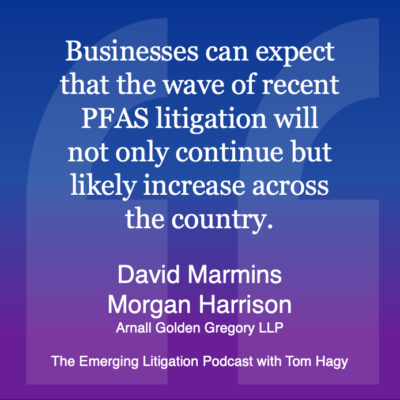
    An enforceable drinking water standard will be an important tool for plaintiffs. Defendants will no longer be able to assert that they have not violated any federal limitations …. And with more government scrutiny … businesses can expect that the wave of recent PFAS litigation will not only continue but will likely increase across the country. 

    Abstract:

    The U.S. Environmental Protection Agency (EPA) announced the long-awaited proposed National Primary Drinking Water Regulation for six per- and polyfluoroalkyl substances, known as “PFAS,” on March 14, 2023. The agency anticipates finalizing the regulation by the end of 2023, and claims that it will save thousands of lives and reduce tens of thousands of serious illnesses.

    The EPA has been aware of PFAS since at least the 1990s, when one farmer’s investigation into the chemicals concluded with a seminal lawsuit against multinational chemical company DuPont. A book and subsequent feature film put that lawsuit in the spotlight, and PFAS became mainstream news.

    Today, PFAS claims are widely recognized as the next frontier of mass tort and environmental litigation. With the EPA poised to finally enact the first regulation of these chemicals, that frontier is ripe for exploration.

    This article explores PFAS and the origin of litigation around the substances as well as the state of PFAS litigation and regulation today. It concludes with some thoughts on what to expect when it comes to PFAS litigation going forward.

    Download the article now!

    Loved reading David & Morgan’s Journal Article?

    Listen to their Podcast!

    PFAS Regulation, Litigation, and Differentiation

    Tags

    Emerging Litigation & Risk Compliance Litigation & appeals Cybersecurity Data Privacy Artificial Intelligence (AI) Insurance Companies Risk Management Corporate & Securities Insurance Claims Recovery Regulations Data Breach Toxic Torts Antitrust Legal Tech Product Liability Settlements Trial Personal Injury Privacy Healthcare Per- and Polyfluoroalkyl Substances (PFAS) Data Analytics Arbitration Constitutional Law Climate Change Cannabis Labor Law Insurance Fraud Liability Claims COVID Alternative Dispute Resolution (ADR) Mediation Diversity Equity Inclusion (DEI) Claims management Professional Liability Legal Research & Writing Business Interruption Law Practice Management Trial Skills Property and Casualty Drug Laws Copyright Law Catastrophic Loss

  • TVPRA, State Statutes Open Door for Civil Damage Claims by Human-Trafficking Victims

    TVPRA, State Statutes Open Door for Civil Damage Claims by Human-Trafficking Victims

    The Authors

    Coryne Leyendecker

    Coryne Leyendecker Swift, Currie, McGhee & Hiers LLP

    Coryne Leyendecker is an attorney practicing in Swift Currie’s litigation section, defending businesses and insurers against claims related to commercial litigation, sexual abuse, governmental liability, premises liability, automobile litigation and construction law.

    Pamela Lee

    Pamela LeeSwift, Currie, McGhee & Hiers LLP

    Pamela N. Lee is a partner at Swift Currie with more than 15 years of experience practicing in the firm’s litigation section. Pamela devotes her entire practice to litigation, including various tort liability litigation, insurance coverage disputes and the defense of insurance bad faith matters. Her liability practice is wide and varied, encompassing premises liability, product liability, escalator and elevator liability, automobile liability and general personal injury law. She represents companies in the food, automobile and retail industries.

    The Journal on Emerging Issues in Litigation

    Emerging Litigation Podcast

    Emerging Litigation PodcastProduced by HB Litigation and Law Street Media

    Interviews with leading attorneys and other subject matter experts on new twists in the law and how the law is responding to new twists in the world.

    TVPRA, State Statutes Open Door for Civil Damage Claims by Human-Trafficking Victims

    “A plethora of nonprofit organizations and government agencies have collectively produced hundreds of available resources on how to help prevent human trafficking. Overwhelmingly, groups across the board agree that bringing awareness to human trafficking is the most foundational method to stopping human trafficking. By implementing intentional training and internal policies, businesses can not only insulate themselves from third-party claims but they can be a force for good in the fight against human trafficking. “

    Abstract: There is not a person alive with a soul that would believe sex trafficking and other variants of modern slavery is a good thing. The individuals that perpetrate those heinous acts should be punished accordingly. In 2003, Congress opened the door for human-trafficking victims to sue for civil damages under the Trafficking Victims Protection Act of 2000 (TVPRA). Since then the TVPRA and similarly drafted state statutes have allowed for human-trafficking victims to seek civil damages against any party that has benefited from their trafficking. Given this expansive inclusion of third-party liability, more and more businesses, especially those in the hospitality industry, are ultimately the ones left to pay for the criminal acts of human traffickers. This article discusses the evolving litigation around human-trafficking claims, beginning with a broad overview of human trafficking, followed by a discussion of the legal standard behind human-trafficking civil suits and recent guidance from U.S. courts on these types of claims. The article concludes with guidance of its own on how businesses can build a foundation for their own defense while simultaneously helping prevent human-trafficking crimes from ever occurring.

    Download the article now!

    Have an idea for an article?

    If you would like to propose an article for publication in the Journal on Emerging Issues in Litigation please review our specifications and benefits, then send us a summary, outline, or draft. If you also would like to discuss the topic on the Emerging Litigation Podcast, please note that.

  • Spotting the Risk, Reaping Rewards: Avoiding Increased Antitrust Scrutiny

    Spotting the Risk, Reaping Rewards: Avoiding Increased Antitrust Scrutiny

    The Authors

    Katie Reilly

    Katie ReillyWheeler Trigg O’Donnell LLP

    Katie has favorably represented antitrust clients in matters involving monopolization, conspiracy, price fixing, exclusive dealing, and other competition-related disputes, including trade secrets and non-compete actions. She has extensive knowledge of the regulatory hurdles and obligations her clients face. Katie earned her J.D. from the New York University School of Law, cum laude.

    Natalie West

    Natalie WestWheeler Trigg O’Donnell LLP

    Natalie West represents sophisticated clients in complex commercial disputes. She regularly serves as the lead brief writer in antitrust cases, employment and consumer class actions, and appellate matters. Natalie graduated with high honors from the University of Texas School of Law, where she served as a member of the Texas Law Review and was elected to the Order of the Coif.

    The Journal on Emerging Issues in Litigation

    Emerging Litigation Podcast

    Emerging Litigation PodcastProduced by HB Litigation and Law Street Media

    Interviews with leading attorneys and other subject matter experts on new twists in the law and how the law is responding to new twists in the world.

    Avoiding Antitrust Scrutiny

    Spotting the Risk, Reaping Rewards

    The increase in aggressive antitrust enforcement has certainly received significant attention. For the moment, juries are not rewarding the prosecutors. That said, even an unsuccessful government investigation is itself costly and can motivate plaintiffs’ lawyers. Best practices involve not only following the law but also maintaining solid optics to avoid the need for an expensive, if ultimately successful, defense.

    Abstract: 

    A decade ago, few lawyers across the country spent significant time thinking about antitrust law. But, since then, there has been an onslaught of antitrust attacks on businesses and executives across all sectors of the economy. Enforcement efforts have skyrocketed following President Biden’s July 2021 executive order directing a “whole of government” crackdown on competition abuses—and the trend shows no sign of letting up.

    Today, no matter the industry or the size of the business, everyone needs to understand these risks and have strategies to minimize them.

    This article will walk through the top antitrust risks of the moment and conclude with strategies on how to avoid not only violations but also bad optics that increase exposure.

    Download the article now!