Author: Tom Hagy

  • How Companies Seeking to Leave China for Mexico Can Mitigate Their Legal Risks and Protect Against New Ones

    How Companies Seeking to Leave China for Mexico Can Mitigate Their Legal Risks and Protect Against New Ones

    The Author

    Dan Harris

    Dan HarrisHarris Bricken

    Dan Harris (dan@harrisbricken.com) is co-founder of Harris Bricken where he focuses his practice on international law and protecting businesses in their foreign operations. A leading authority on the subject, he is also editor of the highly regarded China Law Blog, and a valued member of the Editorial Board of Advisors for the Journal of
    Emerging Issues in Litigation.

    The Journal on Emerging Issues in Litigation

    Emerging Litigation Podcast

    Emerging Litigation PodcastProduced by HB Litigation and Law Street Media

    Interviews with leading attorneys and other subject matter experts on new twists in the law and how the law is responding to new twists in the world.

    How Companies Seeking to Leave China for Mexico Can Mitigate Their Legal Risks and Protect Against New Ones

    “Chinese manufacturers commonly seek retaliation against foreign buyers that cease buying product from them. For this reason, it is critical that you line up your new suppliers (preferably in a country other than China) and have them ready to go before you even hint to anyone in China that you might cease or reduce production with an existing China supplier.”

    Abstract: The author, one of the leading authorities on the legal issues related to international manufacturing, discusses the risks companies will face if they move their manufacturing out of China, what they should do to mitigate those risks, and what new risks they will face in a new country, such as Mexico. He comments on a variety of concepts, including manufacturing agreements, protection of intellectual property, strategies for a safe departure, potential retaliation tactics, and even personal security matters.

    Download the article now!

  • Climate Change, Property Rights, and Conservation: Highlights from a Decade of Environmental Law (2013–2023)

    Climate Change, Property Rights, and Conservation: Highlights from a Decade of Environmental Law (2013–2023)

    The Author

    Victoria Kline

    Victoria Kline2023 J.D. and Incoming Associate at Reed Smith

    Victoria Kline (linkedin.com/in/victoria-kline) just graduated from the University of Miami School of Law, and is an incoming associate at Jones Day. She focused her studies on environmental law, which also will be her area of practice. (Congratulations to Victoria on her graduation and getting her start at Reed Smith!)

    The Journal on Emerging Issues in Litigation

    Emerging Litigation Podcast

    Emerging Litigation PodcastProduced by HB Litigation and Law Street Media

    Interviews with leading attorneys and other subject matter experts on new twists in the law and how the law is responding to new twists in the world.

    Climate Change, Property Rights, and Conservation:
    Highlights from a Decade of Environmental Law (2013–2023)

    Abstract: The author discusses nine recent decisions—all but one handed down by the Supreme Court—that demonstrate the ongoing debate over responsibility for the effects of climate change, how the courts are essentially asked to strike a balance between environmental protection and economic development, the intersection of property rights and conservation, and how litigants fared with their arguments over different aspects of this important and, many would say, existential dilemma. The author concludes with an update from the United Nations Framework Convention on Climate Change and the establishment of a loss and damage fund for countries harmed by climate change.

    “The past decade has seen numerous legal challenges and landmark rulings in environmental law, reflecting the growing recognition of the critical importance of protecting the environment for current and future generations. From the Supreme Court’s decision in Michigan v. EPA to the recent Juliana v. United States case, the judicial branch has dramatically changed the way litigation can be used to protect the interests of the earth and its inhabitants.”

    Download the article now!

  • Procedural Challenges to the IRS’s Compliance With the APA and Its Impact on Tax Litigation

    Procedural Challenges to the IRS’s Compliance With the APA and Its Impact on Tax Litigation

    The Author

    Jeffrey S. Luechtefeld

    Jeffrey S. LuechtefeldChamberlain | Hrdlicka

    Jeffrey S. Luechtefeld (jeff.luechtefeld@chamberlainlaw.com) is a tax controversy and litigation attorney with Chamberlain, Hrdlicka, White, Williams, and Aughtry (Atlanta, Georgia) where he focuses his practice on resolving tax disputes with the Internal Revenue Service, administratively or through litigation. Jeff previously was a Special Trial Attorney for the IRS Office of Chief Counsel as well as a director in the tax controversy practice of a big four accounting firm.

    The Journal on Emerging Issues in Litigation

    Emerging Litigation Podcast

    Emerging Litigation PodcastProduced by HB Litigation and Law Street Media

    Interviews with leading attorneys and other subject matter experts on new twists in the law and how the law is responding to new twists in the world.

    Procedural Challenges to IRS Compliance With the APA and Its Impact on Tax Litigation

    Abstract: The Administrative Procedure Act (APA) places specific requirements on agencies of the federal government when engaged in a “rule making” that has the force and effect  of law. Recently, the APA has become a focal point in tax litigation, due in large part to the IRS’s history of refusing to comply with the process mandated by the APA. This article focuses on procedural challenges to the IRS’s compliance with the APA based on the IRS’s history of non-compliance with the APA’s notice-and-comment requirement. It highlights recent trends in tax litigation and considers the future of APA challenges in this area.

    “IRS’s level of APA non-compliance matters significantly …

    “APA challenges predicated on the IRS’s failure to adequately follow the APA’s notice-and-comment process are inherently fact-intensive endeavors …

    “The challenging party should gauge the usefulness of the relief requested and balance that against the cost required to prevail …

    “Ultimately, APA challenges are important, and may be necessary for a taxpayer to get to argue the merits of their case, but they do not often end the dispute with the IRS.”

    Download the article now!

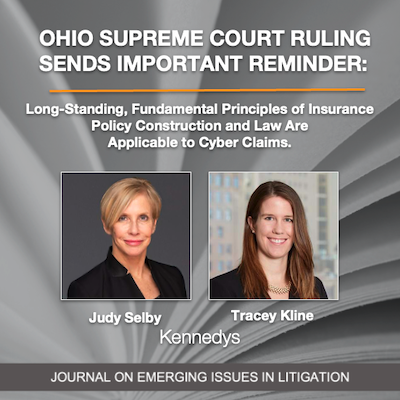
  • Ohio Supreme Court Ruling Sends Important Reminder: Long-Standing, Fundamental Principles of Insurance Policy Construction and Law Are Applicable to Cyber Claims

    Ohio Supreme Court Ruling Sends Important Reminder: Long-Standing, Fundamental Principles of Insurance Policy Construction and Law Are Applicable to Cyber Claims

    The Authors

    Judy Selby

    Judy SelbyKennedys

    Judy Selby (judy.selby@kennedyslaw.com) is a Partner at Kennedys (New York) where she focuses her practice primarily on insurance coverage matters with a concentration in coverage for exposures arising out of emerging technology, digital, and compliance risks.

    Tracey Kline

    Tracey KlineKennedys

    Tracey M.Kline (tracey.kline@kennedyslaw.com) is an Associate at Kennedys (Philadelphia) where she focuses her practice primarily on insurance coverage litigation and cyber matters.

    The Journal on Emerging Issues in Litigation

    Emerging Litigation Podcast

    Emerging Litigation PodcastProduced by HB Litigation and Law Street Media

    Interviews with leading attorneys and other subject matter experts on new twists in the law and how the law is responding to new twists in the world.

    Ohio Supreme Court Ruling Sends Important Reminder:

    Long-Standing, Fundamental Principles of Insurance Policy Construction and Law Are Applicable to Cyber Claims

    Abstract: On December 27, 2022, the Ohio Supreme Court unanimously ruled that a business owner’s property insurance policy issued by Owners Insurance Co. to EMOI Services, LLC did not afford coverage for losses sustained in a ransomware attack because computer software is “entirely intangible” and “cannot experience ‘direct physical loss or physical damage.’” EMOI Servs., LLC. v. Owners Ins. Co., 2022-Ohio-4649 (Ohio 2022). In doing so, the court reversed an attention-getting split decision by the lower appellate court. This article takes an in-depth look at the case and discusses its significant implications.

    The Ohio Supreme Court’s decision was based on its commonsense conclusions that software (as intangible property) cannot suffer physical damage, and that coverage for restoration of information under the Electronic Equipment Endorsement could not be triggered absent the threshold requirement of “direct physical loss or damage” to the media on which the information was stored. Although claims involving cyber events may be relatively new, this decision is an important reminder that long-standing, fundamental principles of insurance policy construction and law are applicable to cyber claims.

    Download the article now!

  • Unarmed or Unwell: How Federal Law Infringes Medical Marijuana Users’ Second Amendment Rights

    Unarmed or Unwell: How Federal Law Infringes Medical Marijuana Users’ Second Amendment Rights

    The Author

    Griffen Thorne

    Griffen ThorneHarris Bricken

    Griffen Thorne (griffen@harrisbricken.com) is an attorney in the Los Angeles office of Harris Bricken Sliwoski LLP, an international emerging markets law firm. He represents clients in highly regulated emerging industries, such as cannabis, in corporate and commercial transactions.

    The Journal on Emerging Issues in Litigation

    Emerging Litigation Podcast

    Emerging Litigation PodcastProduced by HB Litigation and Law Street Media

    Interviews with leading attorneys and other subject matter experts on new twists in the law and how the law is responding to new twists in the world.

    Unarmed or Unwell:
    How Federal Law Infringes Medical Marijuana Users’ Second Amendment Rights

    As Justice Amy Coney Barrett noted while on the Seventh Circuit, “legislatures have the power to prohibit dangerous people from possessing guns. But that power extends only to people who are dangerous.” In the coming years, the government’s ability to write off all medical marijuana users as dangerous is likely to be curtailed, even if the Controlled Substances Act continues to make marijuana use a federal crime.

    Abstract: In the wake of the 2022 U.S. Supreme Court case New York State Rifle & Pistol Association, Inc. v. Bruen, federal courts have reached opposite outcomes on whether federal prohibitions on marijuana users’ rights to own or possess firearms are constitutional. As a result, there is a high likelihood of a circuit split that results in the overturning of those federal laws. The author discusses Bruen and several other cases at the intersection of drug laws and gun laws.

    Download the article now!

  • Law Firm Technology Directors? Yes.

    Law Firm Technology Directors? Yes.

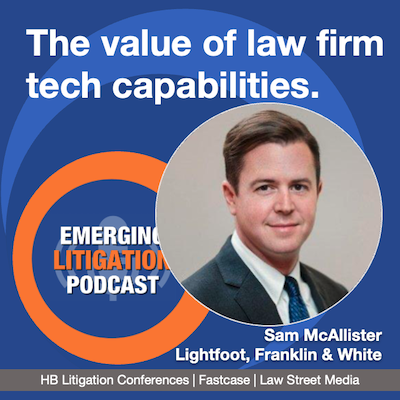
    The Value of Law Firm Technology Directors with Sam McAllister

    In this episode we talk about the advantages of having technology and software development capabilities inside your law firm. Can you imagine? And we’re not just talking about someone who is adept at unjamming the printer.  

    While the legal tech industry offers myriad high-quality solutions (some of my best friends are technology solutions), there are times when a litigator just wants that one thing that the tech doesn’t do. Or, working with the tech has such a long learning curve that the attorney won’t embrace it, that is, if he or she even tries it.

    There are also service enhancements attorneys would like to offer clients – capabilities that set the firm apart, that demonstrate the firm has the client’s best interests at heart and that the firm is even (gasp!) innovative.

    Litigators want to get an edge at trial. They want to be able to collaborate smoothly with clients. They want clients to get answers to important questions quickly. Focusing on customer experience is not just for retailers anymore.

    Joining me to talk about how one law firm benefits from having its own in-house technology developer is Sam McAllister, Director of Litigation Technology at Lightfoot Franklin & White in Birmingham, Alabama.

    Sam works on creative solutions for the firm’s litigation defense teams in the categories of communications, workflows, automation, multimedia, task efficiency, jury selection, information organization, and courtroom visualization, and more. The results come in the form of proprietary software, custom platforms, and apps. Many make the firm more efficient, cost-effective, and better equipped to collaborate with clients. Some have the effect of wowing clients, too.

    It’s no wonder Sam found himself on the Fastcase 50, a unique award that celebrates innovative professionals in the legal field. Sam, they said, exemplifies the “build-your-own spirit” of the award.

    He is the leader of the firm’s Case Clarity Group, which provides “highly-developed technology to clients throughout the duration of a case, e-discovery collaboration with Lightfoot lawyers, and adaptive evidence models to make complex ideas simple.” And – I like this part – “ask any lawyer who knows him – Sam does what it takes to help you win a case and is known for bringing calm to the most intense of trials.” (I can think of some work groups that would benefit from a position I just made up – Director of Calm. I mean, a cat can only do so much.) Sam received his B.S. in computer science from Auburn University. Speaking of cats – Go Tigers!

    I hope you enjoy the episode. If so, give us a rating!

    *******

    This podcast is the audio companion to the Journal on Emerging Issues in Litigation. The Journal is a collaborative project between HB Litigation Conferences and the Fastcase legal research family, which includes Full Court Press, Law Street Media, and Docket Alarm. The podcast itself is a joint effort between HB and our friends at Law Street Media. If you have comments or wish to participate in one our projects please drop me a note at Editor@LitigationConferences.com.

    Tom Hagy

    (actual size)

    Tom Hagy
    Litigation Enthusiast and
    Host of the Emerging Litigation Podcast
    Home Page
    LinkedIn

    Sam McAllister

    Sam McAllisterLightfoot Franklin & White

    Sam works on creative solutions for the firm’s litigation defense teams in the categories of communications, workflows, automation, multimedia, task efficiency, jury selection, information organization, and courtroom visualization, and more.

    The results come in the form of proprietary software, custom platforms, and apps. Many make the firm more efficient, cost-effective, and better equipped to collaborate with clients. Some have the effect of wowing clients, too.

  • Digital Health Care Companies, Beware: Federal Agencies Are Tracking Your Use of Online Tracking Technologies

    Digital Health Care Companies, Beware: Federal Agencies Are Tracking Your Use of Online Tracking Technologies

    The Authors

    Patricia Markus

    Patricia MarkusNelson Mullins

    Patricia A. Markus (trish.markus@nelsonmullins.com) represents health care providers and health technology companies across the country on wide-ranging regulatory compliance, reimbursement, licensure, and operational matters, with a special focus on issues surrounding health information privacy, security, and technology.

    Shane Duer

    Shane DuerNelson Mullins

    Shane Duer (shane.duer@nelsonmullins.com) focuses his practice on healthcare regulatory and corporate matters, with an emphasis on data privacy, cyber security, and information management concerns within and beyond the health care industry.

    The Journal on Emerging Issues in Litigation

    Emerging Litigation Podcast

    Emerging Litigation PodcastProduced by HB Litigation and Law Street Media

    Interviews with leading attorneys and other subject matter experts on new twists in the law and how the law is responding to new twists in the world.

    Digital Health Care Companies, Beware 

    Federal Agencies Are Tracking Your Use of Online Tracking Technologies.

    Abstract: Health care industry stakeholders have regularly used online tracking technologies to help improve patient experience. However, growing scrutiny by the Office for Civil Rights, which enforces the Health Insurance Portability and Accountability Act of 1996 (HIPAA), requires covered entities and business associates to proceed cautiously in their use of such technologies. In addition, recent enforcement actions by the Federal Trade Commission make clear that a wide range of digital health companies, whether or not regulated by HIPAA, must tread carefully when collecting and disclosing personal information related to health, especially where consumers’ location data is to be used for a company’s advertising purposes, as they may be held accountable for failing to maintain the privacy and security of individuals’ protected and individually identifiable health information.

    The increasing number of lawsuits and news articles regarding use of these technologies demonstrates that third-party technology tracking vendors who receive PHI often are not operating under Business Associate Agreements (BAAs). The vendors in most instances disavow any need to collect PHI and accordingly instruct users to avoid sending PHI or other personally identifiable information. Under HIPAA, covered entities and business associates generally may not disclose PHI to third parties for health care operations purposes, unless such disclosure is to a business associate pursuant to a BAA, or the disclosure is made pursuant to an individual’s HIPAA-compliant authorization.

    Not only does sharing PHI through third-party tracking technologies without individuals’ authorizations violate HIPAA, but the FTC has asserted in two recent enforcement actions that the collection and sharing of individuals’ IIHI through these technologies without individuals’ “affirmative express consent” constitutes unfair and deceptive trade practices.

    Download the article now!

  • Big Tech’s Race to Develop Superior Artificial Intelligence Technology

    Big Tech’s Race to Develop Superior Artificial Intelligence Technology

    Big Tech’s Race to Develop Superior Artificial Intelligence Technology

    Will A.I. Compromise Free Enterprise, Disclosure and Security?

    robots typing

    “Robots Typing” generated by ChatGPT

    America’s Big Five tech companies – Amazon, Apple, Facebook, Google and Microsoft – are racing to develop technology they claim will change the world — again. The tech Goliaths have more than 33,000 researchers at their disposal to create artificial intelligence (A.I.) technology with an obvious and perpetual prize: revenue. 

    It’s the talk of the world. NBC Nightly News recently predicted the impacts that A.I. will have on society in the coming years. A.I. tech was also the center of attention at the 2023 Davos Economic Summit.  Prominent tech leaders such as Elon Musk and the CEO of OpenAI, Sam Altman, heralded that A.I. will improve virtually everyone’s lives, but with some risks involved. 

    Andrew Perlman, dean of Suffolk University Law School, says there is nothing “future” about it. In The Implications of ChatGPT for Legal Services and Society, he wrote, “The disruptions from AI’s rapid development are no longer in the distant future. They have arrived …” And for the legal industry, he said, “ChatGPT may portend an even more momentous shift than the advent of the internet.”

    Just one legal application out there today is the use of A.I. technology (GPT-3) by Docket Alarm, a popular court docket search service. Docket Alarm allows users to see A.I.-generated summaries of filings without even opening them. Michael Sander, VP of analytics with Docket Alarm owner Fastcase, told legal technology enthusiast Bob Ambrogi that the feature is experimental and should be relied upon with some healthy caution. [Disclosure: HB collaborates with Fastcase in creating litigation content, e.g., the Journal of Emerging Issues in Litigation and the Emerging Litigation Podcast.]

    As non-attorney and comic book hero Spiderman famously said, “With great power comes great responsibility.” But will the tech companies (or their algorithms) take responsibility for the rush of legal issues certain to continue from an unregulated A.I. Wild West? Critics say this automated technology has already damaged democratic discourse. A.I.-generated content is easily observed on Twitter and other platforms — flooding the digital town square of public opinion. 

    An unregulated A.I. race creates myriad legal issues that our lawmakers and our Constitution seem ill-equipped to address — at least quickly. Legal issues to which A.I. will, critics fear, play a role include degradation of free speech and public discourse, increased monopolization, greater economic inequality, and the mass proliferation of copyright infringement.   

    Damage to Discourse and Democracy

    FDR on the radio

    FDR photo courtesy of the Library of Congress

    Technology and democracy have historically gone hand in hand, from typesetters allowing printers to produce newspapers and magazines, to famous radio fireside chats with President Roosevelt.  A healthy democracy relies on input from its citizens as well as unhindered First Amendment rights for the citizens who utilize technologies to disseminate messages, so long as they do not promote violence or undermine security.  

    Since 2015, A.I. has increasingly influenced the democratic process in both the United States and abroad.  Chatbots — an A.I. technology designed to automate text via algorithms to respond to people’s messages.  Bots have been used to repost, repopulate, and generate social media posts on Twitter and other social media sites. Misinformation abounds.

    A popular bot is ChatGPT developed by OpenAI, which we used to augment this article. [Editor’s Note: See the photo at the top and writing examples in the sidebar. The rest was drafted by a human being. Or so he claims.] 

    In a November 2022 op-ed published in Scientific American by A.I. expert Gary Marcus, OpenAI’s ChatGPT was deemed to “sound authoritative, even when it’s wrong, which makes it a perfect tool for mass-producing misinformation.” A Stanford University analytical research paper co-sponsored by the school’s sociology and psychology departments explains that messages generated by ChatGPT are just as capable of persuading readers as human writers are.

    A.I. has also been developed to write text for news stories. Blogger Jacob Bergdahl experimented in July 2021 with OpenAI’s GPT-3 bot to generate comical fake news stories about how President Biden’s favorite food was pizza with ice cream on top, how Sweden’s prime minister rode a pig, and the European Union’s investment in onion farms. (Again, those are made up!) Bergdahl said, “I don’t know about you, but I’m equal parts impressed and terrified at how convincingly the algorithm explained these ridiculous topics. To reiterate: I only entered the first sentence of each story, and I didn’t edit the AI’s output in the slightest.”

    A.I. has recently been employed to manipulate images, generating a startlingly realistic image of Donald Trump being dramatically arrested in front of a Manhattan federal courthouse in March. Belgian-based journalist Eliot Higgins believes he has since been banned from the image generating platform, Midjourney. The image was on Bellingcat, Higgins’ investigative journalism site. He shared it on Twitter where it went viral; it was shared by millions social media users. 

    Critics say the challenges to democracy are exacerbated by the Big Five’s hold on the technology.

    Monopolization and Free Enterprise Limitations 

    Text-based A.I. tools are already widely used by mid-sized companies to large corporations, particularly in the form of chatbots. Tech companies like Outreach.io promotes chatbot services to streamline customer service, reduce costs, and reduce labor needs.  However many executives are, “proceeding with caution given the limitations of ChatGPT” according to a Wall Street Journal article published this January.  Chatbots through ChatGPT and eventually through more advanced A.I. language systems may even convince most customers into believing they are interacting with human beings.  The WSJ further reports that, “[w]hile many chatbots are trained to deliver a version of “I don’t know” to requests they cannot compute, ChatGPT, for example, is more likely to spout off a response with complete confidence—even if the information is wrong.”

    “[G]enerative A.I. risks turbocharging fraud. It may not be ready to replace professional writers, but it can already do a vastly better job of crafting a seemingly authentic message than your average con artist — equipping scammers to generate content quickly and cheaply. — FTC Chair Lina Khan, May 3, 2023, New York Times

    Data security company Cyberhaven recently performed an audit of its employees using OpenAI’s ChatGPT to determine if sensitive company data was being passed on to the chatbot service. Their audit revealed as much as 11% of the content pasted into ChatGPT contained sensitive company data. Cyberhaven, which offers data security software to a variety of companies, observed that a growing number of their clients had employees utilizing ChatGPT.  “Despite some companies blocking ChatGPT, its use in the workplace is growing rapidly,” wrote Cyberhaven’s Cameron Coles.

    A.I. developers have also implemented their own chatbots or partnered with A.I. companies to optimize online search engines with the technologies. Google uses an A.I. tool called Bard. Microsoft, through its search engine Bing, recently implemented ChatGPT.  A report by Public Citizen explains that an “A.I.-generated answer means the search engine becomes less a tool for finding unique and original sources of information and more a tool for synthesizing those original sources into a secondary source.” Microsoft started incorporating ads into its Bing search chatbot which means it will likely drive more online traffic away from an original information source and channel the traffic more to the answer provided by the A.I. service. 

    Publishers have also sounded the alarm about chatbots and A.I.-generated search engines.  Publishers rely on users finding their content through search engines and worry that A.I. tools will drive traffic away from their sites. A.I. search engine results also further threaten small to mid-sized businesses and their economic prospects. OpenAI states on its website that it is developing plug-ins that will allow its latest model of ChatGPT to perform automated actions online for customers such as booking flights, ordering groceries, and shopping.  

    As the report by Public Citizen notes, “A.I. tools as intermediaries is another way tech corporations can insert themselves into supply chains and charge commissions that raise prices for consumers, while siphoning money away from small and local businesses.”

    A.I. potentially sets up large businesses for claims of monopolization and unfair business practices, some forecast.

    “While the technology is moving swiftly, we already can see several risks. The expanding adoption of A.I. risks further locking in the market dominance of large incumbent technology firms. A handful of powerful businesses control the necessary raw materials that start-ups and other companies rely on to develop and deploy A.I. tools. This includes cloud services and computing power, as well as vast stores of data.” — FTC Chair Lina Khan, May 3, 2023, New York Times

    What is more, this technology has been widely predicted to cause greater economic inequality than exists today. 

    Economic Inequality

    The Big Five and their whopping 33,000 doctoral A.I. researchers clearly indicate their intentions – to generate more corporate wealth.  According to a March 27, 2023 article written by the Washington Post, nearly 70% of A.I. Ph.Ds. opt to work for the corporate sector whereas, 20 years ago, that number was roughly 20%. This metric indicates that the vast majority of A.I. tools and technology being developed are not for academia or truly life-improving purposes, but for corporations to render them more machine-like and more easily generate and manipulate money.

    OpenAI CEO Sam Altman wrote a manifesto in 2021 predicting that the widespread deployment of A.I. would lead to most people being worse off than they are today. Altman painted an ominous picture of the world to come, decrying how “in the next five years, computer programs that can think will read legal documents and give medical advice. In the next decade, they will do assembly-line work and maybe even become companions. And in the decades after that, they will do practically everything, including making new scientific discoveries that will expand our concept of everything.” 

    Altman also argued that A.I. will “create phenomenal wealth,” and “if we get this right…can improve the standard of living for people more than we ever have before.” OpenAI conducted their own research into this topic in 2023 and published a paper indicating that approximately 80% of the U.S. workforce could have least 10% of their tasks affected by the introduction of GPTs (generative pre-trained transformers), while roughly 19% of the workforce could have as much as 50% of their tasks automated. The extent of unregulated image, text, and even voice manipulation by GPTs has the potential to create many copyright issues, especially for professional artists, musicians, and actors. 

    Copyright Infringement

    Public Citizen reported that artists and writers have had the content they produced and published online used without their consent to train A.I. tools to produce derivative art. Cartoonist Sarah Anderson’s artwork was turned into neo-Nazi memes by far-right political activists. Voice actors have similarly been impacted by non-consensual use of their voices with the use of A.I. tech. 

    Vice News reported on Feb. 7, 2023, that voice actors were increasingly subjected to contracts containing language that gives away their rights to use of their A.I.-generated voices.  (Demonstrating the high-wire act that online media is, Vice itself is reportedly headed to bankruptcy.)

    Tim Friedlander, President and founder of the National Association of Voice Actors said clauses “are very prevalent right now” that sign rights to an actor’s voice over to publishers. “[M]any voice actors may have signed a contract without realizing language like this had been added. We are also finding clauses in contracts for non-synthetic voice jobs that give away the rights to use an actor’s voice for synthetic voice training or creation without any additional compensation or approval. Some actors are being told they cannot be hired without agreeing to these clauses.” Actor Emma Watson’s voice was recently used without her consent for a reading of Mein Kamph, according to Vice News.  

    U.K.-based Getty Images has launched a lawsuit in federal court in Delaware against Stability A.I., alleging that the company copied 12 million images without permission to train its A.I. tools. Stability A.I. has responded to the complaint, arguing that their use of the images falls under the Fair Use Act 17 U.S.C. § 107 and does not constitute copyright infringement. Legal analysts believe that Getty Images has a stronger case than an individual artist would have given the blatant use of millions of its images. 

    Proposed Public Solutions

    Media attention surrounding A.I. tools and technology is accelerating. The Biden Administration acknowledged that policymaking was woefully lagging in mitigating potential harms stemming from the widespread deployment of A.I.  In response, the Biden Administration published a “Blueprint for an A.I. Bill of Rights” in October 2022. 

    This blueprint is intended to serve as a broad guide for the federal government’s deployment of A.I. and model of best practices for society at-large. 

    There are five principles outlined in the guidance document: 

    1) Americans should be protected from unsafe or ineffective systems.

    2) Americans should not face discrimination by algorithms. 

    3) Americans should be protected from abusive data practices and have agency over how data about them is used. 

    4) Americans should know when, how and why automated systems are being used to make decisions that affect them.

    5) Americans should have the choice to opt out of automated customer service and have access to a person who can help troubleshoot problems. 

    Critics of the blueprint argue that while the White House did seek input from the Big Five’s lobbyists, the guide “is essentially a white paper with no enforcement authority against Big Tech.” Some in the corporate world have already contested that, saying ,“even [the] unenforceable guidelines could stifle innovation.”

    U.S. Representative Ted Lieu (D-Calif.), who has a background in computer science, is advocating for the creation of a federal agency dedicated to regulating A.I. technologies. Lieu argues that Congress needs to implement the creation of this new agency to “ensure that the development and deployment of A.I. is done in a way that is safe, ethical, and respects the rights and privacy of all Americans, and that the benefits of A.I. are widely distributed and the risks are minimized.” 

    As the Big Five and other contributing A.I. companies continue their race to develop the newest and best A.I. technologies, people worldwide remain at risk for potential nonconsensual data collection, unwarranted marketing solicitation, and nonconsensual use of personal information, pictures, published text, and videos. This report highlights but a portion of the foreseeable legal issues arising in the unregulated Wild West of A.I. technology.

    [Editor’s Note: Would it be petty to point out that in the photo of Robots Typing some appear not to have heads? But, then, maybe their brains and eyeballs are located elsewhere. 😊 ]

    Tom Hagy edited and contributed to this article. 

    By Hunter Schmitz

    By Hunter SchmitzGuest Writer

    Hunter Schmitz is a freelance legal writer and paralegal with Focus on Property Law and Civil Litigation.

    How A.I. Can Benefit Society

    By ChatGPT

    Artificial intelligence has the potential to benefit society in a multitude of ways. One of the most significant areas of impact is in automation, where AI can perform repetitive and tedious tasks more efficiently and accurately than humans. This can lead to cost savings and increased productivity, freeing up people’s time to focus on more creative and strategic endeavors. Additionally, AI can help in areas such as healthcare by improving diagnostics and developing personalized treatment plans. It can also be used in education to provide personalized learning experiences and in environmental conservation to monitor and protect wildlife and natural resources. AI can also assist in disaster response and relief efforts by analyzing data and predicting outcomes. Overall, artificial intelligence has the potential to improve many aspects of society, from healthcare to education to the environment, and beyond.

    Can ChatGPT Really Pass the Bar?

    By ChatGPT

    As an AI language model, I do not have the ability to pass a bar exam or attend law school in the traditional sense. While I have been trained on a vast amount of legal information, including case law, statutes, and legal principles, I am not a licensed attorney and cannot provide legal advice or representation. However, I can assist in answering legal questions and providing information about legal topics. It is important to note that relying solely on information provided by an AI language model is not a substitute for seeking the advice of a licensed attorney.

    What is This Article About?

    By ChatGPT

    The article discusses the race among America’s Big Five tech companies – Amazon, Apple, Facebook, Google, and Microsoft – to develop artificial intelligence (AI) technology that they claim will change the world. The author raises concerns about the legal issues that may arise from an unregulated AI race, including degradation of free speech and public discourse, increased monopolization, greater economic inequality, and copyright infringement. The article also discusses how AI has already influenced the democratic process by being used to spread misinformation and generate fake news stories. The article further argues that the almost exclusive development of AI technology by the Big Five could lead to monopolization and limitations on free enterprise.


  • Intellectual Property Trial Team Diversity with Tara Trask

    Intellectual Property Trial Team Diversity with Tara Trask

    Intellectual Property Trial Team Diversity with Tara Trask

    Diversity and inclusion initiatives aren’t just valuable for checking off compliance boxes and writing marketing copy. Those benefits are a distant second and third to the genuine value team diversity has on the success of a company or a project. That also means law firms and trials.

    A recent article published by the American Bar Association Tort and Insurance Practice Section hailed diversity of perspectives for how they improve a team’s ability to resolve legal issues, innovate solutions, and introduce  factors homogeneous teams may miss.

    The National Association for Law Placement reported that women and people of color are making great progress at major law firms. Nearly half of associates are women and, based on summer associate statistics, women are expected to break the 50% as early as this year or next. Black associates made impressive gains, but there remains room for improvement. At the partner level, however, Black and Latinx women and men remain stuck in the low single digits.

    In this episode we drill down even further to examine trial teams in the intellectual property arena. I was thrilled to speak with Tara Trask, one of the nation’s leading experts on IP trials and juries, having directly worked on or observed more of these proceedings than just about anyone. Tara has championed research on this topic as part of her work and presentations for the American Intellectual Property Law Association. The diversity spark lit up for Tara when she and her panelists enjoyed an enthusiastic reaction to an AIPLA conference session she moderated titled, “Perspectives on Diversity: Views on Trial Teams From the Bench, The Boardroom, and the Jury Box.”

    Listen to Tara’s insights based on analysis of her own cases, analysis of related studies, and expanded fact-gathering she is leading in collaboration with the association.

    BREAKING NEWS! This episode kicks off a series of guest-hosted sessions for which Tara will take the mic to interview professionals from her impressive network on legal team diversity.

    Now You Can Watch the Podcast

    WATCH IT NOW

    This podcast is the audio companion to the Journal on Emerging Issues in Litigation. The Journal is a collaborative project between HB Litigation Conferences and the Fastcase legal research family, which includes Full Court Press, Law Street Media, and Docket Alarm. The podcast itself is a joint effort between HB and our friends at Law Street Media. If you have comments or wish to participate in one our projects please drop me a note at Editor@LitigationConferences.com.

    Tom Hagy
    Litigation Enthusiast and
    Host of the Emerging Litigation Podcast
    Home Page
    LinkedIn

    Loved hearing what Tara said about this subject matter?

    Explore more content from Tara!

    Podcast: Jury Selection in the Age of Conspiracy Theories and Distrust with Tara Trask 

    Podcast: Lawyers for Good with Tara Trask and Jason Flom

    Tara Trask

    Tara TraskTrask Consulting

    Tara Trask is the President of Trask Consulting, a boutique litigation strategy, jury research, and trial consulting firm with offices in San Francisco, Houston, and New York. She focuses on civil litigation with an emphasis on complex commercial litigation, including intellectual property, antitrust, securities, breach of contract, and fraud.

    She has assisted both plaintiffs and defendants in cases involving products liability, insurance, and oil and gas. Tara has extensive experience in assisting institutions and individuals in matters involving regulatory enforcement and white-collar defense, as well. She has been involved in more than 500 jury trials.

    Tara Trask Consulting

    Tags

    Emerging Litigation & Risk Compliance Litigation & appeals Cybersecurity Data Privacy Artificial Intelligence (AI) Insurance Companies Risk Management Corporate & Securities Insurance Claims Recovery Regulations Data Breach Toxic Torts Antitrust Legal Tech Product Liability Settlements Trial Personal Injury Privacy Healthcare Per- and Polyfluoroalkyl Substances (PFAS) Data Analytics Arbitration Constitutional Law Climate Change Cannabis Labor Law Insurance Fraud Liability Claims COVID Alternative Dispute Resolution (ADR) Mediation Diversity Equity Inclusion (DEI) Claims management Professional Liability Legal Research & Writing Business Interruption Law Practice Management Trial Skills Property and Casualty Drug Laws Copyright Law Catastrophic Loss

  • Persuasion as Direct and Honest Trial Advocacy with Jack Siegal

    Persuasion as Direct and Honest Trial Advocacy with Jack Siegal

    Persuasion as Direct and Honest Advocacy with Jack Siegal

    The relevance to jury trials and jury persuasion is obvious. According to studies cited in a 2019 article in Business Insider, people develop first impressions of you “even before you open your mouth.” That means your mere appearance “affects how trustworthy, promiscuous, and powerful people think you are.”

    It’s the trustworthy part that attorneys need to pay attention to. Regardless of the strength of their case or whether the law is on their side, an attorney still must be persuasive. And, unless the audience – whether it is a judge, a panel of judges, a regulatory body, or a jury – sees you as credible, the rest will likely not matter. But what makes an attorney, or anyone for that matter, credible? Is this something you’re born with or is it something you can develop over time? Is it true, as some studies suggest, that you can change some first impressions by making some changes in how you present yourself, or are you just stuck with a less than trustworthy vibe? Interested in upping your jury persuasion game?

    A Good Place to Start

    Listen to my interview with attorney Jack I. Siegal, a partner with Fox Rothschild LLP in Boston. Jack believes we can all make positive adjustments in the nuanced practice of achieving credibility.

    This podcast is the audio companion to the Journal on Emerging Issues in Litigation. The Journal is a collaborative project between HB Litigation Conferences and the Fastcase legal research family, which includes Full Court Press, Law Street Media, and Docket Alarm. The podcast itself is a joint effort between HB and our friends at Law Street Media. If you have comments or wish to participate in one our projects please drop me a note at Editor@LitigationConferences.com.

    P.S. Toward the end I could barely manager my ADHD and took the conversation into a chat that ranged from TikTok clips of the attorneys in the Amber Heard/ Johnny Depp trial, somewhat on point, to discussion of great drumming, which would take some crafty knots to tie that in. Jack, being good natured and a good sport, went right along with me. Also, that’s me on the bongos.

    Tom Hagy

    (actual size)

    Tom Hagy
    Litigation Enthusiast and
    Host of the Emerging Litigation Podcast
    Home Page
    LinkedIn

    Jack Siegal

    Jack SiegalFox Rothschild LLP

    Jack is a seasoned trial lawyer with experience spanning 20 years experience, during which he has tried cases in several jurisdictions. He also provides transactional counseling for executive compensation agreements, mergers, and other matters. Jack focuses on complex commercial disputes, government investigations and white-collar defense, regulatory proceedings, and compliance across a wide range of industries, including financial, healthcare, high-technology, and government contracting.  Education: Santa Clara University School of Law, J.D., magna cum laude; Santa Clara University, B.A., Greek and Latin, magna cum laude, Phi Beta Kappa; University of Virginia, Graduate Study, Classics and Classical Languages, Literature, and Linguistics.