Tag: Emerging Litigation & Risk

  • Will a New Wave of New Environmental/Toxic Tort Litigation and Claims Upend Insurance Industry Environmental Reserves?

    Will a New Wave of New Environmental/Toxic Tort Litigation and Claims Upend Insurance Industry Environmental Reserves?

    The Author

    Charlie Kingdollar

    Charlie Kingdollar

    Charlie Kingdollar spent his career as emerging issues officer for a major global insurance company, tracking hundreds of future risks like those discussed in this article. Charlie is also a valued member of the Editorial Board of Advisors for the Journal of Emerging Issues in Litigation.

    The Journal on Emerging Issues in Litigation

    Emerging Litigation Podcast

    Emerging Litigation PodcastProduced by HB Litigation and Law Street Media

    Interviews with leading attorneys and other subject matter experts on new twists in the law and how the law is responding to new twists in the world.

    Will a New Wave of New Environmental/Toxic Tort Litigation and Claims Upend Insurance Industry Environmental Reserves?

    “PFAS chemicals are commonly called “forever chemicals,” because once released into the environment they can take hundreds or even thousands of years to break down.”

    “Estimates that the ultimate costs of [these and other] environmental claims will land between $45 billion and $55 billion is terribly low. Maybe I’m missing something (always a possibility).  If not, the insurance industry is in for a rude awakening.” 

    Abstract: To remain profitable and viable, the insurance and reinsurance industry must rely on estimated forecasts of potential claims many years out to establish an appropriate level of reserves. They rely on data from rating agencies and, based on these estimates, ratchet their reserves up or down accordingly. In past years, major and once unforeseen developments like massive asbestos and environmental litigation provided urgent reasons to cast an especially critical eye on the adequacy of industry reserves. In this article, the author explains why it is that time again. In light of several potentially calamitous emerging global liabilities he reviews here, particularly if they land with the impact he fears they might, the author believes the insurance industry and its policyholders may be in for a jolt a few short years from now.

    Download the article now!

  • Autonomous Vehicles: The New Technology Driving the Litigation Conversation

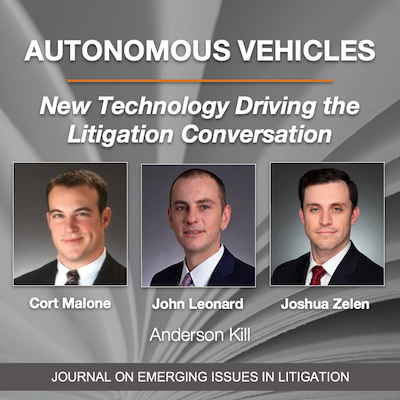
    Autonomous Vehicles: The New Technology Driving the Litigation Conversation

    The Authors

    Cort Malone

    Cort MaloneAnderson Kill

    Cort T. Malone (cmalone@andersonkill.com) is a shareholder in the New York and Stamford offices of Anderson Kill and practices in the Insurance Recovery and the Corporate and Commercial Litigation Departments. An experienced litigator, he focuses on insurance coverage litigation and dispute resolution, with an emphasis on commercial general liability insurance, directors and officers insurance, employment
    practices liability insurance, advertising injury insurance, and property insurance issues.

    John M. Leonard

    John M. LeonardAnderson Kill

    John M. Leonard (jleonard@andersonkill.com) is a shareholder in Anderson Kill’s New York, New York, office, where he handles a full spectrum of insurance coverage matters, such as business interruption losses, D&O and E&O, commercial general liability, environmental liability.

    Joshua A. Zelen

    Joshua A. ZelenAnderson Kill

    Joshua A. Zelen (jzelen@andersonkill.com) is a law clerk pending admission in Anderson Kill’s New York office. He focuses his practice on insurance recovery.

    The Journal on Emerging Issues in Litigation

    Emerging Litigation Podcast

    Emerging Litigation PodcastProduced by HB Litigation and Law Street Media

    Interviews with leading attorneys and other subject matter experts on new twists in the law and how the law is responding to new twists in the world.

    Autonomous Vehicles: The New Technology Driving the Litigation Conversation

    “The AEV Act requires a policyholder’s insurance company to cover third-party damage caused by a self-driving automated vehicle. A policy may not exclude such damages, except for damages suffered as a direct result of software alterations made without the policyholder’s knowledge, or failure to install safety-critical software updates.”

    Abstract: So far, Congress has not been able to pass regulations governing the emergence of self-driving or autonomous vehicles. Twenty-one states and the United Kingdom are leading the way. As more of these vehicles take to the highway implications will emerge for the insurance industry. Auto
    insurance policies will have to determine how to insure against losses caused by nonhuman operators, commercial general liability policies will be affected when technology developers and car makers are sued for bodily injury and property damage arising from malfunctioning technology, and cyber policies could be implicated in the event of hacks or data breaches. The authors review these subjects and share their insights into what autonomous vehicle producers should consider when it comes to mitigating their risk.

    Download the article now!

    Read, listen, explore more content on the subject!

    Podcast: Biometric Privacy Litigation and Coverage Disputes with John Leonard and Cort Malone

    JEIL: Litigation After Biometric Privacy Law Violations: Policyholder Victories and Their Implications. Co-authors Cort Malone and Abigal Damsky 

    JEIL: Biometric Privacy Laws: Companies Will Need Insurance as Protection From New and Expanding Liability. Co-authors Cort Malone and Jade Sobh

    Podcast: Autonomous Vehicles: The New Technology Driving the Litigation Conversation with John Leonard and Cort Malone

    Tags

    Emerging Litigation & Risk Compliance Litigation & appeals Cybersecurity Data Privacy Artificial Intelligence (AI) Insurance Companies Risk Management Corporate & Securities Insurance Claims Recovery Regulations Data Breach Toxic Torts Antitrust Legal Tech Product Liability Settlements Trial Personal Injury Privacy Healthcare Per- and Polyfluoroalkyl Substances (PFAS) Data Analytics Arbitration Constitutional Law Climate Change Cannabis Labor Law Insurance Fraud Liability Claims COVID Alternative Dispute Resolution (ADR) Mediation Diversity Equity Inclusion (DEI) Claims management Professional Liability Legal Research & Writing Business Interruption Law Practice Management Trial Skills Property and Casualty Drug Laws Copyright Law Catastrophic Loss

  • Labor Organizing in Retail: Conditions Remain for Continued Momentum

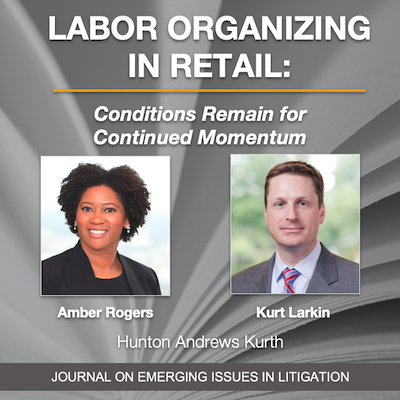
    Labor Organizing in Retail: Conditions Remain for Continued Momentum

    The Authors

    Amber Rogers

    Amber RogersHunton Andrews Kurth

    Amber is Board Certified in Labor & Employment Law by the Texas Board of Legal Specialization, and is a trial lawyer who has extensive experience representing and advising clients in traditional labor relations, such as collective bargaining, representation elections, decertification elections, unfair labor practice charges, arbitrating grievances, contract administration and interpretation, and union avoidance strategies.

    Amber’s litigation experience includes regularly representing clients in wage and hour collective and class actions, trade secrets and post-employment restrictive covenant disputes, and complex employment discrimination. As a part of Amber’s partnership with clients to avoid litigation, she frequently conducts and coordinates sensitive corporate investigations, and provides training presentations for clients on a multitude of topics.

    Kurt Larkin

    Kurt LarkinHunton Andrews Kurth

    Kurt helps businesses of all sizes solve their complex labor and employment challenges. He counsels clients on all aspects of labor-management relations, including representation elections, collective bargaining and strikes and lockouts, and also advises clients in strategic employment and human relations matters. Kurt litigates labor and employment cases in federal and state trial and appellate courts around the country and before the NLRB and EEOC.

    Kurt is a recognized thought leader in the area of traditional labor-management relations. He has been recognized as a leader in Labor and Employment by Chambers USA Virginia and as a 2022 Top 10 Labor Lawyer by Benchmark Litigation.

    The Journal on Emerging Issues in Litigation

    Emerging Litigation Podcast

    Emerging Litigation PodcastProduced by HB Litigation and Law Street Media

    Interviews with leading attorneys and other subject matter experts on new twists in the law and how the law is responding to new twists in the world.

    Labor Organizing in Retail: Conditions Remain for Continued Momentum

    “The political and social issues of the past few years, inflation, the looming recession, job security, wages, and pandemic-related frustration/unhappiness are just a few of the countless reasons cited for the boom in union support/approval.”

    Abstract: In 2022, labor organizing was in the spotlight with workers organizing at a rate not seen in years. The National Labor Relations Board saw an increase of union petitions during the last fiscal year, it was more than 50% higher than the previous year. Relatedly, more unions have won representation and American approval is at its highest in over 50 years. The rise of the “homegrown” union has directly impacted employers of all industries. The year 2022 can provide all industries and companies with lessons learned, particularly from those who faced threats for the first time. It is crucial to note too, however, that many of these companies and retailers have positive reputations. Labor and union laws continue to evolve as the Biden administration takes full control of the NLRB.

    Download the article now!

  • Modernizing Our Court System (but Don’t Attend Trial from Your Car) with Hon. Scott Schlegel

    Modernizing Our Court System (but Don’t Attend Trial from Your Car) with Hon. Scott Schlegel

    Modernizing Our Court System

    Photo by Ernest Ojeh via Unsplash

    The judicial system is overburdened for a number of reasons, and greater efficiency is a must if court systems are to achieve their important objectives.

    Technology and openness to all that it offers is a key solution, something that was tried, tested and proven during the Covid pandemic which closed courthouses and law offices around the nation. Along with technology, improvements can be made by reexamining their orthodoxies about how things should be done based on decades of “that’s how we’ve always done it.”

    This is a matter of importance to judges, lawyers, plaintiffs, defendants, and numerous others whose lives are impacted directly or indirectly when either the civil or criminal justice systems are inefficient, cumbersome, costly, confusing, slow, and even inaccessible. If only we had an example of at least one judge who is trying to do something about it. But wait …

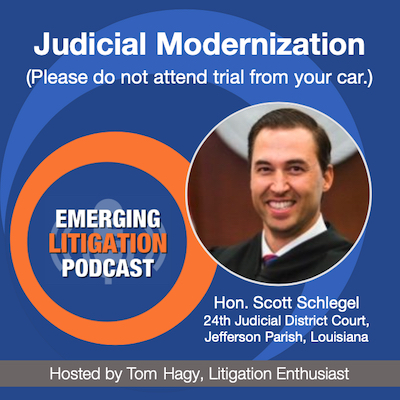
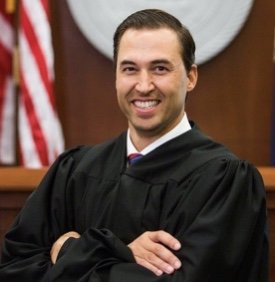
    Listen to my interview with the Hon. Scott Schlegelwho presides over criminal civil and domestic matters in Louisiana’s 24th Judicial District Court in Jefferson Parish. Judge Schlegel was elected to the bench in 2013, and quickly earned a reputation as a modern judge using technology to bring his court into the digital age, even before the pandemic forced the change on other jurists. He partnered with tech companies to develop efficiency tools like chat bots and online forms software. He launched courtonline.us and onlinejudge.us to consolidate his processes for the public. Judge Schlegel has received numerous awards and accolades, like the National Center for State Courts’ 26th Annual William H. Rehnquist Award for Judicial Excellence. He was the American Bar Association’s 2021 Legal Rebel. And he received the Fastcase 50 Award for his innovative approaches to the administration of justice. Prior to becoming a judge, he was a prosecutor and litigator. Judge Schlegel graduated with honors from Loyola University New Orleans College of Law.

    This podcast is the audio companion to the Journal on Emerging Issues in Litigation. The Journal is a collaborative project between HB Litigation Conferences and the Fastcase legal research family, which includes Full Court Press, Law Street Media, and Docket Alarm. The podcast itself is a joint effort between HB and our friends at Law Street Media. If you have comments or wish to participate in one our projects please drop me a note at Editor@LitigationConferences.com.

    Tom Hagy

    (actual size)

    Tom Hagy
    Litigation Enthusiast and
    Host of the Emerging Litigation Podcast
    Home Page
    LinkedIn
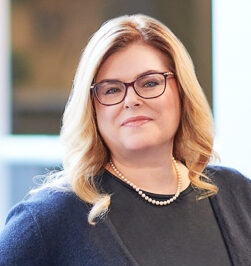
    Hon. Scott Schlegel

    Hon. Scott SchlegelLouisiana State Judge, Jefferson Parish

    Judge Schlegel was elected to the bench in 2013, and quickly earned a reputation as a modern judge using technology to bring his court into the digital age, even before the pandemic forced the change on other jurists. He partnered with tech companies to develop efficiency tools like chat bots and online forms software.

    He launched courtonline.us and onlinejudge.us to consolidate his processes for the public. Judge Schlegel has received numerous awards and accolades, like the National Center for State Courts’ 26th Annual William H. Rehnquist Award for Judicial Excellence. He was the American Bar Association’s 2021 Legal Rebel. And he received the Fastcase 50 Award for his innovative approaches to the administration of justice. Prior to becoming a judge, he was a prosecutor and litigator. Judge Schlegel graduated with honors from Loyola University New Orleans College of Law.

  • Discovery Strategies in Wage and Hour Class and Collective Actions Before and After Certification of Putative Class

    Discovery Strategies in Wage and Hour Class and Collective Actions Before and After Certification of Putative Class

    Discovery Strategies in Wage and Hour Class and Collective Actions Before and After Certification of Putative Class

    Strategically Limiting Discovery, Resolving Discovery Disputes

    Wage and hour class and collective actions are complex and discovery intensive. Discovery requests are often burdensome, seeking information concerning a broad swath of workers. This causes the discovery process to sometimes linger for years and creates a significant expense for employers.In recent years, courts have emphasized that parties must rein in extensive and expensive discovery requests. Employment litigators are increasingly raising proportionality arguments as a basis for objecting to opposing counsel’s discovery requests.

    Drafters are responding by tailoring requests to anticipate such challenges. Drafting discovery requests that are likely to withstand burden and proportionality challenges and objections to broad discovery requests is critical for litigators representing employers in wage and hour class and collective actions. Employment litigators must develop and implement effective discovery strategies both before and, as applicable, after certification of the putative class. These strategies often must anticipate the possibility of a future summary judgment motion, further certification practice, and trial on the merits.

    Listen as our authoritative panel of employment law attorneys explains effective strategies for pursuing or objecting to discovery requests in wage and hour collective and class actions and resolving discovery disputes that arise during litigation.

    Questions Addressed:

    • What are the most common discovery challenges counsel face when litigating wage and hour collective and class actions–from initiation through resolution of the case?
    • What strategies have been effective in wage and hour collective and class actions for obtaining essential information with the least expense?
    • What is the scope of discoverable evidence before and after certification of the putative class, and how can you limit or best manage discovery?
    • When drafting discovery requests in wage and hour class and collective actions, what should employment counsel consider to ensure that the requests align with the proportionality standard?

    Interested in More CLE OnDemand? Click Here.

    Interested in this program? Click here to send us a note.

    On Demand CLE Webinar

    Interested in this program? Click here to send us a note.

    Speakers

    Gerald Maatman Jr.
    Partner
    Duane Morris
    GMaatman@duanemorris.com

    Noel P. Tripp
    Principal
    Jackson Lewis
    Noel.Tripp@jacksonlewis.com

    Outline

    1. Pursuing or objecting to discovery requests in wage and hour collective and class actions
      1. Before conditional collective or class certification
      2. After conditional certification of a collective action
      3. After class certification
    2. Discovery considerations for summary judgment
    3. Discovery considerations for trial
    4. Resolving discovery disputes

    Explore more from Duane Morris LLP!

    Journal (JEIL) Artificial Intelligence Litigation Risks in the Employment Discrimination Context. By Gerald Maatman Jr., Alex Karasik, and George Schaller

    CLE OnDemand Webinar: AI Nuts & Bolts Survival Guide: Artificial Intelligence – Discrimination in Employment Context. Gerald Maatman Jr., Alex Karasik, and George Schaller

    CLE OnDemand Webinar: Discovery Strategies in Wage and Hour Class and Collective Actions Before and After Certification of Putative Class. Gerald Maatman Jr., Noel P. Tripp

    CLE OnDemand Webinar: Rule 23(c)(4) Issue Certification: Reconciling the Conflict With the Predominance Requirement. Gerald Maatman Jr., Timothy Congrove, Jennifer Mesko and James Muehlberger

  • Under Pressure: Courts and Lawyers Trying to Deal With It with Diana Manning

    Under Pressure: Courts and Lawyers Trying to Deal With It with Diana Manning

    The pressure on trial lawyers, judges, plaintiffs, defendants, and court systems is only increasing.

    The backlog of cases in New Jersey, for example, nearly quadrupled between February 2020 and 2021, the first year of the pandemic, according to NJ Spotlight News (NJSN). The state is also facing a historic shortage of jurists, NJSN reported, “leading to overworked judges, huge case backlogs and nearly 7,000 defendants in jail without bail, some 500 of them for more than two years despite a law that essentially requires a trial within two years for anyone detained.”

    As reported by NJSN, one court official told the state Assembly Budget Committee about the impact of the pandemic on the court system: “Buildings were closed to most in-person trials for more than a year, although other proceedings continued virtually. The business closures and high unemployment led to a housing crisis that resulted in more than 46,000 pending cases that involve landlord-tenant issues . . . . But with all courts open and staff back to work in person, it is impossible to eliminate the backlog of cases with so many open judge seats.” The problem is attributed to the state Senate, where the process is mired, even though the governor is making appointments.

    According to the National Counsel for State Courts, backlogs at one third of U.S. courts increased by 5%.  It would have been worse had courts not held virtual hearings.

    Using the Court Statistic Project database, the numbers reveal in stark terms the impact the pandemic had in the year it came to America. Dispositions dropped from 43M in 2019 to 28M in 2020. Bench trials fell from 3M in 2019 to under 2M in 2020. Jury trials plummeted from 49K in 2019 to less than 19K in 2020.

    The Washington Post reported that the Pennsylvania Supreme Court declared a judicial emergency and extended deadlines. Virginia’s Supreme Court suspended nonessential proceedings. The Iowa Supreme Court pushed back criminal trials and the Alabama’s Supreme Court suspended in-person proceedings. New Jersey Supreme Court Chief Justice Stuart Rabner warned that the judicial shortage “comes with a price.”

    Listen to my interview with Diana C. Manning, Managing Principal, Bressler, Amery & Ross, P.C., for the fallout from the judicial shortage and swelling case backlogs, and what needs to be done to dig out. An experienced and award winning complex commercial litigator, Diana is co-chair of the firm’s business and commercial litigation practice group. She received her J.D. from Rutgers University School of Law.

    This episode is the first of two about challenges to the court system and what can be done to address them. An upcoming episode will feature an Alabama state judge who is leading the way in the use of technology to modernize the courts.

    This podcast is the audio companion to the Journal on Emerging Issues in Litigation. The Journal is a collaborative project between HB Litigation Conferences and the Fastcase legal research family, which includes Full Court Press, Law Street Media, and Docket Alarm. The podcast itself is a joint effort between HB and our friends at Law Street Media. If you have comments or wish to participate in one our projects please drop me a note at Editor@LitigationConferences.com.

    Tom Hagy

    (actual size)

    Tom Hagy
    Litigation Enthusiast and
    Host of the Emerging Litigation Podcast
    Home Page
    LinkedIn

    Diana Manning

    Diana Manning

    Diana Manning is Managing Principal at Bressler, Amery & Ross in New Jersey. Diana has more than two decades of experience in complex commercial litigation at both the trial and appellate levels. She is Co-Chair of the firm’s Business and Commercial Litigation practice group, and spearheads the firm’s Appellate practice team. Diana has developed a successful track record of trial verdicts and settlements, especially in complex matters. She also has a reputation as a strategic, thoughtful, and fearless advocate for all of her clients.

    A distinguished trial lawyer, Diana is Certified by the Supreme Court of New Jersey as a Civil Trial Attorney. She is also an accomplished appellate lawyer who has participated in six matters before the New Jersey Supreme Court, including arguing four times. Diana is an avid presenter and author on business litigation, legal ethics, and professional liability. She is the author of the New Jersey Chapter of The Law of Lawyer’s Liability: Fifty-State Survey of Legal Malpractice, ABA/First Chair Press, which provides an overview of the laws governing attorney malpractice in each state.

    To date, Diana’s distinguished career has brought her offices and honors from many professional and legal industry organizations. Diana served on the District XA Ethics Committee for 10 years and was appointed Chair by the New Jersey Supreme Court from 2017-2019. She is also President of the New Jersey Women Lawyers Association, and is a Past President of Trial Attorneys of New Jersey, the Morris County Bar Association, and the Morris County Bar Foundation.


  • Policy Derailed: Can U.S. Antitrust Policy Toward Standard Essential Patents Get Back on Track by Jonathan Rubin

    Policy Derailed: Can U.S. Antitrust Policy Toward Standard Essential Patents Get Back on Track by Jonathan Rubin

    The Author

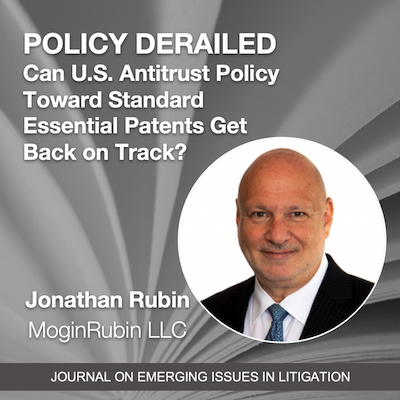
    Jonathan Rubin

    Jonathan RubinMoginRubin LLP

    Jonathan Rubin (jrubin@moginrubin.com) is Co-Founder and Partner of MoginRubin LLP, a boutique antitrust, mergers and acquisitions, and class action law firm. Since 2001, he has focused his legal practice exclusively on antitrust and competition law and policy. As a litigator he has led trial teams in major antitrust cases in courts throughout the country.

    Rubin is a member of the Editorial Board of Advisors for the Journal of Emerging
    Issues in Litigation.

    The Journal on Emerging Issues in Litigation

    Emerging Litigation Podcast

    Emerging Litigation PodcastProduced by HB Litigation and Law Street Media

    Interviews with leading attorneys and other subject matter experts on new twists in the law and how the law is responding to new twists in the world.

    Policy Derailed:
    Can U.S. Antitrust Policy Toward Standard Essential Patents Get Back on Track?

    “The failure to appropriately adjust the patent system to accommodate the competitive circumstances created when patents are incorporated into standards undermines the purposes of the standard-setting enterprise and impairs the utility and proliferation of standardized technologies. Without a course correction among the judiciary, the United States risks finding itself as a less desirable jurisdiction for pro-growth and pro-competitive patenting and standard-setting activities.”

    Abstract: A consensus at the intersection of patent and anti-trust law was achieved after a series of decisions finding that in some circumstances owners of standard essential patents (SEPs) have an antitrust duty to deal with willing licensees. Beginning in 2017, however, the Department of Justice derailed U.S. policy by undermining the role and usefulness of antitrust for policing abuses of the standard setting process. This article traces the emergence of the consensus, its abrogation by the DOJ, and the resulting effects and prospects for the future.

    Download the article now!

    Explore more from MoginRubin LLP!

    Blog: Emboldened by New Resources and Expanded Authority, Feds Continue 10-Year Look Back at Chinese Investment. By Dan Mogin, Jonathan Rubin, Jennifer Oliver, and Timothy LaComb. List

    OnDemand CLE Webinar: The Antitrust Case Against Google. Dan Mogin, Jonathan Rubin, Jennifer Oliver, Timothy LaComb, John Newman, Dr. Alan Grant

    Blog: FTC’s Case Against Facebook Will Test the Flexibility of U.S. Antitrust Law.Authors: Jonathan Rubin and Jennifer Oliver, MoginRubin LLP

    Blog: Full Ninth Circuit Removes Unwarranted Hurdles to Class Certification.

    Journal: Policy Derailed: Can U.S. Antitrust Policy Toward Standard Essential Patents Get Back on Track by Jonathan Rubin

    Webinar: Class Certification After Olean v. Bumble Bee with Jonathan Rubin, James Bogan lll, Jonathan Cohn, Bradley Hamburger.

    Journal: FTC v. Amazon: Market Definitions and Section 5 of the FTC Act

    Podcast: Algorithmic Software Facilitated Price Fixing with Jonathan Rubin

    Plus, additional insights from the MoginRubin Blog.

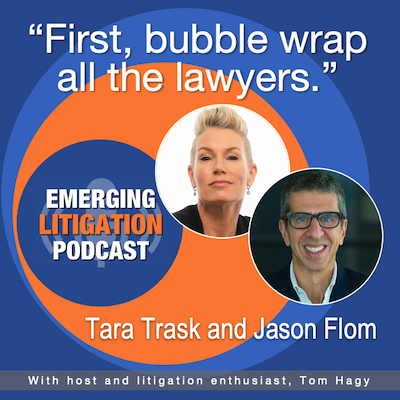
  • Lawyers for Good with Tara Trask and Jason Flom

    Lawyers for Good with Tara Trask and Jason Flom

    If you’re feeling bad about being a lawyer, or just maybe tingling with the holiday spirit of giving back, this episode is for you. Listen to three professionals (well, maybe two “professionals”) who deeply admire for the legal profession, the important role attorneys play in society, and all the potential they have to make the world a better place.

    When there is strife, there is a supporting organization, and with them are lawyers. Wrongful convictions. Voting rights. Environmental protection. The rights of women, people of color, workers,  LGBTQ, immigrants, asylum seekers.  Lawyers are in a unique position to do something about all of this. And they do. And we hope more will.

    Join me as I interview nationally acclaimed trial consultant Tara Trask and music industry star-maker Jason Flom.

    Tara Trask is the President of Trask Consulting
    , a boutique litigation strategy, jury research and trial consulting firm. Tara  focuses complex commercial litigation, from intellectual property to antitrust, from products liability to insurance, and oil and gas. She has extensive experience assisting institutions and individuals in matters involving regulatory enforcement and white-collar defense. Tara has been involved in more 450 jury trials.

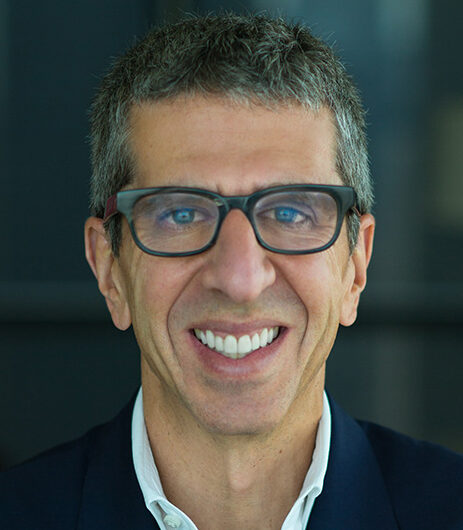
    Music industry executive Jason Flom is  CEO of Lava Records, Lava Music Publishing, and Lava Media, LLC.  He is former  CEO at Atlantic Records, Virgin Records and Capitol Music Group. Jason is personally responsible for launching acts such as Katy Perry and Greta Van Fleet, and discovering and developing the likes of Matchbox 20, The Corrs, Tory Amos, Jewel, and Stone Temple Pilots. The New Yorker described Jason as “one of the most successful record men of the past 20 years. He’s also committed to doing good. Through his Lava for Good company, Jason hosts the hit podcast Wrongful Conviction, now in its ninth season, which features interviews with people who have spent decades in prison for crimes they did not commit. Within two weeks of its release, the podcast shot to #7 on the iTunes charts and has raised more than $1 million to benefit the Innocence Project. Lava for Good’s Bone Valley, which tells the tragic story of  Leo Schofield, who was sentenced to life for the murder of his wife, Michelle, is also one of the top podcasts on iTunes (#19 as of this writing), and received a highly regarded “four thumbs up” from the Crime Writers On  podcast. Jason’s father, the fourth named partner in what is now known as Skadden, was dubbed one of the “Lawyers of the Century by The American Lawyer in 1999.

    This podcast is the audio companion to the Journal on Emerging Issues in Litigation. The Journal is a collaborative project between HB Litigation Conferences and the Fastcase legal research family, which includes Full Court Press, Law Street Media, and Docket Alarm. The podcast itself is a joint effort between HB and our friends at Law Street Media. If you have comments or wish to participate in one our projects please drop me a note at Editor@LitigationConferences.com.

    Tom Hagy

    (actual size)

    Tom Hagy
    Litigation Enthusiast and
    Host of the Emerging Litigation Podcast
    Home Page
    LinkedIn

    Loved hearing what Tara said on this subject matter?

    Explore more of subject content with Tara!

    Podcast: Jury Selection in the Age of Conspiracy Theories and Distrust with Tara Trask

    Podcast: Intellectual Property Trial Team Diversity with Tara Trask

    Tara Trask

    Tara TraskTrask Consulting

    Tara Trask is the President of Trask Consulting, a boutique litigation strategy, jury research and trial consulting firm. Tara focuses complex commercial litigation, from intellectual property to antitrust, from products liability to insurance, and oil and gas. She has extensive experience assisting institutions and individuals in matters involving regulatory enforcement and white-collar defense. Tara has been involved in more 450 jury trials.

    Jason Flom

    Jason Flom Lava Records

    Music industry executive Jason Flom is CEO of Lava Records, Lava Music Publishing, and Lava Media, LLC. He is former CEO at Atlantic Records, Virgin Records and Capitol Music Group. Jason is personally responsible for launching acts such as Katy Perry and Greta Van Fleet, and discovering and developing the likes of Matchbox 20, The Corrs, Tory Amos, Jewel, and Stone Temple Pilots. The New Yorker described Jason as “one of the most successful record men of the past 20 years. He’s also committed to doing good.

    Through his Lava for Good company, Jason hosts the hit podcast Wrongful Conviction, now in its ninth season, which features interviews with people who have spent decades in prison for crimes they did not commit. Within two weeks of its release, the podcast shot to #7 on the iTunes charts and has raised more than $1 million to benefit the Innocence Project. Lava for Good’s Bone Valley, which tells the tragic story of Leo Schofield, who was sentenced to life for the murder of his wife, Michelle, is also one of the top podcasts on iTunes (#19 as of this writing), and received a highly regarded “four thumbs up” from the Crime Writers On podcast. Jason’s father, the fourth named partner in what is now known as Skadden, was dubbed one of the “Lawyers of the Century by The American Lawyer in 1999.

    Tags

    Emerging Litigation & Risk Compliance Litigation & appeals Cybersecurity Data Privacy Artificial Intelligence (AI) Insurance Companies Risk Management Corporate & Securities Insurance Claims Recovery Regulations Data Breach Toxic Torts Antitrust Legal Tech Product Liability Settlements Trial Personal Injury Privacy Healthcare Per- and Polyfluoroalkyl Substances (PFAS) Data Analytics Arbitration Constitutional Law Climate Change Cannabis Labor Law Insurance Fraud Liability Claims COVID Alternative Dispute Resolution (ADR) Mediation Diversity Equity Inclusion (DEI) Claims management Professional Liability Legal Research & Writing Business Interruption Law Practice Management Trial Skills Property and Casualty Drug Laws Copyright Law Catastrophic Loss

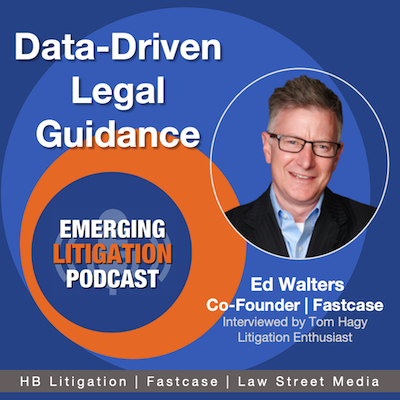
  • Data-Driven Legal Guidance with Ed Walters

    Data-Driven Legal Guidance with Ed Walters

    Today we’re going to talk about the weather. But only for a minute. Mostly we’re going to talk about the use of big data in the practice of law.

    There is a reason IBM acquired the digital assets of The Weather Channel, and it’s not because they are climate nerds. They bought it to put weather data to work to “operationalize [the] understanding of the impact of weather on business outcomes.” Think about the economic impact of snowstorms, hurricanes, and even less dramatic weather conditions, or the impact on the durability of manufacturing or building materials as temperatures rise or fall outside the norm.

    While we all crave meteorological precision, we also crave precision when making legal and business decisions.

    Clients ask questions like these all the time: What is our case worth? What size award will we get? Where should I file? Will the judge grant summary judgment? Should I even bring this suit?  Lawyers will draw on experience to offer their best advice, providing ranges followed by caveats and usually preceded by the most lawyerly of lawyer answers: “It depends.”  As my guest points out, lawyers also get business-related questions. Business-related answers may begin with “it depends,” but must end with a number. When a CEO asks how much revenue your project will generate, “more” is not the answer they’re looking for. I know. I’ve tried.

    Lawyers who seek greater precision in their predictions can take comfort in the increasing sophistication of analytical tools that can evaluate massive troves of data and account for myriad variables. Not only are we seeing advances in machine learning, artificial intelligence, and language processing, but there is greater access to important litigation-related data – BIG DATA – than ever before. Using new technologies to comb through millions of records – combined with an attorney’s insights – cannot only sharpen their predictive capabilities, but it can help them build, defend, and resolve cases.

    For insights on the past, present and future of legal guidance and analysis, listen to my interview with Ed Walters, co-founder and CEO of our partners on this podcast, Fastcase, the legal research and software company whose divisions include Fastcase Full Court Press (publishing), Law Street Media (legal news), Docket Alarm (docket tools), and NextChapter (software).  An entrepreneur, writer and professor, Ed brings his experience advising global Fortune 500 tech and pharma companies and sports leagues, serving in the White House on media affairs and speechwriting, and contributing to several major newspapers and journals. Ed is an adjunct law professor at Georgetown and Cornell universities. He is also a self-described “weather nerd,” which explains my tortured introduction.

    This podcast is the audio companion to the Journal on Emerging Issues in Litigation. The Journal is a collaborative project between HB Litigation Conferences and the Fastcase legal research family, which includes Full Court Press, Law Street Media, and Docket Alarm. The podcast itself is a joint effort between HB and our friends at Law Street Media. If you have comments or wish to participate in one our projects please drop me a note at Editor@LitigationConferences.com.

    Tom Hagy

    (actual size)

    Tom Hagy
    Litigation Enthusiast and
    Host of the Emerging Litigation Podcast
    Home Page
    LinkedIn

    Data-Driven Legal Guidance

    Ed Walters

    Ed WaltersFastcase

    Ed Walters is the CEO and co-founder of Fastcase, an online legal research software company based in Washington, D.C. Under Professor Walters’s leadership, Fastcase has grown to one of the world’s largest legal publishers, serving more than 1.1 million subscribers from around the world.

    Before founding Fastcase, Professor Walters worked at Covington & Burling, in Washington D.C. and Brussels, where he advised Microsoft, Merck, SmithKline, the Business Software Alliance, the National Football League, and the National Hockey League. His practice focused on corporate advisory work for software companies and sports leagues, and intellectual property litigation.

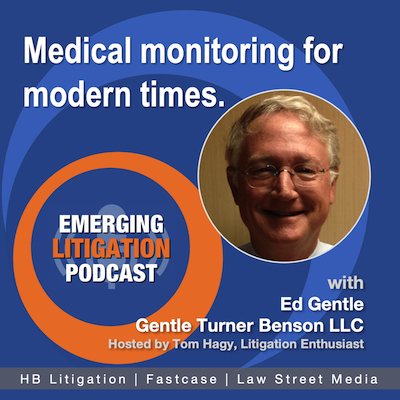
  • Medical Monitoring for Modern Times with Ed Gentle

    Medical Monitoring for Modern Times with Ed Gentle

    Medical Monitoring for Modern Times:
    Attorney and court-appointed neutral Ed Gentle shares his vision for a new paradigm for mass torts. 

    Marissa, a resident of a small town in Kentucky, learned that for some time her drinking water may have been contaminated with so-called “forever chemicals” or PFAS. It’s really a collection of chemicals used in products like fire-suppression foam, cookware, stain-resistant sprays, and food packaging. A local public radio reporter covering the story asked Marissa for her reaction. “I was never informed,” she said. “And now I’m worried, like, I hope I don’t have issues some day in my life.”  

    Marissa’s concern is like that of many people who find themselves in this situation and is at the center of this episode. When a case like Marissa’s goes to court, plaintiffs will seek a ruling that the responsible parties pay for years of medical monitoring. That means they are suing often without signs of an existing injury, and that defendants must pay for something when an injury may not arise.

    Attorney, author, and court-appointed case neutral, Edgar C. Gentle III, says  that approach is antiquated. He outlines a better way in his 2014 essay titled The Medical Monitoring Tort Remedy: Its Nationwide Status, Rationale and Practical Application (A Possible Dynamic Tort Remedy for Long Term Tort Maladies). Now he shares his latest insights on the Emerging Litigation Podcast.

    Ed Gentle is the Founding Partner of Gentle Turner & Benson, LLCin Birmingham, Ala. He is a Rhodes Scholar and has five college degrees, three in law. He has practiced for nearly four decades, spending 90% of his professional time serving as a neutral assigned by judges to oversee aspects of  mass tort litigation and settlements. He has helped create and administer over $2 billion in settlements during the past 25 years. Education: Bachelor of Science, Auburn University, summa cum laude, Danforth Scholar; Master of Science, University of Miami, summa cum laude, Maytag Fellow; B.A. and M.A. Degrees, Oxford University, Rhodes Scholar, Honors in Jurisprudence; and Juris Doctorate; University of Alabama School of Law, Hugo Black Scholar.

    This podcast is the audio companion to the Journal on Emerging Issues in Litigation. The Journal is a collaborative project between HB Litigation Conferences and the Fastcase legal research family, which includes Full Court Press, Law Street Media, and Docket Alarm. The podcast itself is a joint effort between HB and our friends at Law Street Media. If you have comments or wish to participate in one our projects please drop me a note at Editor@LitigationConferences.com.

    Tom Hagy

    (actual size)

    Tom Hagy
    Litigation Enthusiast and
    Host of the Emerging Litigation Podcast

    Loved Ed’s podcast?

    Explore Ed’s additional content on Medical Monitoring Tort.

    JEIL: Medical Monitoring for Modern Times with Ed Gentle

    OnDemand CLE Webinar: The Medical Monitoring Tort Remedy with Gentle and Benson

    Tags

    Emerging Litigation & Risk Compliance Litigation & appeals Cybersecurity Data Privacy Artificial Intelligence (AI) Insurance Companies Risk Management Corporate & Securities Insurance Claims Recovery Regulations Data Breach Toxic Torts Antitrust Legal Tech Product Liability Settlements Trial Personal Injury Privacy Healthcare Per- and Polyfluoroalkyl Substances (PFAS) Data Analytics Arbitration Constitutional Law Climate Change Cannabis Labor Law Insurance Fraud Liability Claims COVID Alternative Dispute Resolution (ADR) Mediation Diversity Equity Inclusion (DEI) Claims management Professional Liability Legal Research & Writing Business Interruption Law Practice Management Trial Skills Property and Casualty Drug Laws Copyright Law Catastrophic Loss

    Ed Gentle

    Ed Gentle Gentle Turner & Benson, LLC

    Ed Gentle is the Founding Partner of Gentle Turner & Benson, LLC in Birmingham, Ala. He is a Rhodes Scholar and has five college degrees, three in law. He has practiced for nearly four decades, spending 90% of his professional time serving as a neutral assigned by judges to oversee aspects of mass tort litigation and settlements.
    Education: Bachelor of Science, Auburn University, summa cum laude, Danforth Scholar; Master of Science, University of Miami, summa cum laude, Maytag Fellow; B.A. and M.A. Degrees, Oxford University, Rhodes Scholar, Honors in Jurisprudence; and Juris Doctorate; University of Alabama School of Law, Hugo Black Scholar.