Blog

  • PFAS Consumer Fraud Litigation with John Gardella

    PFAS Consumer Fraud Litigation with John Gardella

    These stubborn chemicals are everywhere. But when they find their way into products, shouldn’t someone tell consumers?

    Per- and poly-fluoroalkyl substances (“PFAS”) are a family of more 12,000 manmade compounds.  That’s a huge family. Most people would recognize the brand names Teflon, produced by Dupont and Scotchgard produced by 3M. They also go by the nickname “forever chemicals” because they are highly persistent and mobile in the environment and the human body. In addition to bodily injury and environmental pollution litigation, plaintiffs are bringing suits against companies for claiming their products and the making of their products are safe and green. New consumer lawsuits seeking millions in damages are targeting oral hygiene products — like a recent case involving dental floss — cosmetics, apparel, and food packaging.

    Listen to my interview with environmental lawyer John Gardella of CMBG3 Law who discusses why PFAS concern citizens, media and legislators, what legal risks corporations face, and why we’re seeing  a surge in consumer fraud litigation.

    This podcast is the audio companion to the Journal on Emerging Issues in Litigation. The Journal is a collaborative project between HB Litigation Conferences and the Fastcase legal research family, which includes Full Court Press, Law Street Media, and Docket Alarm. The podcast itself is a joint effort between HB and our friends at Law Street Media. If you have comments or wish to participate in one our projects please drop me a note at Editor@LitigationConferences.com.

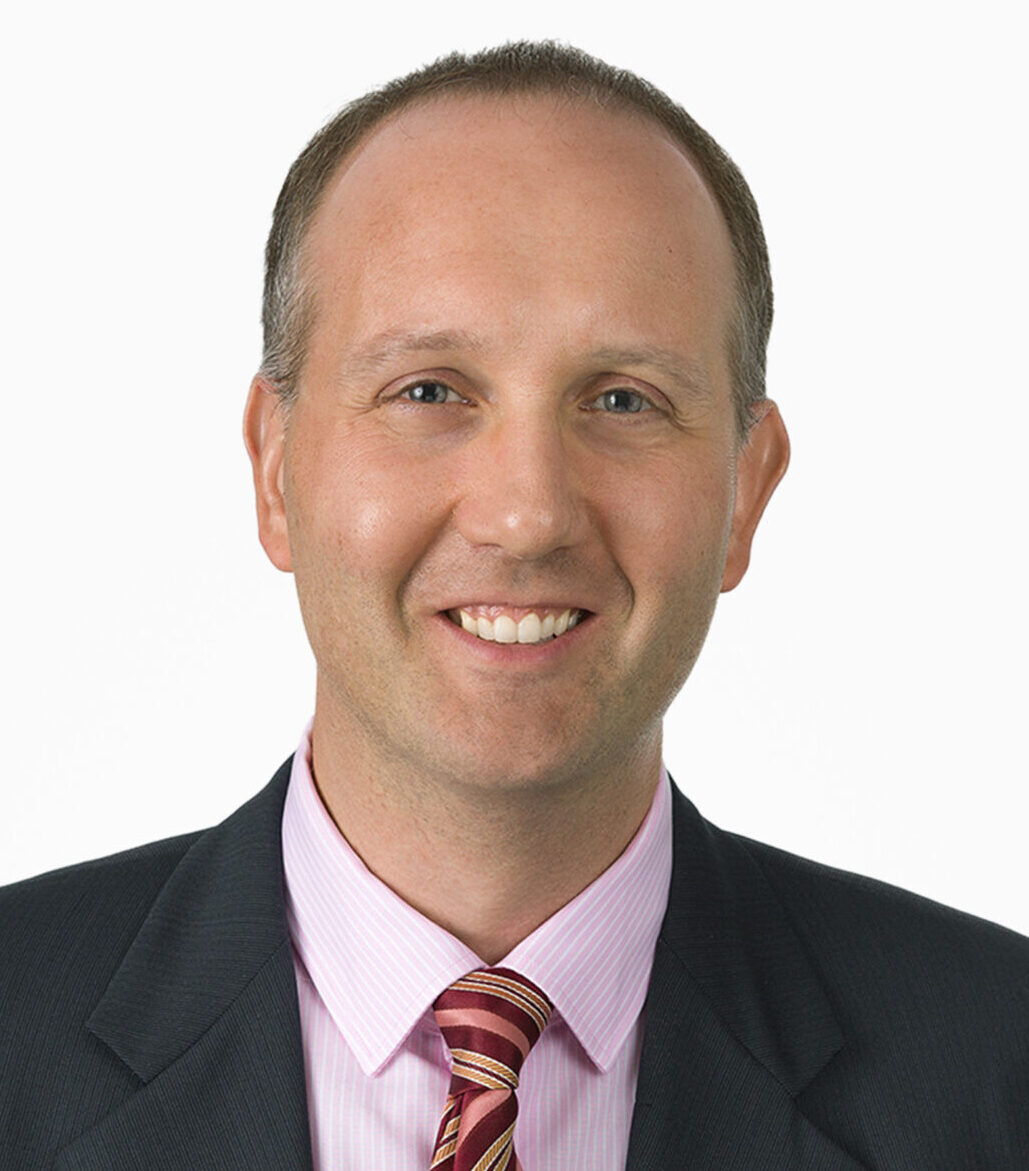
    Tom Hagy

    (actual size)

    Tom Hagy
    Litigation Enthusiast and
    Host of the Emerging Litigation Podcast
    Home Page
    LinkedIn

    PFAS Consumer Fraud Litigation with John Gardella

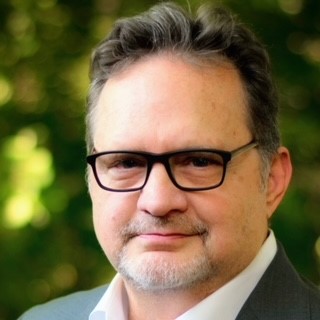
    John Gardella

    John GardellaCMBG3 Law

    John Gardella is a Shareholder and recognized thought leader on PFAS issues. He is licensed to practice in Massachusetts and Tennessee.

    A seasoned trial attorney with over 75 verdicts, John is the Chair of the firm’s PFAS, Environmental, Risk Management & Consulting, and ESG practice groups. His thought leadership and predictive risk abilities with respect to PFAS earned him the honor of being the only person in the country that was recognized as a thought leader on PFAS in 2020 and 2021 by the esteemed National Law Review. John is regularly interviewed by media on the subject of PFAS and other emerging chemicals of concern, and he consistently publishes his own thought leadership in several nationally syndicated resources, including Bloomberg Law, AM Best, and National Law Review. Private equity firms, the financial world, insurance companies, and corporations regularly seek John’s opinions on forward-looking environmental and chemical substances risk issues.

  • Medical Monitoring for Modern Times with Ed Gentle

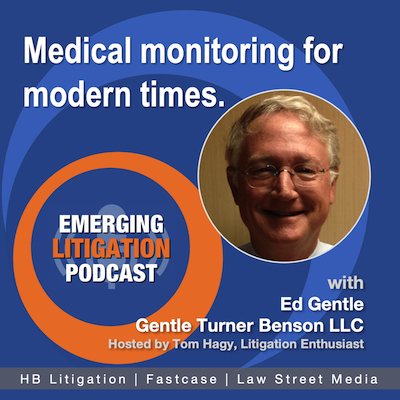
    Medical Monitoring for Modern Times with Ed Gentle

    Medical Monitoring for Modern Times:
    Attorney and court-appointed neutral Ed Gentle shares his vision for a new paradigm for mass torts. 

    Marissa, a resident of a small town in Kentucky, learned that for some time her drinking water may have been contaminated with so-called “forever chemicals” or PFAS. It’s really a collection of chemicals used in products like fire-suppression foam, cookware, stain-resistant sprays, and food packaging. A local public radio reporter covering the story asked Marissa for her reaction. “I was never informed,” she said. “And now I’m worried, like, I hope I don’t have issues some day in my life.”  

    Marissa’s concern is like that of many people who find themselves in this situation and is at the center of this episode. When a case like Marissa’s goes to court, plaintiffs will seek a ruling that the responsible parties pay for years of medical monitoring. That means they are suing often without signs of an existing injury, and that defendants must pay for something when an injury may not arise.

    Attorney, author, and court-appointed case neutral, Edgar C. Gentle III, says  that approach is antiquated. He outlines a better way in his 2014 essay titled The Medical Monitoring Tort Remedy: Its Nationwide Status, Rationale and Practical Application (A Possible Dynamic Tort Remedy for Long Term Tort Maladies). Now he shares his latest insights on the Emerging Litigation Podcast.

    Ed Gentle is the Founding Partner of Gentle Turner & Benson, LLCin Birmingham, Ala. He is a Rhodes Scholar and has five college degrees, three in law. He has practiced for nearly four decades, spending 90% of his professional time serving as a neutral assigned by judges to oversee aspects of  mass tort litigation and settlements. He has helped create and administer over $2 billion in settlements during the past 25 years. Education: Bachelor of Science, Auburn University, summa cum laude, Danforth Scholar; Master of Science, University of Miami, summa cum laude, Maytag Fellow; B.A. and M.A. Degrees, Oxford University, Rhodes Scholar, Honors in Jurisprudence; and Juris Doctorate; University of Alabama School of Law, Hugo Black Scholar.

    This podcast is the audio companion to the Journal on Emerging Issues in Litigation. The Journal is a collaborative project between HB Litigation Conferences and the Fastcase legal research family, which includes Full Court Press, Law Street Media, and Docket Alarm. The podcast itself is a joint effort between HB and our friends at Law Street Media. If you have comments or wish to participate in one our projects please drop me a note at Editor@LitigationConferences.com.

    Tom Hagy

    (actual size)

    Tom Hagy
    Litigation Enthusiast and
    Host of the Emerging Litigation Podcast

    Loved Ed’s podcast?

    Explore Ed’s additional content on Medical Monitoring Tort.

    JEIL: Medical Monitoring for Modern Times with Ed Gentle

    OnDemand CLE Webinar: The Medical Monitoring Tort Remedy with Gentle and Benson

    Tags

    Emerging Litigation & Risk Compliance Litigation & appeals Cybersecurity Data Privacy Artificial Intelligence (AI) Insurance Companies Risk Management Corporate & Securities Insurance Claims Recovery Regulations Data Breach Toxic Torts Antitrust Legal Tech Product Liability Settlements Trial Personal Injury Privacy Healthcare Per- and Polyfluoroalkyl Substances (PFAS) Data Analytics Arbitration Constitutional Law Climate Change Cannabis Labor Law Insurance Fraud Liability Claims COVID Alternative Dispute Resolution (ADR) Mediation Diversity Equity Inclusion (DEI) Claims management Professional Liability Legal Research & Writing Business Interruption Law Practice Management Trial Skills Property and Casualty Drug Laws Copyright Law Catastrophic Loss

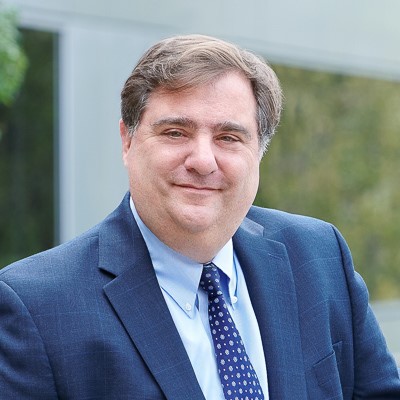
    Ed Gentle

    Ed Gentle Gentle Turner & Benson, LLC

    Ed Gentle is the Founding Partner of Gentle Turner & Benson, LLC in Birmingham, Ala. He is a Rhodes Scholar and has five college degrees, three in law. He has practiced for nearly four decades, spending 90% of his professional time serving as a neutral assigned by judges to oversee aspects of mass tort litigation and settlements.
    Education: Bachelor of Science, Auburn University, summa cum laude, Danforth Scholar; Master of Science, University of Miami, summa cum laude, Maytag Fellow; B.A. and M.A. Degrees, Oxford University, Rhodes Scholar, Honors in Jurisprudence; and Juris Doctorate; University of Alabama School of Law, Hugo Black Scholar.

  • Safeguarding Against Financial Exploitation

    Safeguarding Against Financial Exploitation

    An on-demand CLE-eligible webinar

    Safeguarding Against Financial Exploitation  

    America’s senior population is growing. Nearly one in five U.S. residents will be 65 or older in 2030. Which means the average age of U.S. investors is climbing too. With that comes the risk that they will be exploited by people with access – or gain access through nefarious methods – to their investment portfolio. Seniors and vulnerable persons lose billions of dollars each year. Remarkably, 90% of the people to take advantage of senior investors are members of their own family. Attorneys who represent senior clients need to know the signs of vulnerability, red flags that their clients are being exploited, what laws apply, and rules lawyers must follow in these matters.  

    Questions our speakers answer:

    • What is senior / vulnerable investor exploitation?  
    • Who is protected by state and federal laws?  
    • How prevalent is senior financial exploitation? What do the numbers tell us? 
    • What is the pace of financial abuse SAR filings by securities firms? 
    • What are the most popular scams?  
    • What is diminished capacity? 
    • What are the red flags indicating possible exploitation? 
    • What are the laws, rules, and regulations governing law firms? 
    • What are some best practices for law firms? 
    • How can firms best protect their senior clients?  

    Blue image of money.

    On Demand CLE Webinar

    What You Get

    • PowerPoint and supplemental materials.
    • Complete recording for later review.
    • Answers to your questions via email.
    • Invitation to contact speakers.
    • 1.5 CLE credits (for licensed attorneys).
    • CLE assistance.*

    *Subject to state bar rules. For licensed attorneys. 

    Register

    Meet the Speakers

    Joseph Calabrese
    Bressler, Amery & Ross, P.C.

    A 1991 Graduate of St. John’s University Law School, Mr. Calabrese brings 30 years of practice and 18 years of Securities Litigation/Regulatory experience to his role as principal in the New York office of  Bressler, Amery & Ross’s Financial Institutions Group. He began his career as a Wall Street litigator as an associate general counsel for Citigroup’s Smith Barney and later served as an executive director and senior member of the Wealth Management Client Litigation Group at Morgan Stanley, where he ran the Early Dispute Resolution Group for seven years.

    He spent the first 13 years of his career as a prosecutor with the Kings County D.A.’s Office in Brooklyn, NY, the majority of that time, as a senior assistant district attorney in the Homicide Bureau. His areas of practice include financial institutions, financial institutions advisory practice, financial institutions enforcement defense, financial institutions litigation and arbitration. He is the co-head of the Pro Bono Committee and a member of the firm’s Senior & Vulnerable Investor Group. 

    More about Joseph

    Logan S. Fisher
    Bressler, Amery & Ross, P.C. 

    Logan Fisher is a Principal of Bressler, Amery and Ross. His practice is primarily devoted to representing and advising financial services professionals including broker-dealers, financial advisors, registered investment advisors, private equity, crowdfunding and other financial services professionals. Logan frequently represents broker-dealers and registered representatives in securities litigation, including customer-initiated complaints with self-regulatory organizations such as the Financial Industry Regulatory Authority (FINRA).

    He has successfully handled numerous arbitrations involving a variety of claims, including fraud, misrepresentation, unsuitability, unauthorized trading and churning. Logan also has experience counseling individual financial advisors regarding Form U4 and U5 disclosures. In his securities regulatory practice, Logan has represented broker-dealer and registered investment advisor clients in a variety of state, SEC and FINRA investigations. He has also counseled registered investment advisor clients concerning required disclosures under Form ADV. 

    More about Logan

    Angela Turiano
    Bressler, Amery & Ross, P.C.

    Angela Turiano represents brokerage firms and individual registered representatives in customer and employment arbitrations and litigation, as well as regulatory matters. Angela has worked as in-house counsel for two major securities firms, and thus understands, from an internal perspective, the highly specific needs of her clients. Highly respected throughout the financial services industry, Angela is an active speaker in the securities community, including speaking engagements at the SIFMA Annual Compliance and Legal Seminar, the New York State Bar Association, the American Conference Institute, and the renowned NYU Stern School of Business, all of where she has lectured on the latest trends in securities litigation.

    Angela is also an active member of Bressler’s Senior and Vulnerable Investor Group, where, in addition to advising and defending her clients with regard to senior issues, designs and conducts training and supervisory education programs on how to avoid regulatory and litigation risk in this space.

    More about Angela

  • Litigation’s Role in Gun Safety Advocacy: An Interview With Adam Skaggs of Giffords

    Litigation’s Role in Gun Safety Advocacy: An Interview With Adam Skaggs of Giffords

    The Role of Litigation in Advocating for Gun Safety

    Read the article

    We’re closing in on 400 million guns in America, weapons that have been used to kill 1.5 million Americans between 1968 and 2017. Can litigation be an effective tool in curbing this loss of life?

    In 2020 alone there were more than 45,000 gun deaths. The beyond tragic and senseless mass shootings at schools has become all too routine. Most Americans want stricter gun laws which they believe will reduce the senseless killing in our country, which leads the world in both the number of privately owned firearms and gun-related deaths.

    The Supreme Court, of course, didn’t take public opinion into account when it struck down a more than century old New York City ban on concealed firearms. Politicians do, however, pay close attention to polls. At the federal level, President Joe Biden signed a bipartisan law designed to make Americans safer in our gun-toting nation. Hailed as a “great start” and a rare but welcome exercise in reaching across the aisle, the law will result in safer citizens, but didn’t include much of what gun advocates say is really needed to effect meaningful change. In California, Governor Gavin Newsom signed a new law that gives citizens incentives to pursue gun manufacturers and dealers who sell illegal firearms. In New York, Democratic leaders, undaunted by the Supreme Court, have pushed through new gun restrictions at vulnerable locations like schools, malls, and stadiums.

    But what can lawyers and lawsuits do about it? Plenty. What reasonable measurers can be put into place that will not infringe on Second Amendment rights?  Several. Are we seeing litigation over these issues? You bet.

    For more specifics, read or listen to my interview with Adam Skaggs, chief counsel and policy director at leading gun safety advocacy group Giffords Law Center, co-founded by former Congresswoman Gabby Giffords. Prior to Giffords Law Center Adam was senior counsel at Everytown for Gun Safety and at the Brennan Center for Justice, where he worked on election law issues.  Adam’s commentary has been published in Slate, Politico, the Atlantic, and the New York Times, among other publications, and he has been widely quoted by media ranging from the Wall Street Journal and Fox News to the New York Times and MSNBC. Adam graduated summa cum laude from Brooklyn Law School, received an MS in Urban Affairs from Hunter College of the City University of New York, and holds a BA, awarded with distinction, from Swarthmore College.

    If you would like to learn more about Giffords Law Center and how you can get engaged, please reach out to to them. You may also email Adam directly. 

    The podcast is the audio companion to the Journal on Emerging Issues in Litigation. The Journal is a collaborative project between HB Litigation Conferences and the Fastcase legal research family, which includes Full Court Press, Law Street Media, and Docket Alarm. The podcast itself is a joint effort between HB and our friends at Law Street Media. If you have comments or wish to participate in one our projects please drop me a note at Editor@LitigationConferences.com.

    Gun Safety: The Role of Litigation in Advocacy

    Adam Skaggs

    Adam SkaggsChief Counsel & Policy Director

    Adam Skaggs serves as Giffords Law Center’s chief counsel and policy director. Previously, he was senior counsel at Everytown for Gun Safety and at the Brennan Center for Justice, where he worked on election law issues. Adam was also a litigation associate at Paul, Weiss, Rifkind, Wharton & Garrison and a law clerk at the Eleventh Circuit and the US District Court for the Eastern District of New York.

    Adam’s commentary has been published in Slate, Politico, the Atlantic, and the New York Times, among other publications, and he has been widely quoted by media ranging from the Wall Street Journal and Fox News to the New York Times and MSNBC.

    Adam graduated summa cum laude from Brooklyn Law School, received an MS in Urban Affairs from Hunter College of the City University of New York, and holds a BA, awarded with distinction, from Swarthmore College.

    Listen

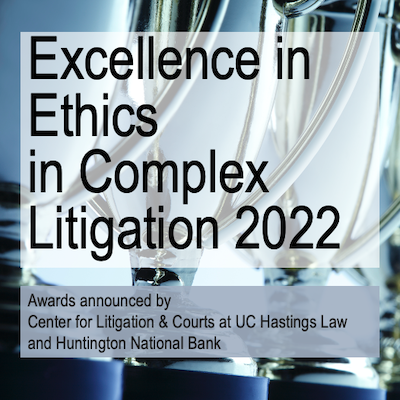
  • Federal Judge, Two Attorneys Honored for Excellence in Ethics in Complex Litigation

    Federal Judge, Two Attorneys Honored for Excellence in Ethics in Complex Litigation

    For Immediate Release

    U.S. Appellate Judge, Two Attorneys Honored for Ethics in Complex Litigation

    • First-ever awards for ethics in complex litigation excellence will be presented Oct. 22, 2022.
    • Nominations were evaluated by a committee comprising a federal judge, scholars, and litigators.
    • Committee selected a current judge on the Ninth Circuit U.S. Court of Appeals, a plaintiff’s attorney, and a defense attorney.

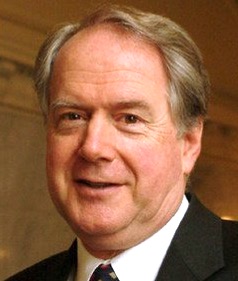
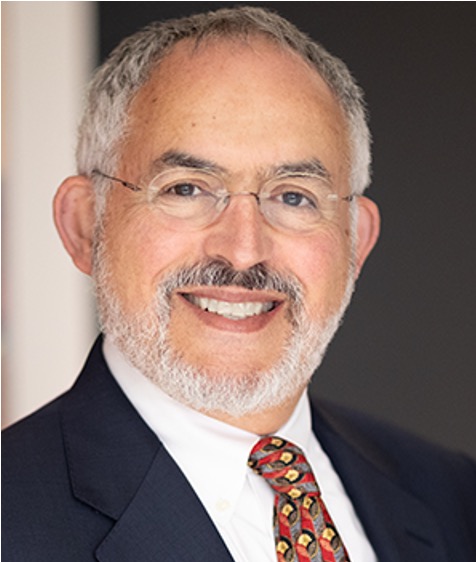
    SAN FRANCISCO – Sept. 28, 2022 – Nominated for their contributions to ethics in class actions and complex litigation, the first-ever recipients of the Awards for Excellence in Ethics in Complex Litigation are: jurist, scholar, and teacher, the Honorable William Fletcher; preeminent plaintiff’s attorney Elizabeth J. Cabraser; and distinguished employment defense attorney Fred W. Alvarez. The awards will be presented at the inaugural Complex Litigation Ethics Conference on Oct. 22, 2022, held at the UC Hastings College of the Law in association with the college’s Center for Litigation and Courts.

    Program co-chairs Joshua P. Davis and Scott Dodson – both professors at UC Hastings – have assembled an exemplary faculty of leading jurists, litigators, and other subject matter experts.

    “In developing this program we wanted not only to educate litigators and stimulate discussion on the important and evolving ethical aspects of this practice, but also to honor those who have demonstrated leadership, scholarship, and dedication in promoting ethical behavior and professionalism and to whom others look for inspiration,” said Davis.  “Judge Fletcher, Elizabeth Cabraser, and Fred Alvarez,” Dodson added, “are exactly the kinds of individuals and representatives of the profession we had in mind when we developed these awards.

    More about the recipients of the Awards for Excellence in Ethics in Complex Litigation:

    Honorable William Fletcher, U.S. Court of Appeals for the Ninth Circuit (Judicial Recipient) – A respected jurist, scholar and teacher, Judge Fletcher was a professor at Berkeley Law for decades before his appointment to the federal bench. He is the co-author of an authoritative textbook on civil procedure which addresses complex litigation and class actions. Lauded for his wisdom and integrity, Judge Fletcher has demonstrated his respect for “the need to circumscribe the role of unelected judges in a democracy” and ensuring parties have the “practical capacity to protect their legal rights in court.” As he once explained in an interview, Judge Fletcher believes it is paramount that judges develop “a culture of decision making,” one in which they will, “to the extent of their ability and to the extent human nature will permit, state carefully, fully, and honestly the factual and legal bases for their decisions. I make no claim that American judges always live up to that ideal. We do not,” he said, “but we try.”

    Elizabeth J. Cabraser, Partner, Lieff Cabraser Heimann & Bernstein, LLP (Plaintiffs’ Counsel Recipient) – Few attorneys can boast leadership positions and success in so many consequential complex legal disputes implicating so many industries and varieties of claims. Cabraser’s role in litigation against Big Tobacco, Big Oil, Big Pharma, Big Auto, and others inspired Law360 to call her “a titan of the plaintiffs’ bar.” In their profile of Cabraser, Law360 wrote that defense attorneys see her as “a formidable opponent who comes to cases thoroughly prepared” and someone who can “win a judge’s ear.” Cabraser serves on the Executive Committee of the Counsel of the American Law Institute and as a Fellow of the American Academy of Arts and Sciences. She regularly lectures on complex litigation at Berkeley and Columbia Law Schools, publishes scholarship on complex litigation, and presents and conducts seminars in various settings, including the Federal Judicial Center, ALI-ABA, and the National Center for State Courts. She was nominated, in part, because she has “broken new ground not only as a plaintiffs’ lawyer, but also as a professional overcoming the various impediments to success for diverse attorneys. She serves as a role model for diverse young lawyers to pursue justice through complex litigation.”

    Fred W. Alvarez, Partner, Coblentz, Patch, Duffy & Bass LLP (Defense Counsel Recipient) – Alvarez is one of the foremost employment attorneys in the country, known for his experience, public service, and leadership in the profession. Early in his career, Alvarez was a trial attorney with the National Labor Relations Board, a commissioner on the U.S. Equal Employment Opportunity Commission, and Assistant Secretary of Labor. After serving in the government he moved into private practice defending employers against class actions. Alvarez, who has been recognized for his integrity and ethics before, has repeatedly been selected as a monitor or special master to oversee the implementation of employment and civil rights consent decrees and settlements. “This work is complex, typically spans several years, and requires the trust of the litigants and counsel,” his nomination read. “It matters that, once the active class action litigation is over, Mr. Alvarez commits his time to ensure that reforms negotiated as part of a class action settlement are faithfully implemented. In other words, it’s not just about the money. His work helps ensure that the promise of civil rights class action litigation can be realized.”

    The Complex Litigation Ethics Conference is being co-sponsored by Huntington National Bank, a nationwide provider of settlement fund and other financial services for law firms. Professor Davis is both a research professor at UC Hastings and managing partner of the San Francisco offices of Berger Montague, one of the nation’s oldest and most respected class action and complex litigation law firms. Professor Scott Dodson is Founding Director of the Center for Litigation and Courts at UC Hastings Law. The awards are being presented by the Center for Litigation and Courts and Huntington National Bank.

    Qualifying attorney attendees will be eligible to receive eight CLE credits (subject to state and local bar rules). Learn more and register at bit.ly/LitEthicsConf.

    Members of the legal and business press are invited to request passes to attend the event in San Francisco or via webstream, and to receive program materials. Pre-program interviews with the conference leaders and faculty should be addressed to Tom Hagy, +1 (484) 844-0428, or Editor@LitigationConferences.com.

    Media Contact:
    Tom Hagy, Critical Legal Content
    +1 (484) 844-0428

    Editor@LitigationConferences.com

    Excellence in Ethics in
    Complex Litigation

    2022 Honorees
    Judge Fletcher

    Hon. William Fletcher

    Elizabeth Cabraser
    Elizabeth Cabraser

    Fred Alvarez

    Fred Alvarez

    Awards presented by the Center for Litigation and Courts at UC Hastings Law and Huntington National Bank.

    Download the release
  • Covid Insurance Coverage Decisions with Guest Marshall Gilinsky. Are Policyholders Catching Up?

    Covid Insurance Coverage Decisions with Guest Marshall Gilinsky. Are Policyholders Catching Up?

    According to the online Covid Coverage Litigation Tracker (CCLT) run by Penn Law there have been more than 2,300 insurance coverage cases filed over denial of claims relating to Covid-19. Restaurants and bars were hardest hit by the pandemic and so led the way in seeking – and being denied – coverage, too. They are also leading the way in suing their insurers. The top five insurers in the defense position are Chubb Limited at #5, then #4 Lloyds of London, #3 Cincinnati Financial, and #2 Zurich.  And in the #1 position facing the most coverage suits is Hartford. 

    The insurance industry started off strong when this litigation began, winning the vast majority of the coverage suits. And they continue to do well, scoring with the argument that many of the claims do not involve actual property damage. Government closures don’t cause property damage, they argue. Courts have largely been siding with the carriers – but not all. Policyholders, a tenacious bunch, appear to be chipping away at the body of law in this suddenly expanding category.

    A recent case involving a New Orleans restaurant against Lloyd’s was penciled into the win column for carriers by a trial court , but an appeals court erased it and wrote the policyholder a narrow 3-2 victory. The appeals court said the language of the policy was ambiguous, and therefore had to be construed in favor of the restaurant.  What’s it  mean? Does this bode well for policyholders? Or can we expect to see, as we did in previous coverage wars, a mixed bag of decisions across the nation?

    For more on that case and today’s Covid coverage landscape, listen to my interview with Marshall Gilinsky, a shareholder in the New York office of Anderson Kill. Marshall has represented policyholders of various policy types for two decades, including those seeking coverage in the aftermath of the 9/11 attacks, Hurricane Katrina, and Superstorm Sandy. Thanks to Marshall for sharing his insights.

    This podcast is the audio companion to the Journal on Emerging Issues in Litigation. The Journal is a collaborative project between HB Litigation Conferences and the Fastcase legal research family, which includes Full Court Press, Law Street Media, and Docket Alarm. The podcast itself is a joint effort between HB and our friends at Law Street Media. If you have comments or wish to participate in one our projects please drop me a note at Editor@LitigationConferences.com.

    P.S. Please excuse my periodic memory lane strolls as I waxed nostalgic while stroking the gray bristles of my chin about the pollution exclusion, the sudden and accidental exception to the exclusion, and, you know, what really does it mean for something to “occur”? I’ve led a heart-stopping existence. And so can you.

    Tom Hagy

    (actual size)

    Tom Hagy
    Host
    Emerging Litigation Podcast

    Marshall Gilinsky

    Marshall GilinskyAnderson Kill

    Marshall Gilinsky is a shareholder in the New York office of Anderson Kill and practices in the firm’s Insurance Recovery and Commercial Litigation Departments. Marshall is co-chair of the firm’s Sexual Harassment and Abuse Insurance Recovery Group, and a member of the firm’s Banking and Lending Group and Hospitality Industry Practice Group.

    During his 20-year career representing policyholders, Marshall has recovered hundreds of millions of dollars for his clients, successfully litigating disputed claims under a variety of insurance products, including property and business interruption insurance, commercial general liability (CGL) insurance, errors and omissions (E&O) insurance, directors’ and officers’ (D&O) insurance and life insurance. Marshall has represented clients on numerous high-stakes, complex insurance claims arising out of prominent losses such as 9/11, Hurricane Katrina, Superstorm Sandy and the “Big Dig” in Boston. He also focuses extensively on assisting clients that own and manage captive insurance companies, especially with respect to resolving coverage disputes between the captive and its reinsurers.

  • EMR Audit Trail—What Is It? Why Do They Matter? What Should You Look For? by Haley K. Grieco and Brooke E. Reddin

    EMR Audit Trail—What Is It? Why Do They Matter? What Should You Look For? by Haley K. Grieco and Brooke E. Reddin

    The Authors

    Haley Grieco

    Haley GriecoHall Booth Smith

    Haley K. Grieco (hgrieco@hallboothsmith.com) is a partner in the Paramus, New Jersey, office of Hall Booth Smith, where she defends physicians, hospitals, and other healthcare providers in a wide range of medical malpractice litigation.

    Brooke Reddin

    Brooke ReddinHall Booth Smith

    Brooke E. Reddin (breddin@hallboothsmith.com) is an associate with the firm, where she focuses her practice on healthcare, medical malpractice, and aging services litigation.

    The Journal on Emerging Issues in Litigation

    Emerging Litigation Podcast

    Emerging Litigation PodcastProduced by HB Litigation and Law Street Media

    Interviews with leading attorneys and other subject matter experts on new twists in the law and how the law is responding to new twists in the world.

    EMR Audit Trail—What Is It? Why Do They Matter? What Should You Look For?

    “As the healthcare industry becomes increasingly digitized, it is imperative that attorneys appreciate the impact it may have on their clients and their practice. In medical malpractice matters, discovery requests for metadata—specifically, the production of the EMR audit trail—has steadily increased over the past few years.”

    Abstract: Maintaining electronic medical records, or EMRs, is now a nearly universal best practice among medical providers from small physician practices to large hospital networks. Unlike handwritten or typed records, these digital documents carry with them much more data than meets the eye. In this article, the authors—two medical malpractice attorneys— discuss what attorneys need to know about EMRs in the litigation context and the metadata bread crumb trail they leave behind. They discuss the types of data involved, federal requirements, discovery considerations, privacy implications, and the pros and cons and risks of using these records in defending healthcare providers.

    During the past ten years electronic medical records (EMR) have all but rendered obsolete handwritten medical records. Medical providers have had to learn  computer systems, programs, software, hardware, and forms like never before. When hospitals, facilities, and medical offices change EMR systems, the process of learning the new system starts over. But what about the data you do not see? What lurks beneath the surface of the records that providers never see?

    This article looks at EMR from the perspective of the individual seeking to understand the data retrospectively in the context of a pending litigation rather than the requirements for those developing and maintaining EMR.

    Download the article now!

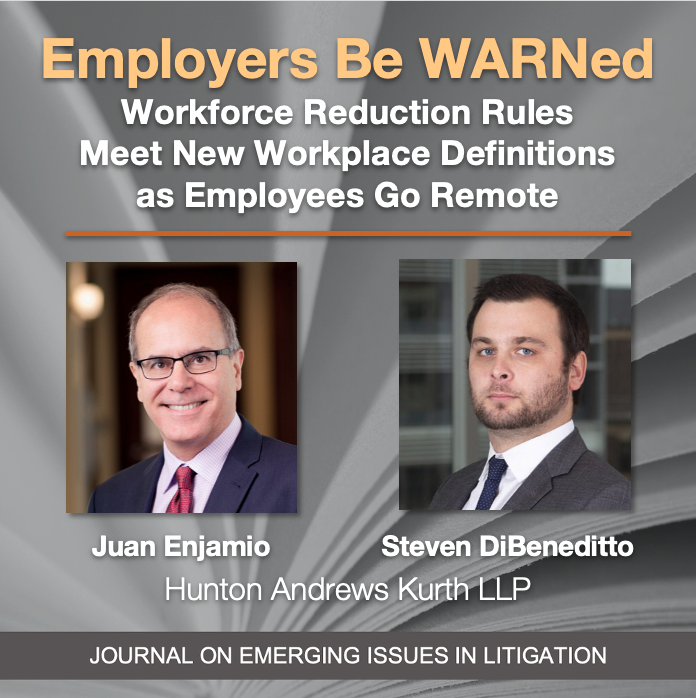
  • Employers Be WARNed: Workforce Reduction Rules Meet New Workplace Definitions as Employees Go Remote by Juan Enjamio and Steven DiBeneditto

    Employers Be WARNed: Workforce Reduction Rules Meet New Workplace Definitions as Employees Go Remote by Juan Enjamio and Steven DiBeneditto

    The Authors:

    Juan Enjamio

    Juan EnjamioHunton Andrews Kurth

    Juan C. Enjamio (jenjamio@huntonak.com) is managing parter of the Miami office of Hunton Andrews Kurth where he dedicates his practice to complex domestic and international employment law matters.

    Steven DiBeneditto Jr.

    Steven DiBeneditto Jr.Hunton Andrews Kurth

    Steven J. DiBeneditto Jr. (sdibeneditto@huntonak.com) is a Washington, DC-based associate in the firm’s employment and labor group.

    The Journal on Emerging Issues in Litigation

    Emerging Litigation Podcast

    Emerging Litigation PodcastProduced by HB Litigation and Law Street Media

    Interviews with leading attorneys and other subject matter experts on new twists in the law and how the law is responding to new twists in the world.

    Employers Be WARNed

    Workforce Reduction Rules Meet New Workplace Definitions as Employees Go Remote

    “Numerous courts have opined that a “home base” is a place in which the employee has some sort of physical connection. But this connection must be more than a “notional” base, whereby the employee has a menial relationship.”

    Introduction

    A common sentiment during the Covid-19 pandemic was that a different society would emerge from its ashes. While overstated in many cases, one segment of society that appears to have changed for good is the white collar workplace. Indeed, after enjoying the flexibility of working from home for more than 2 years, many white collar workers are demanding that a remote work option remain a permanent fixture at their place of employment. And with seemingly no negotiating leverage due to worker shortages across the country, employers have mostly acceded to these demands, with many opting to implement a “hybrid” workforce where employees work from home for part of the work week and transit to the physical workplace for the rest of the week. Other employers have opted to have employees work entirely from home in what is now generally known as a “remote” employee.

    But widespread adoption of a Hybrid Workforce presents a complex set of legal challenges for employers. These challenges are especially prevalent when making employment decisions using laws that were drafted decades ago to a new workplace that was never considered during the laws’ enactment. Nowhere is this problem more apparent than with the Worker Adjustment and Retraining Notification (“WARN”) Act, a statute adopted almost four decades ago in 1988. Simply put, the WARN Act sets forth notice requirements for employers who plan to close a plant or implement a reduction in force. Yet the WARN Act’s reduction in force provisions apply only to “single sites of employment,” which has been traditionally understood to mean a physical building or a group of buildings in contiguous locations. This  single site of employment definition makes the WARN Act ill-suited to address the emerging (but ubiquitous) issue of workers who are dispersed, e.g. Remote and Hybrid Workplaces.

    With that in mind, this article seeks to highlight the issues with the WARN Act and Remote and Hybrid Workplaces and package them into a guide for employers. The article begins by summarizing the WARN Act and the regulations for single sites of employment. It then shifts to a recent district court case analyzing the issue of Remote Work under the WARN Act for purposes of Rule 23(b)(3)’s predominance requirement for class certification. The article concludes by offering some suggestions to help prevent WARN Act liability.

    Download the article now!

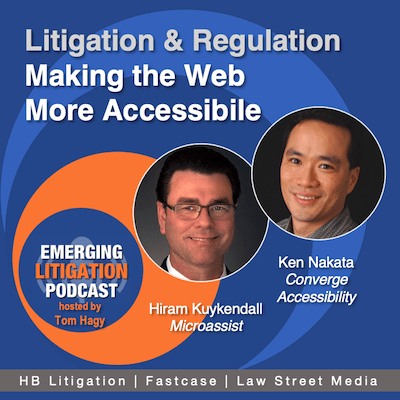
  • The Role of Litigation and Regulation in Making the Web More Accessible with Guests Ken Nakata and Hiram Kuykendall

    The Role of Litigation and Regulation in Making the Web More Accessible with Guests Ken Nakata and Hiram Kuykendall

    Are Litigation and Regulation Making the Web More Accessible?

    According to the International Agency for the Prevention of Blindness there are 43 million people around the world living with blindness, and 300 million living with moderate to severe visual impairment. Put those statistics next to these: There are nearly 2 billion websites, and 550,000 created every day.

    Shouldn’t sight-impaired people have the same access to these sites as sighted people? Of course they should. There is good news. After previously announcing guidance, the DOJ says new regulations are on the way under Title II of the Americans with Disabilities Act, which describes the obligations for state and local governments. My guests say there are many reasons to be excited about this.

    My guests say there are many reasons to be excited about this.

    Ken Nakata is Co-Founder and Principal at Converge Accessibility, whose solutions help make sure websites and other technologies are accessible to people with disabilities. Ken is former Senior Trial Attorney with the DOJ Disability Rights Section where he developed nationwide ADA policies for the internet. Joining Ken is Hiram Kuykendall, Chief Technology Officer at Microassist, an Austin-based learning and development consulting. Hiram is a technical leader with hands-on experience in instructional design and digital accessibility.

    This podcast is the audio companion to the Journal on Emerging Issues in Litigation. The Journal is a collaborative project between HB Litigation Conferences and the Fastcase legal research family, which includes Full Court Press, Law Street Media, and Docket Alarm. The podcast itself is a joint effort between HB and our friends at Law Street Media. If you have comments or wish to participate in one our projects please drop me a note at Editor@LitigationConferences.com.

    Tom Hagy

    (actual size)

    Tom Hagy
    Host
    Emerging Litigation Podcast

    P.S. Anytime I make a self-effacing remark about my ignorance concerning this or any subject, it’s strictly for entertainment value, a story I will cling to with every fiber of my being.

    Ken Nakata

    Ken NakataConverge Accessibility

    Ken Nakata is Co-Founder and Principal at Converge Accessibility, whose solutions help make sure websites and other technologies are accessible to people with disabilities. Ken is former Senior Trial Attorney with the DOJ Disability Rights Section where he developed nationwide ADA policies for the internet.

     Hiram Kuykendall

    Hiram Kuykendall Microassist

    Hiram Kuykendall is Chief Technology Officer at Microassist, an Austin-based learning and development consulting. Hiram is a technical leader with hands-on experience in instructional design and digital accessibility. He has more than 25 years’ experience developing and managing custom applications on a variety of platforms and public and private sectors, supporting training and training related services.

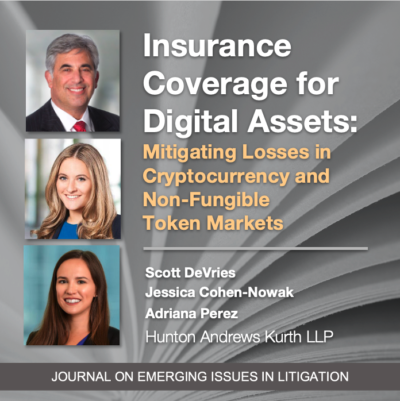
  • Insurance Coverage for Digital Assets: Mitigating Losses in Cryptocurrency and Non‐Fungible Token Markets by Scott DeVries, Jessica Cohen-Nowak and Adriana Perez of Hunton Andrews Kurth

    Insurance Coverage for Digital Assets: Mitigating Losses in Cryptocurrency and Non‐Fungible Token Markets by Scott DeVries, Jessica Cohen-Nowak and Adriana Perez of Hunton Andrews Kurth

    Journal on Emerging Issues in LitigationCompanies and individuals are riding the ups and downs of cryptocurrency and NFTs—with losses and swings in the billions of dollars—but digital assets are not going away.

    Abstract: The risk of loss in certain categories may be mitigated by insurance, whether provided by tailored policies and/or under policies designed specifically for digital asset owners. Those with exposure to the digital asset sector should be attuned to the emerging marketplace for such insurance products. While it is early days for NFT-specific coverage, the rise of cryptocurrency has created a substantial marketplace for crypto coverage. Insurers are becoming increasingly able to model and assess risk, so more products are coming to market. That said, digital asset holders need to be able to select coverage that best suits their needs. In this article, the authors discuss the history and status of coverage for digital assets to assist readers in exploring how they might use insurance to mitigate risk in this emerging and rocky sector of global finance.

    “Over the course of a decade, the marketplace for cryptocurrency has increased from zero to an estimated $250 billion. However, only $6 billion in insurance coverage is currently available. It would be a gross understatement to say that there is a truly remarkable imbalance between market value and insurance capacity.”

    Introduction

    Crypto markets are experiencing the greatest crash in their history to date.  The value of a Bitcoin (BTC) has plummeted 70% from its peak and Ethereum (ETH) has fallen 77%.  Since last November, the value of cryptocurrency tokens has lost $2 billion in value. As noted financial publication Barron’s put it: “Crypto is having a ‘Lehman moment,’ a shattering of confidence triggered by plunging asset prices, liquidity freezing up, and billions of dollars wiped out in a few scary weeks.” Cryptocurrency companies are halting withdrawals and transfers, platforms are seizing up, and regulators are circling.

    Nor has the devastation been limited to the coins themselves.  Non-fungible token (NFT) sales have reduced by 90% since September 2021.  The New York Times reported that Opensea.io (OpenSea) an NFT marketplace that receives 2.5% share of the proceeds for each NFT sale, has been plagued by “a surge of plagiarism, as sellers convert traditional artwork into NFTs and then list the images for sale without compensating the original creator.”  For example, DeviantArt, an artist collective that scans OpenSea for copyright infringement of the work of its artists, found 290,000 instances of unauthorized NFTs copying its artists’ works. While infringing listings can be deleted in response to take down requests filed by the artist, buyers of counterfeit NFTs are rarely given a refund.

    Against this backdrop, the issue of whether there may be claims associated with cryptocurrency and NFTs is far from a theoretical or esoteric thought exercise.  It is very real.  And when there are claims, businesses and investors doubtless will look to their insurers.

    A business or home is devastated by a wildfire.  Property insurance is available up to limits.  A home is broken into, and art and jewelry are stolen.  Crime/specie insurance is available.

    But what about new age assets?  What about cryptocurrency?  What about NFTs?  These obviously are not immune from theft by hackers.  In 2021, hackers stole at least $3.2 billion in cryptocurrency with schemes short of outright theft accounting for another $7.8 billion. In the first four months of 2022, NFT hacks accounted for $52 million in losses, an almost eight-fold increase from 2021.

    There typically is a significant time lag between the development of a product and the availability of product-specific insurance.  This general proposition applies with equal force here.  Over the course of a decade, the marketplace for cryptocurrency has increased from zero to an estimated $250 billion.  However, only $6 billion in insurance coverage is currently available.  It would be a gross understatement to say that there is a truly remarkable imbalance between market value and insurance capacity.

    Although NFTs have been around for the better part of a decade, it was only during the last two years that the marketplace has grown to upwards of $41 billion. In addition to its newness, NFTs pose additional risks for insurers, including questions of ownership, authenticity and the valuation of a truly “unique” asset.  Consequently, availability of insurance coverage for NFTs is even further behind.

    Given the rapid rate at which the digital asset field is developing, and claims are emerging, and the insurance industry’s attempts to specifically address coverage for these losses and claims, anything written on this topic will, at least in part, be outdated by the time it is published.  The objective of this article is to educate the reader on the history and status of the field, enabling them to ask the questions they need to ask, and to procure the coverage they need if available now or in coming months. 

    Download the article now!

    Insurance Coverage for Digital Assets:

    Mitigating Losses in Crypto and NFT Markets

    Scott DeVries

    Scott DeVriesHunton Andrews Kurth

    Scott DeVries (sdevries@huntonak.com) is Special Counsel at Hunton Andrews Kurth and long-time insurance coverage attorney for policyholders in a range of complex disputes as well as mass torts, class action, product liability, and complex business litigation.

    Jessica Cohen-Nowak

    Jessica Cohen-NowakHunton Andrews Kurth

    Jessica Cohen-Nowak (jcohen-nowak@huntonak.com) is an associate in Hunton Andrew Kurth LLP’s Intellectual Property group in the firm’s New York office. Jessica focuses her counseling and litigation practice on intellectual property matters in the fashion, fitness, entertainment, hospitality, and gaming industries as well as in technology and digital assets.

    Adriana Perez

    Adriana PerezHunton Andrews Kurth

    Adriana Perez (pereza@huntonak.com) is an associate in the firm’s Miami office where she focuses on insurance, reinsurance, and other business litigation.