Category: Mass Torts

  • AI Image Generators and Copyright: Eligibility in the U.S., UK, EU, and More; Fair Use, Derivative Works, Liability
    AI Image Generators and Copyright: Eligibility in the U.S., UK, EU, and More; Fair Use, Derivative Works, Liability

    AI Image Generators and Copyright:

    Eligibility in the U.S., UK, EU, and More; Fair Use, Derivative Works, Liability

    Photo by Hitesh Choudhary on Unsplash

    AI programs are now readily available for all. Stability AI, Lensa, and other AI image creation tools create original works of art, raising the question of IP protection for such art. The United States requires human authorship in order to obtain copyright protection, and so far, the U.S. Copyright Office has declined to grant copyright registrations for AI-created works of art based on a lack of human authorship (one of these decisions is being challenged in Thaler v. Perlmutter (D.D.C. filed June 2, 2022)). While some countries take a similar approach to the US, others treat the issue of copyright eligibility for AI-generated art quite differently and provide at least some protection of computer generated works.

    Questions have also been raised as to whether AI-generated images constitute derivative works and whether such images and the AI generation tools used to create them infringe third-party copyrights, or whether the fair use doctrine or other defenses may apply. The first lawsuits involving image generators have now been filed raising copyright claims in addition to other claims.

    Listen as our authoritative panel of IP attorneys examines AI image generators and the associated copyright issues. The panel will discuss eligibility in the U.S. and the recent actions by the Copyright Office and contrast this with the approaches used in other countries. The panel will also address the recent cases that have been filed and the potential liability for copyright infringement in the U.S. and other countries.

    Strafford and HB Logos

    Speakers

    Michael R. Graif
    Member
    Mintz Levin Cohn Ferris Glovsky and Popeo

    Lisa T. Oratz
    Senior Counsel
    Perkins Coie

    Scott J. Sholder
    Partner
    Cowan DeBaets Abrahams & Sheppard

    CLE On-Demand Webinar

    This Strafford production has been specially selected for HB audiences.

    Topics

    • What hurdles confront counsel when demonstrating authorship of AI-generated works?
    • How does copyright apply to AI-generated works? How does it differ across jurisdictions?
    • What steps can counsel take to increase the likelihood of success when seeking copyright protection for AI-generated works?

    Outline

    1. AI-generated works of art and copyrightability
      1. Eligibility in the U.S.
      2. Eligibility in other countries
    2. AI image generators and copyright infringement
      1. Derivative works
      2. Fair use and other defenses
      3. Liability in other jurisdictions
      4. Best practices
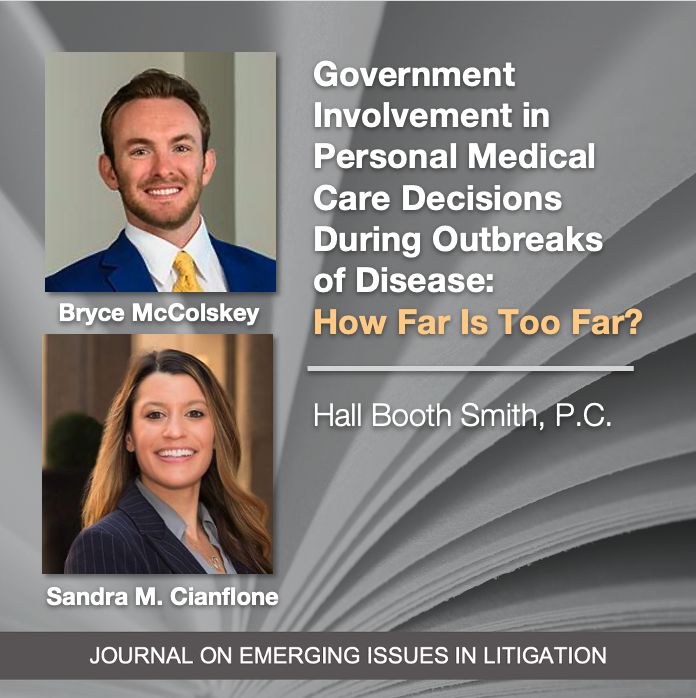
  • Government Involvement in Personal Medical Care Decisions During Outbreaks of Disease: How Far Is Too Far? by Bryce McColskey and Sandra M. Cianflone

    Government Involvement in Personal Medical Care Decisions During Outbreaks of Disease: How Far Is Too Far? by Bryce McColskey and Sandra M. Cianflone

    The Authors

    Bryce McColskey

    Bryce McColskeyHall Booth Smith

    Bryce McColskey (bmccolskey@hallboothsmith.com) is an attorney with Hall Booth Smith, P.C., based in Jacksonville, Florida, where he focuses on medical malpractice and professional liability law.

    Sandra Cianflone

    Sandra CianfloneHall Booth Smith

    Sandra M. Cianflone (scianflone@hallboothsmith.com) is a partner in the Atlanta office of Hall Booth Smith, where she concentrates on a variety of aspects of healthcare defense and chairs the firm’s Coronavirus Task Force. She is also a member of the Editorial Board of Advisors of the Journal of Emerging Issues in Litigation.

    The Journal on Emerging Issues in Litigation

    Emerging Litigation Podcast

    Emerging Litigation PodcastProduced by HB Litigation and Law Street Media

    Interviews with leading attorneys and other subject matter experts on new twists in the law and how the law is responding to new twists in the world.

    Government Involvement in Personal Medical Care Decisions During Outbreaks of Disease: 

    How Far Is Too Far?

    “Breakthroughs in technologies, our knowledge of diseases and mutations, and advances in treatment options have been remarkable and have drastically reduced fatality rates from disease outbreaks. However, regardless of medical achievements, rapid changes in any field open the door to renewed debates over different laws and individual rights.”

    Abstract: The coronavirus pandemic is the latest health issue to raise the question of government’s involvement (or interference) with an individual’s control over their own healthcare and medical treatment. In this article, the authors, two health care and professional liability attorneys, discuss the intersection of law and medicine with a review of medical mandates, the impact of advances in science and medicine, and where role of government to protect public health intersects (or collides) with personal healthcare choices. Their focus is on governmental response to the coronavirus pandemic, and not the recent landmark case dealing with choice. But add to the equation the Supreme Court’s ruling on abortion in Dobbs v. Jackson Women’s Health, the “government as healthcare decision maker” is an issue that will be on the front burner for courts, policymakers, healthcare providers, patients, and attorneys for years to come.

    How much authority do government agencies or even the judiciary have over the healthcare decisions of individuals? This question has been hotly contested in recent years, specifically with the emergence of COVID-19. Individuals often assume the practice of medicine and the enactment and enforcement of laws are separate and independent enterprises; that they remain fixed in their respective corners.

    However, when we dive deeper into this issue and look at history and precedent, it is evident that the rights of individuals versus mandates of government in respect to healthcare has been going on for some time, and will continue for years to come.

    Download the article now!

  • Medical Monitoring and PFAS Litigation—A Significant Growing Trend

    Medical Monitoring and PFAS Litigation—A Significant Growing Trend

    The Author

    John P. Gardella

    John P. GardellaCMBG3 Law

    John P. Gardella (jgardella@cmbg3.com) is a shareholder with CMBG3 Law and a recognized thought leader on PFAS issues. In his environmental and toxic torts practice, he represents companies ranging in size from small shops to the Fortune 100. John is also a member of the Editorial Board of Advisors for the Journal of Emerging Issues in Litigation.

    The Journal on Emerging Issues in Litigation

    Emerging Litigation Podcast

    Emerging Litigation PodcastProduced by HB Litigation and Law Street Media

    Interviews with leading attorneys and other subject matter experts on new twists in the law and how the law is responding to new twists in the world.

    Medical Monitoring and PFAS Litigation—A Significant Growing Trend

    “The arguments in favor of medical monitoring as a cause of action in lawsuits stem from the notion that having such programs funded by allegedly tortious companies promotes the public health benefit of early detection, which in turn often results in lower health care costs to plaintiffs and society at large.”

    Abstract: Medical monitoring as a tort claim is a hot-button issue in toxic torts, personal injury, and product liability litigation. The ubiquity of PFAS chemical compounds and the real and potential harm to health and the environment they create make examination of the medical monitoring debate specific to this burgeoning litigation worthy of individual attention. This article provides an explanation of PFAS, a brief overview of medical monitoring claims, how PFAS medical monitoring claims have impacted the litigation thus far, and what legal cases are pending that could alter the course of traditional medical monitoring litigation in the future.

    Download the article now!

  • The Medical Monitoring Tort Remedy: Its Nationwide Status, Rationale, and Practical Application (A Possible Dynamic Tort Remedy for Long-Term Tort Maladies)

    The Medical Monitoring Tort Remedy: Its Nationwide Status, Rationale, and Practical Application (A Possible Dynamic Tort Remedy for Long-Term Tort Maladies)

    The Author

    Edgar C. Gentle

    Edgar C. GentleGentle, Turner, Sexton & Harbison LLC

    Edgar C. Gentle III (egentle@gtandslaw.com) is founder and managing partner of Gentle, Turner, Sexton & Harbison LLC in Birmingham, Alabama, where he focuses on complex commercial litigation, mass torts, and class actions. He also serves as a court appointed neutral and settlement administrator.

    The Journal on Emerging Issues in Litigation

    Emerging Litigation Podcast

    Emerging Litigation PodcastProduced by HB Litigation and Law Street Media

    Interviews with leading attorneys and other subject matter experts on new twists in the law and how the law is responding to new twists in the world.

    The Medical Monitoring Tort Remedy: Its Nationwide Status, Rationale, and Practical Application (A Possible Dynamic Tort Remedy for Long-Term Tort Maladies)

    “States that allow medical monitoring do so when a group of claimants has been exposed to a known hazardous substance, such as lead, or a dangerous product, such as football helmet concussions, or air decompression in an airplane, through the conduct of the Defendant, with the claimants therefore being at increased risk of contracting disease.  Under this tort remedy, claimants are tested periodically, for an agreed or decided period, usually between 10 and 40 years, to see if they contract the disease linked to the toxic substance or dangerous product. Thus, medical monitoring recognizes the long-term harmful nature of toxins and man-made products, thereby matching a remedy with the malady.“

    Abstract: The author administers six mass tort settlements with a medical component, including two with medical monitoring. This article reviews the status and history of medical monitoring, known claimant medical monitoring participation rates, the rationale for the remedy, arguments for and against its implementation, and its execution in practice. The author suggests a more holistic medical monitoring remedy,  which includes not only testing/or disease but paying claimants for personal injury when they get sicker later, from a capped fund and under an agreed payment matrix, to provide closure to defendants and class members for claims resulting from toxic substances and product defects, which have long-term and often unknown effects on plaintiffs. It is suggested that this remedy is the logical long-term result of the evolution of medical monitoring, and will provide a much needed dynamic remedy for long-term maladies.

    Download the article now!

    Loved what Ed covered in his article?

    Explore Ed’s additional content on the subject matter.

    OnDemand CLE Webinar: The Medical Monitoring Tort Remedy with Ed Gentle and Kip Benson

    Podcast: Medical Monitoring for Modern Times with Ed Gentle

    Tags

    Emerging Litigation & Risk Compliance Litigation & appeals Cybersecurity Data Privacy Artificial Intelligence (AI) Insurance Companies Risk Management Corporate & Securities Insurance Claims Recovery Regulations Data Breach Toxic Torts Antitrust Legal Tech Product Liability Settlements Trial Personal Injury Privacy Healthcare Per- and Polyfluoroalkyl Substances (PFAS) Data Analytics Arbitration Constitutional Law Climate Change Cannabis Labor Law Insurance Fraud Liability Claims COVID Alternative Dispute Resolution (ADR) Mediation Diversity Equity Inclusion (DEI) Claims management Professional Liability Legal Research & Writing Business Interruption Law Practice Management Trial Skills Property and Casualty Drug Laws Copyright Law Catastrophic Loss

  • Class Certification Evidence: Standards of Admissibility and Probative Value Among the Circuits

    Class Certification Evidence: Standards of Admissibility and Probative Value Among the Circuits

    Class Certification Evidence

    What Are the Standards of Admissibility and Probative Value Among the Circuits?

    Numerous splits exist among the circuits on two key certification issues: What is required to prove the elements for class certification and whether plaintiff’s certification evidence must be admissible. Further, courts apply different admissibility standards to fact evidence than to expert evidence. Certain courts have issued clear guidance on these important issues, while others have remained circumspect, sending mixed signals. This is particularly vexing for defendants, who may be sued in more than one district or circuit. What is sufficient for class certification in one jurisdiction may be inadequate in another. With standards unsettled, counsel must anticipate and preserve the right to revisit class certification by preserving all objections and the factual record. Listen as the panel of class action attorneys discusses the standards of admissibility of evidence at certification and best strategies for leveraging ambiguities.

    Questions Addressed

    • How can defense counsel preserve objections to admissibility?
    • How can counsel leverage the law of other circuits in jurisdictions with no controlling precedent?
    • What does how a court assesses evidence imply about its view on admissibility standards?

    Webinar Outline

    1. Fact evidence
      1. Need not be admissible
      2. Must be admissible
      3. Ambiguous
    2. Expert evidence
      1. Full Daubert analysis
      2. Limited Daubert analysis
    3. Strategies for managing and leveraging the uncertainty

    Strafford and HB Logos

    On Demand CLE Webinar

    A Strafford production specially selected for HB audiences.

    Learn Strategies for
    Opposing or Narrowing Class Certification
    and Preserving Objections

    This Strafford production has been specially selected for HB audiences.

    Speakers

    Kevin Daly
    Counsel
    Robinson & Cole

    Alexander Madrid
    Partner
    McGuire Woods

    Michael Ruttinger
    Partner
    Tucker Ellis

    Robert Sparkes, III
    Partner
    K&L Gates

    This Strafford production has been specially selected for HB audiences.

  • Discovery Strategies in Wage and Hour Class and Collective Actions Before and After Certification of Putative Class

    Discovery Strategies in Wage and Hour Class and Collective Actions Before and After Certification of Putative Class

    Discovery Strategies in Wage and Hour Class and Collective Actions Before and After Certification of Putative Class

    Strategically Limiting Discovery, Resolving Discovery Disputes

    Wage and hour class and collective actions are complex and discovery intensive. Discovery requests are often burdensome, seeking information concerning a broad swath of workers. This causes the discovery process to sometimes linger for years and creates a significant expense for employers.In recent years, courts have emphasized that parties must rein in extensive and expensive discovery requests. Employment litigators are increasingly raising proportionality arguments as a basis for objecting to opposing counsel’s discovery requests.

    Drafters are responding by tailoring requests to anticipate such challenges. Drafting discovery requests that are likely to withstand burden and proportionality challenges and objections to broad discovery requests is critical for litigators representing employers in wage and hour class and collective actions. Employment litigators must develop and implement effective discovery strategies both before and, as applicable, after certification of the putative class. These strategies often must anticipate the possibility of a future summary judgment motion, further certification practice, and trial on the merits.

    Listen as our authoritative panel of employment law attorneys explains effective strategies for pursuing or objecting to discovery requests in wage and hour collective and class actions and resolving discovery disputes that arise during litigation.

    Questions Addressed:

    • What are the most common discovery challenges counsel face when litigating wage and hour collective and class actions–from initiation through resolution of the case?
    • What strategies have been effective in wage and hour collective and class actions for obtaining essential information with the least expense?
    • What is the scope of discoverable evidence before and after certification of the putative class, and how can you limit or best manage discovery?
    • When drafting discovery requests in wage and hour class and collective actions, what should employment counsel consider to ensure that the requests align with the proportionality standard?

    Interested in More CLE OnDemand? Click Here.

    Interested in this program? Click here to send us a note.

    On Demand CLE Webinar

    Interested in this program? Click here to send us a note.

    Speakers

    Gerald Maatman Jr.
    Partner
    Duane Morris
    GMaatman@duanemorris.com

    Noel P. Tripp
    Principal
    Jackson Lewis
    Noel.Tripp@jacksonlewis.com

    Outline

    1. Pursuing or objecting to discovery requests in wage and hour collective and class actions
      1. Before conditional collective or class certification
      2. After conditional certification of a collective action
      3. After class certification
    2. Discovery considerations for summary judgment
    3. Discovery considerations for trial
    4. Resolving discovery disputes

    Explore more from Duane Morris LLP!

    Journal (JEIL) Artificial Intelligence Litigation Risks in the Employment Discrimination Context. By Gerald Maatman Jr., Alex Karasik, and George Schaller

    CLE OnDemand Webinar: AI Nuts & Bolts Survival Guide: Artificial Intelligence – Discrimination in Employment Context. Gerald Maatman Jr., Alex Karasik, and George Schaller

    CLE OnDemand Webinar: Discovery Strategies in Wage and Hour Class and Collective Actions Before and After Certification of Putative Class. Gerald Maatman Jr., Noel P. Tripp

    CLE OnDemand Webinar: Rule 23(c)(4) Issue Certification: Reconciling the Conflict With the Predominance Requirement. Gerald Maatman Jr., Timothy Congrove, Jennifer Mesko and James Muehlberger

  • Greatly Exaggerated: The Impact of Bankruptcy on Mass Torts with Jennifer Hoekstra

    Greatly Exaggerated: The Impact of Bankruptcy on Mass Torts with Jennifer Hoekstra

    ear plugs on red background

    When large companies face massive mass tort litigation, one way they can survive is to file for bankruptcy protection and reorganize. 

    3M recently put its Aearo Technologies subsidiary into bankruptcy in the face of more than 230,000 claims that’s its defective earplugs caused hearing loss.  When it came to filing bankruptcy 3M said Aearo was solely responsible for the product. But for several years of litigation 3M argued that it, as the parent, was solely responsible, not its various subsidiaries. That was a strategy that was beneficial to the company in multidistrict litigation.

    Why did 3M suddenly change course? What impact does bankruptcy have on claimants? Could corporations use bankruptcy law to neuter mass tort litigation for all eternity?  And how did the strategy sit with the federal magistrate judge overseeing the multidistrict litigation?

    Joining me to discuss this incredibly complex litigation is Jennifer M. Hoekstra, a partner with Aylstock Witkin Kreis & Overholtz. Jennifer has been involved in all varieties of complex litigation since 2007, focusing on mass torts, drug and device litigation, and others.  She has a J.D. from Tulane, which she earned while also completing a certificate in Environmental Law. She has actively served as trial counsel or an integral member of the trial team in several of the 3M Earplug trials securing nearly $300 million in compensatory damages for military veterans. Jennifer shared her insights on the intersection of complex mass torts and bankruptcy, an intersection that wasn’t originally on her roadmap.

    This podcast is the audio companion to the Journal on Emerging Issues in Litigation. The Journal is a collaborative project between HB Litigation Conferences and the Fastcase legal research family, which includes Full Court Press, Law Street Media, and Docket Alarm. The podcast itself is a joint effort between HB and our friends at Law Street Media. If you have comments or wish to participate in one our projects please drop me a note at Editor@LitigationConferences.com.

    Tom Hagy

    (actual size)

    Tom Hagy
    Litigation Enthusiast and
    Host of the Emerging Litigation Podcast
    Home Page
    LinkedIn

    P.S. During the podcast I mentioned an article and wanted to share the link. It’s called “Bankruptcy Grifters” by Lindsey D. Simon. It was published in the Yale Law Journal.

    Jennifer Hoekstra

    Jennifer Hoekstra

    Jennifer M. Hoekstra is a partner with Aylstock, Witkin, Kreis & Overholtz, PLLC. A native of Saint Paul, Minnesota, Ms. Hoekstra boasts an impressive academic and professional record, including graduation from two of the nation’s top schools. She earned her Bachelor of Arts in Environmental Science from Columbia College, Columbia University in the City of New York. She relocated to Louisiana to attend Tulane Law School, where she earned her J.D. while also completing a certificate in Environmental Law. During her law school career, she spent a semester studying at the University of Wisconsin School of Law and visited on their International Law Journal as a Junior Member during her Hurricane Katrina evacuation semester.

    Ms. Hoekstra has been involved in complex litigation cases of all forms since 2007. Ms. Hoekstra has earned a solid reputation as a skilled writer and researcher, and plays an integral role in several complex litigation cases, practicing in the areas of Pharmaceutical Mass Torts, Defective Device Mass Torts, and other complex litigation. She is currently a member of the Proton-Pump Inhibitors Plaintiff Executive Committee and the 3M Earplugs MDL Discovery and ESI Committee.

    Jennifer was central to the successful outcome in bellwether trials in the Genetically Modified Rice, Actos and DePuy Pinnacle Hip MDLs with more than $11 Billion in trial verdicts resulting from those cases. She has actively served as trial counsel or an integral member of the trial team in several of the 3M Earplug trials securing nearly $300 Million in compensatory damages for military veterans.

    She is licensed to practice before all Louisiana state and federal courts and the U.S. District Courts for the Northern District of Texas and Eastern District of Missouri as well as the 5th and 8th Circuit Courts. She is a member of the American Bar Association, the Louisiana Bar Association, the Acadiana Federal Bar Association, the Alexandria Louisiana Bar Association and the American Association for Justice. She is a member of Women En Mass, founding member of the board for the Society Women Trial Lawyers and was also a member of the inaugural 2018 Board of Directors for Emerge Louisiana.

  • PFAS Litigation—A Historical Overview and the Growing Trend in Consumer Fraud Lawsuits: What Are the Legal and Business Risks to Companies by John Gardella

    PFAS Litigation—A Historical Overview and the Growing Trend in Consumer Fraud Lawsuits: What Are the Legal and Business Risks to Companies by John Gardella

    The Author

    John Gardella

    John GardellaCMBG3

    John P. Gardella (jgardella@cmbg3.com) is a shareholder and Chief Services Officer at CMBG3 Law, where he also chairs the firm’s PFAS, Environmental, Risk Management and Consulting and ESG practice groups. John is the latest addition to the Editorial Board of Directors for the Journal on Emerging Issues in Litigation.

    The Journal on Emerging Issues in Litigation

    Emerging Litigation Podcast

    Emerging Litigation PodcastProduced by HB Litigation and Law Street Media

    Interviews with leading attorneys and other subject matter experts on new twists in the law and how the law is responding to new twists in the world.

    PFAS Litigation

    A Historical Overview and the Growing Trend in Consumer Fraud Lawsuits

    “It is of the utmost importance that businesses along the whole supply chain in the consumer goods sector evaluate their PFAS risk and fully understand the legal arguments that plaintiffs could make against companies in litigation.”

    Abstract: Per- and polyfluoroalkyl substances (PFAS) are a class of over 12,000 man-made compounds. Most people would recognize the brand names Teflon, produced by DuPont, and Scotchgard, produced by 3M. They also go by the nickname “forever chemicals” because they are highly persistent and mobile in the environment and the human body. In addition to bodily injury and environmental pollution litigation, plaintiffs are also bringing suits against companies for claiming their products and the making of their products are safe and green. This article explains why PFAS are of concern to citizens, media, and legislators; what legal risks they pose to corporations; and the recent surge in consumer fraud litigation. The article examines the legal theories at issue in the PFAS consumer fraud cases, as well as the potential damages that can stem from the cases to corporations.

    Questions addressed include:

    What do state and federal regulations say about PFAS in drinking water?

    If your company doesn’t use the two original types of PFAS, are you at less risk of litigation?

    Which industries currently face the most risk of PFAS-related consumer fraud cases?

    Are plaintiffs securing significant verdicts in personal injury litigation?

    Download the article now!

  • Rule 23(c)(4) Issue Certification: Reconciling the Conflict With the Predominance Requirement

    Rule 23(c)(4) Issue Certification:

    Reconciling the Conflict with the 23(b)(3) Predominance Requirement 

    Proposed class actions seeking monetary damages are often difficult to certify because common issues do not predominate over individualized issues as required by Rule 23(b)(3). Rule 23(c)(4) provides that “[w]hen appropriate, an action may be brought or maintained as a class action with respect to particular issues.”Although Rule 23(c)(4) has been part of the rule since the landmark 1966 amendments, it was often overlooked until the Supreme Court’s decision in Wal-Mart v. Dukes. Plaintiffs now routinely seek limited issue certification for purported common issues, such as liability, arguing that questions of injury, reliance, or causation should be left for individual cases. When approved, this approach increases defendants’ exposure by permitting certification in some cases that would otherwise fail the Rule 23(b)(3) standards.The federal circuits are now in a three-way split on how issue certification should be treated under Rule 23(b)(3)’s predominance requirement. While the Fifth Circuit has taken the textual view in Castano v. American Tobacco Co. that permits issue certification only if the class first qualifies under Rule 23(b)(3), the Ninth, Sixth, Second, and Seventh Circuits have adopted the opposite view that Rule 23(c)(4) certification does not require predominance. The Third Circuit has clarified and heightened the test in Russell v. Educ. Comm’n for Foreign Med. Graduates, 20-2128 (3d Cir. Sept. 24, 2021), but offers both sides plenty to consider. The remaining circuits are uncommitted, leaving the district courts to address the matter.Listen as our panel of experienced class action litigators analyzes the varying circuit court positions on Rule 23(c)(4) issue classes and the implications of practitioners’ decisions when pursuing or opposing class certification.

    Outline

    1. The emergence of issue classes under Rule 23(c)(4)
      1. What is an issue class?
      2. How are they being strategically used?
      3. Where are the grey areas?
    2. Key court decisions on issue class certification
    3. Textual and historical analysis of Rule 23(c)(4)
    4. Strategies for defending the trial of “issue” classes

    Be sure to check out more of Duane Morris LLP contributions!

    Journal (JEIL):  Artificial Intelligence Litigation Risks in the Employment Discrimination Context. By Gerald Maatman Jr., Alex Karasik, and George Schaller

    CLE OnDemand Webinar: AI Nuts & Bolts Survival Guide: Artificial Intelligence – Discrimination in Employment Context. Gerald Maatman Jr., Alex Karasik, and George Schaller

    CLE OnDemand Webinar: Discovery Strategies in Wage and Hour Class and Collective Actions Before and After Certification of Putative Class. Gerald Maatman Jr., Noel P. Tripp

    CLE OnDemand Webinar: Rule 23(c)(4) Issue Certification: Reconciling the Conflict With the Predominance Requirement. Gerald Maatman Jr., Timothy Congrove, Jennifer Mesko and James Muehlberger

    Details

    Recorded 10/6/2022

    Speakers

    Timothy E. Congrove
    Partner
    Shook, Hardy & Bacon

    Gerald L. Maatman Jr.
    Partner
    Duane Morris

    Jennifer L. Mesko
    Partner
    Tucker Ellis

    James P. Muehlberger
    Co-Chair, Food, Beverages & Agribusiness Practice Group
    Shook, Hardy & Bacon

    Benefits

    The panel will review these and other key issues:

    • What is the tension between the requirements of Rule 23(c)(4) and Rule 23 (b)(3), and how are courts reconciling the conflict?
    • What impact does the rise in issue class certifications have on the trial and settlement of class claims?
    • How class action practitioners leverage the various circuit court opinions on Rule 23(c)(4) issue classes at the certification stage

    Interested in this program? Click here to send us a note.

    Interested in More CLE OnDemand? Click Here.

  • EMR Audit Trail—What Is It? Why Do They Matter? What Should You Look For? by Haley K. Grieco and Brooke E. Reddin

    EMR Audit Trail—What Is It? Why Do They Matter? What Should You Look For? by Haley K. Grieco and Brooke E. Reddin

    The Authors

    Haley Grieco

    Haley GriecoHall Booth Smith

    Haley K. Grieco (hgrieco@hallboothsmith.com) is a partner in the Paramus, New Jersey, office of Hall Booth Smith, where she defends physicians, hospitals, and other healthcare providers in a wide range of medical malpractice litigation.

    Brooke Reddin

    Brooke ReddinHall Booth Smith

    Brooke E. Reddin (breddin@hallboothsmith.com) is an associate with the firm, where she focuses her practice on healthcare, medical malpractice, and aging services litigation.

    The Journal on Emerging Issues in Litigation

    Emerging Litigation Podcast

    Emerging Litigation PodcastProduced by HB Litigation and Law Street Media

    Interviews with leading attorneys and other subject matter experts on new twists in the law and how the law is responding to new twists in the world.

    EMR Audit Trail—What Is It? Why Do They Matter? What Should You Look For?

    “As the healthcare industry becomes increasingly digitized, it is imperative that attorneys appreciate the impact it may have on their clients and their practice. In medical malpractice matters, discovery requests for metadata—specifically, the production of the EMR audit trail—has steadily increased over the past few years.”

    Abstract: Maintaining electronic medical records, or EMRs, is now a nearly universal best practice among medical providers from small physician practices to large hospital networks. Unlike handwritten or typed records, these digital documents carry with them much more data than meets the eye. In this article, the authors—two medical malpractice attorneys— discuss what attorneys need to know about EMRs in the litigation context and the metadata bread crumb trail they leave behind. They discuss the types of data involved, federal requirements, discovery considerations, privacy implications, and the pros and cons and risks of using these records in defending healthcare providers.

    During the past ten years electronic medical records (EMR) have all but rendered obsolete handwritten medical records. Medical providers have had to learn  computer systems, programs, software, hardware, and forms like never before. When hospitals, facilities, and medical offices change EMR systems, the process of learning the new system starts over. But what about the data you do not see? What lurks beneath the surface of the records that providers never see?

    This article looks at EMR from the perspective of the individual seeking to understand the data retrospectively in the context of a pending litigation rather than the requirements for those developing and maintaining EMR.

    Download the article now!