
Category: New Featured Post for Home Page

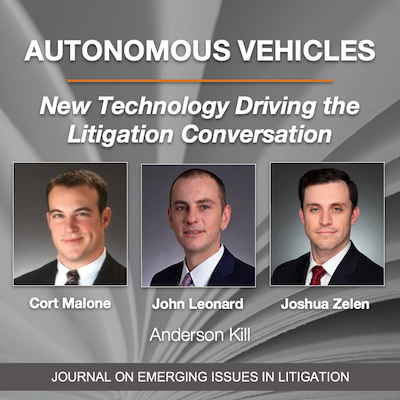
  • Autonomous Vehicles: The New Technology Driving the Litigation Conversation

    Autonomous Vehicles: The New Technology Driving the Litigation Conversation

    The Authors

    Cort Malone

    Cort MaloneAnderson Kill

    Cort T. Malone (cmalone@andersonkill.com) is a shareholder in the New York and Stamford offices of Anderson Kill and practices in the Insurance Recovery and the Corporate and Commercial Litigation Departments. An experienced litigator, he focuses on insurance coverage litigation and dispute resolution, with an emphasis on commercial general liability insurance, directors and officers insurance, employment
    practices liability insurance, advertising injury insurance, and property insurance issues.

    John M. Leonard

    John M. LeonardAnderson Kill

    John M. Leonard (jleonard@andersonkill.com) is a shareholder in Anderson Kill’s New York, New York, office, where he handles a full spectrum of insurance coverage matters, such as business interruption losses, D&O and E&O, commercial general liability, environmental liability.

    Joshua A. Zelen

    Joshua A. ZelenAnderson Kill

    Joshua A. Zelen (jzelen@andersonkill.com) is a law clerk pending admission in Anderson Kill’s New York office. He focuses his practice on insurance recovery.
    The Journal on Emerging Issues in Litigation

    Emerging Litigation Podcast

    Emerging Litigation PodcastProduced by HB Litigation and Law Street Media

    Interviews with leading attorneys and other subject matter experts on new twists in the law and how the law is responding to new twists in the world.

    Autonomous Vehicles: The New Technology Driving the Litigation Conversation

    “The AEV Act requires a policyholder’s insurance company to cover third-party damage caused by a self-driving automated vehicle. A policy may not exclude such damages, except for damages suffered as a direct result of software alterations made without the policyholder’s knowledge, or failure to install safety-critical software updates.”

    Abstract: So far, Congress has not been able to pass regulations governing the emergence of self-driving or autonomous vehicles. Twenty-one states and the United Kingdom are leading the way. As more of these vehicles take to the highway implications will emerge for the insurance industry. Auto
    insurance policies will have to determine how to insure against losses caused by nonhuman operators, commercial general liability policies will be affected when technology developers and car makers are sued for bodily injury and property damage arising from malfunctioning technology, and cyber policies could be implicated in the event of hacks or data breaches. The authors review these subjects and share their insights into what autonomous vehicle producers should consider when it comes to mitigating their risk.

    Download the article now!

    Read, listen, explore more content on the subject!

    Podcast: Biometric Privacy Litigation and Coverage Disputes with John Leonard and Cort Malone

    JEIL: Litigation After Biometric Privacy Law Violations: Policyholder Victories and Their Implications. Co-authors Cort Malone and Abigal Damsky 

    JEIL: Biometric Privacy Laws: Companies Will Need Insurance as Protection From New and Expanding Liability. Co-authors Cort Malone and Jade Sobh

    Podcast: Autonomous Vehicles: The New Technology Driving the Litigation Conversation with John Leonard and Cort Malone

    Tags

    Emerging Litigation & Risk Compliance Litigation & appeals Cybersecurity Data Privacy Artificial Intelligence (AI) Insurance Companies Risk Management Corporate & Securities Insurance Claims Recovery Regulations Data Breach Toxic Torts Antitrust Legal Tech Product Liability Settlements Trial Personal Injury Privacy Healthcare Per- and Polyfluoroalkyl Substances (PFAS) Data Analytics Arbitration Constitutional Law Climate Change Cannabis Labor Law Insurance Fraud Liability Claims COVID Alternative Dispute Resolution (ADR) Mediation Diversity Equity Inclusion (DEI) Claims management Professional Liability Legal Research & Writing Business Interruption Law Practice Management Trial Skills Property and Casualty Drug Laws Copyright Law Catastrophic Loss
  • Labor Organizing in Retail: Conditions Remain for Continued Momentum

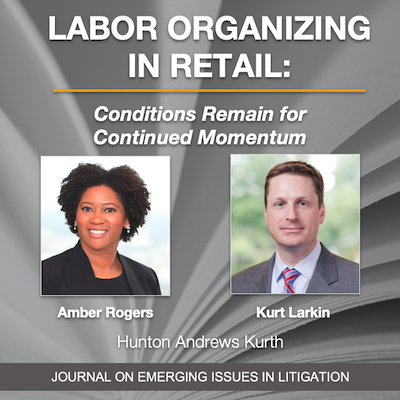
    Labor Organizing in Retail: Conditions Remain for Continued Momentum

    The Authors

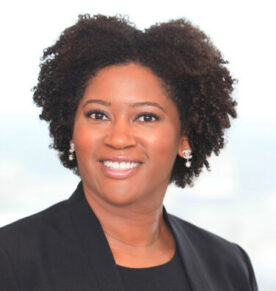
    Amber Rogers

    Amber RogersHunton Andrews Kurth

    Amber is Board Certified in Labor & Employment Law by the Texas Board of Legal Specialization, and is a trial lawyer who has extensive experience representing and advising clients in traditional labor relations, such as collective bargaining, representation elections, decertification elections, unfair labor practice charges, arbitrating grievances, contract administration and interpretation, and union avoidance strategies.

    Amber’s litigation experience includes regularly representing clients in wage and hour collective and class actions, trade secrets and post-employment restrictive covenant disputes, and complex employment discrimination. As a part of Amber’s partnership with clients to avoid litigation, she frequently conducts and coordinates sensitive corporate investigations, and provides training presentations for clients on a multitude of topics.

    Kurt Larkin

    Kurt LarkinHunton Andrews Kurth

    Kurt helps businesses of all sizes solve their complex labor and employment challenges. He counsels clients on all aspects of labor-management relations, including representation elections, collective bargaining and strikes and lockouts, and also advises clients in strategic employment and human relations matters. Kurt litigates labor and employment cases in federal and state trial and appellate courts around the country and before the NLRB and EEOC.

    Kurt is a recognized thought leader in the area of traditional labor-management relations. He has been recognized as a leader in Labor and Employment by Chambers USA Virginia and as a 2022 Top 10 Labor Lawyer by Benchmark Litigation.

    The Journal on Emerging Issues in Litigation

    Emerging Litigation Podcast

    Emerging Litigation PodcastProduced by HB Litigation and Law Street Media

    Interviews with leading attorneys and other subject matter experts on new twists in the law and how the law is responding to new twists in the world.

    Labor Organizing in Retail: Conditions Remain for Continued Momentum

    “The political and social issues of the past few years, inflation, the looming recession, job security, wages, and pandemic-related frustration/unhappiness are just a few of the countless reasons cited for the boom in union support/approval.”

    Abstract: In 2022, labor organizing was in the spotlight with workers organizing at a rate not seen in years. The National Labor Relations Board saw an increase of union petitions during the last fiscal year, it was more than 50% higher than the previous year. Relatedly, more unions have won representation and American approval is at its highest in over 50 years. The rise of the “homegrown” union has directly impacted employers of all industries. The year 2022 can provide all industries and companies with lessons learned, particularly from those who faced threats for the first time. It is crucial to note too, however, that many of these companies and retailers have positive reputations. Labor and union laws continue to evolve as the Biden administration takes full control of the NLRB.

    Download the article now!

  • Policy Derailed: Can U.S. Antitrust Policy Toward Standard Essential Patents Get Back on Track by Jonathan Rubin

    Policy Derailed: Can U.S. Antitrust Policy Toward Standard Essential Patents Get Back on Track by Jonathan Rubin

    The Author

    Jonathan Rubin

    Jonathan RubinMoginRubin LLP

    Jonathan Rubin (jrubin@moginrubin.com) is Co-Founder and Partner of MoginRubin LLP, a boutique antitrust, mergers and acquisitions, and class action law firm. Since 2001, he has focused his legal practice exclusively on antitrust and competition law and policy. As a litigator he has led trial teams in major antitrust cases in courts throughout the country.

    Rubin is a member of the Editorial Board of Advisors for the Journal of Emerging
    Issues in Litigation.

    The Journal on Emerging Issues in Litigation

    Emerging Litigation Podcast

    Emerging Litigation PodcastProduced by HB Litigation and Law Street Media

    Interviews with leading attorneys and other subject matter experts on new twists in the law and how the law is responding to new twists in the world.

    Policy Derailed:
    Can U.S. Antitrust Policy Toward Standard Essential Patents Get Back on Track?

    “The failure to appropriately adjust the patent system to accommodate the competitive circumstances created when patents are incorporated into standards undermines the purposes of the standard-setting enterprise and impairs the utility and proliferation of standardized technologies. Without a course correction among the judiciary, the United States risks finding itself as a less desirable jurisdiction for pro-growth and pro-competitive patenting and standard-setting activities.”

    Abstract: A consensus at the intersection of patent and anti-trust law was achieved after a series of decisions finding that in some circumstances owners of standard essential patents (SEPs) have an antitrust duty to deal with willing licensees. Beginning in 2017, however, the Department of Justice derailed U.S. policy by undermining the role and usefulness of antitrust for policing abuses of the standard setting process. This article traces the emergence of the consensus, its abrogation by the DOJ, and the resulting effects and prospects for the future.

    Download the article now!

    Explore more from MoginRubin LLP!

    Blog: Emboldened by New Resources and Expanded Authority, Feds Continue 10-Year Look Back at Chinese Investment. By Dan Mogin, Jonathan Rubin, Jennifer Oliver, and Timothy LaComb. List

    OnDemand CLE Webinar: The Antitrust Case Against Google. Dan Mogin, Jonathan Rubin, Jennifer Oliver, Timothy LaComb, John Newman, Dr. Alan Grant

    Blog: FTC’s Case Against Facebook Will Test the Flexibility of U.S. Antitrust Law.Authors: Jonathan Rubin and Jennifer Oliver, MoginRubin LLP

    Blog: Full Ninth Circuit Removes Unwarranted Hurdles to Class Certification.

    Journal: Policy Derailed: Can U.S. Antitrust Policy Toward Standard Essential Patents Get Back on Track by Jonathan Rubin

    Webinar: Class Certification After Olean v. Bumble Bee with Jonathan Rubin, James Bogan lll, Jonathan Cohn, Bradley Hamburger.

    Journal: FTC v. Amazon: Market Definitions and Section 5 of the FTC Act

    Podcast: Algorithmic Software Facilitated Price Fixing with Jonathan Rubin

    Plus, additional insights from the MoginRubin Blog.

  • PFAS Litigation—A Historical Overview and the Growing Trend in Consumer Fraud Lawsuits: What Are the Legal and Business Risks to Companies by John Gardella

    PFAS Litigation—A Historical Overview and the Growing Trend in Consumer Fraud Lawsuits: What Are the Legal and Business Risks to Companies by John Gardella

    The Author

    John Gardella

    John GardellaCMBG3

    John P. Gardella (jgardella@cmbg3.com) is a shareholder and Chief Services Officer at CMBG3 Law, where he also chairs the firm’s PFAS, Environmental, Risk Management and Consulting and ESG practice groups. John is the latest addition to the Editorial Board of Directors for the Journal on Emerging Issues in Litigation.

    The Journal on Emerging Issues in Litigation

    Emerging Litigation Podcast

    Emerging Litigation PodcastProduced by HB Litigation and Law Street Media

    Interviews with leading attorneys and other subject matter experts on new twists in the law and how the law is responding to new twists in the world.

    PFAS Litigation

    A Historical Overview and the Growing Trend in Consumer Fraud Lawsuits

    “It is of the utmost importance that businesses along the whole supply chain in the consumer goods sector evaluate their PFAS risk and fully understand the legal arguments that plaintiffs could make against companies in litigation.”

    Abstract: Per- and polyfluoroalkyl substances (PFAS) are a class of over 12,000 man-made compounds. Most people would recognize the brand names Teflon, produced by DuPont, and Scotchgard, produced by 3M. They also go by the nickname “forever chemicals” because they are highly persistent and mobile in the environment and the human body. In addition to bodily injury and environmental pollution litigation, plaintiffs are also bringing suits against companies for claiming their products and the making of their products are safe and green. This article explains why PFAS are of concern to citizens, media, and legislators; what legal risks they pose to corporations; and the recent surge in consumer fraud litigation. The article examines the legal theories at issue in the PFAS consumer fraud cases, as well as the potential damages that can stem from the cases to corporations.

    Questions addressed include:

    What do state and federal regulations say about PFAS in drinking water?

    If your company doesn’t use the two original types of PFAS, are you at less risk of litigation?

    Which industries currently face the most risk of PFAS-related consumer fraud cases?

    Are plaintiffs securing significant verdicts in personal injury litigation?

    Download the article now!

  • EMR Audit Trail—What Is It? Why Do They Matter? What Should You Look For? by Haley K. Grieco and Brooke E. Reddin

    EMR Audit Trail—What Is It? Why Do They Matter? What Should You Look For? by Haley K. Grieco and Brooke E. Reddin

    The Authors

    Haley Grieco

    Haley GriecoHall Booth Smith

    Haley K. Grieco (hgrieco@hallboothsmith.com) is a partner in the Paramus, New Jersey, office of Hall Booth Smith, where she defends physicians, hospitals, and other healthcare providers in a wide range of medical malpractice litigation.

    Brooke Reddin

    Brooke ReddinHall Booth Smith

    Brooke E. Reddin (breddin@hallboothsmith.com) is an associate with the firm, where she focuses her practice on healthcare, medical malpractice, and aging services litigation.

    The Journal on Emerging Issues in Litigation

    Emerging Litigation Podcast

    Emerging Litigation PodcastProduced by HB Litigation and Law Street Media

    Interviews with leading attorneys and other subject matter experts on new twists in the law and how the law is responding to new twists in the world.

    EMR Audit Trail—What Is It? Why Do They Matter? What Should You Look For?

    “As the healthcare industry becomes increasingly digitized, it is imperative that attorneys appreciate the impact it may have on their clients and their practice. In medical malpractice matters, discovery requests for metadata—specifically, the production of the EMR audit trail—has steadily increased over the past few years.”

    Abstract: Maintaining electronic medical records, or EMRs, is now a nearly universal best practice among medical providers from small physician practices to large hospital networks. Unlike handwritten or typed records, these digital documents carry with them much more data than meets the eye. In this article, the authors—two medical malpractice attorneys— discuss what attorneys need to know about EMRs in the litigation context and the metadata bread crumb trail they leave behind. They discuss the types of data involved, federal requirements, discovery considerations, privacy implications, and the pros and cons and risks of using these records in defending healthcare providers.

    During the past ten years electronic medical records (EMR) have all but rendered obsolete handwritten medical records. Medical providers have had to learn  computer systems, programs, software, hardware, and forms like never before. When hospitals, facilities, and medical offices change EMR systems, the process of learning the new system starts over. But what about the data you do not see? What lurks beneath the surface of the records that providers never see?

    This article looks at EMR from the perspective of the individual seeking to understand the data retrospectively in the context of a pending litigation rather than the requirements for those developing and maintaining EMR.

    Download the article now!

  • Employers Be WARNed: Workforce Reduction Rules Meet New Workplace Definitions as Employees Go Remote by Juan Enjamio and Steven DiBeneditto

    Employers Be WARNed: Workforce Reduction Rules Meet New Workplace Definitions as Employees Go Remote by Juan Enjamio and Steven DiBeneditto

    The Authors:

    Juan Enjamio

    Juan EnjamioHunton Andrews Kurth

    Juan C. Enjamio (jenjamio@huntonak.com) is managing parter of the Miami office of Hunton Andrews Kurth where he dedicates his practice to complex domestic and international employment law matters.

    Steven DiBeneditto Jr.

    Steven DiBeneditto Jr.Hunton Andrews Kurth

    Steven J. DiBeneditto Jr. (sdibeneditto@huntonak.com) is a Washington, DC-based associate in the firm’s employment and labor group.

    The Journal on Emerging Issues in Litigation

    Emerging Litigation Podcast

    Emerging Litigation PodcastProduced by HB Litigation and Law Street Media

    Interviews with leading attorneys and other subject matter experts on new twists in the law and how the law is responding to new twists in the world.

    Employers Be WARNed

    Workforce Reduction Rules Meet New Workplace Definitions as Employees Go Remote

    “Numerous courts have opined that a “home base” is a place in which the employee has some sort of physical connection. But this connection must be more than a “notional” base, whereby the employee has a menial relationship.”

    Introduction

    A common sentiment during the Covid-19 pandemic was that a different society would emerge from its ashes. While overstated in many cases, one segment of society that appears to have changed for good is the white collar workplace. Indeed, after enjoying the flexibility of working from home for more than 2 years, many white collar workers are demanding that a remote work option remain a permanent fixture at their place of employment. And with seemingly no negotiating leverage due to worker shortages across the country, employers have mostly acceded to these demands, with many opting to implement a “hybrid” workforce where employees work from home for part of the work week and transit to the physical workplace for the rest of the week. Other employers have opted to have employees work entirely from home in what is now generally known as a “remote” employee.

    But widespread adoption of a Hybrid Workforce presents a complex set of legal challenges for employers. These challenges are especially prevalent when making employment decisions using laws that were drafted decades ago to a new workplace that was never considered during the laws’ enactment. Nowhere is this problem more apparent than with the Worker Adjustment and Retraining Notification (“WARN”) Act, a statute adopted almost four decades ago in 1988. Simply put, the WARN Act sets forth notice requirements for employers who plan to close a plant or implement a reduction in force. Yet the WARN Act’s reduction in force provisions apply only to “single sites of employment,” which has been traditionally understood to mean a physical building or a group of buildings in contiguous locations. This  single site of employment definition makes the WARN Act ill-suited to address the emerging (but ubiquitous) issue of workers who are dispersed, e.g. Remote and Hybrid Workplaces.

    With that in mind, this article seeks to highlight the issues with the WARN Act and Remote and Hybrid Workplaces and package them into a guide for employers. The article begins by summarizing the WARN Act and the regulations for single sites of employment. It then shifts to a recent district court case analyzing the issue of Remote Work under the WARN Act for purposes of Rule 23(b)(3)’s predominance requirement for class certification. The article concludes by offering some suggestions to help prevent WARN Act liability.

    Download the article now!

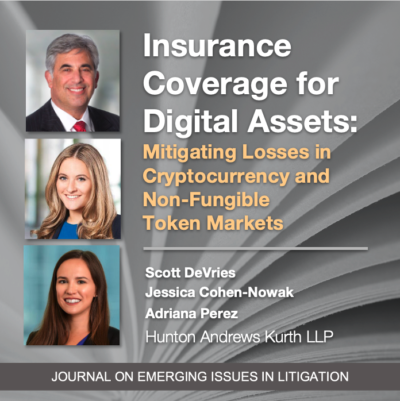
  • Insurance Coverage for Digital Assets: Mitigating Losses in Cryptocurrency and Non‐Fungible Token Markets by Scott DeVries, Jessica Cohen-Nowak and Adriana Perez of Hunton Andrews Kurth

    Insurance Coverage for Digital Assets: Mitigating Losses in Cryptocurrency and Non‐Fungible Token Markets by Scott DeVries, Jessica Cohen-Nowak and Adriana Perez of Hunton Andrews Kurth

    Journal on Emerging Issues in LitigationCompanies and individuals are riding the ups and downs of cryptocurrency and NFTs—with losses and swings in the billions of dollars—but digital assets are not going away.

    Abstract: The risk of loss in certain categories may be mitigated by insurance, whether provided by tailored policies and/or under policies designed specifically for digital asset owners. Those with exposure to the digital asset sector should be attuned to the emerging marketplace for such insurance products. While it is early days for NFT-specific coverage, the rise of cryptocurrency has created a substantial marketplace for crypto coverage. Insurers are becoming increasingly able to model and assess risk, so more products are coming to market. That said, digital asset holders need to be able to select coverage that best suits their needs. In this article, the authors discuss the history and status of coverage for digital assets to assist readers in exploring how they might use insurance to mitigate risk in this emerging and rocky sector of global finance.

    “Over the course of a decade, the marketplace for cryptocurrency has increased from zero to an estimated $250 billion. However, only $6 billion in insurance coverage is currently available. It would be a gross understatement to say that there is a truly remarkable imbalance between market value and insurance capacity.”

    Introduction

    Crypto markets are experiencing the greatest crash in their history to date.  The value of a Bitcoin (BTC) has plummeted 70% from its peak and Ethereum (ETH) has fallen 77%.  Since last November, the value of cryptocurrency tokens has lost $2 billion in value. As noted financial publication Barron’s put it: “Crypto is having a ‘Lehman moment,’ a shattering of confidence triggered by plunging asset prices, liquidity freezing up, and billions of dollars wiped out in a few scary weeks.” Cryptocurrency companies are halting withdrawals and transfers, platforms are seizing up, and regulators are circling.

    Nor has the devastation been limited to the coins themselves.  Non-fungible token (NFT) sales have reduced by 90% since September 2021.  The New York Times reported that Opensea.io (OpenSea) an NFT marketplace that receives 2.5% share of the proceeds for each NFT sale, has been plagued by “a surge of plagiarism, as sellers convert traditional artwork into NFTs and then list the images for sale without compensating the original creator.”  For example, DeviantArt, an artist collective that scans OpenSea for copyright infringement of the work of its artists, found 290,000 instances of unauthorized NFTs copying its artists’ works. While infringing listings can be deleted in response to take down requests filed by the artist, buyers of counterfeit NFTs are rarely given a refund.

    Against this backdrop, the issue of whether there may be claims associated with cryptocurrency and NFTs is far from a theoretical or esoteric thought exercise.  It is very real.  And when there are claims, businesses and investors doubtless will look to their insurers.

    A business or home is devastated by a wildfire.  Property insurance is available up to limits.  A home is broken into, and art and jewelry are stolen.  Crime/specie insurance is available.

    But what about new age assets?  What about cryptocurrency?  What about NFTs?  These obviously are not immune from theft by hackers.  In 2021, hackers stole at least $3.2 billion in cryptocurrency with schemes short of outright theft accounting for another $7.8 billion. In the first four months of 2022, NFT hacks accounted for $52 million in losses, an almost eight-fold increase from 2021.

    There typically is a significant time lag between the development of a product and the availability of product-specific insurance.  This general proposition applies with equal force here.  Over the course of a decade, the marketplace for cryptocurrency has increased from zero to an estimated $250 billion.  However, only $6 billion in insurance coverage is currently available.  It would be a gross understatement to say that there is a truly remarkable imbalance between market value and insurance capacity.

    Although NFTs have been around for the better part of a decade, it was only during the last two years that the marketplace has grown to upwards of $41 billion. In addition to its newness, NFTs pose additional risks for insurers, including questions of ownership, authenticity and the valuation of a truly “unique” asset.  Consequently, availability of insurance coverage for NFTs is even further behind.

    Given the rapid rate at which the digital asset field is developing, and claims are emerging, and the insurance industry’s attempts to specifically address coverage for these losses and claims, anything written on this topic will, at least in part, be outdated by the time it is published.  The objective of this article is to educate the reader on the history and status of the field, enabling them to ask the questions they need to ask, and to procure the coverage they need if available now or in coming months. 

    Download the article now!

    Insurance Coverage for Digital Assets:

    Mitigating Losses in Crypto and NFT Markets

    Scott DeVries

    Scott DeVriesHunton Andrews Kurth

    Scott DeVries (sdevries@huntonak.com) is Special Counsel at Hunton Andrews Kurth and long-time insurance coverage attorney for policyholders in a range of complex disputes as well as mass torts, class action, product liability, and complex business litigation.

    Jessica Cohen-Nowak

    Jessica Cohen-NowakHunton Andrews Kurth

    Jessica Cohen-Nowak (jcohen-nowak@huntonak.com) is an associate in Hunton Andrew Kurth LLP’s Intellectual Property group in the firm’s New York office. Jessica focuses her counseling and litigation practice on intellectual property matters in the fashion, fitness, entertainment, hospitality, and gaming industries as well as in technology and digital assets.

    Adriana Perez

    Adriana PerezHunton Andrews Kurth

    Adriana Perez (pereza@huntonak.com) is an associate in the firm’s Miami office where she focuses on insurance, reinsurance, and other business litigation.

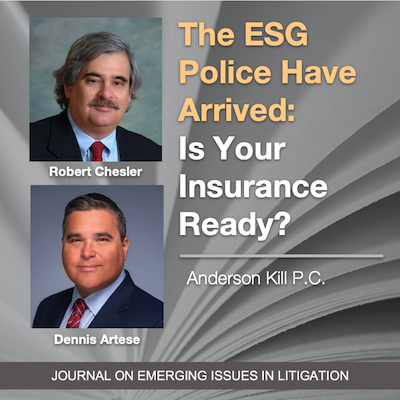
  • The Environmental, Social, and Governance Police Have Arrived: Is Your Insurance Ready? by Robert D. Chesler and Dennis J. Artese

    The Environmental, Social, and Governance Police Have Arrived: Is Your Insurance Ready? by Robert D. Chesler and Dennis J. Artese

    The Authors

    Robert Chesler

    Robert CheslerAnderson Kill

    Robert D. Chesler (rchesler@andersonkill.com) is a shareholder in Anderson Kill’s New Jersey office and is a member of the firm’s Cyber Insurance Recovery Group. He represents policyholders in a broad variety of coverage claims against their insurers and advises companies with respect to their insurance programs.

    Dennis Artese

    Dennis ArteseAnderson Kill

    Dennis J. Artese is a shareholder in Anderson Kill’s New York office and chairs the firm’s Climate Change and Disaster Recovery Group. Both are members of the Editorial Advisory Board of the Journal.

    The Journal on Emerging Issues in Litigation

    Emerging Litigation Podcast

    Emerging Litigation PodcastProduced by HB Litigation and Law Street Media

    Interviews with leading attorneys and other subject matter experts on new twists in the law and how the law is responding to new twists in the world.

    The ESG Police Have Arrived:
    Is Your Insurance Ready?

    “ESG has become a major initiative for corporate America. In particular, the environmental prong of ESG calls for companies to institute sustainability goals and to invest in environmentally friendly companies. This emphasis has both economic and popular support. Environmental sustainability will make companies better able to compete and make their businesses less risky.”

    Abstract: The environmental, social, and governance movement is a positive one, but like many well-intentioned efforts there is room for abuse and risk. As corporations endeavor to earn accolades and good will for “doing the right thing,” they must also be certain they truly are. In this article the authors discuss increased government scrutiny, the attendant risks of implementing and reporting on ESG initiatives, insurance coverage implications for directors and officers, the pollution and other exclusions, the potential civil fines and penalties, and what companies can expect in the era of ESG.

    Download the article now!

    Explore More from Anderson Kill!

    Podcast 1 of 2 series: Insurance Coverage with Dr. Jaana Pietari and Jim Fenstermacher and Litigation with Bob Chesler.

    Podcast 2 of 2 series: PFAS Insurance Coverage with Robert D. Chesler of Anderson Kill.

    Sister article to podcast 1 of 2 series: Remediating, Insuring, and Litigating PFAS Claims. Authors: Dr. Jaana Pietari, PhD, MBA, PE, Jim Fenstermacher, PE, Dr. Michael Bock, PhD, MS, Robert D. Chesler and Nicholas M. Insua, Sheila Mulrennan, Robin Kelliher, Jason R. Waters

    Podcast: Autonomous Vehicles: The New Technology Driving the Litigation Conversation Podcast with Cort Malone, John Leonard, Joshua Zelen

    Podcast: Violations of Biometric Privacy Laws: Policyholders’ Victories and the Implications Going Forward with John Leonard and Cort Malone

    Journal on Emerging Issues, Editorial Board of Advisors: Dennis Artese, Robert D. Chesler

    Asymmetrical Combat: Bad Faith Liability in Insurance Recovery Cases. By William Passannante

    Climate Change, ESG, and D&O Insurance: Collision or Cooperation? Authors: Robert Chesler, Dennis J. Artese, and Joseph Villa

    Litigation After Biometric Privacy Law Violations: Policyholder Victories and Their Implications. Authors: Cort T. Malone, Abigail Damsky

    Protecting Policyholders as AI Is Developed for Insurance Claims Handling – Ensuring “Decency and Humanity” in the Digital Age. Authors: Marshall Gilinsky, Madison Marlow

    Police–The Environmental, Social, and Governance Police Have Arrived: Is your Insurance Ready. Authors: Dennis Artese, Bob Chesler

    How Insurance Companies Defraud Their Policyholders, and What Courts and Legislators Should Do About It. Authors: Robert Chesler, Amy Weiss, and Jade Sobh

    The Promise and Peril of Quantum Computing and Its Implications for Cyber Insurance. By Cameron R. Argetsinger

    The Use and Abuse of the Pollution Exclusion. Authors: Dennis Artese, Jamie O’Neil, Robert Chesler

    Property Insurance Coverage for Emerging Risk: Underground Climate Change. Authors: Dennis J. Artese, Ethan W. Middlebrooks, Thomas Dupont

    Autonomous Vehicles: The New Technology Driving the Litigation Conversation. Authors: Cort Malone, John Leonard, and Joshua Zelen

  • Announcing the Complex Litigation Ethics Conference

    Announcing the Complex Litigation Ethics Conference

    Joshua P. Davis

    Joshua P. DavisProfessor & Practicing Attorney

    A leading academic and practitioner, Joshua P. Davis (davisj@usfca.edu) is a nationally recognized expert on legal ethics and class actions, as well as on artificial intelligence in the law, antitrust, civil procedure, free speech, and jurisprudence. He has published more than 30 scholarly articles and book chapters on these subjects and is currently writing a book on AI titled Unnatural Law, which will be published by Cambridge University Press. He is Research Professor of Law at the University of California Hastings College of Law, and a Shareholder of the Berger Montague PC law firm and Manager of its new San Francisco Bay Area Office. Before taking these posts, for more than 20 years Davis was a tenured Professor of Law at University of San Francisco Law School, where he also served as the Director of the Center for Law and Ethics.

    Davis is also a member of the Editorial Board of Advisors for the Journal on Emerging Issues in Litigation, published by Fastcase Full Court Press. Tom Hagy, Editor in Chief.

    Scott Dodson

    Scott DodsonCenter for Litigation and Courts

    An expert in civil procedure and federal courts, Professor Scott Dodson is the James Edgar Hervey Chair in Litigation and Geoffrey C. Hazard Jr. Distinguished Professor of Law at UC Hastings Law. He has published seven book titles, including The Legacy of Ruth Bader Ginsburg (Cambridge 2015) and New Pleading in the Twenty-First Century (Oxford 2013). He has written around 100 shorter works appearing in such journals as Stanford Law Review, New York University Law Review, Michigan Law Review, University of Pennsylvania Law Review, California Law Review, Virginia Law Review, Duke Law Journal, Northwestern University Law Review, Georgetown Law Journal, American Journal of Comparative Law, American Journal of International Law, and Law & Society Review. His scholarly writings have been cited in more than 30 court opinions and have been downloaded more than 45,000 times. For 2010-14, he was listed as the 9th (tied) most-cited civil-procedure scholar. Professor Dodson is a frequent commentator in the news, including appearances on the 10:00 Nightly News, NPR Radio, and CNN Radio; quotes in various print media; and blogging stints at SCOTUSblog, SCOCAblog, Civil Procedure & Federal Courts Blog, and PrawfsBlawg.

    You can also listen to Josh on the Emerging Litigation Podcast!

    New Litigation Ethics Conference to Feature Sitting Judges, Legal Scholars, Prominent Attorneys

    For Immediate Release

    SAN FRANCISCO – Aug. 25, 2022 – Luminaries and thought leaders in the complex litigation arena will gather in San Francisco on Saturday, Oct. 22, 2022, to discuss insights and practices on an issue of critical significance to the nation’s justice system: ethical conduct among litigants and litigators.

    With a projected in-person and remote audience of 100 plus, this important continuing legal education program will be held at the UC Hastings College of Law in association with the school’s Center for Litigation in Courts. Professors Joshua P. Davis and Scott Dodson have assembled a faculty of leading jurists, litigators, and other subject matter experts.

    Complex Litigation Ethics Conference
    Oct. 22, 2022
    UC Hastings College of Law
    Learn more

    “Data suggest that, depending on the year, as much as half of all cases filed in federal court are part of multidistrict litigation, or MDL, proceedings or involve proposed class actions,” said Professor Davis, who is both a research professor at UC Davis and managing partner of the San Francisco offices of Berger Montague, a prominent class action and complex litigation law firm.

    According to the U.S. Judicial Panel on Multidistrict Litigation there were 186 MDL dockets pending, which brought together 770,623 actions, with 426,495 pending as of July 2022. At the same time, thousands of new class actions are filed each year (some put the number as high as 10,000) in state and federal courts representing millions of named and potential class members. Cases and claim types run the gamut, such as consumer product liability, antitrust, toxic substances, drug and device liability, data breaches, securities, employment, environmental contamination, and both injury and damage claims arising from wildfires and floods, to name a few.

    “Despite these figures, insufficient scholarly attention has been paid to the ways in which ethical rules, which are typically designed for traditional litigation, should be adapted and applied to MDLs and class actions,” said Professor Davis. “The Complex Litigation Ethics Conference will address these important and timely issues.”

    Topics include adapting general legal ethics rules to complex matters; ethics in litigation funding; diversity, equity, and inclusivity in complex litigation; and communications with “absent class members.”

    U.S. Judge Jon S. Tigar of the Northern District of California will be among the speakers. Judge Tigar has or continues to preside over headline-grabbing litigation brought against Apple Inc., Meta Platforms Inc. (Facebook), Twitter Inc., Uber Technologies Inc., Wells Fargo & Company, Subway restaurants, Sanofi S.A., and others.

    Also on the faculty are:

    • Lynn A. Baker, University of Texas School of Law
    • Jennifer Bennett, Gupta Wessler PLLC
    • Eric Cramer, Berger Montague PC
    • Lauren Godshall, Tulane Law School
    • Alexandra D. Lahav, Cornell Law School
    • Brent Landau, Hausfeld
    • Roger Michalski, University of Oklahoma College of Law
    • Melissa Mortazavi, University of Oklahoma College of Law
    • Sarah Ray, Latham & Watkins LLP
    • Maya Steinitz, University of Iowa, College of Law
    • Brad Wendel, Cornell Law School

    Three annual Awards for Excellence in Ethics in Complex Litigation will also be announced during the event, one to a plaintiffs’ attorney or law firm, one to a defense attorney or law firm, and one to a judge, scholar, third-party neutral, party to litigation, government official, other lawyer or law firm, non-profit organization, and other participant in or commentator on complex litigation. The winners will have demonstrated excellence in promoting ethics in class actions or other complex litigation (e.g., MDLs).

    Huntington National BankThe event is being co-sponsored by Huntington National Bank, a nationwide provider of settlement fund and other financial services for law firms.

    Members of the legal and business press are invited to request passes to attend the event in San Francisco or via webstream, and to receive program materials. Pre-program interviews with the conference leaders and faculty should be addressed to Tom Hagy, +1 (484) 844-0428, or Editor@LitigationConferences.com.

    DOWNLOAD THE RELEASE

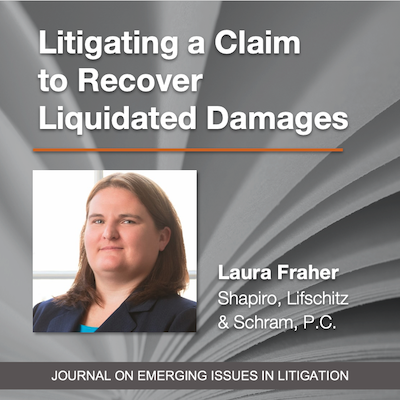
  • Litigating a Claim to Recover Liquidated Damages by Laura Fraher

    Litigating a Claim to Recover Liquidated Damages by Laura Fraher

    The Author

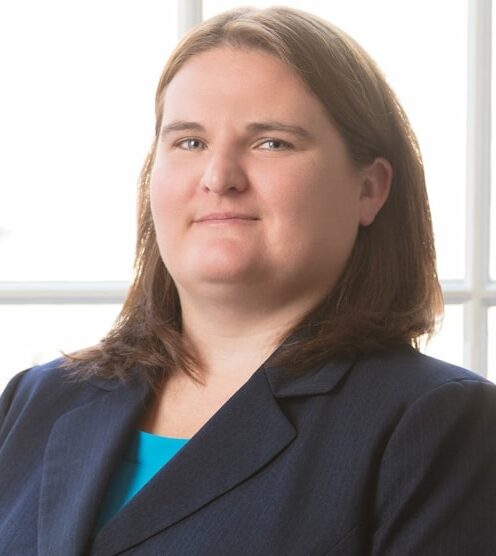
    Laura C. Fraher

    Laura C. FraherShapiro, Lifschitz and Schram

    Laura C. Fraher (fraher@slslaw.com) is a senior attorney in the trial and construction group at Shapiro, Lifschitz & Schram in Washington, D.C. She has extensive experience in civil litigation at both the trial court and appellate level. Competitive by nature, Laura played rugby for nearly 20 years. She puts this competitive spirit to work through her passion for the law and her clients.

    Education: St. John’s University School of Law, J.D., 2001, magna cum laude; SUNY College at Geneseo, B.A., Political Science, 1998.

    The Journal on Emerging Issues in Litigation

    Emerging Litigation Podcast

    Emerging Litigation PodcastProduced by HB Litigation and Law Street Media

    Interviews with leading attorneys and other subject matter experts on new twists in the law and how the law is responding to new twists in the world.

    Litigating a Claim to Recover Liquidated Damages:

    Enforceability Depends on Evidence of Good Faith Expectations

    “The tests and standards that courts apply to evaluate whether a particular liquidated damage provision is enforceable vary from state to state and it is imperative that litigants research and fully appreciate the particular standards that will be applied by the court in which they are litigating.”

    Abstract: The liquidated damages provision in a contract is a useful mechanism for mitigating risk in the event one of the parties to an agreement breaches the contract, costing the aggrieved party sometimes significant difficulty and substantial expense. Unfortunately, these provisions are often challenged, allowing the party responsible for the beach to exacerbate the burdens on the other party. In this article, the author discusses concepts of enforceability, proof, and avoiding litigation over liquidated damage provisions.

    A liquidated damage provision is an advance agreement of the damages that a party will be entitled to recover in the event of a future breach by the other party to a contract. These provisions can be an important tool for risk allocation and mitigation between parties when entering into a contract; both because the provision allows the parties to predict with certainty the financial ramifications of a future breach and because the liquidated damage provision should protect the aggrieved party against the difficulty and expense associated with proving actual damages in the event of a breach.

    In reality, however, when a breach occurs, liquidated damage provisions are frequently challenged and become the subject of costly litigation.  At the outset, it should be noted that the enforceability of a liquidated damage provision is generally considered an issue of law to be determined by the court, not an issue of fact to be presented to a fact finder. Thus, the key threshold issue of enforceability is likely to be determined on a pretrial motion rather than at trial and you should be prepared with both evidence and argument in order to sustain your claim.

    If you are faced with a challenge to dismiss your claim to recover liquidated damages based on unenforceability, it is important to remember that the law is in your favor.

    Liquidated damage provisions are viewed favorably by courts across the country and will generally be enforced so long as a court is satisfied that a liquidated damage provision is a stipulated agreement based on anticipated actual damages and not a penalty. A liquidated damages provision will be considered a penalty, and therefore unenforceable, if the court determines that the provision is designed to induce or secure performance by one party; conversely, a liquidated damage provision will not be viewed as a penalty, and will therefore be enforced if the court is satisfied that the provision is designed not to punish, but to provide a sum certain as compensation for a breach.

    Download the article now!