Category: Journal

  • PFAS Regulation: EPA Ushers in Next Era of Mass Tort and Environmental Litigation

    PFAS Regulation: EPA Ushers in Next Era of Mass Tort and Environmental Litigation

    The Authors

    David J. Marmins

    David J. MarminsArnall Golden Gregory LLP

    David is a business litigation partner at Arnall Golden Gregory LLP in Atlanta. He is at the forefront of land use law and environmental law in the context of PFAS, currently defending three manufacturers in litigation. He also has extensive experience handling banking and related disputes, and additional experience in complex business litigation, class actions, and medical malpractice defense of hospitals. David started his legal career as civil rights prosecutor and, before law school, as a reporter. He earned his J.D. from Georgia State University College of Law.

    Morgan E.M. Harrison

    Morgan E.M. HarrisonArnall Golden Gregory LLP

    Morgan is a partner at Arnall Golden Gregory LLP where she has represented defendants in PFAS litigation since 2016. Morgan also frequently speaks and writes on the subject. In addition to PFAS, she a member of the firm’s teams dedicated to Litigation & Dispute Resolution, Employment law, Payment Systems and Fintech, and the Background Screening industry. She earned her J.D. from Vanderbilt University School of Law.

    The Journal on Emerging Issues in Litigation

    Emerging Litigation Podcast

    Emerging Litigation PodcastProduced by HB Litigation and Law Street Media

    Interviews with leading attorneys and other subject matter experts on new twists in the law and how the law is responding to new twists in the world.

    Forever Chemicals Will Now Be Regulated

    EPA Ushers in New Era of Mass Tort and Environmental Litigation

    An enforceable drinking water standard will be an important tool for plaintiffs. Defendants will no longer be able to assert that they have not violated any federal limitations …. And with more government scrutiny … businesses can expect that the wave of recent PFAS litigation will not only continue but will likely increase across the country. 

    Abstract:

    The U.S. Environmental Protection Agency (EPA) announced the long-awaited proposed National Primary Drinking Water Regulation for six per- and polyfluoroalkyl substances, known as “PFAS,” on March 14, 2023. The agency anticipates finalizing the regulation by the end of 2023, and claims that it will save thousands of lives and reduce tens of thousands of serious illnesses.

    The EPA has been aware of PFAS since at least the 1990s, when one farmer’s investigation into the chemicals concluded with a seminal lawsuit against multinational chemical company DuPont. A book and subsequent feature film put that lawsuit in the spotlight, and PFAS became mainstream news.

    Today, PFAS claims are widely recognized as the next frontier of mass tort and environmental litigation. With the EPA poised to finally enact the first regulation of these chemicals, that frontier is ripe for exploration.

    This article explores PFAS and the origin of litigation around the substances as well as the state of PFAS litigation and regulation today. It concludes with some thoughts on what to expect when it comes to PFAS litigation going forward.

    Download the article now!

    Loved reading David & Morgan’s Journal Article?

    Listen to their Podcast!

    PFAS Regulation, Litigation, and Differentiation

    Tags

    Emerging Litigation & Risk Compliance Litigation & appeals Cybersecurity Data Privacy Artificial Intelligence (AI) Insurance Companies Risk Management Corporate & Securities Insurance Claims Recovery Regulations Data Breach Toxic Torts Antitrust Legal Tech Product Liability Settlements Trial Personal Injury Privacy Healthcare Per- and Polyfluoroalkyl Substances (PFAS) Data Analytics Arbitration Constitutional Law Climate Change Cannabis Labor Law Insurance Fraud Liability Claims COVID Alternative Dispute Resolution (ADR) Mediation Diversity Equity Inclusion (DEI) Claims management Professional Liability Legal Research & Writing Business Interruption Law Practice Management Trial Skills Property and Casualty Drug Laws Copyright Law Catastrophic Loss

  • TVPRA, State Statutes Open Door for Civil Damage Claims by Human-Trafficking Victims

    TVPRA, State Statutes Open Door for Civil Damage Claims by Human-Trafficking Victims

    The Authors

    Coryne Leyendecker

    Coryne Leyendecker Swift, Currie, McGhee & Hiers LLP

    Coryne Leyendecker is an attorney practicing in Swift Currie’s litigation section, defending businesses and insurers against claims related to commercial litigation, sexual abuse, governmental liability, premises liability, automobile litigation and construction law.

    Pamela Lee

    Pamela LeeSwift, Currie, McGhee & Hiers LLP

    Pamela N. Lee is a partner at Swift Currie with more than 15 years of experience practicing in the firm’s litigation section. Pamela devotes her entire practice to litigation, including various tort liability litigation, insurance coverage disputes and the defense of insurance bad faith matters. Her liability practice is wide and varied, encompassing premises liability, product liability, escalator and elevator liability, automobile liability and general personal injury law. She represents companies in the food, automobile and retail industries.

    The Journal on Emerging Issues in Litigation

    Emerging Litigation Podcast

    Emerging Litigation PodcastProduced by HB Litigation and Law Street Media

    Interviews with leading attorneys and other subject matter experts on new twists in the law and how the law is responding to new twists in the world.

    TVPRA, State Statutes Open Door for Civil Damage Claims by Human-Trafficking Victims

    “A plethora of nonprofit organizations and government agencies have collectively produced hundreds of available resources on how to help prevent human trafficking. Overwhelmingly, groups across the board agree that bringing awareness to human trafficking is the most foundational method to stopping human trafficking. By implementing intentional training and internal policies, businesses can not only insulate themselves from third-party claims but they can be a force for good in the fight against human trafficking. “

    Abstract: There is not a person alive with a soul that would believe sex trafficking and other variants of modern slavery is a good thing. The individuals that perpetrate those heinous acts should be punished accordingly. In 2003, Congress opened the door for human-trafficking victims to sue for civil damages under the Trafficking Victims Protection Act of 2000 (TVPRA). Since then the TVPRA and similarly drafted state statutes have allowed for human-trafficking victims to seek civil damages against any party that has benefited from their trafficking. Given this expansive inclusion of third-party liability, more and more businesses, especially those in the hospitality industry, are ultimately the ones left to pay for the criminal acts of human traffickers. This article discusses the evolving litigation around human-trafficking claims, beginning with a broad overview of human trafficking, followed by a discussion of the legal standard behind human-trafficking civil suits and recent guidance from U.S. courts on these types of claims. The article concludes with guidance of its own on how businesses can build a foundation for their own defense while simultaneously helping prevent human-trafficking crimes from ever occurring.

    Download the article now!

    Have an idea for an article?

    If you would like to propose an article for publication in the Journal on Emerging Issues in Litigation please review our specifications and benefits, then send us a summary, outline, or draft. If you also would like to discuss the topic on the Emerging Litigation Podcast, please note that.

  • Spotting the Risk, Reaping Rewards: Avoiding Increased Antitrust Scrutiny

    Spotting the Risk, Reaping Rewards: Avoiding Increased Antitrust Scrutiny

    The Authors

    Katie Reilly

    Katie ReillyWheeler Trigg O’Donnell LLP

    Katie has favorably represented antitrust clients in matters involving monopolization, conspiracy, price fixing, exclusive dealing, and other competition-related disputes, including trade secrets and non-compete actions. She has extensive knowledge of the regulatory hurdles and obligations her clients face. Katie earned her J.D. from the New York University School of Law, cum laude.

    Natalie West

    Natalie WestWheeler Trigg O’Donnell LLP

    Natalie West represents sophisticated clients in complex commercial disputes. She regularly serves as the lead brief writer in antitrust cases, employment and consumer class actions, and appellate matters. Natalie graduated with high honors from the University of Texas School of Law, where she served as a member of the Texas Law Review and was elected to the Order of the Coif.

    The Journal on Emerging Issues in Litigation

    Emerging Litigation Podcast

    Emerging Litigation PodcastProduced by HB Litigation and Law Street Media

    Interviews with leading attorneys and other subject matter experts on new twists in the law and how the law is responding to new twists in the world.

    Avoiding Antitrust Scrutiny

    Spotting the Risk, Reaping Rewards

    The increase in aggressive antitrust enforcement has certainly received significant attention. For the moment, juries are not rewarding the prosecutors. That said, even an unsuccessful government investigation is itself costly and can motivate plaintiffs’ lawyers. Best practices involve not only following the law but also maintaining solid optics to avoid the need for an expensive, if ultimately successful, defense.

    Abstract: 

    A decade ago, few lawyers across the country spent significant time thinking about antitrust law. But, since then, there has been an onslaught of antitrust attacks on businesses and executives across all sectors of the economy. Enforcement efforts have skyrocketed following President Biden’s July 2021 executive order directing a “whole of government” crackdown on competition abuses—and the trend shows no sign of letting up.

    Today, no matter the industry or the size of the business, everyone needs to understand these risks and have strategies to minimize them.

    This article will walk through the top antitrust risks of the moment and conclude with strategies on how to avoid not only violations but also bad optics that increase exposure.

    Download the article now!

  • International Discovery Tool Kit Aims to Facilitate Discovery in Both Domestic and Foreign Litigation

    International Discovery Tool Kit Aims to Facilitate Discovery in Both Domestic and Foreign Litigation

    The Authors

    Benjamin Daniels

    Benjamin DanielsRobinson+Cole

    Benjamin Daniels advises financial institutions and global corporations about litigation and dispute resolution. As a member of the Business Litigation Group, Ben provides creative and ardent advocacy during litigation, enforcement actions, investigations, crisis management, and white-collar defense matters.

    Ben’s clients often face complex, cross-border disputes. He has deep experience with the interplay between domestic and international courts, including discovery disputes and Hague convention proceedings. He also represents clients in international arbitrations and mediations.

    Jenna Scoville

    Jenna ScovilleRobinson+Cole

    Jenna Scoville is a member of the firm’s Business Litigation Group. She focuses her practice on all aspects of general business litigation and dispute resolution, as well as government enforcement matters, and appellate work. She helps companies respond to a variety of business disputes, including claims for breach of contract, unfair trade practices and fraud.

    Jenna also has extensive appellate experience. Prior to joining the firm, she clerked for the Honorable Peter W. Hall of the U.S. Court of Appeals for the Second Circuit.

    The Journal on Emerging Issues in Litigation

    Emerging Litigation Podcast

    Emerging Litigation PodcastProduced by HB Litigation and Law Street Media

    Interviews with leading attorneys and other subject matter experts on new twists in the law and how the law is responding to new twists in the world.

    International Discovery Tool Kit Aims to Facilitate Discovery in Both Domestic and Foreign Litigation

    “At a time when litigants have increasingly relied on U.S. federal courts to obtain otherwise unobtainable evidence from entities located within the United States, the U.S. Supreme Court has decisively closed the door to U.S.-style discovery in private arbitrations abroad. That means U.S. companies will no longer face the time, exposure, and expense of U.S.-style discovery that § 1782 had injected into those proceedings.“

    Abstract: Business knows no borders. Every year companies increase their global reach and open new offices both domestically and abroad. The COVID-19 pandemic accelerated this process—remote employees spread documents and witnesses from Chicago to Shanghai to Sumatra. This has made litigation—especially discovery—more complex. Navigating this environment requires a tool kit of resources to secure discovery in support of both domestic and foreign litigation. This article discusses those tools and several traps for the unwary practitioner facing cross-border discovery to anticipate to effectively use those tools to their benefit.

    When evaluating whether to allow a party to use the Hague Evidence Convention, courts consider several factors, including:

    1) the importance of the documents or information to the case,

    2) the specificity of the request,

    3) whether the information originated in the United States,

    4) the availability of other ways to secure the information, and

    5) whether compliance with the request would undermine important interests of the United States or the foreign country.

    Download the article now!

    Enjoyed reading Ben & Jenna’s article?

    Ben has a podcast exploring the subject more in 2024!

     Podcast: Navigating International Discovery

  • The Use—and Abuse—of Rule 41(a) to Destroy Federal Question Jurisdiction Post-Removal

    The Use—and Abuse—of Rule 41(a) to Destroy Federal Question Jurisdiction Post-Removal

    The Authors

    John Sear

    John SearNelson Mullins

    John defends manufacturers in product liability litigation involving a range of products, e.g., ATVs, RVs, institutional chemicals, medical devices, and pharmaceuticals. From single cases to mass tort litigation and class actions, John has defended clients in courtrooms around the country.

    T. Michael Pangburn

    T. Michael PangburnThor Motor Coach Inc.

    Michael is General Counsel of Thor Motor Coach Inc., a final-stage manufacturer of motor homes headquartered in Elkhart, Indiana. He is also an adjunct professor of commercial law at the Notre Dame Law School.

    Taryn Ryan

    Taryn RyanNelson Mullins

    Taryn focuses her practice on litigation. She has experience dealing with products liability, discovery issues, corporate structure and governance, wealth management, private and commercial lending, real estate, and Indian affairs for lobbying both on state and federal levels. Taryn contributed valuable research to this article.

    The Journal on Emerging Issues in Litigation

    Emerging Litigation Podcast

    Emerging Litigation PodcastProduced by HB Litigation and Law Street Media

    Interviews with leading attorneys and other subject matter experts on new twists in the law and how the law is responding to new twists in the world.

    The Use—and Abuse—of Rule 41(a) to Destroy Federal Question Jurisdiction Post-Removal

    “A plaintiff seeking to divest the court of subject matter jurisdiction post-removal should at least comply with the requirements of the rule they have relied on. Glossing over those requirements undermines the purpose and intent of both the rule and removal statutes. The case should stay put in federal court in the absence of compliance.”

    Abstract: Defendants in civil litigation can level the often uneven state court playing field by removing cases to federal court through federal question removal. In those cases in which the plaintiff has alleged a claim grounded in federal law, the defendant may remove the case to an often more impartial federal forum. Once removed, the plaintiff has few options for defeating removal. About the only option available to the plaintiff is to forgo the federal claim and divest the court of federal question jurisdiction, forcing remand to state court. In pursuit of a ticket back to state court, however, plaintiffs routinely misuse Fed. R. Civ. P. 41 in seeking to dismiss fewer than all claims and less than the entire action. Too frequently courts simply go along with the ruse. This article addresses the misuse and abuse of Rule 41. It provides an overview of the text and history of Rule 41, discusses how the rule should be used and applied, analyzes decisions that indulge the misuse, and explains how the misuse can and does prejudice defendants.

    GET THE COMPLETE ARTICLE

  • The Rise of Multi-Claimant Litigation in England and How Companies Can Manage Potential Exposure

    The Rise of Multi-Claimant Litigation in England and How Companies Can Manage Potential Exposure

    The Authors

    Sheila L. Birnbaum

    Mark S. Cheffo

    Dorothy Cory-Wright

    Evan Flowers

    Jacqueline Harrington

    Will Sachse

    Stephen Surgeoner

    Rachel Leary

    Caroline Power

    Julie Witham

    The Journal on Emerging Issues in Litigation

    Emerging Litigation Podcast

    Emerging Litigation PodcastProduced by HB Litigation and Law Street Media

    Interviews with leading attorneys and other subject matter experts on new twists in the law and how the law is responding to new twists in the world.

    The Rise of Multi-Claimant Litigation in England and How Companies Can Manage
    Potential Exposure

    “With the growth in US/English partnerships for bringing multi-claimant actions in England, there may be an increased interest in leveraging US discovery for copycat English claims. The larger mass torts become in the United States, the more likely they are to feed into related multi-claimant actions in England.”

    Abstract: Recent court decisions have signaled the English courts’ willingness to embrace multi-claimant litigation and to broaden the types of questions decided on a collective basis. These developments have led UK-based plaintiffs’ lawyers to expand mass tort filings, including doing so in partnership with US plaintiffs’ lawyers who are actively advertising in England. This article provides an overview of multi-claimant litigation in England, highlights some of the factors that may lead to its increase, and discusses steps that companies operating in the English market can take now to manage potential exposure.

    Three primary mechanisms for bringing collective actions before an English court:

    1) Representative actions, group litigation orders (GLOs), and collective actions before the Competition Appeal Tribunal (CAT).

    2) Representative actions, in their current form, and GLOs are products of the general Civil Procedure Rules (CPR).

    3) Representative actions originated in the common law and permit a representative claimant or defendant with the “same interest” in a claim to represent that interest on behalf of a class.

    Download the article now!

  • How Companies Seeking to Leave China for Mexico Can Mitigate Their Legal Risks and Protect Against New Ones

    How Companies Seeking to Leave China for Mexico Can Mitigate Their Legal Risks and Protect Against New Ones

    The Author

    Dan Harris

    Dan HarrisHarris Bricken

    Dan Harris (dan@harrisbricken.com) is co-founder of Harris Bricken where he focuses his practice on international law and protecting businesses in their foreign operations. A leading authority on the subject, he is also editor of the highly regarded China Law Blog, and a valued member of the Editorial Board of Advisors for the Journal of
    Emerging Issues in Litigation.

    The Journal on Emerging Issues in Litigation

    Emerging Litigation Podcast

    Emerging Litigation PodcastProduced by HB Litigation and Law Street Media

    Interviews with leading attorneys and other subject matter experts on new twists in the law and how the law is responding to new twists in the world.

    How Companies Seeking to Leave China for Mexico Can Mitigate Their Legal Risks and Protect Against New Ones

    “Chinese manufacturers commonly seek retaliation against foreign buyers that cease buying product from them. For this reason, it is critical that you line up your new suppliers (preferably in a country other than China) and have them ready to go before you even hint to anyone in China that you might cease or reduce production with an existing China supplier.”

    Abstract: The author, one of the leading authorities on the legal issues related to international manufacturing, discusses the risks companies will face if they move their manufacturing out of China, what they should do to mitigate those risks, and what new risks they will face in a new country, such as Mexico. He comments on a variety of concepts, including manufacturing agreements, protection of intellectual property, strategies for a safe departure, potential retaliation tactics, and even personal security matters.

    Download the article now!

  • Climate Change, Property Rights, and Conservation: Highlights from a Decade of Environmental Law (2013–2023)

    Climate Change, Property Rights, and Conservation: Highlights from a Decade of Environmental Law (2013–2023)

    The Author

    Victoria Kline

    Victoria Kline2023 J.D. and Incoming Associate at Reed Smith

    Victoria Kline (linkedin.com/in/victoria-kline) just graduated from the University of Miami School of Law, and is an incoming associate at Jones Day. She focused her studies on environmental law, which also will be her area of practice. (Congratulations to Victoria on her graduation and getting her start at Reed Smith!)

    The Journal on Emerging Issues in Litigation

    Emerging Litigation Podcast

    Emerging Litigation PodcastProduced by HB Litigation and Law Street Media

    Interviews with leading attorneys and other subject matter experts on new twists in the law and how the law is responding to new twists in the world.

    Climate Change, Property Rights, and Conservation:
    Highlights from a Decade of Environmental Law (2013–2023)

    Abstract: The author discusses nine recent decisions—all but one handed down by the Supreme Court—that demonstrate the ongoing debate over responsibility for the effects of climate change, how the courts are essentially asked to strike a balance between environmental protection and economic development, the intersection of property rights and conservation, and how litigants fared with their arguments over different aspects of this important and, many would say, existential dilemma. The author concludes with an update from the United Nations Framework Convention on Climate Change and the establishment of a loss and damage fund for countries harmed by climate change.

    “The past decade has seen numerous legal challenges and landmark rulings in environmental law, reflecting the growing recognition of the critical importance of protecting the environment for current and future generations. From the Supreme Court’s decision in Michigan v. EPA to the recent Juliana v. United States case, the judicial branch has dramatically changed the way litigation can be used to protect the interests of the earth and its inhabitants.”

    Download the article now!

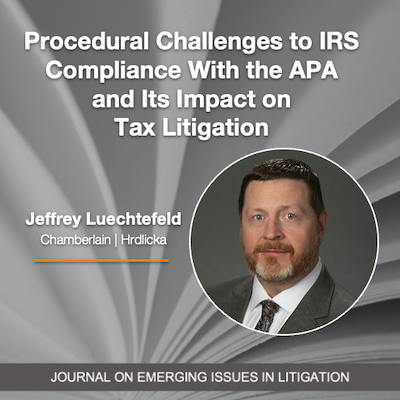
  • Procedural Challenges to the IRS’s Compliance With the APA and Its Impact on Tax Litigation

    Procedural Challenges to the IRS’s Compliance With the APA and Its Impact on Tax Litigation

    The Author

    Jeffrey S. Luechtefeld

    Jeffrey S. LuechtefeldChamberlain | Hrdlicka

    Jeffrey S. Luechtefeld (jeff.luechtefeld@chamberlainlaw.com) is a tax controversy and litigation attorney with Chamberlain, Hrdlicka, White, Williams, and Aughtry (Atlanta, Georgia) where he focuses his practice on resolving tax disputes with the Internal Revenue Service, administratively or through litigation. Jeff previously was a Special Trial Attorney for the IRS Office of Chief Counsel as well as a director in the tax controversy practice of a big four accounting firm.

    The Journal on Emerging Issues in Litigation

    Emerging Litigation Podcast

    Emerging Litigation PodcastProduced by HB Litigation and Law Street Media

    Interviews with leading attorneys and other subject matter experts on new twists in the law and how the law is responding to new twists in the world.

    Procedural Challenges to IRS Compliance With the APA and Its Impact on Tax Litigation

    Abstract: The Administrative Procedure Act (APA) places specific requirements on agencies of the federal government when engaged in a “rule making” that has the force and effect  of law. Recently, the APA has become a focal point in tax litigation, due in large part to the IRS’s history of refusing to comply with the process mandated by the APA. This article focuses on procedural challenges to the IRS’s compliance with the APA based on the IRS’s history of non-compliance with the APA’s notice-and-comment requirement. It highlights recent trends in tax litigation and considers the future of APA challenges in this area.

    “IRS’s level of APA non-compliance matters significantly …

    “APA challenges predicated on the IRS’s failure to adequately follow the APA’s notice-and-comment process are inherently fact-intensive endeavors …

    “The challenging party should gauge the usefulness of the relief requested and balance that against the cost required to prevail …

    “Ultimately, APA challenges are important, and may be necessary for a taxpayer to get to argue the merits of their case, but they do not often end the dispute with the IRS.”

    Download the article now!

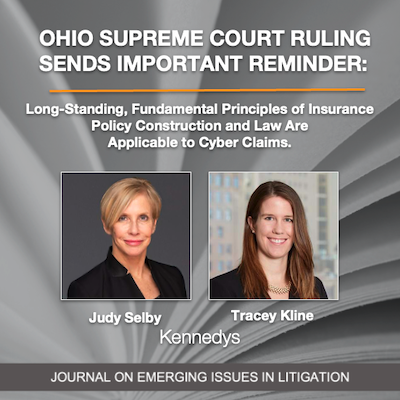
  • Ohio Supreme Court Ruling Sends Important Reminder: Long-Standing, Fundamental Principles of Insurance Policy Construction and Law Are Applicable to Cyber Claims

    Ohio Supreme Court Ruling Sends Important Reminder: Long-Standing, Fundamental Principles of Insurance Policy Construction and Law Are Applicable to Cyber Claims

    The Authors

    Judy Selby

    Judy SelbyKennedys

    Judy Selby (judy.selby@kennedyslaw.com) is a Partner at Kennedys (New York) where she focuses her practice primarily on insurance coverage matters with a concentration in coverage for exposures arising out of emerging technology, digital, and compliance risks.

    Tracey Kline

    Tracey KlineKennedys

    Tracey M.Kline (tracey.kline@kennedyslaw.com) is an Associate at Kennedys (Philadelphia) where she focuses her practice primarily on insurance coverage litigation and cyber matters.

    The Journal on Emerging Issues in Litigation

    Emerging Litigation Podcast

    Emerging Litigation PodcastProduced by HB Litigation and Law Street Media

    Interviews with leading attorneys and other subject matter experts on new twists in the law and how the law is responding to new twists in the world.

    Ohio Supreme Court Ruling Sends Important Reminder:

    Long-Standing, Fundamental Principles of Insurance Policy Construction and Law Are Applicable to Cyber Claims

    Abstract: On December 27, 2022, the Ohio Supreme Court unanimously ruled that a business owner’s property insurance policy issued by Owners Insurance Co. to EMOI Services, LLC did not afford coverage for losses sustained in a ransomware attack because computer software is “entirely intangible” and “cannot experience ‘direct physical loss or physical damage.’” EMOI Servs., LLC. v. Owners Ins. Co., 2022-Ohio-4649 (Ohio 2022). In doing so, the court reversed an attention-getting split decision by the lower appellate court. This article takes an in-depth look at the case and discusses its significant implications.

    The Ohio Supreme Court’s decision was based on its commonsense conclusions that software (as intangible property) cannot suffer physical damage, and that coverage for restoration of information under the Electronic Equipment Endorsement could not be triggered absent the threshold requirement of “direct physical loss or damage” to the media on which the information was stored. Although claims involving cyber events may be relatively new, this decision is an important reminder that long-standing, fundamental principles of insurance policy construction and law are applicable to cyber claims.

    Download the article now!