
Category: Complex Business Litigation

  • Despite Relative Inactivity on the Virtual Front in Ukraine, Russia’s Global Cyber-Attacks are Coming

    Despite Relative Inactivity on the Virtual Front in Ukraine, Russia’s Global Cyber-Attacks are Coming

    Editor

    Tom Hagy

    Tom HagyHB Founder

    Tom is HB’s Founder and Managing Director. His career in litigation content spans four decades during which he was editor, managing editor, and finally publisher at Mealey’s Litigation Reports. After Mealey’s was acquired by LexisNexis Tom became a vice president involved in creating new content and services at the legal research and services giant. He has always overseen or directly created articles, blogs, conferences, webinars, data collections, and now podcasts — all on litigation. Tom founded HB in 2008, and four years later he founded Custom Legal Content, a boutique content creation shop serving boutique and specialized legal practices and litigation services. In addition to his work at HB and CLC, Tom is Editor in Chief of the Journal on Emerging Issues in Litigation, and host of the Emerging Litigation Podcast. For years he was a leader in an international specialized publishing association, frequently speaking and writing about publishing, and is now active in an open community of content and event producers called Renewd. Sometime during the last millennium Tom proudly graduated with a B.A. in Communications from Bethany College in West Virginia.


    The Journal on Emerging Issues in Litigation

    Emerging Litigation Podcast

    Emerging Litigation PodcastProduced by HB Litigation and Law Street Media

    Interviews with leading attorneys and other subject matter experts on new twists in the law and how the law is responding to new twists in the world.

    Despite Relative Inactivity on the Virtual Front in Ukraine, Russia’s Global Cyber-Attacks are Coming
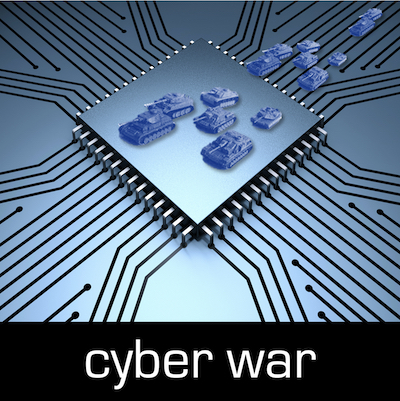
    Cyber WarSince his cyber-war capabilities seem to have worked well for him, why isn’t Vladimir Putin launching more cyber-attacks against Ukraine and its allies? Reports suggest he didn’t think he’d need them, plus they take time to execute. Other reports suggest he is trying to get some cyber damage on the scoreboard. Maybe the actual disruption to Ukraine from tanks and bombs, even though the Ukrainians aren’t giving him the satisfaction of a clean and easy parade-style invasion, could be redundant.

    But many experts did think that much of Russia’s invasion – and Ukraine’s defense –  would take place in cyberspace. Some of that is happening, but there are reasons Russia hasn’t launched large-scale attacks. Kyle Fendorf and Jessie Miller wrote for the Council on Foreign Relations on March 24, 2022, that reasons include “the higher efficacy of kinetic attacks and difficulties in planning and executing massive cyberattacks in a short timeline.” Ukraine, meanwhile, has taken a novel approach: “attempting to mobilize international sentiment” to “create an army of cybersecurity professionals to attack military and critical infrastructure targets in Russia.” Fendorf and Miller list several Russian efforts, including DDoS attacks on Ukrainian banking and defense websites. And hackers like Anonymous have “declared war” on Russia. The group has taken credit for several successes, including interrupting television broadcasts with clips from the war and leaking thousands of confidential government files.

    According to Reuters, the pro-Ukraine cyber assaults are hitting their targets, saying Russian government websites are facing “unprecedented cyber-attacks.” Relying on the Russian news agency TASS, websites for the Aeroflot airline, the Sberbank bank, and the Kremlin itself have experienced “outages and temporary access.” The Kremlin, facing greater isolation from global financial systems and supply chains, is taking steps to bolster its IT sector, such as tax breaks and easier access to lending, Reuters reports.

    President Biden has warned U.S. organizations to “lock their digital doors” for fear of a Russian cyber-attack, adding that “evolving intelligence” indicates attacks are coming.

    As quoted in Politico, Jen Easterly, director of the Cybersecurity and Infrastructure Security Agency, told 13,000 participants on a recent call that we should “assume that disruptive cyber activity will occur: and “we should consider every sector vulnerable.”

    On March 24, the Department of Justice Department unsealed two indictments charging four Russian nationals working for the Kremlin with “attempting, supporting and conducting” cyber-attacks on the global energy sector between 2012 and 2018. The targets were hundreds of organizations in 135 countries, including the U.S. Nuclear Regulatory Commission and a Kansas power plant.  “The potential of cyberattacks to disrupt, if not paralyze, the delivery of critical energy services to hospitals, homes, businesses and other locations essential to sustaining our communities is a reality in today’s world,” said U.S. Attorney Duston Slinkard for the District of Kansas.

    BBC News reported that Ukraine “has remained relatively untroubled” by Russia’s cyber weapons, but “experts now fear that Russia may go on a cyber-offensive against Ukraine’s allies. The BBC News article reminds us of the three types of Russian cyber-attacks “the West fears most,” detailing Russia’s takedown of Ukraine’s electricity grid in 2015 in an attack called BlackEnergy; the “most costly” attack in cyber history called NotPetya, a worldwide computer killer that caused $10 billion in damage, followed by WannaCry which scrambled data in 150 countries; and the one executed by a Russian criminal organization called DarkSide which caused a state of emergency in the U.S. in May 2021 when their ransomware strike shut down the vital Colonial Pipeline.

    The insurance industry, which is always impacted by any global calamity, man-made or natural, is also worried about a parallel cyberwar. Ben Dyson, a reporter for S&P Global Market Intelligence, wrote on March 28, 2022, that while the industry’s direct exposures to Russian and Ukrainian cyberrisk “is likely small,” the larger risk is the “potential for spillover” to networks in other countries. “The insurance industry can look back to at least one precedent for a cyberattack related to the wider conflict between Ukraine and Russia having global implications: the 2017 NotPetya malware attack. NotPetya spread to thousands of companies globally, handing the insurance industry a $3 billion claims bill and its first taste of a cyber catastrophe. NotPetya occurred in relative peacetime and was largely covered by cyber-specific policies.”

    Attorney Vincent Vitkowsky, in an article for the Insurance Journal posted on March 25, 2022, agreed that Russia may try to turn up the stress of other countries if the war drags on. “After the conflict ends, however it ends, Russia will be the object of extreme resentment and suspicion. It may launch cyberattacks to increase disorder, believing that an environment of disorder would be serve its position as a significant power.” Vitkowsky said new cyber weapons will only make the threats worse, such as “zero click vulnerabilities” which don’t even need the help of an unsuspecting employee to click on a link, and the so-called HermeticWizard, “a new strain of software designed to autonomously spread another strain, HermeticWipe, to computers in a network.”  He writes that carriers face exposure to losses from direct or indirect cyberattacks against their insureds globally, but says the so-called War Exclusions “may mitigate that exposure,” then goes on to explain how in his article. [Vince is a member of the Editorial Board of Advisors for the Journal on Emerging Issues in Litigation.]

    FT technology correspondent Hannah Murphy asked Kevin Mandia, the founder of cyber security company Mandiant (which was just acquired by Google for $5.4 billion) about the current state of the cyber conflict between nations.

    The current state feels like, Mandia said, “braced for impact.”

    The cybersecurity expert noted operation “Shields Up” by the Cybersecurity and Infrastructure Security Agency, plus all of the private and public players in the West and NATO, “all watching the cyber domain waiting for what happens.” He sees the war in Ukraine as “an opportunity for us to figure out what is the new normal because we’re used to conflict being air, land, sea, maybe a little bit of space . . . but a cyber domain is part of that conflict, too.” He went on to say, however, he’s “not sure everyone’s got fully fleshed-out strategies for how to do warfare in the cyber domain, and when to bring it to bear.”

    He predicted that if Russia wants to retaliate against sanctions and embargoes, a cyber-attack is “probably the first tool that might be chosen.”

    What do you think?

  • The Impact of Sanctions on Russia on Global Financial Markets with Brad Rustin

    The Impact of Sanctions on Russia on Global Financial Markets with Brad Rustin

    The Impact on Global Financial Systems of U.S. Sanctions on Russia with Brad Rustin

    Brad Rustin on FinTechBut what risks do American corporations and financial institutions face in light of these measures? What difficult reverberations will companies feel across the world? What should global businesses and FinTechs be doing right now to avoid, among other things, violating the restrictions imposed by the U.S. Treasury Department’s Office of Foreign Assets Control (OFAC)? What role will cryptocurrency play in all of this? Also, do institutions whose data are stored in Russia and Ukraine face an additional risk as a parallel (albeit less horrific) battle rages on in cyberspace?

    Listen to my interview with Brad Rustin, a partner with Nelson Mullins Riley & Scarborough LLP and chair of the firm’s Financial Services Regulatory Practice. Brad is a highly regarded FinTech law and industry expert. This will be apparent when you listen. Brad is also on the Editorial Advisory Board of the Journal on Emerging Issues in Litigation. This is a special rapid-release episode given we feel the insights Brad shares are insights business and FinTech’s — and their attorneys — urgently need to hear.

    This podcast is the audio companion to the Journal on Emerging Issues in Litigation, a collaborative project between HB Litigation Conferences and the Fastcase legal research family, which includes Full Court Press, Law Street Media, and Docket Alarm. The podcast itself is a joint effort between HB and our friends at Law Street Media. If you have comments or wish to participate in one our projects, or want to tell me how much  you learned from Brad,  please drop me a note at Editor@LitigationConferences.com.

    Tom Hagy
    Host and Litigation Enthusiast

    P.S. We did not get to discuss Russia’s retaliatory sanctions against President Biden, his son, Hunter, and Hillary Clinton. No word on sanctions against the Biden dogs. Oh! This just in from People magazine: “Hillary Clinton Thanks Russia for ‘Lifetime Achievement Award’ After Country Issues Sanction Against Her.” That’s just good comedy.

    Economic sanctions leveled against Russia, its leaders, and selected oligarchs by the United States and many other countries for its invasion of Ukraine are arguably the most aggressive in history. Their impact on the Russian economy has been severe and immediate, pushing the nation to the brink of economic collapse.


    But, as they must, the gears of global business and finance must keep turning.

  • Social Inflation’s Impact on Jury Verdicts

    Social Inflation’s Impact on Jury Verdicts

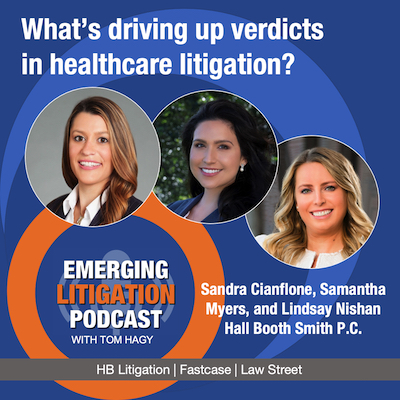
    Social Inflation’s Impact on Jury Verdicts in Healthcare Litigation

    Our guests wrote in the Journal on Emerging Issues in Litigation: “These outsize awards are often driven by myriad factors including sympathetic jurors, societal conceptions about income and wealth of corporations, the use of emotion-driven ‘Reptile Theory’ tactics by plaintiff attorneys, the media spotlight on ‘bad apple’ physicians, and numerous other social factors. A new factor that influences elevated jury verdicts is the increasing volume of information—whether true or false—that is exchanged on social media platforms.”

    Podcast on jury verdictsListen to my interview with Hall Booth Smith P.C. attorneys Sandra Cianflone, Samantha Myers, and Lindsay Nishan, each of whom represents members of the healthcare industry, as they discuss what drives large verdict and what attorneys should consider in mitigating the effects of this phenomenon.

    In keeping with tradition, we may have strayed a bit from the topic. One guest’s Aunt Lulu made an appearance. It turns out Covid lockdowns may have produced more enthusiastic jurors. And I added another reason why writing and podcasting, and not the practice of law, was a better career path for me. (Apparently lawyers aren’t supposed to laugh in people’s faces. Noted.)

    This podcast is the audio companion to the Journal on Emerging Issues in Litigation, a collaborative project between HB Litigation Conferences and the Fastcase legal research family, which includes Full Court Press, Law Street Media, and Docket Alarm. The podcast itself is a joint effort between HB and our friends at Law Street Media. If you have comments or wish to participate in one our projects, or want to tell me how much  you learned from Sandie, Sam, Lindsay, or Aunt Lulu,  please drop me a note at Editor@LitigationConferences.com.

    Tom Hagy
    Litigation Enthusiast
    Host of the Emerging Litigation Podcast

    Jurors’ perceptions of big corporations, insurance companies, drug companies, physicians and other healthcare providers is increasingly colored by TV and social media. 


    The same is true for people’s understanding of the practice law or medicine, which may be as wrong as it is immovable. “Social inflation” refers to rising litigation costs and the resulting higher insurance payouts which drive up the cost of insurance. The phrase has taken on new meanings as it is used in the general press. To some it means tort reform rollbacks, litigation funding, and is most often seen in references to so-called “nuclear” jury verdicts, i.e., awards that exceed $10 million.

    What factors contribute to these jury awards?

  • The Shifting Gun Liability Landscape: Plaintiffs Say Companies are Marketing Illegally, Insurers End Up Paying

    The Shifting Gun Liability Landscape: Plaintiffs Say Companies are Marketing Illegally, Insurers End Up Paying

    The Author

    Charlie Kingdollar

    Charlie KingdollarInsurance Industry Expert

    Charlie spent more than four decades with General Reinsurance, three-quarters of which as the company’s Emerging Issues Officer. One colleague described him as “one of the most prescient and gifted industry futurists I have met in my 36 year professional career within the insurance industry. Entertaining and insightful, his ability to digest and communicate complex issues, many before they are readily apparent, is both a gift and a talent.” Charlie is also a member of the Editorial Board of Advisors for the Journal on Emerging Issues in Litigation.

    The Shifting Gun Liability Landscape: Plaintiffs Say Companies are Marketing Illegally, Insurers End Up Paying

    By Charlie Kingdollar

    On Feb. 15, 2022, Remington Arms, manufacturer of the Bushmaster AR15-style rifle agreed to pay $73 million to settle a lawsuit filed by the families of nine of the victims of the Dec. 14, 2012, Sandy Hook Elementary School shooting. The $73 million will be paid by four of Remington’s insurers (and likely their reinsurers).[i]

    Why is this a big deal? Insurers and reinsurers providing liability coverage for gun manufacturers did so believing that federal law protected gun manufacturers from liability arising from shootings under the federal Protection of Lawful Commerce in Arms Act (PLCAA). It seems likely that policy terms and conditions as well as pricing of the risk reflected that perceived liability protection.

    Things have changed. The Connecticut plaintiffs filed their suit under the Connecticut Fair Trade Practices Act. The plaintiffs alleged that the Bushmaster was a combat weapon and that Remington improperly marketed it to civilians – particularly trying to reach young men. In 2019, the Connecticut Supreme Court ruled that the federal PLCAA did have some carve-outs for state laws and subsequently declined Remington’s request to dismiss the lawsuit. It seems a safe bet that the families of other Connecticut gun violence victims will file similar suits over past and/or future incidents.

    Okay, so this is Connecticut. But it seems likely that this lawsuit will be used as a template by plaintiffs in other states that have similar statutes – and many do. This lawsuit and settlement could result in burgeoning litigation against gun manufacturers.

    Presumably, even a single victim shot with a Bushmaster, or any gun that could be argued is a combat weapon, could file a similar suit under a state’s Fair Trade Practices Act.

    Which other guns could be deemed “combat weapons” and therefore unfit for civilian populations? Only time and future litigation will tell. One possible example is the WEE1 Tactical, the manufacturer of the AR-15, which is similar to the Bushmaster, may find itself facing litigation. A look at AR-15-style guns on Wikipedia results in a list of 27 guns by 26 manufacturers – and I doubt this is a comprehensive list.[ii] Would a machine pistol be considered a “combat weapon”? How many other types of firearms might be deemed “combat weapons”?

    WEE1 Tactical has recently begun advertising the JR-15 – a smaller, lighter version of the AR-15 that fires smaller .22 caliber rounds for use by children. WEE1’s website states: “The JR-15 is the first in a line of shooting platforms that will safely help adults introduce children to the shooting sports.”[iii] Given that the plaintiffs in the Sandy hook case stressed the firm was specifically marketing the Bushmaster to young men it will be interesting to see how this marketing strategy will play out in any future similar litigation.

    There’s been another crack in the perceived liability protection afforded to gun manufacturers in the U.S.  Last year the State of New York enacted a law that “would classify the illegal or improper marketing or sale of guns as a nuisance…that supporters said would bolster litigation against gun companies.”[iv]

    Will other states follow? If even a few enact similar statutes, the defense and indemnity costs could be significant to the gun manufacturers and their insurers and reinsurers.

    Bushmaster has settled once before with the families of victims shot by one of its guns. In 2004, the company agreed to pay $2.5 million to settle with the families of victims shot by the D.C. sniper.[v] Not much changed after that settlement. It may be different this time.

    What about other entities in the gun liability chain? If the gun manufacturer can be held libel for marketing a combat weapon to civilians, can wholesalers and retailers also be found liable?  Could courts find that these companies also played a role in putting “combat weapons” into the hands of civilians?  If so, the costs to the Property/Casualty insurance industry will be greater.

    Unfortunately, mass shootings and gun violence are on the rise in the United States. The number of mass shootings (defined as 4 or more people shot – killed or wounded) have increased every year except one from 2014 to 2021. In 2014 there were 269 mass shootings in the U.S.  By 2021, this increased to 691 mass shootings. There have been 2,402 mass shootings in the U.S. in the past five years. And we’ve only mentioned mass shootings incidents.[vi]

    Gun violence generally continues to rise. “Guns were involved in 75% of all homicides and 91% of homicides involving youths between 2018 and 2019 … those new numbers represent a significant and troubling uptick from a decade before.”[vii]

    I suspect insurers and reinsurers providing liability for companies that manufacture and sell guns find themselves as defendants in an increasing number of lawsuits.

    [i] https://www.washingtonpost.com/nation/2022/02/15/remington-sandy-hook-settlement/

    [ii] https://en.wikipedia.org/wiki/AR-15_style_rifle

    [iii] https://en.wikipedia.org/wiki/AR-15_style_rifle

    [iv] https://www.nytimes.com/2022/02/15/nyregion/sandy-hook-families-settlement.html?referringSource=articleShare

    [v] https://www.washingtonpost.com/nation/2022/02/15/remington-sandy-hook-settlement/

    [vi]   https://www.gunviolencearchive.org/

    [vii]   “Gun Deaths Continue to Rise In American Cities,” U.S. News, 1/10/22

  • Robojudges: If Machines Could Make Judicial Decisions, Should They?

    Robojudges: If Machines Could Make Judicial Decisions, Should They?

    The Author

    Joshua P. Davis

    Joshua P. DavisProfessor & Practicing Attorney

    A leading academic and practitioner, Joshua P. Davis (davisj@usfca.edu) is a nationally recognized expert on legal ethics and class actions, as well as on artificial intelligence in the law, antitrust, civil procedure, free speech, and jurisprudence. He has published more than 30 scholarly articles and book chapters on these subjects and is currently writing a book on AI titled Unnatural Law, which will be published by Cambridge University Press. He is Research Professor of Law at the University of California Hastings College of Law, and a Shareholder of the Berger Montague PC law firm and Manager of its new San Francisco Bay Area Office. Before taking these posts, for more than 20 years Davis was a tenured Professor of Law at University of San Francisco Law School, where he also served as the Director of the Center for Law and Ethics.

    Davis is also a member of the Editorial Board of Advisors for the Journal on Emerging Issues in Litigation, published by Fastcase Full Court Press. Tom Hagy, Editor in Chief.

    You can also listen to Josh on the Emerging Litigation Podcast!

    Robojudges: If Machines Could Make Judicial Decisions, Should They?

    By Joshua P. Davis

    Abstract: As artificial intelligence makes its way into every aspect of our daily lives—including the practice of law—humans have some decisions to make. Do we wish for AI to replace human judges? What are the risks and how might they be mitigated? What breakthroughs need to occur? How might robotic judges, or “robojudges,” perform better than human jurists? What surprises might be in store? Read on for the author’s perspectives on these important questions. After all, as he points out, AI is already being used by the judiciary, albeit to a limited extent. 

    Some of the most exciting, vexing, and terrifying issues at the intersection of artificial intelligence (AI) and law involve robojudges. Can we build a robojudiciary that replaces human judiciaries? Should we? These are no small questions given such a shift would massively disrupt how our legal systems operate and transform democratic self-government. 

    Part of the challenge in thinking about robojudges is technical. There are all sorts of practical technological advances that would be necessary to build an effective robojudge. We are not there yet and we likely won’t be for a while. Some of the steps would likely require increasing the power of computers, designing programs for natural language, and possibly mastering quantum computing. 

    More general and accessible, however, are a series of conceptual issues. We might frame them as questions. 

    1. What breakthroughs are necessary for AI to think the way we do? 
    2. Will AI be able to simulate human instrumental reasoning; that is, reasoning about how best to achieve prescribed objectives? 
    3. Will AI be able to simulate human purposive reasoning; that is, reasoning about which objectives to pursue? 
    4. What role does consciousness play in answering these questions? 
    5. Could we program AI to have conscious experiences similar enough to ours for it to make reliable instrumental and purposive judgments? 
    6. Do human judges engage in instrumental or purposive reasoning?

    Answering these questions can serve a few major purposes.

    First, it can help us deal with the present and immediate future. Reliance on AI in judging may soon be commonplace. To some extent, it already occurs. AI has become a judicial tool in setting bail and deciding which children should be removed from their families to protect their well-being.

    Second, the answers can help us prepare for far greater disruptions in the future. We should think carefully now about the outer limits of AI, lest we are caught off guard and allow changes that we regret and cannot undo. In times of great and rapid change, foresight is necessary to steer societies toward improvements and away from pitfalls.

    Third, AI offers a grand experiment that may tell us a great deal about ourselves. It may shed light on how our brains and minds work, how the two relate, how the law works, and what role consciousness plays in it all. With these purposes in mind, below is an analysis that offers some preliminary and admittedly speculative answers to the above questions. 

    See what else the author has to say about robojudges and get the complete article. 

    Get the article now!

  • Persuasion Science for Trial Lawyers with John Blumberg

    Persuasion Science for Trial Lawyers with John Blumberg

    Persuasion Science for Trial Lawyers with John Blumberg

    John joins me to discuss his study of the science behind persuasion. He examines a number of important concepts for trial attorneys, such as how emotions overcome rational thought, and how mental fatigue interferes with how we receive information, leading us to take mental shortcuts rather than doing the hard work of critical thinking. He also writes about understanding the differences between liberal and conservative brains.

    In addition to being an author, John is a board-certified trial attorney based in Long Beach, California. He handles both legal and medical malpractice litigation and is on American Board of Trial Advocates.

    You will especially want to hear my contributions, such as what I know about the rule of threes. For example, a joke about a doctor, a lawyer, and a duck is much funnier than one about just a doctor and a lawyer. Unless, of course, at least one of them is a duck.

    This podcast is the audio companion to the Journal on Emerging Issues in Litigation, a collaborative project between HB Litigation Conferences and the Fastcase legal research family, which includes Full Court Press, Law Street Media, and Docket Alarm. The podcast itself is a joint effort between HB and Law Street Media. If you have comments or wish to participate in one our projects, or want to tell me how much  you learned from John,  please drop me a note at Editor@LitigationConferences.com.

    Tom Hagy
    Litigation Enthusiast and Host of the Emerging Litigation Podcast

    “Your proposition may be good, but let’s have one thing understood: Whatever it is, I’m against it. And even when you’ve changed it or condensed it—I’m against it!”

    —Professor Wagstaff (Groucho Marx) in the 1932 movie Horse Feathers


    Attorney John P. Blumberg’s new book, Persuasion Science for Trial Lawyers, published by Fastcase Full Court Press, “takes a fascinating new approach to examining why certain advocacy techniques do and don’t work to persuade trial juries,” writes Susan G. Poehls. Director of Trial Advocacy Programs and William C. Hobbs Professor of Trial Advocacy at Loyola Law School, Poehls calls it an eye-opening read, one that will run “counter to what many of us have been taught for decades.”

  • The Humble Beginnings and Wild Evolution of the TCPA with Joe Apatov

    The Humble Beginnings and Wild Evolution of the TCPA with Joe Apatov

    The Humble Beginnings and Wild Evolution of the TCPA with Joe Apatov

    Only $32 million!  I mean, why bother even getting out of bed? Joining me to discuss the evolution of the TCPA is Joseph A. Apatov (japatov@mcglinchey.com), a member of the McGlinchey Stafford law firm’s Consumer Financial Services Litigation practice group. Based in their Fort Lauderdale office, Joe litigates on behalf of financial services clients in both state and federal courts, with an emphasis on defending banks, mortgage lenders and servicers, private-label card issuers, and automobile finance companies. 

    Apologies for my trip down memory lane. Bear with me as I regale you with stories from the newsroom at Mealey’s Litigation Reports and the team’s anxious reliance on the “latest” technology: the facsimile machine.

    This podcast is the audio companion to the Journal on Emerging Issues in Litigation, a collaborative project between HB Litigation Conferences and the Fastcase legal research family, which includes Full Court Press, Law Street Media, and Docket Alarm. The podcast itself is a joint effort between HB and Law Street Media. If you have comments or wish to participate in one our projects, or want to tell me how much Joe enlightened you, please drop me a note at Editor@LitigationConferences.com.
     
    Tom Hagy
    Litigation Enthusiast and Host of the Emerging Litigation Podcast

    “The Telephone Consumer Protection Act had humble beginnings,” our guest writes, “with the bill’s sponsor explaining that the statute would permit consumers to bring small claims cases ‘without an attorney,’ and provides for an ‘amount of damages … fair to both the consumer and the telemarketer.’ Twenty-eight years after its enactment in 1991, the Eighth Circuit Court of Appeals affirmed a District Court’s decision to reduce a $1.6 billion jury award in a TCPA class action to only $32 million because the former was ‘shockingly large’ and ‘oppressive,’ in violation of the Due Process Clause …..”

  • Where’s Your Head? Managing the Mind in Mediation with Jeff Trueman

    Where’s Your Head? Managing the Mind in Mediation with Jeff Trueman

    Where’s Your Head? Managing the Mind in Mediation with Jeff Trueman

    Joining me to discuss this is  Jeff Trueman, an experienced, full-time mediator and arbitrator. Jeff helps parties resolve a wide variety of litigated and pre-suit disputes and interpersonal problems concerning catastrophic injuries, professional malpractice, wrongful death, employment, family business dissolution, real property, estate, and domestic relations. He is a panel mediator for the American Arbitration Association; a  panel arbitrator for the Financial Industry Regulatory Authority; a Distinguished Fellow of the International Academy of Mediators; a recipient of the Paul A. Dorf Alternative Dispute Resolution Memorial Award by the Bar Association of Baltimore City; and will soon hold an LLM from the Straus Institute for Dispute Resolution at the prestigious Pepperdine School of Law. 

    Finally, did I really suggest that having a mediator with a bad hip could help achieve a faster resolution? Did I really give a review of the HBO original movie Oslo, which I consider a must-see for anyone interested in conflict resolution? Did I really compare married couples during Covid-19 lockdowns to angry bees in a jar? Listen and find out. Spoiler alert: Yes. Yes I did. 

    This podcast is the audio companion to the Journal on Emerging Issues in Litigation, a collaborative project between HB Litigation Conferences and the Fastcase legal research family, which includes Full Court Press, Law Street Media, and Docket Alarm. The podcast itself is a joint effort between HB and Law Street Media. If you have comments or wish to participate in one our projects, or want to tell me how Jeff really got you thinking, please drop me a note at Editor@LitigationConferences.com.

    Tom Hagy
    Litigation Enthusiast and Host of the Emerging Litigation Podcast

    “Attorneys possess many of the same characteristics as their human cousins.” Someone said that. Probably me. They often bring to their jobs cognitive barriers that get in the way of negotiating resolutions to conflicts. Same for their human clients.

    Things like refusal to cede the moral high-ground, or stubbornly believing  there must always be someone to blame. Then there is overconfidence (i.e.,  “I am right and will win in court!”) or they might enjoy selective memory, confirmation bias, and loss aversion.  Attorneys are often in the position of mediator and problem solver. What can attorneys do to more effectively achieve satisfactory outcomes when the parties bring in their own set of human characteristics and emotions? 

  • 7th Circuit: Is Each Transmission of Biometric Data a BIPA Violation? | By Jennifer M. Oliver | MoginRubin LLP

    7th Circuit: Is Each Transmission of Biometric Data a BIPA Violation? | By Jennifer M. Oliver | MoginRubin LLP

    7th Circuit: Is Each Transmission of Biometric Data a BIPA Violation?

    By Jennifer M. Oliver

    The outcome of this case will have a dramatic impact on statutory damages.

    The Seventh Circuit U.S. Court of Appeals has certified a question to the Illinois Supreme Court over the accrual of claims under the Illinois Biometric Information Privacy Act (BIPA). The question, posed by the court in Cothron v. White Castle Systems, Inc., reads:

    “Do section 15(b) and 15(d) claims accrue each time a private entity scans a person’s biometric identifier and each time a private entity transmits such a scan to a third party, respectively, or only upon the first scan and first transmission?”

    The case was brought by an employee of the White Castle hamburger chain, which requires fingerprint scans for employees to access computer systems. The plaintiff charged that sharing her fingerprints with a third party vendor violated the law. Cothron v. White Castle Sys., No. 20-3202, 2021 U.S. App. LEXIS 37593 (7th Cir. Dec. 20, 2021).

    An accrual rule based on each collection, opponents to such a finding argue, would pose potentially existential damages — especially in the class action context — since BIPA provides for statutory damages of $1,000 or $5,000 per violation. Parties disagree on whether BIPA damages are mandatory or discretionary, however. Should the court determine that the first scan is the only scan that starts the statute of limitations clock ticking, opponents to that interpretation say,  anyone bringing a claim after five years would be out of luck, even if their private biometric data continued to be transmitted more than five years after the first occurrence.

    Preceding the federal court’s certification of this question by just five days, an Illinois appellate court ruled that, yes, claims under sections 15(a) and (b) accrue with each capture and use of a plaintiff’s biometric  information. Watson v. Legacy Healthcare Financial Services, LLC, et al., 2021 IL App (1st) 210279 No. 1-21-0279, Opinion filed Dec. 15, 2021.

    This is an important case to watch. Illinois was the first to implement such legislation, something several states have since emulated.

    Should the state Supreme Court come down in favor of an “all scans” interpretation, defendants may find themselves on the receiving end of devastating damages multipliers. Of course, the Illinois Supreme Court could determine that damage awards are at the discretion of a court, and are not mandatory under the law. Or it could rule that every scan or transmission restarts the statute of limitations clock, but that a claimant may only collect damages once for a series of transmissions of the same data, similar to how damages for defamation are not based on each publication of the same defaming remarks. Yet another possibility is that the court could determine that the clock starts to run when a claimant first learns of an alleged violation, which has precedent in litigation involving latent diseases caused by products, where individuals cannot know they were harmed until they developed a signature disease, i.e., one connected to a specific product.

    The ruling in this case is especially interesting as the COVID-19 pandemic has led to skyrocketing adoption of remote access tools that can collect biometric data for learning, court appearances, and work-from-home arrangements, and a corresponding uptick in BIPA lawsuits.

    Edited by Tom Hagy for MoginRubin LLP. Reposted with permission from the MoginRubin Blog. © 2022 MoginRubin LLP. 

    The Author

    Jennifer M. Oliver

    Jennifer M. OliverMoginRubin LLP

    Jennifer is a partner in the San Diego offices of MoginRubin LLP, where she focuses on antitrust, complex business, and investment litigation. Her experience includes active roles in several high-profile jury trials, serving as lead counsel in complex mediations, and arguing before courts at both the trial and appellate levels. Jennifer earned her B.S. (Business Administration), M.B.A., and J.D. degrees from the University at Buffalo, each with honors, where she also served as the Vice President of the undergraduate student body and was an editor of the Buffalo Law Review and Buffalo Intellectual Property Law Journal. Jennifer is also a certified information privacy professional.

    We are pleased to add that Jennifer is a member of the Board of Advisors for the Journal on Emerging Issues in Litigation and the Emerging Litigation Podcast.

    More from Jennifer and her colleagues.

  • The New Lloyd’s Market Association War, Cyber War and Cyber Operation Exclusions for Cyber Insurance Policies | By Vincent J. Vitkowsky | Gfeller Laurie LLP

    The New Lloyd’s Market Association War, Cyber War and Cyber Operation Exclusions for Cyber Insurance Policies | By Vincent J. Vitkowsky | Gfeller Laurie LLP

    The Author

    Vincent J. Vitkowsky

    Vincent J. VitkowskyPartner | Gfeller Laurie LLP

    Vince Vitkowsky is a partner in Gfeller Laurie LLP, resident in New York. He focuses on cyber risks, liabilities, insurance, and litigation. Vince assists insurers and reinsurers in product development, and in all aspects of coverage evaluation and dispute resolution in many lines of business, including cyber, CGL, property, and professional liability. He also assists in complex claim evaluations, and if necessary, the defense of insureds in complex matters.

    Vince is also a member of the Editorial Advisory Board for the Journal on Emerging Issues in Litigation.

    Contact: vvitkowsky@gllawgroup.com

    More from Vince and his colleagues.

    Melicent Thompson

    The New LMA War, Cyber War and Cyber Operation Exclusions for Cyber Insurance Policies

    By Vincent J. Vitkowsky

    On November 25, 2021, the Lloyd’s Market Association released four War, Cyber War and Cyber Operation Exclusions (“Exclusions”). The LMA Cyber Business Panel spent well over two years drafting the Exclusions, which are models for use in standalone cyber insurance policies.  Lloyd’s has agreed that they meet the requirement that all insurance and reinsurance policies written at Lloyd’s must, except in very limited circumstances, contain a clause which excludes all losses caused by war.  The Exclusions address some difficult issues troubling the cyber insurance market for several years, following cyberattacks by nation-states (“states”) and threat actors associated with them.  They attempt to reduce uncertainty for both insurers and policyholders.

    Five interrelated issues.

    • The treatment of collateral damage (borrowing a concept from the traditional Law of Armed Conflict). Some state-sponsored attacks had significant effects on many entities that were not the intended targets.
    • How attribution is to be determined, and whether the insurers have an obligation to make payments while attribution is being determined.
    • The extent to which attacks by non-state actors associated with a state are excluded.
    • The treatment of state and state-sponsored cyberattacks directed at essential services, most notably those disrupting financial institutions and the financial markets infrastructure.
    • As in war exclusions in all lines of business, attempting to limit the aggregation risk.

    The Exclusions.

    The principal innovations in the Exclusions are to introduce the concept of “cyber operation” to insurance, to set processes for determining attribution, to partially clarify the scope of essential service, and to set a structure that de facto mitigates the aggregation risk.

    The key concepts and terms are as follows.

    War.  All four Exclusions contain an identical definition of War, largely based on traditional insurance policy language dating back to the Spanish Civil War.  It is “the use of physical force by a state against another state, or as part of a civil war, rebellion, revolution, insurrection, and/or military or usurped power or confiscation or nationalisation or requisition or destruction or damage to property by or under the order of any government or public or local authority, whether war be declared or not.”  (Emphasis is added, throughout this note.)  In the context of cyber war, this would include a cyberattack with kinetic effects.

    Cyber operation.  All four Exclusions also have an identical and innovative definition of cyber operation.  It is “the use of a computer system by or on behalf of a state to disrupt, deny, degrade, manipulate or destroy information in a computer system of or in another state.”

    Attribution.  All four Exclusions also contain an identical and innovative provision on “Attribution of a cyber operation to a state.”  It provides that the “primary but not exclusive factor” in attribution “shall be whether the government of the state (including its intelligence and security services) in which the computer system affected by the cyber operation is physically located attributes the cyber operation to another state or those acting on its behalf.”  Pending attribution by a state, “the insurer may rely upon an inference which is objectively reasonable as to attribution,” and no loss shall be paid.  If the affected state “takes an unreasonable length of time to, or does not, or declares it is unable to attribute the cyber operation to another state or those acting on its behalf,” the insurer, bearing the burden of proof, must “prove attribution by reference to such other evidence as is available.”

    Specified States.  This term appears in some of the Exclusions.  The specified states are China, France, Germany, Japan, Russia, UK or USA.

    The four exclusions treat cyber operations differently.

    The first Exclusion simply provides a blanket denial of coverage for loss “directly or indirectly occasioned by, happening through or in consequence of war or a cyber operation.”

    The other three Exclusions deny coverage for loss “directly or indirectly occasioned by, happening through or in consequence of war or a cyber operation that is carried out in the course of war.”

    The second Exclusion has additional provisions denying coverage for “retaliatory cyber operations between any specified states; and/or a cyber operation that has a major detrimental impact on the functioning of a state due to the direct or indirect effect of the cyber operation on the availability, integrity, or delivery of an essential service in that state; and/or the security or defense of a state.”  Although these are excluded, the policy may grant coverage for “any other cyber operations,” with a separately negotiated limit and aggregate.

    Significantly, essential service is defined as “a service that is essential for the maintenance or vital functions of a state including without limitation: financial institutions and associated financial market infrastructure, health services or utility services.”

    The third Exclusion is identical to the second, except it does not grant coverage for “any other cyber operations,” i.e., those not carried out in the course of war, retaliatory cyber operations between specified states, or those having a major detrimental impact.

    The fourth Exclusion is identical to the third, except it introduces the concept of “impacted state,” defined as “any state where a cyber operation has had a major detrimental impact on the functioning of that state [as defined in the third Exclusion], and/or security or defense of that state.”  Moreover, it limits the Exclusion for retaliatory cyber operations to those “leading to two or more specified states becoming impacted states.”  It also provides an exception to the Exclusion for loss from a cyber operation that has a major detrimental impact, so the Exclusion “shall not apply to the direct or indirect effect of a cyber operation on a bystanding cyber asset.”  That term is defined as “a computer system used by an insured or its third party service providers that is not physically located in an impacted state but is affected by a cyber operation.”

    The complete Exclusions can be found here.

    A serious attempt to reduce uncertainty.

    These Exclusions are not perfect.  Nothing is.  There is scope for dispute about the terms “an inference which is objectively reasonable,” “reference to such other evidence as is available,” “major detrimental impact,” and “essential service,” among others, as applied to specific facts.  But the Exclusions reflect a well-reasoned, serious attempt to reduce some of the uncertainties over the scope of coverage for state and state-sponsored attacks.

    Written Dec. 9, 2021 and posted with permission with minor formatting changes. Copyright 2021 by Vincent J. Vitkowsky.  All rights reserved.