Category: Complex Business Litigation

  • Cannabis, CBD: Advertising and Drug Test Problems

    Cannabis, CBD: Advertising and Drug Test Problems

    COVID-19 vs Cannabis: Are Closures Legal?

    In the category of “damned if you do; damned if you don’t,” Massachusetts Governor Charlie Baker shut down recreational cannabis shops, citing concerns over the spread of COVID-19. The dispensaries say the shutdown could seriously damage the industry. But, the governor said, the spread of disease will continue to damage the health of his constituents, especially as residents of states where recreational marijuana is illegal, come to Massachusetts to do their cannabis shopping. Citizens of the state may still obtain medical cannabis, as reported by WBUR.

    Too Much TCH: Can CBD Use Cost You Your Job?

    A New York truck driver has sued a CBD company for allegedly making a product, which he says he uses for pain relief, with too much THC, more than the label indicates. A Pennsylvania woman filed a similar case and a Missouri school bus monitor had a similar experience. Another Missourian blames the store where he purchased his CBD, saying he was assured the product contained minimal THC. All claim they were told they could pass drug tests. All failed their test. And all lost their jobs, according to a post on the Huffs & Puffs website.

    “Courtesy of a dearth of strict standards of testing, many companies tend to list lower values of THC on the product label,” writes Huffs & Puffs. “The quantities of THC will never be ‘as high to make you high’ but they may be enough for you to fail a drug test, conducted via not the most of the sophisticated equipment out there.”

    “For entrepreneurs in the cannabis niche, this is a topic of huge concern as the number of such lawsuits are only going to increase as people keep failing drug tests after consuming CBD.

    Not Enough THC: No Golden Ticket

    Californians have proposed a class action against the owners of a CBD-infused-chocolate factory for selling candy with far less CBD and THC than advertised. For consumers these ingredients justified the premium prices they were paying. And yet, as shareholders, executive officers and managers allegedly knew, the levels were below what the labels had them believe, says Law360.

    No Proof of Health Claims

    The FTC has sued Whole Leaf Organics over the company’s claims that their CBD products effectively treat cancer and prevent or reduce COVID-19 risk. The Bureau of Consumer Protection says that there is “no proof that any product will prevent or treat COVID-19 or that any CBD product will treat cancer.” We can only hope.

    The California marketer and founder of Whole Leaf, Marc Ching, agreed to a preliminary order that prohibits him from making those claims. Pending the resolution of a parallel FTC administrative action, the proposed order also bars the defendant from representing that three CBD-based products he sells are effective cancer treatments.
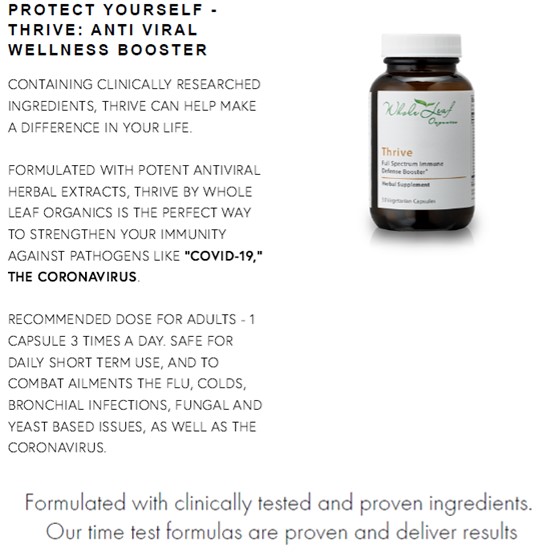
    According to the FTC: Since December 2018, defendant Marc Ching, also doing business as Whole Leaf Organics, has sold Thrive – a tablet consisting primarily of Vitamin C and herbal extracts. But beginning in March 2020, Thrive underwent something of a marketing make-over. The defendant began pitching the product as a way for consumers to ward off coronavirus. His website claimed, “Formulated with potent antiviral herbal extracts, Thrive by Whole Leaf Organics is the perfect way to strengthen your immunity against pathogens like ‘COVID-19,’ the coronavirus.” The defendant also represented that the product is indicated to “combat” a list of ailments, “as well as the coronavirus.” In addition, the defendant claimed Thrive is “formulated with clinically tested and proven ingredients” and that “our time test formulas are proven and deliver results.”

    Photo by Matthew Brodeur on Unsplash
  • Monsanto, Bayer Paying Billions for PCB Cleanups

    Monsanto, Bayer Paying Billions for PCB Cleanups

    Roundup Weed Killer


    Read Baltimore Sun environmental writer Scott Dance’s June 24, 2020, article titled, “A $550M national class-action settlement includes money for cleanup of PCBs in Baltimore waterways.” He offers the Maryland angle on the $550 million class action settlement between Monsanto and 13 government agencies across the U.S., just part of a much larger agreement.

    “The settlement was one of several that Monsanto’s owner, German pharmaceutical company Bayer, announced Wednesday. Bayer said it’s paying up to $10.9 billion to settle current and potential future litigation over Monsanto’s weedkiller Roundup, which has faced numerous lawsuits over claims it causes cancer, and $1.22 billion to settle two further cases, including the class action focused on PCBs.”

    Dance writes that the terms of this settlement are off to Judge Fernando M. Olquin of the Central District of California for his review. Judge Olquin was one of the presenters on multiple panels at the Class Action Law Forum presented by Western Alliance Bank and produced by my team at HB. Kenneth R. Feinberg, also a presenter, is the court-appointed special master in the case.

    The Baltimore Sun piece was one of many that gave the local perspective on this nationwide litigation and settlement in progress, like this one from the San Francisco Chronicle, with a Seattle dateline, and this one from the Washington State Wire quoting the state’s AG, and this one from the Portland Tribune, with a take on the Oregon impact. And law firms, which stand to gain a great deal in attorney fees issued announcements of their part in the deal, like this one from Baron & Budd. It doesn’t appear the leading defense firm, Skadden Arps, issued a separate statement, but joined in the Bayer announcement. It quoted the firm’s John Beisner, “a consultant to Bayer’s Supervisory Board and a mass tort expert,” as saying, “Taking account of various options, I am convinced this plan provides a comprehensive, reasonable solution to the complex, contested issues presented by this litigation.”

    Bayer’s announcement from Leverkusen, Germany, basically said it was the right thing to do, but that it admits to no wrong-doing.

    “Bayer announced today a series of agreements that will substantially resolve major outstanding Monsanto litigation, including U.S. Roundup™ product liability litigation, dicamba drift litigation and PCB water litigation. The main feature is the U.S. Roundup™ resolution that will bring closure to approximately 75% of the current Roundup™ litigation involving approximately 125,000 filed and unfiled claims overall. The resolved claims include all plaintiff law firms leading the Roundup™ federal multi-district litigation (MDL) or the California bellwether cases, and those representing approximately 95% of the cases currently set for trial, and establish key values and parameters to guide the resolution of the remainder of the claims as negotiations advance. The resolution also puts in place a mechanism to resolve potential future claims efficiently. The company will make a payment of $8.8 billion to $9.6 billion to resolve the current Roundup™ litigation, including an allowance expected to cover unresolved claims, and $1.25 billion to support a separate class agreement to address potential future litigation. The Roundup™ class agreement will be subject to approval by Judge Vince Chhabria of the U.S. District Court for the Northern District of California. The resolutions were approved unanimously by Bayer’s Board of Management and Supervisory Board with input from its Special Litigation Committee. The agreements contain no admission of liability or wrongdoing.”

    The company said it can now get on with tackling global challenges, such as the COVID-19 pandemic, and generally “improv[ing] quality of life for a growing and aging population of an estimated 10 billion people by 2050.”

  • Contract Drafting Fundamentals

    Contract Drafting Fundamentals

    Contract Drafting Fundamentals with Will Marshall

    Register Now

    Contract Drafting Fundamentals:
    What I Wish They Taught Me in Law School

    Speaker:

    Will Marshall | Partner
    UBM Law LLP

    Date:
    Thursday | July 23, 2020

    Time:
    2pm ET
    1pm CT
    12pm MT
    11am PT

    Duration:
    75 minutes

    Price:
    Early Bird Registration: $75
    After July 14: $95

    Special:
    Complimentary with discount code!

    What you get:

    • CLE credit

    • Course materials

    • Webinar recording

    • Answers to your questions!

    Contact CLE Manager

    Get practical insights on contract drafting.

    For new and seasoned attorneys alike, this 75-minute program will cover core, practical aspects of contract drafting, including a broad range of fundamental concepts, skills, and tips.  The program is designed to make you a more deliberate drafter and improve your ability to assess the purpose and effectiveness of each provision in your contract.  We will discuss not only what is on the page, but external dynamics that affect drafting and negotiation. Finally, we will reserve time to answer your questions.

    I am offering this program for free to my network to help you develop these foundational skills. If you haven’t received it, please contact me directly for the complimentary pass code.  — Will Marshall,  Partner, UBM Law Group LLP

    Key topics: 

    • The goals and challenges of good drafting.

    • The anatomy and building blocks of a contract.

    • Categories of contract language.

    • Typical sources of ambiguity.

    • Tips on everything from file naming conventions to how to draft a nested signature block and what a tipping basket is.

    • Your questions via live chat or by email before or and after the event.

    Send Will a Question

    Meet our panelist.

    Will Marshall

    Will Marshall | Partner
    UBM Law Group, LLC

    UBM Law Group

    Will is a co-founder of UBM Law Group. He has substantial experience in drafting and negotiating a wide range of commercial contracts, including SaaS and traditional software licensing agreements, supply, distribution, and professional services agreements, and confidentiality agreements.

    Prior to co-founding UBM Law Group, Mr. Marshall served as General Counsel and SEVP of Operations of Javo Beverage Company, a publicly traded manufacturing company in Vista, California. As one of the founding executives of Javo, he was integral in leading the ground-up capitalization and commercialization of the company over the course of a decade and he uses his in-house and executive experience to help his clients negotiate clear, effective contracts.

    Read more about Will Marshall here …

  • The Intersection of Privacy and Antitrust Webinar Now Available On-Demand on the West LegalEdcenter

    Available as part of your subscription to
    The Thomson Reuters West LegalEdcenter®.

    Don’t subscribe to the West LegalEdcenter?
    This webinar is still available directly from HB. Take it now!

    Questions for speakers
    Questions@LitigationConferences.com

    CLE questions
    CLE@LitigationConferences.com

    Check out the MoginRubin blog for more insights on antitrust and privacy law.

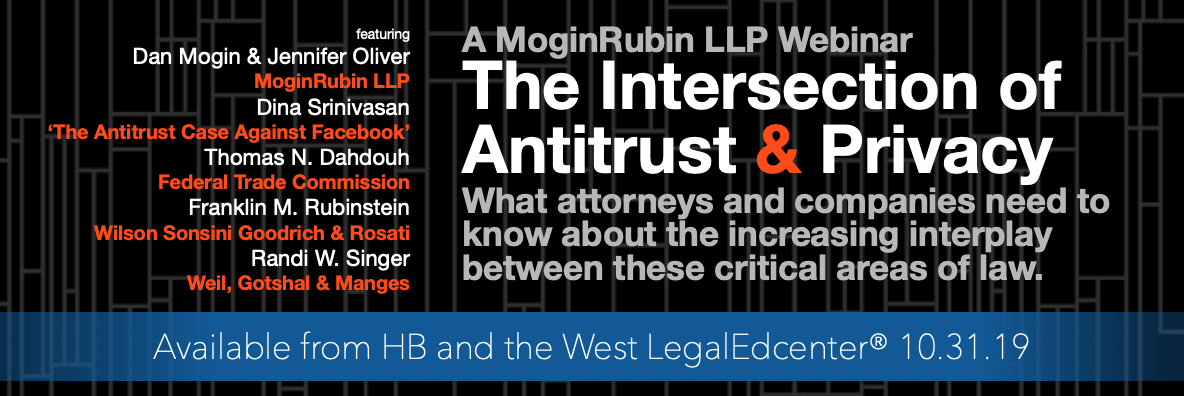
    What attorneys and companies need to know about the increasing interplay between these critical areas of the law. 

    Highly publicized cases and investigations in the U.S. and Europe of big technology, e-commerce, and social media companies demonstrate how anti-competition laws are being used to scrutinize and challenge not only how these corporations conduct themselves in the marketplace, but the very core of their colossal success: the mass collection and utilization of user data.

    Are the privacy and antitrust worlds beginning to cross over? Or do they simply run parallel while addressing entirely different types of conduct? Whatever the answer, data is the raw material that drives the likes of Google, Facebook, Apple and Amazon, so how it is handled is a critical question when counseling clients on mergers and acquisitions.

    Moderator
    Daniel J.  Mogin | Managing Partner, MoginRubin LLP

    Speakers
    Jennifer M. Oliver, CIPP/US | Partner, MoginRubin LLP
    Thomas N. Dahdouh | Director, Western Region, Federal Trade Commission
    Franklin M. Rubinstein | Partner, Wilson Sonsini Goodrich & Rosati
    Randi W. Singer, CIPP/US, CIPT | Partner, Weil, Gotshal & Manges

    Contributor
    Dina Srinivasan | 
    Independent Researcher & Author of The Antitrust Case Against Facebook
    Dina was unable to present but we thank her for her content contributions. 

    Agenda

    • Who should regulate privacy violations in the U.S.?
    • Which antitrust issues implicate privacy concerns?
    • What role does machine learning play on the competitive landscape?
    • What is big data really? How is it different from “data”?
    • What are the elements of effective merger reviews?
    • What are the appropriate remedies?
    • What are “notice-and-choice” versus “harms-based” approaches?
    • Plus answers to your questions. Send them to Questions@LitigationConferences.com.

  • The Intersection of Antitrust & Privacy | A MoginRubin Webinar | 10.31.2019

    The Intersection of Antitrust & Privacy Law


    [two-fifths-first] Recorded: Oct. 31, 2019
    Duration: 100 minutes
    Presented by:  MoginRubin LLP
    Produced by: HB Litigation Conferences

    The Panel

    Moderator
    Daniel J.  Mogin | Managing Partner, MoginRubin LLP

    Speakers
    Jennifer M. Oliver, CIPP/US | Partner, MoginRubin LLP
    Thomas N. Dahdouh | Director, Western Region, Federal Trade Commission
    Franklin M. Rubinstein | Partner, Wilson Sonsini Goodrich & Rosati
    Randi W. Singer, CIPP/US, CIPT | Partner, Weil, Gotshal & Manges

    Contributor
    Dina Srinivasan |
    Independent Researcher & Author of The Antitrust Case Against Facebook
    Dina was unable to present but we thank her for her content contributions. 

    What you will get:

    • At least 1 hour of CLE credit.
    • Answers to your questions via email.
    • The opportunity to share with others on your team.
    • The complete Powerpoint.
    • The Antitrust Case Against Facebook
    • Dina Srinivasan’s statement to the House Committee on the Judiciary, Subcommittee on Antitrust, Commercial, and Administrative Law
    • The Chicago Booth School Stigler Center Committee on Digital Platforms Final Report

    Write to us at CLE@LitigationConferences.com to:

    • Ask about CLE
    • Request the materials
    • Send a question for the speakers

    [/two-fifths-first][three-fifths]

    Market Behavior and Data-Driven Market Power

    Highly publicized cases and investigations in the U.S. and Europe of big technology, e-commerce, and social media companies demonstrate how anti-competition laws are being used to scrutinize and challenge not only how these corporations conduct themselves in the marketplace, but the very core of their colossal success: the mass collection and utilization of user data.

    Are the privacy and antitrust worlds beginning to cross over?

    Or do they simply run parallel while addressing entirely different types of conduct? Whatever the answer, data is the raw material that drives the likes of Google, Facebook, Apple and Amazon, so how it is handled is a critical question when counseling clients on mergers and acquisitions.


    Meanwhile, there is increasing pressure on antitrust enforcers to consider privacy issues when conducting merger reviews.

    Antitrust laws allow and require consideration of data collection, handling, and use if there is a risk to fair competition. But are the agencies equipped to analyze the effect of post-merger datasets? Should they examine the privacy ramifications of proposed deals?

    Viewpoints on the overlap between the regimes are wide-ranging and nuanced. In a June speech, DOJ Antitrust Division chief Makan Delrahim said that “by protecting competition we can have an impact on privacy and data protection.” During a 2018 interview, though, FTC commissioner Noah Phillips argued that “privacy law and antitrust law each addresses different harms and vindicates different rights.”

    What does all of this mean to the practitioner or in-house counsel?

    Take this 100-minute webinar now to gain insights from leading experts on these issues, with a balance of perspectives from both the plaintiff and defense bars, academia, and regulatory enforcement.

    Get answers to questions like these:

    • Who should regulate privacy violations in the U.S.?
    • Which antitrust issues implicate privacy concerns?
    • What role does machine learning play on the competitive landscape?
    • What is big data really? How is it different from “data”?
    • What are the elements of effective merger reviews?
    • What are the appropriate remedies?
    • What are “notice-and-choice” versus “harms-based” approaches?
    • And more!

    [/three-fifths]


    Moderator & Speaker

    Daniel J.  Mogin, Managing Partner, MoginRubin LLP. Dan concentrates on antitrust, unfair competition and complex and business litigation. He has been selected as lead or liaison counsel in numerous cases and has also frequently served on Steering and Executive committees charged with overall responsibility for direction of complex Multi-District Litigation and Judicial Council Coordination Proceedings. He has participated in some of the largest antitrust class actions in the United States. Dan is frequently invited to participate in these cases by other law firms and often consults with law firms engaged in antitrust cases. He has also provided expert testimony in cases and before the California State Senate Judiciary Committee. Dan received his B.A. in Economics from Indiana University and his J.D. from the University of San Diego.

    Speakers

    Jennifer M. Oliver, CIPP/US, Partner, MoginRubin LLP.  Jennifer joined MoginRubin LLP in 2017 after nearly ten years as a complex business litigator in New York City. She focuses on antitrust, as well as complex business and investment litigation.  Jennifer is a member of the California Lawyer’s Association’s Privacy subcommittee and of the International Association of Privacy Professionals (IAPP), and is an IAPP Certified Information Privacy Professional. Jennifer has played active roles in high-profile jury trials, served as lead counsel in complex mediations, and argued before both trial and appellate courts. In addition to her merger and cartel work, Jennifer has also advised on antitrust issues in mergers and acquisitions and litigated cases involving trade secrets, RICO conspiracies, securities fraud, unfair trade practices, breaches of contract and privacy cases. She earned her B.S. in Business Administration, M.B.A., and J.D. from the University at Buffalo, each with honors.

    Thomas N. Dahdouh, Director, Western Region, Federal Trade Commission.  Prior to his current position Tom served as Assistant Regional Director for the Western Region.  He worked for 14 years as a staff attorney in the San Francisco office of the FTC, handling consumer protection and antitrust matters.  Previously, he worked at the FTC’s Washington, D.C., headquarters for two commissioners.  He has also served on the Executive Committee of the California State Bar’s Antitrust, UCL and Privacy Section since 2009, most recently serving as its Chair from 2014-2015.  He received his J.D. from Harvard Law School and his B.A. from Yale University.

    Franklin M. Rubinstein, Partner, Wilson Sonsini Goodrich & Rosati. Franklin is an antitrust partner in the Washington, D.C., office. His practice encompasses a wide variety of antitrust matters, including mergers and acquisitions, investigations by the United States Department of Justice and the Federal Trade Commission, litigation, criminal investigations, and counseling on issues such as distribution, monopolization, tying, exclusive dealing, price-fixing, and antitrust compliance. Franklin has represented a diverse set of clients in the software, computer hardware, pharmaceutical, medical device, gaming, automobile, natural resource, Internet, and media industries. Education: J.D., University of Chicago Law School; B.A., Swarthmore College.

    Randi W. Singer, CIPP/US, CIPT, Partner, Weil, Gotshal & Manges. Randi has earned the Certified Information Privacy Professional (CIPP/US) and Certified Information Privacy Technologist (CIPT) credentials and regularly advises clients in connection with privacy, cybersecurity, and social media issues in a wide variety of matters, including hundreds of transactions ranging from high-profile deals such as Facebook’s acquisition of Whatsapp, Inc. to large public company mergers and small talent acquisitions. In 2015, The National Law Journal recognized Randi as one of its inaugural “Trailblazers” nationwide for her cutting-edge work in the cybersecurity and data privacy area. 

    Contributor

    Dina Srinivasan, Independent Researcher & Author of The Antitrust Case Against Facebook. Dina currently advises on the economics of digital advertising markets and continues to write about tech and antitrust. She is the author of “The Antitrust Case Against Facebook“, an academic paper published in the Berkeley Business Law Journal (February 2019)  that explains Facebook’s monopoly power under U.S. antitrust law. Her research and commentary on tech and antitrust have been covered or cited by U.S. Congress, The New York Times, Bloomberg, Business Insider, NBC News, the Today Show, and other publications and radio stations, domestically and globally. She was an executive with WPP, the world’s largest advertising holding company. She founded Effidia, an advertising technology company whose technology was acquired by a division of WPP. Dina also created one of the first applications to bridge text messaging across CDMA, TDMA, and GSM spectrum networks in the U.S.  She holds a J.D. from Yale Law School, where she studied law & economics and was an Olin Fellow with the Kauffman Program in Law, Economics and Entrepreneurship.


    Privacy Matters

    Take a look at the Apple privacy commercial. This comes up during the webinar. If it raises any questions for you, please let the speaker know. Write to us at Questions@LitigationConferences.com. What do you think?


    Check out the MoginRubin Blog for insights on anticompetition, privacy, mergers and more.

  • Canna Law Blog Reviews Hemp-CBD Regulations State-by-State, Week-by-Week

    “When it comes to hemp, few states have embraced it like Colorado,” writes Harris Bricken attorney Daniel Shortt. “If you buy a product containing hemp, in any state across the country, it likely came from Colorado.” The state has allocated more than 12,000 acres of outdoor space and 2.35 million square feet of indoor space to hemp cultivation, according to Marijuana Business Daily.

    Shortt and his colleagues are working their way through a state-by-state series on the Canna Law Blog™, titled Hemp-CBD Across State Lines. The Harris Bricken team has covered Alabama, Alaska, Arizona, Arkansas and California, and added Colorado to the list yesterday, July 21.

    The firm’s series covers state regulatory activity following the enactment of the federal Agriculture Improvement Act of 2018, aka “The Farm Bill,” which removed hemp and its derivatives from the definition of marijuana under the Controlled Substances Act. The bill gave the USDA regulatory authority over hemp cultivation at the federal level, but states may maintain primary regulatory authority over the crop cultivated within their borders by submitting a plan to the USDA, Shortt explains.

    Read the Canna Law Blog’s Colorado post and follow this series, updated weekly.

    Related Webinar This Week

    The Harris Bricken law firm has been on the forefront of the law regarding cannabis and related products for years. Three Harris Bricken attorneys, Daniel Shortt, Nathalie Bougenies, and Griffen Thorne — plus Anastasia Gilmartin, General Counsel at CBD product maker OLEO Inc. — will discuss how the legal landscape of hemp-derived CBD is affecting various stakeholders.

    They will:

    + Discuss both the 2014 and 2018 Farm Bills
    + Analyze the FDA’s position on products containing hemp and/or CBD (including food, beverages, cosmetics, dietary supplements, drugs, and smokeable products)
    + Provide an overview of state laws
    + Share insights on where this industry is headed
    + Answer your questions via live chat

    Learn more

  • PTSD in Multi-Plaintiff and Mass Tort Cases | Webinar OnDemand


    [one-fourth-first]

    Price: $47
    When: On-demand
    Where:
    Your computer or mobile device
    CLE:
    1 hour

    Speakers

    Mark I. Levy MD, DLFAPA
    Medical Director
    Forensic Psychiatric Associates Medical Corporation
    Associate Clinical Professor, Psychiatry
    University of California, San Francisco, School of Medicine
    415.388.8040
    mlevy@fpamed.com 

    Sarah A. Hall, PhD.
    Psychologist for Forensic & Neuropsychological Assessments
    Forensic Psychiatric Associates Medical Corporation
    shall@fpamed.com 

    [/one-fourth-first][three-fourths]

    What tort attorneys need to know about PTSD claims.

    Mass tort claims arise most frequently in man-made and natural disaster catastrophe litigation as well as personal injury, employment, product liability and toxic tort litigation. Frequently, these lawsuits include either primary or secondary allegations of emotional distress. PTSD is one of the most common emotional distress claims alleged within mass tort litigation, as well as allegations of depression and emotional stress (anxiety). 

    Join an experienced psychiatrist and psychologist who will cover the following topics relevant to the forensic psychiatric assessment of emotional damages within mass tort and complex litigation: 

    + Introduction: Defining PTSD. What it is and what it is not.

    + The methodological approach to assessing allegations of emotional distress in mass tort & complex litigation.

    + The importance and the methodology of psychological testing as part of the assessment of emotional distress claims in mass tort litigation.

    + Claimant population screening. Using psychological test instruments to differentiate claimants who require in-depth forensic psychiatric assessment from claimants who do not. 

    + Are all psych tests the same? Types of psychological test instruments we recommend and ones that we do not — and why.  

    + So-called “PTSD Tests.” Do they have a role in forensic psychological assessments?

    + Accuracy and reliability of conclusions derived from psychological test data.

    + Taking a “team approach” to emotional distress claim assessment in mass tort litigation. 

    [/three-fourths]

  • Wells Fargo Proposes to Settle Auto Insurance Case for $386M — Yahoo!

    In 2017 customers of Wells Fargo & Company (WFC) filed a class action lawsuit alleging the bank forced unwanted auto insurance without permission from the customers. Currently WFC plans to pay around $386 million to settle the 2017 class action lawsuit. The high payout is due to the sheer number of customers affected. About 270,000 WFC customers were “pushed into delinquency ” and “almost 25,000 wrongful vehicle repossessions.” In addition to the class action settlement, WFC will be reaching out to individual customers offering financial service recovery, and restructuring their leadership teams. WFC is still seeing a decrease in sales and their numbers. In six months WFC shares “lost 4.5% against 6.5% growth recorded by the industry.”

    Read the complete post on Yahoo! here.

  • CannaLawBlog — Legalizing Cannabis Cash

    On May 20, 2019 banking associations from all 50 states and 1 territory sent a letter to Senate Banking, Housing, and Urban Affairs Committee urging them to conduct hearings on the merits of providing cannabis-related business access to banking services.

    CannaLawBlog highlighted the primary concerns of the letter in a recent post:

    “Again, the primary concern expressed was that current law forces state-legal businesses to operate on a cash basis, which poses a safety risk, complicates enforcement efforts, and could damage local economies.”

    The banking associations wanted to emphasize their neutrality on the legality of cannabis, rather they wanted to show strength as a national community and validate, support, and respect those communities that have voted for legalized recreational marijuana.

    Read the complete post by
    HarrisBricken attorney Jihee Ahn on The CannaLawBlog.

  • The Wrong-Headedness of Hindsight Standards — Michelle Yeary | Drug & Device Law Blog

    Dechert LLP attorney Michelle Yeary cautions against applying perfect hindsight to drug liability.

    “We all know hindsight is 20/20.  And, it’s easy.  There are dozens of television and radio programs that thrive on Monday morning quarterbacking.  There’s no risk in saying the coach should have called for a pass when you already know the run didn’t work.  It’s also dangerous because it’s easy.  People are often too quick to point out that you should have taken path B after everyone learns path A is full of potholes.  Pointing it out is one thing, holding you liable for it is another.”

    Yeary takes a look at what happened in Holley v. Gilead Science, Inc., 2019 WL 2077845 (N.D. Cal. May 10, 2019). The case involves two of the main active ingredients in AIDS drugs: TDF and TAF. The plaintiff alleges that the defendant should be responsible for allegedly knowingly using TDF over TAF (allegedly a safer alternative). TDF was FDA approved first and TAF second.  Unfortunately, Yeary wrote, hindsight “can be used to demand perfection,” allowing  plaintiffs to “proceed on what is essentially a stop-selling theory,” that first-generation drugs should not be submitted to the FDA because, in hindsight, “later approved treatments were safer.” That’s what happened in Holley, she said.

    Read the complete post by Michelle Yeary on the Drug and Device Law Blog here. 

    Read the opinion here.