Author: Tom Hagy
-
Strategies for Maximizing Insurance Recovery for Climate Change–Related Loss and Damage
Strategies for Maximizing Insurance Recovery for Climate Change–Related Loss and Damage
Abstract
Losses from natural catastrophes are costing many tens of billions as year, from hurricanes and tornadoes to record-breaking rainfall and floods. Whether the insurance industry will or can provide coverage for all of the devastating effects of climate change (or, as some might put it, a new and calamitous phase in our earth’s existence) only time will tell. In the meantime, policyholders must cross their Ts if they expect coverage. In this article the author shares insights on the complex but essential task of documenting and valuing post-storm losses.
Author
Dennis J. Artese (dartese@andersonkill.com) is a shareholder in the New York office of Anderson Kill P.C. His practice concentrates on insurance recovery litigation, with an emphasis on securing insurance coverage for first-party property losses, construction accidents, and third-party liability claims.
About
The Journal on Emerging Issues in Litigation is a co-production of HB, Fastcase, and Law Street Media. You can also hear the complementary (and complimentary) Emerging Litigation Podcast wherever podcasts appear. For questions, contact Tom Hagy, Editor in Chief, at Editor@LitigationConferences.com.Loading Viewer…
-

Biotech Patent Wars: If at First You Don’t Succeed . . . University of California v. The Broad Institute
Biotech Patent Wars: If at First You Don’t Succeed . . . University of California v. The Broad Institute
Abstract
This case discussed in this article is about two methods of editing DNA: one that has infinitely more lucrative applications because it can edit human DNA (plus all animals and plants), another that works in cell-free environments. Whether inventions are separate or part of the same innovation is an important factor in patent interference disputes; if there are two patentably distinct inventions there cannot be interference. One party in this case lost its argument that there was only one invention at issue, but returned with a second interference claim, arguing that it was the first inventor to constructively reduce to practice the animal and plant DNA editor. In this article, the author examines the nuances and intricacies of the patent process in the world of biology, and how patent lawyers must possess a level of knowledge in disciplines related to the inventions they seek to protect. This is necessary, for example, in understanding whether an invention is a significant improvement over prior innovations. The author also shares the importance of confidentiality especially when potentially groundbreaking (and lucrative) inventions are in development.
Author
Adrienne B. Naumann (adriennebnaumann@uchicago.edu) practices intellectual property law at the Law Office of Adrienne B. Naumann in Skokie, Illinois. She has held leadership positions relating to patents, science, and technology law with the Chicago Bar Association and the Converging Technologies Association. She currently serves as Secretary on the Board of the University of Chicago Women’s Alliance. Ms. Naumann has also written numerous articles on intellectual 56 Journal of Emerging Issues in Litigation property law and her book United States Federal Intellectual Property Developments includes discussion of decisions under the Defend Trade Secrets Act as well as those by the Supreme Court and was published by Pincus Professional Education.
About
The Journal on Emerging Issues in Litigation is a co-production of HB, Fastcase, and Law Street Media. You can also hear the complementary (and complimentary) Emerging Litigation Podcast wherever podcasts appear. For questions, contact Tom Hagy, Editor in Chief, at Editor@LitigationConferences.com.Loading Viewer…
-
Mega Verdict Threat: Tackling Damages Early Can Mitigate Outsized Jury Awards
Mega Verdict Threat: Tackling Damages Early Can Mitigate Outsized Jury Awards

Abstract
Why have medical malpractice verdicts in recent years reached such astronomical new heights? In this article the author addresses several of the factors that drive juries to return such punishing awards, discussing the unexpected impact of tort reform, the role of life-care planners and economists in determining damages, the ramifications of litigation financing, plaintiff attorneys’ utilization of the so-called reptile theory, and the influence of how the media reports on these verdicts. The author offers practical methods for defense attorneys involved in this litigation and insights that will benefit attorneys in any type of tort matter.
Author
Sandra M. Cianflone (scianflone@hallboothsmith.com) is an attorney at law firm Hall Booth Smith, P.C., whose practice primarily focuses on medical malpractice.
About
The Journal on Emerging Issues in Litigation is a co-production of HB, Fastcase, and Law Street Media. You can also hear the complementary (and complimentary) Emerging Litigation Podcast wherever podcasts appear. For questions, contact Tom Hagy, Editor in Chief, at Editor@LitigationConferences.com.Loading Viewer…
-
Remediating, Insuring, and Litigating PFAS Claims
Remediating, Insuring, and Litigating PFAS Claims

Abstract
PFAS are a group of chemicals found in a variety of products (e.g., Teflon®) and have been used widely in industrial and environmental processes (e.g., oil recovery, firefighting). They do not break down, and over time can accumulate in the body and the environment. While largely no longer used in the United States, they continue to be used internationally. Studies have shown they have adverse health effects on humans and animals.
In this article the authors discuss the history and impact of PFAS, insurance coverage for claims relating to PFAS contamination, the practice of “insurance archaeology,” maximizing insurance coverage, and, finally, existing and anticipated litigation arising from environmental damage and bodily harm from PFAS.Authors
Dr. Jaana Pietari, PhD, MBA, PE (jpietari@ramboll.com), Senior Managing Consultant with Ramboll Group, has more than twenty years of professional and academic experience in the fate and transport of contaminants, the reconstruction of environmental releases to groundwater and sediments, and environmental forensics.
Jim Fenstermacher, PE (jim.fenstermacher@ramboll.com), is a Subject Matter Expert on PFAS environmental fate, transport, and regularly interfaces with academia, provides branding, and supports business development efforts regarding PFAS issues.
Dr. Michael Bock, PhD, MS (mbock@intell-group.com), Managing Director at The Intelligence Group, has more than twenty-five years of experience in environmental consulting with a specialization in environmental forensics and the investigation and assessment of contaminated soils, groundwater, and marine and freshwater sediments.
Robert D. Chesler (rchesler@andersonkill.com) is a shareholder in Anderson Kill’s Newark office. Bob represents policyholders in a broad variety of coverage claims against their insurers and advises companies with respect to their insurance programs. Bob is also a member of Anderson Kill’s Cyber Insurance Recovery group.
Nicholas M. Insua (ninsua@andersonkill.com) is a shareholder in the New Jersey and Philadelphia offices of Anderson Kill who focuses his practice on insurance recovery litigation and counseling. Nick also represents clients in business disputes outside the insurance coverage context. He is a member of the firm’s COVID Task Group.
Sheila Mulrennan (smulrennan@iagltd.com) is the President of Insurance Archaeology Group (IAG) which she founded in 1985. Featured in a survey of “One Hundred Leading Women” in Business Insurance, Sheila is one of the nation’s foremost specialists in historic insurance reconstruction. Under her direction, IAG has pioneered the methods to research missing policies.
Robin Kelliher (robin.kelliher@willistowerswatson.com) is the National Director for Environmental Claims with the Environmental Practice at WillisTowersWatson. As National Director of the Environmental Claims Practice, Robin leads a team of claim professionals responsible for delivery of technical and strategic consulting services designed to assist clients in managing environmental loss and claims.
Jason R. Waters (jason.waters@wilsonelser.com) is the Regional Managing Partner of Wilson Elser’s McLean, Virginia office. He also co-chairs the firm’s national Toxic Tort & Environmental Practice Team. Jason has more than 20 years of experience litigating complex claims involving a wide variety of alleged exposures.
About
The Journal on Emerging Issues in Litigation is a co-production of HB, Fastcase, and Law Street Media. You can also hear the complementary (and complimentary) Emerging Litigation Podcast wherever podcasts appear. For questions, contact Tom Hagy, Editor in Chief, at Editor@LitigationConferences.com.Loading Viewer…
Explore more from Bob Chesler and Anderson Kill
Journal on Emerging Issues, Editorial Board of Advisors
The Use and Abuse of the Pollution Exclusion. By Dennis Artese, Jamie O’Neil, Robert Chesler
PFAS Insurance Coverage with Robert D. Chesler of Anderson Kill. Part 2 of 2 Podcasts
-

Surfside Condo Collapse: A 360-Degree Insurance Coverage Analysis
Surfside Condo Collapse: A 360-Degree Insurance Coverage Analysis
Abstract
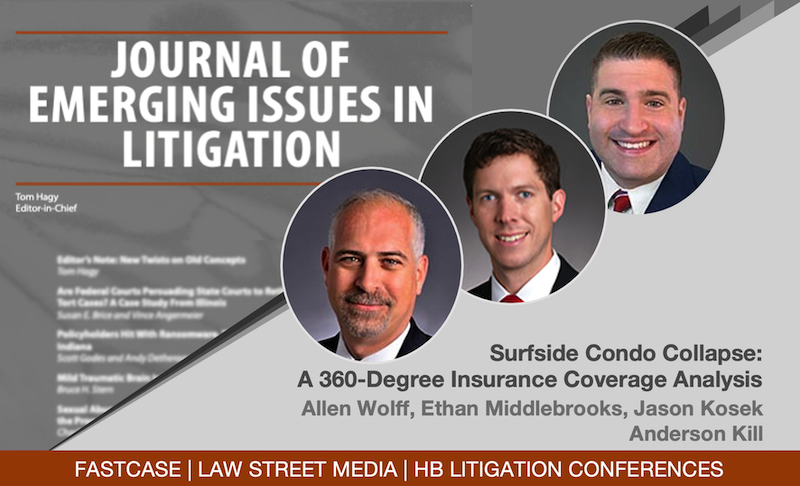
The horrific and fatal collapse of Champlain Towers South in the summer of 2021 not only shook the ground in Surfside, Florida, but it brought into question the integrity of structures everywhere. If professionals in the construction, real estate, and building management industries were relaxed about signs of structural decay before, they are not anymore. The insurance industry also has reasons to worry, as potentially responsible players turn to their policies to defend or indemnify them for claims for accidents causing losses including from property damage, personal injury, or death. In this article the authors evaluate the factors that are addressed when coverage determinations are made, as well as the various types of policies that come into play.
Authors
Allen R. Wolff (awolff@andersonkill.com) is a shareholder in Anderson Kill’s New York office, where he concentrates on the intersection of construction litigation and insurance recovery. Allen is co-chair of the firm’s Construction Industry Practice group and Corporate and Commercial Litigation Practice group. He advises and represents policyholders—building owners, developers, contractors, retailers, municipalities, financial institutions, hospitality businesses, condominium associations, and tenants’ associations—in a range of insurance coverage disputes. Allen’s colleagues, Ethan W. Middlebrooks (emiddlebrooks@andersonkill.com) and Jason Kosek (jkosek@andersonkill.com), are also attorneys in Anderson Kill’s New York office. They also concentrate on insurance recovery for policyholders and other complex matters.
About
The Journal on Emerging Issues in Litigation is a co-production of HB, Fastcase, and Law Street Media. You can also hear the complementary (and complimentary) Emerging Litigation Podcast wherever podcasts appear. For questions, contact Tom Hagy, Editor in Chief, at Editor@LitigationConferences.com.Loading Viewer…
-

To Pay or Not to Pay: Does Your Insurance Policy Cover Ransomware Losses? | By Pamela Hans | Anderson Kill
To Pay or Not to Pay: Does Your Insurance Policy Cover Ransomware Losses?

Abstract
Ransomware attacks are a rapidly growing threat against organizations. Paying ransom demands is a risky proposition and may even lead to sanctions against the targeted company. Either way, the damage to a company’s operation and integrity can be cripplingly severe. Should a company suffer losses from cyber extortion, its insurance company will be one of the resources it turns to for relief. But with cyber
coverage increasingly out of reach for some, policyholders may find coverage in more traditional coverages. In this article, the author evaluates the potential for coverage under several policy types, and underscores the importance of understanding policy language, the relevant law, and the potential regulatory ramifications of meeting ransom demands.Author
Pamela D. Hans (phans@andersonkill.com) is the managing shareholder of Anderson Kill’s Philadelphia office. Her practice concentrates on insurance coverage exclusively on behalf of policyholders. Pam is also a member of the firm’s COVID Task Group and Cyber Recovery Group.
About
The Journal on Emerging Issues in Litigation is a co-production of HB, Fastcase, and Law Street Media. You can also hear the complementary (and complimentary) Emerging Litigation Podcast wherever podcasts appear. For questions, contact Tom Hagy, Editor in Chief, at Editor@LitigationConferences.com.Loading Viewer…
-

Wildfire Litigation and Recovery with Ed Diab
Wildfire Litigation and Recovery with Ed Diab
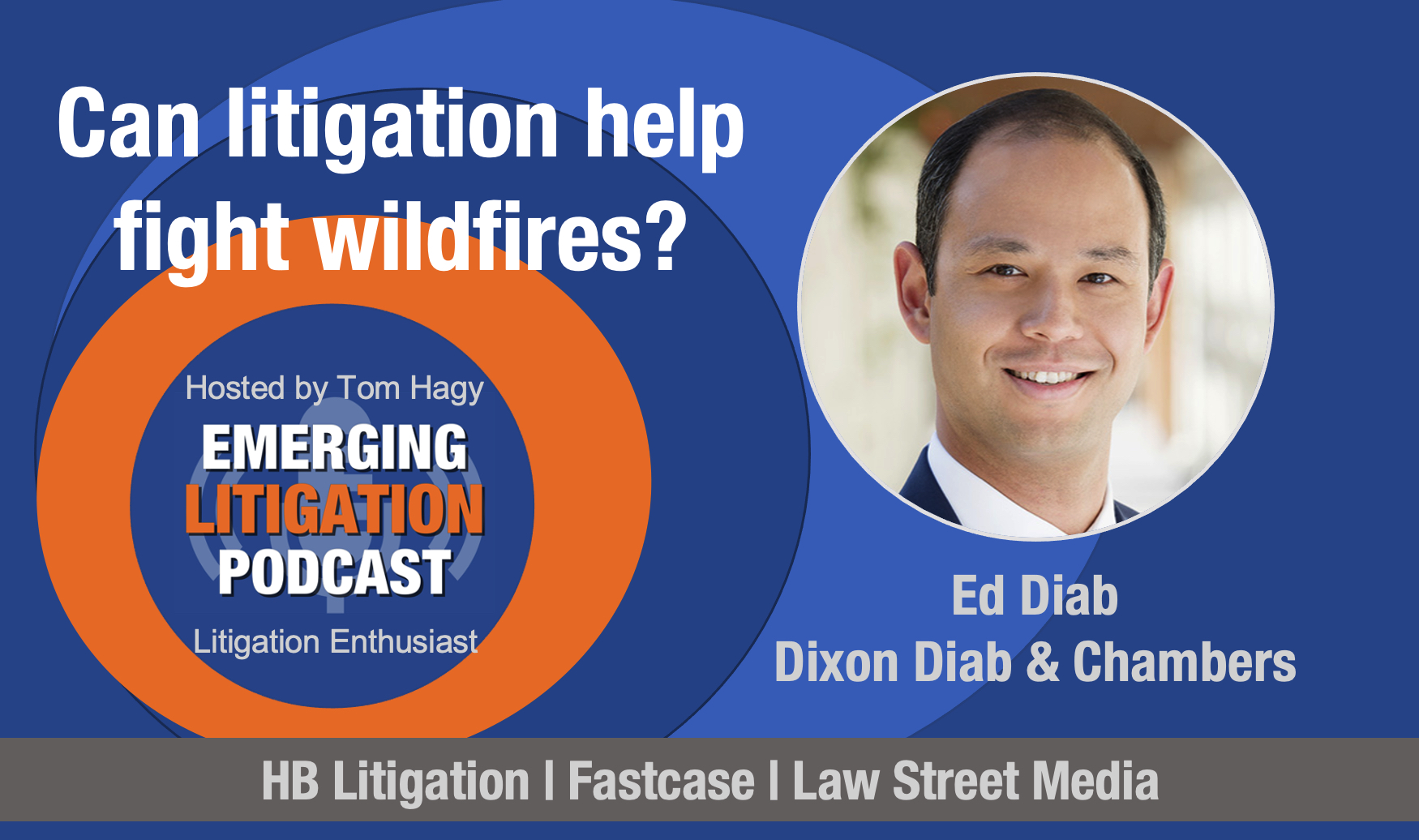
I had the pleasure of interviewing Ed Diab, co-founder of Dixon Diab & Chambers in San Diego, about his firm’s role in the litigation, what the claims are, what defenses they encounter, settlements they have secured, what evidentiary hurdles plaintiffs face, and more. They’ve been successful. Since 2018, Dixon Diab & Chambers has recovered more $1.4 billion in settlements. And there is more to come. The firm represents more than 40 public entities – including some of the largest cities and counties in California – as well as thousands of individuals and families. Ed leads the firm’s mass tort practice which, in addition to wildfire litigation, represents people who allege injuries from defective drugs and medical devices.
This podcast is the audio companion to the Journal on Emerging Issues in Litigation, a collaborative project between HB Litigation Conferences and the legal news folks at Law Street Media. If you have comments or wish to participate in one our projects, or want to tell me how insightful our guests are, please drop me a note at Editor@LitigationConferences.com.
Thanks to Ed Diab for speaking with me about this fascinating and frightening subject, and to Baron & Budd’s Scott Summy for introducing us. For my part, I am sure my suggestion that they install smoke detectors all over the forest is complete nonsense. Also, I spoke with a friend who majored in Latin. Even though I showed zero confidence, I apparently stumbled close to the pronunciation of flammagenitus, Latin for “fire cloud.” I promised you a photo of one. Also called pyrocumulus clouds, they look as terrifying as they sound.
Tom Hagy
Host
Emerging Litigation PodcastWildfires are causing more destruction in North America than at any time in recorded history.
In 2010 they consumed 3.4 million acres, but nearly tripled to devour more than 10 million acres in 2020.
They also have been responsible for numerous injuries and loss of life, razing thousands of homes, displacing wildlife, destroying natural resources, and even spewing air pollution thousands of miles away. Fighting these hellish infernos is a massive, all-out-war-like undertaking. The 2020 Dixie Fire was finally brought under control with the help of 6,500 personnel (from firefighters to the people who fed them), 1,000 fire trucks, water tankers, and bulldozers, and 1,000 miles of firehose. While some fires occur naturally, set off by lightening, for example, 84% are caused by humans. And, no matter how you slice it, humans are helping create the conditions of this continental tinderbox.
One group of attorneys from Baron & Budd and Dixon Diab & Chambers LLP is securing and seeking recovery for individuals, municipalities, and insurance companies that pay claims, when they can accomplish the difficult task of identifying the responsible parties. Positioned as “Wildfire Recovery Attorneys,” they have done so in cases against Pacific Gas & Electric Corp. and Southern California Edison, which they have sued for allegedly failing to maintain power lines and the areas beneath them, among other things.
-
Gamification of Stock Trading with Brad Rustin
Gamification of Stock Trading with Brad Rustin

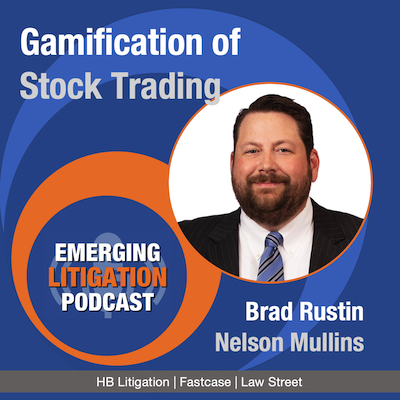
“What’s the deal?” you ask? Find out! Listen to my interview with FinTech attorney Brad Rustin, a partner with Nelson Mullins. In addition to chairing the firm’s Financial Services Regulatory Practice, Brad counsels financial institutions in regulatory matters, including strategic agreements, product development, and operational compliance.
A large portion of his work is on bank and non-bank partnerships involving white-label deployments, FinTech partnerships, or payments, digital assets, cryptocurrency, and lending partnerships. Brad is a Certified Anti-Money Laundering Specialist (CAMS) by ACAMS and a Certified Regulatory Compliance Manager (CRCM) by the American Bankers Association.
He received his JD, magna cum laude, from the University of South Carolina School of Law and his BA in Political Science and History, cum laude, from Furman University. And now, he is not only a guest on the Emerging Litigation Podcast, but the FinTech advisor on the Editorial Advisory Board of the Journal on Emerging Issues in Litigation.
This podcast is the audio companion to the Journal on Emerging Issues in Litigation, a collaborative project between HB Litigation Conferences and the legal news folks at Law Street Media, and the Fastcase legal research family, which includes Docket Alarm and Judicata. If you have comments or wish to participate in one our projects, or want to tell me how insightful and informative our guests are, please drop me a note at Editor@LitigationConferences.com.
Thanks to Brad for speaking with me about this fascinating subject. As for me, I will stay away from “game trading.” Hearing people describe it reminds me of my PacMan obsession in college, which frequently cost me many hours that I should have spent differently, and too often a functioning shoulder.
Tom Hagy
As brokerages focus on enhancing user experience, they risk shifting their customer’s focus from serious financial decisions to a game-like experience. Some think this is a good thing. That it will help engage the next generation of traders. Others think it’s a bad thing. That it will create a more spastic type of trader with unrealistic expectations on potential returns. State and federal regulators are focusing on digital brokerages and exploring guardrails for these types of platforms.
The challenges facing traditional technology providers (volume controls, fraud, system outages, and liquidity) are now facing these digital brokerages—with real-life consequences for individuals and their savings and retirement accounts.
One company that has been making headlines is Robinhood, which was on the receiving end of a $70 million fine handed down by the Financial Industry Regulatory Authority, or FINRA, for what it called “systemic supervisory failures.”
In coming up with the award, FINRA said it considered the “widespread and significant harm suffered by customers, including millions of customers who received false or misleading information from the firm, millions of customers affected by the firm’s systems outages in March 2020, and thousands of customers the firm approved to trade options even when it was not appropriate for the customers to do so.” Robinhood is also defending itself in litigation involving dozens of cases.
Will we continue to see litigation over these platforms as more and more retail customers (many young and inexperienced) realize that securities involve market risks?
What’s the deal?
-
A Special Episode: A lovable litigator with Danny Karon
A Special Episode: A lovable litigator with Danny Karon

For 30 years attorney Daniel R. Karon has successfully represented plaintiffs and defendants in class-action and individual lawsuits. He’s also chair of one of the leading class action conferences for lawyers, judges and law professors: the American Bar Association National Institute on Class Actions. He’s passionate about educating up-and-coming lawyers. He teaches and writes extensively, and has been featured on podcasts and television news shows.
While practicing law (handling some intensely serious matters), Danny became acutely aware of “a societal bias against access to justice where people who need justice the most often get it the least.” One response to that was to launch Your Lovable Lawyer, a multi-media website whose goal is to “make justice more accessible to people who don’t know, can’t find, or can’t pay for lawyers.” He endeavors to provide actionable insights regarding common legal problems. He refers to his “lovable” concept as “legal wellness,” and encourages regular folks to take a proactive approach to legal matters and potential conflicts.
This podcast is the audio companion to the Journal on Emerging Issues in Litigation, a collaborative project between HB Litigation Conferences and the Fastcase legal research family, which includes Full Court Press, Law Street Media, Docket Alarm and, most recently, Judicata. If you have comments or wish to participate in one our projects, or want to tell me how lovable Danny is, please drop me a note at Editor@LitigationConferences.com.