Tag: Compliance

  • The Commercial Drone Industry: Privacy, Security, Threats, and Mitigation of Risk

    The Commercial Drone Industry: Privacy, Security, Threats, and Mitigation of Risk

    HB presents a CLE-eligible webinar
    Now on-demand at the West LegalEdcenter
    THE COMMERCIAL DRONE INDUSTRY
    Privacy, Security, Threats, and Mitigation of Risk

    Drones have become an increasingly valuable tool for businesses of all types and sizes.

    Drones are already being used in many applications, but more will certainly arise as the technology advances. This means that certain risks, like cyber threats, will also continue to present themselves. Protecting the transmission and storage of data collected through drones is critical.

    Unfortunately, security usually comes as an afterthought. The drone industry is part of the aviation industry, which, based on its knowledge, keeps safety as a number one concern. Part of that safety is having proper protection for your systems, including security as a fundamental design principle.

    Take this webinar to gain insights on the topics listed below, and shared by an attorney who practices on the cutting-edge of this evolving technology.

    Topics:

    • Defining drones.
    • Current and future applications.
    • FAA Modernization and Reform Act of 2012.
    • FAA Part 107 Regulations and waivers.
    • Resources, e.g. the FAA Drone Zone and LAANC Portal.
    • Penalties for violations.
    • Privacy implications.
    • Drones as weapons.
    • Vulnerability to cyber attacks.

    Take it now!

    What you get:

    1+ CLE credits (subject to bar rules).

    Insights from an experienced professional who specializes in this area of the law.

    The complete PowerPoint presentation.

    Continued access to the complete recording for later use.

    Answers to your questions.

    Fee:

    No additional charge to subscribers to the West LegalEdcenter.

    Non-subscribers may take the course for $170.

    Meet the Speaker

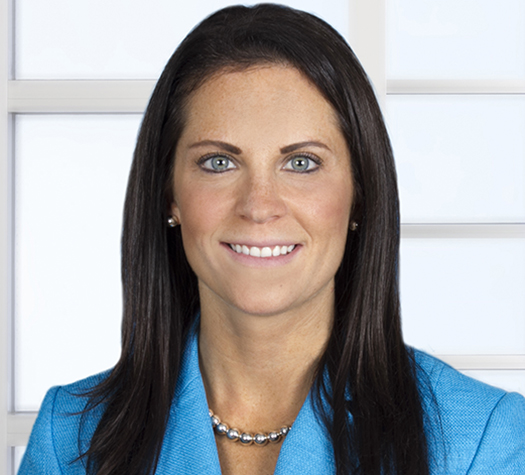
    Kathryn Rattigan
    Robinson & Cole LLP

    Kathryn Rattigan is a member of the firm’s Business Litigation Group and Data Privacy + Cybersecurity Team. She advises clients on data privacy and security, cybersecurity, and compliance with related state and federal laws. She assists clients in assessing risks related to technology and software contracts, as well as with compliance-related issues with outsourcing and vendor management. She represents clients across all industries, such as manufacturing, insurance, health care, education, energy, and construction.

    Kathryn helps clients comply with all state and federal regulations related to data privacy and cybersecurity. She is also a member of the firm’s Drone Compliance Team. As such, she advises clients on all legal issues surrounding the use of commercial drones, including navigation of Federal Aviation Administration regulations, commercial registration requirements, and Part 107 waivers.

    She is committed to doing pro bono work and being involved in the community. Her recent efforts include assisting Inner Explorer, a non-profit which works to help students focus and succeed through mindfulness practice in the classroom, and College Visions, which helps low-income students pursue a college education.

    She writes for two of the firm’s blogs, Data Privacy + Security Insider and Health Law Diagnosis.

    More about Kathryn

    Also, listen to my interview with Kathryn for the the Emerging Litigation Podcast!

    –Tom Hagy

  • Gamification of Stock Trading with Brad Rustin

    Gamification of Stock Trading with Brad Rustin

    Gamification of Stock Trading with Brad Rustin

    “What’s the deal?” you ask? Find out! Listen to my interview with FinTech attorney Brad Rustin, a partner with Nelson Mullins. In addition to chairing the firm’s Financial Services Regulatory Practice, Brad counsels  financial institutions in regulatory matters, including strategic agreements, product development, and operational compliance.

    A large portion of his work is on bank and non-bank partnerships involving white-label deployments, FinTech partnerships, or payments, digital assets, cryptocurrency, and lending partnerships. Brad is a Certified Anti-Money Laundering Specialist (CAMS) by ACAMS and a Certified Regulatory Compliance Manager (CRCM) by the American Bankers Association.

    He received his JD, magna cum laude, from the University of South Carolina School of Law and his BA in Political Science and History, cum laude, from Furman University. And now, he is not only a guest on the Emerging Litigation Podcast, but the FinTech advisor on the  Editorial Advisory Board of the Journal on Emerging Issues in Litigation.

    This podcast is the audio companion to the Journal on Emerging Issues in Litigation, a collaborative project between HB Litigation Conferences and the legal news folks at Law Street Media, and the Fastcase legal research family, which includes Docket Alarm and Judicata. If you have comments or wish to participate in one our projects, or want to tell me how insightful and informative our guests are, please drop me a note at Editor@LitigationConferences.com.

    Thanks to Brad for speaking with me about this fascinating subject. As for me, I will stay away from “game trading.” Hearing people describe it reminds me of my PacMan obsession in college, which frequently cost me many hours that I should have spent differently, and too often a functioning shoulder.

    Tom Hagy

    via GIPHY

    As brokerages focus on enhancing user experience, they risk shifting their customer’s focus from serious financial decisions to a game-like experience.  Some think this is a good thing. That it will help engage the next generation of traders. Others think it’s a bad thing. That it will create a more spastic type of trader with unrealistic expectations on potential returns. State and federal regulators are focusing on digital brokerages and exploring guardrails for these types of platforms.

    The challenges facing traditional technology providers (volume controls, fraud, system outages, and liquidity) are now facing these digital brokerages—with real-life consequences for individuals and their savings and retirement accounts.

    One company that has been making headlines is Robinhood, which was on the receiving end of a $70 million fine handed down by the Financial Industry Regulatory Authority, or FINRA, for what it called “systemic supervisory failures.”

    In coming up with the award, FINRA said it considered the “widespread and significant harm suffered by customers, including millions of customers who received false or misleading information from the firm, millions of customers affected by the firm’s systems outages in March 2020, and thousands of customers the firm approved to trade options even when it was not appropriate for the customers to do so.” Robinhood is also defending itself in litigation involving dozens of cases.

    Will we continue to see litigation over these platforms as more and more retail customers (many young and inexperienced) realize that securities involve market risks?

    What’s the deal?

  • Digital Payments in Class Administration

    Digital Payments in Class Administration

    Now On Demand

    Epiq presents
    DIGITAL PAYMENTS
    Best Practices for Efficiency in Class Actions

    Recorded: Sept. 23, 2020
    75 minutes

    CLE credit: 1+
    Registration includes recording, materials, and answers to your questions.

    TAKE IT NOW!

    Epiq presents a CLE-eligible webinar
    Digital Payments
    Best Practices for Efficiency in Class Actions

    Recorded Live | Sept. 23, 2020

    produced by HB Litigation Conferences

    Modern life increasingly relies on digital solutions. Nothing has made that more apparent than the novel coronavirus pandemic. In terms of class action settlement payments, the impetus has never been greater to transition to the e-payment realm for security, convenience, cost-reduction, and improved fund disbursement.

    Class counsel and claims administrators have experimented for years with pre-paid debit cards, automated clearing house (ACH) deposits, and wire transfers, while others have tested judicial appetites for registered-user payment systems like PayPal and Venmo. However, digital payment schemes with multiple options — the primary of which is direct deposit — seem to be emerging as the favored solution.

    Though class action notice is increasingly being digitized, aided by the 2018 amendments to Federal Rule of Civil Procedure, particularly Rule 23(c)(2)(B), which permits notice by electronic means like emails and digital and social media, payment itself has lagged behind. Even with these challenges, electronic payment distribution is now a viable option. Courts are encouraging the shift to electronic payments, too. As the U.S. District Court for the Northern District of California specified in its November 2018 Procedural Guidance for Class Action Settlements, “[c]lass counsel should consider… distributions to class members via direct deposit.”

    As class actions lawyers and claims administrators consider digital payments, they must propose workable and achievable solutions, adhere to Rule 23, and minimize cy pres. Though widespread acceptance of this technology is still evolving, understanding the concept and embracing its benefits may lead to quicker adoption.

    Take our webinar as our panelists will address: 

    • Statistical trends in digital payment.
    • How to choose the right plan for your settlement structure.
    • How to choose the right plan for your class size & payment amounts.
    • Cost variables associated with different methods.
    • Vendor and program characteristics.
    • How to implement an effective program.
    • Avoiding excessive unclaimed funds.
    • Data security and privacy concerns.
    • Questions your judge will ask.

    Meet the Speakers

    Adam Zapala
    Partner
    Cotchett Pitre

    Adam Zapala is a partner in the San Francisco office of Cotchett Pitre, where he focuses on complex litigation, including antitrust, employment and civil rights, privacy and cybersecurity, qui tam/false claims, consumer protection, and class actions generally. He has served as lead counsel in some of the largest and most complex litigation matters in the country. He received his B.A. from Stanford University and his J.D. from the University of California Hastings College of Law. Read more about Adam and Cotchett Pitre.

    Paul G. Karlsgodt
    Partner
    BakerHostetler

    Paul is a partner in the Denver office of BakerHostetler, and serves as leader of the firm’s Privacy and Digital Risk Class Action and Litigation Team. He has significant experience representing companies in the insurance, healthcare, consumer, and education sectors, and is routinely named among the best lawyers in his field. Paul earned his J.D. from the University of Denver Sturm College of law and his B.S. from Purdue University. Read more about Paul and BakerHostetler. 

    Chris Ljungkull
    Director of Sales
    Digital Pay

    Chris brings Ljungkull 10+ years of experience building strategic partnerships across Financial Services, Enterprise SaaS, CPG, eCommerce, and Logistics. He draws heavily on his experience in fulfillment, print, and mail industries to help Legal Service customers develop solutions that do more with less. Read more about Chris and Digital Pay.

    Kim Stephens
    Member Partner
    Tousley Brain Stephens

    Kim Stephens is a Member Partner at Tousley Brain Stephens PLLC, where he focuses on commercial and class action litigation.  Prior to joining the firm he was a judicial extern clerk to Hon. Eugene A. Wright of the Ninth Circuit, and worked for the Seattle criminal defense firm of Allen &Hansen.  He has been appointed special attorney general for Washington State, as well as lead and co-lead counsel to manage numerous state, federal and multi-district class action matters. He received his B.A. from the University of Washington and his J.D. from the University of Washington School of Law. Read more about Kim and Tousley Brain Stephens.

    Judge Suzanne H. Segal (Ret.)
    Mediator
    Signature Resolution

    After 18 years as a U.S. Magistrate Judge with the Central District of California, including four years as the Chief Magistrate Judge, Hon. Suzanne H. Segal (Ret.) joined Signature Resolution as a mediator and arbitrator. During her tenure on the federal bench, Judge Segal presided over numerous trials, evidentiary hearings, motions and discovery conferences involving a variety of cases. Before that she served for 12 years as Assistant U.S. Attorney in the Civil Division of the Los Angeles U.S. Attorney’s Office. She received her J.D. from Claremont McKenna College and her J.D. from Cornell Law School. Read more about Judge Suzanne H. Legal.

    Moderator: Aideen Gaffney
    Vice President
    Epiq

    Aideen Gaffney draws upon over two decades of experience as an attorney and a skilled business development strategist to expand the scope and impact of our service offerings while providing effective solutions to our clients’ project needs.  Based on the West Coast, her particular experience centers upon class action administration, mass tort global litigation programs, and data breach response programs. Earlier in her career, Gaffney practiced law in San Francisco at Gordon & Rees LLP, and in Portland at Bullivant Houser Bailey PC,  handling complex insurance litigation and participating in two jury trials and two bench trials involving ‘bad faith’ litigation. She is a frequent speaker and writer on current topics affecting the legal administration industry, and has presented numerous CLE programs to clients. Aideen received her B.S. from Santa Clara University and her J.D. from Santa Clara University School of Law. Read more about Aideen and Epiq here.

  • Drone Law with Kathryn Rattigan

    Drone Law with Kathryn Rattigan

    Drone Law with Kathryn Rattigan

    Joining me to discuss this emerging area of law is Kathryn M. Rattigan, a member of the Business Litigation Group, the Data Privacy + Cybersecurity Team, and the Drone Compliance Team in the Rhode Island office of Robinson Cole.  Kathryn advises clients on these matters with expertise in the relevant Federal Aviation Administration regulations. She and her colleagues also advise clients on employee and subcontractor contracts, insurance policies, privacy regulations, state and local laws, and best practices as recommended by the National Telecommunications and Information Administration.  She handles product defect, personal injury, and property damage litigation, too.  Kathryn is a frequent contributor to the excellent Robinson Cole Data Privacy + Cybersecurity Insider blog.  She holds a J.D. from the Roger Williams University School of Law and a B.A. (magna cum laude) from Stonehill College.

    This podcast is the audio companion to the Journal on Emerging Issues in Litigation, a collaborative project between HB Litigation Conferences and the Fastcase legal research family, which includes Full Court Press, Law Street Media, Docket Alarm and, most recently, Judicata. If you have comments or wish to participate in one our projects, or want to tell me how insightful and informative Kathryn is, please drop me a note at Editor@LitigationConferences.com. This podcast is based on an article she wrote for the Journal.

    Just to clarify. Kathryn does own a drone, but not a “sheep drone.” I regret the error, and I wouldn’t have it any other way.  Thanks to Kathryn for speaking with me about this fascinating area of the law.

    Tom Hagy
    Host and Litigation Enthusiast

    via GIPHY

    The sky will be speckled with commercial drones, carrying our precious products and pills, or performing risky work, like inspecting bridges and buildings, monitoring crops and livestock, and keeping an eye on pipelines and oil rigs.

    It’s not “if,” but “when.”

    What must companies know about deploying a drone fleet?

    What industries are leading the way?

    What are the potential legal liabilities?

    How does one begin to navigate the regulatory labyrinth?

    If one is flying over my swimming pool taking photos, may I shoot it down?

    And who in their right minds would ever allow a teenage boy to operate one?

    via GIPHY

  • Virtual Hearings: Changing Perceptions of Executive Testimony?

    Virtual Hearings: Changing Perceptions of Executive Testimony?

    Virtual Hearings: Changing Perceptions of Executive Testimony?

    Abstract
    Given the newly acceptable ease of securing testimony via webcam—necessitated by the pandemic—this article focuses on efforts to compel the appearance of corporate executives to testify in litigation. While there are many practical advantages to virtual testimony, the authors maintain that mere convenience cannot replace legal standards of relevance and undue burden when pursing the testimony of executives.

    Authors

    Sean J. Coughlin (scoughlin@bressler.com) is a Principal in the Financial Institutions group at Bressler, Amery & Ross, P.C., where he represents institutions and individuals in regulatory investigations and defense litigation. Before joining the firm, he was an Executive Director in the legal department at Morgan Stanley, a Managing Director at Citigroup/Smith Barney, and a Senior Assistant District Attorney in the Kings County District Attorney’s office.

    Jacqueline R. Meyers (jmeyers@bressler.com) is an associate at Bressler, Amery & Ross, P.C., whose practice focuses on securities defense litigation, arbitration, and regulatory investigations. She has specialized experience in litigation concerning arbitrability and enforcement of arbitration awards.

    About
    The Journal on Emerging Issues in Litigation is a co-production of HB, Fastcase, and Law Street Media. You can also hear the complementary (and complimentary) Emerging Litigation Podcast wherever podcasts appear. For questions, contact Tom Hagy, Editor in Chief, at Editor@LitigationConferences.com.

    Loading Viewer…

  • The False Claims Act with Jack Siegal

    The False Claims Act with Jack Siegal

    The False Claims Act with Jack Siegal

    Joining me to discuss this important civil statute is Jack Siegal of McGlinchey Stafford in Boston. Jack’s practice focuses on financial services litigation, complex commercial disputes, government investigations and white-collar defense, securities litigation, regulatory proceedings, and compliance.

    This podcast is the audio companion to the Journal on Emerging Issues in Litigation, a collaborative project between HB Litigation Conferences and the Fastcase legal research family, which includes Full Court Press, Law Street Media, Docket Alarm and, most recently, Judicata. If you have comments or wish to participate in one our projects, or want to tell me how insightful and informative Jack is , please drop me a note at Editor@LitigationConferences.com.

    I hope you enjoy the interview, and especially how I managed not to include Jack’s answer to whether my dog could be sued for violating the FCA. “Nope. Not a person,” he said, with zero hesitation. I want to thank Jack for immediately taking on the role as Shiloh’s advocate, and for speaking with me about this important law.  –Tom Hagy

    Unscrupulous contractors have been ripping off the federal government for as long as there has been a federal government. President Lincoln, tired of being sold lame mules and rancid rations, signed the Federal Claims Act into law during The Civil War.

    In the last two decades the government, with the help of whistleblowers, has raked in more than $20 billion. 

  • Labor Law in 2021 with Kathryn Hatfield

    Labor Law in 2021 with Kathryn Hatfield

    Labor Law in 2021 with Kathryn Hatfield

    Participation in labor unions is less than half of what it was 40 years ago. It has seen an uptick in the service sector, but a sharp decline in manufacturing. According to economist Heidi Shierholz decline in union rolls is partly responsible for today’s yawning income inequality gap. Recently we’ve seen the formation of a modest union at Google and a movement among Amazon workers. We’ve also seen how the pandemic has shone a bright light on the fragility of our nation’s workforce struggling to survive at the bottom rungs of the pay scale.

    Joining me to speak about these issues is Kathryn Van Deusen Hatfield, a senior managing partner at Hatfield Schwartz Law Group in New Jersey.  Kathy represents private and public sector employers in all aspects of labor and employment law, with expertise in litigating state and federal cases on behalf of employers involving Title VII, the ADA, the ADEA and the New Jersey Law Against Discrimination, and providing legal opinions and advice on personnel, employment and labor issues.  Kathy shares her insights on recent developments in the labor movement, some of the causes of its decline, how unions get a bad rap, and how, even though she represents management, she believes unions can be a good thing for everyone — employees and companies alike.

    This podcast is the audio companion to the Journal on Emerging Issues in Litigation, a collaborative project between HB Litigation Conferences and the Fastcase legal research family, which includes Full Court Press, Law Street Media, Docket Alarm and, most recently, Judicata. If you have comments or wish to participate in one our projects, or want to tell me how insightful and informative David and Dan are, please drop me a note at Editor@LitigationConferences.com.

    I hope you enjoy the interview, and how I managed to demonstrate how little I know about sports. I feel made up for it by learning something about baseball Hall of Famer Jim Rice, who did something really cool and heroic in 1982.

  • Cannabis Industry Competition Law with Ausra Deluard and Jennifer Oliver

    Cannabis Industry Competition Law with Ausra Deluard and Jennifer Oliver

    Ausra O. Deluard

    Ausra O. DeluardCounsel | Dentons LLP

    Jennifer M. Oliver

    Jennifer M. OliverPartner | MoginRubin LLP

    Attorneys Ausra Deluard and Jennifer Oliver on Cannabis Industry Competition Law

    What can legitimate cannabis companies do to level the playing field, not only against others who walk the straight and narrow, but dealers still thriving on the black market?

    It was my pleasure to interview Ausra Deluard and Jennifer Oliver for what was an informative and even surprising podcast. It’s based on their article — Clearing the Haze: State Laws and Private Plaintiffs Critical to Preserve Competition in Cannabis — which will be featured in the inaugural issue of the Journal on Emerging Issues in Litigation, which will release in January 2021.

    Ausra, who is an attorney with the global law firm Dentons LLP, has spent more than a decade advising clients in a range of antitrust matters including merger investigations, competitor collaborations, and pricing and distribution policies. She works closely with cannabis clients to help them navigate the rapidly evolving cannabis laws and regulations throughout the U.S.

    Jennifer is a partner at national antitrust boutique MoginRubin LLP, where she litigates and advises clients on competition issues.  Her work includes representing classes of plaintiffs in class actions, risk mitigation and regulatory advice in mergers and acquisitions, and other complex business litigation. Check out the MoginRubin Blog.

    The Journal is a collaborative project between HB and the Fastcase legal research family, which includes Full Court Press, Law Street Media, Docket Alarm and, most recently, Judicata. If you have comments or wish to participate in one our projects, or want to tell me how awesome Ausra and Jennifer are, drop me a note at Question@LitigationConferences.com.

    We hope you enjoy the interview.

    Tom Hagy
    Founder & Managing Director
    HB Litigation Conferences

  • Biotech, Life Sciences, Food & Drug News from NLR

    Biotech,
    Life Sciences,
    Food & Drug News
    from
    National Law Review

    [wp-rss-aggregator feeds=”nlr-biotech-drugs”]

  • Kathryn Hatfield on Labor Law in 2021
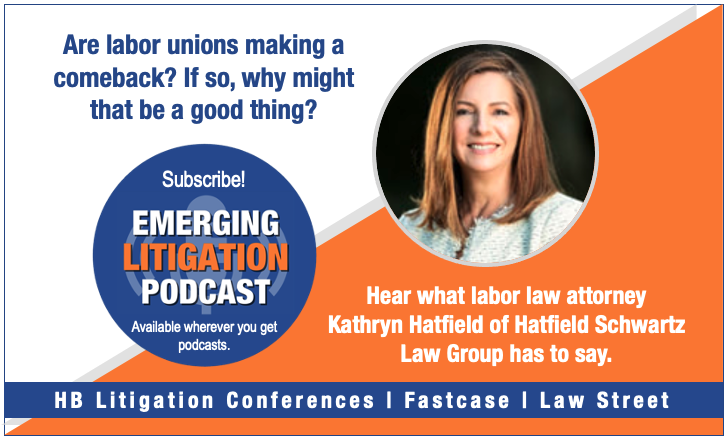
    Kathryn Hatfield on Labor Law in 2021

    Kathryn Hatfield on Labor Law in 2021

    Participation in labor unions is less than half of what it was 40 years ago. It has seen an uptick in the service sector, but a sharp decline in manufacturing. According to Heidi Shierholz — former chief economist at the Department of Labor, now senior economist and policy director at the Economic Policy Institute — decline in union rolls is partly responsible for today’s yawning income inequality gap. Recently we’ve seen the formation of a modest union at Google and a movement among Amazon workers. We’ve also seen how the pandemic has shone a bright light on the fragility of our nation’s workforce struggling to survive at the bottom rungs of the pay scale.

    Joining me to speak about these issues is Kathryn Van Deusen Hatfield, a senior managing partner at Hatfield Schwartz Law Group in New Jersey.  Kathy represents private and public sector employers in all aspects of labor and employment law, with expertise in litigating state and federal cases on behalf of employers involving Title VII, the ADA, the ADEA and the New Jersey Law Against Discrimination, and providing legal opinions and advice on personnel, employment and labor issues.  Kathy shares her insights on recent developments in the labor movement, some of the causes of its decline, how unions get a bad rap, and how, even though she represents management, she believes unions can be a good thing for everyone — employees and companies alike.

    This podcast is the audio companion to the Journal on Emerging Issues in Litigation, a collaborative project between HB Litigation Conferences and the Fastcase legal research family, which includes Full Court Press, Law Street Media, Docket Alarm and, most recently, Judicata. If you have comments or wish to participate in one our projects, or want to tell me how insightful and informative Kathy is, please drop me a note at Editor@LitigationConferences.com.

    I hope you enjoy the interview, and how I managed to demonstrate how little I know about sports. I feel made up for it by learning something about baseball Hall of Famer Jim Rice, who did something really cool and heroic in 1982.

    Safeguarding Against Financial Exploitation

    An on-demand CLE-eligible webinar Safeguarding Against Financial Exploitation   America’s senior population is growing. Nearly one in five U.S. residents will be 65 or older in 2030. Which means the average age of U.S. investors is climbing too. With that comes the risk that they will be exploited by people with access – or gain access through nefarious methods – to their investment portfolio. Seniors and vulnerable persons lose billions of dollars each year. Remarkably, 90% of the people to take advantage of senior investors are members of their own family. Attorneys who represent senior clients need to know the signs of vulnerability, red flags that their clients are being exploited, what laws apply, and rules lawyers must follow in these matters.   Questions our speakers answer: What is senior / vulnerable investor exploitation?   Who is protected by state and federal laws?   How prevalent is senior financial exploitation? What do the numbers tell us?  What is the pace of financial abuse SAR filings by securities firms?  What are the most popular scams?   What is diminished capacity?  What are the red flags indicating possible exploitation?  What are the laws, rules, and regulations governing law firms?  What are some best practices for law firms?  How can firms best protect their senior clients?   On Demand CLE Webinar What You Get PowerPoint and supplemental materials. Complete recording for later review. Answers to your questions via email. Invitation to contact speakers. 1.5 CLE credits (for licensed attorneys). CLE assistance.* *Subject to state bar rules. For licensed attorneys.  Register Meet the Speakers Joseph Calabrese Bressler, Amery & Ross, P.C. A 1991 Graduate of St. John’s University Law School, Mr. Calabrese brings 30 years of practice and 18 years of Securities Litigation/Regulatory experience to his role as principal in the New York office of  Bressler, Amery & Ross’s Financial Institutions Group. He began his career as a Wall Street litigator as an associate general counsel for Citigroup’s Smith Barney and […]

    Lien Resolution: Government & Private Plans Get Aggressive (Against Attorneys)

    Includes Nearly 75 minutes of insights from experienced professionals. CLE credit: 1+ (subject to bar rules). For CLE questions: CLE@LitigationConference.com The complete Power Point presentation. Continued access to the complete recording for later use. Answers to your questions via email to the presenters or write to HB and we will be sure to contact the speakers. What can you do to settle personal injury suits cleanly and avoid costly litigation and penalties? What recent cases can inform you about protecting your settlements and, as attorneys, yourselves, from post-settlement federal lawsuits? How can your firm set itself up to meet government expectations? What role might experts play in navigating these pitfalls? Medicare Advantage (42 USC § 1395w-22) Federal Medical Care Recovery Act (FMCRA) (42 USC § 2651) Armed Forces Act (10 USC §1095) Veterans’ Benefits (38 USC §1729) Third-Party Collection Rules (32 CFR 537.24; 38 CFR 17.101, etc.) Set-Asides under the Medicare Secondary Payer Act (42 USC § 1395y(b)(2)] On Demand Registration Lien Resolution Government & Private Plans Get Aggressive (Against Attorneys!) On Demand | Recorded September 2020 It is increasingly common these days. Personal injury attorneys settle a case, only to find themselves sued by a U.S. Attorney for failing to reimburse Medicare for conditional payments as required by the Medicare Secondary Payer Act. In some cases the attorney may be required to pay fines in addition to the reimbursements and interest, a costly proposition. Are you up to speed on issues surrounding Medicare Advantage, TRICARE, veterans’ claims, and Medicare set-asides? Join nationally recognized healthcare lien and resolution expert Franklin P. Solomon and go-to lien resolution provider Brett Newman as they offer a practical, in-depth CLE presentation. Franklin P. Solomon, Esq. Attorney & Founder, Solomon Law Firm  A graduate of Rutgers University School of Law at Camden, Franklin Solomon is based in Cherry Hill, NJ, with a practice focused on evaluation, litigation and resolution of healthcare “liens” and reimbursement claims. Mr. Solomon represents personal injury victims and their attorneys […]

    Telepsychiatry: Mitigating the Risks

    REGISTER Registration Includes Nearly 90 minutes of insights from experienced professionals. CLE credit: 1+ (subject to bar rules). For CLE questions: CLE@LitigationConference.com The complete Power Point presentation. Continued access to the complete recording for later use. Answers to your questions via email to the presenters or write to HB and we will be sure to contact the speakers. Understand the risks associated with telepsychiatry and how to manage them.  Telemedicine has emerged as an important solution for healthcare in general and psychiatric medicine specifically during the current global pandemic. Remote access for sub-practices including addiction counseling have been commonly used. Our panel of psychiatric professionals who have served as expert witnesses and attorneys who counsel and represent physicians have prepared a 90-minute session to share insights with attorneys, physicians, healthcare providers, risk professionals, and more. Agenda Examining procedures and best practices that exist for ensuring confidentiality in a telemedicine practice How do you draft a telepsychiatric consent form? What is the emerging standard of care for telemedicine? Will the standard of care for telemedicine become a national standard? (Should it?) Review the case law addressing telemedicine or telepsychiatry How do the HIPAA regulations and HITECH privacy laws impact telemedicine? How have the HIPAA regulations and HITECH privacy laws been relaxed during the pandemic? Will the relaxed HIPAA and HITECH regulations impacting telemedicine continue past the pandemic? Which technical platforms are preferred? Which ones to avoid? Panelists Mark Levy, M.D., Medical Director at fpamed David Kan, M.D., UCSF Psychiatry Department and the California Society for Substance Abuse Medicine Ayesha Ashai, M.D., associated with fpamed Stephen M. Fatum, J.D., Partner, Barnes & Thornburg LLP Angela W. Russell, J.D., Partner, Wilson Elser Moskowitz Edelman & Dicker LLP Meet our physician and attorney panelists. Mark Levy MD Medical Director fpamed Dr. Levy is a graduate of Columbia College (A.B. 1967) and the Columbia University College of Physicians and Surgeons (M.D. 1971) in New York. He is a Physician […]

    The Commercial Drone Industry: Privacy, Security, Threats, and Mitigation of Risk

    HB presents a CLE-eligible webinar Now on-demand at the West LegalEdcenter THE COMMERCIAL DRONE INDUSTRY Privacy, Security, Threats, and Mitigation of Risk Drones have become an increasingly valuable tool for businesses of all types and sizes. Drones are already being used in many applications, but more will certainly arise as the technology advances. This means that certain risks, like cyber threats, will also continue to present themselves. Protecting the transmission and storage of data collected through drones is critical. Unfortunately, security usually comes as an afterthought. The drone industry is part of the aviation industry, which, based on its knowledge, keeps safety as a number one concern. Part of that safety is having proper protection for your systems, including security as a fundamental design principle. Take this webinar to gain insights on the topics listed below, and shared by an attorney who practices on the cutting-edge of this evolving technology. Topics: Defining drones. Current and future applications. FAA Modernization and Reform Act of 2012. FAA Part 107 Regulations and waivers. Resources, e.g. the FAA Drone Zone and LAANC Portal. Penalties for violations. Privacy implications. Drones as weapons. Vulnerability to cyber attacks. Take it now! What you get: 1+ CLE credits (subject to bar rules). Insights from an experienced professional who specializes in this area of the law. The complete PowerPoint presentation. Continued access to the complete recording for later use. Answers to your questions. Fee: No additional charge to subscribers to the West LegalEdcenter. Non-subscribers may take the course for $170. Meet the Speaker Kathryn Rattigan Robinson & Cole LLP Kathryn Rattigan is a member of the firm’s Business Litigation Group and Data Privacy + Cybersecurity Team. She advises clients on data privacy and security, cybersecurity, and compliance with related state and federal laws. She assists clients in assessing risks related to technology and software contracts, as well as with compliance-related issues with outsourcing and […]

    The Intersection of Privacy and Antitrust Webinar Now Available On-Demand on the West LegalEdcenter

    Available as part of your subscription to The Thomson Reuters West LegalEdcenter®. Don’t subscribe to the West LegalEdcenter? This webinar is still available directly from HB. Take it now! Questions for speakers Questions@LitigationConferences.com CLE questions CLE@LitigationConferences.com Check out the MoginRubin blog for more insights on antitrust and privacy law. What attorneys and companies need to know about the increasing interplay between these critical areas of the law.  Highly publicized cases and investigations in the U.S. and Europe of big technology, e-commerce, and social media companies demonstrate how anti-competition laws are being used to scrutinize and challenge not only how these corporations conduct themselves in the marketplace, but the very core of their colossal success: the mass collection and utilization of user data. Are the privacy and antitrust worlds beginning to cross over? Or do they simply run parallel while addressing entirely different types of conduct? Whatever the answer, data is the raw material that drives the likes of Google, Facebook, Apple and Amazon, so how it is handled is a critical question when counseling clients on mergers and acquisitions. Moderator Daniel J.  Mogin | Managing Partner, MoginRubin LLP Speakers Jennifer M. Oliver, CIPP/US | Partner, MoginRubin LLP Thomas N. Dahdouh | Director, Western Region, Federal Trade Commission Franklin M. Rubinstein | Partner, Wilson Sonsini Goodrich & Rosati Randi W. Singer, CIPP/US, CIPT | Partner, Weil, Gotshal & Manges Contributor Dina Srinivasan | Independent Researcher & Author of The Antitrust Case Against Facebook Dina was unable to present but we thank her for her content contributions.  Agenda Who should regulate privacy violations in the U.S.? Which antitrust issues implicate privacy concerns? What role does machine learning play on the competitive landscape? What is big data really? How is it different from “data”? What are the elements of effective merger reviews? What are the appropriate remedies? What are “notice-and-choice” versus “harms-based” approaches? Plus answers to your questions. Send them to Questions@LitigationConferences.com.