Tag: Compliance

  • European Union’s Top Court Strikes Down EU-US Privacy Shield

    European Union’s Top Court Strikes Down EU-US Privacy Shield

    European Union’s Top Court Strikes Down EU-US Privacy Shield

    The Court of Justice for the European Union has invalidated the EU-US Privacy Shield as an approved mechanism for transferring personal data from the European Union to the United States. The Privacy Shield had been in place since October 2015, and enabled U.S. companies to more easily receive personal data from EU entities. The decision by the court “leaves many companies scrambling to implement alternative mechanisms to safeguard personal data transfers to the U.S.,” says Sten-Erik Hoidal of Frederikson & Byron, P.A. With the invalidation of the privacy shield, companies are essentially left to decide on their own how data will be lawfully transferred. Attorneys from Perkins Coie recommend companies “consider amending any data processing addenda (DPAs) which companies have signed with vendors or customers to incorporate the EU Standard Contract Clauses.” Moving forward, U.S. and European companies will now attempt to create a new deal that complies with the privacy standards for transferring digital information. The first large company to weigh in on the decision, Microsoft tells customers that they “can continue to use Microsoft services in full compliance with European law” and that the ruling “does not change the data flows of our services to Consumers.”  

    Photo by Tabrez Syed on Unsplash

    Send Us Your News

  • Organizational Values & Business Risks: Properly Balancing Stakeholder Concerns

    Organizational Values & Business Risks: Properly Balancing Stakeholder Concerns

    Topics Covered

    Accommodations. Appropriate accommodation for high-risk employees or employees with family members who are at a heightened risk.

    Mitigation. Attention to means of mitigating transmission and infection.

    Tracing. Contact tracing and management of data collected, including health data, as well as responses to employees who refuse to report.

    Patient Sensitivity. Duty to avoid discrimination and stigmatization.

    Preparedness. Developing plans to address possibility of re-occurrence in the fall and managing possible outbreaks in company’s offices.

    Take it now

    On-demand on the Thomson Reuters West LegalEdcenter as part of the HB catalog.

    Register now!

    Organizational Values & Coronavirus Business Risks:
    Properly Balancing Stakeholder Concerns

    Produced for Emory University Center for Ethics by HB Litigation Conferences

    The current pandemic confronts businesses, nonprofit organizations, governments, and the legal profession with innumerable ethical challenges.  Management issues and liability concerns, stakeholder demands and legal duties become even more complex in an environment of uncertainty and one where the consequences could result in serious illness or even death.  This program seeks to engage the participants in thinking through these challenges and developing processes of ethical response to them.  Managers must acknowledge and address the framework of fear associated with the pandemic, ranging from fear of contagion and death to fears of unemployment, childcare, and the duties of home-schooling.  Additionally, as the economy reopens there must be serious attention to the processes of doing so.

    Join Professor Edward L. Queen from Emory University for invaluable insights. Emory’s medical team was on the frontline of the 2014-2016 Ebola epidemic, which began in December 2013 when an 18-month-old Guinean boy contracted the disease. According to the CDC, the outbreak ended with more than 28,600 cases and 11,325 deaths. Eleven people were treated for Ebola in the United States.

    Edward L. Queen
    Director of Ethics and Servant Leadership
    Emory University

    Professor Queen Coronavirus-Ethical-Issues-Litigation Conferences-June-19-2020-

    Professor Edward L. Queen

    Edward L. Queen is director of the D. Abbott Turner Program in Ethics and Servant Leadership and Coordinator of Undergraduate Studies at Emory University’s Center for Ethics.  At Emory he also serves as Director of Research for the Institute of Human Rights and co-convener of the Initiative on Religion, Conflict, and Peacebuilding.  Queen received his B.A. from Birmingham-Southern College, his M.A. and Ph.D. degrees from the Divinity School of the University of Chicago, and his J.D. from the Indiana University School of Law-Indianapolis. Queen’s previously served as founding director of the Religion and Philanthropy Project at the Indiana University Center on Philanthropy and of the Islamic Society of North America’s Fellowship Program in Nonprofit Management and Governance.  A former program officer at Lilly Endowment, Inc. with a major responsibility for grants in nonprofit governance and leadership, Queen has consulted with numerous nonprofit, governmental, and educational organizations on management issues and ethics policies.  These organizations have included the Helsinki Committee for Human Rights, the Pew Charitable Trusts, Independent Sector, USAID, NAFSA: The Association of International Educators, the Southeastern Council of Foundations, and the Corporation for National and Community Service.

    A specialist in issues related to professional and social ethics, religious and ethnic conflict, and civil society, Queen has written, coauthored, or edited numerous books, including Serving Those In Need: A Handbook for Managing Faith-Based Human Services Organizations (2000), Philanthropy in the World’s Traditions (1998), and The Encyclopedia of American Religious History (1992, rev. ed. 2002, 3rd rev. ed. 2009).

  • Healthcare Industry Antitrust Measures Advance as Pandemic Pressures Persist

    Healthcare Industry Antitrust Measures Advance as Pandemic Pressures Persist

    Healthcare Industry Antitrust Measures Advance as Pandemic Pressures Persist

    Did consolidation help frustrate U.S. COVID-19 preparedness?

    Clearly antitrust enforcers must consider external circumstances like the COVID-19 crisis when making enforcement decisions, and the agencies have bene able to pivot to respond to this crisis remarkably quickly. It is important, however, to also consider whether and how these emergency COVID-19 collaborations will unwind once the crisis has subsided. Collaborating competitors will have already shared critical information and resources, and that momentum can be difficult to halt.

    Jennifer M. Oliver, Partner, MoginRubin LLP

    READ MORE

    Jennifer M. Oliver
    Partner
    MoginRubin LLP

  • Tech’s Big Four Will Testify Before Antitrust Subcommittee

    Tech’s Big Four Will Testify Before Antitrust Subcommittee

    Four Technology Giants’ CEOs Will Testify Before Congress in On-going Antitrust Investigation

    Executives from Amazon, Apple, Facebook, and Google will appear (either virtually, as they are permitted to, or in person) before the U.S. House of Representatives’ Judiciary Antitrust Subcommittee on July 27, 2020. According to its press release, the Subcommittee has been scrutinizing the companies’ dominance in their respective digital spheres and the “adequacy of existing antitrust laws and enforcement,” since June 2019.

    The hearing will enable legislators to question the executives about possible antitrust abuses, which have been the focus of many federal, state, and foreign regulatory inquiries. For example, Representatives may inquire about Amazon’s treatment of third-party merchants who sell products on its e-commerce platform, Google’s highly profitable ad business, Apple’s App Store terms that infringe on the rights of third-party app developers, and Facebook’s leverage of previously acquired companies to solidify its social media dominance, according to a July 1, 2020 New York Times article by David McCabe. The hearing may serve as the crowning piece of the Subcommittee’s antitrust probe. As the Subcommittee’s press release stated, the CEOs’ “forthcoming” testimony is “essential” to completion of the investigation.

    Apple Amazon Facebook Google

  • Organizational Values & Coronavirus Business Risks | Join Our Webinar June 18

    Organizational Values & Coronavirus Business Risks | Join Our Webinar June 18

    Webinar:
    June 18, 2020
    2:00 pm ET
    60 mins.
    CLE: 1+
    Complimentary with registration.

    Get:
    +CLE
    +Materials
    +Recording
    +Answers!

    Also available to subscribers of the West LegalEdcenter.
    Register there!

    Email us your:
    Speaker questions
    CLE questions

    Speaker:

    Professor Edward L. Queen Ph.D. , J.D.
    Director Ethics and Servant Leadership: Emory Center for Ethics
    Emory University

    Organizational Values & Coronavirus Business Risks
    Properly Balancing Stakeholder Concerns

    Thursday, June 18, 2020 | 2pm ET | 1pm CT | 12pm MT | 11am PT 

    The pandemic brings with it complex liability concerns, stakeholder demands and legal duties.  We will take a closer look. 

    The current pandemic confronts businesses, nonprofit organizations, governments, and the legal profession with innumerable ethical challenges.  Management issues and liability concerns, stakeholder demands and legal duties become even more complex in an environment of uncertainty and one where the consequences could result in serious illness or even death.  This program seeks to engage the participants in thinking through these challenges and developing processes of ethical response to them.  Managers must acknowledge and address the framework of fear associated with the pandemic, ranging from fear of contagion and death to fears of unemployment, child care, and the duties of home-schooling.  Additionally, as the economy reopens there must be serious attention to the processes of doing so, including:

    We will address:   

    • Appropriate accommodation for high-risk employees or employees with family members who are at a heightened risk;

    • Attention to means of mitigating transmission and infection;

    • Contact tracing and management of data collected, including health data, as well as responses to employees who refuse to report;

    • Duty to avoid discrimination and stigmatization;

    • Developing plans to address possibility of re-occurrence in the fall and managing possible outbreaks in company’s offices.

  • The Intersection of Privacy and Antitrust Webinar Now Available On-Demand on the West LegalEdcenter

    Available as part of your subscription to
    The Thomson Reuters West LegalEdcenter®.

    Don’t subscribe to the West LegalEdcenter?
    This webinar is still available directly from HB. Take it now!

    Questions for speakers
    Questions@LitigationConferences.com

    CLE questions
    CLE@LitigationConferences.com

    Check out the MoginRubin blog for more insights on antitrust and privacy law.

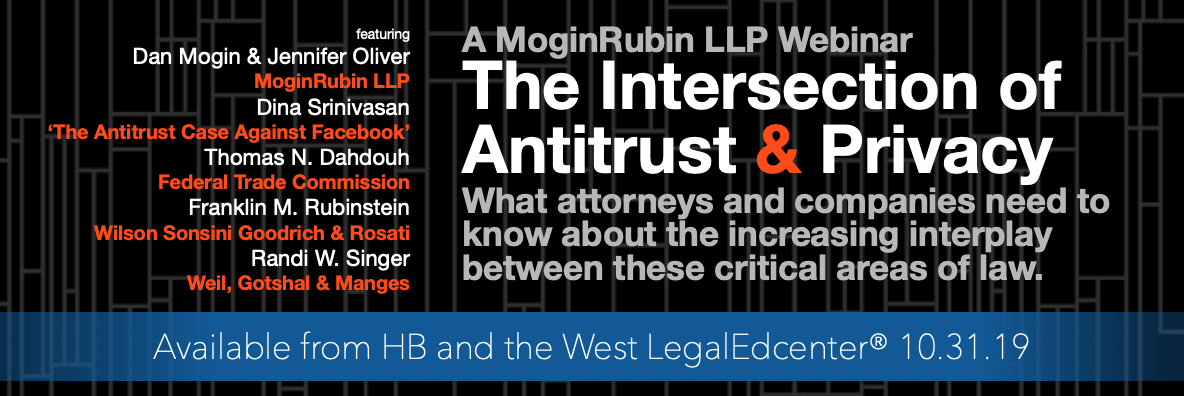
    What attorneys and companies need to know about the increasing interplay between these critical areas of the law. 

    Highly publicized cases and investigations in the U.S. and Europe of big technology, e-commerce, and social media companies demonstrate how anti-competition laws are being used to scrutinize and challenge not only how these corporations conduct themselves in the marketplace, but the very core of their colossal success: the mass collection and utilization of user data.

    Are the privacy and antitrust worlds beginning to cross over? Or do they simply run parallel while addressing entirely different types of conduct? Whatever the answer, data is the raw material that drives the likes of Google, Facebook, Apple and Amazon, so how it is handled is a critical question when counseling clients on mergers and acquisitions.

    Moderator
    Daniel J.  Mogin | Managing Partner, MoginRubin LLP

    Speakers
    Jennifer M. Oliver, CIPP/US | Partner, MoginRubin LLP
    Thomas N. Dahdouh | Director, Western Region, Federal Trade Commission
    Franklin M. Rubinstein | Partner, Wilson Sonsini Goodrich & Rosati
    Randi W. Singer, CIPP/US, CIPT | Partner, Weil, Gotshal & Manges

    Contributor
    Dina Srinivasan | 
    Independent Researcher & Author of The Antitrust Case Against Facebook
    Dina was unable to present but we thank her for her content contributions. 

    Agenda

    • Who should regulate privacy violations in the U.S.?
    • Which antitrust issues implicate privacy concerns?
    • What role does machine learning play on the competitive landscape?
    • What is big data really? How is it different from “data”?
    • What are the elements of effective merger reviews?
    • What are the appropriate remedies?
    • What are “notice-and-choice” versus “harms-based” approaches?
    • Plus answers to your questions. Send them to Questions@LitigationConferences.com.

  • The Intersection of Antitrust & Privacy | A MoginRubin Webinar | 10.31.2019

    The Intersection of Antitrust & Privacy Law


    [two-fifths-first] Recorded: Oct. 31, 2019
    Duration: 100 minutes
    Presented by:  MoginRubin LLP
    Produced by: HB Litigation Conferences

    The Panel

    Moderator
    Daniel J.  Mogin | Managing Partner, MoginRubin LLP

    Speakers
    Jennifer M. Oliver, CIPP/US | Partner, MoginRubin LLP
    Thomas N. Dahdouh | Director, Western Region, Federal Trade Commission
    Franklin M. Rubinstein | Partner, Wilson Sonsini Goodrich & Rosati
    Randi W. Singer, CIPP/US, CIPT | Partner, Weil, Gotshal & Manges

    Contributor
    Dina Srinivasan |
    Independent Researcher & Author of The Antitrust Case Against Facebook
    Dina was unable to present but we thank her for her content contributions. 

    What you will get:

    • At least 1 hour of CLE credit.
    • Answers to your questions via email.
    • The opportunity to share with others on your team.
    • The complete Powerpoint.
    • The Antitrust Case Against Facebook
    • Dina Srinivasan’s statement to the House Committee on the Judiciary, Subcommittee on Antitrust, Commercial, and Administrative Law
    • The Chicago Booth School Stigler Center Committee on Digital Platforms Final Report

    Write to us at CLE@LitigationConferences.com to:

    • Ask about CLE
    • Request the materials
    • Send a question for the speakers

    [/two-fifths-first][three-fifths]

    Market Behavior and Data-Driven Market Power

    Highly publicized cases and investigations in the U.S. and Europe of big technology, e-commerce, and social media companies demonstrate how anti-competition laws are being used to scrutinize and challenge not only how these corporations conduct themselves in the marketplace, but the very core of their colossal success: the mass collection and utilization of user data.

    Are the privacy and antitrust worlds beginning to cross over?

    Or do they simply run parallel while addressing entirely different types of conduct? Whatever the answer, data is the raw material that drives the likes of Google, Facebook, Apple and Amazon, so how it is handled is a critical question when counseling clients on mergers and acquisitions.


    Meanwhile, there is increasing pressure on antitrust enforcers to consider privacy issues when conducting merger reviews.

    Antitrust laws allow and require consideration of data collection, handling, and use if there is a risk to fair competition. But are the agencies equipped to analyze the effect of post-merger datasets? Should they examine the privacy ramifications of proposed deals?

    Viewpoints on the overlap between the regimes are wide-ranging and nuanced. In a June speech, DOJ Antitrust Division chief Makan Delrahim said that “by protecting competition we can have an impact on privacy and data protection.” During a 2018 interview, though, FTC commissioner Noah Phillips argued that “privacy law and antitrust law each addresses different harms and vindicates different rights.”

    What does all of this mean to the practitioner or in-house counsel?

    Take this 100-minute webinar now to gain insights from leading experts on these issues, with a balance of perspectives from both the plaintiff and defense bars, academia, and regulatory enforcement.

    Get answers to questions like these:

    • Who should regulate privacy violations in the U.S.?
    • Which antitrust issues implicate privacy concerns?
    • What role does machine learning play on the competitive landscape?
    • What is big data really? How is it different from “data”?
    • What are the elements of effective merger reviews?
    • What are the appropriate remedies?
    • What are “notice-and-choice” versus “harms-based” approaches?
    • And more!

    [/three-fifths]


    Moderator & Speaker

    Daniel J.  Mogin, Managing Partner, MoginRubin LLP. Dan concentrates on antitrust, unfair competition and complex and business litigation. He has been selected as lead or liaison counsel in numerous cases and has also frequently served on Steering and Executive committees charged with overall responsibility for direction of complex Multi-District Litigation and Judicial Council Coordination Proceedings. He has participated in some of the largest antitrust class actions in the United States. Dan is frequently invited to participate in these cases by other law firms and often consults with law firms engaged in antitrust cases. He has also provided expert testimony in cases and before the California State Senate Judiciary Committee. Dan received his B.A. in Economics from Indiana University and his J.D. from the University of San Diego.

    Speakers

    Jennifer M. Oliver, CIPP/US, Partner, MoginRubin LLP.  Jennifer joined MoginRubin LLP in 2017 after nearly ten years as a complex business litigator in New York City. She focuses on antitrust, as well as complex business and investment litigation.  Jennifer is a member of the California Lawyer’s Association’s Privacy subcommittee and of the International Association of Privacy Professionals (IAPP), and is an IAPP Certified Information Privacy Professional. Jennifer has played active roles in high-profile jury trials, served as lead counsel in complex mediations, and argued before both trial and appellate courts. In addition to her merger and cartel work, Jennifer has also advised on antitrust issues in mergers and acquisitions and litigated cases involving trade secrets, RICO conspiracies, securities fraud, unfair trade practices, breaches of contract and privacy cases. She earned her B.S. in Business Administration, M.B.A., and J.D. from the University at Buffalo, each with honors.

    Thomas N. Dahdouh, Director, Western Region, Federal Trade Commission.  Prior to his current position Tom served as Assistant Regional Director for the Western Region.  He worked for 14 years as a staff attorney in the San Francisco office of the FTC, handling consumer protection and antitrust matters.  Previously, he worked at the FTC’s Washington, D.C., headquarters for two commissioners.  He has also served on the Executive Committee of the California State Bar’s Antitrust, UCL and Privacy Section since 2009, most recently serving as its Chair from 2014-2015.  He received his J.D. from Harvard Law School and his B.A. from Yale University.

    Franklin M. Rubinstein, Partner, Wilson Sonsini Goodrich & Rosati. Franklin is an antitrust partner in the Washington, D.C., office. His practice encompasses a wide variety of antitrust matters, including mergers and acquisitions, investigations by the United States Department of Justice and the Federal Trade Commission, litigation, criminal investigations, and counseling on issues such as distribution, monopolization, tying, exclusive dealing, price-fixing, and antitrust compliance. Franklin has represented a diverse set of clients in the software, computer hardware, pharmaceutical, medical device, gaming, automobile, natural resource, Internet, and media industries. Education: J.D., University of Chicago Law School; B.A., Swarthmore College.

    Randi W. Singer, CIPP/US, CIPT, Partner, Weil, Gotshal & Manges. Randi has earned the Certified Information Privacy Professional (CIPP/US) and Certified Information Privacy Technologist (CIPT) credentials and regularly advises clients in connection with privacy, cybersecurity, and social media issues in a wide variety of matters, including hundreds of transactions ranging from high-profile deals such as Facebook’s acquisition of Whatsapp, Inc. to large public company mergers and small talent acquisitions. In 2015, The National Law Journal recognized Randi as one of its inaugural “Trailblazers” nationwide for her cutting-edge work in the cybersecurity and data privacy area. 

    Contributor

    Dina Srinivasan, Independent Researcher & Author of The Antitrust Case Against Facebook. Dina currently advises on the economics of digital advertising markets and continues to write about tech and antitrust. She is the author of “The Antitrust Case Against Facebook“, an academic paper published in the Berkeley Business Law Journal (February 2019)  that explains Facebook’s monopoly power under U.S. antitrust law. Her research and commentary on tech and antitrust have been covered or cited by U.S. Congress, The New York Times, Bloomberg, Business Insider, NBC News, the Today Show, and other publications and radio stations, domestically and globally. She was an executive with WPP, the world’s largest advertising holding company. She founded Effidia, an advertising technology company whose technology was acquired by a division of WPP. Dina also created one of the first applications to bridge text messaging across CDMA, TDMA, and GSM spectrum networks in the U.S.  She holds a J.D. from Yale Law School, where she studied law & economics and was an Olin Fellow with the Kauffman Program in Law, Economics and Entrepreneurship.


    Privacy Matters

    Take a look at the Apple privacy commercial. This comes up during the webinar. If it raises any questions for you, please let the speaker know. Write to us at Questions@LitigationConferences.com. What do you think?


    Check out the MoginRubin Blog for insights on anticompetition, privacy, mergers and more.

  • Canna Law Blog Reviews Hemp-CBD Regulations State-by-State, Week-by-Week

    “When it comes to hemp, few states have embraced it like Colorado,” writes Harris Bricken attorney Daniel Shortt. “If you buy a product containing hemp, in any state across the country, it likely came from Colorado.” The state has allocated more than 12,000 acres of outdoor space and 2.35 million square feet of indoor space to hemp cultivation, according to Marijuana Business Daily.

    Shortt and his colleagues are working their way through a state-by-state series on the Canna Law Blog™, titled Hemp-CBD Across State Lines. The Harris Bricken team has covered Alabama, Alaska, Arizona, Arkansas and California, and added Colorado to the list yesterday, July 21.

    The firm’s series covers state regulatory activity following the enactment of the federal Agriculture Improvement Act of 2018, aka “The Farm Bill,” which removed hemp and its derivatives from the definition of marijuana under the Controlled Substances Act. The bill gave the USDA regulatory authority over hemp cultivation at the federal level, but states may maintain primary regulatory authority over the crop cultivated within their borders by submitting a plan to the USDA, Shortt explains.

    Read the Canna Law Blog’s Colorado post and follow this series, updated weekly.

    Related Webinar This Week

    The Harris Bricken law firm has been on the forefront of the law regarding cannabis and related products for years. Three Harris Bricken attorneys, Daniel Shortt, Nathalie Bougenies, and Griffen Thorne — plus Anastasia Gilmartin, General Counsel at CBD product maker OLEO Inc. — will discuss how the legal landscape of hemp-derived CBD is affecting various stakeholders.

    They will:

    + Discuss both the 2014 and 2018 Farm Bills
    + Analyze the FDA’s position on products containing hemp and/or CBD (including food, beverages, cosmetics, dietary supplements, drugs, and smokeable products)
    + Provide an overview of state laws
    + Share insights on where this industry is headed
    + Answer your questions via live chat

    Learn more

  • Nevada to try limited banking for cash-heavy pot industry — ElkoDaily.com

    Most marijuana dispensaries are forced to handle massive amounts of cash. Business owners are paying their employees with envelopes full of dollar bills, and bringing duffle bags full of money to government buildings to pay their taxes.

    That could all change with the new Nevada state law that allows dispensaries to offer a cashless option. This program will be tested for three years before being considered as a permanent feature. State Treasurer Zach Conine likened the system to gift cards or digital apps such as Venmo and said the program would not include broader banking services like loans. Since marijuana is still not legal federally, states are on their own with coming up with a cashless option. Hawaii took similar steps and included a debit payment app, which has spread to other states as well. California lawmakers are also devising a cashless system by creating a class of banks specifically for the industry. This temporary law is set to take place by July 1, 2020 with the hopes of easing transactions and lessen cash handling for customers and businesses

    Read the complete post by Michelle L. Price on ElkoDaily.com here! 

  • First Class Action Lawsuit Filed on Behalf of Victims of First American Title Company Data Breach — Yahoo!

    “Gibbs Law Group LLP has filed the first nationwide class action lawsuit accusing First American Title Company of failing to properly secure 885 million sensitive customer files, instead choosing to store them in a ‘woefully insecure,’” publicly-accessible system. “First American has turned the American dream of home ownership into a financial security nightmare for its customers,” according to the complaint.

    Specifically, the lawsuit alleges that First American Title Company was negligent, and violated its contracts with customers, in the way it stored their personal information, which included bank account numbers, Social Security numbers, financial and tax records, and photos of their drivers’ licenses. “This grave lapse in security resulted in publicly exposing hundreds of millions of customers’ personal files, leaving them vulnerable to identify theft and other cybercrimes,” the plaintiffs maintain. 

    Read the complete Press Release on Yahoo! here