Blog

  • The Cyber Insurance Market Has Problems: A Conversation With Tom Johansmeyer
    The Cyber Insurance Market Has Problems: A Conversation With Tom Johansmeyer

    The Cyber Insurance Market Has Problems: A Conversation With Tom Johansmeyer

    The author of the piece is my guest on our latest episode. He is Tom Johansmeyer, ARM, is head of PCS, a Verisk business. PCS investigates and provide, independent loss estimates on catastrophes and large individual losses to the benefit of the global risk and capital supply chain. Tom has focused on the broad and rapid expansion of PCS, leading the team into Japan, New Zealand, and other APAC regions in 2019 – as well as Mexico. Tom is the architect of the PCS entry into global specialty lines, most recently adding large risk loss reporting to the group’s portfolio. Previously, Tom held insurance industry roles at Guy Carpenter (where he launched the first corporate blog in the reinsurance sector) and Deloitte. Personally, I like his LinkedIn description: “Aspiring cyclist and distance swimmer, former soldier. Leading the global charge at PCS. Haven’t driven anything with a motor since 2007.” Excellent.

    This podcast is the audio companion to the Journal on Emerging Issues in Litigation, a collaborative project between HB Litigation Conferences and the legal news folks at Law Street Media, and the Fastcase legal research family, which includes Docket Alarm and Judicata. If you have comments or wish to participate in one our projects, or want to tell me how insightful our guests are, please drop me a note at Editor@LitigationConferences.com.

    You might notice that I misused a commonly used term, one specifically common in the world of insurance, or maybe you weren’t paying that much attention. That would make two of us. Also, Tom J. was just a fun interview and I hope to get him back! I like the way he explained his candor at the end. He suffers from an infliction that I wish were a pandemic. I hope you enjoy it.

    Tom Hagy
    Host of the Emerging Litigation Podcast

    “Facing the prospect of major financial fallout from an attack, C-suites around the world have turned to cyber insurance. Insurers are issuing more policies, and the amounts of protection available are increasing.

    “In 2020, according to data proprietary to the team I lead, the global insurance community saw the first cyber insurance program to exceed $1 billion — and the second. However, the momentum that has propelled the sector this far may be running out. The cyber insurance sector may still be in its infancy, but there are signs that it’s hit a (hopefully temporary) plateau.”
    From a Jan. 11, 2021, article in the Harvard Business Review titled “Cybersecurity Insurance Has a Big Problem.”

  • Public Justice Shares Inside Look at Roundup Trial and Appeal in First Episode of “Justice Pod”

    Public Justice Shares Inside Look at Roundup Trial and Appeal in First Episode of “Justice Pod”

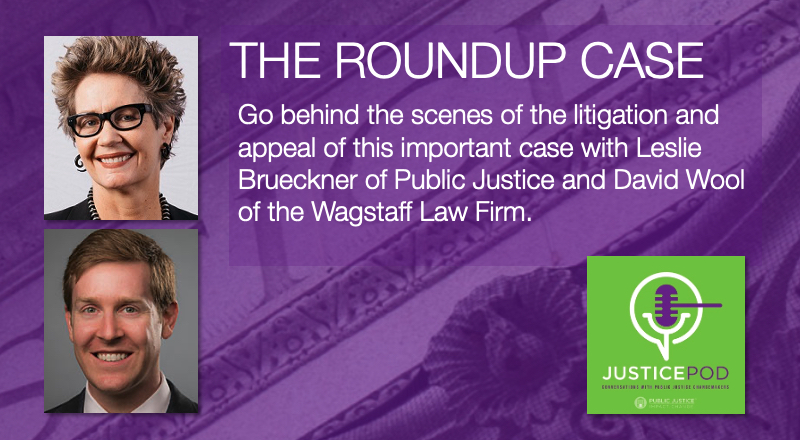
    Public Justice Discusses Hardeman v. Monsanto in First Episode of Justice Pod

    Justice Pod

    That is according to a post written by Leslie Brueckner, Senior Attorney with Public Justice following the May 2021 Ninth Circuit U.S. Court of Appeals ruling against Monsanto, and for Edwin Hardeman, a California resident who developed non-Hodgkin’s lymphoma after decades of exposure to Roundup. The jury awarded Hardeman $5,267.634.10 in compensatory damages, and $75 million in punitive damages. The district court reduced the punitive damages award to $20 million. 

    In this inaugural episode of Justice Pod: Conversations with Public Justice Change Makers, Leslie, is joined by David J. Wool, an attorney with the Wagstaff Law Firm.  Wool and Jennifer A. Moore of the Moore Law Group, were on the trial team led by highly-regarded mass tort plaintiff attorney Aimee Wagstaff.  Public Justice’s Brueckner served as co-lead appellate counsel along with Wool before the Ninth Circuit.

    Listen to what they felt inspired the jury to return such a substantial award, how Monsanto attempted to defend its actions, what the evidence revealed, and what it was like in the courtroom with the Hardeman family when the foreman read the verdict.

    I hope you find the episode inspiring and informative!

    Susan Gombert
    Host of Justice Pod:
    Conversations with Public Justice Change Makers

    Listen Now!

    Monsanto Co. has “stopped at nothing to deny the overwhelming scientific evidence” that its widely used and extremely profitable weed killer,  Roundup, is a “deadly product that causes cancer and ruins lives and families.”

  • Putting an AI App to Work to Protect IP with Jan-Diederik Lindemans and Judith Bussé

    Putting an AI App to Work to Protect IP with Jan-Diederik Lindemans and Judith Bussé

    Putting an AI App to Work to Protect IP with Jan-Diederik Lindemans and Judith Bussé

    They are Crowell & Moring partner Jan-Diederik Lindemans and Judith Bussé, both part of the firm’s Technology & Intellectual Property Department in Brussels. And, working with Neotalogic, they developed an interactive app that takes you through a set of attorney-crafted questions that, depending on your answers, take you to other questions. The app applies a layer of artificial intelligence to enhance the information gathering process. Listen to what these innovators had to say about the Crowell & Moring IP Check-Up application, and take it for a test drive yourself.  Or, here is a quick video of someone using the app.

    This podcast is the audio companion to the Journal on Emerging Issues in Litigation*, a collaborative project between HB Litigation Conferences and the legal news folks at Law Street Media, and the Fastcase legal research family, which includes Docket Alarm and Judicata. If you have comments or wish to participate in one our projects, or want to tell me how insightful our guests are, please drop me a note at Editor@LitigationConferences.com.

    Tom Hagy
    Host of the Emerging Litigation Podcast

    * Highly regarded insurance and reinsurance industry attorney Laura Foggan of Crowell & Moring’s Washington, DC, office is on the Editorial Advisory Board. Thanks to Laura for connecting me with J.D. and Judith. 

    An organization’s intellectual property is often its most valuable asset.

    Whether it’s a patent or a trademark, a graphic design or proprietary market information, or just the unique way they do what they do, organizations must protect their innovations or risk significant damage to their future prospects.

    Assessing the vulnerabilities of such valuable inventory is as important as it is time-consuming. But a portfolio protection and process review involves answering the same long set of questions posed to any organization, no matter what type.

    There is the problem. You have a critical invention. You don’t know if it’s at risk. What do you do? You contact a lawyer, of course. You go through the process, one they have managed many times before. What if you could do this yourself first, before contacting a firm? What if it took just 20 minutes and could be done from the comfort of your desk? If you’re the attorney, what if you already had many of your questions answered before your first meeting with a new client? 

    An innovative pair of attorneys in Brussels asked these questions and came up with a solution. And I had the pleasure of interviewing them.

  • IP Check-Up

  • Strategies for Maximizing Insurance Recovery for Climate Change–Related Loss and Damage

    Strategies for Maximizing Insurance Recovery for Climate Change–Related Loss and Damage

    Strategies for Maximizing  Insurance Recovery for Climate Change–Related Loss and Damage

    Abstract

    Losses from natural catastrophes are costing many tens of billions as year, from hurricanes and tornadoes to record-breaking rainfall and floods. Whether the insurance industry will or can provide coverage for all of the devastating effects of climate change (or, as some might put it, a new and calamitous phase in our earth’s existence) only time will tell. In the meantime, policyholders must cross their Ts if they expect coverage. In this article the author shares insights on the complex but essential task of documenting and valuing post-storm losses.

    Author

    Dennis J. Artese (dartese@andersonkill.com) is a shareholder in the New York office of Anderson Kill P.C. His practice concentrates on insurance recovery litigation, with an emphasis on securing insurance coverage for first-party property losses, construction accidents, and third-party liability claims.

    About
    The Journal on Emerging Issues in Litigation is a co-production of HB, Fastcase, and Law Street Media. You can also hear the complementary (and complimentary) Emerging Litigation Podcast wherever podcasts appear. For questions, contact Tom Hagy, Editor in Chief, at Editor@LitigationConferences.com.

    Loading Viewer…

  • Biotech Patent Wars: If at First You Don’t Succeed . . . University of California v. The Broad Institute

    Biotech Patent Wars: If at First You Don’t Succeed . . . University of California v. The Broad Institute

    Biotech Patent Wars: If at First You Don’t Succeed . . . University of California v. The Broad Institute

    Abstract

    This case discussed in this article is about two methods of editing DNA: one that has infinitely more lucrative applications because it can edit human DNA (plus all animals and plants), another that works in cell-free environments. Whether inventions are separate or part of the same innovation is an important factor in patent interference disputes; if there are two patentably distinct inventions there cannot be interference. One party in this case lost its argument that there was only one invention at issue, but returned with a second interference claim, arguing that it was the first inventor to constructively reduce to practice the animal and plant DNA editor. In this article, the author examines the nuances and intricacies of the patent process in the world of biology, and how patent lawyers must possess a level of knowledge in disciplines related to the inventions they seek to protect. This is necessary, for example, in understanding whether an invention is a significant improvement over prior innovations. The author also shares the importance of confidentiality especially when potentially groundbreaking (and lucrative) inventions are in development.

    Author

    Adrienne B. Naumann (adriennebnaumann@uchicago.edu) practices intellectual property law at the Law Office of Adrienne B. Naumann in Skokie, Illinois. She has held leadership positions relating to patents, science, and technology law with the Chicago Bar Association and the Converging Technologies Association. She currently serves as Secretary on the Board of the University of Chicago Women’s Alliance. Ms. Naumann has also written numerous articles on intellectual 56 Journal of Emerging Issues in Litigation property law and her book United States Federal Intellectual Property Developments includes discussion of decisions under the Defend Trade Secrets Act as well as those by the Supreme Court and was published by Pincus Professional Education.

    About
    The Journal on Emerging Issues in Litigation is a co-production of HB, Fastcase, and Law Street Media. You can also hear the complementary (and complimentary) Emerging Litigation Podcast wherever podcasts appear. For questions, contact Tom Hagy, Editor in Chief, at Editor@LitigationConferences.com.

    Loading Viewer…

  • Mega Verdict Threat: Tackling Damages Early Can Mitigate Outsized Jury Awards

    Mega Verdict Threat: Tackling Damages Early Can Mitigate Outsized Jury Awards

    Mega Verdict Threat: Tackling Damages Early Can Mitigate Outsized Jury Awards

    Abstract

    Why have medical malpractice verdicts in recent years reached such astronomical new heights? In this article the author addresses several of the factors that drive juries to return such punishing awards, discussing the unexpected impact of tort reform, the role of life-care planners and economists in determining damages, the ramifications of litigation financing, plaintiff attorneys’ utilization of the so-called reptile theory, and the influence of how the media reports on these verdicts. The author offers practical methods for defense attorneys involved in this litigation and insights that will benefit attorneys in any type of tort matter.

    Author

    Sandra M. Cianflone (scianflone@hallboothsmith.com) is an attorney at law firm Hall Booth Smith, P.C., whose practice primarily focuses on medical malpractice.

    About
    The Journal on Emerging Issues in Litigation is a co-production of HB, Fastcase, and Law Street Media. You can also hear the complementary (and complimentary) Emerging Litigation Podcast wherever podcasts appear. For questions, contact Tom Hagy, Editor in Chief, at Editor@LitigationConferences.com.

    Loading Viewer…

  • Remediating, Insuring, and Litigating PFAS Claims

    Remediating, Insuring, and Litigating PFAS Claims

    Remediating, Insuring, and Litigating PFAS Claims

    Abstract
    PFAS are a group of chemicals found in a variety of products (e.g., Teflon®) and have been used widely in industrial and environmental processes (e.g., oil recovery, firefighting). They do not break down, and over time can accumulate in the body and the environment. While largely no longer used in the United States, they continue to be used internationally. Studies have shown they have adverse health effects on humans and animals.
    In this article the authors discuss the history and impact of PFAS, insurance coverage for claims relating to PFAS contamination, the practice of “insurance archaeology,” maximizing insurance coverage, and, finally, existing and anticipated litigation arising from environmental damage and bodily harm from PFAS.

    Authors

    Dr. Jaana Pietari, PhD, MBA, PE (jpietari@ramboll.com), Senior Managing Consultant with Ramboll Group, has more than twenty years of professional and academic experience in the fate and transport of contaminants, the reconstruction of environmental releases to groundwater and sediments, and environmental forensics.

    Jim Fenstermacher, PE (jim.fenstermacher@ramboll.com), is a Subject Matter Expert on PFAS environmental fate, transport, and regularly interfaces with academia, provides branding, and supports business development efforts regarding PFAS issues.

    Dr. Michael Bock, PhD, MS (mbock@intell-group.com), Managing Director at The Intelligence Group, has more than twenty-five years of experience in environmental consulting with a specialization in environmental forensics and the investigation and assessment of contaminated soils, groundwater, and marine and freshwater sediments.

    Robert D. Chesler (rchesler@andersonkill.com) is a shareholder in Anderson Kill’s Newark office. Bob represents policyholders in a broad variety of coverage claims against their insurers and advises companies with respect to their insurance programs. Bob is also a member of Anderson Kill’s Cyber Insurance Recovery group.

    Nicholas M. Insua (ninsua@andersonkill.com) is a shareholder in the New Jersey and Philadelphia offices of Anderson Kill who focuses his practice on insurance recovery litigation and counseling. Nick also represents clients in business disputes outside the insurance coverage context. He is a member of the firm’s COVID Task Group.

    Sheila Mulrennan (smulrennan@iagltd.com) is the President of Insurance Archaeology Group (IAG) which she founded in 1985. Featured in a survey of “One Hundred Leading Women” in Business Insurance, Sheila is one of the nation’s foremost specialists in historic insurance reconstruction. Under her direction, IAG has pioneered the methods to research missing policies.

    Robin Kelliher (robin.kelliher@willistowerswatson.com) is the National Director for Environmental Claims with the Environmental Practice at WillisTowersWatson. As National Director of the Environmental Claims Practice, Robin leads a team of claim professionals responsible for delivery of technical and strategic consulting services designed to assist clients in managing environmental loss and claims.

    Jason R. Waters (jason.waters@wilsonelser.com) is the Regional Managing Partner of Wilson Elser’s McLean, Virginia office. He also co-chairs the firm’s national Toxic Tort & Environmental Practice Team. Jason has more than 20 years of experience litigating complex claims involving a wide variety of alleged exposures.

    About
    The Journal on Emerging Issues in Litigation is a co-production of HB, Fastcase, and Law Street Media. You can also hear the complementary (and complimentary) Emerging Litigation Podcast wherever podcasts appear. For questions, contact Tom Hagy, Editor in Chief, at Editor@LitigationConferences.com.

    Loading Viewer…

    via GIPHY

    Listen Now

    Explore more from Bob Chesler and Anderson Kill

    Journal on Emerging Issues, Editorial Board of Advisors

    The Use and Abuse of the Pollution Exclusion. By Dennis Artese, Jamie O’Neil, Robert Chesler

    The Environmental, Social, and Governance Police Have Arrived: Is your Insurance Ready. Authors: Dennis Artese, Bob Chesler.

    PFAS Insurance Coverage with Jaana Pietari and Jim Fenstermacher and Litigation with Bob Chesler: Part 1 of 2 Podcasts

    PFAS Insurance Coverage with Robert D. Chesler of Anderson Kill. Part 2 of 2 Podcasts

    How Insurance Companies Defraud Their Policyholders, and What Courts and Legislators Should Do About It. By Robert Chesler and Amy Weiss 

    Climate Change, ESG, D&O Insurance: Collision or Cooperation? By Robert D. Chesler, Dennis J. Artese and Joseph Villa

    Remediating, Insuring, and Litigating PFAS Claims. Authors: Dr. Jaana Pietari, PhD, MBA, PE, Jim Fenstermacher, PE, Dr. Michael Bock, PhD, MS, Robert D. Chesler and Nicholas M. Insua, Sheila Mulrennan, Robin Kelliher, Jason R. Waters