Blog

  • Persuasion Science for Trial Lawyers with John Blumberg

    Persuasion Science for Trial Lawyers with John Blumberg

    Persuasion Science for Trial Lawyers with John Blumberg

    John joins me to discuss his study of the science behind persuasion. He examines a number of important concepts for trial attorneys, such as how emotions overcome rational thought, and how mental fatigue interferes with how we receive information, leading us to take mental shortcuts rather than doing the hard work of critical thinking. He also writes about understanding the differences between liberal and conservative brains.

    In addition to being an author, John is a board-certified trial attorney based in Long Beach, California. He handles both legal and medical malpractice litigation and is on American Board of Trial Advocates.

    You will especially want to hear my contributions, such as what I know about the rule of threes. For example, a joke about a doctor, a lawyer, and a duck is much funnier than one about just a doctor and a lawyer. Unless, of course, at least one of them is a duck.

    This podcast is the audio companion to the Journal on Emerging Issues in Litigation, a collaborative project between HB Litigation Conferences and the Fastcase legal research family, which includes Full Court Press, Law Street Media, and Docket Alarm. The podcast itself is a joint effort between HB and Law Street Media. If you have comments or wish to participate in one our projects, or want to tell me how much  you learned from John,  please drop me a note at Editor@LitigationConferences.com.

    Tom Hagy
    Litigation Enthusiast and Host of the Emerging Litigation Podcast

    “Your proposition may be good, but let’s have one thing understood: Whatever it is, I’m against it. And even when you’ve changed it or condensed it—I’m against it!”

    —Professor Wagstaff (Groucho Marx) in the 1932 movie Horse Feathers


    Attorney John P. Blumberg’s new book, Persuasion Science for Trial Lawyers, published by Fastcase Full Court Press, “takes a fascinating new approach to examining why certain advocacy techniques do and don’t work to persuade trial juries,” writes Susan G. Poehls. Director of Trial Advocacy Programs and William C. Hobbs Professor of Trial Advocacy at Loyola Law School, Poehls calls it an eye-opening read, one that will run “counter to what many of us have been taught for decades.”

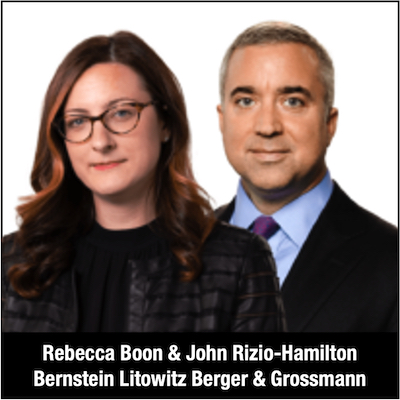
  • Can we rely on shareholders to compel corporations to meaningfully act on ESG issues? | By Rebecca Boon and John Rizio-Hamilton | Bernstein Litowitz Berger & Grossmann

    Can we rely on shareholders to compel corporations to meaningfully act on ESG issues? | By Rebecca Boon and John Rizio-Hamilton | Bernstein Litowitz Berger & Grossmann

    The Authors

    Rebecca Boon

    Rebecca BoonPartner | Bernstein Litowitz Berger & Grossmann

    Rebecca Boon has been litigating securities fraud and shareholder rights actions for over a decade, recovering more than $1.5 billion for the firm’s institutional investor clients. Her work at the firm expands beyond litigation. Rebecca has advanced equality in the workplace by co-founding the Beyond #MeToo working group and leading landmark recoveries that have resulted in hundreds of millions of dollars back to investors and important social change among industries.

    Contact: rebecca.Boon@blbglaw.com

    John Rizio-Hamilton

    John Rizio-HamiltonPartner | Bernstein Litowitz Berger & Grossmann

    John Rizio-Hamilton is one of America’s top shareholder litigators. He works on the most complex and high-stakes securities class action cases, and has recovered billions of dollars on behalf of institutional investor clients.

    John led the trial team that recovered $240 million for investors in In re Signet Jewelers Limited Securities Litigation, a precedent-setting case that marks the first successful resolution of a securities fraud class action based on allegations of sexual harassment.

    Contact: johnr@blbglaw.com

    Can we rely on shareholders to compel corporations to meaningfully act on ESG issues?

    By Rebecca Boon and John Rizio-Hamilton

    This article was first published in the Responsible Investor, Aug., 10th, 2021. Posted with permission of the authors. Copyright 2021 by Rebecca Boon & John Rizio-Hamilton.  All rights reserved.

    There is an ongoing debate about the role that regulators should take regarding corporate obligations and accountability for ESG issues. Earlier this year, the Ontario Capital Markets Modernization Taskforce weighed in with its long-anticipated recommendation on diversity quotas for corporate boards. After receiving significant industry feedback, the Ontario Taskforce changed its initial recommendation from a requirement that public companies meet specific diversity targets, to allowing companies to set their own targets, report them, and develop a timeline for implementation. This ‘market-based’ framework for diversity would rely on investors to push corporations and hold them accountable.

    There was significant backlash when the Ontario Taskforce changed its initial recommendation. It was accused of not going far enough and caving to corporate pressure. However, it decided that allowing corporations to set their own quotas would avoid a ‘one size fits all’ approach, prevent corporations from simply complying with a minimum target, and limit instances of tokenism. The reporting requirement would force companies to implement material quotas and stand by them because they would be too afraid of investor reactions to do anything less than meaningful.

    In crafting governance reforms in some of the most significant derivative litigation in history, we spend considerable time thinking about how to enact meaningful and lasting social change at corporations. One key component is to get insider buy-in – because if the change is simply imposed from above, there could be internal resistance, a lack of commitment and a tendency to make only superficial progress. But the question is: can we rely on shareholders to compel corporations to meaningfully act on ESG issues? Recent history says yes. A market-based approach that incentivises good ESG practices could make a significant difference, when coupled with smart regulation.

    A recent study found that for every additional 8% of a company’s stock owned by the Big Three, the number of new women board members increased by 76%.

    For example, UK regulators just announced that London-listed companies should have at least 40% women and one non-white director on their boards. Similar to the Ontario Taskforce, the goals are not binding but if companies do not meet them, they must explain why. In the US, the Securities and Exchange Commission’s Advisory Panel also recently offered ESG and Diversity & Inclusion disclosure recommendations, designed to allow investors to understand what terms like ‘sustainable’ or ‘green’ actually mean.

    According to Chairman Gary Gensler, “investors should be able to drill down to see what’s under the hoods” at the companies and investment funds making these claims.

    The ‘Big Three’ asset management firms – BlackRock, Vanguard and State Street Global Advisors – recently made headlines when they supported Engine No.1, the Exxon activist investor that led a successful campaign to secure three board seats for its chosen candidates, in a bid to push Exxon to address long-term climate risk and move to clean energy, among other things. Exxon Director Ursula Burns acknowledged that the campaign’s success is part of a “tidal wave” of investor concerns on ESG issues. This victory would not have been possible without the support of three of the biggest investors in the US.

    In addition, big investors have committed to vote against firms that do not appoint more women directors to their boards. In January, State Street announced that it will now vote against the Chair of the Nominating & Governance Committee at companies in the S&P 500 and FTSE 100 that do not disclose the racial and ethnic composition of their boards; and in 2022, it will vote against them if they do not have at least one director from an underrepresented community.

    Similarly, Goldman Sachs will no longer take a company public without two diverse board members, one of whom must be a woman.

    The SEC has just approved a proposal by US marketplace Nasdaq for all its listed companies to disclose board-level diversity statistics and either meet the objective of 1 or 2 ‘diverse’ directors (depending on size) or explain why they have not. Some criticised the Ontario Taskforce – and others heralded it – for not taking Nasdaq’s “extreme position”.

    Are any of these initiatives enough? No. But investor pressure works. A recent study from the Kellogg School of Management at Northwestern University found that for every additional 8% of a company’s stock owned by the Big Three, the number of new women board members increased by 76%. Critically, the same study found that in response to investor pressure, women on boards get “power positions” on audit and nominating committees at even higher numbers than companies complying with mandatory quotas.

    Investors have also taken direct action by filing lawsuits alleging toxic workplace cultures of discrimination and retaliation against female executives, and racial and gender bias. And investors are no less active on environmental issues. For example, investors are currently prosecuting a securities fraud class action in Ohio against Energy Transfer, arising from the explosion of a natural gas pipeline that wreaked environmental havoc in Pennsylvania. These lawsuits are in early stages, but the pressure is on. Corporations have to address social issues because investors are demanding it.

    We have already seen what investor demands for accountability can do in US securities cases involving #MeToo issues and sexual harassment allegations. As the #MeToo movement went mainstream, we saw the first successful securities case addressing sexual harassment allegations – in a shareholder derivative lawsuit involving Fox News parent Twenty-First Century Fox. Investors were listening.

    Following a year of litigation, the lawsuit uncovered allegedly systemic problems at the network involving multiple senior executives, multiple types of discrimination and harassment, and a toxic workplace characterised by surveillance, retaliation and fear.

    Ultimately, as part of a $90m settlement, the plaintiff and the company unveiled a series of governance reforms designed to fix the broken sexual harassment culture at Fox News. The resulting Fox News Workplace Professionalism and Inclusion Council is majority-independent, but also has company participation, along with broad powers and a mandate to identify and solve the problems at the company. A critical component is investor accountability – the Council has the power to issue minority reports that Fox is mandated to post publicly for investors and the world to see. It also has a mandatory five-year term and if Fox determines to dissolve the Council, it must publicly state the reasons why. This approach set the stage for the recent high-profile settlement of a securities case against L Brands, which also settled for $90m. The firm committed to invest a further $45m over at least five years in a Diversity, Equity & Inclusion Council, and take other measures to protect employees from harassment and discrimination, requiring accountability when misconduct occurs.

    We also recently saw the first successful direct securities action certified as a class action involving allegations of sexual harassment against Signet Jewelers. When the market learned that hundreds of women had submitted declarations describing alleged sexual harassment reaching to the company’s highest levels, Signet was forced to halt trading to address them; and when trading resumed, the company’s stock price declined 13%. Again, investors were listening.  The Signet case settled for $240m in late 2020.

    It is too soon to know whether the newer cases will be successful, or whether the new regulations will have any teeth. But pressure from the Big Three and the corresponding dramatic increase in the number of women on corporate boards confirms that when investors demand diversity, companies respond. Investors have shown that they are willing and ready to compel corporations to act on important social issues. And recent securities cases involving #MeToo issues have demonstrated to the corporate world that investors can use their significant power to demand change and hold corporations accountable when they fail to act.

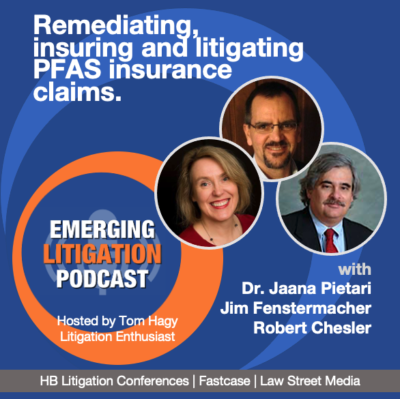
  • PFAS Science with Jaana Pietari and Jim Fenstermacher and Litigation with Bob Chesler

    PFAS Science with Jaana Pietari and Jim Fenstermacher and Litigation with Bob Chesler

    PFAS Science with Jaana Pietari and Jim Fenstermacher and Litigation with Bob Chesler

    In Part 1 of the episode, we discussed the PFAS from the scientific and environmental engineering perspective. And to do that I was fortunate to have  Jim Fenstermacher and Dr. Jaana Pietari from the global engineering firm Ramboll.  Jim and Jaana have deep experience in environmental remediation involving a variety of contaminants, including PFAS.

    In Part 2, I am joined by Robert Chesler of Anderson Kill. Bob is a long-time expert on insurance coverage for long-tail and other claims. He’s considered a guru in the field, and has represented policyholders in disputes over coverage with insurers for as long as I’ve known him.

    It’s a serious subject and these are seriously qualified folks. I did my part to make a mockery of scientific terms as I struggled to say the name of this family of chemicals. Fortunately for you my guests were much more linguistically nimble and it is their voices you will hear more of.

    This podcast is the audio companion to the Journal on Emerging Issues in Litigation, a collaborative project between HB Litigation Conferences and the Fastcase legal research family, which includes Full Court Press, Law Street Media, and Docket Alarm. The podcast itself is a joint effort between HB and Law Street Media. If you have comments or wish to participate in one our projects, or want to tell me how much  you learned from Jaana, Jim and Bob,  please drop me a note at Editor@LitigationConferences.com.

    Tom Hagy
    Litigation Enthusiast and Host of the Emerging Litigation Podcast

    p.s. Here’s a bonus for you. Write to me and I will send you the latest issue of the Journal on Emerging Issues in Litigation with my compliments.  That’s some serious value right there.

    In our first two-part episode, we dive into the troubling existence of a group of chemicals referred to as PFAS, with the nickname “Forever Chemicals,” because they stubbornly hang around in water, air, fish, soil, people, and animals.  

    PFAS — which stands for per- and polyfluoroalkyl  chemicals — are man-made creations that have been used in industry and consumer products worldwide since the 1950s. There are more than 4,000 of them, so it’s a big family. They can be found in non-stick cookware, water-repellent clothing, stain-resistant fabrics and carpets,  cosmetics,  firefighting foams, and products that resist grease, water, and oil. Studies have shown that exposure to some PFAS in the environment may be harmful to humans and animals.

    PFAS contamination has sparked some major litigation, with some cases involving hundreds or thousands of individuals that have settled for hundreds of millions of dollars. The PFAS issue is significant enough that  — despite so many other pressing issues — the White House made it a top priority, kicking eight federal departments into gear to tackle the situation.  It’s a hot topic that’s going to be with us for many years.

    Explore More from Anderson Kill!

    Journal on Emerging Issues, Editorial Board of Advisors

    The Use and Abuse of the Pollution Exclusion. By Dennis Artese, Jamie O’Neil, Robert Chesler

    The Environmental, Social, and Governance Police Have Arrived: Is your Insurance Ready. Authors: Dennis Artese, Bob Chesler.

    Podcast 1 of 2: PFAS Insurance Coverage with Jaana Pietari and Jim Fenstermacher and Litigation with Bob Chesler

    Sister to Podcast 1 of 2 Article. Remediating, Insuring, and Litigating PFAS Claims. Authors: Dr. Jaana Pietari, PhD, MBA, PE, Jim Fenstermacher, PE, Dr. Michael Bock, PhD, MS, Robert D. Chesler and Nicholas M. Insua, Sheila Mulrennan, Robin Kelliher, Jason R. Waters

    Podcast 2 of 2: Insurance Coverage for PFAS Claims with Robert Chesler

    Podcast: Autonomous Vehicles: The New Technology Driving the Litigation Conversation Podcast with Cort Malone, John Leonard, Joshua Zelen

    Podcast: Violations of Biometric Privacy Laws: Policyholders’ Victories and the Implications Going Forward with John Leonard and Cort Malone

    Journal on Emerging Issues, Editorial Board of Advisors: Dennis Artese, Robert D. Chesler

    How Insurance Companies Defraud Their Policyholders, and What Courts and Legislators Should Do About It. Authors: Robert Chesler, Dennis J. Artese, and Joseph Villa

    Asymmetrical Combat: Bad Faith Liability in Insurance Recovery Cases. By William Passannante

    Litigation After Biometric Privacy Law Violations: Policyholder Victories and Their Implications. Authors: Cort T. Malone, Abigail Damsky

    Climate Change, ESG, D&O Insurance: Collision or Cooperation? By Robert D. Chesler, Dennis J. Artese and Joseph Villa

    Protecting Policyholders as AI Is Developed for Insurance Claims Handling – Ensuring “Decency and Humanity” in the Digital Age. Authors: Marshall Gilinsky, Madison Marlow

    Police–The Environmental, Social, and Governance Police Have Arrived: Is your Insurance Ready. Authors: Dennis Artese, Bob Chesler

    How Insurance Companies Defraud Their Policyholders, and What Courts and Legislators Should Do About It. Authors: Robert Chesler, Amy Weiss, and Jade Sobh

    The Promise and Peril of Quantum Computing and Its Implications for Cyber Insurance. By Cameron R. Argetsinger

    The Use and Abuse of the Pollution Exclusion. Authors: Dennis Artese, Jamie O’Neil, Robert Chesler

    Property Insurance Coverage for Emerging Risk: Underground Climate Change. Authors: Dennis J. Artese, Ethan W. Middlebrooks, Thomas Dupont

    Autonomous Vehicles: The New Technology Driving the Litigation Conversation. Authors: Cort Malone, John Leonard, and Joshua Zelen

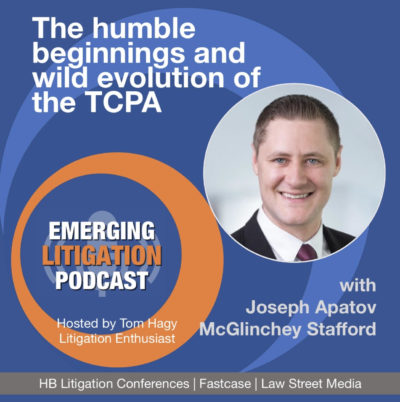
  • The Humble Beginnings and Wild Evolution of the TCPA with Joe Apatov

    The Humble Beginnings and Wild Evolution of the TCPA with Joe Apatov

    The Humble Beginnings and Wild Evolution of the TCPA with Joe Apatov

    Only $32 million!  I mean, why bother even getting out of bed? Joining me to discuss the evolution of the TCPA is Joseph A. Apatov (japatov@mcglinchey.com), a member of the McGlinchey Stafford law firm’s Consumer Financial Services Litigation practice group. Based in their Fort Lauderdale office, Joe litigates on behalf of financial services clients in both state and federal courts, with an emphasis on defending banks, mortgage lenders and servicers, private-label card issuers, and automobile finance companies. 

    Apologies for my trip down memory lane. Bear with me as I regale you with stories from the newsroom at Mealey’s Litigation Reports and the team’s anxious reliance on the “latest” technology: the facsimile machine.

    This podcast is the audio companion to the Journal on Emerging Issues in Litigation, a collaborative project between HB Litigation Conferences and the Fastcase legal research family, which includes Full Court Press, Law Street Media, and Docket Alarm. The podcast itself is a joint effort between HB and Law Street Media. If you have comments or wish to participate in one our projects, or want to tell me how much Joe enlightened you, please drop me a note at Editor@LitigationConferences.com.
     
    Tom Hagy
    Litigation Enthusiast and Host of the Emerging Litigation Podcast

    “The Telephone Consumer Protection Act had humble beginnings,” our guest writes, “with the bill’s sponsor explaining that the statute would permit consumers to bring small claims cases ‘without an attorney,’ and provides for an ‘amount of damages … fair to both the consumer and the telemarketer.’ Twenty-eight years after its enactment in 1991, the Eighth Circuit Court of Appeals affirmed a District Court’s decision to reduce a $1.6 billion jury award in a TCPA class action to only $32 million because the former was ‘shockingly large’ and ‘oppressive,’ in violation of the Due Process Clause …..”

  • Where’s Your Head? Managing the Mind in Mediation with Jeff Trueman

    Where’s Your Head? Managing the Mind in Mediation with Jeff Trueman

    Where’s Your Head? Managing the Mind in Mediation with Jeff Trueman

    Joining me to discuss this is  Jeff Trueman, an experienced, full-time mediator and arbitrator. Jeff helps parties resolve a wide variety of litigated and pre-suit disputes and interpersonal problems concerning catastrophic injuries, professional malpractice, wrongful death, employment, family business dissolution, real property, estate, and domestic relations. He is a panel mediator for the American Arbitration Association; a  panel arbitrator for the Financial Industry Regulatory Authority; a Distinguished Fellow of the International Academy of Mediators; a recipient of the Paul A. Dorf Alternative Dispute Resolution Memorial Award by the Bar Association of Baltimore City; and will soon hold an LLM from the Straus Institute for Dispute Resolution at the prestigious Pepperdine School of Law. 

    Finally, did I really suggest that having a mediator with a bad hip could help achieve a faster resolution? Did I really give a review of the HBO original movie Oslo, which I consider a must-see for anyone interested in conflict resolution? Did I really compare married couples during Covid-19 lockdowns to angry bees in a jar? Listen and find out. Spoiler alert: Yes. Yes I did. 

    This podcast is the audio companion to the Journal on Emerging Issues in Litigation, a collaborative project between HB Litigation Conferences and the Fastcase legal research family, which includes Full Court Press, Law Street Media, and Docket Alarm. The podcast itself is a joint effort between HB and Law Street Media. If you have comments or wish to participate in one our projects, or want to tell me how Jeff really got you thinking, please drop me a note at Editor@LitigationConferences.com.

    Tom Hagy
    Litigation Enthusiast and Host of the Emerging Litigation Podcast

    “Attorneys possess many of the same characteristics as their human cousins.” Someone said that. Probably me. They often bring to their jobs cognitive barriers that get in the way of negotiating resolutions to conflicts. Same for their human clients.

    Things like refusal to cede the moral high-ground, or stubbornly believing  there must always be someone to blame. Then there is overconfidence (i.e.,  “I am right and will win in court!”) or they might enjoy selective memory, confirmation bias, and loss aversion.  Attorneys are often in the position of mediator and problem solver. What can attorneys do to more effectively achieve satisfactory outcomes when the parties bring in their own set of human characteristics and emotions? 

  • 7th Circuit: Is Each Transmission of Biometric Data a BIPA Violation? | By Jennifer M. Oliver | MoginRubin LLP

    7th Circuit: Is Each Transmission of Biometric Data a BIPA Violation? | By Jennifer M. Oliver | MoginRubin LLP

    7th Circuit: Is Each Transmission of Biometric Data a BIPA Violation?

    By Jennifer M. Oliver

    The outcome of this case will have a dramatic impact on statutory damages.

    The Seventh Circuit U.S. Court of Appeals has certified a question to the Illinois Supreme Court over the accrual of claims under the Illinois Biometric Information Privacy Act (BIPA). The question, posed by the court in Cothron v. White Castle Systems, Inc., reads:

    “Do section 15(b) and 15(d) claims accrue each time a private entity scans a person’s biometric identifier and each time a private entity transmits such a scan to a third party, respectively, or only upon the first scan and first transmission?”

    The case was brought by an employee of the White Castle hamburger chain, which requires fingerprint scans for employees to access computer systems. The plaintiff charged that sharing her fingerprints with a third party vendor violated the law. Cothron v. White Castle Sys., No. 20-3202, 2021 U.S. App. LEXIS 37593 (7th Cir. Dec. 20, 2021).

    An accrual rule based on each collection, opponents to such a finding argue, would pose potentially existential damages — especially in the class action context — since BIPA provides for statutory damages of $1,000 or $5,000 per violation. Parties disagree on whether BIPA damages are mandatory or discretionary, however. Should the court determine that the first scan is the only scan that starts the statute of limitations clock ticking, opponents to that interpretation say,  anyone bringing a claim after five years would be out of luck, even if their private biometric data continued to be transmitted more than five years after the first occurrence.

    Preceding the federal court’s certification of this question by just five days, an Illinois appellate court ruled that, yes, claims under sections 15(a) and (b) accrue with each capture and use of a plaintiff’s biometric  information. Watson v. Legacy Healthcare Financial Services, LLC, et al., 2021 IL App (1st) 210279 No. 1-21-0279, Opinion filed Dec. 15, 2021.

    This is an important case to watch. Illinois was the first to implement such legislation, something several states have since emulated.

    Should the state Supreme Court come down in favor of an “all scans” interpretation, defendants may find themselves on the receiving end of devastating damages multipliers. Of course, the Illinois Supreme Court could determine that damage awards are at the discretion of a court, and are not mandatory under the law. Or it could rule that every scan or transmission restarts the statute of limitations clock, but that a claimant may only collect damages once for a series of transmissions of the same data, similar to how damages for defamation are not based on each publication of the same defaming remarks. Yet another possibility is that the court could determine that the clock starts to run when a claimant first learns of an alleged violation, which has precedent in litigation involving latent diseases caused by products, where individuals cannot know they were harmed until they developed a signature disease, i.e., one connected to a specific product.

    The ruling in this case is especially interesting as the COVID-19 pandemic has led to skyrocketing adoption of remote access tools that can collect biometric data for learning, court appearances, and work-from-home arrangements, and a corresponding uptick in BIPA lawsuits.

    Edited by Tom Hagy for MoginRubin LLP. Reposted with permission from the MoginRubin Blog. © 2022 MoginRubin LLP. 

    The Author

    Jennifer M. Oliver

    Jennifer M. OliverMoginRubin LLP

    Jennifer is a partner in the San Diego offices of MoginRubin LLP, where she focuses on antitrust, complex business, and investment litigation. Her experience includes active roles in several high-profile jury trials, serving as lead counsel in complex mediations, and arguing before courts at both the trial and appellate levels. Jennifer earned her B.S. (Business Administration), M.B.A., and J.D. degrees from the University at Buffalo, each with honors, where she also served as the Vice President of the undergraduate student body and was an editor of the Buffalo Law Review and Buffalo Intellectual Property Law Journal. Jennifer is also a certified information privacy professional.

    We are pleased to add that Jennifer is a member of the Board of Advisors for the Journal on Emerging Issues in Litigation and the Emerging Litigation Podcast.

    More from Jennifer and her colleagues.

  • The New Lloyd’s Market Association War, Cyber War and Cyber Operation Exclusions for Cyber Insurance Policies | By Vincent J. Vitkowsky | Gfeller Laurie LLP

    The New Lloyd’s Market Association War, Cyber War and Cyber Operation Exclusions for Cyber Insurance Policies | By Vincent J. Vitkowsky | Gfeller Laurie LLP

    The Author

    Vincent J. Vitkowsky

    Vincent J. VitkowskyPartner | Gfeller Laurie LLP

    Vince Vitkowsky is a partner in Gfeller Laurie LLP, resident in New York. He focuses on cyber risks, liabilities, insurance, and litigation. Vince assists insurers and reinsurers in product development, and in all aspects of coverage evaluation and dispute resolution in many lines of business, including cyber, CGL, property, and professional liability. He also assists in complex claim evaluations, and if necessary, the defense of insureds in complex matters.

    Vince is also a member of the Editorial Advisory Board for the Journal on Emerging Issues in Litigation.

    Contact: vvitkowsky@gllawgroup.com

    More from Vince and his colleagues.

    Melicent Thompson

    The New LMA War, Cyber War and Cyber Operation Exclusions for Cyber Insurance Policies

    By Vincent J. Vitkowsky

    On November 25, 2021, the Lloyd’s Market Association released four War, Cyber War and Cyber Operation Exclusions (“Exclusions”). The LMA Cyber Business Panel spent well over two years drafting the Exclusions, which are models for use in standalone cyber insurance policies.  Lloyd’s has agreed that they meet the requirement that all insurance and reinsurance policies written at Lloyd’s must, except in very limited circumstances, contain a clause which excludes all losses caused by war.  The Exclusions address some difficult issues troubling the cyber insurance market for several years, following cyberattacks by nation-states (“states”) and threat actors associated with them.  They attempt to reduce uncertainty for both insurers and policyholders.

    Five interrelated issues.

    • The treatment of collateral damage (borrowing a concept from the traditional Law of Armed Conflict). Some state-sponsored attacks had significant effects on many entities that were not the intended targets.
    • How attribution is to be determined, and whether the insurers have an obligation to make payments while attribution is being determined.
    • The extent to which attacks by non-state actors associated with a state are excluded.
    • The treatment of state and state-sponsored cyberattacks directed at essential services, most notably those disrupting financial institutions and the financial markets infrastructure.
    • As in war exclusions in all lines of business, attempting to limit the aggregation risk.

    The Exclusions.

    The principal innovations in the Exclusions are to introduce the concept of “cyber operation” to insurance, to set processes for determining attribution, to partially clarify the scope of essential service, and to set a structure that de facto mitigates the aggregation risk.

    The key concepts and terms are as follows.

    War.  All four Exclusions contain an identical definition of War, largely based on traditional insurance policy language dating back to the Spanish Civil War.  It is “the use of physical force by a state against another state, or as part of a civil war, rebellion, revolution, insurrection, and/or military or usurped power or confiscation or nationalisation or requisition or destruction or damage to property by or under the order of any government or public or local authority, whether war be declared or not.”  (Emphasis is added, throughout this note.)  In the context of cyber war, this would include a cyberattack with kinetic effects.

    Cyber operation.  All four Exclusions also have an identical and innovative definition of cyber operation.  It is “the use of a computer system by or on behalf of a state to disrupt, deny, degrade, manipulate or destroy information in a computer system of or in another state.”

    Attribution.  All four Exclusions also contain an identical and innovative provision on “Attribution of a cyber operation to a state.”  It provides that the “primary but not exclusive factor” in attribution “shall be whether the government of the state (including its intelligence and security services) in which the computer system affected by the cyber operation is physically located attributes the cyber operation to another state or those acting on its behalf.”  Pending attribution by a state, “the insurer may rely upon an inference which is objectively reasonable as to attribution,” and no loss shall be paid.  If the affected state “takes an unreasonable length of time to, or does not, or declares it is unable to attribute the cyber operation to another state or those acting on its behalf,” the insurer, bearing the burden of proof, must “prove attribution by reference to such other evidence as is available.”

    Specified States.  This term appears in some of the Exclusions.  The specified states are China, France, Germany, Japan, Russia, UK or USA.

    The four exclusions treat cyber operations differently.

    The first Exclusion simply provides a blanket denial of coverage for loss “directly or indirectly occasioned by, happening through or in consequence of war or a cyber operation.”

    The other three Exclusions deny coverage for loss “directly or indirectly occasioned by, happening through or in consequence of war or a cyber operation that is carried out in the course of war.”

    The second Exclusion has additional provisions denying coverage for “retaliatory cyber operations between any specified states; and/or a cyber operation that has a major detrimental impact on the functioning of a state due to the direct or indirect effect of the cyber operation on the availability, integrity, or delivery of an essential service in that state; and/or the security or defense of a state.”  Although these are excluded, the policy may grant coverage for “any other cyber operations,” with a separately negotiated limit and aggregate.

    Significantly, essential service is defined as “a service that is essential for the maintenance or vital functions of a state including without limitation: financial institutions and associated financial market infrastructure, health services or utility services.”

    The third Exclusion is identical to the second, except it does not grant coverage for “any other cyber operations,” i.e., those not carried out in the course of war, retaliatory cyber operations between specified states, or those having a major detrimental impact.

    The fourth Exclusion is identical to the third, except it introduces the concept of “impacted state,” defined as “any state where a cyber operation has had a major detrimental impact on the functioning of that state [as defined in the third Exclusion], and/or security or defense of that state.”  Moreover, it limits the Exclusion for retaliatory cyber operations to those “leading to two or more specified states becoming impacted states.”  It also provides an exception to the Exclusion for loss from a cyber operation that has a major detrimental impact, so the Exclusion “shall not apply to the direct or indirect effect of a cyber operation on a bystanding cyber asset.”  That term is defined as “a computer system used by an insured or its third party service providers that is not physically located in an impacted state but is affected by a cyber operation.”

    The complete Exclusions can be found here.

    A serious attempt to reduce uncertainty.

    These Exclusions are not perfect.  Nothing is.  There is scope for dispute about the terms “an inference which is objectively reasonable,” “reference to such other evidence as is available,” “major detrimental impact,” and “essential service,” among others, as applied to specific facts.  But the Exclusions reflect a well-reasoned, serious attempt to reduce some of the uncertainties over the scope of coverage for state and state-sponsored attacks.

    Written Dec. 9, 2021 and posted with permission with minor formatting changes. Copyright 2021 by Vincent J. Vitkowsky.  All rights reserved.

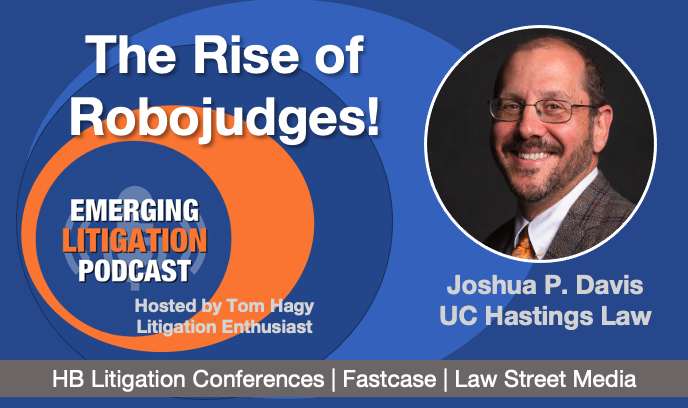
  • The Rise of Robojudges with Josh Davis

    The Rise of Robojudges with Josh Davis

    The Rise of Robojudges with Joshua Davis

    The good news for all of us, not the least of which are the robe and wig industries,  is that we still have time. Artificial intelligence is advancing rapidly, but it’s still not able to think like a learned jurist. We can say it will have flaws, but so do our human deciders. So it will be a tradeoff, right? What are the risks? What are the upsides? Will robojudges be able to absorb infinitely more information quickly? Will they hand down decisions free from the influence of bias? Wouldn’t it be great to eliminate conflicts of interest? 

    Joining me to discuss this not-so-out-there concept is Joshua P. Davis, a nationally recognized expert on legal ethics, class actions, and artificial intelligence in the law. He is Research Professor of Law at the University of California Hastings College of Law, and Shareholder and Manager of Berger & Montague, P.C.’s new San Francisco Bay Area Office. For more than 20 years Josh was a tenured Professor of Law at the University of San Francisco Law School, where he also served as the Director of the Center for Law and Ethics. Josh is authoring two books, one titled Unnatural Law, dealing with AI and the law, and a second on the important issue of class action ethics. 

    Finally, remind me never to assume anything when I ask Josh a question. I said something like, “Surely we’re not talking about sci-fi robots here,” to which he basically said, “Not so fast.” This happened more than once. When will I learn? 

    This podcast is the audio companion to the Journal on Emerging Issues in Litigation, a collaborative project between HB Litigation Conferences and the Fastcase legal research family, which includes Full Court Press, Law Street Media, Docket Alarm and, most recently, Judicata. If you have comments or wish to participate in one our projects, or want to tell me how insightful and forward-thinking Josh is, please drop me a note at Editor@LitigationConferences.com.

    Tom Hagy
    Host of the Emerging Litigation Podcast

    According to an article written by our guest, “Some of the most exciting, vexing, and terrifying issues at the intersection of AI and law involve robojudges.” 

    Can we build a robojudiciary that replaces human judiciaries? Should we? Doing so would massively disrupt how our legal systems operate. It also might transform democratic self-government.” I have to ask: Would any of that be so bad? It’s not like humans are doing such a bang-up job. The risk, of course, is what if we get it all wrong? 

    via GIPHY

  • Broken Privilege and IoT with Kathryn Rattigan

    Broken Privilege and IoT with Kathryn Rattigan

    Broken Privilege and IoT with Kathryn Rattigan

    Broken Privilege IOT Kathryn Rattigan

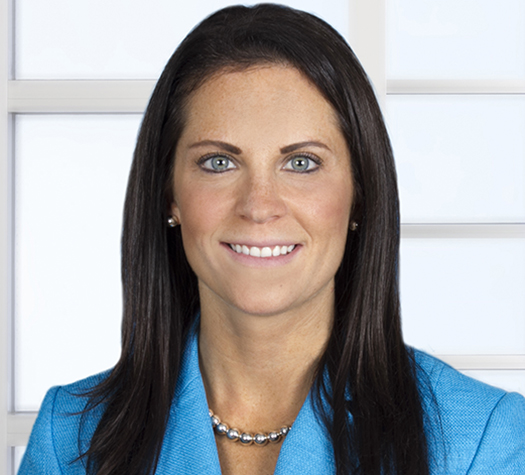
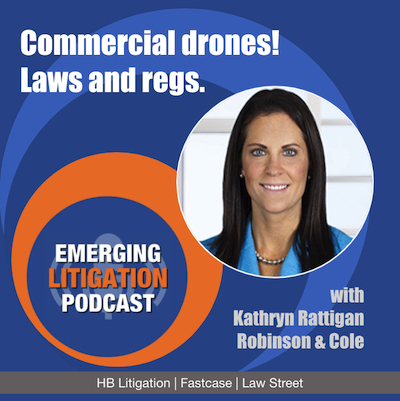
    Joining me to discuss this emerging area of law is Kathryn M. Rattigan, a member of the Business Litigation Group, the Data Privacy + Cybersecurity Team, and the Drone Compliance Team in the Rhode Island office of Robinson Cole.

    Kathryn provides clients guidance regarding privacy and data protection in connection with mobile devices, data storage technologies, mobile apps, and location-based services. She  assists with the development of website and mobile app privacy policies and  terms and conditions. Kathryn is a frequent contributor to the excellent Robinson Cole Data Privacy + Cybersecurity Insider blog.  She holds a J.D. from the Roger Williams University School of Law and a B.A. (magna cum laude) from Stonehill College.

    This podcast is the audio companion to the Journal on Emerging Issues in Litigation, a collaborative project between HB Litigation Conferences and the Fastcase legal research family, which includes Full Court Press, Law Street Media, Docket Alarm and, most recently, Judicata. If you have comments or wish to participate in one our projects, or want to tell me how insightful and informative Kathryn is, please drop me a note at Editor@LitigationConferences.com.

    Finally, yes, “skeevy” is a word. And the law is not settled as to whether Shiloh has privacy rights.

    Tom Hagy
    Host of the Emerging Litigation Podcast

    There are now billions and billions of interconnected devices in the world with more coming online every day. Smart cars. Smart cities. Smart agriculture and so much more. Even our pets are connected.

    And you have to look no further than the Colonial Pipeline ransomware attack to see the real-world consequences of what criminals can pull off by connecting with things large and small.

    Worried about your privacy? Well. There is plenty to worry about.

    Fortunately we also have a lot of people fighting back on the technical, security, law enforcement, and legal fronts.

  • The Commercial Drone Industry: Privacy, Security, Threats, and Mitigation of Risk

    The Commercial Drone Industry: Privacy, Security, Threats, and Mitigation of Risk

    HB presents a CLE-eligible webinar
    Now on-demand at the West LegalEdcenter
    THE COMMERCIAL DRONE INDUSTRY
    Privacy, Security, Threats, and Mitigation of Risk

    Drones have become an increasingly valuable tool for businesses of all types and sizes.

    Drones are already being used in many applications, but more will certainly arise as the technology advances. This means that certain risks, like cyber threats, will also continue to present themselves. Protecting the transmission and storage of data collected through drones is critical.

    Unfortunately, security usually comes as an afterthought. The drone industry is part of the aviation industry, which, based on its knowledge, keeps safety as a number one concern. Part of that safety is having proper protection for your systems, including security as a fundamental design principle.

    Take this webinar to gain insights on the topics listed below, and shared by an attorney who practices on the cutting-edge of this evolving technology.

    Topics:

    • Defining drones.
    • Current and future applications.
    • FAA Modernization and Reform Act of 2012.
    • FAA Part 107 Regulations and waivers.
    • Resources, e.g. the FAA Drone Zone and LAANC Portal.
    • Penalties for violations.
    • Privacy implications.
    • Drones as weapons.
    • Vulnerability to cyber attacks.

    Take it now!

    What you get:

    1+ CLE credits (subject to bar rules).

    Insights from an experienced professional who specializes in this area of the law.

    The complete PowerPoint presentation.

    Continued access to the complete recording for later use.

    Answers to your questions.

    Fee:

    No additional charge to subscribers to the West LegalEdcenter.

    Non-subscribers may take the course for $170.

    Meet the Speaker

    Kathryn Rattigan
    Robinson & Cole LLP

    Kathryn Rattigan is a member of the firm’s Business Litigation Group and Data Privacy + Cybersecurity Team. She advises clients on data privacy and security, cybersecurity, and compliance with related state and federal laws. She assists clients in assessing risks related to technology and software contracts, as well as with compliance-related issues with outsourcing and vendor management. She represents clients across all industries, such as manufacturing, insurance, health care, education, energy, and construction.

    Kathryn helps clients comply with all state and federal regulations related to data privacy and cybersecurity. She is also a member of the firm’s Drone Compliance Team. As such, she advises clients on all legal issues surrounding the use of commercial drones, including navigation of Federal Aviation Administration regulations, commercial registration requirements, and Part 107 waivers.

    She is committed to doing pro bono work and being involved in the community. Her recent efforts include assisting Inner Explorer, a non-profit which works to help students focus and succeed through mindfulness practice in the classroom, and College Visions, which helps low-income students pursue a college education.

    She writes for two of the firm’s blogs, Data Privacy + Security Insider and Health Law Diagnosis.

    More about Kathryn

    Also, listen to my interview with Kathryn for the the Emerging Litigation Podcast!

    –Tom Hagy