Category: Mass Torts

  • Wildfire Litigation and Recovery with Ed Diab

    Wildfire Litigation and Recovery with Ed Diab

    Wildfire Litigation and Recovery with Ed Diab

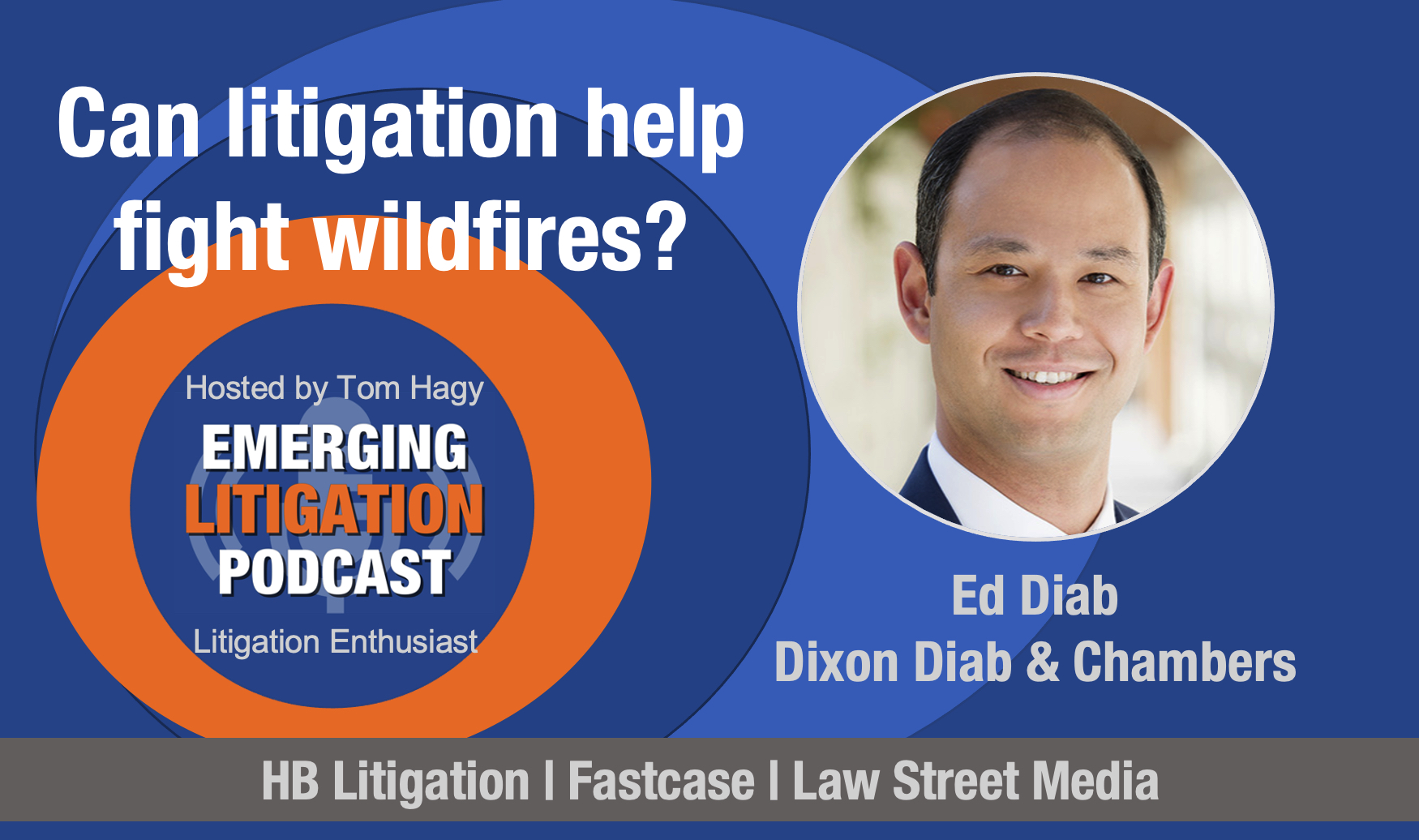
    I had the pleasure of interviewing Ed Diab, co-founder of Dixon Diab & Chambers in San Diego, about his firm’s role in the litigation, what the claims are, what defenses they encounter, settlements they have secured, what evidentiary hurdles plaintiffs face, and  more.  They’ve been successful. Since 2018, Dixon Diab & Chambers has recovered more $1.4 billion in settlements. And there is more to come. The firm represents more than 40 public entities – including some of the largest cities and counties in California – as well as thousands of individuals and families. Ed leads the firm’s mass tort practice which, in addition to wildfire litigation, represents people who allege injuries from defective drugs and medical devices.

    This podcast is the audio companion to the Journal on Emerging Issues in Litigation, a collaborative project between HB Litigation Conferences and the legal news folks at Law Street Media. If you have comments or wish to participate in one our projects, or want to tell me how insightful our guests are, please drop me a note at Editor@LitigationConferences.com.

    Thanks to Ed Diab for speaking with me about this fascinating and frightening subject, and to Baron & Budd’s Scott Summy for introducing us.  For my part, I am sure my suggestion that they install smoke detectors all over the forest is complete nonsense.  Also, I spoke with a friend who majored in Latin. Even though I showed zero confidence, I apparently stumbled close to the pronunciation of flammagenitus, Latin for “fire cloud.” I promised you a photo of one. Also called pyrocumulus clouds, they look as terrifying as they sound.

    Tom Hagy
    Host
    Emerging Litigation Podcast

    via GIPHY

    Wildfires are causing more destruction in North America than at any time in recorded history. 

    In 2010 they consumed 3.4 million acres, but nearly tripled to devour more than 10 million acres in 2020.

    They also have been responsible for numerous injuries and loss of life, razing thousands of homes, displacing wildlife, destroying natural resources, and even spewing air pollution thousands of miles away. Fighting these hellish infernos is a massive, all-out-war-like undertaking. The 2020 Dixie Fire was finally brought under control with the help of 6,500 personnel (from firefighters to the people who fed them), 1,000 fire trucks, water tankers, and bulldozers, and 1,000 miles of firehose. While some fires occur naturally, set off by lightening, for example, 84% are caused by humans. And, no matter how you slice it, humans are helping create the conditions of this continental tinderbox.

    One group of attorneys from Baron & Budd and Dixon Diab & Chambers LLP is securing and seeking recovery for individuals, municipalities, and insurance companies that pay claims, when they can accomplish the difficult task of identifying the responsible parties. Positioned as “Wildfire Recovery Attorneys,” they have done so in cases against Pacific Gas & Electric Corp. and Southern California Edison, which they have sued for allegedly failing to maintain power lines and the areas beneath them, among other things.

  • Impact of Surfside Condo Collapse with Judah Lifschitz

    Impact of Surfside Condo Collapse with Judah Lifschitz

    Impact of Surfside Condo Collapse with Judah Lifschitz

    Joining me is experienced construction law attorney Judah Lifschitz of Shapiro, Lifschitz & Schram  who spoke about the near- and long-term impacts of the Surfside condo collapse not only in Florida around the country.  Judah has extensive experience dealing with construction matters, representing clients in engineering, procurement and construction contracts and disputes. He represents and advises government agencies and private owners; regional, national and international contractors; construction managers and subcontractors; design professionals; and insurance companies. Notably, Judah won one of the largest liquidated damages awards in the history of the construction industry.  Education: George Washington University, J.D.; Yeshiva University, B.A., magna cum laude.

    This podcast is the audio companion to the Journal on Emerging Issues in Litigation, a collaborative project between HB Litigation Conferences and the Fastcase legal research family, which includes Full Court Press, Law Street Media, Docket Alarm and, most recently, Judicata. If you have comments or wish to participate in one our projects, or want to tell me how insightful and informative Judah is, please drop me a note at Editor@LitigationConferences.com.

    Thanks to Judah for speaking with me about this important topic. I was especially proud that I pronounced his name correctly on the first try, though he assured me that I could in no way do more damage to it than those who have come before me. (Clearly he doesn’t know me well.)

    Tom Hagy
    (pronounced HEY-ghee, for the record)

    via GIPHY

    Nothing illustrates the tragic consequences of building decay more than the June 24, 2021, collapse of the Champlain Towers South in Surfside, Florida, which claimed the lives of nearly 100 residents.

    The event raises questions about the building inspection process not only in Florida but around the country.

    What caused this calamity?

    Who is responsible?

    How many other buildings are in similar condition?

    Since any compensation for the loss of life, injuries, and property damage will likely be astronomical, where will any financial awards come from?

  • The Mega Verdict Trend in Healthcare Litigation with Sandra Cianflone

    The Mega Verdict Trend in Healthcare Litigation with Sandra Cianflone

    The Mega Verdict Trend in Healthcare Litigation with Sandra Cianflone

    Joining me to discuss this high-stakes litigation is Sandra M. Cianflone of Hall Booth Smith, P.C.Sandiecounsels and defends hospitals, physicians, nurses and institutional employees in a broad spectrum of catastrophic injury and medical malpractice cases. She received her Juris Doctorate from Pace University School of Law and her undergraduate degree from Fairleigh Dickinson University.

    This podcast is the audio companion to the Journal on Emerging Issues in Litigation, a collaborative project between HB Litigation Conferences and the Fastcase legal research family, which includes Full Court Press, Law Street Media, Docket Alarm and, most recently, Judicata. If you have comments or wish to participate in one our projects, or want to tell me how insightful and informative Sandie is, please drop me a note at Editor@LitigationConferences.com. This podcast is based on an article she wrote for the forthcoming issues of the Journal.

    Note that in my introduction I have created the phrase “badly wrong,” which is, itself, badly wrong.  Listen to the bitter end when Sandie and I discuss working from home, and how we really feel about family and co-workers.  Feel free to scold me at the email address provided. I hope you enjoy the interview and this professional’s practical insights into defending healthcare providers.

    Tom Hagy

    Damage awards against physicians, hospitals, and other healthcare providers have been coming in bigger and bigger, with juries awarding more than $20 million in a string of cases that should send chills down the spines of defendants and counsel. 

    What are the factors behind this trend? Besides the severe (or even alarming)  nature of the harm alleged, what is fueling these mega verdicts?

    What can defense attorneys do, knowing they are facing a well-organized, well-funded plaintiffs bar?

    For that matter, what can defense attorneys learn from their opponents?

    What strategies can defense employ early in the life of a case?

  • Sandra Cianflone on Current and Emerging COVID-19 Litigation

    Sandra Cianflone on Current and Emerging COVID-19 Litigation

    Sandra Cianflone on COVID-19 Litigation in 2021 and Beyond

    It’s now been more than 18 months since the world was besieged by the novel coronavirus pandemic.

    In addition to the human toll, it disrupted our lives in ways big and small, new and old, as it raced across continents, first visiting North America in January 2020. There are an estimated 15,000 lawsuits relating to the outbreak, with some 350 filings directed toward the healthcare and medical communities. The number of insurance coverage suits is fast-approaching 1,800.

    Litigation has been initiated against aging services, hospitals, and healthcare providers, with the next anticipated wave likely to  surround vaccines themselves. What will be the basis of these claims? What defenses will we see? And what can healthcare providers do now in anticipation of this onslaught?

    Joining me to discuss this out-of-the-blue rash of litigation is Sandra M. Cianflone of Hall Booth Smith, P.C.Sandiecounsels and defends hospitals, physicians, nurses and institutional employees in a broad spectrum of catastrophic injury and medical malpractice cases. She received her Juris Doctorate from Pace University School of Law and her undergraduate degree from Fairleigh Dickinson University.

    This podcast is the audio companion to the Journal on Emerging Issues in Litigation, a collaborative project between HB Litigation Conferences and the Fastcase legal research family, which includes Full Court Press, Law Street Media, Docket Alarm and, most recently, Judicata. If you have comments or wish to participate in one our projects, or want to tell me how insightful and informative Sandie is, please drop me a note at Editor@LitigationConferences.com. This podcast is based on an article she wrote for the forthcoming issues of the Journal.

    I hope you enjoy the interview, and especially a brief story (after we wrap up) about Sandie’s experience delivering a baby in the Age of COVID-19. I also mangled a bit of basic Spanish, for which I am ashamed (lo siento), and was a little cavalier with some statistics, for which I am mortified.  Feel free to chastise me at the email address provided. –Tom Hagy

  • Charlie Kingdollar on Sexual Abuse Claims

    Charlie Kingdollar on Sexual Abuse Claims

    Charlie Kingdollar on Sexual Abuse Claims and Litigation: Their Impact on the Insurance Industry

    Abstract
    The statistics surrounding childhood sexual abuse and molestation are staggering. Many make headlines such as the cases brought against clergy, athletic coaches, Boy Scout leaders, and actors and movie producers. This article attempts to size the impact of these cases on the insurance industry, and what measures are being taken that will allow more lawsuits to be filed on behalf of victims years after they were abused or molested.

    Author
    Charlie Kingdollar recently retired after 40 years with General Reinsurance Corp., where he was Vice President and Emerging Issues Officer. He is widely considered to be among the best resources for new liability risks, even called by one colleague as a “prescient and gifted industry futurist.” I recommend you follow him on LinkedIn. –Tom Hagy

    About
    The Journal on Emerging Issues in Litigation is a co-production of HB, Fastcase, and Law Street Media. You can also hear the complementary (and complimentary) Emerging Litigation Podcast wherever podcasts appear. For questions, contact Tom Hagy, Editor in Chief, at Editor@LitigationConferences.com.

    Loading Viewer…

  • Susan E. Brice and Vince Angermeier on Causation in Toxic Torts

    Susan E. Brice and Vince Angermeier on Causation in Toxic Torts

    Susan E. Brice and Vince Angermeier on Causation in Toxic Torts

    Susan E. Brice and Vince Angermeier on Causation in Toxic Torts

    Abstract
    Concepts of “substantial factors,” “any exposure,” and “de minimis” contact have long-supported claims brought by toxic tort plaintiffs against manufacturers. They have furthered tort actions against defendants based on the “cumulative expo-sure” theory, particularly in the asbestos arena, even when a single fiber could not be connected to a specific defendant. But a 2017 Seventh Circuit decision dealing with Illinois law is part of a trend toward tightening up these standards. This article discusses the various cases on this threshold issue as the authors ponder whether this is a movement that needs some pushing.

    Authors
    Susan E. Brice (sb@nijmanfranzetti.com) is a partner at Nijman Franzetti, LLP. She has litigated state and federal disputes and has counseled clients on complicated scientific issues arising in environmental law, toxic torts, and product liability. Susan works with scientists on matters in the fields of genomics, toxicology, and epidemiology in industries such as chemical manufacturing, energy production, food, agriculture, and real estate.

    Vince Angermeier (va@nijmanfranzetti.com) is Of Counsel at Nijman Franzetti, LLP, where he concentrates his work on CERCLA, EPCRA, RCRA, and Clean Water Act matters, a practice enhanced by his environmental engineering experience. Vince has assisted on civil litigation, administrative rulemakings, regulatory and compliance matters involving water, solid waste, and EPCRA reporting issues.

    About
    The Journal on Emerging Issues in Litigation is a co-production of HB, Fastcase, and Law Street Media. You can also hear the complementary (and complimentary) Emerging Litigation Podcast wherever podcasts appear. For questions, contact Tom Hagy, Editor in Chief, at Editor@LitigationConferences.com.

    Loading Viewer…

    Safeguarding Against Financial Exploitation

    An on-demand CLE-eligible webinar Safeguarding Against Financial Exploitation   America’s senior population is growing. Nearly one in five U.S. residents will be 65 or older in 2030. Which means the average age of U.S. investors is climbing too. With that comes the risk that they will be exploited by people with access – or gain access through nefarious methods – to their investment portfolio. Seniors and vulnerable persons lose billions of dollars each year. Remarkably, 90% of the people to take advantage of senior investors are members of their own family. Attorneys who represent senior clients need to know the signs of vulnerability, red flags that their clients are being exploited, what laws apply, and rules lawyers must follow in these matters.   Questions our speakers answer: What is senior / vulnerable investor exploitation?   Who is protected by state and federal laws?   How prevalent is senior financial exploitation? What do the numbers tell us?  What is the pace of financial abuse SAR filings by securities firms?  What are the most popular scams?   What is diminished capacity?  What are the red flags indicating possible exploitation?  What are the laws, rules, and regulations governing law firms?  What are some best practices for law firms?  How can firms best protect their senior clients?   On Demand CLE Webinar What You Get PowerPoint and supplemental materials. Complete recording for later review. Answers to your questions via email. Invitation to contact speakers. 1.5 CLE credits (for licensed attorneys). CLE assistance.* *Subject to state bar rules. For licensed attorneys.  Register Meet the Speakers Joseph Calabrese Bressler, Amery & Ross, P.C. A 1991 Graduate of St. John’s University Law School, Mr. Calabrese brings 30 years of practice and 18 years of Securities Litigation/Regulatory experience to his role as principal in the New York office of  Bressler, Amery & Ross’s Financial Institutions Group. He began his career as a Wall Street litigator as an associate general counsel for Citigroup’s Smith Barney and […]

    Lien Resolution: Government & Private Plans Get Aggressive (Against Attorneys)

    Includes Nearly 75 minutes of insights from experienced professionals. CLE credit: 1+ (subject to bar rules). For CLE questions: CLE@LitigationConference.com The complete Power Point presentation. Continued access to the complete recording for later use. Answers to your questions via email to the presenters or write to HB and we will be sure to contact the speakers. What can you do to settle personal injury suits cleanly and avoid costly litigation and penalties? What recent cases can inform you about protecting your settlements and, as attorneys, yourselves, from post-settlement federal lawsuits? How can your firm set itself up to meet government expectations? What role might experts play in navigating these pitfalls? Medicare Advantage (42 USC § 1395w-22) Federal Medical Care Recovery Act (FMCRA) (42 USC § 2651) Armed Forces Act (10 USC §1095) Veterans’ Benefits (38 USC §1729) Third-Party Collection Rules (32 CFR 537.24; 38 CFR 17.101, etc.) Set-Asides under the Medicare Secondary Payer Act (42 USC § 1395y(b)(2)] On Demand Registration Lien Resolution Government & Private Plans Get Aggressive (Against Attorneys!) On Demand | Recorded September 2020 It is increasingly common these days. Personal injury attorneys settle a case, only to find themselves sued by a U.S. Attorney for failing to reimburse Medicare for conditional payments as required by the Medicare Secondary Payer Act. In some cases the attorney may be required to pay fines in addition to the reimbursements and interest, a costly proposition. Are you up to speed on issues surrounding Medicare Advantage, TRICARE, veterans’ claims, and Medicare set-asides? Join nationally recognized healthcare lien and resolution expert Franklin P. Solomon and go-to lien resolution provider Brett Newman as they offer a practical, in-depth CLE presentation. Franklin P. Solomon, Esq. Attorney & Founder, Solomon Law Firm  A graduate of Rutgers University School of Law at Camden, Franklin Solomon is based in Cherry Hill, NJ, with a practice focused on evaluation, litigation and resolution of healthcare “liens” and reimbursement claims. Mr. Solomon represents personal injury victims and their attorneys […]

    Telepsychiatry: Mitigating the Risks

    REGISTER Registration Includes Nearly 90 minutes of insights from experienced professionals. CLE credit: 1+ (subject to bar rules). For CLE questions: CLE@LitigationConference.com The complete Power Point presentation. Continued access to the complete recording for later use. Answers to your questions via email to the presenters or write to HB and we will be sure to contact the speakers. Understand the risks associated with telepsychiatry and how to manage them.  Telemedicine has emerged as an important solution for healthcare in general and psychiatric medicine specifically during the current global pandemic. Remote access for sub-practices including addiction counseling have been commonly used. Our panel of psychiatric professionals who have served as expert witnesses and attorneys who counsel and represent physicians have prepared a 90-minute session to share insights with attorneys, physicians, healthcare providers, risk professionals, and more. Agenda Examining procedures and best practices that exist for ensuring confidentiality in a telemedicine practice How do you draft a telepsychiatric consent form? What is the emerging standard of care for telemedicine? Will the standard of care for telemedicine become a national standard? (Should it?) Review the case law addressing telemedicine or telepsychiatry How do the HIPAA regulations and HITECH privacy laws impact telemedicine? How have the HIPAA regulations and HITECH privacy laws been relaxed during the pandemic? Will the relaxed HIPAA and HITECH regulations impacting telemedicine continue past the pandemic? Which technical platforms are preferred? Which ones to avoid? Panelists Mark Levy, M.D., Medical Director at fpamed David Kan, M.D., UCSF Psychiatry Department and the California Society for Substance Abuse Medicine Ayesha Ashai, M.D., associated with fpamed Stephen M. Fatum, J.D., Partner, Barnes & Thornburg LLP Angela W. Russell, J.D., Partner, Wilson Elser Moskowitz Edelman & Dicker LLP Meet our physician and attorney panelists. Mark Levy MD Medical Director fpamed Dr. Levy is a graduate of Columbia College (A.B. 1967) and the Columbia University College of Physicians and Surgeons (M.D. 1971) in New York. He is a Physician […]

    The Commercial Drone Industry: Privacy, Security, Threats, and Mitigation of Risk

    HB presents a CLE-eligible webinar Now on-demand at the West LegalEdcenter THE COMMERCIAL DRONE INDUSTRY Privacy, Security, Threats, and Mitigation of Risk Drones have become an increasingly valuable tool for businesses of all types and sizes. Drones are already being used in many applications, but more will certainly arise as the technology advances. This means that certain risks, like cyber threats, will also continue to present themselves. Protecting the transmission and storage of data collected through drones is critical. Unfortunately, security usually comes as an afterthought. The drone industry is part of the aviation industry, which, based on its knowledge, keeps safety as a number one concern. Part of that safety is having proper protection for your systems, including security as a fundamental design principle. Take this webinar to gain insights on the topics listed below, and shared by an attorney who practices on the cutting-edge of this evolving technology. Topics: Defining drones. Current and future applications. FAA Modernization and Reform Act of 2012. FAA Part 107 Regulations and waivers. Resources, e.g. the FAA Drone Zone and LAANC Portal. Penalties for violations. Privacy implications. Drones as weapons. Vulnerability to cyber attacks. Take it now! What you get: 1+ CLE credits (subject to bar rules). Insights from an experienced professional who specializes in this area of the law. The complete PowerPoint presentation. Continued access to the complete recording for later use. Answers to your questions. Fee: No additional charge to subscribers to the West LegalEdcenter. Non-subscribers may take the course for $170. Meet the Speaker Kathryn Rattigan Robinson & Cole LLP Kathryn Rattigan is a member of the firm’s Business Litigation Group and Data Privacy + Cybersecurity Team. She advises clients on data privacy and security, cybersecurity, and compliance with related state and federal laws. She assists clients in assessing risks related to technology and software contracts, as well as with compliance-related issues with outsourcing and […]

    The Intersection of Privacy and Antitrust Webinar Now Available On-Demand on the West LegalEdcenter

    Available as part of your subscription to The Thomson Reuters West LegalEdcenter®. Don’t subscribe to the West LegalEdcenter? This webinar is still available directly from HB. Take it now! Questions for speakers Questions@LitigationConferences.com CLE questions CLE@LitigationConferences.com Check out the MoginRubin blog for more insights on antitrust and privacy law. What attorneys and companies need to know about the increasing interplay between these critical areas of the law.  Highly publicized cases and investigations in the U.S. and Europe of big technology, e-commerce, and social media companies demonstrate how anti-competition laws are being used to scrutinize and challenge not only how these corporations conduct themselves in the marketplace, but the very core of their colossal success: the mass collection and utilization of user data. Are the privacy and antitrust worlds beginning to cross over? Or do they simply run parallel while addressing entirely different types of conduct? Whatever the answer, data is the raw material that drives the likes of Google, Facebook, Apple and Amazon, so how it is handled is a critical question when counseling clients on mergers and acquisitions. Moderator Daniel J.  Mogin | Managing Partner, MoginRubin LLP Speakers Jennifer M. Oliver, CIPP/US | Partner, MoginRubin LLP Thomas N. Dahdouh | Director, Western Region, Federal Trade Commission Franklin M. Rubinstein | Partner, Wilson Sonsini Goodrich & Rosati Randi W. Singer, CIPP/US, CIPT | Partner, Weil, Gotshal & Manges Contributor Dina Srinivasan | Independent Researcher & Author of The Antitrust Case Against Facebook Dina was unable to present but we thank her for her content contributions.  Agenda Who should regulate privacy violations in the U.S.? Which antitrust issues implicate privacy concerns? What role does machine learning play on the competitive landscape? What is big data really? How is it different from “data”? What are the elements of effective merger reviews? What are the appropriate remedies? What are “notice-and-choice” versus “harms-based” approaches? Plus answers to your questions. Send them to Questions@LitigationConferences.com.

  • COVID-19 and the Courtroom with Alison Besunder

    COVID-19 and the Courtroom with Alison Besunder

    COVID-19 and the Courtroom with Alison Besunder

    Joining me is Alison Besunder on this timely and evolving subject.  It’s based on her article — Crisis is the Mother of Change: How a Pandemic Sparked Progress in Courtroom Efficiency — which will be featured in the January 2021 issue of the Journal on Emerging Issues in Litigation.
    Alison brings extensive experience counseling clients on matters ranging from the simple to complex, helping them prevent future disputes through proactive planning and to resolve disputes that proceed to litigation. She is a frequent speaker on topics such as Estate Planning During Divorce, End of Life Decision Making, Cyber-Security for Lawyers, and Social Media and Ethics.  She operated her own firm for several years and in 2019 joined Goetz Fitzpatrick LLP.
    The Journal is a collaborative project between HB and the Fastcase legal research family, which includes Full Court Press, Law Street Media, Docket Alarm and, most recently, Judicata. If you have comments or wish to participate in one our projects, or want to tell me how awesome Alison is, drop me a note at Editor@LitigationConferences.com.
    We hope you enjoy the interview.

    What efficiencies have been foisted upon our nation’s courts as a result of the COVID-19 pandemic? 

    What has worked and what has not?

    Are we going to see permanent implementation of things like webcam hearings and virtual trials?

  • The Antitrust Case Against Google

    The Antitrust Case Against Google

    The Antitrust Case Against Google

    Perspectives from highly regarded competition law attorneys, litigators, and economists.

    This overview and Q&A has been developed for advertisers, mobile device makers, app developers,
    corporate counsel, business writers, and search market participants.

    The U.S. Department of Justice and 11 states have filed a sweeping antitrust suit against Google alleging the tech giant  abuses its position as “monopoly gatekeeper for the internet” to block competitors. The complaint says Google has used anticompetitive tactics to maintain and extend its monopolies in the markets for general search services, search advertising, and general search text advertising.

    The federal and state governments charge Google uses “exclusionary agreements, including tying arrangements” to “lock up distribution channels and block rivals.” Google’s considerable wealth helps make this happen. Google pays billions of dollars a year to distributors to secure their position as the default search engine, and prohibits these companies from dealing with Google competitors. Google’s exclusionary strategy is being applied more harshly in newer technologies, such as voice assistants, and in its goal of dominating other platforms in the IoT category, such as smart speakers, home appliances, and autonomous cars.

    Without a court order, the government plaintiffs say, “Google will continue executing its anticompetitive strategy, crippling the competitive process, reducing consumer choice, and stifling competition.”

    What does all of this mean to actual or potential rivals, ad buyers, consumer, developers, and device makers in three markets Search Service, Search Advertising, and Search Text Advertising? What type of defense might Google mount? What might the ultimate resolution look like?

    Join our panel, led by competition law thought leaders, as they address the potential impact of the litigation and answer your questions via live chat.

    • Setting the stage: What constitutes an illegal monopoly?
    • Lessons from United States v. Microsoft?
    • How does the government define the three markets?
    • What is in the alleged exclusionary agreements and tying arrangements?
    • What does the government allege is improper about Google default settings?
    • Why is requiring app bundles on devices considered improper in this case?
    • Which companies is Google allegedly harming and how?
    • What does Google’s immediate response tell us?
    • Will private antitrust actions follow the government’s suit?

    Interested in this topic? Contact Tom Hagy for more information.

    Meet the Speakers

    Dan Mogin
    Managing Partner
    MoginRubin LLP

    Read more about Dan Mogin or email him at DMogin@MoginRubin.com.

    Jonathan Rubin
    Partner
    MoginRubin LLP

    Read more about Jonathan Rubin or email him at JRubin@MoginRubin.com.

    Jennifer M. Oliver
    Partner
    MoginRubin LLP

    Read more about Jennifer Oliver or email her at JOliver@MoginRubin.com.

    Timothy Z. LaComb
    Associate
    MoginRubin LLP

    Read more about Tim LaComb or email him at TLaComb@MoginRubin.com.

    John M. Newman
    Associate Professor
    Miami Univ. School of Law

    Read more about Professor Newman.

    Dr. Alan Grant
    Associate Director
    NERA Economic Consulting

    Read more about Dr. Grant or email him at Alan.Grant@NERA.com.
    Interested in this program? Click here to send us a note.
    Interested in More CLE OnDemand? Click Here. 

    Explore more from MoginRubin LLP!

    Plus, additional insights from the MoginRubin Blog.

    Blog: Emboldened by New Resources and Expanded Authority, Feds Continue 10-Year Look Back at Chinese Investment. By Dan Mogin, Jonathan Rubin, Jennifer Oliver, and Timothy LaComb. needs tags. List completed 7/17/24

    OnDemand CLE Webinar: The Antitrust Case Against Google. Dan Mogin, Jonathan Rubin, Jennifer Oliver, Timothy LaComb, John Newman, Dr. Alan Grant

    Blog: FTC’s Case Against Facebook Will Test the Flexibility of U.S. Antitrust Law.Authors: Jonathan Rubin and Jennifer Oliver, MoginRubin LLP

    Blog: Full Ninth Circuit Removes Unwarranted Hurdles to Class Certification.

    Journal: Policy Derailed: Can U.S. Antitrust Policy Toward Standard Essential Patents Get Back on Track by Jonathan Rubin

    Webinar: Class Certification After Olean v. Bumble Bee with Jonathan Rubin, James Bogan lll, Jonathan Cohn, Bradley Hamburger.

    Journal: FTC v. Amazon: Market Definitions and Section 5 of the FTC Act

    Podcast: Algorithmic Software Facilitated Price Fixing with Jonathan Rubin

    Interested in this program? Click here to send us a note.

    A few words about antitrust law.

    Jennifer Oliver, an antitrust attorney and a certified privacy professional, kicked off the webinar with some background for those of you less familiar with antitrust. Here is a recap of what she had to say. 

    Section 7 of the Clayton Act prohibits mergers whose effect may be to substantially lessen competition or to tend to create a monopoly. Most Section 7 suits are filed by the government or private plaintiffs seeking to prevent damage to competition before the damage happens. While there is no allegation of violation of Section 7 in U.S. v. Google, many would argue that Google’s earlier acquisitions have harmed competition or quashed nascent competitors and should have been examined more closely.

    The Sherman Act, part of which is implicated in the Google case, is more familiar to attorneys and businesspeople.

    Section 2 of the Sherman Act, which is most relevant to U.S. v. Google, says you cannot monopolize or attempt to monopolize a line of interstate commerce through anti-competitive conduct. Contrary to a common misconception, monopolies are not per se illegal which, if you think about it, makes sense: If you invent a new product, you have 100% of the market for that product. Competitors will follow. But the fact of monopolizing a market is not in itself illegal. What is illegal is acquiring or maintaining that monopoly in a defined “relevant market” through anti-competitive conduct. Monopoly power is often measured in terms of the ability to control prices in the relevant market, or to exclude competitors in that market, which often means that smaller rivals can’t reach scale or can’t exercise any sort of price discipline over the monopolist.

    How do we define the relevant market? That is an art onto itself in antitrust law, but you must define both product and geographic markets to successfully allege a monopoly exists. The concept of “product substitutes” is very important here, e.g., Would consumers be able to switch to another product if the alleged monopolist raised its prices or otherwise harmed consumers, for example through diminished quality or privacy?

    Next we ask whether anticompetitive conduct was used to obtain a monopoly, and/or whether anticompetitive conduct is ongoing to maintain a monopoly. A monopolist may achieve its dominance illegally, while not maintaining its status through anticompetitive conduct, or vice versa. The relevant statutes are very broad and are open to judicial interpretation. Much of the conduct in modern monopolization cases occurs in new markets that didn’t exist when the laws were written. Internet search engines and digital advertising are perfect examples.

    While anticompetitive conduct is not explicitly defined by Section 2 of the Sherman Act, caselaw offers examples, including exercising the power to engage in conduct that raises a rival’s costs and pricing below cost to drive rivals out of business.

    These are key questions in U.S. v. Google. Does Google have monopoly power, has the relevant market been defined, and has it engaged in anticompetitive conduct? The panel discusses these issues and more.

  • Washington AG Sues Juul, Minnesota Judge Tosses RJR’s Suit to Overturn City’s Flavored Tobacco Ban, Verus Reports

    Washington AG Sues Juul, Minnesota Judge Tosses RJR’s Suit to Overturn City’s Flavored Tobacco Ban, Verus Reports

    By Kim Lavin

    Manager of Research Services
    Verus LLC
    klavin@verusllc.com
    609-466-0427

    Photo by Rubén Bagüés on Unsplash

    Litigation Update: Vaping and Flavored Tobacco Products Lawsuits

    The Washington state attorney general has filed a lawsuit in King County Superior Court against Juul Inc., alleging that the company knowingly targeted minors in its marketing campaign on social media in an effort to push its products on young consumers. In the suit, Attorney Bob Ferguson claimed that in using young models, brightly colored ads and candy-flavored vaping juice, Juul violated Washington state’s consumer protection laws and failed to meet state tobacco product licensing regulations which would make the sales of the company’s e-cigarettes unlawful between August 2016 and April 2018 ….

    In another tobacco-related case, U.S. District Judge Patrick J. Schiltz tossed out R.J. Reynolds’ lawsuit against Edina, MN over the city’s ban on flavored tobacco products.  The company had claimed that Edina had overstepped its authority with a ban that was aimed at curbing vaping by younger consumers. In his ruling, Judge Schiltz wrote that the ban fell under a provision of the federal tobacco laws granting local governments the authority to regulate the sale of certain products ….

    Read more at VerusLLC.com.

    Safeguarding Against Financial Exploitation

    An on-demand CLE-eligible webinar Safeguarding Against Financial Exploitation   America’s senior population is growing. Nearly one in five U.S. residents will be 65 or older in 2030. Which means the average age of U.S. investors is climbing too. With that comes the risk that they will be exploited by people with access – or gain access through nefarious methods – to their investment portfolio. Seniors and vulnerable persons lose billions of dollars each year. Remarkably, 90% of the people to take advantage of senior investors are members of their own family. Attorneys who represent senior clients need to know the signs of vulnerability, red flags that their clients are being exploited, what laws apply, and rules lawyers must follow in these matters.   Questions our speakers answer: What is senior / vulnerable investor exploitation?   Who is protected by state and federal laws?   How prevalent is senior financial exploitation? What do the numbers tell us?  What is the pace of financial abuse SAR filings by securities firms?  What are the most popular scams?   What is diminished capacity?  What are the red flags indicating possible exploitation?  What are the laws, rules, and regulations governing law firms?  What are some best practices for law firms?  How can firms best protect their senior clients?   On Demand CLE Webinar What You Get PowerPoint and supplemental materials. Complete recording for later review. Answers to your questions via email. Invitation to contact speakers. 1.5 CLE credits (for licensed attorneys). CLE assistance.* *Subject to state bar rules. For licensed attorneys.  Register Meet the Speakers Joseph Calabrese Bressler, Amery & Ross, P.C. A 1991 Graduate of St. John’s University Law School, Mr. Calabrese brings 30 years of practice and 18 years of Securities Litigation/Regulatory experience to his role as principal in the New York office of  Bressler, Amery & Ross’s Financial Institutions Group. He began his career as a Wall Street litigator as an associate general counsel for Citigroup’s Smith Barney and […]

    Lien Resolution: Government & Private Plans Get Aggressive (Against Attorneys)

    Includes Nearly 75 minutes of insights from experienced professionals. CLE credit: 1+ (subject to bar rules). For CLE questions: CLE@LitigationConference.com The complete Power Point presentation. Continued access to the complete recording for later use. Answers to your questions via email to the presenters or write to HB and we will be sure to contact the speakers. What can you do to settle personal injury suits cleanly and avoid costly litigation and penalties? What recent cases can inform you about protecting your settlements and, as attorneys, yourselves, from post-settlement federal lawsuits? How can your firm set itself up to meet government expectations? What role might experts play in navigating these pitfalls? Medicare Advantage (42 USC § 1395w-22) Federal Medical Care Recovery Act (FMCRA) (42 USC § 2651) Armed Forces Act (10 USC §1095) Veterans’ Benefits (38 USC §1729) Third-Party Collection Rules (32 CFR 537.24; 38 CFR 17.101, etc.) Set-Asides under the Medicare Secondary Payer Act (42 USC § 1395y(b)(2)] On Demand Registration Lien Resolution Government & Private Plans Get Aggressive (Against Attorneys!) On Demand | Recorded September 2020 It is increasingly common these days. Personal injury attorneys settle a case, only to find themselves sued by a U.S. Attorney for failing to reimburse Medicare for conditional payments as required by the Medicare Secondary Payer Act. In some cases the attorney may be required to pay fines in addition to the reimbursements and interest, a costly proposition. Are you up to speed on issues surrounding Medicare Advantage, TRICARE, veterans’ claims, and Medicare set-asides? Join nationally recognized healthcare lien and resolution expert Franklin P. Solomon and go-to lien resolution provider Brett Newman as they offer a practical, in-depth CLE presentation. Franklin P. Solomon, Esq. Attorney & Founder, Solomon Law Firm  A graduate of Rutgers University School of Law at Camden, Franklin Solomon is based in Cherry Hill, NJ, with a practice focused on evaluation, litigation and resolution of healthcare “liens” and reimbursement claims. Mr. Solomon represents personal injury victims and their attorneys […]

    Telepsychiatry: Mitigating the Risks

    REGISTER Registration Includes Nearly 90 minutes of insights from experienced professionals. CLE credit: 1+ (subject to bar rules). For CLE questions: CLE@LitigationConference.com The complete Power Point presentation. Continued access to the complete recording for later use. Answers to your questions via email to the presenters or write to HB and we will be sure to contact the speakers. Understand the risks associated with telepsychiatry and how to manage them.  Telemedicine has emerged as an important solution for healthcare in general and psychiatric medicine specifically during the current global pandemic. Remote access for sub-practices including addiction counseling have been commonly used. Our panel of psychiatric professionals who have served as expert witnesses and attorneys who counsel and represent physicians have prepared a 90-minute session to share insights with attorneys, physicians, healthcare providers, risk professionals, and more. Agenda Examining procedures and best practices that exist for ensuring confidentiality in a telemedicine practice How do you draft a telepsychiatric consent form? What is the emerging standard of care for telemedicine? Will the standard of care for telemedicine become a national standard? (Should it?) Review the case law addressing telemedicine or telepsychiatry How do the HIPAA regulations and HITECH privacy laws impact telemedicine? How have the HIPAA regulations and HITECH privacy laws been relaxed during the pandemic? Will the relaxed HIPAA and HITECH regulations impacting telemedicine continue past the pandemic? Which technical platforms are preferred? Which ones to avoid? Panelists Mark Levy, M.D., Medical Director at fpamed David Kan, M.D., UCSF Psychiatry Department and the California Society for Substance Abuse Medicine Ayesha Ashai, M.D., associated with fpamed Stephen M. Fatum, J.D., Partner, Barnes & Thornburg LLP Angela W. Russell, J.D., Partner, Wilson Elser Moskowitz Edelman & Dicker LLP Meet our physician and attorney panelists. Mark Levy MD Medical Director fpamed Dr. Levy is a graduate of Columbia College (A.B. 1967) and the Columbia University College of Physicians and Surgeons (M.D. 1971) in New York. He is a Physician […]

    The Commercial Drone Industry: Privacy, Security, Threats, and Mitigation of Risk

    HB presents a CLE-eligible webinar Now on-demand at the West LegalEdcenter THE COMMERCIAL DRONE INDUSTRY Privacy, Security, Threats, and Mitigation of Risk Drones have become an increasingly valuable tool for businesses of all types and sizes. Drones are already being used in many applications, but more will certainly arise as the technology advances. This means that certain risks, like cyber threats, will also continue to present themselves. Protecting the transmission and storage of data collected through drones is critical. Unfortunately, security usually comes as an afterthought. The drone industry is part of the aviation industry, which, based on its knowledge, keeps safety as a number one concern. Part of that safety is having proper protection for your systems, including security as a fundamental design principle. Take this webinar to gain insights on the topics listed below, and shared by an attorney who practices on the cutting-edge of this evolving technology. Topics: Defining drones. Current and future applications. FAA Modernization and Reform Act of 2012. FAA Part 107 Regulations and waivers. Resources, e.g. the FAA Drone Zone and LAANC Portal. Penalties for violations. Privacy implications. Drones as weapons. Vulnerability to cyber attacks. Take it now! What you get: 1+ CLE credits (subject to bar rules). Insights from an experienced professional who specializes in this area of the law. The complete PowerPoint presentation. Continued access to the complete recording for later use. Answers to your questions. Fee: No additional charge to subscribers to the West LegalEdcenter. Non-subscribers may take the course for $170. Meet the Speaker Kathryn Rattigan Robinson & Cole LLP Kathryn Rattigan is a member of the firm’s Business Litigation Group and Data Privacy + Cybersecurity Team. She advises clients on data privacy and security, cybersecurity, and compliance with related state and federal laws. She assists clients in assessing risks related to technology and software contracts, as well as with compliance-related issues with outsourcing and […]

    The Intersection of Privacy and Antitrust Webinar Now Available On-Demand on the West LegalEdcenter

    Available as part of your subscription to The Thomson Reuters West LegalEdcenter®. Don’t subscribe to the West LegalEdcenter? This webinar is still available directly from HB. Take it now! Questions for speakers Questions@LitigationConferences.com CLE questions CLE@LitigationConferences.com Check out the MoginRubin blog for more insights on antitrust and privacy law. What attorneys and companies need to know about the increasing interplay between these critical areas of the law.  Highly publicized cases and investigations in the U.S. and Europe of big technology, e-commerce, and social media companies demonstrate how anti-competition laws are being used to scrutinize and challenge not only how these corporations conduct themselves in the marketplace, but the very core of their colossal success: the mass collection and utilization of user data. Are the privacy and antitrust worlds beginning to cross over? Or do they simply run parallel while addressing entirely different types of conduct? Whatever the answer, data is the raw material that drives the likes of Google, Facebook, Apple and Amazon, so how it is handled is a critical question when counseling clients on mergers and acquisitions. Moderator Daniel J.  Mogin | Managing Partner, MoginRubin LLP Speakers Jennifer M. Oliver, CIPP/US | Partner, MoginRubin LLP Thomas N. Dahdouh | Director, Western Region, Federal Trade Commission Franklin M. Rubinstein | Partner, Wilson Sonsini Goodrich & Rosati Randi W. Singer, CIPP/US, CIPT | Partner, Weil, Gotshal & Manges Contributor Dina Srinivasan | Independent Researcher & Author of The Antitrust Case Against Facebook Dina was unable to present but we thank her for her content contributions.  Agenda Who should regulate privacy violations in the U.S.? Which antitrust issues implicate privacy concerns? What role does machine learning play on the competitive landscape? What is big data really? How is it different from “data”? What are the elements of effective merger reviews? What are the appropriate remedies? What are “notice-and-choice” versus “harms-based” approaches? Plus answers to your questions. Send them to Questions@LitigationConferences.com.
  • Climate Change Litigation Expands with Addition of Hoboken, NJ’s Suit Against Big Oil

    Climate Change Litigation Expands with Addition of Hoboken, NJ’s Suit Against Big Oil

    Excerpt of Sept. 2, 2020 post at HobokenNJ.gov.

    Decades-long campaign of misinformation has directly contributed to effects of climate change in Hoboken, City seeks relief for costs associated with climate adaptation efforts.

    Hoboken Mayor Ravi S. Bhalla today announced that the City of Hoboken has filed a lawsuit in Hudson County against Exxon Mobil, other Big Oil companies, and the American Petroleum Institute for a decades-long campaign of misinformation related to climate change and its devastating impact on Hoboken. According to the lawsuit, Big Oil companies have caused substantial harm to the public in Hoboken and New Jersey by actively lying about the detrimental effects of their products when in fact their own research indicated otherwise, all in order to generate multibillion dollar profits by producing, marketing, and selling vast quantities of fossil fuels. Big Oil engaged in a continuous practice of misleading the public about climate change and their role in it, directly resulting in adverse impacts in Hoboken including rising sea levels that jeopardize the long-term health of the City.

    Photo by Patrick Hendry on Unsplash

    “As a coastal community, Hoboken has directly felt the impacts of climate change, including rising sea levels and more frequent storms,” said Mayor Bhalla. “At the same time we’ve invested hundreds of millions of dollars adapting to the realities of climate change, Big Oil companies have engaged in a decades long campaign of misinformation that has contributed to global warming which has disproportionately impacted our residents. We cannot stand idly by and allow Big Oil to continue profiting at the expense of Hoboken residents. It’s time these companies pay their fair share and be held accountable for their actions.”

    Hoboken joins at least 19 other cities, states and counties across the country, and the first in New Jersey to allege that Big Oil companies have engaged in repeated deception over a span of decades that has resulted in adverse impacts of climate change. The litigation comes at no expense to the City of Hoboken or Hoboken taxpayers. Legal fees associated with the lawsuit are funded, in part, by the Institute for Governance and Sustainable Development and, in part, through a contingency arrangement ….

    Read more and get the complaint from HobokenNJ.gov.