Category: Mass Torts

  • Philadelphia Jury Hits J&J with $120M Award in Mesh Injury Case — Law360

    [one-half-first][/one-half-first] [one-half]

    “Jurors credited claims from Susan McFarland that the negligent design of a mesh implant she received in 2008 caused the product to saw through the soft tissue in her pelvis and become exposed in her vagina. She was eventually forced to undergo a second surgery to remove a portion of the implant.

    “The pain she’s been left with as a result of the complications, she says, has prevented her from having sex with her husband for the last 10 years.

    “This is the second time jurors have been asked to determine whether McFarland and her husband should be awarded damages for injuries she attributes to alleged defects in a so-called TVT-O implant she received to treat urinary stress incontinence.”

    Read the complete article on Law360 here. [/one-half]

  • Top Class Actions: Vaccine Litigation Case Roundup


    [one-half-first][/one-half-first] [one-half]There have been numerous lawsuits filed alleging injuries caused by the shingles vaccine Zostavax. Cases have stated they were not warned of the adverse side effects of the vaccine alleging it caused the diseases it is meant to prevent, among other things.

    Here is what the CDC says to consumers: “Your risk of shingles and postherpetic neuralgia (PHN) increases as you get older. CDC recommends that people 60 years old and older get shingles vaccine (Zostavax®) to prevent shingles and PHN. Shingrix (recombinant zoster vaccine) is the preferred vaccine, over Zostavax® (zoster vaccine live), a shingles vaccine in use since 2006. Zostavax may still be used to prevent shingles in healthy adults 60 years and older. For example, you could use Zostavax if a person is allergic to Shingrix, prefers Zostavax, or requests immediate vaccination and Shingrix is unavailable. Zostavax (zoster vaccine live) was licensed by the FDA in 2006. This vaccine reduces the risk of developing shingles by 51% and PHN by 67%. It is given in one dose as a shot, and can be given in a doctor’s office or pharmacy.“

    Read more: https://www.cdc.gov/vaccines/vpd/shingles/public/zostavax/index.html

    The vaccine is produced by Merck & Co.  Their product information can be found here: https://www.merckvaccines.com/Products/Zostavax

    Here is a roundup of the cases filed.

    [/one-half]

    1.Husband and Wife File Zostavax Shingles Vaccine Lawsuit 

    “A North Carolina husband and wife recently filed a new Zostavax shingles vaccine lawsuit against pharmaceutical giant Merck & Co., alleging the vaccine caused serious side effects.

    “The plaintiff, Cecilia S., says she was inoculated with the Zostavax vaccine on March 5, 2017, in order to prevent shingles (or herpes zoster). Unfortunately, the day after receiving this vaccine, Cecilia alleges she suffered from a number of problems, including herpes zoster, cellulitis, and postherpetic neuralgia.”

    2. Zostavax Lawsuit Says Vaccine Caused Shingles

    “West Virginia patient has filed a Zostavax lawsuit claiming the shingles vaccine gave her shingles instead of preventing her from getting it.

    “Shingles is a rash caused by a virus, and can have lasting effects, according to Science News. Shingles is more common in older people, and recently, Pharmacy Times reported that there has been a push to increase vaccination rates.”

    3. Can You File a Shingles Vaccine Lawsuit?

    “Some patients have come forward with reports of major complications after treatment with Zostavax, a popular shingles vaccine—and some have even filed a shingles vaccine lawsuit over these Zostavax side effects.”

    4. No Warning of Severe Reactions to Shingles Vaccine, Couple Claims

    “A couple from Illinois alleges they are suffering from severe reactions to shingles vaccine, complications that pharmaceutical company Merck allegedly failed to warn about.

    “The couple filed legal action after discovering other patients had reported similar adverse vaccine reactions soon after getting the Zostavax shot.

    “Plaintiffs Victoria and Earl V. filed this Zostavax lawsuit alleging Victoria developed shingles, or herpes zoster, despite having been vaccinated against it.”

    5. Lawsuit Alleges Hearing Problems Due to Zostavax Shingles Vaccine

    “Plaintiff Kim M. is the latest to lodge a lawsuit against Zostavax maker Merck and Company, arguing that the shingles vaccine causes preventable and dangerous Zostavax side effects such as hearing loss. She argues that she might have made a different decision about getting the shot if she had known about the risks.

    “The plaintiff alleges that she received the Zostavax vaccine for regular health purposes and prevention of shingles in February 2016 while a resident of California.”

    6. Lawsuit Alleges Shingles Vaccine Adverse Effects are Permanent 

    “A couple has filed a lawsuit alleging they suffer from shingles vaccine adverse effects.

    “Plaintiffs Kathleen H. and Joseph W. say Kathleen received the Zostavax vaccine in 2017 for the prevention of shingles, medically known as herpes zoster.

    “They allege she suffered severe side effects from the inoculation, including a stroke, physical limitations, mental and emotional distress and severe, permanent personal injuries.”

    7. Common Zostavax Shingles Vaccine Complaints Named in New Lawsuit

    “The Zostavax shingles vaccine emerged on to the market as a new option for people at risk for developing shingles to guard against it. The CDC recommends that individuals aged 60 and older get the shingles vaccine whether or not they remember having had chicken pox previously in their life. According to research studies, more than 99 percent of Americans 40 and beyond have gotten chickenpox even if they don’t remember getting the disease.”

    8. Growing MDL Alleges Serious Zostavax Shingles Vaccine Reactions

    “Merck & Co. is facing a growing multidistrict litigation (MDL) consisting of similar claims alleging patients developed serious side effects from the company’s Zostavax shingles vaccine.

    “One of the most recent Zostavax shingles lawsuits was filed by a woman from Tennessee, who alleges Merck failed to disclose the full scope of potential vaccine reactions.”

    9. Zostavax Lawsuit alleges Vaccine caused Permanent Cardiovascular Complications 

    “This Zostavax lawsuit is joining a growing multidistrict litigation (MDL), which consists of similar claims alleging Merck failed to warn them against the full severity of the potential side effects associated with their shingles vaccine.

    “Plaintiff couple Terrance and Brenda O. conjointly filed this Zostavax lawsuit, stating the side effects of the shingles has permanently impacted their marriage and their quality of life. Like numerous other patients in the United States, Terrance says he was prescribed the Zostavax injection to prevent shingles soon after he turned 60.”

    10. Lawsuit Claims Shingles Vaccine and Eye Problems Connection

    “Many consumers have already come forward to allege a connection between the Zostavax shingles vaccine and the development of shingles itself.

    “However, more patients are now arguing that the shingles vaccine and eye problems is another troubling connection about which the public is not aware.”

  • The Need for Real MDL Rules Will Only Grow More Acute — Drug and Device Law Blog

    By Bexis 

    [one-half-first].[/one-half-first] [one-half]”In the ensuing procedural gamesmanship, plaintiffs are in the process of losing one of the main ways they gamed the system to keep diverse cases in state court – the so-called ‘forum defendant rule’ whereby even a diverse action could be kept in state court by the presence of defendant domiciled in the plaintiff’s chosen forum. The forum defendant rule applies only to parties ‘properly joined and served,’ and technologically-savvy defendants have discovered that, by monitoring electronic dockets, they can remove diverse cases faster than plaintiffs can serve forum defendants. We call this ‘pre-service,’ ‘snap,’ or ‘wrinkle’ removal, and we’ve chronicled (and advocated) its rise since 2007.”

    Read the complete post by Bexis on Drug and Device Law Blog here. [/one-half]


    This is an excellent blog. One of my favorites. It’s unapologetically defense-oriented, of course. A phrase like “gamed the system” is practically an invitation for rebuttal! So if you would like to respond, rebut, or rebuke, please write to us at Editor@LitigationConferences.com. –Tom Hagy, HB

  • A Generic Drug Failure to Warn Claim? –Michelle Hart Yeary


    [one-half-first][/one-half-first] [one-half] “Rather than focusing on what plaintiff’s off-label marketing claim really was – a claim that defendant’s label should have contained different information or warnings about off-label uses – an impliedly preempted claim, the court got distracted trying to fit the case in under Bausch and started talking about parallel violation claims.
    “The court found that because plaintiff was alleging a violation of federal regulations, his claims “run parallel to [defendant’s] state law duties,” and thus were not preempted. The problem with this is that Mensing is not an express preemption case.  It was an implied preemption case, and the district court had no business applying ‘parallel claim’ analysis to implied preemption, where a ‘parallel claim’ exception does not exist.  It makes no difference whether plaintiff’s off-label promotion claim is ‘parallel’ to federal regulations, defendant could not have offered any different warning so any claim that the warning or information it provided was inadequate is preempted under Mensing.  The court was trying to fit a square peg into a round whole – and the only way that works is to cut off the corners.”

    Read the complete post by Dechert’s Michelle Hart Yeary here!

    [/one-half]

  • Private Calif. Plaintiffs Seemingly Enforcing FDCA, Drug & Device Law Blog Says

    “Doctors treated two plaintiffs for severe psychological problems, ultimately employing defendant’s Thymatron System IV to perform electroconvulsive therapy. Plaintiffs claimed that, as a result, they suffered brain trauma, memory loss and other brain-related injuries. They filed product liability claims based, in the main, on the manufacturer’s alleged failure to report adverse events. The decision in Riera addressed summary judgment motions, ones filed by both the plaintiffs and the defendant. You don’t ordinarily see summary judgment motions by plaintiffs, and Riera is an example of why.”

    Read the complete post by John J. Sullivan of Cozen O’Connor.

  • Attorney General Ferguson of Washington Sues State’s Top Opioid Distributers

    “We are woefully under-resourced when it comes to treatment. The people who are responsible for this epidemic should being paying for it. We are going to hold these companies accountable and get more money into our communities for treatment.” –Washington AG Bob Ferguson

    The three largest distributors of prescription opioids in Washington State are being sued by Attorney General Bob Ferguson for fueling the state’s opioid epidemic. Detailed in Ferguson’s King County lawsuit are the billions of dollars made from these suspicious shipments of over 2 billion pills of unregulated oxycodone, fentanyl, hydrocodone and other opioids.

    “Prescriptions and sales of opioids in Washington skyrocketed more than 500 percent between 1997 and 2011. In 2011, at the peak of overall sales in Washington, more than 112 million daily doses of all prescription opioids were dispensed in the state — enough for a 16-day supply for every woman, man and child in Washington,” according to the AG’s announcement.

    “In 2014 McKesson, Cardinal Health and AmerisourceBergen shipped enough opioids to Pend Orielle County to supply every single resident with dozens of pills. In 2009, McKesson alone supplied enough for dozens of pills for every resident of the county. The specific shipment numbers are currently under seal.”

    County Prescription Rates Map

    The accused distributors are in the top 15 Fortune 500 list based on 2017 revenue. In addition to the lawsuit, the distributors owe millions of dollars in fines, and must surrender the profits, the state maintains. “The surrendered profits will be used to remediate the effects of the opioid epidemic, possibly funding treatment, education and more.”

    In September of 2017, Ferguson sued one of the nation’s largest opioid manufacturers, Purdue Pharma, accusing the OxyContin maker of “fueling the state’s opioid epidemic by embarking on a massive deceptive marketing campaign and convincing doctors and the public that their drugs are effective for treating chronic pain and have a low risk of addiction, contrary to overwhelming evidence.”  In April  2018 a King County judge denied Purdue’s attempt to dismiss Ferguson’s lawsuit. State medical boards have since implemented opioid prescription limits.  Read the Washington State Attorney General’s Press Release here.

  • Foggan & Huggins on Opioid Litigation Defense Coverage

    Is a drug company that’s sued in connection with the manufacture, promotion and distribution of opioids covered by its insurer for defense costs?

    According to Laura A. Foggan and Michael Lee Huggins of Crowell & Moring, LLP, that determination will come down to whether, in the relevant state, an accident takes place when either the act or the injury was unintentional, or whether an accident occurred if only the act was unintentional.

    This definition will vary by state, Foggan and Huggins wrote in California Litigation, published by the Litigation Section of the California Bar earlier this year.

    South Carolina may permit coverage if “either the act or the injury was unintentional,” they explained. In Liberty Mutual v. J.M. Smith, the Fourth Circuit held that if a drug company failed to identify and alert regulatory agencies of suspicious drug orders, then there may be a duty to defend.

    But in California, the Crowell & Moring attorneys wrote, with that state’s definition of “accident” a state appellate court in Travelers v. Actavis held that a “deliberate act is not an accident, even if the injury is unintentional, unless the injury was produced by an additional, unexpected, independent, and unforeseen happening.”

    In that case drug company Actavis allegedly engaged in deceptive marketing in order to sell more opioids and reap more profits. According to Foggan and Huggins, the court said such alleged conduct can only be described as deliberate and intentional. Whether the company intended to injure anyone is irrelevant in determining coverage, the court determined.

    “[T]he court concluded that none of the alleged injuries — including the flood of opioids into the American medical market, the opioid epidemic, the resurgence in heroin use, or the increased public healthcare costs resulting from long-term opioid use — was an ‘additional, unexpected, independent, or unforeseen’ event that would support a duty to defend,” the attorneys wrote. For these reasons the California appeals court found there was no possibility of defense coverage under a CGL policy.

    The latest is that the California Supreme Court granted review of Travelers v. Actavis but deferred briefing until there is a ruling on the definition of “occurrence” in another case, Liberty Surplus v. Ledesma & Meyer.

    Foggan and Huggins also discussed issues such as “relief sought ‘for’ or ‘because of’ bodily injury,” products exclusions, and a number of untested coverage issues, such as whether opioid injuries constitute a continuous trigger of coverage or how the role a defendant played in the opioid market impacts coverage.

    The complete article will be included with the handouts accompanying our Dec. 4, 2018, CLE webinar. Laura will be joined by policyholder counsel Bernard Bell of Miller Friel PLLC. 

  • Complex Post-Settlement Liens | CLE Course | Recorded July 26, 2018


    [two-fifths-first]

    Two ways to access this session.

    Get it direct from HB for just $197 for the video — audio synced with slides.

    Or, it’s included in your West LegalEdcenter (Thomson Reuters) subscription.

    ____________________


    Speakers

    Franklin Solomon
    Solomon Law Firm

    Brett Newman
    Lien Resolution Group

    [/two-fifths-first] [three-fifths]

    Complex Post-Settlement Liens:

    Beyond Traditional Medicare and Medicaid Issues

    Take this highly practical course with two deeply experienced practitioners who share insights on issues that impact the cases on your desk today.

    Learn about the newest case law, agency positions and litigation tactics affecting health and disability plan reimbursement claims, including how to protect your clients and your practice in this rapidly developing area.

    Our speakers discuss:

    Medicare Advantage Plans

    Federal Employees Health Benefits Act (FEHBA) Plans

    Employee Retirement Income Security Act (ERISA) Claims

    Medicare set-asides

    TRICARE

    Veterans Administration Claims


    Speaker Bios

    Franklin P. Solomon | Solomon Law Firm

    Franklin Solomon has a nationwide practice focused on evaluation, litigation and resolution of healthcare lien/reimbursement claims. He represents personal injury victims and their attorneys in defending against claims by health plans and government benefits programs seeking payment out of tort recoveries. Most recently, he was plaintiffs’ counsel in two federal appellate court cases decided last summer: Wurtz v. The Rawlings Company, ___ F.3d ___, (2d Cir. 2014), a class action challenging New York insurers’ reimbursement claims against their insureds, and Taransky v. Sec. U.S. Dept. of Health & Human Svcs., ___ F.3d ___ (3d Cir. 2014), a class action challenging Medicare’s claims for reimbursement out of New Jersey tort recoveries.

    Brett Newman | The Lien Resolution Group

    Brett Newman is known nationally by plaintiff attorneys for his expertise on claims avoidance and reduction. Recognizing the ever-growing nature of lien resolution and the ever-increasing associated liability, Brett established The Lien Resolution Group and The Newman Structured Settlement Group to assist both individual claimants of personal injury lawsuits and mass tort claimants in the protection of their proceeds and government benefits.

    [/three-fifths]

  • HB Announces Alliance with Alliance of Women Trial Lawyers

    We are proud to announce our latest alliance with a new trial attorneys group just for women on the plaintiff side of tort litigation.

    Founded by plaintiff law conference veteran Nancy Holston, the Alliance of Women Trial Lawyers is committed to empowering these professionals, helping them to overcome “systematic obstacles and to realize greater self-sufficiency and wholeness through support, acknowledgement and utilization of dormant, yet innate strengths.” Before founding the Alliance in July 2018, Nancy was a principal at 360 Advocacy and before that the first Executive Director of Mass Torts Made Perfect.  Nancy is well-connected in the plaintiff bar and is excited by the initial reaction to her new venture.

    Nancy is equally inspired by the feedback she is getting for the Alliance’s first national conference which will be held from Saturday, Oct. 27th through Monday, Oct. 29 at the Ritz-Carlton in New Orleans. The program features many of the leading women trial attorneys in the country and a range of topics on practice development, litigation strategy, preparing witnesses, jury selection, deposition skills, direct examination, opening arguments and ethical issues involved in settlements. 

    “I admire anyone who takes a risk to do something they believe in, and Nancy has demonstrated both enthusiasm and commitment to improving the professional lives — and personal lives, for that matter — of women who represent plaintiffs in mass torts,” said Tom Hagy of HB Litigation Conferences. “It’s an important mission and we’re excited to lend our support.”

    “We look forward to working together to grow our respective portfolios and educate attorneys on important and emerging legal issues. There is an outside chance we will also have some fun along the way,” Tom added.

    Click here for more information about the AWTL’s 2018 Fall Conference. 

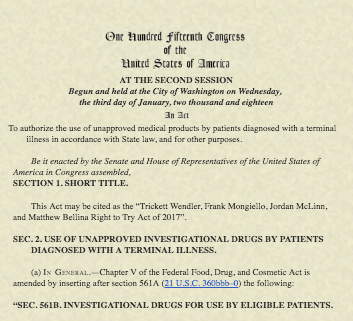
  • Right to Try Act: Commentary Roundup


    A Life Saver, Political Grandstand, or Harmful Scam?

    Depends on Who You Ask. And When.

    It’s been two months since President Donald J. Trump signed into law the Right to Try Act which allows terminally ill patients access to experimental drugs not yet approved by the FDA. Like many things in America in 2018, opinions on the efficacy of this new law vary along party or ideological lines. Will it give hope and precious life-extending solutions for patients fighting terminal disease? Or is it a money-driven scheme intended to enrich corporations and the super rich? Signed into law on May 24, 2018, is it something that can be implemented effectively? Here are a few quotes that explain the controversy.

    Additional commentary or insights welcome.
    Send yours to Editor@LitigationConferences.com.

    “Timely access to promising treatments in … devastating circumstances.”

    “This new law amends the Federal Food, Drug, and Cosmetic Act to establish a new pathway aimed at increasing access to unapproved, investigational treatments for patients diagnosed with life-threatening diseases or conditions who have exhausted approved treatment options and who are unable to participate in a clinical trial. Our implementation of the Right to Try Act will build on our long-standing efforts to help patients and families who are facing life-threatening diseases or conditions, in a way that seeks to protect their autonomy, their safety, and the safety of others following in their paths.”

    “The decisions we reach related to products that can serve as an effective treatment for a terminal illness, or that can arrest a devastating and debilitating condition, are among the most important and carefully considered judgments that we make. We recognize the important balance between making sure patients have the assurances Congress intends, while enabling timely access to promising treatments in these devastating circumstances. And we’ll implement this new law consistent with these longstanding values.”

    FDA Commissioner Scott Gottlieb

    “GOP senator reveals the truth: Right-to-try bill was a scam tailored to harm public health”

    “Anyone with a smidgen of knowledge about healthcare understood that the right-to-try legislation signed by President Trump on Wednesday was a scam, perpetrated by the Koch brothers and their henchmen.”

    “Masquerading as a “compassionate” measure aimed at providing victims of terminal diseases with a last bit of hope that an experimental treatment might save them, it really was aimed at undermining the authority of the Food and Drug Administration to make sure our drugs are safe and effective.”

    Read the full article in the Los Angeles Times.

    “We remain skeptical about whether right-to-try statutes actually help anyone …

    … as opposed to being political grandstanding.  That said, from the perspective of attorneys representing pharmaceutical companies, this bill is about as good as it could be, and – to the extent that it extends preemption to the compassionate use program – it even marginally improves current law.”

    Read the full commentary written by James M. Beck of Reed Smith on the Drug & Device Law Blog. 

    Note: Beck’s commentary was written in March 2018.

    “Very little change for most patients …”

    “Despite these state gains and the policy’s growing popularity among states, ethical questions remain about the tangible impact of a federal right to try law on Americans with terminal illnesses. Most notably, a growing body of evidence from policy analysts argues that the legislation would unfortunately accomplish very little change for most patients, and it could actually make it harder to get new drugs approved in the future.”

    Written for CBS.com by Morten Wendelbo, a lecturer at the Bush School of Government and Public Service and a research fellow at the Scowcroft Institute of International Affairs at Texas A&M University, and Timothy Callaghan, assistant professor at Texas A&M University Health Science Center. Read the complete commentary. 


    Additional commentary or insights welcome.

    Send yours to Editor@LitigationConferences.com.

    This controversial topic will be on the agenda at the Drug & Device Defense Forum in New York Oct. 15, 2018.