Category: Insurance

  • Surfside Condo Collapse: A 360-Degree Insurance Coverage Analysis
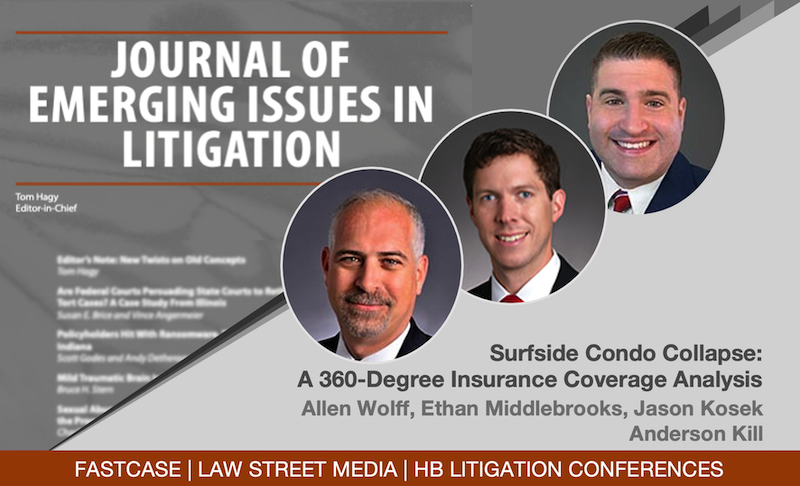
    Surfside Condo Collapse: A 360-Degree Insurance Coverage Analysis

    Surfside Condo Collapse: A 360-Degree Insurance Coverage Analysis

    Abstract

    The horrific and fatal collapse of Champlain Towers South in the summer of 2021 not only shook the ground in Surfside, Florida, but it brought into question the integrity of structures everywhere. If professionals in the construction, real estate, and building management industries were relaxed about signs of structural decay before, they are not anymore. The insurance industry also has reasons to worry, as potentially responsible players turn to their policies to defend or indemnify them for claims for accidents causing losses including from property damage, personal injury, or death. In this article the authors evaluate the factors that are addressed when coverage determinations are made, as well as the various types of policies that come into play.

    Authors

    Allen R. Wolff (awolff@andersonkill.com) is a shareholder in Anderson Kill’s New York office, where he concentrates on the intersection of construction litigation and insurance recovery. Allen is co-chair of the firm’s Construction Industry Practice group and Corporate and Commercial Litigation Practice group. He advises and represents policyholders—building owners, developers, contractors, retailers, municipalities, financial institutions, hospitality businesses, condominium associations, and tenants’ associations—in a range of insurance coverage disputes. Allen’s colleagues, Ethan W. Middlebrooks (emiddlebrooks@andersonkill.com) and Jason Kosek (jkosek@andersonkill.com), are also attorneys in Anderson Kill’s New York office. They also concentrate on insurance recovery for policyholders and other complex matters.

    About
    The Journal on Emerging Issues in Litigation is a co-production of HB, Fastcase, and Law Street Media. You can also hear the complementary (and complimentary) Emerging Litigation Podcast wherever podcasts appear. For questions, contact Tom Hagy, Editor in Chief, at Editor@LitigationConferences.com.

    Loading Viewer…
  • To Pay or Not to Pay: Does Your Insurance Policy Cover Ransomware Losses? | By Pamela Hans | Anderson Kill

    To Pay or Not to Pay: Does Your Insurance Policy Cover Ransomware Losses? | By Pamela Hans | Anderson Kill

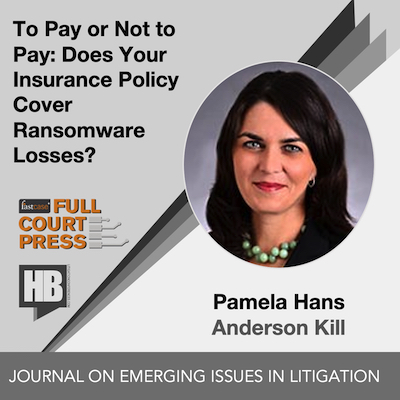
    To Pay or Not to Pay: Does Your Insurance Policy Cover Ransomware Losses?

    Abstract

    Ransomware attacks are a rapidly growing threat against organizations. Paying ransom demands is a risky proposition and may even lead to sanctions against the targeted company. Either way, the damage to a company’s operation and integrity can be cripplingly severe. Should a company suffer losses from cyber extortion, its insurance company will be one of the resources it turns to for relief. But with cyber
    coverage increasingly out of reach for some, policyholders may find coverage in more traditional coverages. In this article, the author evaluates the potential for coverage under several policy types, and underscores the importance of understanding policy language, the relevant law, and the potential regulatory ramifications of meeting ransom demands.

    Author

    Pamela D. Hans (phans@andersonkill.com) is the managing shareholder of Anderson Kill’s Philadelphia office. Her practice concentrates on insurance coverage exclusively on behalf of policyholders. Pam is also a member of the firm’s COVID Task Group and Cyber Recovery Group.

    About
    The Journal on Emerging Issues in Litigation is a co-production of HB, Fastcase, and Law Street Media. You can also hear the complementary (and complimentary) Emerging Litigation Podcast wherever podcasts appear. For questions, contact Tom Hagy, Editor in Chief, at Editor@LitigationConferences.com.

    Loading Viewer…

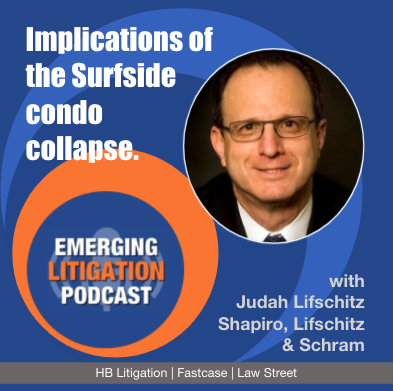
  • Impact of Surfside Condo Collapse with Judah Lifschitz

    Impact of Surfside Condo Collapse with Judah Lifschitz

    Impact of Surfside Condo Collapse with Judah Lifschitz

    Joining me is experienced construction law attorney Judah Lifschitz of Shapiro, Lifschitz & Schram  who spoke about the near- and long-term impacts of the Surfside condo collapse not only in Florida around the country.  Judah has extensive experience dealing with construction matters, representing clients in engineering, procurement and construction contracts and disputes. He represents and advises government agencies and private owners; regional, national and international contractors; construction managers and subcontractors; design professionals; and insurance companies. Notably, Judah won one of the largest liquidated damages awards in the history of the construction industry.  Education: George Washington University, J.D.; Yeshiva University, B.A., magna cum laude.

    This podcast is the audio companion to the Journal on Emerging Issues in Litigation, a collaborative project between HB Litigation Conferences and the Fastcase legal research family, which includes Full Court Press, Law Street Media, Docket Alarm and, most recently, Judicata. If you have comments or wish to participate in one our projects, or want to tell me how insightful and informative Judah is, please drop me a note at Editor@LitigationConferences.com.

    Thanks to Judah for speaking with me about this important topic. I was especially proud that I pronounced his name correctly on the first try, though he assured me that I could in no way do more damage to it than those who have come before me. (Clearly he doesn’t know me well.)

    Tom Hagy
    (pronounced HEY-ghee, for the record)

    via GIPHY

    Nothing illustrates the tragic consequences of building decay more than the June 24, 2021, collapse of the Champlain Towers South in Surfside, Florida, which claimed the lives of nearly 100 residents.

    The event raises questions about the building inspection process not only in Florida but around the country.

    What caused this calamity?

    Who is responsible?

    How many other buildings are in similar condition?

    Since any compensation for the loss of life, injuries, and property damage will likely be astronomical, where will any financial awards come from?

  • The Mega Verdict Trend in Healthcare Litigation with Sandra Cianflone

    The Mega Verdict Trend in Healthcare Litigation with Sandra Cianflone

    The Mega Verdict Trend in Healthcare Litigation with Sandra Cianflone

    Joining me to discuss this high-stakes litigation is Sandra M. Cianflone of Hall Booth Smith, P.C.Sandiecounsels and defends hospitals, physicians, nurses and institutional employees in a broad spectrum of catastrophic injury and medical malpractice cases. She received her Juris Doctorate from Pace University School of Law and her undergraduate degree from Fairleigh Dickinson University.

    This podcast is the audio companion to the Journal on Emerging Issues in Litigation, a collaborative project between HB Litigation Conferences and the Fastcase legal research family, which includes Full Court Press, Law Street Media, Docket Alarm and, most recently, Judicata. If you have comments or wish to participate in one our projects, or want to tell me how insightful and informative Sandie is, please drop me a note at Editor@LitigationConferences.com. This podcast is based on an article she wrote for the forthcoming issues of the Journal.

    Note that in my introduction I have created the phrase “badly wrong,” which is, itself, badly wrong.  Listen to the bitter end when Sandie and I discuss working from home, and how we really feel about family and co-workers.  Feel free to scold me at the email address provided. I hope you enjoy the interview and this professional’s practical insights into defending healthcare providers.

    Tom Hagy

    Damage awards against physicians, hospitals, and other healthcare providers have been coming in bigger and bigger, with juries awarding more than $20 million in a string of cases that should send chills down the spines of defendants and counsel. 

    What are the factors behind this trend? Besides the severe (or even alarming)  nature of the harm alleged, what is fueling these mega verdicts?

    What can defense attorneys do, knowing they are facing a well-organized, well-funded plaintiffs bar?

    For that matter, what can defense attorneys learn from their opponents?

    What strategies can defense employ early in the life of a case?

  • Plastics-Related Liabilities and Insurance Recovery with Mikaela Whitman

    Plastics-Related Liabilities and Insurance Recovery with Mikaela Whitman

    Plastics-Related Liabilities and Insurance Recovery with Mikaela Whitman

    Joining me to discuss this important civil statute is Mikaela Whitman for what was an informative and insightful podcast on this potentially enormous area of litigation. It’s based on her article — One Word: Plastics. Two Words: Pollution Exclusion. Why CGL Policies Should Cover Plastics-Related Liabilities — which will be featured in the inaugural issue of the Journal on Emerging Issues in Litigation  in January 2021.
    Mikaela (mwhitman@pasichllp.com) is a partner in Pasich LLP’s New York office and a member of the firm’s insurance recovery practice. Her practice focuses on the representation of insureds in all phases of insurance coverage recovery, from pre-suit negotiations through alternative dispute resolution and litigation.
    The Journal and Podcast are part of a collaborative project between HB and the Fastcase legal research family, which includes Full Court Press, Law Street Media, Docket Alarm and, most recently, Judicata. If you have comments or wish to participate in one our projects, or want to tell me how awesome Mikaela is, drop me a note at Editor@LitigationConferences.com.
    We hope you enjoy the interview.

    As we see liability actions relating to plastics creeping into the nation’s dockets, what types of claims will survive?

    How much more of this might we see?

    And if it really hits the fan, how will insurance companies respond?

    Will policyholders find protection in their comprehensive general liability policies?

    Their directors and officers policies? Other policies?  

  • Cryptocurrency with Stephen Palley

    Cryptocurrency with Stephen Palley

    Cryptocurrency with Stephen Palley

    Joining me to discuss this paradigm-shattering model is Anderson Kill Partner Stephen D. Palley, a seasoned trial lawyer and litigator with extensive experience in complex commercial disputes like insurance recovery, securities litigation, and corporate governance.  Stephen has significant hands-on software development and design experience. Based in the firm’s D.C. office, he is co-chair of its cross-disciplinary blockchain and virtual currency group. At several points during our conversation I referred to an article co-written by Stephen and his New York colleague Joshua Gold, titled Protecting Cryptocurrency Assets. Stephen earned his J.D. from Washington University, his M.A. from the University of Delaware, and his B.A. (cum laude) from Tufts University (Go Jumbos!).
    This podcast is the audio companion to the Journal on Emerging Issues in Litigation, a collaborative project between HB Litigation Conferences and the Fastcase legal research family, which includes Full Court Press, Law Street Media, Docket Alarm and, most recently, Judicata. If you have comments or wish to participate in one our projects, or want to tell me how insightful and informative Stephen is, please drop me a note at Editor@LitigationConferences.com.
    I hope you enjoy the interview, especially when Leo, my cat, knocked over my microphone and when Stephen educated me on the existence of the Weird Beard Festival and other whisker-based celebrations. –Tom Hagy

    Cryptocurrency assets now exceed $1.5 trillion globally.

    What a great innovation, as is the magic that makes these transactions possible. Of course, I’m talking about blockchain. The possibilities are endless on both counts. No central authority. No regulators.

    But (there’s always a but), thanks to the world’s miscreants, desperados and other baddies there is escalating potential for theft of these assets whether they are held in Bitcoin or other forms of digital currency.

    What should businesses consider if they plan to invest in virtual assets?

    How might they mitigate risk? What security measures should they have in place?

    Is the theft of digital currency covered by insurance?

  • The Age of Social Disparagement with Charlie Kingdollar

    The Age of Social Disparagement with Charlie Kingdollar

    The Age of Social Disparagement with Charlie Kingdollar

    It was my pleasure to interview Charlie Kingdollar for our first episode of the Emerging Litigation Podcast.

    Charlie spent more than four decades with General Reinsurance, three-quarters of which as the company’s Emerging Issues Officer. One colleague described him as “one of the most prescient and gifted industry futurists I have met in my 36 year professional career within the insurance industry. Entertaining and insightful, his ability to digest and communicate complex issues, many before they are readily apparent, is both a gift and a talent.”

    This interview is based on his article on social disparagement coming out in the inaugural issue of the Journal on Emerging Issues in Litigation in January 2021.  The Journal is a collaborative project between HB and Fastcase. If you have comments or wish to participate in one our projects, or want to tell me how awesome Charlie is, drop me a note at Editor@LitigationConferences.com.

    We hope you enjoy the interview.

    Are the risks posed by social media — which has added jet fuel to one person’s ability to smear another — adequately addressed by the insurance market?

  • Policyholders Hit With Ransomware, Then Strike Insurance Coverage Oil in Indiana

    Policyholders Hit With Ransomware, Then Strike Insurance Coverage Oil in Indiana

    Policyholders Hit With Ransomware, Then Strike Insurance Coverage Oil in Indiana

    Abstract

    The cost of ransomware to businesses is estimated to have doubled since 2019 to $20 billion, according to Coveware. Policyholders turn to their insurance policies to recover losses that average more than $230,000 per incident. In the case discussed, the carrier denied a policyholder’s claim as being outside the computer fraud provisions of the commercial crime portion of the policy. Two lower courts sided with the carrier, but the

    Indiana Supreme Court ruled in favor of coverage. This is a significant win for policyholders seeking coverage for losses under policies not sold as “cyber insurance.” The article discusses the decision and the precedents cited in an area of litigation that only promises to expand as ransomware and similar digital crimes proliferate.

    Author

    Scott Godes and Andy Detherage were counsel to United Policy-holders, which submitted an amicus brief in favor of granting transfer and reversing the lower court decision, in the Indiana Supreme Court decision referenced in this article. Messrs. Godes and Detherage are partners in Barnes & Thornburg LLP.

    About
    The Journal on Emerging Issues in Litigation is a co-production of HB, Fastcase, and Law Street Media. You can also hear the complementary (and complimentary) Emerging Litigation Podcast wherever podcasts appear. For questions, contact Tom Hagy, Editor in Chief, at Editor@LitigationConferences.com.

    Loading Viewer…
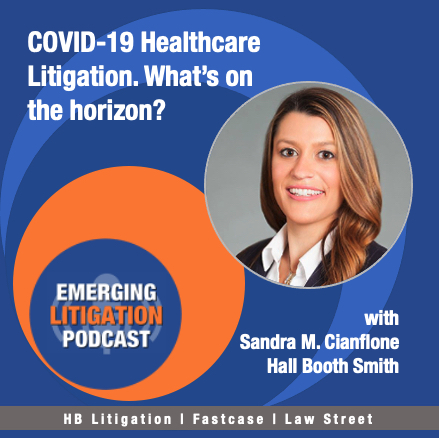
  • Sandra Cianflone on Current and Emerging COVID-19 Litigation

    Sandra Cianflone on Current and Emerging COVID-19 Litigation

    Sandra Cianflone on COVID-19 Litigation in 2021 and Beyond

    It’s now been more than 18 months since the world was besieged by the novel coronavirus pandemic.

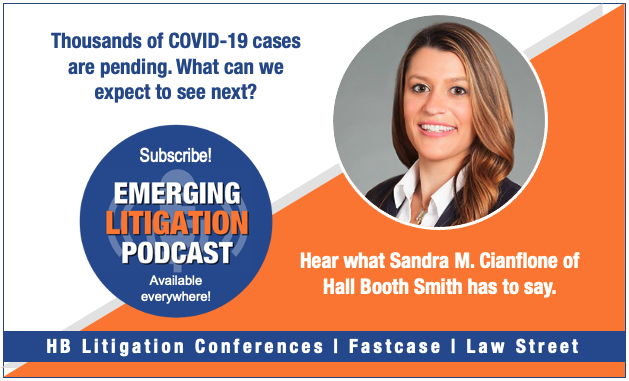
    In addition to the human toll, it disrupted our lives in ways big and small, new and old, as it raced across continents, first visiting North America in January 2020. There are an estimated 15,000 lawsuits relating to the outbreak, with some 350 filings directed toward the healthcare and medical communities. The number of insurance coverage suits is fast-approaching 1,800.

    Litigation has been initiated against aging services, hospitals, and healthcare providers, with the next anticipated wave likely to  surround vaccines themselves. What will be the basis of these claims? What defenses will we see? And what can healthcare providers do now in anticipation of this onslaught?

    Joining me to discuss this out-of-the-blue rash of litigation is Sandra M. Cianflone of Hall Booth Smith, P.C.Sandiecounsels and defends hospitals, physicians, nurses and institutional employees in a broad spectrum of catastrophic injury and medical malpractice cases. She received her Juris Doctorate from Pace University School of Law and her undergraduate degree from Fairleigh Dickinson University.

    This podcast is the audio companion to the Journal on Emerging Issues in Litigation, a collaborative project between HB Litigation Conferences and the Fastcase legal research family, which includes Full Court Press, Law Street Media, Docket Alarm and, most recently, Judicata. If you have comments or wish to participate in one our projects, or want to tell me how insightful and informative Sandie is, please drop me a note at Editor@LitigationConferences.com. This podcast is based on an article she wrote for the forthcoming issues of the Journal.

    I hope you enjoy the interview, and especially a brief story (after we wrap up) about Sandie’s experience delivering a baby in the Age of COVID-19. I also mangled a bit of basic Spanish, for which I am ashamed (lo siento), and was a little cavalier with some statistics, for which I am mortified.  Feel free to chastise me at the email address provided. –Tom Hagy

  • Charlie Kingdollar on Sexual Abuse Claims

    Charlie Kingdollar on Sexual Abuse Claims

    Charlie Kingdollar on Sexual Abuse Claims and Litigation: Their Impact on the Insurance Industry

    Abstract
    The statistics surrounding childhood sexual abuse and molestation are staggering. Many make headlines such as the cases brought against clergy, athletic coaches, Boy Scout leaders, and actors and movie producers. This article attempts to size the impact of these cases on the insurance industry, and what measures are being taken that will allow more lawsuits to be filed on behalf of victims years after they were abused or molested.

    Author
    Charlie Kingdollar recently retired after 40 years with General Reinsurance Corp., where he was Vice President and Emerging Issues Officer. He is widely considered to be among the best resources for new liability risks, even called by one colleague as a “prescient and gifted industry futurist.” I recommend you follow him on LinkedIn. –Tom Hagy

    About
    The Journal on Emerging Issues in Litigation is a co-production of HB, Fastcase, and Law Street Media. You can also hear the complementary (and complimentary) Emerging Litigation Podcast wherever podcasts appear. For questions, contact Tom Hagy, Editor in Chief, at Editor@LitigationConferences.com.

    Loading Viewer…