Category: Insurance

  • Climate Change, ESG, and D&O Insurance: Collision or Cooperation?

    Climate Change, ESG, and D&O Insurance: Collision or Cooperation?

    The Authors

    Robert D. Chesler (rchesler@andersonkill.com) is a shareholder in Anderson Kill’s New Jersey office and is a member of the firm’s Cyber Insurance Recovery Group. Bob represents policyholders in a broad variety of coverage claims against their insurers and advises companies with respect to their insurance programs. Dennis J. Artese (dartese@andersonkill.com) is a shareholder in Anderson Kill’s New York office and chairs the firm’s Climate Change and Disaster Recovery Group. Joseph Vila (jvila@andersonkill.com) is an insurance recovery attorney in Anderson Kill’s New Jersey office.

    Journal on Emerging Issues in Litigation

    Climate Change, ESG, and D&O Insurance: Collision or Cooperation?

    By Robert D. Chesler, Dennis J. Artese, and Joseph Villa

    Abstract:
    Climate change has been tied to the recent increase in catastrophic weather events. Insurance coverage for often billions of dollars in damage becomes a source of argument between insurers, who want to limit their exposure, and policyholders, who want the coverage they argue the carriers are contractually obligated to pay. The authors discuss the nature of the underlying suits and the potential coverage issues; the types of policies implicated; cases that have addressed these issues; the rising societal concern over climate change that have played a role in the new corporate emphasis on environmental, social, and governance, or ESG, and the insurance industry’s response to this trend.

    Excerpts:
    Directors and Officers (D&O) policies [are] directly affected by climate change. Two types of suits are already happening. First, there are at least 1,375 climate change–related suits pending in the United States, about two dozen of which have been filed by local municipalities and states seeking damages because of climate change. For example, the attorneys general of New York, Massachusetts, and the U.S. Virgin Islands launched investigations to determine whether Exxon Mobil Corporation misrepresented to investors the risks of how climate change might impact its business. Although the U.S. Virgin Islands attorney general terminated its investigation, the New York and Massachusetts attorneys general filed separate suits against Exxon.

    In the seminal case People of the State of New York, By Letitia James v. Exxon Mobil Corporation, 119 N.Y.S.3d 829 (N.Y. Sup. Ct. 2019), the State of New York sued Exxon, alleging that it violated the state’s securities act by making materially false and misleading statements to the public and investors about how the company manages risks of climate change and the cost of carbon in assessing demand for its products. The state dropped its common law fraud claims prior to trial, but proceeded with a claim under New York’s Martin Act, which permits the attorney general to sue for fraud in connection with the marketing of securities without requiring proof of scienter, reliance, and damages, as well as under New York’s Executive Law, which prohibits persistent fraudulent acts. After a trial, the New York Supreme Court held that the state failed to demonstrate by a preponderance of the evidence that Exxon made any material misrepresentations to investors ….

    As regulatory activity and private litigation activity surrounding climate change issues continue to increase, liabilities likely will follow. D&O insurance companies will be called on to address those liabilities with increasing frequency.

    Those claims will present complex coverage issues of first impression, and policyholders can expect a fight. Policyholders also should be on the lookout for more restrictive coverage terms on D&O renewals. Policyholders should work with their brokers to obtain the broadest coverage available, and consult with sophisticated coverage counsel in the event that they are faced with climate change–related claims. 

    Get the article now!

    Explore more from Bob Chesler and contributing specialists!

    Journal on Emerging Issues, Editorial Board of Advisors

    The Use and Abuse of the Pollution Exclusion. By Dennis Artese, Jamie O’Neil, Robert Chesler

    The Environmental, Social, and Governance Police Have Arrived: Is your Insurance Ready. Authors: Dennis Artese, Bob Chesler.

    PFAS Insurance Coverage with Jaana Pietari and Jim Fenstermacher and Litigation with Bob Chesler: Part 1 of 2 Podcasts

    PFAS Insurance Coverage with Robert D. Chesler of Anderson Kill. Part 2 of 2 Podcasts

    How Insurance Companies Defraud Their Policyholders, and What Courts and Legislators Should Do About It

    Climate Change, ESG, D&O Insurance: Collision or Cooperation? By Robert D. Chesler, Dennis J. Artese and Joseph Villa

    Remediating, Insuring, and Litigating PFAS Claims. By Dr. Jaana Pietari, PhD, MBA, PE, Jim Fenstermacher, PE, Dr. Michael Bock, PhD, MS, Robert D. Chesler and Nicholas M. Insua, Sheila Mulrennan, Robin Kelliher, Jason R. Waters

  • The Impact of Sanctions on Russia on Global Financial Markets with Brad Rustin

    The Impact of Sanctions on Russia on Global Financial Markets with Brad Rustin

    The Impact on Global Financial Systems of U.S. Sanctions on Russia with Brad Rustin

    Brad Rustin on FinTechBut what risks do American corporations and financial institutions face in light of these measures? What difficult reverberations will companies feel across the world? What should global businesses and FinTechs be doing right now to avoid, among other things, violating the restrictions imposed by the U.S. Treasury Department’s Office of Foreign Assets Control (OFAC)? What role will cryptocurrency play in all of this? Also, do institutions whose data are stored in Russia and Ukraine face an additional risk as a parallel (albeit less horrific) battle rages on in cyberspace?

    Listen to my interview with Brad Rustin, a partner with Nelson Mullins Riley & Scarborough LLP and chair of the firm’s Financial Services Regulatory Practice. Brad is a highly regarded FinTech law and industry expert. This will be apparent when you listen. Brad is also on the Editorial Advisory Board of the Journal on Emerging Issues in Litigation. This is a special rapid-release episode given we feel the insights Brad shares are insights business and FinTech’s — and their attorneys — urgently need to hear.

    This podcast is the audio companion to the Journal on Emerging Issues in Litigation, a collaborative project between HB Litigation Conferences and the Fastcase legal research family, which includes Full Court Press, Law Street Media, and Docket Alarm. The podcast itself is a joint effort between HB and our friends at Law Street Media. If you have comments or wish to participate in one our projects, or want to tell me how much  you learned from Brad,  please drop me a note at Editor@LitigationConferences.com.

    Tom Hagy
    Host and Litigation Enthusiast

    P.S. We did not get to discuss Russia’s retaliatory sanctions against President Biden, his son, Hunter, and Hillary Clinton. No word on sanctions against the Biden dogs. Oh! This just in from People magazine: “Hillary Clinton Thanks Russia for ‘Lifetime Achievement Award’ After Country Issues Sanction Against Her.” That’s just good comedy.

    Economic sanctions leveled against Russia, its leaders, and selected oligarchs by the United States and many other countries for its invasion of Ukraine are arguably the most aggressive in history. Their impact on the Russian economy has been severe and immediate, pushing the nation to the brink of economic collapse.


    But, as they must, the gears of global business and finance must keep turning.

  • Social Inflation’s Impact on Jury Verdicts

    Social Inflation’s Impact on Jury Verdicts

    Social Inflation’s Impact on Jury Verdicts in Healthcare Litigation

    Our guests wrote in the Journal on Emerging Issues in Litigation: “These outsize awards are often driven by myriad factors including sympathetic jurors, societal conceptions about income and wealth of corporations, the use of emotion-driven ‘Reptile Theory’ tactics by plaintiff attorneys, the media spotlight on ‘bad apple’ physicians, and numerous other social factors. A new factor that influences elevated jury verdicts is the increasing volume of information—whether true or false—that is exchanged on social media platforms.”

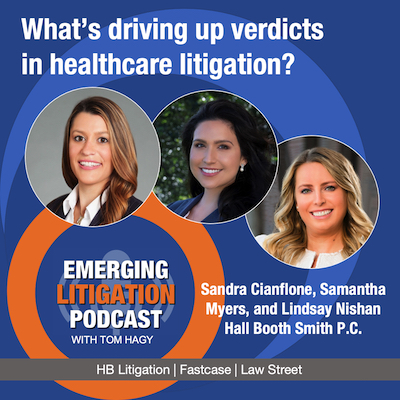
    Podcast on jury verdictsListen to my interview with Hall Booth Smith P.C. attorneys Sandra Cianflone, Samantha Myers, and Lindsay Nishan, each of whom represents members of the healthcare industry, as they discuss what drives large verdict and what attorneys should consider in mitigating the effects of this phenomenon.

    In keeping with tradition, we may have strayed a bit from the topic. One guest’s Aunt Lulu made an appearance. It turns out Covid lockdowns may have produced more enthusiastic jurors. And I added another reason why writing and podcasting, and not the practice of law, was a better career path for me. (Apparently lawyers aren’t supposed to laugh in people’s faces. Noted.)

    This podcast is the audio companion to the Journal on Emerging Issues in Litigation, a collaborative project between HB Litigation Conferences and the Fastcase legal research family, which includes Full Court Press, Law Street Media, and Docket Alarm. The podcast itself is a joint effort between HB and our friends at Law Street Media. If you have comments or wish to participate in one our projects, or want to tell me how much  you learned from Sandie, Sam, Lindsay, or Aunt Lulu,  please drop me a note at Editor@LitigationConferences.com.

    Tom Hagy
    Litigation Enthusiast
    Host of the Emerging Litigation Podcast

    Jurors’ perceptions of big corporations, insurance companies, drug companies, physicians and other healthcare providers is increasingly colored by TV and social media. 


    The same is true for people’s understanding of the practice law or medicine, which may be as wrong as it is immovable. “Social inflation” refers to rising litigation costs and the resulting higher insurance payouts which drive up the cost of insurance. The phrase has taken on new meanings as it is used in the general press. To some it means tort reform rollbacks, litigation funding, and is most often seen in references to so-called “nuclear” jury verdicts, i.e., awards that exceed $10 million.

    What factors contribute to these jury awards?

  • The Shifting Gun Liability Landscape: Plaintiffs Say Companies are Marketing Illegally, Insurers End Up Paying

    The Shifting Gun Liability Landscape: Plaintiffs Say Companies are Marketing Illegally, Insurers End Up Paying

    The Author

    Charlie Kingdollar

    Charlie KingdollarInsurance Industry Expert

    Charlie spent more than four decades with General Reinsurance, three-quarters of which as the company’s Emerging Issues Officer. One colleague described him as “one of the most prescient and gifted industry futurists I have met in my 36 year professional career within the insurance industry. Entertaining and insightful, his ability to digest and communicate complex issues, many before they are readily apparent, is both a gift and a talent.” Charlie is also a member of the Editorial Board of Advisors for the Journal on Emerging Issues in Litigation.

    The Shifting Gun Liability Landscape: Plaintiffs Say Companies are Marketing Illegally, Insurers End Up Paying

    By Charlie Kingdollar

    On Feb. 15, 2022, Remington Arms, manufacturer of the Bushmaster AR15-style rifle agreed to pay $73 million to settle a lawsuit filed by the families of nine of the victims of the Dec. 14, 2012, Sandy Hook Elementary School shooting. The $73 million will be paid by four of Remington’s insurers (and likely their reinsurers).[i]

    Why is this a big deal? Insurers and reinsurers providing liability coverage for gun manufacturers did so believing that federal law protected gun manufacturers from liability arising from shootings under the federal Protection of Lawful Commerce in Arms Act (PLCAA). It seems likely that policy terms and conditions as well as pricing of the risk reflected that perceived liability protection.

    Things have changed. The Connecticut plaintiffs filed their suit under the Connecticut Fair Trade Practices Act. The plaintiffs alleged that the Bushmaster was a combat weapon and that Remington improperly marketed it to civilians – particularly trying to reach young men. In 2019, the Connecticut Supreme Court ruled that the federal PLCAA did have some carve-outs for state laws and subsequently declined Remington’s request to dismiss the lawsuit. It seems a safe bet that the families of other Connecticut gun violence victims will file similar suits over past and/or future incidents.

    Okay, so this is Connecticut. But it seems likely that this lawsuit will be used as a template by plaintiffs in other states that have similar statutes – and many do. This lawsuit and settlement could result in burgeoning litigation against gun manufacturers.

    Presumably, even a single victim shot with a Bushmaster, or any gun that could be argued is a combat weapon, could file a similar suit under a state’s Fair Trade Practices Act.

    Which other guns could be deemed “combat weapons” and therefore unfit for civilian populations? Only time and future litigation will tell. One possible example is the WEE1 Tactical, the manufacturer of the AR-15, which is similar to the Bushmaster, may find itself facing litigation. A look at AR-15-style guns on Wikipedia results in a list of 27 guns by 26 manufacturers – and I doubt this is a comprehensive list.[ii] Would a machine pistol be considered a “combat weapon”? How many other types of firearms might be deemed “combat weapons”?

    WEE1 Tactical has recently begun advertising the JR-15 – a smaller, lighter version of the AR-15 that fires smaller .22 caliber rounds for use by children. WEE1’s website states: “The JR-15 is the first in a line of shooting platforms that will safely help adults introduce children to the shooting sports.”[iii] Given that the plaintiffs in the Sandy hook case stressed the firm was specifically marketing the Bushmaster to young men it will be interesting to see how this marketing strategy will play out in any future similar litigation.

    There’s been another crack in the perceived liability protection afforded to gun manufacturers in the U.S.  Last year the State of New York enacted a law that “would classify the illegal or improper marketing or sale of guns as a nuisance…that supporters said would bolster litigation against gun companies.”[iv]

    Will other states follow? If even a few enact similar statutes, the defense and indemnity costs could be significant to the gun manufacturers and their insurers and reinsurers.

    Bushmaster has settled once before with the families of victims shot by one of its guns. In 2004, the company agreed to pay $2.5 million to settle with the families of victims shot by the D.C. sniper.[v] Not much changed after that settlement. It may be different this time.

    What about other entities in the gun liability chain? If the gun manufacturer can be held libel for marketing a combat weapon to civilians, can wholesalers and retailers also be found liable?  Could courts find that these companies also played a role in putting “combat weapons” into the hands of civilians?  If so, the costs to the Property/Casualty insurance industry will be greater.

    Unfortunately, mass shootings and gun violence are on the rise in the United States. The number of mass shootings (defined as 4 or more people shot – killed or wounded) have increased every year except one from 2014 to 2021. In 2014 there were 269 mass shootings in the U.S.  By 2021, this increased to 691 mass shootings. There have been 2,402 mass shootings in the U.S. in the past five years. And we’ve only mentioned mass shootings incidents.[vi]

    Gun violence generally continues to rise. “Guns were involved in 75% of all homicides and 91% of homicides involving youths between 2018 and 2019 … those new numbers represent a significant and troubling uptick from a decade before.”[vii]

    I suspect insurers and reinsurers providing liability for companies that manufacture and sell guns find themselves as defendants in an increasing number of lawsuits.

    [i] https://www.washingtonpost.com/nation/2022/02/15/remington-sandy-hook-settlement/

    [ii] https://en.wikipedia.org/wiki/AR-15_style_rifle

    [iii] https://en.wikipedia.org/wiki/AR-15_style_rifle

    [iv] https://www.nytimes.com/2022/02/15/nyregion/sandy-hook-families-settlement.html?referringSource=articleShare

    [v] https://www.washingtonpost.com/nation/2022/02/15/remington-sandy-hook-settlement/

    [vi]   https://www.gunviolencearchive.org/

    [vii]   “Gun Deaths Continue to Rise In American Cities,” U.S. News, 1/10/22

  • Going Viral or Going Nuclear: Social Inflation’s Impact on Jury Verdicts …

    Going Viral or Going Nuclear: Social Inflation’s Impact on Jury Verdicts …

    The Authors

    All three authors are with the law firm of Hall Booth Smith, P.C., and concentrate on various aspects of healthcare defense.  Lindsay A. Nishan (lnishan@hallboothsmith.com) is an Associate in the HBS Charleston office. Samantha Bowen Myers (smyers@hallboothsmith.com) is an Associate in their West Palm Beach, Florida, office. Sandra Mekita Cianflone (scianflone@hallboothsmith.com) is a Partner in the firm’s Atlanta office. She is also a member of the Editorial Board of Advisors for the Journal on Emerging Issues in Litigation, and a frequent contributor to the Emerging Litigation Podcast.

    Going Viral or Going Nuclear:

    Social Inflation’s Impact on Jury Verdicts and How to Safeguard Against It

    By Lindsay A. Nishan, Samantha B. Myers
    and Sandra M. Cianflone

    A juror’s perception of companies and healthcare providers is increasingly colored by TV and social media. The same is true for their understanding of the practice law or medicine, which may be as wrong as it is immovable. “Social inflation” refers to rising litigation costs and the resulting higher insurance payouts which drive up the cost of insurance. In this article the authors, each of whom represents parties in the healthcare industry, discuss the evolving social trends that lead jurors to render “nuclear verdicts,” and what attorneys should consider in mitigating the effects of this phenomenon.

    Social media feeds today are crammed with flashy advertisements from lawyers promising big-dollar settlements against “rich insurance companies.” The number of these commercials has spiked since the 1970s as the phenomenon known as “social inflation” has taken root in the legal system.

    Social inflation is a term of art that refers to rising litigation costs, the impact those costs have on insurance claim payouts, and how much the average policyholder is expected to pay for basic coverage. Recently, the term social inflation has taken on a new meaning as it has become more widely used in the general press. The phrase has come to be associated with tort reform rollbacks, litigation funding, and is most seen in references to so-called “nuclear” jury verdicts, i.e., a jury award that exceeds $10 million.

    But the question remains: What factors contribute to these exorbitantly high jury verdicts?  These outsize awards are often driven by myriad factors including sympathetic jurors, societal conceptions about income and wealth of corporations, the use of emotion-driven “Reptile Theory” tactics by plaintiff attorneys, the media spotlight on “bad apple” physicians, and numerous other social factors. A new factor that influences elevated jury verdicts is the increasing volume of information—whether true or false—that is exchanged on social media platforms.

    One of the lines most affected by this form of social inflation is the healthcare industry and the soaring costs of medical malpractice litigation. This includes lawsuits involving hospital systems, pharmaceutical companies, and their insurers.

    See what the authors have to say about mitigating the impact of social inflation. 

    Get the article now!

  • PFAS Science with Jaana Pietari and Jim Fenstermacher and Litigation with Bob Chesler

    PFAS Science with Jaana Pietari and Jim Fenstermacher and Litigation with Bob Chesler

    PFAS Science with Jaana Pietari and Jim Fenstermacher and Litigation with Bob Chesler

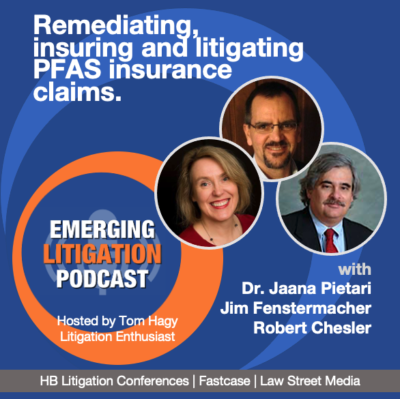
    In Part 1 of the episode, we discussed the PFAS from the scientific and environmental engineering perspective. And to do that I was fortunate to have  Jim Fenstermacher and Dr. Jaana Pietari from the global engineering firm Ramboll.  Jim and Jaana have deep experience in environmental remediation involving a variety of contaminants, including PFAS.

    In Part 2, I am joined by Robert Chesler of Anderson Kill. Bob is a long-time expert on insurance coverage for long-tail and other claims. He’s considered a guru in the field, and has represented policyholders in disputes over coverage with insurers for as long as I’ve known him.

    It’s a serious subject and these are seriously qualified folks. I did my part to make a mockery of scientific terms as I struggled to say the name of this family of chemicals. Fortunately for you my guests were much more linguistically nimble and it is their voices you will hear more of.

    This podcast is the audio companion to the Journal on Emerging Issues in Litigation, a collaborative project between HB Litigation Conferences and the Fastcase legal research family, which includes Full Court Press, Law Street Media, and Docket Alarm. The podcast itself is a joint effort between HB and Law Street Media. If you have comments or wish to participate in one our projects, or want to tell me how much  you learned from Jaana, Jim and Bob,  please drop me a note at Editor@LitigationConferences.com.

    Tom Hagy
    Litigation Enthusiast and Host of the Emerging Litigation Podcast

    p.s. Here’s a bonus for you. Write to me and I will send you the latest issue of the Journal on Emerging Issues in Litigation with my compliments.  That’s some serious value right there.

    In our first two-part episode, we dive into the troubling existence of a group of chemicals referred to as PFAS, with the nickname “Forever Chemicals,” because they stubbornly hang around in water, air, fish, soil, people, and animals.  

    PFAS — which stands for per- and polyfluoroalkyl  chemicals — are man-made creations that have been used in industry and consumer products worldwide since the 1950s. There are more than 4,000 of them, so it’s a big family. They can be found in non-stick cookware, water-repellent clothing, stain-resistant fabrics and carpets,  cosmetics,  firefighting foams, and products that resist grease, water, and oil. Studies have shown that exposure to some PFAS in the environment may be harmful to humans and animals.

    PFAS contamination has sparked some major litigation, with some cases involving hundreds or thousands of individuals that have settled for hundreds of millions of dollars. The PFAS issue is significant enough that  — despite so many other pressing issues — the White House made it a top priority, kicking eight federal departments into gear to tackle the situation.  It’s a hot topic that’s going to be with us for many years.

    Explore More from Anderson Kill!

    Journal on Emerging Issues, Editorial Board of Advisors

    The Use and Abuse of the Pollution Exclusion. By Dennis Artese, Jamie O’Neil, Robert Chesler

    The Environmental, Social, and Governance Police Have Arrived: Is your Insurance Ready. Authors: Dennis Artese, Bob Chesler.

    Podcast 1 of 2: PFAS Insurance Coverage with Jaana Pietari and Jim Fenstermacher and Litigation with Bob Chesler

    Sister to Podcast 1 of 2 Article. Remediating, Insuring, and Litigating PFAS Claims. Authors: Dr. Jaana Pietari, PhD, MBA, PE, Jim Fenstermacher, PE, Dr. Michael Bock, PhD, MS, Robert D. Chesler and Nicholas M. Insua, Sheila Mulrennan, Robin Kelliher, Jason R. Waters

    Podcast 2 of 2: Insurance Coverage for PFAS Claims with Robert Chesler

    Podcast: Autonomous Vehicles: The New Technology Driving the Litigation Conversation Podcast with Cort Malone, John Leonard, Joshua Zelen

    Podcast: Violations of Biometric Privacy Laws: Policyholders’ Victories and the Implications Going Forward with John Leonard and Cort Malone

    Journal on Emerging Issues, Editorial Board of Advisors: Dennis Artese, Robert D. Chesler

    How Insurance Companies Defraud Their Policyholders, and What Courts and Legislators Should Do About It. Authors: Robert Chesler, Dennis J. Artese, and Joseph Villa

    Asymmetrical Combat: Bad Faith Liability in Insurance Recovery Cases. By William Passannante

    Litigation After Biometric Privacy Law Violations: Policyholder Victories and Their Implications. Authors: Cort T. Malone, Abigail Damsky

    Climate Change, ESG, D&O Insurance: Collision or Cooperation? By Robert D. Chesler, Dennis J. Artese and Joseph Villa

    Protecting Policyholders as AI Is Developed for Insurance Claims Handling – Ensuring “Decency and Humanity” in the Digital Age. Authors: Marshall Gilinsky, Madison Marlow

    Police–The Environmental, Social, and Governance Police Have Arrived: Is your Insurance Ready. Authors: Dennis Artese, Bob Chesler

    How Insurance Companies Defraud Their Policyholders, and What Courts and Legislators Should Do About It. Authors: Robert Chesler, Amy Weiss, and Jade Sobh

    The Promise and Peril of Quantum Computing and Its Implications for Cyber Insurance. By Cameron R. Argetsinger

    The Use and Abuse of the Pollution Exclusion. Authors: Dennis Artese, Jamie O’Neil, Robert Chesler

    Property Insurance Coverage for Emerging Risk: Underground Climate Change. Authors: Dennis J. Artese, Ethan W. Middlebrooks, Thomas Dupont

    Autonomous Vehicles: The New Technology Driving the Litigation Conversation. Authors: Cort Malone, John Leonard, and Joshua Zelen

  • The New Lloyd’s Market Association War, Cyber War and Cyber Operation Exclusions for Cyber Insurance Policies | By Vincent J. Vitkowsky | Gfeller Laurie LLP

    The New Lloyd’s Market Association War, Cyber War and Cyber Operation Exclusions for Cyber Insurance Policies | By Vincent J. Vitkowsky | Gfeller Laurie LLP

    The Author

    Vincent J. Vitkowsky

    Vincent J. VitkowskyPartner | Gfeller Laurie LLP

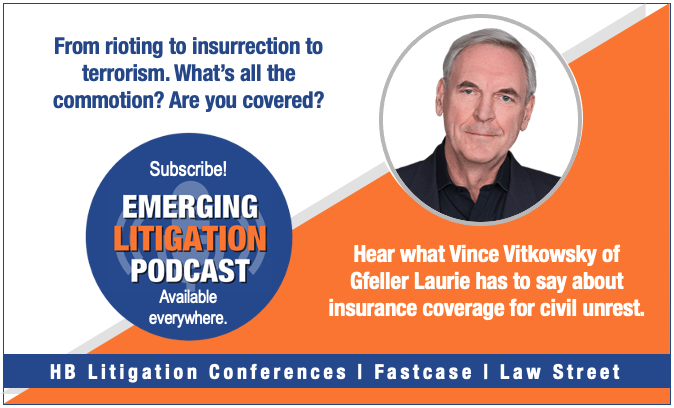
    Vince Vitkowsky is a partner in Gfeller Laurie LLP, resident in New York. He focuses on cyber risks, liabilities, insurance, and litigation. Vince assists insurers and reinsurers in product development, and in all aspects of coverage evaluation and dispute resolution in many lines of business, including cyber, CGL, property, and professional liability. He also assists in complex claim evaluations, and if necessary, the defense of insureds in complex matters.

    Vince is also a member of the Editorial Advisory Board for the Journal on Emerging Issues in Litigation.

    Contact: vvitkowsky@gllawgroup.com

    More from Vince and his colleagues.

    Melicent Thompson

    The New LMA War, Cyber War and Cyber Operation Exclusions for Cyber Insurance Policies

    By Vincent J. Vitkowsky

    On November 25, 2021, the Lloyd’s Market Association released four War, Cyber War and Cyber Operation Exclusions (“Exclusions”). The LMA Cyber Business Panel spent well over two years drafting the Exclusions, which are models for use in standalone cyber insurance policies.  Lloyd’s has agreed that they meet the requirement that all insurance and reinsurance policies written at Lloyd’s must, except in very limited circumstances, contain a clause which excludes all losses caused by war.  The Exclusions address some difficult issues troubling the cyber insurance market for several years, following cyberattacks by nation-states (“states”) and threat actors associated with them.  They attempt to reduce uncertainty for both insurers and policyholders.

    Five interrelated issues.

    • The treatment of collateral damage (borrowing a concept from the traditional Law of Armed Conflict). Some state-sponsored attacks had significant effects on many entities that were not the intended targets.
    • How attribution is to be determined, and whether the insurers have an obligation to make payments while attribution is being determined.
    • The extent to which attacks by non-state actors associated with a state are excluded.
    • The treatment of state and state-sponsored cyberattacks directed at essential services, most notably those disrupting financial institutions and the financial markets infrastructure.
    • As in war exclusions in all lines of business, attempting to limit the aggregation risk.

    The Exclusions.

    The principal innovations in the Exclusions are to introduce the concept of “cyber operation” to insurance, to set processes for determining attribution, to partially clarify the scope of essential service, and to set a structure that de facto mitigates the aggregation risk.

    The key concepts and terms are as follows.

    War.  All four Exclusions contain an identical definition of War, largely based on traditional insurance policy language dating back to the Spanish Civil War.  It is “the use of physical force by a state against another state, or as part of a civil war, rebellion, revolution, insurrection, and/or military or usurped power or confiscation or nationalisation or requisition or destruction or damage to property by or under the order of any government or public or local authority, whether war be declared or not.”  (Emphasis is added, throughout this note.)  In the context of cyber war, this would include a cyberattack with kinetic effects.

    Cyber operation.  All four Exclusions also have an identical and innovative definition of cyber operation.  It is “the use of a computer system by or on behalf of a state to disrupt, deny, degrade, manipulate or destroy information in a computer system of or in another state.”

    Attribution.  All four Exclusions also contain an identical and innovative provision on “Attribution of a cyber operation to a state.”  It provides that the “primary but not exclusive factor” in attribution “shall be whether the government of the state (including its intelligence and security services) in which the computer system affected by the cyber operation is physically located attributes the cyber operation to another state or those acting on its behalf.”  Pending attribution by a state, “the insurer may rely upon an inference which is objectively reasonable as to attribution,” and no loss shall be paid.  If the affected state “takes an unreasonable length of time to, or does not, or declares it is unable to attribute the cyber operation to another state or those acting on its behalf,” the insurer, bearing the burden of proof, must “prove attribution by reference to such other evidence as is available.”

    Specified States.  This term appears in some of the Exclusions.  The specified states are China, France, Germany, Japan, Russia, UK or USA.

    The four exclusions treat cyber operations differently.

    The first Exclusion simply provides a blanket denial of coverage for loss “directly or indirectly occasioned by, happening through or in consequence of war or a cyber operation.”

    The other three Exclusions deny coverage for loss “directly or indirectly occasioned by, happening through or in consequence of war or a cyber operation that is carried out in the course of war.”

    The second Exclusion has additional provisions denying coverage for “retaliatory cyber operations between any specified states; and/or a cyber operation that has a major detrimental impact on the functioning of a state due to the direct or indirect effect of the cyber operation on the availability, integrity, or delivery of an essential service in that state; and/or the security or defense of a state.”  Although these are excluded, the policy may grant coverage for “any other cyber operations,” with a separately negotiated limit and aggregate.

    Significantly, essential service is defined as “a service that is essential for the maintenance or vital functions of a state including without limitation: financial institutions and associated financial market infrastructure, health services or utility services.”

    The third Exclusion is identical to the second, except it does not grant coverage for “any other cyber operations,” i.e., those not carried out in the course of war, retaliatory cyber operations between specified states, or those having a major detrimental impact.

    The fourth Exclusion is identical to the third, except it introduces the concept of “impacted state,” defined as “any state where a cyber operation has had a major detrimental impact on the functioning of that state [as defined in the third Exclusion], and/or security or defense of that state.”  Moreover, it limits the Exclusion for retaliatory cyber operations to those “leading to two or more specified states becoming impacted states.”  It also provides an exception to the Exclusion for loss from a cyber operation that has a major detrimental impact, so the Exclusion “shall not apply to the direct or indirect effect of a cyber operation on a bystanding cyber asset.”  That term is defined as “a computer system used by an insured or its third party service providers that is not physically located in an impacted state but is affected by a cyber operation.”

    The complete Exclusions can be found here.

    A serious attempt to reduce uncertainty.

    These Exclusions are not perfect.  Nothing is.  There is scope for dispute about the terms “an inference which is objectively reasonable,” “reference to such other evidence as is available,” “major detrimental impact,” and “essential service,” among others, as applied to specific facts.  But the Exclusions reflect a well-reasoned, serious attempt to reduce some of the uncertainties over the scope of coverage for state and state-sponsored attacks.

    Written Dec. 9, 2021 and posted with permission with minor formatting changes. Copyright 2021 by Vincent J. Vitkowsky.  All rights reserved.

  • The Cyber Insurance Market Has Problems: A Conversation With Tom Johansmeyer

    The Cyber Insurance Market Has Problems: A Conversation With Tom Johansmeyer

    The Cyber Insurance Market Has Problems: A Conversation With Tom Johansmeyer

    The author of the piece is my guest on our latest episode. He is Tom Johansmeyer, ARM, is head of PCS, a Verisk business. PCS investigates and provide, independent loss estimates on catastrophes and large individual losses to the benefit of the global risk and capital supply chain. Tom has focused on the broad and rapid expansion of PCS, leading the team into Japan, New Zealand, and other APAC regions in 2019 – as well as Mexico. Tom is the architect of the PCS entry into global specialty lines, most recently adding large risk loss reporting to the group’s portfolio. Previously, Tom held insurance industry roles at Guy Carpenter (where he launched the first corporate blog in the reinsurance sector) and Deloitte. Personally, I like his LinkedIn description: “Aspiring cyclist and distance swimmer, former soldier. Leading the global charge at PCS. Haven’t driven anything with a motor since 2007.” Excellent.

    This podcast is the audio companion to the Journal on Emerging Issues in Litigation, a collaborative project between HB Litigation Conferences and the legal news folks at Law Street Media, and the Fastcase legal research family, which includes Docket Alarm and Judicata. If you have comments or wish to participate in one our projects, or want to tell me how insightful our guests are, please drop me a note at Editor@LitigationConferences.com.

    You might notice that I misused a commonly used term, one specifically common in the world of insurance, or maybe you weren’t paying that much attention. That would make two of us. Also, Tom J. was just a fun interview and I hope to get him back! I like the way he explained his candor at the end. He suffers from an infliction that I wish were a pandemic. I hope you enjoy it.

    Tom Hagy
    Host of the Emerging Litigation Podcast

    “Facing the prospect of major financial fallout from an attack, C-suites around the world have turned to cyber insurance. Insurers are issuing more policies, and the amounts of protection available are increasing.

    “In 2020, according to data proprietary to the team I lead, the global insurance community saw the first cyber insurance program to exceed $1 billion — and the second. However, the momentum that has propelled the sector this far may be running out. The cyber insurance sector may still be in its infancy, but there are signs that it’s hit a (hopefully temporary) plateau.”

    From a Jan. 11, 2021, article in the Harvard Business Review titled “Cybersecurity Insurance Has a Big Problem.”

  • Strategies for Maximizing Insurance Recovery for Climate Change–Related Loss and Damage

    Strategies for Maximizing Insurance Recovery for Climate Change–Related Loss and Damage

    Strategies for Maximizing  Insurance Recovery for Climate Change–Related Loss and Damage

    Abstract

    Losses from natural catastrophes are costing many tens of billions as year, from hurricanes and tornadoes to record-breaking rainfall and floods. Whether the insurance industry will or can provide coverage for all of the devastating effects of climate change (or, as some might put it, a new and calamitous phase in our earth’s existence) only time will tell. In the meantime, policyholders must cross their Ts if they expect coverage. In this article the author shares insights on the complex but essential task of documenting and valuing post-storm losses.

    Author

    Dennis J. Artese (dartese@andersonkill.com) is a shareholder in the New York office of Anderson Kill P.C. His practice concentrates on insurance recovery litigation, with an emphasis on securing insurance coverage for first-party property losses, construction accidents, and third-party liability claims.

    About
    The Journal on Emerging Issues in Litigation is a co-production of HB, Fastcase, and Law Street Media. You can also hear the complementary (and complimentary) Emerging Litigation Podcast wherever podcasts appear. For questions, contact Tom Hagy, Editor in Chief, at Editor@LitigationConferences.com.

    Loading Viewer…

  • Remediating, Insuring, and Litigating PFAS Claims

    Remediating, Insuring, and Litigating PFAS Claims

    Remediating, Insuring, and Litigating PFAS Claims

    Abstract
    PFAS are a group of chemicals found in a variety of products (e.g., Teflon®) and have been used widely in industrial and environmental processes (e.g., oil recovery, firefighting). They do not break down, and over time can accumulate in the body and the environment. While largely no longer used in the United States, they continue to be used internationally. Studies have shown they have adverse health effects on humans and animals.
    In this article the authors discuss the history and impact of PFAS, insurance coverage for claims relating to PFAS contamination, the practice of “insurance archaeology,” maximizing insurance coverage, and, finally, existing and anticipated litigation arising from environmental damage and bodily harm from PFAS.

    Authors

    Dr. Jaana Pietari, PhD, MBA, PE (jpietari@ramboll.com), Senior Managing Consultant with Ramboll Group, has more than twenty years of professional and academic experience in the fate and transport of contaminants, the reconstruction of environmental releases to groundwater and sediments, and environmental forensics.

    Jim Fenstermacher, PE (jim.fenstermacher@ramboll.com), is a Subject Matter Expert on PFAS environmental fate, transport, and regularly interfaces with academia, provides branding, and supports business development efforts regarding PFAS issues.

    Dr. Michael Bock, PhD, MS (mbock@intell-group.com), Managing Director at The Intelligence Group, has more than twenty-five years of experience in environmental consulting with a specialization in environmental forensics and the investigation and assessment of contaminated soils, groundwater, and marine and freshwater sediments.

    Robert D. Chesler (rchesler@andersonkill.com) is a shareholder in Anderson Kill’s Newark office. Bob represents policyholders in a broad variety of coverage claims against their insurers and advises companies with respect to their insurance programs. Bob is also a member of Anderson Kill’s Cyber Insurance Recovery group.

    Nicholas M. Insua (ninsua@andersonkill.com) is a shareholder in the New Jersey and Philadelphia offices of Anderson Kill who focuses his practice on insurance recovery litigation and counseling. Nick also represents clients in business disputes outside the insurance coverage context. He is a member of the firm’s COVID Task Group.

    Sheila Mulrennan (smulrennan@iagltd.com) is the President of Insurance Archaeology Group (IAG) which she founded in 1985. Featured in a survey of “One Hundred Leading Women” in Business Insurance, Sheila is one of the nation’s foremost specialists in historic insurance reconstruction. Under her direction, IAG has pioneered the methods to research missing policies.

    Robin Kelliher (robin.kelliher@willistowerswatson.com) is the National Director for Environmental Claims with the Environmental Practice at WillisTowersWatson. As National Director of the Environmental Claims Practice, Robin leads a team of claim professionals responsible for delivery of technical and strategic consulting services designed to assist clients in managing environmental loss and claims.

    Jason R. Waters (jason.waters@wilsonelser.com) is the Regional Managing Partner of Wilson Elser’s McLean, Virginia office. He also co-chairs the firm’s national Toxic Tort & Environmental Practice Team. Jason has more than 20 years of experience litigating complex claims involving a wide variety of alleged exposures.

    About
    The Journal on Emerging Issues in Litigation is a co-production of HB, Fastcase, and Law Street Media. You can also hear the complementary (and complimentary) Emerging Litigation Podcast wherever podcasts appear. For questions, contact Tom Hagy, Editor in Chief, at Editor@LitigationConferences.com.

    Loading Viewer…

    via GIPHY

    Listen Now

    Explore more from Bob Chesler and Anderson Kill

    Journal on Emerging Issues, Editorial Board of Advisors

    The Use and Abuse of the Pollution Exclusion. By Dennis Artese, Jamie O’Neil, Robert Chesler

    The Environmental, Social, and Governance Police Have Arrived: Is your Insurance Ready. Authors: Dennis Artese, Bob Chesler.

    PFAS Insurance Coverage with Jaana Pietari and Jim Fenstermacher and Litigation with Bob Chesler: Part 1 of 2 Podcasts

    PFAS Insurance Coverage with Robert D. Chesler of Anderson Kill. Part 2 of 2 Podcasts

    How Insurance Companies Defraud Their Policyholders, and What Courts and Legislators Should Do About It. By Robert Chesler and Amy Weiss 

    Climate Change, ESG, D&O Insurance: Collision or Cooperation? By Robert D. Chesler, Dennis J. Artese and Joseph Villa

    Remediating, Insuring, and Litigating PFAS Claims. Authors: Dr. Jaana Pietari, PhD, MBA, PE, Jim Fenstermacher, PE, Dr. Michael Bock, PhD, MS, Robert D. Chesler and Nicholas M. Insua, Sheila Mulrennan, Robin Kelliher, Jason R. Waters