Category: Emerging Litigation & Risk

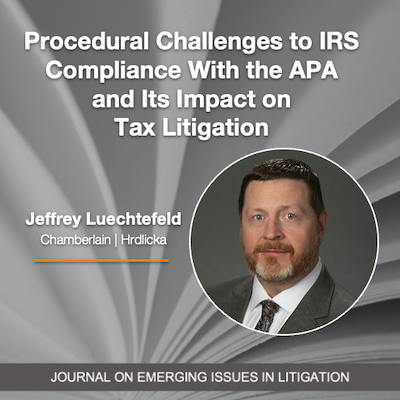
  • Procedural Challenges to the IRS’s Compliance With the APA and Its Impact on Tax Litigation

    Procedural Challenges to the IRS’s Compliance With the APA and Its Impact on Tax Litigation

    The Author

    Jeffrey S. Luechtefeld

    Jeffrey S. LuechtefeldChamberlain | Hrdlicka

    Jeffrey S. Luechtefeld (jeff.luechtefeld@chamberlainlaw.com) is a tax controversy and litigation attorney with Chamberlain, Hrdlicka, White, Williams, and Aughtry (Atlanta, Georgia) where he focuses his practice on resolving tax disputes with the Internal Revenue Service, administratively or through litigation. Jeff previously was a Special Trial Attorney for the IRS Office of Chief Counsel as well as a director in the tax controversy practice of a big four accounting firm.

    The Journal on Emerging Issues in Litigation

    Emerging Litigation Podcast

    Emerging Litigation PodcastProduced by HB Litigation and Law Street Media

    Interviews with leading attorneys and other subject matter experts on new twists in the law and how the law is responding to new twists in the world.

    Procedural Challenges to IRS Compliance With the APA and Its Impact on Tax Litigation

    Abstract: The Administrative Procedure Act (APA) places specific requirements on agencies of the federal government when engaged in a “rule making” that has the force and effect  of law. Recently, the APA has become a focal point in tax litigation, due in large part to the IRS’s history of refusing to comply with the process mandated by the APA. This article focuses on procedural challenges to the IRS’s compliance with the APA based on the IRS’s history of non-compliance with the APA’s notice-and-comment requirement. It highlights recent trends in tax litigation and considers the future of APA challenges in this area.

    “IRS’s level of APA non-compliance matters significantly …

    “APA challenges predicated on the IRS’s failure to adequately follow the APA’s notice-and-comment process are inherently fact-intensive endeavors …

    “The challenging party should gauge the usefulness of the relief requested and balance that against the cost required to prevail …

    “Ultimately, APA challenges are important, and may be necessary for a taxpayer to get to argue the merits of their case, but they do not often end the dispute with the IRS.”

    Download the article now!

  • Ohio Supreme Court Ruling Sends Important Reminder: Long-Standing, Fundamental Principles of Insurance Policy Construction and Law Are Applicable to Cyber Claims

    Ohio Supreme Court Ruling Sends Important Reminder: Long-Standing, Fundamental Principles of Insurance Policy Construction and Law Are Applicable to Cyber Claims

    The Authors

    Judy Selby

    Judy SelbyKennedys

    Judy Selby (judy.selby@kennedyslaw.com) is a Partner at Kennedys (New York) where she focuses her practice primarily on insurance coverage matters with a concentration in coverage for exposures arising out of emerging technology, digital, and compliance risks.

    Tracey Kline

    Tracey KlineKennedys

    Tracey M.Kline (tracey.kline@kennedyslaw.com) is an Associate at Kennedys (Philadelphia) where she focuses her practice primarily on insurance coverage litigation and cyber matters.

    The Journal on Emerging Issues in Litigation

    Emerging Litigation Podcast

    Emerging Litigation PodcastProduced by HB Litigation and Law Street Media

    Interviews with leading attorneys and other subject matter experts on new twists in the law and how the law is responding to new twists in the world.

    Ohio Supreme Court Ruling Sends Important Reminder:

    Long-Standing, Fundamental Principles of Insurance Policy Construction and Law Are Applicable to Cyber Claims

    Abstract: On December 27, 2022, the Ohio Supreme Court unanimously ruled that a business owner’s property insurance policy issued by Owners Insurance Co. to EMOI Services, LLC did not afford coverage for losses sustained in a ransomware attack because computer software is “entirely intangible” and “cannot experience ‘direct physical loss or physical damage.’” EMOI Servs., LLC. v. Owners Ins. Co., 2022-Ohio-4649 (Ohio 2022). In doing so, the court reversed an attention-getting split decision by the lower appellate court. This article takes an in-depth look at the case and discusses its significant implications.

    The Ohio Supreme Court’s decision was based on its commonsense conclusions that software (as intangible property) cannot suffer physical damage, and that coverage for restoration of information under the Electronic Equipment Endorsement could not be triggered absent the threshold requirement of “direct physical loss or damage” to the media on which the information was stored. Although claims involving cyber events may be relatively new, this decision is an important reminder that long-standing, fundamental principles of insurance policy construction and law are applicable to cyber claims.

    Download the article now!

  • Unarmed or Unwell: How Federal Law Infringes Medical Marijuana Users’ Second Amendment Rights

    Unarmed or Unwell: How Federal Law Infringes Medical Marijuana Users’ Second Amendment Rights

    The Author

    Griffen Thorne

    Griffen ThorneHarris Bricken

    Griffen Thorne (griffen@harrisbricken.com) is an attorney in the Los Angeles office of Harris Bricken Sliwoski LLP, an international emerging markets law firm. He represents clients in highly regulated emerging industries, such as cannabis, in corporate and commercial transactions.

    The Journal on Emerging Issues in Litigation

    Emerging Litigation Podcast

    Emerging Litigation PodcastProduced by HB Litigation and Law Street Media

    Interviews with leading attorneys and other subject matter experts on new twists in the law and how the law is responding to new twists in the world.

    Unarmed or Unwell:
    How Federal Law Infringes Medical Marijuana Users’ Second Amendment Rights

    As Justice Amy Coney Barrett noted while on the Seventh Circuit, “legislatures have the power to prohibit dangerous people from possessing guns. But that power extends only to people who are dangerous.” In the coming years, the government’s ability to write off all medical marijuana users as dangerous is likely to be curtailed, even if the Controlled Substances Act continues to make marijuana use a federal crime.

    Abstract: In the wake of the 2022 U.S. Supreme Court case New York State Rifle & Pistol Association, Inc. v. Bruen, federal courts have reached opposite outcomes on whether federal prohibitions on marijuana users’ rights to own or possess firearms are constitutional. As a result, there is a high likelihood of a circuit split that results in the overturning of those federal laws. The author discusses Bruen and several other cases at the intersection of drug laws and gun laws.

    Download the article now!

  • Digital Health Care Companies, Beware: Federal Agencies Are Tracking Your Use of Online Tracking Technologies

    Digital Health Care Companies, Beware: Federal Agencies Are Tracking Your Use of Online Tracking Technologies

    The Authors

    Patricia Markus

    Patricia MarkusNelson Mullins

    Patricia A. Markus (trish.markus@nelsonmullins.com) represents health care providers and health technology companies across the country on wide-ranging regulatory compliance, reimbursement, licensure, and operational matters, with a special focus on issues surrounding health information privacy, security, and technology.

    Shane Duer

    Shane DuerNelson Mullins

    Shane Duer (shane.duer@nelsonmullins.com) focuses his practice on healthcare regulatory and corporate matters, with an emphasis on data privacy, cyber security, and information management concerns within and beyond the health care industry.

    The Journal on Emerging Issues in Litigation

    Emerging Litigation Podcast

    Emerging Litigation PodcastProduced by HB Litigation and Law Street Media

    Interviews with leading attorneys and other subject matter experts on new twists in the law and how the law is responding to new twists in the world.

    Digital Health Care Companies, Beware 

    Federal Agencies Are Tracking Your Use of Online Tracking Technologies.

    Abstract: Health care industry stakeholders have regularly used online tracking technologies to help improve patient experience. However, growing scrutiny by the Office for Civil Rights, which enforces the Health Insurance Portability and Accountability Act of 1996 (HIPAA), requires covered entities and business associates to proceed cautiously in their use of such technologies. In addition, recent enforcement actions by the Federal Trade Commission make clear that a wide range of digital health companies, whether or not regulated by HIPAA, must tread carefully when collecting and disclosing personal information related to health, especially where consumers’ location data is to be used for a company’s advertising purposes, as they may be held accountable for failing to maintain the privacy and security of individuals’ protected and individually identifiable health information.

    The increasing number of lawsuits and news articles regarding use of these technologies demonstrates that third-party technology tracking vendors who receive PHI often are not operating under Business Associate Agreements (BAAs). The vendors in most instances disavow any need to collect PHI and accordingly instruct users to avoid sending PHI or other personally identifiable information. Under HIPAA, covered entities and business associates generally may not disclose PHI to third parties for health care operations purposes, unless such disclosure is to a business associate pursuant to a BAA, or the disclosure is made pursuant to an individual’s HIPAA-compliant authorization.

    Not only does sharing PHI through third-party tracking technologies without individuals’ authorizations violate HIPAA, but the FTC has asserted in two recent enforcement actions that the collection and sharing of individuals’ IIHI through these technologies without individuals’ “affirmative express consent” constitutes unfair and deceptive trade practices.

    Download the article now!

  • The Cannabis Employment Law Patchwork with Keya Denner

    The Cannabis Employment Law Patchwork with Keya Denner

    The Cannabis Employment Law Patchwork with Keya Denner

    Maryland and Missouri are the latest states to legalize recreational cannabis for people 21 and older. Voters came out in favor of legalization in the November 2022 midterms, bringing the total recreational jurisdictions to 22 states and the District of Columbia. Voters in North Dakota, South Dakota, and Arkansas, however, decided against recreational marijuana. It remains legal for medical reasons in all five states. 

    In the employment context, both recreational and medicinal uses raise questions about protections for employees who use the drug legally.

    • Which states are enacting those protections?
    • What do multi-state employers need to do?
    • What about drug testing? As a requirement to get a job and as a requirement to keep your job?
    • What about this: who is going to say whether a worker is impaired? Will there really be hall monitors trained in spotting your high?

    For answers to these questions and more, listen to my interview with Keya Denner, a partner at Constangy, Brooks, Smith & Prophete LLP. Keya is an experienced litigator who has been practicing labor and employment law for almost 20 years. Few attorneys nationwide match Keya’s expertise in the area of legal cannabis and its impact on the workplace. He has counseled Fortune 500 companies in the retail, hospitality, and global logistics spaces to create compliant policies and better understand the ever-changing legal landscape brought about by the legalization of cannabis across the United States.  Most recently, Keya was named co-chair along with this colleague Ashley Orler of the firm’s new practice group focused on cannabis and employee substance abuse law. Keya received his J.D., cum laude, from Seton Hall University School of Law, J.D., cum laude, and his B.A., also cum laude, from Boston University.

    This podcast is the audio companion to the Journal on Emerging Issues in Litigation. The Journal is a collaborative project between HB Litigation Conferences and the Fastcase legal research family, which includes Full Court Press, Law Street Media, and Docket Alarm. The podcast itself is a joint effort between HB and our friends at Law Street Media. If you have comments or wish to participate in one our projects please drop me a note at Editor@LitigationConferences.com.

    Tom Hagy

    (actual size)

    Tom Hagy
    Litigation Enthusiast and
    Host of the Emerging Litigation Podcast
    Home Page
    LinkedIn

    Keya Denner

    Keya DennerConstangy, Brooks, Smith & Prophete, LLP

    Keya is an experienced litigator who has been practicing labor and employment law for almost 20 years. He has handled every type of labor and employment matter for his clients, ranging from discrimination, disability, non-compete and trade secret protections, to wage and hour class actions. Keya also has extensive experience counseling employers on matters relating to the Family and Medical Leave Act and the Americans with Disabilities Act.

    Most recently, Keya was named co-chair along with this colleague Ashley Orler of the firm’s new practice group focused on cannabis and employee substance abuse law. Keya received his J.D., cum laude, from Seton Hall University School of Law, J.D., cum laude, and his B.A., also cum laude, from Boston University.

  • How Insurance Companies Defraud Their Policyholders, and What Courts and Legislators Should Do About It

    How Insurance Companies Defraud Their Policyholders, and What Courts and Legislators Should Do About It

    The Authors

    Robert D. Chesler

    Robert D. CheslerAnderson Kill

    Robert D. Chesler (rchesler@andersonkill.com) is a shareholder in Anderson Kill’s Newark office. Bob represents policyholders in a broad variety of coverage claims against their insurers and advises companies with respect to their insurance programs. Bob is also a member of Anderson Kill’s Cyber Insurance Recovery group.

    Bob has served as the attorney of record in more than 30 reported insurance decisions, representing clients including General Electric, Ingersoll-Rand, Westinghouse, Schering, Chrysler, and Unilever, as well as many small businesses including gas stations and dry cleaners. He has received numerous professional accolades, including a top-tier ranking for Insurance Litigation: New Jersey in Chambers USA: American’s Leading Lawyers for Business, which dubs him a “dominant force in coverage disputes” and cites a client who calls him “a dean of the insurance Bar; one of the brightest in writing about and analyzing insurance coverage.”

    Amy Weiss

    Amy WeissAnderson Kill

    Amy Weiss (aweiss@andersonkill.com) is a law clerk pending admission in Anderson Kill’s New York office. She focuses her practice on insurance recovery, exclusively on behalf of policyholders.

    While attending the Benjamin N. Cardozo School of Law, Amy worked as a Summer Associate at Anderson Kill and a Judicial Intern for the Honorable Nicholas G. Garaufis at the United States District Court for the Eastern District of New York.

    She served as Senior Articles Editor for the Cardozo Arts and Entertainment Law Journal, participated in the Cardozo Visual & Performing Arts Law Field Clinic, was a teaching assistant for the Lawyering & Legal writing course, and was a research assistant for Professor Stewart E. Sterk. Amy received the Dean’s Merit Scholarship and graduated with Honors.

    Jade Sobh

    Jade SobhAnderson Kill

    Jade W. Sobh (jsobh@andersonkill.com) is an attorney in Anderson Kill’s New York office. Jade focuses his practice on both insurance recovery, exclusively on behalf of policyholders, as well as Government Enforcement, Internal Investigations, and White Collar Defense. Jade’s practice also encompasses regulatory and complex commercial litigation matters.

    Prior to joining Anderson Kill, Jade was an associate at a leading New Jersey law firm, where he concentrated his practice in commercial litigation and criminal defense. His work there focused on corporate disputes, complex commercial litigation, real estate litigation, and appellate litigation. In his previous role, Jade also assisted in representing clients facing federal drug possession charges, and healthcare fraud allegations, among other criminal matters.

    Previously, Jade was a law clerk to The Honorable Robert C. Wilson in the Superior Court of New Jersey, Civil Division. Jade worked with Judge Wilson on cases in Bergen County’s Complex Business Litigation Program including insurance recovery disputes, construction litigation, corporate ownership issues, breach of contract, arbitration agreements, and franchise agreements.

    The Journal on Emerging Issues in Litigation

    Emerging Litigation Podcast

    Emerging Litigation PodcastProduced by HB Litigation and Law Street Media

    Interviews with leading attorneys and other subject matter experts on new twists in the law and how the law is responding to new twists in the world.

    How Insurance Companies Defraud Their Policyholders 

    What Courts and Legislators Should Do About It

    “By its very nature, fraud involves concealment and is difficult to detect. The overwhelming majority of victims of fraud do not even know that they have been defrauded when an insurance company denies their claim or cancels their policy, and have no recourse.”

    Abstract: Insurance companies have legitimate reasons for denying claims, but sometimes denials or significant delays are the result of unfair practices or even fraud. Such actions may be systemic or undertaken by an individual. What rights do policyholders have? What can they do to combat illegitimate denials? What are the barriers individuals face when they are wrongfully denied coverage? Should there be a private right of action under the Unfair Trade Practices Act? Should policyholders’ attorneys’ fees be covered? What should courts and legislatures do to protect insurance consumers? In this article the authors answer these questions and more.

    Download the article now!

    Explore More from Anderson Kill!

    Journal on Emerging Issues, Editorial Board of Advisors

    The Use and Abuse of the Pollution Exclusion. By Dennis Artese, Jamie O’Neil, Robert Chesler

    The Environmental, Social, and Governance Police Have Arrived: Is your Insurance Ready. Authors: Dennis Artese, Bob Chesler.

    Podcast 1 of 2 series: PFAS Insurance Coverage with Jaana Pietari and Jim Fenstermacher and Litigation with Bob Chesler

    Poscast 2 of 2 series: Insurance Coverage for PFAS Claims

    How Insurance Companies Defraud Their Policyholders, and What Courts and Legislators Should Do About It. Authors: Robert Chesler, Amy Weiss, and Jade Sobh

    Climate Change, ESG, D&O Insurance: Collision or Cooperation? By Robert D. Chesler, Dennis J. Artese and Joseph Villa

    Remediating, Insuring, and Litigating PFAS Claims. By Dr. Jaana Pietari, PhD, MBA, PE, Jim Fenstermacher, PE, Dr. Michael Bock, PhD, MS, Robert D. Chesler and Nicholas M. Insua, Sheila Mulrennan, Robin Kelliher, Jason R. Waters
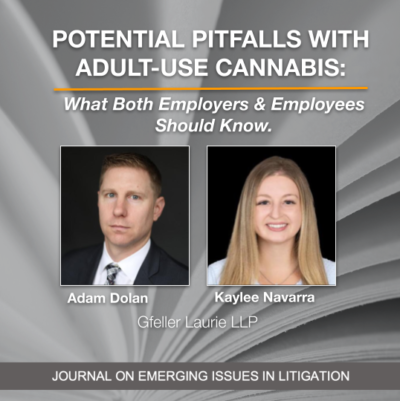
  • Potential Pitfalls with Adult-Use Cannabis: What Both Employers and Employees Should Know

    Potential Pitfalls with Adult-Use Cannabis: What Both Employers and Employees Should Know

    The Authors

    Adam R. Dolan

    Adam R. DolanGfeller Laurie LLP

    Adam R. Dolan (adolan@gllawgroup.com) is a partner with Gfeller Laurie LLP, a tested litigator with a multifaceted practice, he has extensive experience handling catastrophic transportation, general liability, and products liability matters. He is a frequent writer and speaker on topics related to the cannabis industry.

    Kaylee Navarra

    Kaylee NavarraGfeller Laurie LLP

    Kaylee E. Navarra (knavarra@gllawgroup.com) is an associate with Gfeller Laurie LLP where she works on matters involving commercial disputes, bad faith/
    extracontractual liability, and insurance coverage.

    The Journal on Emerging Issues in Litigation

    Emerging Litigation Podcast

    Emerging Litigation PodcastProduced by HB Litigation and Law Street Media

    Interviews with leading attorneys and other subject matter experts on new twists in the law and how the law is responding to new twists in the world.

    Potential Pitfalls with Adult-Use Cannabis:
    What Both Employers and Employees Should Know

    “Employers may also take action when the employee, while working, manifests specific articulable symptoms of cannabis impairment that decrease or lessen the employee’s performance of the employee’s tasks or duties and/or the employee, while working, manifests specific articulable symptoms of cannabis impairment that interfere with the employer’s obligation to provide a safe and healthy workplace as required by state and federal workplace safety laws.”

    Abstract: Recreational cannabis use for adults is legal in 21 states, having made its way eastward from Western jurisdictions that first addressed the issue. But these laws govern personal use during personal time. While they generally prohibit discrimination based on such use, these laws do not greenlight consumption at work or going to work under the influence. But with so many jurisdictions and job types, and variance among state laws, there aren’t simple answers. This is especially true for employers who conduct business nationwide, and because cannabis continues to be a Schedule I substance on the federal Controlled Substances Act. What rights and remedies do companies and workers have to resolve disputes? Are employers permitted to conduct drug tests? What about low-THC products and CBD? In this article the authors will address these and several other important questions.

    Download the article now!

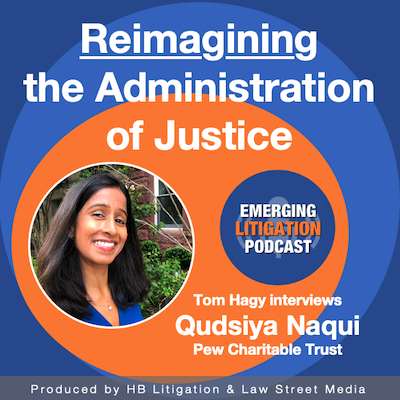
  • Reimagining the Administration of Justice with Qudsiya Naqui of Pew Charitable Trust

    Reimagining the Administration of Justice with Qudsiya Naqui of Pew Charitable Trust

    Before COVID-19 came to America in early 2020, “going to court” literally meant putting on your shoes and walking into a courthouse, typically a large building with courtrooms inside, and people in robes and business suits and, in some cases, more restrictive attire. 

    Stoked by necessity, courts sprinted toward solutions for keeping the wheels of justice spinning while also keeping everyone away from each other. Until then it didn’t seem possible that attorneys could or would appear before judges via digital screens, like George Jetson getting yelled at by Mr. Spacely over some hilarious mishap at the sprocket factory.

    Pew Charitable Trust concluded an in-depth study of the courts with the 2021 release of a report,  “How Courts Embraced Technology, Met the Pandemic Challenge, and Revolutionized Their Operations.” After examining emergency orders from all 50 states and Washington, D.C., and court approaches to virtual hearings, e-filing, and digital notarization, the researchers wrote that it was a time for “reimagining how to administer justice.”

    Was the adoption of technology effective? Were there any hiccups? Was technology widely embraced? Were the effects of new efficiencies enjoyed evenly across the socio-economic spectrum? Do we think courts will continue to reimagine how they administer justice without the crushing pressure of widespread disease?

    Listen to my interview with Qudsiya Naqui who leads Pew’s research at the intersection of technology and civil legal system reform. In this role, she evaluates and tests new technologies to ensure that they further efficiency, equity, and transparency in the legal process. This work is part of Pew’s Civil Justice Modernization Project.

    Before joining Pew, Qudsiya designed and implemented immigration, housing, and disaster recovery legal services programs at Equal Justice Works and the Vera Institute of Justice. She began her legal career representing immigrant women and girls seeking relief from deportation.

    Qudsiya holds a bachelor’s degree in political science and human rights from Barnard College and a Juris Doctor from Temple University.

    For more information about their work and the research, contact them at media@pewtrusts.org.

    This podcast is the audio companion to the Journal on Emerging Issues in Litigation. The Journal is a collaborative project between HB Litigation Conferences and the Fastcase legal research family, which includes Full Court Press, Law Street Media, and Docket Alarm. The podcast itself is a joint effort between HB and our friends at Law Street Media. If you have comments or wish to participate in one our projects please drop me a note at Editor@LitigationConferences.com.

    Tom Hagy

    (actual size)

    Tom Hagy
    Litigation Enthusiast and
    Host of the Emerging Litigation Podcast
    Home Page
    LinkedIn

    Qudsiya Naqui

    Qudsiya NaquiPew Charitable Trust

    Qudsiya Naqui leads Pew’s research at the intersection of technology and civil legal system reform. In this role, she evaluates and tests new technologies to ensure that they further efficiency, equity, and transparency in the legal process. This work is part of Pew’s Civil Justice Modernization Project.

    Before joining Pew, Qudsiya designed and implemented immigration, housing, and disaster recovery legal services programs at Equal Justice Works and the Vera Institute of Justice. She began her legal career representing immigrant women and girls seeking relief from deportation.

    Qudsiya holds a bachelor’s degree in political science and human rights from Barnard College and a Juris Doctor from Temple University.

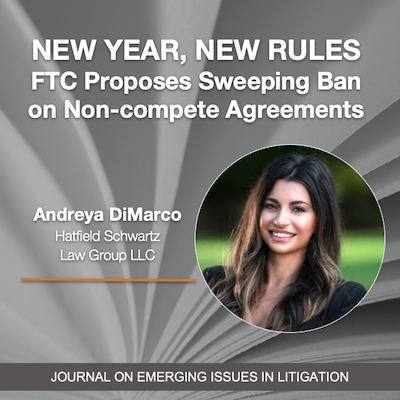
  • New Year, New Rules: FTC Proposes Sweeping Ban on Noncompete Agreements

    New Year, New Rules: FTC Proposes Sweeping Ban on Noncompete Agreements

    The Author

    Andreya DiMarco

    Andreya DiMarcoHatfield Schwartz Law Group LLC

    Andreya DiMarco (adimarco@hatfieldschwartzlaw.com) is counsel with Hatfield Schwartz Law Group LLC where she focuses on employment law and transactional matters.

    She has defended clients in state and federal courts and before administrative agencies, including the EEOC and DCR.

    The Journal on Emerging Issues in Litigation

    Emerging Litigation Podcast

    Emerging Litigation PodcastProduced by HB Litigation and Law Street Media

    Interviews with leading attorneys and other subject matter experts on new twists in the law and how the law is responding to new twists in the world.

    New Year, New Rules:
    FTC Proposes Sweeping Ban on Noncompetes

    “This is the FTC’s first attempt to ban non-compete agreements and strong opposition to the Proposed Rule as well as challenges regarding the scope of the FTC’s rule-making authority are likely to arise especially given the tremendous impact a retroactive and absolute non-compete ban would have.  …. [P]otential litigation over the FTC’s authority to issue and enforce such a rule may cause further delays…. Moreover, the Proposed Rule is full of ambiguity which will likely be challenged.”

    Abstract: On January 5, 2023, the Federal Trade Commission published a Notice of Proposed Rulemaking that would ban the use of noncompete agreements between employers and workers and would create an affirmative obligation for employers to void existing noncompete agreements. The Proposed Rule would also prohibit contractual clauses in other agreements or employment policies that have a similar effect. The Proposed Rule applies categorically to all workers, including independent contractors, without regard to a worker’s earnings or job function. This article discusses the nuances of the Proposed Rule as well as the legal and practical impact it will have if it is adopted.

    Download the article now!

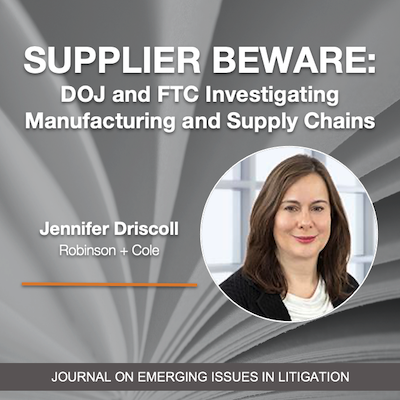
  • Supplier Beware: The DOJ & FTC Investigating Manufacturing & Supply Chains

    Supplier Beware: The DOJ & FTC Investigating Manufacturing & Supply Chains

    The Author

    Jennifer Driscoll

    Jennifer DriscollRobinson + Cole

    Jennifer M. Driscoll (jdriscoll@rc.com) is counsel with Robinson+Cole in New York where she focuses on investigations, litigation, arbitration, mergers, and counseling. She has extensive experience in the medical devices, pharmaceuticals, electronics, and automotive industries.

    The Journal on Emerging Issues in Litigation

    Emerging Litigation Podcast

    Emerging Litigation PodcastProduced by HB Litigation and Law Street Media

    Interviews with leading attorneys and other subject matter experts on new twists in the law and how the law is responding to new twists in the world.

    Supplier Beware:
    DOJ & FTC Investigating Manufacturing & Supply Chain Issues

    “Although competitors may attend trade association meetings, the company representative in attendance should be well versed on the line between lawful discussions and ruses to disguise unlawful collusion in violation of the Sherman Act.”

    Abstract: Challenged by the pandemic, the global supply chain has generated a heightened amount of scrutiny for its impact on the economy, the labor market, the delivery of goods and services, and national security. Attention from the Biden administration portends an era when the federal government will shine a spotlight on the supply chain to root out misconduct. In this article, the author reviews recent supply chain disruptions and reactions from the DOJ and FTC, as well as the government’s efforts to support competition in the labor markets by eliminating noncompete agreements in employment contracts. Finally, she discusses proactive steps companies can take to mitigate the risk that they will find themselves the subject of a government investigation.

    Download the article now!