Category: Emerging Litigation & Risk

  • Employers Be WARNed: Workforce Reduction Rules Meet New Workplace Definitions as Employees Go Remote by Juan Enjamio and Steven DiBeneditto

    Employers Be WARNed: Workforce Reduction Rules Meet New Workplace Definitions as Employees Go Remote by Juan Enjamio and Steven DiBeneditto

    The Authors:

    Juan Enjamio

    Juan EnjamioHunton Andrews Kurth

    Juan C. Enjamio (jenjamio@huntonak.com) is managing parter of the Miami office of Hunton Andrews Kurth where he dedicates his practice to complex domestic and international employment law matters.

    Steven DiBeneditto Jr.

    Steven DiBeneditto Jr.Hunton Andrews Kurth

    Steven J. DiBeneditto Jr. (sdibeneditto@huntonak.com) is a Washington, DC-based associate in the firm’s employment and labor group.

    The Journal on Emerging Issues in Litigation

    Emerging Litigation Podcast

    Emerging Litigation PodcastProduced by HB Litigation and Law Street Media

    Interviews with leading attorneys and other subject matter experts on new twists in the law and how the law is responding to new twists in the world.

    Employers Be WARNed

    Workforce Reduction Rules Meet New Workplace Definitions as Employees Go Remote

    “Numerous courts have opined that a “home base” is a place in which the employee has some sort of physical connection. But this connection must be more than a “notional” base, whereby the employee has a menial relationship.”

    Introduction

    A common sentiment during the Covid-19 pandemic was that a different society would emerge from its ashes. While overstated in many cases, one segment of society that appears to have changed for good is the white collar workplace. Indeed, after enjoying the flexibility of working from home for more than 2 years, many white collar workers are demanding that a remote work option remain a permanent fixture at their place of employment. And with seemingly no negotiating leverage due to worker shortages across the country, employers have mostly acceded to these demands, with many opting to implement a “hybrid” workforce where employees work from home for part of the work week and transit to the physical workplace for the rest of the week. Other employers have opted to have employees work entirely from home in what is now generally known as a “remote” employee.

    But widespread adoption of a Hybrid Workforce presents a complex set of legal challenges for employers. These challenges are especially prevalent when making employment decisions using laws that were drafted decades ago to a new workplace that was never considered during the laws’ enactment. Nowhere is this problem more apparent than with the Worker Adjustment and Retraining Notification (“WARN”) Act, a statute adopted almost four decades ago in 1988. Simply put, the WARN Act sets forth notice requirements for employers who plan to close a plant or implement a reduction in force. Yet the WARN Act’s reduction in force provisions apply only to “single sites of employment,” which has been traditionally understood to mean a physical building or a group of buildings in contiguous locations. This  single site of employment definition makes the WARN Act ill-suited to address the emerging (but ubiquitous) issue of workers who are dispersed, e.g. Remote and Hybrid Workplaces.

    With that in mind, this article seeks to highlight the issues with the WARN Act and Remote and Hybrid Workplaces and package them into a guide for employers. The article begins by summarizing the WARN Act and the regulations for single sites of employment. It then shifts to a recent district court case analyzing the issue of Remote Work under the WARN Act for purposes of Rule 23(b)(3)’s predominance requirement for class certification. The article concludes by offering some suggestions to help prevent WARN Act liability.

    Download the article now!

  • The Role of Litigation and Regulation in Making the Web More Accessible with Guests Ken Nakata and Hiram Kuykendall

    The Role of Litigation and Regulation in Making the Web More Accessible with Guests Ken Nakata and Hiram Kuykendall

    Are Litigation and Regulation Making the Web More Accessible?

    According to the International Agency for the Prevention of Blindness there are 43 million people around the world living with blindness, and 300 million living with moderate to severe visual impairment. Put those statistics next to these: There are nearly 2 billion websites, and 550,000 created every day.

    Shouldn’t sight-impaired people have the same access to these sites as sighted people? Of course they should. There is good news. After previously announcing guidance, the DOJ says new regulations are on the way under Title II of the Americans with Disabilities Act, which describes the obligations for state and local governments. My guests say there are many reasons to be excited about this.

    My guests say there are many reasons to be excited about this.

    Ken Nakata is Co-Founder and Principal at Converge Accessibility, whose solutions help make sure websites and other technologies are accessible to people with disabilities. Ken is former Senior Trial Attorney with the DOJ Disability Rights Section where he developed nationwide ADA policies for the internet. Joining Ken is Hiram Kuykendall, Chief Technology Officer at Microassist, an Austin-based learning and development consulting. Hiram is a technical leader with hands-on experience in instructional design and digital accessibility.

    This podcast is the audio companion to the Journal on Emerging Issues in Litigation. The Journal is a collaborative project between HB Litigation Conferences and the Fastcase legal research family, which includes Full Court Press, Law Street Media, and Docket Alarm. The podcast itself is a joint effort between HB and our friends at Law Street Media. If you have comments or wish to participate in one our projects please drop me a note at Editor@LitigationConferences.com.

    Tom Hagy

    (actual size)

    Tom Hagy
    Host
    Emerging Litigation Podcast

    P.S. Anytime I make a self-effacing remark about my ignorance concerning this or any subject, it’s strictly for entertainment value, a story I will cling to with every fiber of my being.

    Ken Nakata

    Ken NakataConverge Accessibility

    Ken Nakata is Co-Founder and Principal at Converge Accessibility, whose solutions help make sure websites and other technologies are accessible to people with disabilities. Ken is former Senior Trial Attorney with the DOJ Disability Rights Section where he developed nationwide ADA policies for the internet.

     Hiram Kuykendall

    Hiram Kuykendall Microassist

    Hiram Kuykendall is Chief Technology Officer at Microassist, an Austin-based learning and development consulting. Hiram is a technical leader with hands-on experience in instructional design and digital accessibility. He has more than 25 years’ experience developing and managing custom applications on a variety of platforms and public and private sectors, supporting training and training related services.

  • Insurance Coverage for Digital Assets: Mitigating Losses in Cryptocurrency and Non‐Fungible Token Markets by Scott DeVries, Jessica Cohen-Nowak and Adriana Perez of Hunton Andrews Kurth

    Insurance Coverage for Digital Assets: Mitigating Losses in Cryptocurrency and Non‐Fungible Token Markets by Scott DeVries, Jessica Cohen-Nowak and Adriana Perez of Hunton Andrews Kurth

    Journal on Emerging Issues in LitigationCompanies and individuals are riding the ups and downs of cryptocurrency and NFTs—with losses and swings in the billions of dollars—but digital assets are not going away.

    Abstract: The risk of loss in certain categories may be mitigated by insurance, whether provided by tailored policies and/or under policies designed specifically for digital asset owners. Those with exposure to the digital asset sector should be attuned to the emerging marketplace for such insurance products. While it is early days for NFT-specific coverage, the rise of cryptocurrency has created a substantial marketplace for crypto coverage. Insurers are becoming increasingly able to model and assess risk, so more products are coming to market. That said, digital asset holders need to be able to select coverage that best suits their needs. In this article, the authors discuss the history and status of coverage for digital assets to assist readers in exploring how they might use insurance to mitigate risk in this emerging and rocky sector of global finance.

    “Over the course of a decade, the marketplace for cryptocurrency has increased from zero to an estimated $250 billion. However, only $6 billion in insurance coverage is currently available. It would be a gross understatement to say that there is a truly remarkable imbalance between market value and insurance capacity.”

    Introduction

    Crypto markets are experiencing the greatest crash in their history to date.  The value of a Bitcoin (BTC) has plummeted 70% from its peak and Ethereum (ETH) has fallen 77%.  Since last November, the value of cryptocurrency tokens has lost $2 billion in value. As noted financial publication Barron’s put it: “Crypto is having a ‘Lehman moment,’ a shattering of confidence triggered by plunging asset prices, liquidity freezing up, and billions of dollars wiped out in a few scary weeks.” Cryptocurrency companies are halting withdrawals and transfers, platforms are seizing up, and regulators are circling.

    Nor has the devastation been limited to the coins themselves.  Non-fungible token (NFT) sales have reduced by 90% since September 2021.  The New York Times reported that Opensea.io (OpenSea) an NFT marketplace that receives 2.5% share of the proceeds for each NFT sale, has been plagued by “a surge of plagiarism, as sellers convert traditional artwork into NFTs and then list the images for sale without compensating the original creator.”  For example, DeviantArt, an artist collective that scans OpenSea for copyright infringement of the work of its artists, found 290,000 instances of unauthorized NFTs copying its artists’ works. While infringing listings can be deleted in response to take down requests filed by the artist, buyers of counterfeit NFTs are rarely given a refund.

    Against this backdrop, the issue of whether there may be claims associated with cryptocurrency and NFTs is far from a theoretical or esoteric thought exercise.  It is very real.  And when there are claims, businesses and investors doubtless will look to their insurers.

    A business or home is devastated by a wildfire.  Property insurance is available up to limits.  A home is broken into, and art and jewelry are stolen.  Crime/specie insurance is available.

    But what about new age assets?  What about cryptocurrency?  What about NFTs?  These obviously are not immune from theft by hackers.  In 2021, hackers stole at least $3.2 billion in cryptocurrency with schemes short of outright theft accounting for another $7.8 billion. In the first four months of 2022, NFT hacks accounted for $52 million in losses, an almost eight-fold increase from 2021.

    There typically is a significant time lag between the development of a product and the availability of product-specific insurance.  This general proposition applies with equal force here.  Over the course of a decade, the marketplace for cryptocurrency has increased from zero to an estimated $250 billion.  However, only $6 billion in insurance coverage is currently available.  It would be a gross understatement to say that there is a truly remarkable imbalance between market value and insurance capacity.

    Although NFTs have been around for the better part of a decade, it was only during the last two years that the marketplace has grown to upwards of $41 billion. In addition to its newness, NFTs pose additional risks for insurers, including questions of ownership, authenticity and the valuation of a truly “unique” asset.  Consequently, availability of insurance coverage for NFTs is even further behind.

    Given the rapid rate at which the digital asset field is developing, and claims are emerging, and the insurance industry’s attempts to specifically address coverage for these losses and claims, anything written on this topic will, at least in part, be outdated by the time it is published.  The objective of this article is to educate the reader on the history and status of the field, enabling them to ask the questions they need to ask, and to procure the coverage they need if available now or in coming months. 

    Download the article now!

    Insurance Coverage for Digital Assets:

    Mitigating Losses in Crypto and NFT Markets

    Scott DeVries

    Scott DeVriesHunton Andrews Kurth

    Scott DeVries (sdevries@huntonak.com) is Special Counsel at Hunton Andrews Kurth and long-time insurance coverage attorney for policyholders in a range of complex disputes as well as mass torts, class action, product liability, and complex business litigation.

    Jessica Cohen-Nowak

    Jessica Cohen-NowakHunton Andrews Kurth

    Jessica Cohen-Nowak (jcohen-nowak@huntonak.com) is an associate in Hunton Andrew Kurth LLP’s Intellectual Property group in the firm’s New York office. Jessica focuses her counseling and litigation practice on intellectual property matters in the fashion, fitness, entertainment, hospitality, and gaming industries as well as in technology and digital assets.

    Adriana Perez

    Adriana PerezHunton Andrews Kurth

    Adriana Perez (pereza@huntonak.com) is an associate in the firm’s Miami office where she focuses on insurance, reinsurance, and other business litigation.

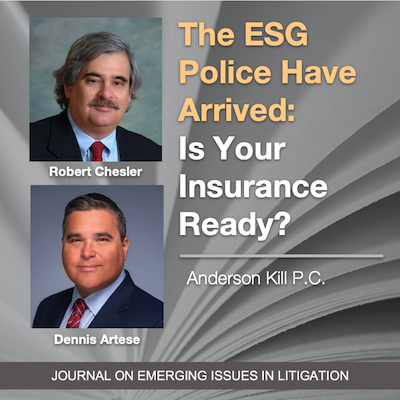
  • The Environmental, Social, and Governance Police Have Arrived: Is Your Insurance Ready? by Robert D. Chesler and Dennis J. Artese

    The Environmental, Social, and Governance Police Have Arrived: Is Your Insurance Ready? by Robert D. Chesler and Dennis J. Artese

    The Authors

    Robert Chesler

    Robert CheslerAnderson Kill

    Robert D. Chesler (rchesler@andersonkill.com) is a shareholder in Anderson Kill’s New Jersey office and is a member of the firm’s Cyber Insurance Recovery Group. He represents policyholders in a broad variety of coverage claims against their insurers and advises companies with respect to their insurance programs.

    Dennis Artese

    Dennis ArteseAnderson Kill

    Dennis J. Artese is a shareholder in Anderson Kill’s New York office and chairs the firm’s Climate Change and Disaster Recovery Group. Both are members of the Editorial Advisory Board of the Journal.

    The Journal on Emerging Issues in Litigation

    Emerging Litigation Podcast

    Emerging Litigation PodcastProduced by HB Litigation and Law Street Media

    Interviews with leading attorneys and other subject matter experts on new twists in the law and how the law is responding to new twists in the world.

    The ESG Police Have Arrived:
    Is Your Insurance Ready?

    “ESG has become a major initiative for corporate America. In particular, the environmental prong of ESG calls for companies to institute sustainability goals and to invest in environmentally friendly companies. This emphasis has both economic and popular support. Environmental sustainability will make companies better able to compete and make their businesses less risky.”

    Abstract: The environmental, social, and governance movement is a positive one, but like many well-intentioned efforts there is room for abuse and risk. As corporations endeavor to earn accolades and good will for “doing the right thing,” they must also be certain they truly are. In this article the authors discuss increased government scrutiny, the attendant risks of implementing and reporting on ESG initiatives, insurance coverage implications for directors and officers, the pollution and other exclusions, the potential civil fines and penalties, and what companies can expect in the era of ESG.

    Download the article now!

    Explore More from Anderson Kill!

    Podcast 1 of 2 series: Insurance Coverage with Dr. Jaana Pietari and Jim Fenstermacher and Litigation with Bob Chesler.

    Podcast 2 of 2 series: PFAS Insurance Coverage with Robert D. Chesler of Anderson Kill.

    Sister article to podcast 1 of 2 series: Remediating, Insuring, and Litigating PFAS Claims. Authors: Dr. Jaana Pietari, PhD, MBA, PE, Jim Fenstermacher, PE, Dr. Michael Bock, PhD, MS, Robert D. Chesler and Nicholas M. Insua, Sheila Mulrennan, Robin Kelliher, Jason R. Waters

    Podcast: Autonomous Vehicles: The New Technology Driving the Litigation Conversation Podcast with Cort Malone, John Leonard, Joshua Zelen

    Podcast: Violations of Biometric Privacy Laws: Policyholders’ Victories and the Implications Going Forward with John Leonard and Cort Malone

    Journal on Emerging Issues, Editorial Board of Advisors: Dennis Artese, Robert D. Chesler

    Asymmetrical Combat: Bad Faith Liability in Insurance Recovery Cases. By William Passannante

    Climate Change, ESG, and D&O Insurance: Collision or Cooperation? Authors: Robert Chesler, Dennis J. Artese, and Joseph Villa

    Litigation After Biometric Privacy Law Violations: Policyholder Victories and Their Implications. Authors: Cort T. Malone, Abigail Damsky

    Protecting Policyholders as AI Is Developed for Insurance Claims Handling – Ensuring “Decency and Humanity” in the Digital Age. Authors: Marshall Gilinsky, Madison Marlow

    Police–The Environmental, Social, and Governance Police Have Arrived: Is your Insurance Ready. Authors: Dennis Artese, Bob Chesler

    How Insurance Companies Defraud Their Policyholders, and What Courts and Legislators Should Do About It. Authors: Robert Chesler, Amy Weiss, and Jade Sobh

    The Promise and Peril of Quantum Computing and Its Implications for Cyber Insurance. By Cameron R. Argetsinger

    The Use and Abuse of the Pollution Exclusion. Authors: Dennis Artese, Jamie O’Neil, Robert Chesler

    Property Insurance Coverage for Emerging Risk: Underground Climate Change. Authors: Dennis J. Artese, Ethan W. Middlebrooks, Thomas Dupont

    Autonomous Vehicles: The New Technology Driving the Litigation Conversation. Authors: Cort Malone, John Leonard, and Joshua Zelen

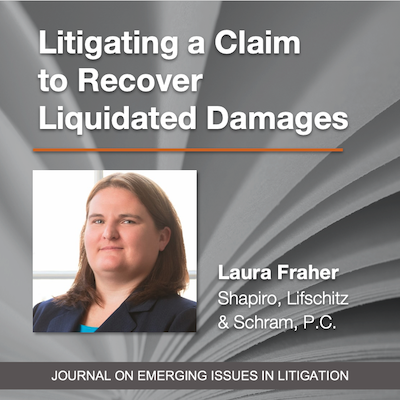
  • Litigating a Claim to Recover Liquidated Damages by Laura Fraher

    Litigating a Claim to Recover Liquidated Damages by Laura Fraher

    The Author

    Laura C. Fraher

    Laura C. FraherShapiro, Lifschitz and Schram

    Laura C. Fraher (fraher@slslaw.com) is a senior attorney in the trial and construction group at Shapiro, Lifschitz & Schram in Washington, D.C. She has extensive experience in civil litigation at both the trial court and appellate level. Competitive by nature, Laura played rugby for nearly 20 years. She puts this competitive spirit to work through her passion for the law and her clients.

    Education: St. John’s University School of Law, J.D., 2001, magna cum laude; SUNY College at Geneseo, B.A., Political Science, 1998.

    The Journal on Emerging Issues in Litigation

    Emerging Litigation Podcast

    Emerging Litigation PodcastProduced by HB Litigation and Law Street Media

    Interviews with leading attorneys and other subject matter experts on new twists in the law and how the law is responding to new twists in the world.

    Litigating a Claim to Recover Liquidated Damages:

    Enforceability Depends on Evidence of Good Faith Expectations

    “The tests and standards that courts apply to evaluate whether a particular liquidated damage provision is enforceable vary from state to state and it is imperative that litigants research and fully appreciate the particular standards that will be applied by the court in which they are litigating.”

    Abstract: The liquidated damages provision in a contract is a useful mechanism for mitigating risk in the event one of the parties to an agreement breaches the contract, costing the aggrieved party sometimes significant difficulty and substantial expense. Unfortunately, these provisions are often challenged, allowing the party responsible for the beach to exacerbate the burdens on the other party. In this article, the author discusses concepts of enforceability, proof, and avoiding litigation over liquidated damage provisions.

    A liquidated damage provision is an advance agreement of the damages that a party will be entitled to recover in the event of a future breach by the other party to a contract. These provisions can be an important tool for risk allocation and mitigation between parties when entering into a contract; both because the provision allows the parties to predict with certainty the financial ramifications of a future breach and because the liquidated damage provision should protect the aggrieved party against the difficulty and expense associated with proving actual damages in the event of a breach.

    In reality, however, when a breach occurs, liquidated damage provisions are frequently challenged and become the subject of costly litigation.  At the outset, it should be noted that the enforceability of a liquidated damage provision is generally considered an issue of law to be determined by the court, not an issue of fact to be presented to a fact finder. Thus, the key threshold issue of enforceability is likely to be determined on a pretrial motion rather than at trial and you should be prepared with both evidence and argument in order to sustain your claim.

    If you are faced with a challenge to dismiss your claim to recover liquidated damages based on unenforceability, it is important to remember that the law is in your favor.

    Liquidated damage provisions are viewed favorably by courts across the country and will generally be enforced so long as a court is satisfied that a liquidated damage provision is a stipulated agreement based on anticipated actual damages and not a penalty. A liquidated damages provision will be considered a penalty, and therefore unenforceable, if the court determines that the provision is designed to induce or secure performance by one party; conversely, a liquidated damage provision will not be viewed as a penalty, and will therefore be enforced if the court is satisfied that the provision is designed not to punish, but to provide a sum certain as compensation for a breach.

    Download the article now!

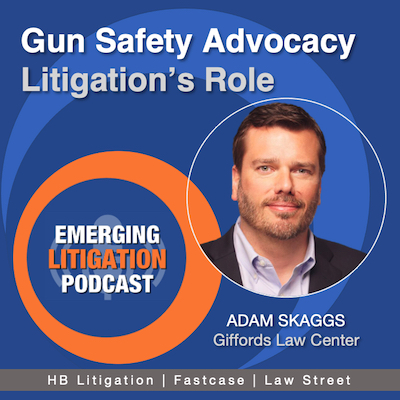
  • Litigation’s Role in Gun Safety Advocacy with Adam Skaggs

    Litigation’s Role in Gun Safety Advocacy with Adam Skaggs

    We’re closing in on 400 million guns in America, weapons that have been used to kill 1.5 million Americans between 1968 and 2017. Can litigation be an effective tool in curbing this loss of life?

    In 2020 alone there were more than 45,000 gun deaths. The beyond tragic and senseless mass shootings at schools has become all too routine. Most Americans want stricter gun laws which they believe will reduce the senseless killing in our country, which leads the world in both the number of privately owned firearms and gun-related deaths.

    The Supreme Court, of course, didn’t take public opinion into account when it struck down a more than century old New York City ban on concealed firearms. Politicians do, however, pay close attention to polls. At the federal level, President Joe Biden signed a bipartisan law designed to make Americans safer in our gun-toting nation. Hailed as a “great start” and a rare but welcome exercise in reaching across the aisle, the law will result in safer citizens, but didn’t include much of what gun advocates say is really needed to effect meaningful change. In California, Governor Gavin Newsom signed a new law that gives citizens incentives to pursue gun manufacturers and dealers who sell illegal firearms. In New York, Democratic leaders, undaunted by the Supreme Court, have pushed through new gun restrictions at vulnerable locations like schools, malls, and stadiums.

    But what can lawyers and lawsuits do about it? Plenty. What reasonable measurers can be put into place that will not infringe on Second Amendment rights?  Several. Are we seeing litigation over these issues? You bet.

    For more specifics, listen to my interview with Adam Skaggs, chief counsel and policy director at leading gun safety advocacy group Giffords Law Center, co-founded by former Congresswoman Gabby Giffords. Prior to Giffords Law Center Adam was senior counsel at Everytown for Gun Safety and at the Brennan Center for Justice, where he worked on election law issues.  Adam’s commentary has been published in Slate, Politico, the Atlantic, and the New York Times, among other publications, and he has been widely quoted by media ranging from the Wall Street Journal and Fox News to the New York Times and MSNBC. Adam graduated summa cum laude from Brooklyn Law School, received an MS in Urban Affairs from Hunter College of the City University of New York, and holds a BA, awarded with distinction, from Swarthmore College.

    If you would like to learn more about Giffords Law Center and how you can get engaged, please reach out to to them. You may also email Adam directly. 

    This podcast is the audio companion to the Journal on Emerging Issues in Litigation. The Journal is a collaborative project between HB Litigation Conferences and the Fastcase legal research family, which includes Full Court Press, Law Street Media, and Docket Alarm. The podcast itself is a joint effort between HB and our friends at Law Street Media. If you have comments or wish to participate in one our projects please drop me a note at Editor@LitigationConferences.com.

    Gun Safety: The Role of Litigation in Advocacy

    Adam Skaggs

    Adam SkaggsChief Counsel & Policy Director

    Adam Skaggs serves as Giffords Law Center’s chief counsel and policy director. Previously, he was senior counsel at Everytown for Gun Safety and at the Brennan Center for Justice, where he worked on election law issues. Adam was also a litigation associate at Paul, Weiss, Rifkind, Wharton & Garrison and a law clerk at the Eleventh Circuit and the US District Court for the Eastern District of New York.

    Adam’s commentary has been published in Slate, Politico, the Atlantic, and the New York Times, among other publications, and he has been widely quoted by media ranging from the Wall Street Journal and Fox News to the New York Times and MSNBC.

    Adam graduated summa cum laude from Brooklyn Law School, received an MS in Urban Affairs from Hunter College of the City University of New York, and holds a BA, awarded with distinction, from Swarthmore College.

  • The “Ending Forced Arbitration of Sexual Assault and Sexual Harassment Act of 2021” Finally Levels the Playing Field by Kathryn Hatfield

    The “Ending Forced Arbitration of Sexual Assault and Sexual Harassment Act of 2021” Finally Levels the Playing Field by Kathryn Hatfield

    The Author

    Kathryn Hatfield

    Kathryn HatfieldHatfield | Schwartz Law Group

    Kathryn V. Hatfield (khatfield@hatfieldschwartzlaw.com) is a
    partner in the women-owned law firm of Hatfield Schwartz Law Group
    LLC where she focuses on advising and representing management in
    labor and employment law matters. Kathryn is a member of the Editorial Advisory Board for the Journal of Emerging Issues in Litigation.

    The Journal on Emerging Issues in Litigation

    Emerging Litigation Podcast

    Emerging Litigation PodcastProduced by HB Litigation and Law Street Media

    Interviews with leading attorneys and other subject matter experts on new twists in the law and how the law is responding to new twists in the world.

    The “Ending Forced Arbitration of Sexual Assault and Sexual Harassment Act of 2021” Finally Levels the Playing Field

    “While arbitration offers privacy and confidentiality, it is for exactly these reasons that the #MeToo movement developed. Moreover, other than perhaps the differences in the speed of the two processes, the advantages of arbitration can be flipped on their head and become disadvantages.”

    Abstract: The Equal Employment Opportunity Center alone receives on average approximately 7,000 sexual harassment claims a year, a figure that does not include claims filed with state and local agencies. The cost of resolving these claims logged by the EEOC averages $63 million a year based on the past four years. On average, there are nearly 464,000 victims (age 12 or older) of rape and sexual assault in the United States each year. The Centers for Disease Control and Prevention reports that nearly 1 in 5 women in America experiences a rape or attempted rape, and nearly 44 percent of women and about 25 percent of all men experience some form of sexual violence in their lifetime. A White House statement called sexual assault a “public health crisis.” But victims of sexual harassment and assault in the workplace have not had open access to the courts due to mandatory arbitration clauses in their employment agreements. In this article, an experienced labor law attorney discusses a new law that puts an end to forced arbitration, what it means to existing claims, and its impact on victims, employees, and employers. 

    Introduction

    The Act adds a new section to the Federal Arbitration Act (FAA). The FAA was passed in 1925 to ensure that courts enforce arbitration agreements contained in “a contract evidencing a transaction involving commerce.” See 9 U.S.C. § 2. Although the FAA was intended to address maritime and commercial disputes, in a series of decisions beginning in the 1980s, the United States Supreme Court “dramatically expanded the applicability of the FAA to arbitration clauses in everyday contracts.” See House Judiciary Committee Report.

    According to that Report, the Supreme Court “has upheld the enforcement of arbitration clauses even when doing so prevents an individual from vindicating a state or federal statutory right. Furthermore, by imposing arbitration on a ‘take it or leave it’ basis, large companies have largely eviscerated the congressional intent of arbitration as a voluntary process agreed to between parties of equal bargaining power.” Id. Ultimately, in 1991, the Supreme Court ruled that an employee whose employment contract contained an arbitration provision was required to arbitrate her claims, thus bringing arbitration mandates into the workplace. See Gilmer v. Interstate/ Johnson Lane, 500 U.S. 20 (1991). Twenty years later, the Supreme Court expanded its jurisprudence on forced arbitration in AT&T Mobility LLC v. Concepcion, 563 U.S. 333 (2011), and American Express Co. v. Italian Colors Restaurant, 570 U.S. 228 (2013), holding that class action waivers in mandatory arbitration agreements were broadly enforceable. The combination of this case law ensured that employers could now protect themselves from court litigation for both individual and class action claims.

    Arbitration requirements are now widespread in consumer contracts and, often, consumers are unaware that they are entering into forced arbitration agreements. Most arbitration clauses are found in application forms, employment contracts, employee handbooks, privacy policies, and even monthly billing statements. The House Judiciary Report noted that these clauses are hidden in order to prevent consumers from pursuing their claims in court and gave an example highlighting the inequity of forced arbitration. In that case, Massage Envy, the largest massage chain in the country, compelled victims of sexual assault to arbitrate their claims and refused to allow women to cancel their monthly membership unless they agreed to forced arbitration …. keep reading!

    Download the article now!

  • Alternative Financial Support for Plaintiffs During Litigation with Erin Waas

    Alternative Financial Support for Plaintiffs During Litigation with Erin Waas

    Our Guest

    Erin Waas

    Erin WaasThe Milestone Foundation

    Erin Waas is Executive Director of The Milestone Foundation, a national 501(c)(3) nonprofit that provides financial assistance to people pursuing a personal injury lawsuit. Erin brings nearly two decades of experience working in the public sector and with nonprofits in fundraising and communications, most recently at the University at Buffalo, where she served as senior advancement writer.

    Prior to relocating to Buffalo, Erin spent the bulk of her career to-date in Boston, where she worked in stewardship at Harvard University and as a consultant for nonprofits of all sizes.

    Alternative Financial Support for Plaintiffs During Litigation with Erin Waas

    For an individual, merely navigating litigation can be expensive, time consuming, and at times overwhelming. But when that individual is also unable to work, or cannot function normally  because they have been disabled by an injury, that explodes the level of stress on a person and their family.

    There are companies in the “non-recourse settlement advancement” space that will provide financial support to claimants in litigation. This helps them with their regular daily expenses – plus medical costs – until their case settles or until they receive an award. But most of these companies, as you can imagine, are for-profit entities. As such, their fees can make their support unaffordable and can leave the plaintiff with a substantially diminished payout.

    Listen to my interview with Erin Waas, Executive Director of The Milestone Foundation, a national 501(c)(3) nonprofit that provides financial assistance to people pursuing a personal injury lawsuit. Erin brings nearly two decades of experience working in the public sector and with nonprofits in fundraising and communications, most recently at the University at Buffalo, where she served as senior advancement writer. Prior to relocating to Buffalo, Erin spent the bulk of her career to-date in Boston, where she worked in stewardship at Harvard University and as a consultant for nonprofits of all sizes.  Speaking of fundraising, and if you believe in the cause, consider supporting the Foundation with a donation today.

    This podcast is the audio companion to the Journal on Emerging Issues in Litigation. The Journal is a collaborative project between HB Litigation Conferences and the Fastcase legal research family, which includes Full Court Press, Law Street Media, and Docket Alarm. The podcast itself is a joint effort between HB and our friends at Law Street Media. If you have comments or wish to participate in one our projects please drop me a note at Editor@LitigationConferences.com.

    Tom Hagy
    Host
    Emerging Litigation Podcast

  • Analysis of Target Decision that Loss-of-Use Damages Included Card Replacement Costs Post-Data Breach | By Joshua Mooney, Judy Selby, and Tracey Kline | Kennedys Law

    Analysis of Target Decision that Loss-of-Use Damages Included Card Replacement Costs Post-Data Breach | By Joshua Mooney, Judy Selby, and Tracey Kline | Kennedys Law

    A Significant Deviation:
    Target v. Ace Finds Loss-of-Use Damages Included Post-Breach Card Replacement

    Analysis

    On March 22, 2022, the United States District Court for the District of Minnesota ruled that two ACE insurers were obligated to indemnify Target Corporation (“Target”) for the amounts it paid to settle claims related to replacement of payment cards impacted in a data breach, vacating an earlier decision in which the court found that Target was not entitled to coverage. Target Corp. v. ACE Am. Ins. Co., No. 19-CV-2916 (WMW/DTS), 2022 WL 848095 (D. Minn. Mar. 22, 2022), vacating 517 F. Supp. 3d 798 (D. Minn. 2021). The new decision deviates from how other courts have evaluated general liability coverage for damages because of “loss of use of tangible property that is not physically injured.” Insurers would do well to take notice.

    Background

    In 2013, Target was the victim of a massive data breach that occurred after hackers installed malicious software on its computer network, which enabled them to steal the payment card data and personal contact information of an estimated 110 million individuals with Target payment cards (the “Data Breach”). Multiple lawsuits were brought against Target, including suits by financial institutions (the “Issuing Banks”) that had issued debit and credit cards (the “Payment Cards”) affected by the Data Breach. The Issuing Banks filed class action lawsuits against Target, which were consolidated, along with various consumer suits, in the United States District Court for the District of Minnesota, in In re: Target Corporation Customer Data Security Breach Litigation, All Financial Institutions Cases, MDL No. 14-2522 (the “Issuing Banks Litigation”). In their Consolidated Class Action Complaint, the Issuing Banks asserted various causes of action against Target, including a claim for negligence by which they alleged that Target breached its duty to implement adequate technical systems or security practices that could have prevented the loss of customers’ sensitive personal and financial information. The Issuing Banks alleged that, because of Target’s failures, they incurred various losses, including costs associated with cancelling and reissuing Payment Cards that were compromised in the Data Breach. In May 2016, Target reached a settlement in the Issuing Banks Litigation for approximately $58 million, which the district court approved.

    In addition to settling the Issuing Bank Litigation, Target reached confidential settlements with the major card issuers, including Visa, MasterCard, American Express, and Discover, as well as numerous individual Issuing Banks. In total, Target settled all of the claims for approximately $138 million. Of that amount, according to Target, at least $74 million was paid to settle the Issuing Banks’ claims for the costs associated with replacing Payment Cards that they alleged had been compromised as a result of the Data Breach (the “Payment Card Claims”).

    Target gave notice of the Data Breach to its commercial general liability (“CGL”) insurers, including ACE American Insurance Company and ACE Property & Casualty Insurance Company (collectively, “ACE”), which had issued two CGL policies to Target that were in effect at the time of the Data Breach (the “ACE Policies”). In relevant part, the ACE Policies provided coverage for “‘ultimate net loss’ . . . because of ‘property damage’.” The policies defined “occurrence” as an “accident, including continuous or repeated exposure to substantially the same general harmful conditions.” They defined “property damage” to include “[l]oss of use of tangible property that is not physically injured,” and provided that “[a]ll such loss of use shall be deemed to occur at the time of the ‘occurrence’ that caused it.” The policies expressly stated that “electronic data” was “not tangible property.”

    ACE denied coverage. Subsequently, Target sued ACE, seeking indemnification exclusively for the payments Target made to settle the Payment Card Claims. Target and ACE agreed that the duty to defend was not at issue. At their Rule 26(f) conference, the parties agreed that they would file cross-motions for summary judgment on the sole issue of coverage and, if the court found coverage, the issue of the amount of damages would be resolved at trial.

    The Motions for Summary Judgment

    Target moved for partial summary judgment, seeking a declaration that the ACE Policies covered the costs Target incurred settling the Payment Card Claims. ACE cross-moved for summary judgment, arguing that Target had failed to satisfy its burden of establishing the elements required to trigger coverage under the ACE Policies—namely, that its settlement satisfied a legal obligation to pay “damages because of loss of use of tangible property” caused by an “occurrence.”

    In their motions, Target and ACE disputed a number of issues related to the question of whether the Issuing Banks claimed “damages because of loss of use of tangible property.” Among other things, the parties proffered contrasting explanations of what was compromised by the Data Breach. Target contended that the physical Payment Cards were compromised. By contrast, ACE argued that it was the intangible data embedded in the Payment Cards, not the Payment Cards themselves, that was compromised in the Data Breach.

    Relatedly, the parties disputed whether the Payment Cards lost their use as a result of the Data Breach. Relying heavily on the Eighth Circuit’s decision in Eyeblaster, Inc. v. Federal Insurance Co., 613 F.3d 797 (8th Cir. 2010),[1] Target argued that the Data Breach caused a loss of use of the Payment Cards because it resulted in the cards’ inability to function as intended. In particular, Target contended that an essential function of the Payment Cards was that each card applied exclusively to the cardholder’s own debts (i.e., the charges the cardholder made) and not to the fraudulent charges of some third person. When the data connected to accounts was compromised in the Data Breach, Target maintained, the physical Payment Cards associated with those compromised accounts could no longer be safely used without the risk of fraud. Accordingly, Target argued that the Payment Cards associated with the hacked accounts immediately lost their ability to function as intended—i.e., to provide secure access only to the cardholder.

    ACE disputed that the Data Breach resulted in loss of use of the Payment Cards. Among other things, ACE disagreed with Target’s contention that the function of the Payment Cards was to make payment transactions “safe and secure.” ACE argued that such a security function was the function not of the Payment Cards but, rather, of the merchant’s computer system. ACE maintained that the function of the Payment Cards was only to facilitate efficient point-of-sale purchases by carrying data and permitting that data to be transmitted to a merchant’s computer network via a “swipe” or “insert.” ACE then contended that the Payment Cards continued to have the ability to perform their function of carrying and transmitting data after the Data Breach. Because of this, and because the Data Breach did not result in the Payment Cards being physically removed from any cardholder’s possession, ACE argued that there was no loss of use of the cards.

    The parties also disputed whether there was a relevant distinction between “loss of use” and “loss of value.” ACE argued that the Supreme Court of Minnesota’s decision in Federated Mutual Insurance Co. v. Concrete Units, Inc., 363 N.W.2d 751 (Minn. 1985) created a distinction between “loss of use” and “loss of value,” holding that “diminution in value” was not “property damage” when the latter was defined as either “physical injury to . . . tangible property” or as “loss of use of tangible property.” Concrete Units, 363 N.W.2d at 756. Relying on Concrete Units, ACE contended that the Data Breach caused the Payment Cards to lose their value, not their use, and therefore Target’s settlement liability arising from the Issuing Banks’ replacement of the Payment Cards did not constitute loss-of-use damages.

    Target countered that Concrete Units did not draw the distinction between losses that ACE claimed it did. Target further asserted that the Issuing Banks did not allege that the Payment Cards merely became less valuable—and did not seek to recoup the economic loss they suffered because the cards’ market value decreased—as a result of the Data Breach. Instead, Target claimed, the Issuing Banks were forced to cancel and reissue the Payment Cards because the cards could no longer effectively or safely be used to perform their intended function.

    The parties further disputed whether the ACE Policies’ loss-of-use coverage applied only to time-based damages. ACE contended that was the case, and argued that loss-of-use damages under the policies should be measured by the losses a claimant incurred because of, and during, the tangible property’s temporary down time. Target countered that no such temporal limitation appeared in the policies or was recognized by, or consistent with, Minnesota case law.

    In addition, the parties disputed whether Target’s liability for the Payment Cards’ replacement costs was caused by a covered “occurrence” (which, as noted above, the ACE Policies defined, in part, as an “accident”). The parties’ dispute in this regard concerned, among other things, from whose perspective an “accident” was determined. Targeted maintained that an accident was determined from the perspective of the policyholder (i.e., Target). Target then argued that, because the Data Breach was an unexpected and unintended happening from its standpoint, its losses stemmed from an accidental “occurrence.”

    ACE counter-argued that an accident had to be determined from the standpoint of the actor who caused the “property damage.” ACE then contended that the relevant actors for purposes of the accident inquiry were the Issuing Banks that deactivated and replaced the Payment Cards. In addition, ACE maintained that the Issuing Banks knowingly, intentionally, and purposefully deactivated and replaced the Payment Cards so as to mitigate future economic losses incurred through fraudulent transactions. ACE argued that, as a result, Target’s liability did not arise out of an accidental “occurrence.”

    The February 8, 2021 Decision

    On February 8, 2021, the Minnesota federal district court, applying Minnesota law, denied Target’s motion for partial summary judgment and granted ACE’s motion for summary judgment, holding that Target had not met its burden of establishing that its settlement liability arising out of the Payment Card Claims was covered under the ACE Policies. Target, 517 F. Supp. 3d at 806 (the “2021 Decision”) Specifically, the court determined that there was an insufficient causal connection between Target’s claimed damages arising out of the Payment Card Claims and the alleged loss of use of the Payment Cards to trigger coverage. Id.

    In arriving at that conclusion, the court initially observed that Target’s theory appeared to be that, because the Payment Cards allegedly lost their use and Target resolved the Payment Card Claims by paying a settlement, the settlement of that liability necessarily constituted damages because of a loss of use. Id. at 804. The court stated that this was, “in essence, a but-for theory of loss-of-use damages.” Id. at 804-05. The court then cited—and seemingly agreed with—several decisions wherein courts rejected a “but-for” test for loss-of-use damages. Id. at 805 (citing Vicor Corp. v. Vigilant Ins. Co., 674 F.3d 1, 13 (1st Cir. 2012); Atmel Corp. v. St. Paul Fire & Marine Ins. Co., 430 F. Supp. 2d 989, 994 (N.D. Cal. 2006)). The court determined that, for loss-of-use damages to be “based on” alleged loss of use under Minnesota law, the damages had to “have some connection to the value of the use of the now-damaged property when it previously was unimpaired.” Id. The court explained that “[a] ‘commonly used measure of loss-of-use’ damages—reasonable rental value—illustrates this point.” Id. (quoting Jacobs v. Rosemount Dodge-Winnebago South, 310 N.W.2d 71, 78 (Minn. 1981)). “Renting a vehicle,” the court added, “allows for use of a vehicle when another vehicle has been rendered unusable and, as such, vehicle-rental costs typically are recognized as loss-of-use damages.” Id. (italics in original, underline added) (citing Barbarossa & Sons, Inc. v. Iten Chevrolet, Inc., 265 N.W.2d 655, 662-63 (Minn. 1978)).

    The court then observed that “the record [was] devoid of any allegation or evidence as to what the value of the use of the payment cards [was], either to Target’s customers or to the payment card companies.” Id. (emphasis in original). Because “the value of the use [was] not established or even approximated,” the court determined that “damages [could not] . . . be ‘based on’ the loss of use because there [was] no nexus between the damages and the loss of use.” Id. (emphasis in original) (citations omitted). The court concluded that Target had “not established a connection between the damages incurred for settling claims related to replacing the payment cards and the value of the use of those cards, either to the payment-card holders or issuers.” Id. For that reason, the court found that “the connection between the damages claimed and the loss of use of the payment cards [was] insufficiently direct and, therefore, the damages claimed [were] not loss-of-use damages covered under the [ACE] Policies.” Id. at 806.

    Before arriving at this conclusion, the court stated that Target’s reliance on the Eighth Circuit’s decision in Eyeblaster was “misplaced” because Eyeblaster involved the duty to defend, which was “distinct” from and “broader” than the duty to indemnify that was at issue. Id. at 803. The court explained:

    “Because the duty to defend is broader in scope than the duty to indemnify, some losses covered under a duty to defend fall outside of the narrower duty to indemnify. As such, it is not necessarily so that the loss covered under the insurer’s duty to defend in Eyeblaster is covered under ACE’s duty to indemnify in this case. For this reason, Eyeblaster does not confirm that coverage is available for Target’s loss.”

    Target filed a motion to alter or amend the court’s 2021 Decision pursuant to Federal Rule of Civil Procedure 59(e). In its motion, Target argued that the court’s decision was in error for two reasons.

    First, Target argued that ACE never raised the legal theory on which the court resolved the summary judgment motions—i.e., that Target had not established “a connection between the damages incurred for settling [the Payment Card Claims] . . . and the value of the use of those cards.” Target contended that the court likewise did not raise that argument at the hearing on the motions. Target claimed that, as a result, it did not have notice of and a reasonable time to respond to the argument, which constituted a violation of Federal Rule of Civil Procedure 56(f)(2).

    Second, Target argued that the 2021 Decision represented a “manifest error of the law” justifying alteration or amendment under Rule 59(e). Target contended that, to obtain coverage under a CGL policy for damages because of “loss of use,” Minnesota law requires the policyholder to demonstrate only that the damages be “causally related” to the loss of use. Target argued that the court “went further and imposed an additional requirement on Target to establish a connection between such damages and the value of the use of the property when it was unimpaired.” Target argued that this additional requirement had never been imposed by a Minnesota court and, furthermore, was incompatible with the Eighth Circuit’s decision in Eyeblaster.

    Target asked the court to (1) vacate its 2021 Decision and entry of judgment to permit additional briefing, evidentiary submissions, and (potentially) discovery; or, in the alternative, (2) alter or amend the judgment to grant summary judgment for Target; or, in the alternative, (3) alter or amend the judgment to deny both Target’s and ACE’s motions for summary judgment, which would permit the case to move forward into discovery and, ultimately, to trial.

    The March 22, 2022 Decision

    On March 22, 2022, the district court granted Target’s motion to alter or amend the 2021 Decision, vacated the court’s 2021 Decision, denied ACE’s motion for summary judgment, and granted Target’s motion for partial summary judgment. Target, 2022 WL 848095, at *4-5 (the “2022 Decision”). The court determined that the expenses Target incurred in settling the Issuing Banks’ Payment Card Claims were covered under the terms of the ACE Policies and that ACE was obligated to indemnify. Id. at *4. The court stated that it had “erred in its prior judgment” when it found that Target’s claim was not covered. Id.

    The court began by explaining that, to establish coverage under the ACE Policies for the costs it incurred settling the Payment Card Claims, Target needed to establish: (1) that its losses were the result of an “occurrence”; (2) that the “occurrence” resulted in the “loss of use” of property; and (3) that the property lacking use was “tangible property that [was] not physically injured.” Id. at *2. The court addressed each requirement and concluded that each was satisfied. Id. at *2-4.

    The court first found that Target satisfied its burden of demonstrating that its losses resulted from an “occurrence.” Id. at *2-3. The court reasoned:

    “The parties do not dispute that Target neither expected nor intended the Data Breach. The Data Breach was an accident, which is an “occurrence” within the terms of the Policies. Under Minnesota law, an accident includes the acts of the insured and “the consequences of the insured’s acts.” [Am. Fam. Ins. Co. v. Walser, 628 N.W.2d 605, 609 (Minn. 2001).] . . . The cancellation and resulting inoperability of the payment cards were the consequences of Target’s discovery of the accident, the Data Breach. For this reason, the Court concludes that the inoperability of the payment cards—necessitated by the Data Breach—is an “occurrence” within the terms of the Policies.”

    Id. at *3.

    Next, the court determined that Target met its burden of establishing that the Data Breach resulted in “loss of use” of the Payment Cards. Id. In doing so, the court favorably cited the Eight Circuit’s decision in Eyeblaster, which the court described as presenting a “factually analogous loss of use” issue—without discussing its previous determination that Target’s reliance on Eyeblaster was “misplaced” or explaining why the court no longer found that to be the case. See id. The court reasoned:

    “Here, the Data Breach compromised Target’s payment cards. By compromising the payment information listed on and associated with the payment cards, the Data Breach caused the Issuing Banks to cancel the compromised payment cards and issue replacement payment cards. Cancellation of the compromised payment cards rendered the payment cards inoperable. The payment cards lost their use. Although the compromised payment cards still existed, like the consumer’s computer in Eyeblaster, they could no longer serve their function. . . . The expense that Target incurred to settle claims brought by the Issuing Banks for the costs of replacing the compromised payment cards was a cost incurred due to the loss of use of the payment cards. As such, Target meets the second requirement for establishing coverage pursuant to the Policies.”

    Id. (citation and footnote omitted).

    The court briefly discussed, in a footnote, the causation issue that formed the basis for the 2021 Decision, stating:

    The parties and this Court’s prior order discuss the connection that must exist between the loss of use of the payment cards and the settlement of the Issuing Banks’ claims against Target. The Court need not repeat that analysis here as Minnesota case law clearly states that the insured’s claims “must be causally related to . . . the lost use.” Federated Mut. Ins. Co. v. Concrete Units, Inc., 363 N.W.2d 751, 757 (Minn. 1985). Target’s insurance claim is for the expense Target incurred settling the Issuing Banks’ legal claims demanding compensation for the cost of replacing the payment cards that lost their use following the Data Breach. There is a sufficient causal connection between Target’s claim for coverage and the payment cards’ loss of use so as to satisfy the causation requirement of Minnesota law.

    Id. at *3 n.3.

    Finally, the court concluded that Target satisfied its burden of showing that its claim was for property damage to “tangible property that [was] not physically injured.” Id. at *4. The court reasoned:

    ACE contends that Target is actually seeking compensation for the missing data, not the payment cards. But the parties do not dispute that the payment cards, the damaged property for which Target seeks coverage, are “tangible property that is not physically injured.” And it is the use of the payment cards, not the use of electronic data, that was lost. Because the payment cards are tangible property and the payment cards are not physically injured, Target has met the third requirement to establish a basis for its claim for coverage.

    Id. (emphasis in original).

    For those reasons, the court concluded that the costs of replacing the Payment Cards affected by the Data Breach were covered under the ACE Policies. Id. Subsequently, the court held that ACE was obligated to indemnify Target for Target’s settlement with the Issuing Banks for those costs. Id.

    The 2022 Decision represents a significant deviation from how other courts have viewed CGL coverage for damages because of “loss of use of tangible property that is not physically injured.” Of particular note is the court’s unexplained change in opinion with respect to whether Target’s claimed damages were sufficiently tied to the alleged loss of use of the Target Payment Cards.

    Courts have often couched loss-of-use damages in terms of consequential damages. See, e.g., J & D Towing, LLC v. Am. Alternative Ins. Corp., 478 S.W.3d 649, 655 (Tex. 2016); see also generally IRMI, Loss of Use as Property Damage, https://www.irmi.com/articles/expert-commentary/loss-of-use-as-property-damage (last visited Apr. 20, 2022). In doing so, courts have determined that, to constitute damages because of “loss of use of tangible property,” the claimed loss-of-use damages must be directly traceable to the loss of use of the tangible property. See, e.g., J & D Towing, 478 S.W.3d at 677.

    Consistent with the foregoing, many courts have determined that loss-of-use damages are not replacement costs. See, e.g., Advanced Network, Inc. v. Peerless Ins. Co., 119 Cal. Rptr. 3d 17, 25 (Cal. Ct. App. 2010) (“Coverage for ‘loss of use’ does not apply to an underlying action in which the claimant seeks only the replacement value of converted property.”). Atmel Corp. v. St. Paul Fire & Marine Insurance Co., 430 F. Supp. 2d 989, supra is illustrative. There, the insured, Atmel, manufactured and sold to Seagate electronic chips, which Seagate incorporated into disk drives that it later sold to its customers. Atmel, 430 F. Supp. 2d at 991. The Atmel chips were allegedly defective and caused Seagate’s disk drives to fail. Id. As a result, Seagate had to repair or replace the defective disk drives. Id. Seagate subsequently sued Atmel, and Atmel ultimately settled the lawsuit by agreeing to pay Seagate millions of dollars. Id. at 991-92.

    In ensuing coverage litigation between Atmel and its CGL insurers, the United States District Court for the Northern District of California held that Atmel’s settlement liability in the Seagate action did not trigger the at-issue CGL policies’ coverage for “loss of use of tangible property of others that isn’t physically damaged.” Id. at 994. The court reasoned:

    Seagate’s damages primarily consisted of costs associated with repairing and replacing the Atmel chips. Although Atmel is correct that these damages would not have been incurred but for the failure of the Atmel chips, that does not compel a finding that these damages are “loss of use” damages. Atmel’s expansive definition of “loss of use” damages includes any and all damages related to the failure of the Atmel chips in the Seagate drives, and does not require a nexus with Seagate’s (or its customers’) inability to use the drives. The Court does not hold . . . that loss of use damages can only consist of rental value or its equivalent. However, the Court holds that the damages alleged by Seagate at the time of the settlement were too attenuated from a “loss of use,” and there must be a more direct connection between the damages claimed and the loss of use of the property in order to establish coverage under the CGL policies.

    The 2021 Decision was largely in accord with Atmel and other decisions finding that costs to repair or replace property are too remote from a loss of use of the property to constitute loss-of-use damages. See Target, 517 F. Supp. 3d at 805. But in its 2022 Decision, the court reversed course, concluding that there was “a sufficient causal connection between Target’s claim for coverage and the payment cards’ loss of use so as to satisfy the causation requirement of Minnesota law.” Target, 2022 WL 848095, at *3 n.2. It is unclear what led to this change in heart by the court. In particular, it is unclear if the court was accepting the but-for theory of loss-of-use damages the court had seemingly rejected in its 2021 Decision.

    The 2022 Decision also raises questions concerning the court’s change of position as to the import of the Eight Circuit’s Eyeblaster decision. It is also unclear to what extent, if at all, the court’s decision was informed by the “loss of use” versus “loss of value” distinction urged by ACE.

    In light of the issues left unresolved by the 2022 Decision, it remains to be seen how the decision will impact courts’ evaluation of similar claims going forward. It will be particularly interesting to see how Target factors into the Home Depot, Inc. v. Steadfast Insurance Co. case, which is currently pending in the United States District Court for the Southern District of Ohio, under docket number 1:21-cv-00242.

    Home Depot involves facts that, at least as alleged by Home Depot, appear to be materially identical to those in Target—with the exception that Home Depot involves alleged breaches of both the duty to indemnify and the duty to defend (whereas Target involved just the former). Specifically, Home Depot was the victim of a data breach that allegedly compromised the payment cards of millions of Home Depot customers. Subsequent to the data breach, credit card issuers that were allegedly forced to cancel the compromised cards and issue replacement cards to customers sued Home Depot, seeking to recover, among other things, the costs they incurred in replacing the cards. Home Depot ultimately reached a settlement with the card issuers. It then sued its CGL insurers, alleging that they wrongfully denied coverage under policies that provided coverage for, in relevant part, “property damage” caused by an “occurrence.”

    Like the policies at issue in Target, the policies at issue in Home Depot define “property damage” to include “[l]oss of use of tangible property that is not physically injured,” and define “occurrence” to mean “an accident, including continuous or repeated exposure to substantially the same general harmful conditions.” Unlike the policies at issue in Target, however, the policies at issue in Home Depot—according to Home Depot, at least—are governed by Georgia law.

    We expect that Home Depot will point to the Target court’s 2022 Decision in an attempt to support an argument that it is entitled to coverage.[2] It is uncertain how the Home Depot court would in that instance evaluate the merits or persuasiveness of the Target decision, which we would expect to be appealed at the appropriate time. We are actively monitoring both the Target and Home Depot cases and will report on any developments.

    [1] In Eyeblaster, the insured, Eyeblaster, was an online marketing campaign management company. Eyeblaster, 613 F.3d at 799. A computer user sued Eyeblaster, alleging that Eyeblaster injured his computer, software, and data after he visited an Eyeblaster website. Id. Specifically, the plaintiff alleged, in pertinent part, that his computer was infected with a spyware program from Eyeblaster, which caused his computer to immediately freeze up and to operate so slowly that it essentially became inoperable. Id. at 799, 802. The plaintiff also alleged that he experienced “a hijacked browser” and “slowed computer performance, sometimes resulting in crashes.” Id. at 802. Additionally, he asserted that his computer had three years of client tax returns that he could not transfer because he believed the spyware files would also be transferred, and he therefore had to reconstruct those records on a new computer. Id. The plaintiff argued that his computer was no longer usable, and claimed among his losses “the cost of his existing computer.” Id.

    In coverage litigation between Eyeblaster and its insurers concerning whether the insurers breached their duties to defend and indemnify Eyeblaster in the underlying action, one of the issues was whether the allegations in the underlying action triggered coverage under a general liability policy that defined “property damage” to include “loss of use of tangible property that is not physically injured.” See id. at 802-03. The Eighth Circuit, applying Minnesota law, held that the allegations triggered coverage, reasoning that “[t]he plain meaning of tangible property include[d] computers, and the [underlying] complaint allege[d] repeatedly the ‘loss of use’ of [the plaintiff’s] computer.” Id. at 802.

    [2] No doubt cognizant of the Target court’s 2021 Decision, Home Depot appeared to craft the allegations in its complaint (which it filed two months after that decision was rendered) to address the standards articulated in the 2021 Decision. For instance, Home Depot alleged in its complaint that the ability to use the payment cards “had significant value” to the card issuers. Complaint ¶ 39, Home Depot, Inc. v. Steadfast Ins. Co., No. 1:21-cv-00242 (S.D. Ohio filed April 8, 2021). Home Depot further alleged that, as a result of the data breach, the card issuers “incurred costs including the cost to replace the compromised plastic payment cards as well as lost interest and transaction fees due to reduced card usage.” Id. ¶ 46. “Alternatively,” Home Depot asserted, “the cost to replace the compromised plastic payment cards approximates the value to the Issuing Banks of the loss of use of these cards.” Id.

    Id. at 994-95 (emphasis in original) (footnote omitted).

    The Authors

    Joshua Mooney

    Joshua MooneyKennedys

    Josh is a partner and head of the firm’s U.S. Cyber and Data Privacy practice. Based in Philadelphia, he advises clients on a wide array of data privacy and security issues, including breach response, compliance under such laws as CCPA, HIPAA, New York’s DFS Cyber Regulation and the SHIELD Act, and BIPA, and big data usage and licensing. Josh also advises on cross-border data transfers and implementation of privacy and security protocols. In addition, Josh represents insurers in media and cyber liability coverage matters.

    Judy Selby

    Judy SelbyKennedys

    Judith Selby is a partner in the firm’s New York office where she focuses on insurance coverage matters. Judy represents clients in all phases of large scale, complex first- and third-party insurance issues. She has extensive experience handling insurance coverage trials in the U.S. and international arbitrations in London. In addition to cyber security and privacy coverage, her experience includes matters involving underlying claims relating to environmental damage, toxic torts, TCPA, business interruption, bad faith, pharmaceutical products, and COVID-19 exposures. She also provides insurance due diligence advice in connection with mergers and acquisitions, run offs, and adverse development cover transactions.

    Judy is also a member of the Editorial Board of Advisors for the Journal on Emerging Issues in Litigation.

    Tracey Kline

    Tracey KlineKennedys

    Tracey is an associate in the firm’s Philadelphia office. Her practice focuses primarily on insurance coverage litigation and cyber matters. Tracey represents and advises clients with respect to a variety of complex insurance coverage matters involving a variety of insurance policies, including general liability, directors and officers liability, cyber, and first-party property policies, among others. She has experience conducting depositions, leading arbitrations, and drafting pleadings and motions at all stages of litigation, and has worked on cases in courts throughout the United States.

    More about the firm.
  • Tanks and Banks: What Fintechs Must Know About Sanctions on Russia

    Tanks and Banks: What Fintechs Must Know About Sanctions on Russia

    The Guest

    Brad Rustin

    Brad RustinPartner | Nelson Mullins Riley & Scarborough

    A highly regarded attorney and much-sought-after speaker for his expertise on the laws and operations of the technology-driven global financial system. Also a member of the Editorial Board of Advisors for the Journal on Emerging Issues in Litigation.

    Emerging Litigation Podcast

    Emerging Litigation PodcastProduced by HB Litigation and Law Street Media

    Interviews with leading attorneys and other subject matter experts on new twists in the law and how the law is responding to new twists in the world.

    The Journal on Emerging Issues in Litigation

    Tanks and Banks: What Fintechs Must Know About Sanctions on Russia

    Tom Hagy Interviews Brad Rustin of Nelson, Mullins, Riley & Scarborough

    Click below to get the complete article.

    Tanks and Banks: an interview with Brad Rustin on Russian Sanctions and Fintechs