Category: Corporate Compliance

  • Litigation Funding Battle Over Litigation Control

    Litigation Funding Battle Over Litigation Control

    Sysco and Burford Capital Butting Heads Over Litigation Control.

    • Food giant claims funder is interfering with antitrust litigation.
    • Funder says its client is settling for too little. 
    • Public dustups over litigation funding are rare.

    bison fighting

    Photo by Richard Lee on Unsplash

    Leading litigation funder Burford Capital LLC and food distribution giant Sysco Corp. are locking horns over the control and use of litigation funds. Burford says Sysco is settling Burford-funded antitrust litigation for amounts that deny the financial company optimal return on its investment. Sysco says the funder has overstepped its bounds and interfered with Sysco’s litigation oversight.

    Sysco received $140 million from Burford in part to fund price-fixing lawsuits against poultry, pork and beef producers – complex multidistrict litigation involving hundreds of plaintiffs, dozens of defendants, and related criminal suits brought by the Department of Justice (DOJ). So far, settlements of private antitrust litigation have reached into the hundreds of millions, and DOJ has levied more than $100 million in fines.

    Burford, which gets a share of any settlements in the antitrust litigation, says Sysco is settling for too little.

    Sysco has sued companies associated with Burford – Glaz LLC, Posen Investments LP, and Kenosha Investments LP – claiming they are meddling in Sysco’s settlement efforts. Glaz, Posen, and Kenosha are all companies which have Burford Capital Limited as the only direct or indirect partner. All three are controlled by Burford and Burford operates as the sole funder of their respective litigation efforts.

    Sysco also criticized its attorneys at Boies Schiller Flexner, whom, they say, allegedly spoke with Burford representatives without Sysco’s knowledge.

    Sysco says the firm gave into Burford’s demands, an accusation the firm vehemently denies. Meanwhile, Burford has obtained an arbitration ruling blocking Sysco from finalizing any of the price-fixing settlements against the meat producers. Sysco has moved to overturn that order, saying it “violates several of the most fundamental public policies underlying our judicial system, including party control over litigation.” Burford claims Sysco gave it veto power over settlements, but only after the food distributor violated the terms of the investment deal.

    This high-stakes kerfuffle raises issues around the role litigation funders play in the cases they fund – a subject critics have hammered on since the inception of the industry. While ethics rules forbid interference by lenders, Sysco and Burford clearly disagree on whether the funder veered out of its lane. Whatever the result, it’s unusual to see disputes between funders, litigants, and counsel fought in broad daylight like this.

    According to Custom Market Insights, the global litigation funding market was $12.2 billion in 2021 and is expected to reach $25.8 billion by 2030. In addition to London-based Burford, it lists key market players as Parabellum Capital, Bentham Capital, Juridica Investments, Woodsford Litigation Funding Ltd., and others.

    Legal News

    Email the Editor

    How AI Is Transforming the Practice of Law with Cristin Traylor

    Artificial intelligence is rapidly changing legal practice, but where does it deliver real value—and where is human judgment still essential? Cristin Traylor of Relativity joins Tom Hagy to discuss generative AI in legal workflows, discovery, defensibility, validation, and what lawyers should consider before relying on AI-generated results.

    The Texas Two-Step: Testing Bankruptcy Law and Jury Rights with Adam Silverstein

    Can financially healthy companies use bankruptcy to resolve billions of dollars in mass tort claims? Plaintiff lawyer Adam Silverstein of Otterbourg examines the Texas two-step, Johnson & Johnson’s unsuccessful talc bankruptcy attempts, the impact of the Supreme Court’s Purdue decision, and the tension between Chapter 11 and plaintiffs’ jury trial rights.

    The Hidden Danger of Carbon Monoxide: Proving Exposure, Brain Injury & Liability with Sam Cannon

    Carbon monoxide poisoning can cause devastating injuries while leaving victims and attorneys with difficult questions about exposure, causation, and liability. Attorney Sam Cannon of Cannon Law discusses how carbon monoxide cases are investigated, how brain injuries are proven, and why deferred maintenance, expert testimony, and multiple responsible parties can become critical to the litigation.

    War Risk Insurance and Exclusion | Webinar for CLE Credit

    War risk exclusions can determine whether a multimillion-dollar loss is covered or excluded. This CLE webinar examines the legal principles governing war risk insurance, political risk coverage, terrorism exclusions, cyber war claims, and the landmark cases that continue to shape insurance recovery. Featuring Robert M. Horkovich of Anderson Kill and Rich Boone of Wilson Elser, the program provides practical guidance for evaluating policy language, analyzing exclusion defenses, and developing effective recovery strategies in an evolving geopolitical and cyber risk environment.

    AI and the Law: A Year-End Retrospective 2025 and Beyond | Webinar for CLE Credit

    Artificial intelligence continues to reshape the legal landscape, bringing new litigation risks, evolving regulatory obligations, and complex governance challenges. In this CLE webinar, Abigail Damsky, Jamie O’Neill, and Seán McCabe of Anderson Kill examine the legal developments that continue to influence AI-related litigation and compliance, including privacy and biometric claims, copyright disputes, AI washing, algorithmic discrimination, product liability, antitrust concerns, and the expanding global regulatory framework. Gain practical insights into the cases, trends, and governance considerations that remain highly relevant for legal professionals advising clients on AI risk.

  • Electronic Fund Transfer Fraud with Brad Rustin

    Electronic Fund Transfer Fraud with Brad Rustin

    Electronic Fund Transfer Fraud with Brad Rustin

    Grifters, scammers, con artists

    Sen. Elizabeth Warren, who championed the creation of Consumer Financial Protection Bureau (CFPB), calls the Zelle digital payments network a “preferred tool for grifters like romance scammers, cryptocurrency con artists, and those who prowl social media sites advertising concert tickets and purebred puppies — only to disappear with buyers’ cash after they pay.”  

    18 million Americans defrauded

    Scams and fraud committed via the Zelle platform and other peer-to-peer services are surging. According to one lawsuit 18 million Americans were defrauded by schemes perpetrated via apps like Zelle in 2020. Some 1,500 member banks and credit unions participate in the Zelle service. People sent $490 billion via the app in 2021.

    But Zelle owner, Early Warning, and its consortium comprising Bank of America, Truist, Capital One, JPMorgan Chase, PNC Bank, U.S. Bank, and Wells Fargo, have refused to refund customers for most of their losses. Sen. Warren issued a report that the claims for fraud received by just four banks will likely exceed $255 million by the end of 2022 – a $165 million increase over 2020. The senator and consumers say Zelle is violating federal consumer protection law.

    What is fraud?

    The heart of the problem is this: banks and consumers do not agree on the definition of “fraud.”

    For clarity on issues surrounding  the Electronic Fund Transfer Act (EFTA) and its implementing regulation—Regulation E—listen to my interview with fintech attorney Brad Rustin of Nelson Mullins.

    In addition to chairing the firm’s Financial Services Regulatory Practice, Brad counsels  financial institutions in regulatory matters, including strategic agreements, product development, and operational compliance.  Brad is a Certified Anti-Money Laundering Specialist and a Certified Regulatory Compliance Manager.  He received his JD, magna cum laude, from the University of South Carolina School of Law and his BA in Political Science and History, cum laude, from Furman University. Brad is also the FinTech advisor on the  Editorial Advisory Board of the Journal on Emerging Issues in Litigation.

    *******

    This podcast is the audio companion to the Journal on Emerging Issues in Litigation. The Journal is a collaborative project between HB Litigation Conferences and the Fastcase legal research family, which includes Full Court Press, Law Street Media, and Docket Alarm. The podcast itself is a joint effort between HB and our friends at Law Street Media. If you have comments or wish to participate in one our projects please drop me a note at Editor@LitigationConferences.com.

    Tom Hagy

    (actual size)

    Tom Hagy
    Litigation Enthusiast and
    Host of the Emerging Litigation Podcast
    Home Page
    LinkedIn

    Brad Rustin

    Brad RustinNelson Mullins

    Brad Rustin chairs the firm’s Financial Services Regulatory Practice.

    He began his career as a litigator focusing on consumer financial services litigation and defense of regulatory claims against chartered and non-chartered financial institutions, finance entities, and money services business. In the wake of the fiscal crisis, he began working with financial institutions, state-licensed lenders money transmitters, non-traditional lenders, check cashers, and mortgage brokers on issues of regulatory compliance.

    Brad is a Certified Anti-Money Laundering Specialist (CAMS) by ACAMS and a Certified Regulatory Compliance Manager (CRCM) by the American Bankers Association. He also serves as an expert witness of matters relating to financial regulations and compliance.

    He received his JD, magna cum laude, from the University of South Carolina School of Law and his BA in Political Science and History, cum laude, from Furman University. Brad is also the FinTech advisor on the Editorial Advisory Board of the Journal on Emerging Issues in Litigation.

  • Conservationists Try Again to Block Drilling in Alaska’s Western Arctic

    Conservationists Try Again to Block Drilling in Alaska’s Western Arctic

    Willow II:
    Conservation Groups Sue Again to Stop Oil Project in Alaska’s Western Arctic

    mountains clouds water

    Photo by Yuval Zukerman on Unsplash

    Several conservation groups filed a lawsuit in the U.S. District Court for the District of Alaska against the federal government in another effort to halt the Willow Master Development Plan (Willow Oil Project), a proposed oil and gas development in Alaska’s Western Arctic. Spearheading the development is ConocoPhillips Alaska Incorporated. The project was approved for a second time by the Biden Administration only a day before the filing of the plaintiffs’ complaint.

    The Willow Oil Project

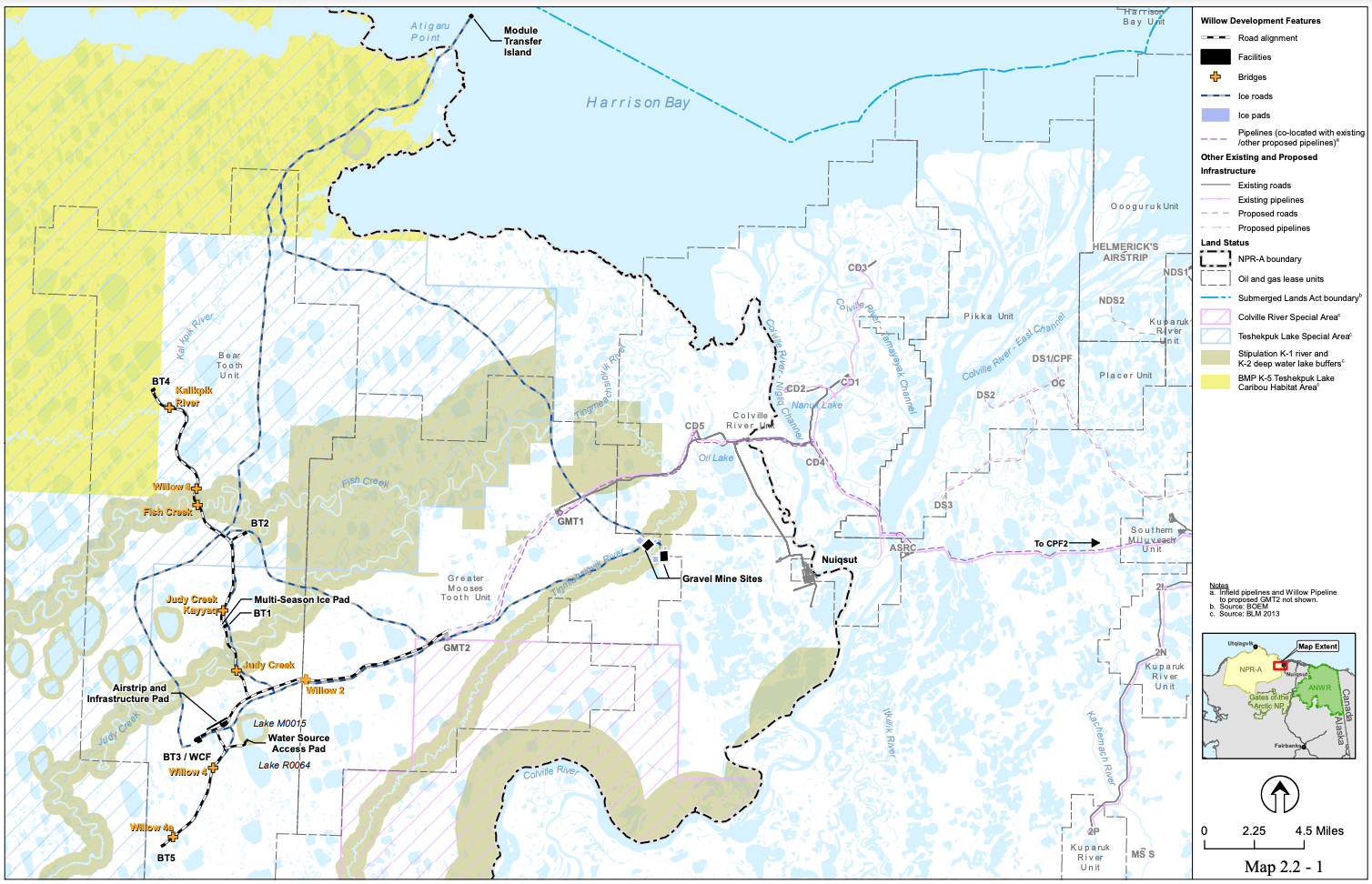
    The Willow Oil Project is a multi-billion dollar project that would involve the construction of drilling pads, pipelines, and other infrastructure in the National Petroleum Reserve-Alaska (Reserve). The project involves drilling up to 250 wells for the purpose of generating 586 million barrels of oil within its 30-year lifespan. As a direct result of the activity, roughly 258 million metric tons of greenhouse gas emissions would be released into the atmosphere. The project has been controversial due to concerns over its potential impacts on the environment and wildlife in the area.

    Willow II Case History

    ConocoPhillips first proposed the Willow Oil Project to the Bureau of Land Management (BoLM) in May of 2018. After determining that the project was a major federally-involved action that would significantly affect the quality of the human environment, the BoLM knew it had to prepare an Environmental Impact Statement (EIS) pursuant to the National Environmental Policy Act (NEPA).

    After studying the Willow Oil Project and comparing it to three action-alternatives and one no-action alternative, as well as seeking public comment, the BLM published a final EIS for the Willow Oil Project on Aug. 14, 2020. The BLM’s approval was immediately contested in the Alaskan District Court by conservation and Alaska-native groups.

    About a year later, on August 18, 2021, the plaintiffs were successful in obtaining a court order vacating the first project approval due to NEPA and Endangered Species Act (ESA) violations. Regarding the NEPA, the BLM “fail[ed] to adequately disclose and analyze the project’s downstream greenhouse gas emissions and by restricting the project alternatives it considered based on the mistaken view that ConocoPhillips had a right to extract all of the oil and gas on its leases.” And, the U.S. Fish and Wildlife Service (FWS) “violated the ESA by relying on unspecified Marine Mammal Protection Act . . . mitigation measures to support the no jeopardy and adverse modification determinations in its biological opinion for the polar bear, and by issuing an arbitrary and capricious incidental take statement for the bear.” The court then remanded to the BoLM for actions not inconsistent with its ruling.

    On remand, the BoLM prepared a draft Supplemental EIS (SEIS) in July of 2022. The draft SEIS contained the same three alternative actions and one non-action alternative from the initial EIS, plus a new action alternative. After receiving public comment, including from the instant plaintiffs, the BoLM published its final SEIS for the Willow Oil Project on Feb. 3, 2023. Subsequently, the BoLM published a record of decision approving the Willow Project on March 13, 2023.

    image1

    Plaintiffs’ Complaint

    On March 14, 2023, Earthjustice, a non-profit environmental law organization, filed a complaint on behalf of several plaintiffs. Included in the group of plaintiffs are the Natural Resources Defense Council, Center for Biological Diversity, Defenders of Wildlife, Friends of the Earth, and Greenpeace, Inc.

    In their complaint, the plaintiffs allege that the BoLM failed to adequately assess the Willow Oil Project’s impacts on the region’s wildlife and its contributions to climate change before issuing its ROD, allowing the project to move forward, thus violating the NEPA, ESA, and Administrative Procedure Act (APA). The complaint consists of five claims for relief.

    Count I: NEPA

    In the first count, plaintiffs assert that the BoLM’s final SEIS violated the NEPA by failing to consider any project-alternative “that would meaningfully reduce the climate impacts of the Willow Project by reducing total downstream greenhouse gas emissions, or any alternative that would prohibit infrastructure in the Teshekpuk Lake Special Area and the Colville River Special Area.” Plaintiffs take issue with the fact that although BLM considered action alternatives as required by NEPA, all of the alternatives were based on BoLM fully developing the entirety of its oil and gas leases. Plaintiffs disagree with the BLM’s assertion that this was proper and necessary to avoid “strand[ing] an economically viable quantity of recoverable oil.”

    Count II: NEPA

    Plaintiffs’ second count alleges that the BLM committed another violation of NEPA by failing to take a “hard look” at the reasonably foreseeable risk of oil spills and potential discoveries of oil production prospects resulting from the project. Thus, the agency fell short of its NEPA duties to disclose and analyze the indirect and cumulative impacts of the Willow Oil Project.

    Count III: Reserves Act (APA)

    The third count in the plaintiffs’ complaint alleges that the BoLM violated the APA’s arbitrary and capricious decision-making standard by failing to act in accordance with the Reserves Act. The Reserves Act requires that the Secretary of the Department of the Interior “protect[] the ‘environmental, fish and wildlife, and historical or scenic values’ within the Reserve.” Plaintiffs believe that the BoLM’s evaluation of only “full lease development” project alternatives contradicts its protection duties under the Reserves Act “to condition, restrict, or prohibit activity as it determines necessary to protect surface resources.”

    Count IV: ESA – Unlawful NMFS Letter of Concurrence

    Plaintiffs’ fourth claim is that the BoLM biological assessment to the National Marine Fisheries Service (NMFS) and the NMFS Willow Letter of Concurrence failed to analyze the possible taking of ringed and bearded seals, along with other listed species. Plaintiffs fear that the taking of these ESA-listed seals would occur as a result of the project’s greenhouse gas emissions affecting their critical habitats. The complaint is silent on the nexus between the emissions and the habitat effects. Still, it asserts that the NMFS conclusions failed to properly engage in ESA Section 7 formal consultation to determine the project’s effects on the listed seals and prepare the necessary incidental take statements. Thus, the letter’s analysis of the affected threatened species and their critical habitats was arbitrary and capricious.

    Count V: ESA – Unlawful FWS Biological Opinion

    The fifth and final claim in the complaint argues that the FWS’s biological opinion was arbitrary and capricious due to its failure to properly consider in view of the best available science the threats to polar bears brought on by climate change exacerbated by the Willow Oil Project’s greenhouse gas emissions. Polar bears, like the seals above, are a listed species under the ESA. Plaintiffs allege that the potential greenhouse gas emissions would increase sea ice melting, which will decrease the availability of ice seal prey in the polar bear’s critical hunting habitat. The agency did not prepare the necessary incidental take statement for polar bears either.

    Requested Remedy

    To remedy the violations asserted, plaintiffs request that the court vacate the BoLM’s project approval and supporting documents on the ground that the approval decision was arbitrary and capricious. Plaintiffs also seek a reward of costs and attorneys fees related to the action.

    Defendants have not yet responded to the federal complaint, filed March 14, 2023. 

    Victoria Kline

    Victoria KlineGuest Writer

    Victoria is a third-year student at the University of Miami School of Law, Juris Doctorate Candidate 2023, Law Review Staff Editor, and soon-to-be associate at Jones Day.

  • New Year, New Rules: FTC Proposes Sweeping Ban on Noncompete Agreements

    New Year, New Rules: FTC Proposes Sweeping Ban on Noncompete Agreements

    The Author

    Andreya DiMarco

    Andreya DiMarcoHatfield Schwartz Law Group LLC

    Andreya DiMarco (adimarco@hatfieldschwartzlaw.com) is counsel with Hatfield Schwartz Law Group LLC where she focuses on employment law and transactional matters.

    She has defended clients in state and federal courts and before administrative agencies, including the EEOC and DCR.

    The Journal on Emerging Issues in Litigation

    Emerging Litigation Podcast

    Emerging Litigation PodcastProduced by HB Litigation and Law Street Media

    Interviews with leading attorneys and other subject matter experts on new twists in the law and how the law is responding to new twists in the world.

    New Year, New Rules:
    FTC Proposes Sweeping Ban on Noncompetes

    “This is the FTC’s first attempt to ban non-compete agreements and strong opposition to the Proposed Rule as well as challenges regarding the scope of the FTC’s rule-making authority are likely to arise especially given the tremendous impact a retroactive and absolute non-compete ban would have.  …. [P]otential litigation over the FTC’s authority to issue and enforce such a rule may cause further delays…. Moreover, the Proposed Rule is full of ambiguity which will likely be challenged.”

    Abstract: On January 5, 2023, the Federal Trade Commission published a Notice of Proposed Rulemaking that would ban the use of noncompete agreements between employers and workers and would create an affirmative obligation for employers to void existing noncompete agreements. The Proposed Rule would also prohibit contractual clauses in other agreements or employment policies that have a similar effect. The Proposed Rule applies categorically to all workers, including independent contractors, without regard to a worker’s earnings or job function. This article discusses the nuances of the Proposed Rule as well as the legal and practical impact it will have if it is adopted.

    Download the article now!

  • Supplier Beware: The DOJ & FTC Investigating Manufacturing & Supply Chains

    Supplier Beware: The DOJ & FTC Investigating Manufacturing & Supply Chains

    The Author

    Jennifer Driscoll

    Jennifer DriscollRobinson + Cole

    Jennifer M. Driscoll (jdriscoll@rc.com) is counsel with Robinson+Cole in New York where she focuses on investigations, litigation, arbitration, mergers, and counseling. She has extensive experience in the medical devices, pharmaceuticals, electronics, and automotive industries.

    The Journal on Emerging Issues in Litigation

    Emerging Litigation Podcast

    Emerging Litigation PodcastProduced by HB Litigation and Law Street Media

    Interviews with leading attorneys and other subject matter experts on new twists in the law and how the law is responding to new twists in the world.

    Supplier Beware:
    DOJ & FTC Investigating Manufacturing & Supply Chain Issues

    “Although competitors may attend trade association meetings, the company representative in attendance should be well versed on the line between lawful discussions and ruses to disguise unlawful collusion in violation of the Sherman Act.”

    Abstract: Challenged by the pandemic, the global supply chain has generated a heightened amount of scrutiny for its impact on the economy, the labor market, the delivery of goods and services, and national security. Attention from the Biden administration portends an era when the federal government will shine a spotlight on the supply chain to root out misconduct. In this article, the author reviews recent supply chain disruptions and reactions from the DOJ and FTC, as well as the government’s efforts to support competition in the labor markets by eliminating noncompete agreements in employment contracts. Finally, she discusses proactive steps companies can take to mitigate the risk that they will find themselves the subject of a government investigation.

    Download the article now!

  • Labor Organizing in Retail: Conditions Remain for Continued Momentum

    Labor Organizing in Retail: Conditions Remain for Continued Momentum

    The Authors

    Amber Rogers

    Amber RogersHunton Andrews Kurth

    Amber is Board Certified in Labor & Employment Law by the Texas Board of Legal Specialization, and is a trial lawyer who has extensive experience representing and advising clients in traditional labor relations, such as collective bargaining, representation elections, decertification elections, unfair labor practice charges, arbitrating grievances, contract administration and interpretation, and union avoidance strategies.

    Amber’s litigation experience includes regularly representing clients in wage and hour collective and class actions, trade secrets and post-employment restrictive covenant disputes, and complex employment discrimination. As a part of Amber’s partnership with clients to avoid litigation, she frequently conducts and coordinates sensitive corporate investigations, and provides training presentations for clients on a multitude of topics.

    Kurt Larkin

    Kurt LarkinHunton Andrews Kurth

    Kurt helps businesses of all sizes solve their complex labor and employment challenges. He counsels clients on all aspects of labor-management relations, including representation elections, collective bargaining and strikes and lockouts, and also advises clients in strategic employment and human relations matters. Kurt litigates labor and employment cases in federal and state trial and appellate courts around the country and before the NLRB and EEOC.

    Kurt is a recognized thought leader in the area of traditional labor-management relations. He has been recognized as a leader in Labor and Employment by Chambers USA Virginia and as a 2022 Top 10 Labor Lawyer by Benchmark Litigation.

    The Journal on Emerging Issues in Litigation

    Emerging Litigation Podcast

    Emerging Litigation PodcastProduced by HB Litigation and Law Street Media

    Interviews with leading attorneys and other subject matter experts on new twists in the law and how the law is responding to new twists in the world.

    Labor Organizing in Retail: Conditions Remain for Continued Momentum

    “The political and social issues of the past few years, inflation, the looming recession, job security, wages, and pandemic-related frustration/unhappiness are just a few of the countless reasons cited for the boom in union support/approval.”

    Abstract: In 2022, labor organizing was in the spotlight with workers organizing at a rate not seen in years. The National Labor Relations Board saw an increase of union petitions during the last fiscal year, it was more than 50% higher than the previous year. Relatedly, more unions have won representation and American approval is at its highest in over 50 years. The rise of the “homegrown” union has directly impacted employers of all industries. The year 2022 can provide all industries and companies with lessons learned, particularly from those who faced threats for the first time. It is crucial to note too, however, that many of these companies and retailers have positive reputations. Labor and union laws continue to evolve as the Biden administration takes full control of the NLRB.

    Download the article now!

  • Telepsychiatry: Mitigating the Risks

    Telepsychiatry: Mitigating the Risks

    REGISTER

    Registration Includes

    • Nearly 90 minutes of insights from experienced professionals.
    • CLE credit: 1+ (subject to bar rules).
    • For CLE questions: CLE@LitigationConference.com
    • The complete Power Point presentation.
    • Continued access to the complete recording for later use.
    • Answers to your questions via email to the presenters or write to HB and we will be sure to contact the speakers.

    Understand the risks associated with telepsychiatry and how to manage them. 

    Telemedicine has emerged as an important solution for healthcare in general and psychiatric medicine specifically during the current global pandemic. Remote access for sub-practices including addiction counseling have been commonly used. Our panel of psychiatric professionals who have served as expert witnesses and attorneys who counsel and represent physicians have prepared a 90-minute session to share insights with attorneys, physicians, healthcare providers, risk professionals, and more.

    Agenda

    • Examining procedures and best practices that exist for ensuring confidentiality in a telemedicine practice
    • How do you draft a telepsychiatric consent form?
    • What is the emerging standard of care for telemedicine?
    • Will the standard of care for telemedicine become a national standard? (Should it?)
    • Review the case law addressing telemedicine or telepsychiatry
    • How do the HIPAA regulations and HITECH privacy laws impact telemedicine?
    • How have the HIPAA regulations and HITECH privacy laws been relaxed during the pandemic?
    • Will the relaxed HIPAA and HITECH regulations impacting telemedicine continue past the pandemic?
    • Which technical platforms are preferred? Which ones to avoid?

    Panelists

    • Mark Levy, M.D., Medical Director at fpamed
    • David Kan, M.D., UCSF Psychiatry Department and the California Society for Substance Abuse Medicine
    • Ayesha Ashai, M.D., associated with fpamed
    • Stephen M. Fatum, J.D., Partner, Barnes & Thornburg LLP
    • Angela W. Russell, J.D., Partner, Wilson Elser Moskowitz Edelman & Dicker LLP

    Meet our physician and attorney panelists.

    Mark Levy MD
    Medical Director
    fpamed

    Dr. Levy is a graduate of Columbia College (A.B. 1967) and the Columbia University College of Physicians and Surgeons (M.D. 1971) in New York. He is a Physician and Surgeon licensed since 1972 by the State of California and the State of Hawaii since 2004.

    He is certified in Adult Psychiatry (1981) and Forensic Psychiatry (1999, 2009) by the American Board of Psychiatry and Neurology. In the past he has served as a Qualified Medical Examiner (“QME”) for the State of California (active status 1993-96, currently “inactive”). He is also a Psychoanalyst and a graduate of the San Francisco Psychoanalytic Institute.

    He is Assistant Clinical Professor, Psychiatry, School of Medicine, University of California, San Francisco where has been on the faculty since 1977 and , among other teaching activities, he lectures in the Law and Psychiatry Fellowship. He is also on the Faculty of the San Francisco Psychoanalytic Institute and is the Founder and former Chairman and President of the San Francisco Foundation for Psychoanalysis, a community service outreach organization.

    In January 2006 Dr. Levy established Forensic Psychiatric Associates Medical Corporation (fpamed.com) of which he is the medical director. In addition to consulting on a broad range of civil (and criminal) matters in which there are behavioral questions to be addressed by a forensic psychiatric expert, fpamed as a group specializes in assessing psychological injury claims of populations of litigants in mass tort or multi-plaintiff litigation.

    Mark Levy founded fpamed in 2006.

    More about Dr. Levy here …

    David Kan MD
    UCSF Psychiatry Dept. &
    Calif. Society for Substance Abuse Medicine

    Dr. Kan graduated from Northwestern University Medical School. He finished his General Psychiatry Residency and Forensic Psychiatry Fellowship at the University of California, San Francisco (UCSF). He is Board-certified by the American Board of Psychiatry and Neurology in General and Forensic Psychiatry and he is Board-Certified by the American Board of Addiction Medicine in Addiction Medicine. He is a member of the faculty at the UCSF Department of Psychiatry.

    Dr. Kan enjoys teaching, in addition to his direct work with patients. He has won multiple awards for teaching and clinical care delivery. Dr. Kan teaches and supervises psychiatrists-in-training in his role as faculty member at UCSF. Throughout the year, he speaks at professional conferences on topics including treatment of addictive disorder.

    Dr. Kan offers forensic consulting services to courts and attorneys in civil, criminal, and administrative matters. He has testified in multiple states, counties and federal court as an expert witness. He is a member of the American Academy of Psychiatry and the Law.

    Dr. Kan is an active member of the California Society of Addiction Medicine (CSAM). CSAM is a physician organization dedicated to improving the treatment of substance use disorders. Dr. Kan has planned conferences and spoken to many physician and non-physician groups. Dr. Kan is the current President of CSAM. Dr. Kan is a Distinguished Fellow of the American Society of Addiction Medicine (D.F.A.S.A.M.).  Dr. Kan has testified numerous times before the California Assembly and Senate on addiction treatment. Dr. Kan has testified before Congress advocating for expanding access to addiction treatment.

    More about Dr. Kan here …

    Ayesha Ashai MD
    Associated with
    fpamed

    Dr. Ayesha Ashai received her BA in Psychology and Spanish from University of Michigan in Ann Arbor. She went on to attend medical school at Wright State University Boonshoft School of Medicine in Dayton, Ohio. She completed her adult psychiatry residency at University of Maryland and Sheppard Enoch Pratt Hospital in Baltimore, Maryland, where she later served as the executive chief resident. After, she completed her forensic psychiatry fellowship under the leadership of Dr. Charles Scott at University of California, Davis in Sacramento, California.

    She is certified by the American Board of Psychiatry and Neurology in Psychiatry with added qualifications in Forensic Psychiatry. She has years of experience in the diagnosis and treatment of a broad range of psychiatric disorders in various settings including civil and forensic hospitals, emergency rooms, outpatient clinics, and jails.  She has specialized experience in working with patients who are Muslim, those with an Indian or Pakistani background, as well as Hispanic patients. She is licensed to practice medicine in California, Ohio, Pennsylvania, Illinois and Texas.

    Currently, Dr. Ashai works as a telepsychiatrist in two outpatient mental health clinics in Ohio and Illinois. She also provides treatment for offenders incarcerated at the Winnebago County Jail and offenders with a serious mental illness that are released from incarceration as part of a therapeutic intervention program. In 2013, she was awarded the Dr. George U. Balis Award for Excellence in Medical Student Education for her work with medical students. She will soon be joining University of Illinois- Chicago as a volunteer clinical faculty member.

    Dr. Ashai has been an independent contractor with fpamed since 2020.

    More about Ayesha Ashai M.D. here …

    Stephen M. Fatum
    Partner
    Barnes & Thornburg LLP

    Stephen Fatum advises on healthcare industry-related matters for physicians, physician organizations and nonprofit entities. Stephen’s decade of in-house experience for large organizations helps him counsel clients about practical strategies to achieve their goals. His style of negotiation relies upon listening, understanding, respect, identifying common ground, appealing to collective self-interests, collaboration and creativity.

    Stephen has counseled senior management and members of the boards of directors of medical groups, associations, hospitals, and health systems regarding governance structures, bylaws, operating agreements, mergers and acquisitions, reimbursement, compensation plans, joint ventures and federal and state regulatory compliance. Notably, Stephen is the former general counsel of Advocate Medical Group, S.C., which at the time was a multispecialty medical group of 270 physicians practicing in the suburbs of Chicago. Before holding this position, he served as general counsel of the Lutheran General Medical Group, S.C. He also acted as assistant general counsel of Lutheran General HealthSystem when it combined with another health system to form Advocate Health Care.

    Having worked in-house as general counsel for healthcare organizations and volunteered for five years as the board chair of a large mental health agency, Stephen has worked closely with board chairs, CEOs, COOs, CFOs, CSOs, CMOs, and numerous other chief executives. He understands the business perspective and multidimensional challenges and financial pressures facing physicians and executives who lead health systems, medical groups, not for profit organizations and physician organizations.

    Read more about Stephen Fatum here …

    On Demand Registration

    Angela Russell Telepsychiatry Standards & Practices COVID 19

    Angela W. Russell
    Partner
    Wilson Elser Moskowitz Edelman & Dicker LLP

    Angela Russell is the regional managing partner of the Baltimore office and chair of the firm’s Diversity Committee. She has significant trial experience and has tried cases in the District of Columbia and across the state of Maryland. Her practice encompasses the defense of professional liability matters, including medical malpractice and legal malpractice actions in addition to claims against agents, brokers and other professionals. Angela regularly handles and supervises general casualty matters for insurers and self-insured entities on premises liability claims, security matters, hospitality cases and recreational defense claims. Angela is also frequently called on to handle toxic tort matters.

    Angela possesses an innate ability to connect with her clients, identify their needs and communicate effectively throughout the litigation cycle. Her rapport in the courtroom is equally impressive. An aggressive litigator, Angela is adept at tapping the persistence, preparation and training she gained early on in a variety of public speaking engagements and tackling two marathons. Angela worked at prominent defense firms in Minnesota and Washington, DC, prior to joining Wilson Elser.

    Professional Distinctions
    Angela is the former co-chairperson of the Civil Jury Instructions Committee for the Bar Association for the District of Columbia as well as a former adjunct professor at William Mitchell College of Law in St. Paul, MN.

    Read more about Angela Russell here …

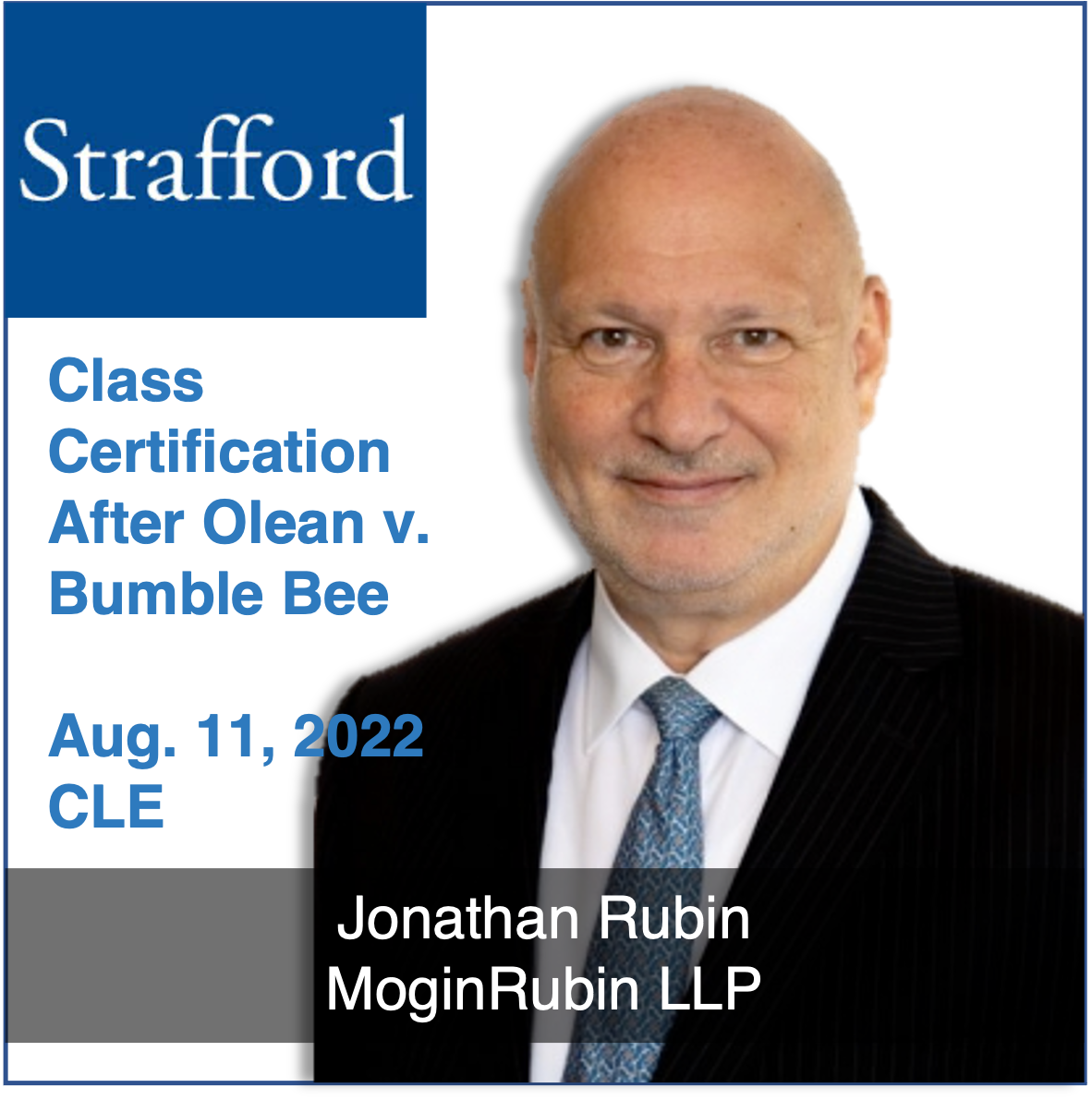
  • Class Certification After Olean v. Bumble Bee with Jonathan Rubin of MoginRubin LLP

    Class Certification After Olean v. Bumble Bee with Jonathan Rubin of MoginRubin LLP

    Featured Speaker

    Jonathan Rubin

    Jonathan RubinPartner

    Jonathan focuses his practice exclusively on antitrust and competition law and policy. As a litigator, he has led trial teams in major antitrust cases in courts throughout the country. As a thought-leader in competition law, he has published in influential academic journals and has spoken to numerous professional groups, including the Directorate General for Competition of the European Commission, the Antitrust Section of the American Bar Association, the University of Wisconsin, and the American Antitrust Institute. Jonathan has also made several appearances before congressional committees.

    More About Rubin

    For more information please email Tom Hagy

    Explore more from MoginRubin LLP!

    Blog: Emboldened by New Resources and Expanded Authority, Feds Continue 10-Year Look Back at Chinese Investment. By Dan Mogin, Jonathan Rubin, Jennifer Oliver, and Timothy LaComb. List

    OnDemand CLE Webinar: The Antitrust Case Against Google. Dan Mogin, Jonathan Rubin, Jennifer Oliver, Timothy LaComb, John Newman, Dr. Alan Grant

    Blog: FTC’s Case Against Facebook Will Test the Flexibility of U.S. Antitrust Law.Authors: Jonathan Rubin and Jennifer Oliver, MoginRubin LLP

    Blog: Full Ninth Circuit Removes Unwarranted Hurdles to Class Certification.

    Journal: Policy Derailed: Can U.S. Antitrust Policy Toward Standard Essential Patents Get Back on Track by Jonathan Rubin

    Webinar: Class Certification After Olean v. Bumble Bee with Jonathan Rubin, James Bogan lll, Jonathan Cohn, Bradley Hamburger.

    Journal: FTC v. Amazon: Market Definitions and Section 5 of the FTC Act

    Podcast: Algorithmic Software Facilitated Price Fixing with Jonathan Rubin

    Plus, additional insights from the MoginRubin Blog.

    Class Certification After Olean v. Bumble Bee

    Expert Testimony, Uninjured Class Members, and Article III Standing 

    This CLE course will discuss the ramifications arising from the Ninth Circuit’s en banc decision in Olean Wholesale Grocery v. Bumble Bee Foods, 31 F.4th 651 (9th Cir. 2022) (en banc), addressing numerous important class certification issues. The program will address Olean’s critical holdings regarding the evidentiary burden under Rule 23, how expert testimony should be assessed at the class certification stage, and the relevance of injury and Article III standing to assessing Rule 23’s predominance requirement and the scope of a proposed class definition. The panel will discuss the impact Olean will have for both plaintiffs and defendants, and will assess how lower courts have reacted to this important Ninth Circuit ruling.

    Description

    Olean addresses numerous key class certification issues and outlines a refined framework for class certification that may extend beyond the Ninth Circuit. The decision clarifies the burden of proof under Rule 23 and a district court’s obligation to assess both the admissibility of expert evidence and its adequacy to satisfy the prerequisites of Rule 23. Counsel will need to understand Olean’s holding regarding uninjured class members. While the Ninth Circuit rejected a categorical rule that a class cannot be certified if it includes more than a de minimis number of uninjured members, it emphasized that injury, both as an element of the underlying claim and as a requirement of Article III, is an essential issue in determining whether Rule 23(b)(3)’s predominance requirement is satisfied.

    Listen as this panel of preeminent class action lawyers discusses how Olean will affect certification and offers new strategies to consider. Get the history of the case, its key holdings and strategies for applying them, and recent decisions applying it.

    The panel will discuss these and other critical issues:

    • How will the issue of uninjured class members impact class certification after Olean?
    • How will Olean change the use of expert testimony at the class certification stage?
    • How will Olean’s guidance impact consumer and employment class actions?

    The speakers:

    Jonathan Rubin, Partner, MoginRubin LLP

    James F. Bogan, III, Partner, Kilpatrick Townsend & Stockton

    Jonathan F. Cohn, Partner, Sidley Austin

    Bradley J. Hamburger, Partner, Gibson Dunn & Crutcher

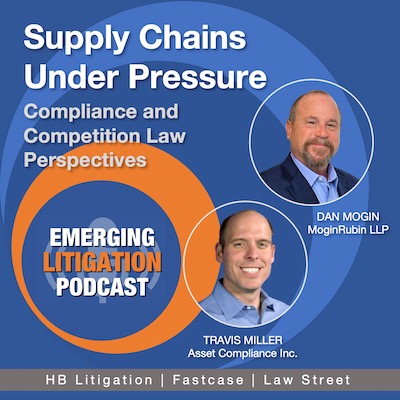
  • Under Pressure: How’s the Integrity of Your Supply Chain? — with Dan Mogin and Travis Miller

    Under Pressure: How’s the Integrity of Your Supply Chain? — with Dan Mogin and Travis Miller

    Our Guests

    Travis Miller

    Travis Miller Assent Compliance Inc.

    Travis is an international trade and compliance attorney who specializes in ITAR/EAR/sanctions, global anti-corruption and anti-slavery, codes of conduct, environmental health and safety, product stewardship, and corporate social responsibility.

    Travis manages Assent’s worldwide legal activities, advises the Board of Directors on legal matters, and oversees corporate compliance, governance initiatives, and other commercial transactions. Before coming to Assent, he served in various high-level counsel positions with companies such as Microchip Technology, Foresite Group, and St. Jude Medical.

    Dan Mogin

    Dan MoginMogin Rubin LLP

    Dan Mogin is co-founding and managing partner of MoginRubin LLP, a leading boutique law firm that focuses on antitrust law and other complex business disputes. A true thought leader in the field, Dan has served as lead counsel in numerous large antitrust cases, chaired the Antitrust Section of the California Bar, taught antitrust law, and was editor-in-chief of a leading competition law treatise.

    Under Pressure: How’s the Integrity of Your Supply Chain? — with Dan Mogin and Travis Miller

    Pressure builds when budgets are cut and fewer resources are available to maintain the necessary vigilance to remain compliant with often complex and changing regulations.

    Corporate risk can be caused by laxity, inattention, misconduct, unethical behavior, or even illegal activities by people and organizations in your supply chain. Often these things are what happen when people are under pressure. They may feel pressure to bend rules to hit sales targets, or they feel significant competitive pressure.

    Listen to my interview in two acts with Travis Miller, General Counsel at Assent Compliance Inc. and Dan Mogin is co-founding and managing partner of MoginRubin LLP, a leading boutique law firm that focuses on antitrust law and other complex business disputes. In Act 1 we discuss the conduct of a fictitious airline that is marketing itself as a green company and its competitors are crying foul, and by that I mean suing them. In Act 2 a fictitious semiconductor manufacturer that is allegedly using its considerable market power to trounce competitors. The fictitious scenarios involving these fictitious companies are as follows:

    Act 1: Greenwashing by AirGreen Corp.

    Commercial jets disproportionately spew high amounts of carbon into the atmosphere. There is no practical way to significantly reduce these harmful pollutants. Corporations are under pressure to be environmentally responsible, and demonstrate they are genuinely embracing the ESG movement. When it comes to carbon neutrality, the FTC says companies should not make “broad, unqualified” claims that they are running green businesses without “reliable scientific evidence” that their carbon offsets will have a timely impact. AirGreen, a major yet fictitious air shipping company, launched a global ad campaign called Super Green Air, dubbing itself the first commercial airline to be carbon neutral. AirGreen hasn’t actually reduced harmful emissions from its flights. Instead, it has purchased carbon offsets, which means it paid to reduce the emissions from other sources, while not actually reducing its carbon footprint. AirGreen’s competitors have filed suits and complaints with the FTC that this is false advertising that gives AirGreen a competitive edge in the air shipping market. 

    Act 2: MegaTech Monopolizing Semiconductor Chips (starts at minute 47:47)

    The global semiconductor industry makes products that run the world. They’re in PCs, large mainframes, smartphones, cable and internet equipment, electric cars, and wind turbines. The demand for silicon chips is enormous. These chips are manufactured by a dirty, environmentally unfriendly process. Their manufacture also relies on a “complex, dynamic and multidirectional global supply and services matrix” (aka supply chain). Recent clogs in that supply chain caused by the Covid pandemic and Russia’s invasion of Ukraine demonstrate that. When people think of monopolies, they think of big conglomerates that control huge markets, like AT&T and Microsoft. AT&T ruled over telephone communications without competition for years. They were “the phone company.” If you wanted assistance their number was “0.” In the case of Microsoft, it controlled more than 95% of the PC operating system market. But monopolies can also mean dominance of one specific piece of one specific product maybe even in a specific region. You could have a monopoly if you made all cell phones, or you could hold a monopoly if you make a component that makes all cellphones work. MegaTech is one such company, albeit a fictitious one. It makes the chip that makes your cable box work. In fact, they are the only maker of these chips. MegaTech has already been investigated and sued by the FTC. It has already agreed to stop anticompetitive conduct such as exclusivity arrangements with its customers. And, it has already broken that promise and is being investigated again. Some of its suppliers are considering major litigation, too.

    We discuss these scenarios from the perspectives of in-house compliance and legal professionals, outside counsel specializing in competition law, and a journalist covering the legal industry.

    This podcast is the audio companion to the Journal on Emerging Issues in Litigation. The Journal is a collaborative project between HB Litigation Conferences and the Fastcase legal research family, which includes Full Court Press, Law Street Media, and Docket Alarm. The podcast itself is a joint effort between HB and our friends at Law Street Media. If you have comments or wish to participate in one our projects please drop me a note at Editor@LitigationConferences.com.

    Tom Hagy
    Litigation Enthusiast and
    Host of the Emerging Litigation Podcast

    p.s. I add brief insights, humbly, on behalf of the Fourth Estate. In so doing, I also demonstrate why — if you’re no good at multitasking —  don’t. Especially around smart people who are really paying attention.  Also, if at some point you think you hear birds chirping, it might be time to see someone. Special thanks to our sound engineer, Jordan Forbes.

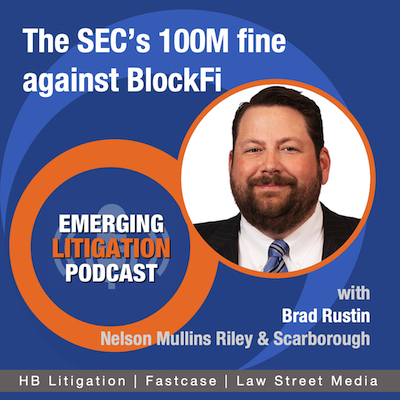
  • Takeaways from the SEC’s $100M Fine Against FinTech Lender BlockFi

    Takeaways from the SEC’s $100M Fine Against FinTech Lender BlockFi

    Our Guest

    Brad Rustin

    Brad RustinNelson Mullins

    Brad is a partner in the Greenville, South Carolina, office of Nelson Mullins Riley and Scarborough where he chairs the firm’s Financial Services Regulatory Practice, leading a team of attorneys in a national practice representing clients in financial regulatory and FinTech matters.

    He is a valued member of the Editorial Board of Advisors for the Journal on Emerging Issues in Litigation, a companion to this podcast.

    Takeaways from the SEC’s $100M Fine Against FinTech Lender BlockFi

    So, apparently this is true:  Running a lending operation without registering with the SEC makes them crabby.

    Spoiler Alert: On Valentine’s Day this year the SEC announced a $100 million fine against retail crypto lender BlockFi Lending. Nothing says “will you be mine?” like a nine-figure bill — for  that special someone who has everything. The company agreed to put an end to some of its offers and sales, and to get to work bringing itself into compliance with, you know, the law, like the Securities Act of 1933 and the Investment Company Act of 1940. So, what does the SEC want companies to do?  What remedies does the SEC have for unregistered securities offerings?  What impact will this have on private litigation? Is there a risk that BlockFi Interest Account investors will have claims against BlockFi? Want to find out?

    Listen to my interview with attorney Brad Rustin. Brad is a partner in the Greenville, South Carolina, office of Nelson Mullins Riley and Scarborough where he chairs the firm’s Financial Services Regulatory Practice, leading a team of attorneys in a national practice representing clients in financial regulatory and FinTech matters. This is Brad’s third appearance on the podcast! He spoke on one episode about the Impact of the Russia Sanctions on Global Financial Markets, and on another popular episode on the Gamification of Stock Trading. Brad is a valued member of the Editorial Board of Advisors for the Journal on Emerging Issues in Litigation, a companion to this podcast. Want a sample copy? Let me send you one. Write to me at Editor@LitigationConferences.com.

    This podcast is the audio companion to the Journal on Emerging Issues in Litigation. The Journal is a collaborative project between HB Litigation Conferences and the Fastcase legal research family, which includes Full Court Press, Law Street Media, and Docket Alarm. The podcast itself is a joint effort between HB and our friends at Law Street Media. If you have comments or wish to participate in one our projects, or want to tell me how much  you learned from Brad,  please drop me a note at Editor@LitigationConferences.com.

    Bonus! For those of you who struggle to understand cryptocurrency, like a certain member of my family, listen for the bonus segment after the outro when Brad politely and patiently helps me in my quest to explain crypto to my mother-in-law. And, if I’m being honest, to me, too.