Category: Corporate Compliance

  • Spotting the Risk, Reaping Rewards: Avoiding Increased Antitrust Scrutiny

    Spotting the Risk, Reaping Rewards: Avoiding Increased Antitrust Scrutiny

    The Authors

    Katie Reilly

    Katie ReillyWheeler Trigg O’Donnell LLP

    Katie has favorably represented antitrust clients in matters involving monopolization, conspiracy, price fixing, exclusive dealing, and other competition-related disputes, including trade secrets and non-compete actions. She has extensive knowledge of the regulatory hurdles and obligations her clients face. Katie earned her J.D. from the New York University School of Law, cum laude.

    Natalie West

    Natalie WestWheeler Trigg O’Donnell LLP

    Natalie West represents sophisticated clients in complex commercial disputes. She regularly serves as the lead brief writer in antitrust cases, employment and consumer class actions, and appellate matters. Natalie graduated with high honors from the University of Texas School of Law, where she served as a member of the Texas Law Review and was elected to the Order of the Coif.

    The Journal on Emerging Issues in Litigation

    Emerging Litigation Podcast

    Emerging Litigation PodcastProduced by HB Litigation and Law Street Media

    Interviews with leading attorneys and other subject matter experts on new twists in the law and how the law is responding to new twists in the world.

    Avoiding Antitrust Scrutiny

    Spotting the Risk, Reaping Rewards

    The increase in aggressive antitrust enforcement has certainly received significant attention. For the moment, juries are not rewarding the prosecutors. That said, even an unsuccessful government investigation is itself costly and can motivate plaintiffs’ lawyers. Best practices involve not only following the law but also maintaining solid optics to avoid the need for an expensive, if ultimately successful, defense.

    Abstract: 

    A decade ago, few lawyers across the country spent significant time thinking about antitrust law. But, since then, there has been an onslaught of antitrust attacks on businesses and executives across all sectors of the economy. Enforcement efforts have skyrocketed following President Biden’s July 2021 executive order directing a “whole of government” crackdown on competition abuses—and the trend shows no sign of letting up.

    Today, no matter the industry or the size of the business, everyone needs to understand these risks and have strategies to minimize them.

    This article will walk through the top antitrust risks of the moment and conclude with strategies on how to avoid not only violations but also bad optics that increase exposure.

    Download the article now!

  • The Light and Dark Sides of Auto-GPT

    The Light and Dark Sides of Auto-GPT

    The Light and Dark Sides of Auto-GPT with Jason Epstein

    Auto-GPT is a new generative artificial intelligence application which autonomously “self-prompts” to engage beyond a human-chatbot discussion.

    This takes us into a realm of AI self-prompted actions that do not need additional human inputs. It also potentially puts the “traditional” GPT models on a fast track to further reduce human interaction. The number of use cases as well as the number of legal and ethical questions is inevitable. For that reason, it’s becoming increasingly important for businesses to understand how Auto-GPT technologies use data, the potential for biased results, and how to responsibly leverage these powerful technologies.

    Listen to my interview with Jason I. Epstein, Partner at Nelson Mullins Riley & Scarborough as we explore this emerging field. Jason is the co-head of the firm’s technology and procurement industry group which provides legal services to global buyers and sellers of technology in industries that include FinTech, HealthIT,  and manufacturing. An experienced business and technology negotiator, Jason has dealt with a variety of matters, e.g., the metaverse, technology transfer, privacy, cryptocurrency, IoT, open-source code, and more. Jason received his JD from the University of Tennessee College of Law. He formerly taught “Law of Cyberspace” as an adjunct professor at Vanderbilt University Law School.

    I hope you enjoy the episode. If so, give us a rating!

    *******

    This podcast is the audio companion to the Journal on Emerging Issues in Litigation. The Journal is a collaborative project between HB Litigation Conferences and the Fastcaselegal research family, which includes Full Court Press, Law Street Media, and Docket Alarm. The podcast itself is a joint effort between HB and our friends at Law Street Media. If you have comments or wish to participate in one our projects please drop me a note at Editor@LitigationConferences.com.

    Tom Hagy

    (actual size)

    Tom Hagy
    Litigation Enthusiast and
    Host of the Emerging Litigation Podcast
    Home Page
    LinkedIn

    Jason Epstein

    Jason EpsteinNelson Mullins Riley & Scarborough

    Jason Epstein is the co-head of the firm’s technology and procurement industry group. Jason and the technology team provide legal services to buyers and sellers of technology both domestically and internationally in various industries, from FinTech and HealthIT to auto and manufacturing

    He often serves as outside general counsel and relationship partner to companies in a variety of industries. His areas of focus include board governance, technology, venture capital and private equity, mergers and acquisitions, reorganizations, international commerce, and litigation. Whether advising clients of Fortune 500, mid-market, or small businesses (including under the SBA), he serves as an advisor to the C-Suite and inside General Counsel regarding business-related law.

  • The IRS and Rules About Rules

    The IRS and Rules About Rules

    The IRS and Rules About Rules with Jeff Luechtefeld

    Concepts:  IRS, Internal Revenue Service, APA, The Administrative Procedure Act

    The IRS closed more than 72,000 appeals last year and its Chief Counsel’s Office received more than 65,000 cases. 

    That’s a lot of disputes. Safe to say they are about rules. Following rules. Not following rules. Questioning rules. Then, there are rules about rules that the IRS must follow.

    The Administrative Procedure Act (APA) is such a beast. The APA places requirements on federal agencies when engaged in a “rule making” that has the force and effect of law. The APA has become a focal point in tax litigation, due in large part to the IRS’s record of refusing to comply with the law’s notice-and-comment mandate. In his article for the Journal on Emerging Issues in Litigation, our guest – Jeffrey S. Luechtefeld, shareholder at Chamberlain Hrdlicka – wrote about challenging the IRS, recent trends in tax litigation, and the future of APA challenges. And now, he’s here on our humble podcast.

    Jeff is a tax controversy and litigation attorney with a strong technical tax background and a deep understanding of the inner workings of the agency. Jeff advocates on behalf of clients in IRS examinations, appeals and litigation. Previously, he led the regional tax controversy practice for a Big Four accounting firm. He began his career with the IRS Office of Chief Counsel as a litigator, eventually becoming a Special Trial Attorney in the Large Business and International Division. Jeff received his JD from the University of Missouri, Columbia School of Law.

    I hope you enjoy the episode. If so, give us a rating!

    *******

    This podcast is the audio companion to the Journal on Emerging Issues in Litigation. The Journal is a collaborative project between HB Litigation Conferences, and the Fastcaselegal research family, which includes Full Court Press, Law Street Media, and Docket Alarm — all now part of vLex. If you have comments or wish to participate in one our projects please drop me a note at Editor@LitigationConferences.com. I’m often polite.

    podcast logo face

    Actual size.

    Tom Hagy
    Litigation Enthusiast and
    Host of the Emerging Litigation Podcast
    Home Page
    LinkedIn

    Jeffrey S. Luechtefeld

    Jeffrey S. LuechtefeldChamberlain Hrdlicka

    Jeff is a tax controversy and litigation attorney with a strong technical tax background as well as a deep understanding of inner-workings of the Internal Revenue Service. Jeff’s practice focuses on representing clients in IRS examinations, appeals and litigation. His knowledge, combined with strong strategic thinking and negotiation skills allows him to effectively advocate for his clients before the IRS.

    Previously, Jeff led the regional Tax Controversy practice for a “Big Four” accounting firm, where he assisted clients in resolving disputes administratively within the IRS either while still in examination or before the IRS Office of Appeals.

    law firm logo

    Read the article.

    man in tie

  • The Blueprint for an “AI Bill of Rights”

    The Blueprint for an “AI Bill of Rights”

    Authors

    Peter Schildkraut

    Peter SchildkrautArnold & Porter Kaye Scholer LLP.

    Peter Schildkraut is a co-leader of the firm’s Technology, Media & Telecommunications industry team and provides strategic counsel on artificial intelligence, spectrum use, broadband, and other TMT regulatory matters. Mr. Schildkraut helps clients navigate the ever-changing opportunities and challenges of technology, policy, and law to achieve their business objectives at the US Federal Communications Commission (FCC) and elsewhere. He is the author of “AI Regulation: What You Need To Know To Stay Ahead of the Curve.

    James Kim

    James KimArnold & Porter Kaye Scholer LLP.

    James W. Kim is a nationally recognized expert in procurement law that regularly advises companies that do business with the US government, with a focus on professional services organizations and the life sciences industry. He is a regular speaker and author on procurement and drug pricing matters and his work is regularly featured in nationally-distributed industry print and digital media.

    Mr. Kim provides clients with strategic counsel related to US government funding and US market access, including assistance with more than $5 billion in procurement and grant awards and regulatory counsel related to more than $40 billion in successful M&A transactions.

    Marne Marotta

    Marne MarottaArnold & Porter Kaye Scholer LLP.

    Marne Marotta works with clients facing complex challenges to develop and implement dynamic government relations strategies. Drawing from her experience in the Senate and the executive branch, she provides clients with strategic guidance and counseling, devises and implements comprehensive advocacy campaigns, and builds coalitions with allied stakeholders. Focused on the intersection between business and public policy, Marne uses a multidisciplinary approach to help clients achieve their legislative and agency goals.

    James Courtney, Jr.

    James Courtney, Jr.Arnold & Porter Kaye Scholer LLP.

    James Courtney focuses his work on a variety of policy areas, including technology, national security, education, and energy and environmental. He conducts research and monitors developing policy issues to aid clients and engage with members of Congress and the Executive Branch. Mr. Courtney works closely with and advises clients on a wide range of regulatory and legislative issues related to technology, privacy, education, workforce development, and energy.

    Paul Waters

    Paul WatersArnold & Porter Kaye Scholer LLP.

    Paul Waters focuses on a variety of policy areas, including financial services, tax, digital asset regulation, technology, and defense. He monitors policy developments and analyzes legislation to support client strategy development and stakeholder outreach in Congress and the Executive branch.

    First Published in

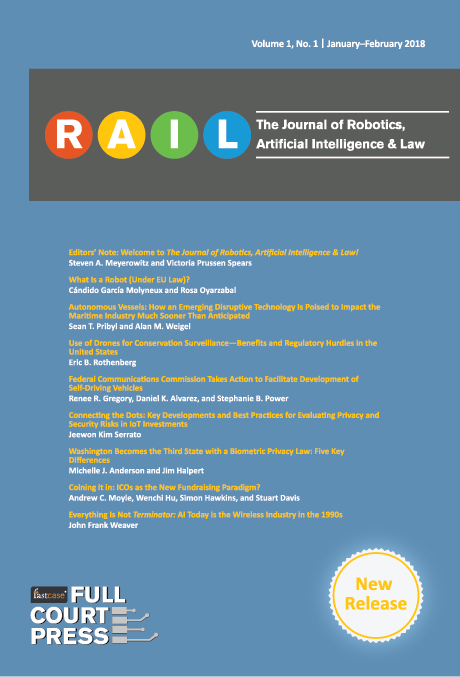
    First Published inThe Journal of Robotics, Artificial Intelligence & Law

    The Journal of Robotics, Artificial Intelligence & Law (RAIL) is the flagship publication of Full Court Press, an imprint of Fastcase. Since 1999, Fastcase has democratized the law and made legal research smarter. Now, Fastcase is proud to publish books and journals that are pioneering, topical, and visionary, written by the law’s leading subject matter experts. Look for more Full Court Press titles available in print, as eBooks, and in the Fastcase legal research service, or at www.fastcase.com/fullcourtpress.

    Blueprint for an “Artificial Intelligence Bill of Rights”

    Photo by Possessed Photography on Unsplash

    Abstract: In this article, the authors discuss the blueprint for an “AI Bill of Rights” unveiled recently by the Biden administration. The blueprint provides a clear indication of the Biden administration’s artificial intelligence regulatory policy goals. This article was first published in The Journal of Robotics, Artificial Intelligence & Law by Fastcase Full Court Press.

    More and more, artificial intelligence (AI) and other automated systems make decisions affecting our lives and economy. These systems are not broadly regulated in the United States—although that will change this year in several states. President Biden recently unveiled a blueprint for an “AI Bill of Rights,” motivated by concerns about potential harms from automated decision-making. Arising from an initiative the White House Office of Science and Technology Policy (OSTP) launched in 2021, the AI Bill of Rights lays out five principles to foster policies and practices—and automated systems—that protect civil rights and promote democratic values.

    For now, at least, adherence to these principles (and the steps recommended for observing them) remains voluntary—the blueprint is a guidance document with no enforcement authority attached to it. Notably, at inception, OSTP was unsure how the AI Bill of Rights might be enforced:

    Possibilities include the federal government refusing to buy software or technology products that fail to respect these rights, requiring federal contractors to use technologies that adhere to this “bill of rights” or adopting new laws and regulations to fill gaps. States might choose to adopt similar practices.

    The Biden administration decided to publish a nonbinding white paper, potentially recognizing the difficulty of shepherding legislation through any potential 118th Congress. Indeed, the document’s first page proclaims that it “is non-binding and does not constitute U.S. government policy.” Nor does it “constitute binding guidance for the public or federal agencies and therefore does not require compliance with the principles described herein.” Notwithstanding this disclaimer, the blueprint provides a clear indication of the Biden administration’s AI regulatory policy goals.

    The Executive Branch and also independent agencies are likely to follow this lead in their respective domains.

    Issues of Definition

    In the debate over the European Union’s pending Artificial Intelligence Act, the definition of “artificial intelligence” has attracted much discussion. OSTP sidesteps this issue in the blueprint by addressing “automated systems,” which are defined as “any system, software or process that uses computation as whole or part of a system to determine outcomes, make or aid decisions, inform policy implementation, collect data or observations, or otherwise interact with individuals and/or communities.” OSTP adds, “Automated systems include, but are not limited to, systems derived from machine learning, statistics or other data processing or AI techniques, and exclude passive computing infrastructure,” which OSTP also defines.

    The blueprint’s coverage of “automated systems” instead of “artificial intelligence” offers business a mixed bag. On the one hand, the broader scope aligns with the regulation of automated decision-making under California, Colorado,10 Connecticut, and Virginia12 privacy laws and New York City’s law on automated employment decision tools, all taking effect this year, as well as Article 2214 of the EU/UK General Data Protection Regulation.

    On the other hand, it potentially threatens international harmonization of regulations based on the seemingly narrower scopes of the UNESCO Recommendation on the Ethics of Artificial Intelligence and the OECD AI Principles (also shared by the G20). Much of the blueprint concerns protection of “rights, opportunities or access.” OSTP explains this phrase as “the set of: civil rights, civil liberties and privacy, including”:

    • “freedom of speech, voting, and protections from discrimination, excessive punishment, unlawful surveillance, and violations of privacy and other freedoms in both public and private sector contexts”;

    • “equal opportunities, including equitable access to education, housing, credit, employment, and other programs”; or

    • “access to critical resources or services, such as healthcare, financial services, safety, social services, non-deceptive information about goods and services, and government benefits.”

    This explanation’s expansiveness underscores the Biden administration’s stated intent that the blueprint apply to automated systems affecting any facet of society or the economy.

    Guiding Principles

    The blueprint outlines five principles for all automated systems with the potential to “meaningfully impact individuals’ or communities’ exercise of rights, opportunities or access”:
    • Safe and Effective Systems. Automated systems should be safe and effective. They should be evaluated independently and monitored regularly to identify and mitigate risks to safety and effectiveness. Results of evaluations, including how potential harms are being mitigated, should be “made public whenever possible.”
    • Algorithmic Discrimination Protections. Automated systems should not “contribute to unjustified different treatment” or impacts that disfavor members of protected classes. Designers, developers, and deployers should include proactive equity assessments in their design processes, use representative data sets, watch for proxies for protected characteristics, ensure accessibility for people with disabilities, and test for and mitigate disparities throughout the system’s life cycle.
    • Data Privacy. Individuals should be protected from abusive data practices and have control over their data. Privacy engineering should be used to ensure automated systems include privacy by default. Automated systems’ design, development, and use should respect individuals’ expectations about their data and the principle of data minimization, collecting only data strictly necessary for the specific context. OSTP stresses that consent should be used only where it can be appropriately and meaningfully provided, limited to specific use contexts and unconstrained by dark patterns; moreover, notice and requests for consent should be brief and understandable in plain language. Certain sensitive data (including data related to work, home, education, health, and finance) should be subject to additional privacy protection, including ethical review and use prohibitions.
    • Notice and Explanation. Operators of automated systems should inform people affected by their outputs when, how, and why the system affected them. This principle applies even “when the automated system is not the sole input determining the outcome.” Notices and explanations should be clear and timely and use plain language.
    • Human Alternatives, Consideration, and Fallback. People should be able to opt out of decision-making by automated systems in favor of a human alternative, where appropriate. Automated decisions should be appealable to humans.

    The blueprint also includes a “Technical Companion” that details “concrete steps” for building these five principles into “policy, practice or the technological design process.” Organizations developing, procuring, and deploying AI and other automated systems will find these concrete steps to be generally consistent with other guidance on best practices.

    What Next from the U.S. Government?

    Having drawn up the blueprint, the Biden administration is ready to build out its AI policies through guidance, rulemaking, and enforcement. This work is already under way.
    Thus far, guidance—both for ethical best practices and compliance with existing laws—has been most common. For instance:
    • Department of Energy AI Advancement Council. In May 2022, the Department of Energy established the AI Advancement Council20 to oversee coordination, advise on AI strategy, and address issues on the ethical use and development of AI systems.
    • Algorithmic Discrimination in Hiring. In May 2022, the Equal Employment Opportunity Commission (EEOC) and the Department of Justice released a technical assistance document that explains how employers’ use of algorithmic decision-making may violate the Americans with Disabilities Act. EEOC’s guidance is a part of its larger initiative to ensure that AI and “other emerging tools used in hiring and other employment decisions comply with federal civilbrights laws that the agency enforces.”
    • Consumer Protection. In May 2021, the Federal Trade Commission’s (FTC) published a blog post providing tips for responsible use of AI in compliance with Section 5 of the Federal Trade Commission Act, the Fair Credit Reporting Act, and the Equal Credit Opportunity Act.

    Increasingly, however, the Executive Branch and independent agencies have been shifting to rulemaking and enforcement:
    • Broad AI Regulation. In August 2022, FTC opened its “commercial surveillance” proceeding, which could lead to a wide range of rules on AI and other automated systems (as well as privacy and data security). FTC’s Advance Notice of Proposed Rulemaking asks a number of questions about algorithmic accuracy, validity, reliability, and error; algorithmic discrimination against traditionally protected classes and “other underserved groups”; and whether AI and other automated systems yield unfair methods of competition or unfair or deceptive acts or practices that violate Section 5 of the FTC Act.25
    • Workplace Protections. The Department of Labor is ramping up enforcement of required surveillance reporting to protect worker organizing. The Department of Labor also released a blog post titled “What the Blueprint for an AI Bill of Rights Means for Workers.”
    • Algorithmic Healthcare Discrimination. The Department of Health and Human Services (HHS) issued a proposed rule in August 2022 that, in relevant part, would prohibit algorithmic discrimination in clinical decision-making by covered health program and activities. HHS also planned to release an evidence-based examination of healthcare algorithms and racial and ethnic disparities by late e 2022.
    • Algorithmic Housing Discrimination. In June 2022, Meta (formerly, Facebook) settled a Justice Department Fair Housing Act suit (following a Department of Housing and Urban Development investigation). The government alleged that Meta had used algorithms in determining which Facebook users received housing ads and that those algorithms relied, in part, on characteristics protected under the Fair Housing Act. As part of the settlement, Meta agreed to change its targeted advertising practices and to pay the maximum civil penalty of $115,054.
    • Algorithmic Credit Discrimination. In March 2022, the Interagency Task Force on Property Appraisal and Valuation Equity released an Action Plan to Advance Property Appraisal and Valuation Equity that includes a commitment from regulators to include a nondiscrimination standard in proposed rules for automated valuation models. Also that month, the Consumer Financial Protection Bureau revised its Supervision and Examination Manual to focus on algorithmic discrimination as a prohibited unfair, deceptive or abusive acts or practice. Businesses should expect the blueprint to inform all such agency actions going forward. It is likely that these agencies will expand their AI initiatives while other agencies will become active addressing AI and other automated systems within their ambits.

    The Chamber of Commerce’s Concerns Following the blueprint’s release, the U.S. Chamber of Commerce (the Chamber) wrote34 OSTP Director Dr. Arati Prabhakar,
    highlighting a number of concerns:
    • Lack of Stakeholder Engagement. OSTP received insufficient stakeholder input in formulating the blueprint, having sought comments only on biometric-identification systems.
    • Poor Definitions. The blueprint supplies definitions of key terms, including “Automated System,” which lack precision and could undercut international harmonization of AI policies and standards.
    • Independent Evaluations. The current lack of “concrete” auditing standards and metrics for AI systems makes it  “pointless” to allow journalists, third-party auditors, and other independent evaluators “unfiltered access” to AI systems—as called for in the blueprint.
    • Conflation of Data Privacy and Artificial Intelligence. Data privacy and AI raise “distinctly different” “nuances and complexities,” so the two issues should not be conflated.

    The Chamber’s “unexpectedly forceful pushback” (to quote Politico’s Brendan Bordelon) to a supposedly nonbinding guidance document reflects the blueprint’s potential influence. In an interview, a representative said the Chamber expects dozens of federal agencies to incorporate the guidance into regulatory mandates and
    fears “copycats at the state and local level.” A patchwork of differing requirements could impose a substantial burden on businesses.

    Having released the Blueprint for an AI Bill of Rights with great fanfare, the Biden administration is unlikely to withdraw it in response to the Chamber’s critique. However, the critique probably does foreshadow coming battles in rulemaking dockets and legislative chambers around the country.

    Conclusion

    AI regulation is arriving swiftly. Businesses should monitor these changes and prepare their compliance programs. Companies with particular concerns may wish to raise them early in legislative and rulemaking processes while proposals remain fluid.

  • How Companies Seeking to Leave China for Mexico Can Mitigate Their Legal Risks and Protect Against New Ones

    How Companies Seeking to Leave China for Mexico Can Mitigate Their Legal Risks and Protect Against New Ones

    The Author

    Dan Harris

    Dan HarrisHarris Bricken

    Dan Harris (dan@harrisbricken.com) is co-founder of Harris Bricken where he focuses his practice on international law and protecting businesses in their foreign operations. A leading authority on the subject, he is also editor of the highly regarded China Law Blog, and a valued member of the Editorial Board of Advisors for the Journal of
    Emerging Issues in Litigation.

    The Journal on Emerging Issues in Litigation

    Emerging Litigation Podcast

    Emerging Litigation PodcastProduced by HB Litigation and Law Street Media

    Interviews with leading attorneys and other subject matter experts on new twists in the law and how the law is responding to new twists in the world.

    How Companies Seeking to Leave China for Mexico Can Mitigate Their Legal Risks and Protect Against New Ones

    “Chinese manufacturers commonly seek retaliation against foreign buyers that cease buying product from them. For this reason, it is critical that you line up your new suppliers (preferably in a country other than China) and have them ready to go before you even hint to anyone in China that you might cease or reduce production with an existing China supplier.”

    Abstract: The author, one of the leading authorities on the legal issues related to international manufacturing, discusses the risks companies will face if they move their manufacturing out of China, what they should do to mitigate those risks, and what new risks they will face in a new country, such as Mexico. He comments on a variety of concepts, including manufacturing agreements, protection of intellectual property, strategies for a safe departure, potential retaliation tactics, and even personal security matters.

    Download the article now!

  • Procedural Challenges to the IRS’s Compliance With the APA and Its Impact on Tax Litigation

    Procedural Challenges to the IRS’s Compliance With the APA and Its Impact on Tax Litigation

    The Author

    Jeffrey S. Luechtefeld

    Jeffrey S. LuechtefeldChamberlain | Hrdlicka

    Jeffrey S. Luechtefeld (jeff.luechtefeld@chamberlainlaw.com) is a tax controversy and litigation attorney with Chamberlain, Hrdlicka, White, Williams, and Aughtry (Atlanta, Georgia) where he focuses his practice on resolving tax disputes with the Internal Revenue Service, administratively or through litigation. Jeff previously was a Special Trial Attorney for the IRS Office of Chief Counsel as well as a director in the tax controversy practice of a big four accounting firm.

    The Journal on Emerging Issues in Litigation

    Emerging Litigation Podcast

    Emerging Litigation PodcastProduced by HB Litigation and Law Street Media

    Interviews with leading attorneys and other subject matter experts on new twists in the law and how the law is responding to new twists in the world.

    Procedural Challenges to IRS Compliance With the APA and Its Impact on Tax Litigation

    Abstract: The Administrative Procedure Act (APA) places specific requirements on agencies of the federal government when engaged in a “rule making” that has the force and effect  of law. Recently, the APA has become a focal point in tax litigation, due in large part to the IRS’s history of refusing to comply with the process mandated by the APA. This article focuses on procedural challenges to the IRS’s compliance with the APA based on the IRS’s history of non-compliance with the APA’s notice-and-comment requirement. It highlights recent trends in tax litigation and considers the future of APA challenges in this area.

    “IRS’s level of APA non-compliance matters significantly …

    “APA challenges predicated on the IRS’s failure to adequately follow the APA’s notice-and-comment process are inherently fact-intensive endeavors …

    “The challenging party should gauge the usefulness of the relief requested and balance that against the cost required to prevail …

    “Ultimately, APA challenges are important, and may be necessary for a taxpayer to get to argue the merits of their case, but they do not often end the dispute with the IRS.”

    Download the article now!

  • Digital Health Care Companies, Beware: Federal Agencies Are Tracking Your Use of Online Tracking Technologies

    Digital Health Care Companies, Beware: Federal Agencies Are Tracking Your Use of Online Tracking Technologies

    The Authors

    Patricia Markus

    Patricia MarkusNelson Mullins

    Patricia A. Markus (trish.markus@nelsonmullins.com) represents health care providers and health technology companies across the country on wide-ranging regulatory compliance, reimbursement, licensure, and operational matters, with a special focus on issues surrounding health information privacy, security, and technology.

    Shane Duer

    Shane DuerNelson Mullins

    Shane Duer (shane.duer@nelsonmullins.com) focuses his practice on healthcare regulatory and corporate matters, with an emphasis on data privacy, cyber security, and information management concerns within and beyond the health care industry.

    The Journal on Emerging Issues in Litigation

    Emerging Litigation Podcast

    Emerging Litigation PodcastProduced by HB Litigation and Law Street Media

    Interviews with leading attorneys and other subject matter experts on new twists in the law and how the law is responding to new twists in the world.

    Digital Health Care Companies, Beware 

    Federal Agencies Are Tracking Your Use of Online Tracking Technologies.

    Abstract: Health care industry stakeholders have regularly used online tracking technologies to help improve patient experience. However, growing scrutiny by the Office for Civil Rights, which enforces the Health Insurance Portability and Accountability Act of 1996 (HIPAA), requires covered entities and business associates to proceed cautiously in their use of such technologies. In addition, recent enforcement actions by the Federal Trade Commission make clear that a wide range of digital health companies, whether or not regulated by HIPAA, must tread carefully when collecting and disclosing personal information related to health, especially where consumers’ location data is to be used for a company’s advertising purposes, as they may be held accountable for failing to maintain the privacy and security of individuals’ protected and individually identifiable health information.

    The increasing number of lawsuits and news articles regarding use of these technologies demonstrates that third-party technology tracking vendors who receive PHI often are not operating under Business Associate Agreements (BAAs). The vendors in most instances disavow any need to collect PHI and accordingly instruct users to avoid sending PHI or other personally identifiable information. Under HIPAA, covered entities and business associates generally may not disclose PHI to third parties for health care operations purposes, unless such disclosure is to a business associate pursuant to a BAA, or the disclosure is made pursuant to an individual’s HIPAA-compliant authorization.

    Not only does sharing PHI through third-party tracking technologies without individuals’ authorizations violate HIPAA, but the FTC has asserted in two recent enforcement actions that the collection and sharing of individuals’ IIHI through these technologies without individuals’ “affirmative express consent” constitutes unfair and deceptive trade practices.

    Download the article now!

  • Big Tech’s Race to Develop Superior Artificial Intelligence Technology

    Big Tech’s Race to Develop Superior Artificial Intelligence Technology

    Big Tech’s Race to Develop Superior Artificial Intelligence Technology

    Will A.I. Compromise Free Enterprise, Disclosure and Security?

    robots typing

    “Robots Typing” generated by ChatGPT

    America’s Big Five tech companies – Amazon, Apple, Facebook, Google and Microsoft – are racing to develop technology they claim will change the world — again. The tech Goliaths have more than 33,000 researchers at their disposal to create artificial intelligence (A.I.) technology with an obvious and perpetual prize: revenue. 

    It’s the talk of the world. NBC Nightly News recently predicted the impacts that A.I. will have on society in the coming years. A.I. tech was also the center of attention at the 2023 Davos Economic Summit.  Prominent tech leaders such as Elon Musk and the CEO of OpenAI, Sam Altman, heralded that A.I. will improve virtually everyone’s lives, but with some risks involved. 

    Andrew Perlman, dean of Suffolk University Law School, says there is nothing “future” about it. In The Implications of ChatGPT for Legal Services and Society, he wrote, “The disruptions from AI’s rapid development are no longer in the distant future. They have arrived …” And for the legal industry, he said, “ChatGPT may portend an even more momentous shift than the advent of the internet.”

    Just one legal application out there today is the use of A.I. technology (GPT-3) by Docket Alarm, a popular court docket search service. Docket Alarm allows users to see A.I.-generated summaries of filings without even opening them. Michael Sander, VP of analytics with Docket Alarm owner Fastcase, told legal technology enthusiast Bob Ambrogi that the feature is experimental and should be relied upon with some healthy caution. [Disclosure: HB collaborates with Fastcase in creating litigation content, e.g., the Journal of Emerging Issues in Litigation and the Emerging Litigation Podcast.]

    As non-attorney and comic book hero Spiderman famously said, “With great power comes great responsibility.” But will the tech companies (or their algorithms) take responsibility for the rush of legal issues certain to continue from an unregulated A.I. Wild West? Critics say this automated technology has already damaged democratic discourse. A.I.-generated content is easily observed on Twitter and other platforms — flooding the digital town square of public opinion. 

    An unregulated A.I. race creates myriad legal issues that our lawmakers and our Constitution seem ill-equipped to address — at least quickly. Legal issues to which A.I. will, critics fear, play a role include degradation of free speech and public discourse, increased monopolization, greater economic inequality, and the mass proliferation of copyright infringement.   

    Damage to Discourse and Democracy

    FDR on the radio

    FDR photo courtesy of the Library of Congress

    Technology and democracy have historically gone hand in hand, from typesetters allowing printers to produce newspapers and magazines, to famous radio fireside chats with President Roosevelt.  A healthy democracy relies on input from its citizens as well as unhindered First Amendment rights for the citizens who utilize technologies to disseminate messages, so long as they do not promote violence or undermine security.  

    Since 2015, A.I. has increasingly influenced the democratic process in both the United States and abroad.  Chatbots — an A.I. technology designed to automate text via algorithms to respond to people’s messages.  Bots have been used to repost, repopulate, and generate social media posts on Twitter and other social media sites. Misinformation abounds.

    A popular bot is ChatGPT developed by OpenAI, which we used to augment this article. [Editor’s Note: See the photo at the top and writing examples in the sidebar. The rest was drafted by a human being. Or so he claims.] 

    In a November 2022 op-ed published in Scientific American by A.I. expert Gary Marcus, OpenAI’s ChatGPT was deemed to “sound authoritative, even when it’s wrong, which makes it a perfect tool for mass-producing misinformation.” A Stanford University analytical research paper co-sponsored by the school’s sociology and psychology departments explains that messages generated by ChatGPT are just as capable of persuading readers as human writers are.

    A.I. has also been developed to write text for news stories. Blogger Jacob Bergdahl experimented in July 2021 with OpenAI’s GPT-3 bot to generate comical fake news stories about how President Biden’s favorite food was pizza with ice cream on top, how Sweden’s prime minister rode a pig, and the European Union’s investment in onion farms. (Again, those are made up!) Bergdahl said, “I don’t know about you, but I’m equal parts impressed and terrified at how convincingly the algorithm explained these ridiculous topics. To reiterate: I only entered the first sentence of each story, and I didn’t edit the AI’s output in the slightest.”

    A.I. has recently been employed to manipulate images, generating a startlingly realistic image of Donald Trump being dramatically arrested in front of a Manhattan federal courthouse in March. Belgian-based journalist Eliot Higgins believes he has since been banned from the image generating platform, Midjourney. The image was on Bellingcat, Higgins’ investigative journalism site. He shared it on Twitter where it went viral; it was shared by millions social media users. 

    Critics say the challenges to democracy are exacerbated by the Big Five’s hold on the technology.

    Monopolization and Free Enterprise Limitations 

    Text-based A.I. tools are already widely used by mid-sized companies to large corporations, particularly in the form of chatbots. Tech companies like Outreach.io promotes chatbot services to streamline customer service, reduce costs, and reduce labor needs.  However many executives are, “proceeding with caution given the limitations of ChatGPT” according to a Wall Street Journal article published this January.  Chatbots through ChatGPT and eventually through more advanced A.I. language systems may even convince most customers into believing they are interacting with human beings.  The WSJ further reports that, “[w]hile many chatbots are trained to deliver a version of “I don’t know” to requests they cannot compute, ChatGPT, for example, is more likely to spout off a response with complete confidence—even if the information is wrong.”

    “[G]enerative A.I. risks turbocharging fraud. It may not be ready to replace professional writers, but it can already do a vastly better job of crafting a seemingly authentic message than your average con artist — equipping scammers to generate content quickly and cheaply. — FTC Chair Lina Khan, May 3, 2023, New York Times

    Data security company Cyberhaven recently performed an audit of its employees using OpenAI’s ChatGPT to determine if sensitive company data was being passed on to the chatbot service. Their audit revealed as much as 11% of the content pasted into ChatGPT contained sensitive company data. Cyberhaven, which offers data security software to a variety of companies, observed that a growing number of their clients had employees utilizing ChatGPT.  “Despite some companies blocking ChatGPT, its use in the workplace is growing rapidly,” wrote Cyberhaven’s Cameron Coles.

    A.I. developers have also implemented their own chatbots or partnered with A.I. companies to optimize online search engines with the technologies. Google uses an A.I. tool called Bard. Microsoft, through its search engine Bing, recently implemented ChatGPT.  A report by Public Citizen explains that an “A.I.-generated answer means the search engine becomes less a tool for finding unique and original sources of information and more a tool for synthesizing those original sources into a secondary source.” Microsoft started incorporating ads into its Bing search chatbot which means it will likely drive more online traffic away from an original information source and channel the traffic more to the answer provided by the A.I. service. 

    Publishers have also sounded the alarm about chatbots and A.I.-generated search engines.  Publishers rely on users finding their content through search engines and worry that A.I. tools will drive traffic away from their sites. A.I. search engine results also further threaten small to mid-sized businesses and their economic prospects. OpenAI states on its website that it is developing plug-ins that will allow its latest model of ChatGPT to perform automated actions online for customers such as booking flights, ordering groceries, and shopping.  

    As the report by Public Citizen notes, “A.I. tools as intermediaries is another way tech corporations can insert themselves into supply chains and charge commissions that raise prices for consumers, while siphoning money away from small and local businesses.”

    A.I. potentially sets up large businesses for claims of monopolization and unfair business practices, some forecast.

    “While the technology is moving swiftly, we already can see several risks. The expanding adoption of A.I. risks further locking in the market dominance of large incumbent technology firms. A handful of powerful businesses control the necessary raw materials that start-ups and other companies rely on to develop and deploy A.I. tools. This includes cloud services and computing power, as well as vast stores of data.” — FTC Chair Lina Khan, May 3, 2023, New York Times

    What is more, this technology has been widely predicted to cause greater economic inequality than exists today. 

    Economic Inequality

    The Big Five and their whopping 33,000 doctoral A.I. researchers clearly indicate their intentions – to generate more corporate wealth.  According to a March 27, 2023 article written by the Washington Post, nearly 70% of A.I. Ph.Ds. opt to work for the corporate sector whereas, 20 years ago, that number was roughly 20%. This metric indicates that the vast majority of A.I. tools and technology being developed are not for academia or truly life-improving purposes, but for corporations to render them more machine-like and more easily generate and manipulate money.

    OpenAI CEO Sam Altman wrote a manifesto in 2021 predicting that the widespread deployment of A.I. would lead to most people being worse off than they are today. Altman painted an ominous picture of the world to come, decrying how “in the next five years, computer programs that can think will read legal documents and give medical advice. In the next decade, they will do assembly-line work and maybe even become companions. And in the decades after that, they will do practically everything, including making new scientific discoveries that will expand our concept of everything.” 

    Altman also argued that A.I. will “create phenomenal wealth,” and “if we get this right…can improve the standard of living for people more than we ever have before.” OpenAI conducted their own research into this topic in 2023 and published a paper indicating that approximately 80% of the U.S. workforce could have least 10% of their tasks affected by the introduction of GPTs (generative pre-trained transformers), while roughly 19% of the workforce could have as much as 50% of their tasks automated. The extent of unregulated image, text, and even voice manipulation by GPTs has the potential to create many copyright issues, especially for professional artists, musicians, and actors. 

    Copyright Infringement

    Public Citizen reported that artists and writers have had the content they produced and published online used without their consent to train A.I. tools to produce derivative art. Cartoonist Sarah Anderson’s artwork was turned into neo-Nazi memes by far-right political activists. Voice actors have similarly been impacted by non-consensual use of their voices with the use of A.I. tech. 

    Vice News reported on Feb. 7, 2023, that voice actors were increasingly subjected to contracts containing language that gives away their rights to use of their A.I.-generated voices.  (Demonstrating the high-wire act that online media is, Vice itself is reportedly headed to bankruptcy.)

    Tim Friedlander, President and founder of the National Association of Voice Actors said clauses “are very prevalent right now” that sign rights to an actor’s voice over to publishers. “[M]any voice actors may have signed a contract without realizing language like this had been added. We are also finding clauses in contracts for non-synthetic voice jobs that give away the rights to use an actor’s voice for synthetic voice training or creation without any additional compensation or approval. Some actors are being told they cannot be hired without agreeing to these clauses.” Actor Emma Watson’s voice was recently used without her consent for a reading of Mein Kamph, according to Vice News.  

    U.K.-based Getty Images has launched a lawsuit in federal court in Delaware against Stability A.I., alleging that the company copied 12 million images without permission to train its A.I. tools. Stability A.I. has responded to the complaint, arguing that their use of the images falls under the Fair Use Act 17 U.S.C. § 107 and does not constitute copyright infringement. Legal analysts believe that Getty Images has a stronger case than an individual artist would have given the blatant use of millions of its images. 

    Proposed Public Solutions

    Media attention surrounding A.I. tools and technology is accelerating. The Biden Administration acknowledged that policymaking was woefully lagging in mitigating potential harms stemming from the widespread deployment of A.I.  In response, the Biden Administration published a “Blueprint for an A.I. Bill of Rights” in October 2022. 

    This blueprint is intended to serve as a broad guide for the federal government’s deployment of A.I. and model of best practices for society at-large. 

    There are five principles outlined in the guidance document: 

    1) Americans should be protected from unsafe or ineffective systems.

    2) Americans should not face discrimination by algorithms. 

    3) Americans should be protected from abusive data practices and have agency over how data about them is used. 

    4) Americans should know when, how and why automated systems are being used to make decisions that affect them.

    5) Americans should have the choice to opt out of automated customer service and have access to a person who can help troubleshoot problems. 

    Critics of the blueprint argue that while the White House did seek input from the Big Five’s lobbyists, the guide “is essentially a white paper with no enforcement authority against Big Tech.” Some in the corporate world have already contested that, saying ,“even [the] unenforceable guidelines could stifle innovation.”

    U.S. Representative Ted Lieu (D-Calif.), who has a background in computer science, is advocating for the creation of a federal agency dedicated to regulating A.I. technologies. Lieu argues that Congress needs to implement the creation of this new agency to “ensure that the development and deployment of A.I. is done in a way that is safe, ethical, and respects the rights and privacy of all Americans, and that the benefits of A.I. are widely distributed and the risks are minimized.” 

    As the Big Five and other contributing A.I. companies continue their race to develop the newest and best A.I. technologies, people worldwide remain at risk for potential nonconsensual data collection, unwarranted marketing solicitation, and nonconsensual use of personal information, pictures, published text, and videos. This report highlights but a portion of the foreseeable legal issues arising in the unregulated Wild West of A.I. technology.

    [Editor’s Note: Would it be petty to point out that in the photo of Robots Typing some appear not to have heads? But, then, maybe their brains and eyeballs are located elsewhere. 😊 ]

    Tom Hagy edited and contributed to this article. 

    By Hunter Schmitz

    By Hunter SchmitzGuest Writer

    Hunter Schmitz is a freelance legal writer and paralegal with Focus on Property Law and Civil Litigation.

    How A.I. Can Benefit Society

    By ChatGPT

    Artificial intelligence has the potential to benefit society in a multitude of ways. One of the most significant areas of impact is in automation, where AI can perform repetitive and tedious tasks more efficiently and accurately than humans. This can lead to cost savings and increased productivity, freeing up people’s time to focus on more creative and strategic endeavors. Additionally, AI can help in areas such as healthcare by improving diagnostics and developing personalized treatment plans. It can also be used in education to provide personalized learning experiences and in environmental conservation to monitor and protect wildlife and natural resources. AI can also assist in disaster response and relief efforts by analyzing data and predicting outcomes. Overall, artificial intelligence has the potential to improve many aspects of society, from healthcare to education to the environment, and beyond.

    Can ChatGPT Really Pass the Bar?

    By ChatGPT

    As an AI language model, I do not have the ability to pass a bar exam or attend law school in the traditional sense. While I have been trained on a vast amount of legal information, including case law, statutes, and legal principles, I am not a licensed attorney and cannot provide legal advice or representation. However, I can assist in answering legal questions and providing information about legal topics. It is important to note that relying solely on information provided by an AI language model is not a substitute for seeking the advice of a licensed attorney.

    What is This Article About?

    By ChatGPT

    The article discusses the race among America’s Big Five tech companies – Amazon, Apple, Facebook, Google, and Microsoft – to develop artificial intelligence (AI) technology that they claim will change the world. The author raises concerns about the legal issues that may arise from an unregulated AI race, including degradation of free speech and public discourse, increased monopolization, greater economic inequality, and copyright infringement. The article also discusses how AI has already influenced the democratic process by being used to spread misinformation and generate fake news stories. The article further argues that the almost exclusive development of AI technology by the Big Five could lead to monopolization and limitations on free enterprise.

  • Litigation Funding Battle Over Litigation Control

    Litigation Funding Battle Over Litigation Control

    Sysco and Burford Capital Butting Heads Over Litigation Control.

    • Food giant claims funder is interfering with antitrust litigation.
    • Funder says its client is settling for too little. 
    • Public dustups over litigation funding are rare.

    bison fighting

    Photo by Richard Lee on Unsplash

    Leading litigation funder Burford Capital LLC and food distribution giant Sysco Corp. are locking horns over the control and use of litigation funds. Burford says Sysco is settling Burford-funded antitrust litigation for amounts that deny the financial company optimal return on its investment. Sysco says the funder has overstepped its bounds and interfered with Sysco’s litigation oversight.

    Sysco received $140 million from Burford in part to fund price-fixing lawsuits against poultry, pork and beef producers – complex multidistrict litigation involving hundreds of plaintiffs, dozens of defendants, and related criminal suits brought by the Department of Justice (DOJ). So far, settlements of private antitrust litigation have reached into the hundreds of millions, and DOJ has levied more than $100 million in fines.

    Burford, which gets a share of any settlements in the antitrust litigation, says Sysco is settling for too little.

    Sysco has sued companies associated with Burford – Glaz LLC, Posen Investments LP, and Kenosha Investments LP – claiming they are meddling in Sysco’s settlement efforts. Glaz, Posen, and Kenosha are all companies which have Burford Capital Limited as the only direct or indirect partner. All three are controlled by Burford and Burford operates as the sole funder of their respective litigation efforts.

    Sysco also criticized its attorneys at Boies Schiller Flexner, whom, they say, allegedly spoke with Burford representatives without Sysco’s knowledge.

    Sysco says the firm gave into Burford’s demands, an accusation the firm vehemently denies. Meanwhile, Burford has obtained an arbitration ruling blocking Sysco from finalizing any of the price-fixing settlements against the meat producers. Sysco has moved to overturn that order, saying it “violates several of the most fundamental public policies underlying our judicial system, including party control over litigation.” Burford claims Sysco gave it veto power over settlements, but only after the food distributor violated the terms of the investment deal.

    This high-stakes kerfuffle raises issues around the role litigation funders play in the cases they fund – a subject critics have hammered on since the inception of the industry. While ethics rules forbid interference by lenders, Sysco and Burford clearly disagree on whether the funder veered out of its lane. Whatever the result, it’s unusual to see disputes between funders, litigants, and counsel fought in broad daylight like this.

    According to Custom Market Insights, the global litigation funding market was $12.2 billion in 2021 and is expected to reach $25.8 billion by 2030. In addition to London-based Burford, it lists key market players as Parabellum Capital, Bentham Capital, Juridica Investments, Woodsford Litigation Funding Ltd., and others.

    Legal News

    Email the Editor

    How AI Is Transforming the Practice of Law with Cristin Traylor

    Artificial intelligence is rapidly changing legal practice, but where does it deliver real value—and where is human judgment still essential? Cristin Traylor of Relativity joins Tom Hagy to discuss generative AI in legal workflows, discovery, defensibility, validation, and what lawyers should consider before relying on AI-generated results.

    The Texas Two-Step: Testing Bankruptcy Law and Jury Rights with Adam Silverstein

    Can financially healthy companies use bankruptcy to resolve billions of dollars in mass tort claims? Plaintiff lawyer Adam Silverstein of Otterbourg examines the Texas two-step, Johnson & Johnson’s unsuccessful talc bankruptcy attempts, the impact of the Supreme Court’s Purdue decision, and the tension between Chapter 11 and plaintiffs’ jury trial rights.

    The Hidden Danger of Carbon Monoxide: Proving Exposure, Brain Injury & Liability with Sam Cannon

    Carbon monoxide poisoning can cause devastating injuries while leaving victims and attorneys with difficult questions about exposure, causation, and liability. Attorney Sam Cannon of Cannon Law discusses how carbon monoxide cases are investigated, how brain injuries are proven, and why deferred maintenance, expert testimony, and multiple responsible parties can become critical to the litigation.

    War Risk Insurance and Exclusion | Webinar for CLE Credit

    War risk exclusions can determine whether a multimillion-dollar loss is covered or excluded. This CLE webinar examines the legal principles governing war risk insurance, political risk coverage, terrorism exclusions, cyber war claims, and the landmark cases that continue to shape insurance recovery. Featuring Robert M. Horkovich of Anderson Kill and Rich Boone of Wilson Elser, the program provides practical guidance for evaluating policy language, analyzing exclusion defenses, and developing effective recovery strategies in an evolving geopolitical and cyber risk environment.

    AI and the Law: A Year-End Retrospective 2025 and Beyond | Webinar for CLE Credit

    Artificial intelligence continues to reshape the legal landscape, bringing new litigation risks, evolving regulatory obligations, and complex governance challenges. In this CLE webinar, Abigail Damsky, Jamie O’Neill, and Seán McCabe of Anderson Kill examine the legal developments that continue to influence AI-related litigation and compliance, including privacy and biometric claims, copyright disputes, AI washing, algorithmic discrimination, product liability, antitrust concerns, and the expanding global regulatory framework. Gain practical insights into the cases, trends, and governance considerations that remain highly relevant for legal professionals advising clients on AI risk.

  • Electronic Fund Transfer Fraud with Brad Rustin

    Electronic Fund Transfer Fraud with Brad Rustin

    Electronic Fund Transfer Fraud with Brad Rustin

    Grifters, scammers, con artists

    Sen. Elizabeth Warren, who championed the creation of Consumer Financial Protection Bureau (CFPB), calls the Zelle digital payments network a “preferred tool for grifters like romance scammers, cryptocurrency con artists, and those who prowl social media sites advertising concert tickets and purebred puppies — only to disappear with buyers’ cash after they pay.”  

    18 million Americans defrauded

    Scams and fraud committed via the Zelle platform and other peer-to-peer services are surging. According to one lawsuit 18 million Americans were defrauded by schemes perpetrated via apps like Zelle in 2020. Some 1,500 member banks and credit unions participate in the Zelle service. People sent $490 billion via the app in 2021.

    But Zelle owner, Early Warning, and its consortium comprising Bank of America, Truist, Capital One, JPMorgan Chase, PNC Bank, U.S. Bank, and Wells Fargo, have refused to refund customers for most of their losses. Sen. Warren issued a report that the claims for fraud received by just four banks will likely exceed $255 million by the end of 2022 – a $165 million increase over 2020. The senator and consumers say Zelle is violating federal consumer protection law.

    What is fraud?

    The heart of the problem is this: banks and consumers do not agree on the definition of “fraud.”

    For clarity on issues surrounding  the Electronic Fund Transfer Act (EFTA) and its implementing regulation—Regulation E—listen to my interview with fintech attorney Brad Rustin of Nelson Mullins.

    In addition to chairing the firm’s Financial Services Regulatory Practice, Brad counsels  financial institutions in regulatory matters, including strategic agreements, product development, and operational compliance.  Brad is a Certified Anti-Money Laundering Specialist and a Certified Regulatory Compliance Manager.  He received his JD, magna cum laude, from the University of South Carolina School of Law and his BA in Political Science and History, cum laude, from Furman University. Brad is also the FinTech advisor on the  Editorial Advisory Board of the Journal on Emerging Issues in Litigation.

    *******

    This podcast is the audio companion to the Journal on Emerging Issues in Litigation. The Journal is a collaborative project between HB Litigation Conferences and the Fastcase legal research family, which includes Full Court Press, Law Street Media, and Docket Alarm. The podcast itself is a joint effort between HB and our friends at Law Street Media. If you have comments or wish to participate in one our projects please drop me a note at Editor@LitigationConferences.com.

    Tom Hagy

    (actual size)

    Tom Hagy
    Litigation Enthusiast and
    Host of the Emerging Litigation Podcast
    Home Page
    LinkedIn

    Brad Rustin

    Brad RustinNelson Mullins

    Brad Rustin chairs the firm’s Financial Services Regulatory Practice.

    He began his career as a litigator focusing on consumer financial services litigation and defense of regulatory claims against chartered and non-chartered financial institutions, finance entities, and money services business. In the wake of the fiscal crisis, he began working with financial institutions, state-licensed lenders money transmitters, non-traditional lenders, check cashers, and mortgage brokers on issues of regulatory compliance.

    Brad is a Certified Anti-Money Laundering Specialist (CAMS) by ACAMS and a Certified Regulatory Compliance Manager (CRCM) by the American Bankers Association. He also serves as an expert witness of matters relating to financial regulations and compliance.

    He received his JD, magna cum laude, from the University of South Carolina School of Law and his BA in Political Science and History, cum laude, from Furman University. Brad is also the FinTech advisor on the Editorial Advisory Board of the Journal on Emerging Issues in Litigation.