
Category: Class Actions
-
Attorney General Ferguson of Washington Sues State’s Top Opioid Distributers
“We are woefully under-resourced when it comes to treatment. The people who are responsible for this epidemic should being paying for it. We are going to hold these companies accountable and get more money into our communities for treatment.” –Washington AG Bob Ferguson
The three largest distributors of prescription opioids in Washington State are being sued by Attorney General Bob Ferguson for fueling the state’s opioid epidemic. Detailed in Ferguson’s King County lawsuit are the billions of dollars made from these suspicious shipments of over 2 billion pills of unregulated oxycodone, fentanyl, hydrocodone and other opioids.
“Prescriptions and sales of opioids in Washington skyrocketed more than 500 percent between 1997 and 2011. In 2011, at the peak of overall sales in Washington, more than 112 million daily doses of all prescription opioids were dispensed in the state — enough for a 16-day supply for every woman, man and child in Washington,” according to the AG’s announcement.
“In 2014 McKesson, Cardinal Health and AmerisourceBergen shipped enough opioids to Pend Orielle County to supply every single resident with dozens of pills. In 2009, McKesson alone supplied enough for dozens of pills for every resident of the county. The specific shipment numbers are currently under seal.”

The accused distributors are in the top 15 Fortune 500 list based on 2017 revenue. In addition to the lawsuit, the distributors owe millions of dollars in fines, and must surrender the profits, the state maintains. “The surrendered profits will be used to remediate the effects of the opioid epidemic, possibly funding treatment, education and more.”
In September of 2017, Ferguson sued one of the nation’s largest opioid manufacturers, Purdue Pharma, accusing the OxyContin maker of “fueling the state’s opioid epidemic by embarking on a massive deceptive marketing campaign and convincing doctors and the public that their drugs are effective for treating chronic pain and have a low risk of addiction, contrary to overwhelming evidence.” In April 2018 a King County judge denied Purdue’s attempt to dismiss Ferguson’s lawsuit. State medical boards have since implemented opioid prescription limits. Read the Washington State Attorney General’s Press Release here.
-
Stigma and Shame Hampered AIDS Treatment in the 80s, and Opioid Treatment Today
By Tom Hagy
 I worked in the press office of the New Jersey Department of Health in the 1980s. Aside from hazardous waste, asbestos, cancer, a chemical fire or two, the annual influenza “crisis” and the occasional salmonella outbreak, AIDS was one of the most urgent, frightening and misunderstood health issues of the day. The U.S. epidemic began with one reported case in 1981, according to the Centers for Disease Control, and grew to an astounding 36.9 million people living with HIV/AIDS in 2017 as reported by the World Health Organization.
The office I worked in was tasked with providing information to the public and members of the press. At the time many public health professionals believed — as is the case with many diseases — that education on how to prevent transmission of the HIV virus would all but eliminate its spread. All we had to do was educate the public and, most importantly, the high-risk groups. Education is a common weapon in fighting disease. It’s why we wash our hands, cough into our elbows and try not to put salt on absolutely everything we put in our mouths.
In the early 1980s the “problem” was that the high-risk groups were having homosexual sex and injecting drugs — not typical themes addressed by politicians. Early on more conservative policymakers didn’t want to distribute pamphlets on methods of having safe homosexual sex — such as mutual masturbation and condom use during anal sex — or exercising hygienic methods of shooting heroin. (The state, did, however, have a needle-exchange program to keep addicts from re-using syringes.)
I recall the frustration of at least one of the state’s public health professionals and AIDS awareness groups who strongly advocated for education — and the more specific the better. The political reality — that the state could at least slow down the epidemic through education but policymakers were not anxious to put their names on “how to” guides for gay sex and illegal drug use — troubled me. At first I didn’t understand it. Then I did. And yet again, I really didn’t. What about our mission of ensuring public health and safety? Well, gradually public health physicians prevailed and policymakers got it. If you look at the NJ DOH website today you will find all kinds of information on prevention and treatment of the disease. They offer HIV Care and Support Services and educational events. They continue to have a syringe access program with listings of locations where drug users can safely dispose of dirty injection equipment and walk away with clean syringes and needles.
AIDS would go on to claim the lives of 448,000 people in the U.S. by the end of 2000. Thanks to medical advancements — and educational programs and services offered by non-governmental and governmental organizations, like the NJ DOH — the rate of deaths slowed. Still, in 2017, 940,000 people died from HIV-related illnesses worldwide, according to WHO.
The social stigma of homosexuality and, relevant to this post, drug use, most certainly played a role in allowing the disease to spread. The same is true today when it comes to the opioid crisis. According to the Hazelden Betty Ford Foundation website there are insufficient resources dedicated to confronting addiction due in part to public stigma.
A Moral Issue or a Health Problem?
 “For generations, [the] combination of personal shame and public stigma has produced tremendous obstacles to addressing the problem of alcoholism and other drug addiction in America. Today, the stigma of addiction is seen as a primary barrier to effective addiction prevention, treatment and recovery efforts at the individual, family, community and societal levels,” the Hazelden Betty Ford Foundation site reads. “Addiction stigma prevents too many people from getting the help they need. Drug and alcohol addiction is too often seen as a moral issue or a criminal matter rather than a health problem. Many public policies and practices related to housing, education, jobs, voting rights and insurance discriminate against individuals who have addiction, even after they’ve established long-term recovery.”
The CDC reported that in 2016 there were 63,600 drug overdoses — a jump of 21% in one year. Opioids are currently the main driver of drug overdoses, comprising 42,000 of the annual total. The states of Ohio, West Virginia, New Hampshire, Washington, DC and Pennsylvania see the most opioid overdoses.
As reported by NPR last year, the crisis has reversed the trend of lengthening life expectancies which fell two years in a row. It was 78.9 in 2014; in 2016 it fell to 78.6. The last time it fell was in 1993 due to the AIDS epidemic, but hasn’t fallen two years in a row since the 1960s, NPR reported based on government statistics.
The Monetary Cost
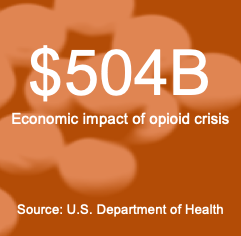
In addition to the toll on life and health, the opioid crisis is costly. The U.S. Department of Health puts the economic costs at $504 billion, which includes healthcare costs, criminal justice costs, lost productivity due to addiction and incarceration, and more. The CDC puts the annual cost of the opioid crisis at $75 billion.
 Efforts to recover these costs include litigation. From there, defendants turn to the insurers where another layer of dispute arises.
Speaking on an HB webinar titled Insurance Coverage Issues Arising from Opioid Litigation and Investigations, policyholder attorney Bernard Bell of Miller Friel PLLC said lawsuits fall into three categories: 1) state and local governments, and tribes, are suing to recover expenses associated with their response to opioid abuse; 2) suits against manufacturers for alleged gross misrepresentation of the risks and against distributors for failing to monitor suspicious orders; and 3) individuals suing drug makers and distributors for their addictions.
There are 2,000 lawsuits pending, with 1,200 of them in MDL in the U.S. District Court for the Northern District of Ohio in Cleveland. Plaintiff attorneys have recently said that a mandatory class maybe be the only way to resolve the litigation.
A new class action lawsuit filed in November 2018 in West Virginia seeks to represent children exposed to opioids in utero. According to Top Class Actions, the suit alleges that in 2017, 50 out of every 1,000 babies born in West Virginia were born addicted to opioids.
Many of the costs associated with the crisis “don’t always fit very well with specific losses that insurance policies are designed to cover,” said insurance industry attorney Laura Foggan of Crowell & Moring LLP.
For that reason, and with so much at stake, so much liability, and so many deep pockets, we can expect policyholders and insurers to battle the issue out in the courts.
Foggan and Bell addressed the insurance aspects of the litigation during a recent HB webinar, titled Insurance Coverage Issues Arising from Opioid Litigation and Investigations. The program is now available on-demand. Click to register.
-
Class Actions Weekly Roundup from Top Class Actions
This roundup is prepared exclusively for HB Litigation Conferences by:

Walmart Class Action Claims Glucosamine Tablets are Mislabeled
Walmart has been hit with a class action lawsuit claiming that their store brand glucosamine tablets are mislabeled. Plaintiffs Cynthia Parker, Reba Garth, Margaret Herrin, and Shirley Reinhard allege that Walmart misrepresents its store-brand glucosamine sulfate dietary… Read More
Sorin 3T Heater Cooler Lawsuit Alleges Serious M. Chimaera Bacterial Infection
An Indiana man has filed a Sorin 3T heater cooler lawsuit against LivaNova PLC, alleging their cardiac heater cooler device had caused him to develop a potentially fatal infection. The claimant filed the Sorin 3T heater cooler… Read More
Coca-Cola Seeks Dismissal of Diet Coke Class Action Lawsuit
Coca-Cola asked a New York federal court to toss a class action lawsuit alleging the company’s use of the name “Diet Coke” is misleading. The company argues that claims against its use of the word “diet” in… Read More
Couple Files Stryker Hip Recall Lawsuit Over Metallosis Complications
Thousands of hip implants were affected by a Stryker hip recall after they were linked with serious complications, including metallosis. Some patients affected by these major side effects have turned to litigation, hoping to regain some… Read More
Facebook Class Action Challenges Facial Recognition Technology
Facebook faces a new class action lawsuit alleging that the social media site captured and stored biometric information of non-users in violation of Illinois state law. Plaintiff Clayton Zellmer argues that Facebook broke state law by… Read More
Woman Alleges Bleeding While Taking Xarelto in Lawsuit Against Drug Makers
A woman who allegedly suffered bleeding while taking Xarelto has filed a lawsuit against the makers of the anticoagulant drug. Plaintiff Emmy L. filed the Xarelto lawsuit in Louisiana federal court, joining a growing multidistrict litigation (MDL) against… Read More
Arthrex Knee Replacement Causes Injuries, Patients Claim
Knee replacement surgery is one of the most common surgical procedures in the U.S., but some patients who have received a knee device like the Arthrex knee replacement alleged that they suffered serious complications. In some cases, Arthrex… Read More
United Industries Can’t Escape Spectracide False Ad Class Action Lawsuit
Last week, a California federal judge denied a bid by herbicide maker United Industries Corp. to dismiss a false advertising class action lawsuit after finding it possible that reasonable consumers would be misled by the labeling… Read More
-
Top Class Actions’ Top Trends Affecting Class Actions in 2018
Editor’s Note: This article was written by Kim Gale at Top Class Actions and is reprinted here with the permission of the publisher. Scott Hardy, the company’s President & CEO, is one of the speakers featured at HB’s Class Action Mastery conference May 9-11, 2018 in New York. Top Class Actions is sponsoring that event and its companion program, Mass Tort Med School, the same week.
As we come close to rounding out the first quarter of 2018, it is clear that several class action lawsuit trends from 2017 will continue to ripple through the court system this year.
Class Action Lawsuit Stats
Did you know three areas are responsible for a third of all class action lawsuits filed in the U.S.? The federal courts in California, Southern District (Miami) of Florida, and the Eastern District (Brooklyn) of New York keep lawyers and judges the busiest.In the initial nine months of 2017, a total 3,136 federal class action lawsuits were filed in those areas alone, according to an article published Dec. 9, 2017 by PorterWright.com.These statistics are apt to change because new Supreme Court decisions (Bristol-Myers Squibb v. Superior Court of California and BNSF Railway Co. v. Tyrrell) rein in a court’s jurisdiction and ability to litigate matters when residents from outside the court’s state make claims.
These new decisions mean a defendant will need to be sued in the state where the business is incorporated. Another option could be for individual states to file class action lawsuits and then seek to have them consolidated through multidistrict litigation (MDL).
Marketing Tactics Under Fire
Makers of everything from washing machines to mascara faced allegations of product misrepresentation. Advertising claims such as “organic,” “preservative free” and “virgin” can land a company in hot water with multiple class action lawsuits if these claims can be proven false.In 2017, class action lawsuits started challenging the way some products are made because consumers possibly paid more for such proclamations.
For example, extra virgin olive oil is the highest quality available, which consumers often pay a premium to receive.
To earn the title extra virgin, the oil must be free of defects, taste like fresh olives, and be produced using no solvents. Extra virgin olive oil has to be manufactured by a mechanical process and in temperatures that will not allow the oil to degrade. Finally, the oil must be sold in darkly tinted bottles to keep the product from degrading on the shelf.
In one olive oil case that led to a class action settlement (Kumar v. Safeway Inc.), olive oil labeled extra virgin was allegedly mixed with refined oil and packaged in clear bottles, ruining any chance at truly being “extra virgin.” To add further insult, the olive oil was labeled as imported from Italy, but contained olive oil from a variety of other countries not particularly known for their brilliantly tasty olives.
Consumers do not take kindly to paying a premium for false enhancements, which has led to multiple class action lawsuits against companies that tout their product as better than the rest due to refinements that don’t exist.
Class Action Settlements Under Scrutiny
In 2013, Subway was hit with a class action lawsuit after a foot-long sandwich that fell short at 11 inches was posted on social media. Subway explained away the one-inch discrepancy by saying the dough is a foot long, but after the bread is baked, the natural action of the dough rising can cause impact on the length.A class action settlement was reached in 2015 in which Subway agreed to make sure all locations adopted a uniform practice to guarantee each unbaked loaf measured 12 inches.
In the settlement, Subway also agreed to pay the class counsel’s $520,000 fees but offered no monetary compensation to consumers.
In September 2017, the 7th Circuit Court in Chicago reversed the Subway settlement on appeal because consumers would see the settlement as “utterly worthless.” The court expressed disgust over the settlement terms, indicating that any settlement that pays the class counsel, but provides no relief to the Class Members, “is no better than a racket.”
The court’s reversal of the settlement will force future defendants to make sure any settlement offer they consider includes a true benefit to Class Members and not just to their counsel.
Opioid Manufacturer Litigation
In 2017, more than 100 cases were filed against opioid manufacturers by individuals, health insurance companies, state governments, county governments and city governments. These opioid lawsuits seek to hold manufacturers accountable for the epidemic of opioids in the country that have led to overworked and under-financed ambulance services, hospital services, EMTs, police officers, rehabilitation facilities and other providers of care to people who overdose on opioids and need life-saving intervention.The judicial panel on multidistrict legislation is considering motions to centralize these pending lawsuits. Whether or not the cases are processed separately or as an MDL, outcomes from these opioid epidemic cases will set new precedents, affecting the medical community and the law.
“Small” Data Breach Litigation
Even though high-profile data breach cases make the news, many smaller data breach class action lawsuits are filed every day. Large and small businesses collect data on customers and employees. Disgruntled current or former employees can cause big headaches by allowing a small data breach.Employees who aren’t particularly computer savvy can accidentally save sensitive information where hackers could access it. As technology to enhance computer security has advanced, so have the skills of potential hackers who constantly look for weaknesses in firewalls.
A Look Forward
In 2018, class action lawsuits will continue to address claims regarding baby powder cancer, Roundup cancer, medication dangers, airbag recalls, whistleblower cases and other consumer-related issues.© Copyright 2018 Top Class Actions