Category: Class Actions

  • Cannabis, CBD: Advertising and Drug Test Problems

    Cannabis, CBD: Advertising and Drug Test Problems

    COVID-19 vs Cannabis: Are Closures Legal?

    In the category of “damned if you do; damned if you don’t,” Massachusetts Governor Charlie Baker shut down recreational cannabis shops, citing concerns over the spread of COVID-19. The dispensaries say the shutdown could seriously damage the industry. But, the governor said, the spread of disease will continue to damage the health of his constituents, especially as residents of states where recreational marijuana is illegal, come to Massachusetts to do their cannabis shopping. Citizens of the state may still obtain medical cannabis, as reported by WBUR.

    Too Much TCH: Can CBD Use Cost You Your Job?

    A New York truck driver has sued a CBD company for allegedly making a product, which he says he uses for pain relief, with too much THC, more than the label indicates. A Pennsylvania woman filed a similar case and a Missouri school bus monitor had a similar experience. Another Missourian blames the store where he purchased his CBD, saying he was assured the product contained minimal THC. All claim they were told they could pass drug tests. All failed their test. And all lost their jobs, according to a post on the Huffs & Puffs website.

    “Courtesy of a dearth of strict standards of testing, many companies tend to list lower values of THC on the product label,” writes Huffs & Puffs. “The quantities of THC will never be ‘as high to make you high’ but they may be enough for you to fail a drug test, conducted via not the most of the sophisticated equipment out there.”

    “For entrepreneurs in the cannabis niche, this is a topic of huge concern as the number of such lawsuits are only going to increase as people keep failing drug tests after consuming CBD.

    Not Enough THC: No Golden Ticket

    Californians have proposed a class action against the owners of a CBD-infused-chocolate factory for selling candy with far less CBD and THC than advertised. For consumers these ingredients justified the premium prices they were paying. And yet, as shareholders, executive officers and managers allegedly knew, the levels were below what the labels had them believe, says Law360.

    No Proof of Health Claims

    The FTC has sued Whole Leaf Organics over the company’s claims that their CBD products effectively treat cancer and prevent or reduce COVID-19 risk. The Bureau of Consumer Protection says that there is “no proof that any product will prevent or treat COVID-19 or that any CBD product will treat cancer.” We can only hope.

    The California marketer and founder of Whole Leaf, Marc Ching, agreed to a preliminary order that prohibits him from making those claims. Pending the resolution of a parallel FTC administrative action, the proposed order also bars the defendant from representing that three CBD-based products he sells are effective cancer treatments.
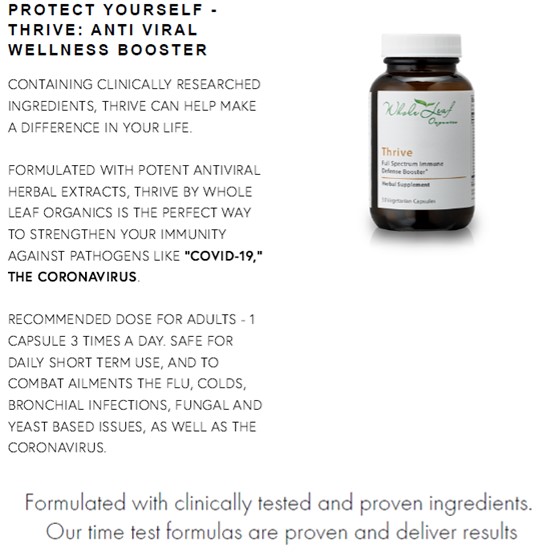
    According to the FTC: Since December 2018, defendant Marc Ching, also doing business as Whole Leaf Organics, has sold Thrive – a tablet consisting primarily of Vitamin C and herbal extracts. But beginning in March 2020, Thrive underwent something of a marketing make-over. The defendant began pitching the product as a way for consumers to ward off coronavirus. His website claimed, “Formulated with potent antiviral herbal extracts, Thrive by Whole Leaf Organics is the perfect way to strengthen your immunity against pathogens like ‘COVID-19,’ the coronavirus.” The defendant also represented that the product is indicated to “combat” a list of ailments, “as well as the coronavirus.” In addition, the defendant claimed Thrive is “formulated with clinically tested and proven ingredients” and that “our time test formulas are proven and deliver results.”

    Photo by Matthew Brodeur on Unsplash

  • Monsanto, Bayer Paying Billions for PCB Cleanups

    Monsanto, Bayer Paying Billions for PCB Cleanups

    Roundup Weed Killer


    Read Baltimore Sun environmental writer Scott Dance’s June 24, 2020, article titled, “A $550M national class-action settlement includes money for cleanup of PCBs in Baltimore waterways.” He offers the Maryland angle on the $550 million class action settlement between Monsanto and 13 government agencies across the U.S., just part of a much larger agreement.

    “The settlement was one of several that Monsanto’s owner, German pharmaceutical company Bayer, announced Wednesday. Bayer said it’s paying up to $10.9 billion to settle current and potential future litigation over Monsanto’s weedkiller Roundup, which has faced numerous lawsuits over claims it causes cancer, and $1.22 billion to settle two further cases, including the class action focused on PCBs.”

    Dance writes that the terms of this settlement are off to Judge Fernando M. Olquin of the Central District of California for his review. Judge Olquin was one of the presenters on multiple panels at the Class Action Law Forum presented by Western Alliance Bank and produced by my team at HB. Kenneth R. Feinberg, also a presenter, is the court-appointed special master in the case.

    The Baltimore Sun piece was one of many that gave the local perspective on this nationwide litigation and settlement in progress, like this one from the San Francisco Chronicle, with a Seattle dateline, and this one from the Washington State Wire quoting the state’s AG, and this one from the Portland Tribune, with a take on the Oregon impact. And law firms, which stand to gain a great deal in attorney fees issued announcements of their part in the deal, like this one from Baron & Budd. It doesn’t appear the leading defense firm, Skadden Arps, issued a separate statement, but joined in the Bayer announcement. It quoted the firm’s John Beisner, “a consultant to Bayer’s Supervisory Board and a mass tort expert,” as saying, “Taking account of various options, I am convinced this plan provides a comprehensive, reasonable solution to the complex, contested issues presented by this litigation.”

    Bayer’s announcement from Leverkusen, Germany, basically said it was the right thing to do, but that it admits to no wrong-doing.

    “Bayer announced today a series of agreements that will substantially resolve major outstanding Monsanto litigation, including U.S. Roundup™ product liability litigation, dicamba drift litigation and PCB water litigation. The main feature is the U.S. Roundup™ resolution that will bring closure to approximately 75% of the current Roundup™ litigation involving approximately 125,000 filed and unfiled claims overall. The resolved claims include all plaintiff law firms leading the Roundup™ federal multi-district litigation (MDL) or the California bellwether cases, and those representing approximately 95% of the cases currently set for trial, and establish key values and parameters to guide the resolution of the remainder of the claims as negotiations advance. The resolution also puts in place a mechanism to resolve potential future claims efficiently. The company will make a payment of $8.8 billion to $9.6 billion to resolve the current Roundup™ litigation, including an allowance expected to cover unresolved claims, and $1.25 billion to support a separate class agreement to address potential future litigation. The Roundup™ class agreement will be subject to approval by Judge Vince Chhabria of the U.S. District Court for the Northern District of California. The resolutions were approved unanimously by Bayer’s Board of Management and Supervisory Board with input from its Special Litigation Committee. The agreements contain no admission of liability or wrongdoing.”

    The company said it can now get on with tackling global challenges, such as the COVID-19 pandemic, and generally “improv[ing] quality of life for a growing and aging population of an estimated 10 billion people by 2050.”

  • PTSD Claims Brought by Facebook’s ‘Graphic Content’ Reviewers Goes to ADR, Putting Civil Action on Pause

    By Tom Hagy

    Facebook can be great fun. How else would I have seen a video of an eight-year-old drummer-girl utterly thrashing Led Zeppelin’s Good Times Bad Times? Or a dog running away with a lit skyrocket as his human friends run, duck and ditch for their lives? Or what your cat looks like in a tuxedo?

    Facebook can also be a source of horror. Some of the most distressful commentary and images you wish you could un-see. And that’s just from my family.

    Imagine your entire job is to monitor Facebook discussions and remove its graphic content. Day in and day out. That’s literally all you did.

    A group of Facebook employees says that was their job, and their exposure to an “unmitigated barrage of horrifying content” and “toxic images” has caused them to suffer “debilitating trauma-related injuries.”

    In September 2018 they filed suit in California Superior Court in San Mateo seeking an order requiring Facebook to implement safety guidelines for content moderators which, they say, the company has admitted are “necessary and appropriate.” They also want the company to fund a medical monitoring program for the diagnosis and treatment of psychological injuries including post-traumatic stress disorder, or PTSD. The plaintiffs quote Chris Harrison, whom they characterize as a Facebook executive in charge of the company’s “global resiliency team” as saying “of course” the company should offer content moderators post-employment counseling.

    The plaintiffs filed the suit as a proposed class action, and relied on state laws including the California Unfair Competition Law alleging Facebook’s conduct was negligent, and negligence forms the basis of a UCL claim.

    Facebook moved for a judgment on the pleadings, saying the facts are insufficient to constitute a community of interest required for class actions and that there is no ascertainable class. The company said the plaintiffs haven’t supported a claim for negligent provision of unsafe equipment or violation of the UCL, either.

    The issue was set for a hearing on Aug. 9 but the parties agreed to take the case to ADR and stay the litigation until Oct. 7. If they don’t come to an agreement by then they will submit a new case schedule to the court (Selena Scola, et al. v. Facebook, Inc., Civil Case No. 18CIV05135, Calif. Super. Ct., San Mateo Co.).

    What Lawyers Should Know

    Coincidentally — and this has nothing whatsoever to do with the Facebook case — in preparing for our Aug. 21 webinar — PTSD in Mass Tort & Multi-Plaintiff Cases — Mark I. Levy, M.D., DLFAPA (who is in no way involved in that case) told me that “a majority of people who experience a traumatic and stressful event do not develop PTSD.” He said that multiple studies revealed that even in the extreme case of rape, 40-50% of victims do not develop PTSD. Of course, the flip side of that is that more than half do.

    People have different levels of resiliency and vulnerability, he said, so what may cause PTSD in one person may not cause it in another. This isn’t to diminish anyone’s traumatic experience. The question is how these experiences impact the individual, not whether their experience was horrible or not, or illegal or not, which are separate questions. “The probability of an event causing PTSD in any particular individual is only partially related to the severity of the stressor,” Dr. Levy said. I asked him if there were degrees of PTSD, or whether someone can have “a touch of PTSD.” Dr. Levy explained that PTSD is a specific diagnosis with specific conditions. In other words, despite how the term may be used in common parlance, you can’t have “a little PTSD,” at least not in the clinical sense of the word.

    In his presentation materials, Dr. Levy gives two examples of bad experiences that resulted in litigation but were found not to cause PTSD. “After a board meeting a secretary ate a left-over pastry contaminated with rat feces. She alleged she had PTSD because she could never work in that office again. Hers was a truly disgusting experience, but it did not cause PTSD,” Dr. Levy said. In another case a woman who endured unwelcome and explicit sexual overtures from her boss were, while clearly offensive and even unlawful, did not result in the woman’s PTSD. Dr. Levy discusses examples where individuals developed PTSD, such as battle experiences, train crashes, and others.

    Here is a summary of the PTSD diagnostic criteria in the Diagnostic and Statistical Manual of Mental Disorders, or DSM-5:

    A. Exposure to actual or threatened death, serious injury, or sexual violence.
    B. Presence of one (or more) intrusive symptoms associated with the traumatic event(s).
    C. Persistent avoidance of stimuli associated with the traumatic event(s), beginning after the traumatic event(s) occurred.
    D. Negative alterations in cognitions and mood associated with the traumatic event(s), beginning or worsening after the traumatic event(s).
    E. Marked alterations in arousal and reactivity associated with the traumatic event(s).
    F. Duration of the disturbance (Criteria B, C, D, and E) is more than 1 month.
    G. Functional Impairment: The disturbance causes clinically significant distress or impairment in social, occupational, or other important areas of functioning.
    H. The disturbance is not attributable to the physiological effects of a substance (e.g., medication, alcohol) or another medical condition.

    In the majority of cases, PTSD is accompanied by other psychiatric diagnoses (co-morbidity): Major Depression and/or Anxiety Disorder and/or Substance Abuse.

    Dr. Levy — who is Medical Director at Forensic Psychiatric Associates Medical Corporation — cautions attorneys and others about the forensic use of DSM-5: “It is important to note that the definition of mental disorder included in DSM-5 was developed to meet the needs of clinicians, public health professionals, and research investigators rather than all of the technical needs of the courts and legal professionals.”

    For attorneys interested in hearing more from Dr. Levy, and his colleague, Sarah A. Hall, PhD., Clinical Psychologist Specializing in Forensic & Neuropsychological Assessments, click the banner below and learn more about the webinar.

  • PTSD in Multi-Plaintiff and Mass Tort Cases | Webinar OnDemand


    [one-fourth-first]

    Price: $47
    When: On-demand
    Where:
    Your computer or mobile device
    CLE:
    1 hour

    Speakers

    Mark I. Levy MD, DLFAPA
    Medical Director
    Forensic Psychiatric Associates Medical Corporation
    Associate Clinical Professor, Psychiatry
    University of California, San Francisco, School of Medicine
    415.388.8040
    mlevy@fpamed.com 

    Sarah A. Hall, PhD.
    Psychologist for Forensic & Neuropsychological Assessments
    Forensic Psychiatric Associates Medical Corporation
    shall@fpamed.com 

    [/one-fourth-first][three-fourths]

    What tort attorneys need to know about PTSD claims.

    Mass tort claims arise most frequently in man-made and natural disaster catastrophe litigation as well as personal injury, employment, product liability and toxic tort litigation. Frequently, these lawsuits include either primary or secondary allegations of emotional distress. PTSD is one of the most common emotional distress claims alleged within mass tort litigation, as well as allegations of depression and emotional stress (anxiety). 

    Join an experienced psychiatrist and psychologist who will cover the following topics relevant to the forensic psychiatric assessment of emotional damages within mass tort and complex litigation: 

    + Introduction: Defining PTSD. What it is and what it is not.

    + The methodological approach to assessing allegations of emotional distress in mass tort & complex litigation.

    + The importance and the methodology of psychological testing as part of the assessment of emotional distress claims in mass tort litigation.

    + Claimant population screening. Using psychological test instruments to differentiate claimants who require in-depth forensic psychiatric assessment from claimants who do not. 

    + Are all psych tests the same? Types of psychological test instruments we recommend and ones that we do not — and why.  

    + So-called “PTSD Tests.” Do they have a role in forensic psychological assessments?

    + Accuracy and reliability of conclusions derived from psychological test data.

    + Taking a “team approach” to emotional distress claim assessment in mass tort litigation. 

    [/three-fourths]

  • First Class Action Lawsuit Filed on Behalf of Victims of First American Title Company Data Breach — Yahoo!

    “Gibbs Law Group LLP has filed the first nationwide class action lawsuit accusing First American Title Company of failing to properly secure 885 million sensitive customer files, instead choosing to store them in a ‘woefully insecure,’” publicly-accessible system. “First American has turned the American dream of home ownership into a financial security nightmare for its customers,” according to the complaint.

    Specifically, the lawsuit alleges that First American Title Company was negligent, and violated its contracts with customers, in the way it stored their personal information, which included bank account numbers, Social Security numbers, financial and tax records, and photos of their drivers’ licenses. “This grave lapse in security resulted in publicly exposing hundreds of millions of customers’ personal files, leaving them vulnerable to identify theft and other cybercrimes,” the plaintiffs maintain. 

    Read the complete Press Release on Yahoo! here

  • Wells Fargo Proposes to Settle Auto Insurance Case for $386M — Yahoo!

    In 2017 customers of Wells Fargo & Company (WFC) filed a class action lawsuit alleging the bank forced unwanted auto insurance without permission from the customers. Currently WFC plans to pay around $386 million to settle the 2017 class action lawsuit. The high payout is due to the sheer number of customers affected. About 270,000 WFC customers were “pushed into delinquency ” and “almost 25,000 wrongful vehicle repossessions.” In addition to the class action settlement, WFC will be reaching out to individual customers offering financial service recovery, and restructuring their leadership teams. WFC is still seeing a decrease in sales and their numbers. In six months WFC shares “lost 4.5% against 6.5% growth recorded by the industry.”

    Read the complete post on Yahoo! here.

  • CNN — Jury returns $2 billion verdict against Monsanto for couple with cancer — the biggest so far

    [one-half-first][/one-half-first] [one-half]

    A California jury returned a $2.055 billion verdict against Monsanto and their popular weed killer, Roundup. “The verdict in Oakland includes more than $55 million in compensatory damage and $2 billion in punitive damages.” The septuagenarian plaintiffs, represented by attorney Michael Miller of The Miller Firm, were a California couple that said long-term exposure to Roundup caused both of them to be diagnosed with non-Hodgkin lymphoma, a cancer that usually cannot be traced back to a source according to the American Cancer Society. The particular carcinogen in Roundup is glyphosate, which the EPA has stated was not a carcinogen in a 2015 assessment, which contradicts WHO’s statement that glyphosate is “probably carcinogenic to humans”. While a Monsanto spokesperson previously denied any manipulation, a jury found that a series of texts and emails between Monsanto and the EPA that proved Monsanto culpable of manipulating science.

    [/one-half]

    Read the complete post by Michael Nedelman on CNN.com here!

  • Suits Allege Apple Concealed Knowledge of iPhone 7 Defect

    Apple Inc. has been sued in federal courts in Illinois and California for allegedly knowingly selling iPhone 7 and 7 plus models with an audio chip defect, called the “Audio IC Defect” or “Loop Disease” by consumers, which causes an array of operational issues.

    The bug gums up handset audio functions, grays out speaker buttons during calls, and degrades microphone fidelity.  And if that’s not enough it can kill Siri’s voice command capabilities.

    The plaintiffs accuse Apple of actively concealing the Audio IC Defect while advertising the iPhone 7 as “the best iPhone we ever made.”

    The plaintiffs claim that when they first experienced operational problems Apple didn’t offer complimentary repairs.

    The suits allege breach of warranty and violation of California and Illinois consumer protection laws. Plaintiffs seek class certification, damages, attorneys’ fees, and injunctive relief. In Illinois, the plaintiffs may also try to force Apple to repair, recall, and/or replace current defective iPhone 7s in the United States and notify all purchasers of the Loop Disease.

    Evidence shows “Apple’s internal acknowledgement and subsequent discontinuation of their out-of-warranty repairs without public announcement of the Audio IC Defect amounts to misrepresentation and concealment of the Audio IC Defect,”  the California complaint in Casillas v. Apple reads. 

    Complaints available on Scribd.com.

    Casillas v. Apple, N.D. Calif., No. 3:19-cv-2455

    Castelli v. Apple, N.D. Ill., Eastern Div., No. ______

  • Top Class Actions: Vaccine Litigation Case Roundup


    [one-half-first][/one-half-first] [one-half]There have been numerous lawsuits filed alleging injuries caused by the shingles vaccine Zostavax. Cases have stated they were not warned of the adverse side effects of the vaccine alleging it caused the diseases it is meant to prevent, among other things.

    Here is what the CDC says to consumers: “Your risk of shingles and postherpetic neuralgia (PHN) increases as you get older. CDC recommends that people 60 years old and older get shingles vaccine (Zostavax®) to prevent shingles and PHN. Shingrix (recombinant zoster vaccine) is the preferred vaccine, over Zostavax® (zoster vaccine live), a shingles vaccine in use since 2006. Zostavax may still be used to prevent shingles in healthy adults 60 years and older. For example, you could use Zostavax if a person is allergic to Shingrix, prefers Zostavax, or requests immediate vaccination and Shingrix is unavailable. Zostavax (zoster vaccine live) was licensed by the FDA in 2006. This vaccine reduces the risk of developing shingles by 51% and PHN by 67%. It is given in one dose as a shot, and can be given in a doctor’s office or pharmacy.“

    Read more: https://www.cdc.gov/vaccines/vpd/shingles/public/zostavax/index.html

    The vaccine is produced by Merck & Co.  Their product information can be found here: https://www.merckvaccines.com/Products/Zostavax

    Here is a roundup of the cases filed.

    [/one-half]

    1.Husband and Wife File Zostavax Shingles Vaccine Lawsuit 

    “A North Carolina husband and wife recently filed a new Zostavax shingles vaccine lawsuit against pharmaceutical giant Merck & Co., alleging the vaccine caused serious side effects.

    “The plaintiff, Cecilia S., says she was inoculated with the Zostavax vaccine on March 5, 2017, in order to prevent shingles (or herpes zoster). Unfortunately, the day after receiving this vaccine, Cecilia alleges she suffered from a number of problems, including herpes zoster, cellulitis, and postherpetic neuralgia.”

    2. Zostavax Lawsuit Says Vaccine Caused Shingles

    “West Virginia patient has filed a Zostavax lawsuit claiming the shingles vaccine gave her shingles instead of preventing her from getting it.

    “Shingles is a rash caused by a virus, and can have lasting effects, according to Science News. Shingles is more common in older people, and recently, Pharmacy Times reported that there has been a push to increase vaccination rates.”

    3. Can You File a Shingles Vaccine Lawsuit?

    “Some patients have come forward with reports of major complications after treatment with Zostavax, a popular shingles vaccine—and some have even filed a shingles vaccine lawsuit over these Zostavax side effects.”

    4. No Warning of Severe Reactions to Shingles Vaccine, Couple Claims

    “A couple from Illinois alleges they are suffering from severe reactions to shingles vaccine, complications that pharmaceutical company Merck allegedly failed to warn about.

    “The couple filed legal action after discovering other patients had reported similar adverse vaccine reactions soon after getting the Zostavax shot.

    “Plaintiffs Victoria and Earl V. filed this Zostavax lawsuit alleging Victoria developed shingles, or herpes zoster, despite having been vaccinated against it.”

    5. Lawsuit Alleges Hearing Problems Due to Zostavax Shingles Vaccine

    “Plaintiff Kim M. is the latest to lodge a lawsuit against Zostavax maker Merck and Company, arguing that the shingles vaccine causes preventable and dangerous Zostavax side effects such as hearing loss. She argues that she might have made a different decision about getting the shot if she had known about the risks.

    “The plaintiff alleges that she received the Zostavax vaccine for regular health purposes and prevention of shingles in February 2016 while a resident of California.”

    6. Lawsuit Alleges Shingles Vaccine Adverse Effects are Permanent 

    “A couple has filed a lawsuit alleging they suffer from shingles vaccine adverse effects.

    “Plaintiffs Kathleen H. and Joseph W. say Kathleen received the Zostavax vaccine in 2017 for the prevention of shingles, medically known as herpes zoster.

    “They allege she suffered severe side effects from the inoculation, including a stroke, physical limitations, mental and emotional distress and severe, permanent personal injuries.”

    7. Common Zostavax Shingles Vaccine Complaints Named in New Lawsuit

    “The Zostavax shingles vaccine emerged on to the market as a new option for people at risk for developing shingles to guard against it. The CDC recommends that individuals aged 60 and older get the shingles vaccine whether or not they remember having had chicken pox previously in their life. According to research studies, more than 99 percent of Americans 40 and beyond have gotten chickenpox even if they don’t remember getting the disease.”

    8. Growing MDL Alleges Serious Zostavax Shingles Vaccine Reactions

    “Merck & Co. is facing a growing multidistrict litigation (MDL) consisting of similar claims alleging patients developed serious side effects from the company’s Zostavax shingles vaccine.

    “One of the most recent Zostavax shingles lawsuits was filed by a woman from Tennessee, who alleges Merck failed to disclose the full scope of potential vaccine reactions.”

    9. Zostavax Lawsuit alleges Vaccine caused Permanent Cardiovascular Complications 

    “This Zostavax lawsuit is joining a growing multidistrict litigation (MDL), which consists of similar claims alleging Merck failed to warn them against the full severity of the potential side effects associated with their shingles vaccine.

    “Plaintiff couple Terrance and Brenda O. conjointly filed this Zostavax lawsuit, stating the side effects of the shingles has permanently impacted their marriage and their quality of life. Like numerous other patients in the United States, Terrance says he was prescribed the Zostavax injection to prevent shingles soon after he turned 60.”

    10. Lawsuit Claims Shingles Vaccine and Eye Problems Connection

    “Many consumers have already come forward to allege a connection between the Zostavax shingles vaccine and the development of shingles itself.

    “However, more patients are now arguing that the shingles vaccine and eye problems is another troubling connection about which the public is not aware.”

  • National Geographic Disclosed Customer Info, Class Action Says — Top Class Actions Blog


    [one-half-first][/one-half-first] [one-half]

    “The National Geographic class action states that prior to and at the time that he subscribed to the magazine, the company did not notify him that it discloses the personal reading information of its customers.

    “Markham also claims that he wasn’t provided with any written notice that National Geographic makes a practice of renting, exchanging, or otherwise disclosing personal reading information to third parties, and provides no means of opting out.

    “However, the National Geographic information disclosure class action lawsuit says that since subscribing to National Geographic and between Mach 26, 2016 andJuly 30, 2016, National Geographic disclosed Markham’s personal reading information to data aggregators, data appenders, and/or data cooperatives.”

    Read the complete post by Top Class Actions Editor Emily Sortor here.

    [/one-half]