Author: Tom Hagy
-

Offshore Wind Power Initiatives with Jack Smith
Joining me to discuss this important subject is Jack Smith, a partner with Nelson Mullins in Charleston, South Carolina. Jack’s practice includes hazardous waste site management and remediation, contaminated property liability negotiation, litigation, redevelopment and related regulatory counseling. He has also worked for several state and federal government environmental agencies. Jack earned his JD from the University of South Carolina School of Law and a BS in Psychology, also from the University of South Carolina.
This podcast is the audio companion to the Journal on Emerging Issues in Litigation, a collaborative project between HB Litigation Conferences and the Fastcase legal research family, which includes Full Court Press, Law Street Media, Docket Alarm and, most recently, Judicata. If you have comments or wish to participate in one our projects, or want to tell me how insightful and informative Jack is, please drop me a note at Editor@LitigationConferences.com. This interview is based in part on an article Jack is writing for the Journal.
I hope you enjoy the interview, and especially my solution for preventing birds from flying into windmills. I’m going to be rich. –Tom Hagy
President Biden has called for the doubling of offshore wind energy capacity by 2030.
To say the process for getting such projects up and running is complex is an understatement. There will be plenty of obstacles to the administration’s lofty goal.
Where will these impediments to development arise?
What role will states play?
How will NGOs react to this ambitious ramp-up?
-

Labor Law in 2021 with Kathryn Hatfield
Participation in labor unions is less than half of what it was 40 years ago. It has seen an uptick in the service sector, but a sharp decline in manufacturing. According to economist Heidi Shierholz decline in union rolls is partly responsible for today’s yawning income inequality gap. Recently we’ve seen the formation of a modest union at Google and a movement among Amazon workers. We’ve also seen how the pandemic has shone a bright light on the fragility of our nation’s workforce struggling to survive at the bottom rungs of the pay scale.
Joining me to speak about these issues is Kathryn Van Deusen Hatfield, a senior managing partner at Hatfield Schwartz Law Group in New Jersey. Kathy represents private and public sector employers in all aspects of labor and employment law, with expertise in litigating state and federal cases on behalf of employers involving Title VII, the ADA, the ADEA and the New Jersey Law Against Discrimination, and providing legal opinions and advice on personnel, employment and labor issues. Kathy shares her insights on recent developments in the labor movement, some of the causes of its decline, how unions get a bad rap, and how, even though she represents management, she believes unions can be a good thing for everyone — employees and companies alike.
This podcast is the audio companion to the Journal on Emerging Issues in Litigation, a collaborative project between HB Litigation Conferences and the Fastcase legal research family, which includes Full Court Press, Law Street Media, Docket Alarm and, most recently, Judicata. If you have comments or wish to participate in one our projects, or want to tell me how insightful and informative David and Dan are, please drop me a note at Editor@LitigationConferences.com.
I hope you enjoy the interview, and how I managed to demonstrate how little I know about sports. I feel made up for it by learning something about baseball Hall of Famer Jim Rice, who did something really cool and heroic in 1982.
-

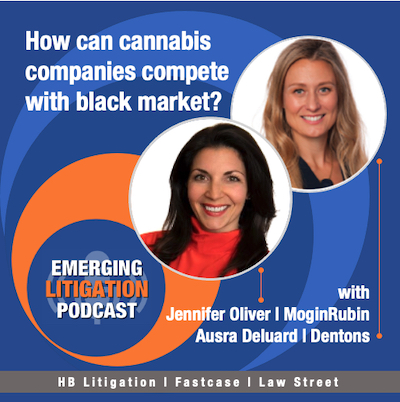
Cannabis Industry Competition Law with Ausra Deluard and Jennifer Oliver
Ausra O. DeluardCounsel | Dentons LLP

Jennifer M. OliverPartner | MoginRubin LLP
Attorneys Ausra Deluard and Jennifer Oliver on Cannabis Industry Competition Law
What can legitimate cannabis companies do to level the playing field, not only against others who walk the straight and narrow, but dealers still thriving on the black market?
It was my pleasure to interview Ausra Deluard and Jennifer Oliver for what was an informative and even surprising podcast. It’s based on their article — Clearing the Haze: State Laws and Private Plaintiffs Critical to Preserve Competition in Cannabis — which will be featured in the inaugural issue of the Journal on Emerging Issues in Litigation, which will release in January 2021.
Ausra, who is an attorney with the global law firm Dentons LLP, has spent more than a decade advising clients in a range of antitrust matters including merger investigations, competitor collaborations, and pricing and distribution policies. She works closely with cannabis clients to help them navigate the rapidly evolving cannabis laws and regulations throughout the U.S.
Jennifer is a partner at national antitrust boutique MoginRubin LLP, where she litigates and advises clients on competition issues. Her work includes representing classes of plaintiffs in class actions, risk mitigation and regulatory advice in mergers and acquisitions, and other complex business litigation. Check out the MoginRubin Blog.
The Journal is a collaborative project between HB and the Fastcase legal research family, which includes Full Court Press, Law Street Media, Docket Alarm and, most recently, Judicata. If you have comments or wish to participate in one our projects, or want to tell me how awesome Ausra and Jennifer are, drop me a note at Question@LitigationConferences.com.
We hope you enjoy the interview.
Tom Hagy
Founder & Managing Director
HB Litigation Conferences -
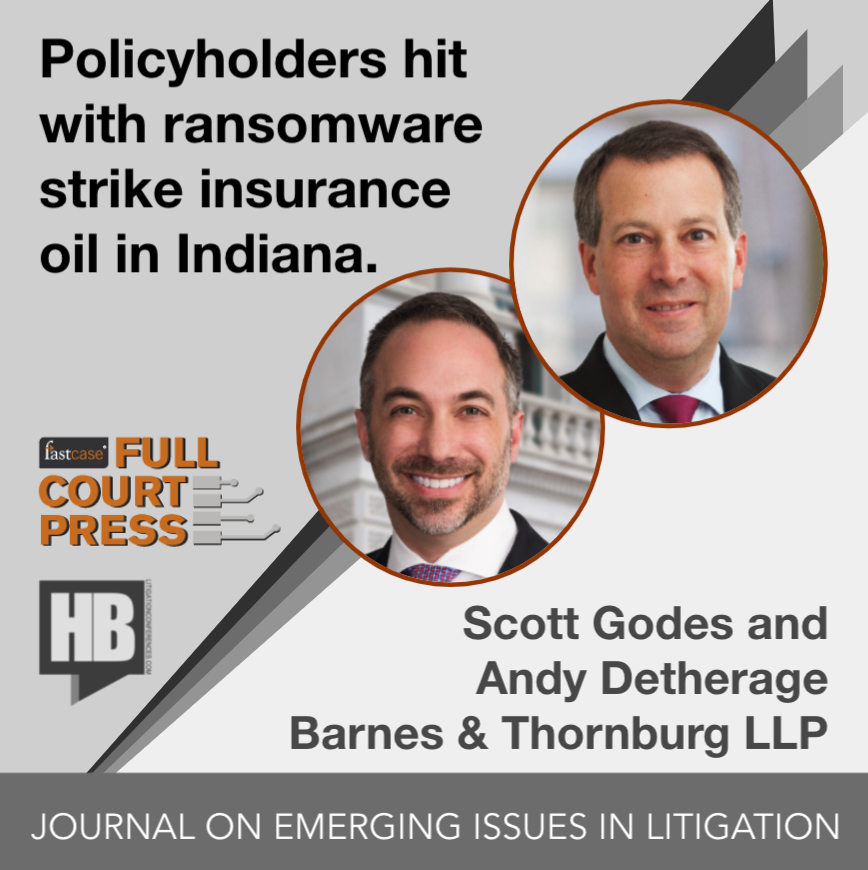
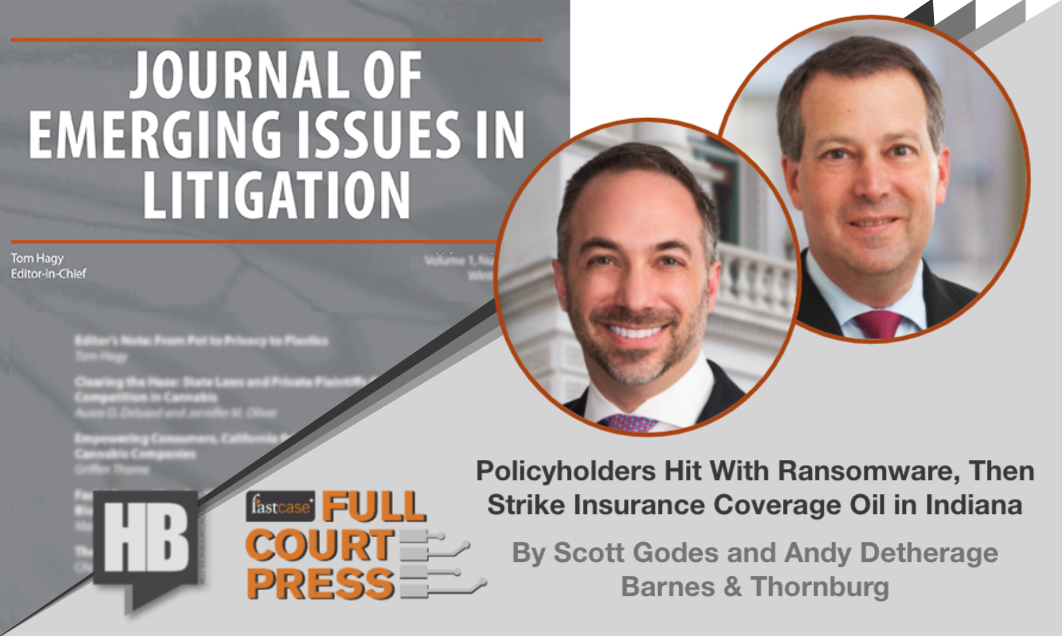
Policyholders Hit With Ransomware, Then Strike Insurance Coverage Oil in Indiana

Abstract
The cost of ransomware to businesses is estimated to have doubled since 2019 to $20 billion, according to Coveware. Policyholders turn to their insurance policies to recover losses that average more than $230,000 per incident. In the case discussed, the carrier denied a policyholder’s claim as being outside the computer fraud provisions of the commercial crime portion of the policy. Two lower courts sided with the carrier, but the
Indiana Supreme Court ruled in favor of coverage. This is a significant win for policyholders seeking coverage for losses under policies not sold as “cyber insurance.” The article discusses the decision and the precedents cited in an area of litigation that only promises to expand as ransomware and similar digital crimes proliferate.
Author
Scott Godes and Andy Detherage were counsel to United Policy-holders, which submitted an amicus brief in favor of granting transfer and reversing the lower court decision, in the Indiana Supreme Court decision referenced in this article. Messrs. Godes and Detherage are partners in Barnes & Thornburg LLP.
About
The Journal on Emerging Issues in Litigation is a co-production of HB, Fastcase, and Law Street Media. You can also hear the complementary (and complimentary) Emerging Litigation Podcast wherever podcasts appear. For questions, contact Tom Hagy, Editor in Chief, at Editor@LitigationConferences.com.Loading Viewer…
-

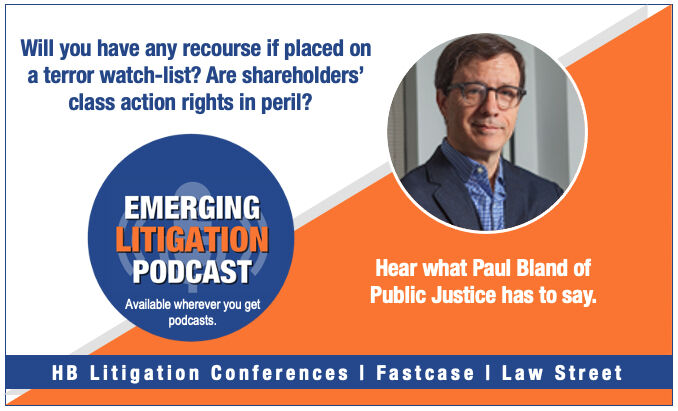
Three Urgent Consumer Class Action Topics with Paul Bland of Public Justice
To discuss these issues, it was my pleasure to interview F. Paul Bland, Jr., Executive Director of Public Justice, an organization that pursues “high impact lawsuits to combat social and economic injustice, protect the Earth’s sustainability, and challenge predatory corporate conduct and government abuses.” Paul has argued and won more than 40 cases that led to reported decisions for consumers, employees or whistleblowers, including one victory in the U.S. Supreme Court, and has won one or more cases in six of the U.S. Courts of Appeals and the high courts of 10 different states.
This podcast is the audio companion to the Journal on Emerging Issues in Litigation, a collaborative project between HB and the Fastcase legal research family, which includes Full Court Press, Law Street Media, Docket Alarm and, most recently, Judicata. If you have comments or wish to participate in one our projects, or want to tell me how insightful and informative Paul is, please drop me a note at Editor@LitigationConferences.com.
We hope you enjoy the interview, and how I slipped in mention of Schrödinger’s cat which, as everyone knows (that’s sarcasm and self-deprecation), is a thought experiment that illustrates an apparent paradox of quantum superposition.
Class actions can be an invaluable tool when consumers need to level the playing field in disputes with corporations.
Two important class action cases are currently before the Supreme Court. One case, TransUnion v. Ramirez, involves innocent consumers who were erroneously added to the government’s watch list for terrorists and drug smugglers. [Note: We recorded before the Supreme Court handed down its ruling that only plaintiffs concretely harmed by a defendant’s statutory violation have Article III standing to seek damages against that private defendant in federal court.]
In the second, Goldman Sachs v. Arkansas Teachers, consumers seek to fend off a decision that could limit securities class actions against companies that make generic statements about integrity before a drop in stock prices.
Another important issue (not currently before the high court) is mass and forced arbitration, something some observers say substantially impedes the ability of consumers’ and employees’ to challenge corporations.