
Tag: Regulations

  • AI Litigation Risks in Employment by Gerald L. Maatman Jr., Alex W. Karasik, and George J. Schaller

    AI Litigation Risks in Employment by Gerald L. Maatman Jr., Alex W. Karasik, and George J. Schaller

    The Authors

    Gerald L. Maatman Jr.

    Gerald L. Maatman Jr.Duane Morris LLP

    Chair Duane Morris’ Workplace Class Action group, Jerry has nearly four decades’ experience practicing law and has represented companies, executive teams, and boards across the country in class action litigation. He defended and won the largest systemic enforcement action ever brought in the history of the U.S. Equal Employment Opportunity Commission, the first  Attorney General prosecution of a Wall Street company for workplace discrimination and harassment, and the largest wage & hour class and collective actions ever brought in Florida and New York. He received his JD from Northwestern University School of Law, where he has been an adjunct professor for more than 30 years.

    Alex W. Karasik

    Alex W. KarasikDuane Morris LLP

    Alex is a core member of Duane Morris’ Workplace Class Action group. He defends businesses in employment law matters ranging from bet-the-company class actions to high-stakes single-plaintiff lawsuits and administrative charges. He represents clients in a broad range of industries, including restaurants, hotels, sporting venues, retailers, automotive manufacturers, logistics companies and staffing entities. Alex received Master of Communication Management and Bachelor of Arts degrees from the University of Southern California and his J.D. from Notre Dame Law School.

    George J. Schaller

    George J. SchallerDuane Morris LLP

    George practices in the area of employment law with a focus on employment-related class action litigation. He defends businesses in matters ranging from nationwide class and collective actions to single-plaintiff lawsuits and administrative charges. He represents clients in across various industries, including restaurants, logistics companies, financial services companies, and staffing entities. He is a 2021 graduate of the University of Illinois Chicago School of Law.

    Explore more from Duane Morris LLP!

    Journal (JEIL):Artificial Intelligence Litigation Risks in the Employment Discrimination Context. By Gerald Maatman Jr., Alex Karasik, and George Schaller

    CLE OnDemand Webinar: AI Nuts & Bolts Survival Guide: Artificial Intelligence – Discrimination in Employment Context. Gerald Maatman Jr., Alex Karasik, and George Schaller

    CLE OnDemand Webinar: Discovery Strategies in Wage and Hour Class and Collective Actions Before and After Certification of Putative Class. Gerald Maatman Jr., Noel P. Tripp

    Artificial Intelligence Litigation Risks in the Employment Discrimination Context

    AI is here to stay. Whether companies choose AI technology for any “employment decision,” companies must keep themselves up to date on any issued guidance and must actively monitor AI tools to prevent any possible discriminatory outputs.

    Abstract:

    AI, and generative AI in particular, took the employment world by storm in 2023, quickly becoming one of the most talked about and debated subjects among corporate counsel across the country. Companies will continue to use AI as a resource to enhance decision-making processes for the foreseeable future. As these processes are fine-tuned, those who seek to harness the power of AI must be aware of the risks associated with its use. This article analyzes two novel AI lawsuits and highlights recent governmental guidance related to AI use. As the impact of AI is still developing, companies should recognize the types of claims apt to be brought for use of AI screening tools in the employment context and the implications of possible discriminatory conduct stemming from these tools.
    Download the article now!

    Emerging Litigation Podcast

    Emerging Litigation PodcastProduced by HB Litigation and Law Street Media

    Interviews with leading attorneys and other subject matter experts on new twists in the law and how the law is responding to new twists in the world.


    Interested in CLE OnDemand? Click Here.

  • Protecting Policyholders as AI Is Developed for Insurance Claims Handling by Marshall Gilinsky and Madison Marlow

    Protecting Policyholders as AI Is Developed for Insurance Claims Handling by Marshall Gilinsky and Madison Marlow

    The Authors

    Marshall Gilinsky

    Marshall GilinskyAnderson Kill P.C.

    Marshall Gilinsky is a shareholder of Anderson Kill and practices in the firm’s Insurance Recovery and Commercial Litigation Departments. Marshall is co-chair of the firm’s Sexual Harassment and Abuse Insurance Recovery Group, and a member of the firm’s Banking and Lending Group and Hospitality Industry Practice Group.

    During his 20-year career representing policyholders, Marshall has recovered hundreds of millions of dollars for his clients, successfully litigating disputed claims under a variety of insurance products, including property and business interruption insurance, commercial general liability (CGL) insurance, errors and omissions (E&O) insurance, directors’ and officers’ (D&O) insurance and life insurance. Marshall has represented clients on numerous high-stakes, complex insurance claims arising out of prominent losses such as 9/11, Hurricane Katrina, Superstorm Sandy and the “Big Dig” in Boston. He also focuses extensively on assisting clients that own and manage captive insurance companies, especially with respect to resolving coverage disputes between the captive and its reinsurers.

    Madison Marlow

    Madison MarlowAnderson Kill P.C.

    Madison Marlow is an attorney in Anderson Kill’s New York office. She focuses her practice on insurance recovery, exclusively on behalf of policyholders.

    Prior to joining Anderson Kill full time, Madison worked at the firm during her law school years as recipient of the Gene Anderson Clerkship and as a summer associate. She was also an Alexander Fellow to the Honorable Susan D. Wigenton at the United States District Court for the District of New Jersey, where she held a full time judicial internship during her Fall 2022 academic semester.

    The Journal on Emerging Issues in Litigation

    Emerging Litigation Podcast

    Emerging Litigation PodcastProduced by HB Litigation and Law Street Media

    Interviews with leading attorneys and other subject matter experts on new twists in the law and how the law is responding to new twists in the world.

    Protecting Policyholders as AI Is Developed for
    Insurance Claims Handling:

    Ensuring “Decency and Humanity” in the Digital Age

    Adherence to “decency and humanity” in the claims-handling function must not be curtailed. In an age increasingly dominated by AI, it becomes even more crucial that these principles guide the integration of technology in insurance company operations.

    Abstract:

    The integration of artificial intelligence (AI) within the insurance industry raises concerns that insurance companies might use the technology to unfairly curtail or deny policyholders’ claims. Drawing on the historical example of the Colossus software, this article outlines the potential consequences of diminished human oversight in AI-driven claims handling. In the past, technology was used to boost insurance companies’ bottom lines while undervaluing policyholders’ claims. We may be seeing a similar situation unfold in real time with recent investigations into and lawsuits against certain health insurance companies for their alleged algorithm-driven claim denials. This article highlights the need for watchdogs and regulators to demand that AI tools under development afford “explainability” and protect policyholder rights. Insurance companies must stand by their fundamental duty of good faith to policyholders, and courts must maintain long-standing precedent that demands “decency and humanity” in insurance company claims operations.

    Download the article now!

  • Adapting to AI: Taking a Practical Approach to Governance by Blair Robinson

    Adapting to AI: Taking a Practical Approach to Governance by Blair Robinson

    The Author

    Blair Robinson

    Blair RobinsonAttorney, Formerly with Robinson+Cole

    Blair Victoria Robinson’s practice areas included Artificial Intelligence, Data Privacy and Cybersecurity, and Business Litigation and Dispute Resolution.

    Blair has experience in data privacy and security, cybersecurity, information security governance, information technology (IT), and General Data Protection Regulation (GDPR).

    The Journal on Emerging Issues in Litigation

    Emerging Litigation Podcast

    Emerging Litigation PodcastProduced by HB Litigation and Law Street Media

    Interviews with leading attorneys and other subject matter experts on new twists in the law and how the law is responding to new twists in the world.

    Adapting to AI:

    Taking a Practical Approach to Governance

    Taking a methodical and use-case-driven approach may allow a business to embrace the transformative power of AI in critical areas while managing “wild west”-style use by employees without governance approval.

    Abstract:

    The burgeoning realm of AI presents a double-edged sword: its potential to enhance efficiency spans sectors, yet it bears considerable risks for privacy, equity, and human rights due to possible inaccuracies, hallucinations, and biases. There has been a call for regulation by both federal and state bodies, fostering a tapestry of AI-related legislation, regulations, and guidance. This paper addresses the demands of navigating this evolving legal milieu, emphasizing the need for a practical AI governance framework that businesses must embrace to harness AI’s transformative promise responsibly. With the regulatory landscape being as fragmented as it is—and with guidelines emerging from numerous authorities such as the FTC, SEC, and state privacy laws—businesses should take a diligent, strategic, and technically nuanced approach to AI governance.

    Download the article now!

  • Fresh Produce Law, Contracts, and Risks

    Fresh Produce Law, Contracts, and Risks

    Fresh Produce Transportation Law

    Concepts: Fresh Produce Law, Perishable Agricultural Commodities Act, PACA, Food Law, Produce Transportation

    The average American consumes 137 pounds of fresh produce per year.* That not only fuels our bodies but also a $146 billion industry.  Produce starts to degrade immediately after harvest, so transporting fresh fruits and vegetables from farms to stores in a safe and timely manner poses numerous challenges.

    What legal and reputational risks do growers, brokers, and shippers face? What laws come into play? What are the essential components of contracts among participants in the supply chain?

    Listen to my interview with Katy Esquivel, founder and principal attorney with Naples, Fla.-based Esquivel Law, Chartered.

    I hope you enjoy the episode. If so, give us a rating!

    This podcast is the audio companion to the Journal on Emerging Issues in Litigation. The Journal is a collaborative project between HB Litigation Conferences and the vLex Fastcaselegal research family, which includes Full Court Press, Law Street Media, and Docket Alarm.

    If you have comments, ideas, or wish to participate, please drop me a note at Editor@LitigationConferences.com.

    Tom Hagy
    Litigation Enthusiast and
    Host of the Emerging Litigation Podcast
    Home Page
    LinkedIn

    *  Source: Department of Agriculture

    Katy Esquivel

    Katy EsquivelOwner and Managing Attorney, Esquivel Law

    Katy Esquivel, a 15-year litigator and founder of her own practice, represents produce growers, buyers, and sellers, and regularly counsels clients on regulatory compliance in food safety, transportation, licensing, and business dealings. She specializes in various food and transportation laws, particularly the Perishable Agricultural Commodities Act (PACA). She is admitted to appear in federal district courts in key agricultural regions around the country. A creative practitioner, Katy began leveraging technology to better serve clients nationwide long before the pandemic.

    Katy earned her J.D. from St. Thomas University Benjamin L. Crump School of Law, and has completed the Produce Safety Alliance Grower Training Course to ensure she remains current on the latest food safety standards within the industry.

    Want to appear on the Emerging Litigation Podcast?

    Send us your idea! 

  • Video Game or Casino? An International Examination of Loot Boxes and Gambling Regulations

    Video Game or Casino? An International Examination of Loot Boxes and Gambling Regulations

    The Author

    Darius C. Gambino

    Darius C. GambinoPartner, Saul Ewing LLP

    Darius Gambino has over 20 years of experience helping clients protect their intellectual property in the United States and abroad. Clients in industries ranging from technology and manufacturing to consumer goods and professional services rely on Darius to represent them in high stakes patent, trademark and copyright litigation. Darius also assists clients with managing global patent and trademark portfolios, and counsels clients on enforcement strategies. He also represents clients in connection with intellectual property licensing, trade secret disputes, and corporate diligence investigations.

    The Journal on Emerging Issues in Litigation

    Emerging Litigation Podcast

    Emerging Litigation PodcastProduced by HB Litigation

    Interviews with leading attorneys and other subject matter experts on new twists in the law and how the law is responding to new twists in the world.

    Video Game or Casino?

    An International Examination of Loot Boxes and Gambling Regulations

    Originally Published in the Journal of Emerging Issues in Litigation, Volume 3, Number 1, Winter 2023

    Game publishers are well aware of the risks that loot boxes pose in terms of regulatory fines and litigation costs. However, loot boxes have become too ingrained in gaming culture to simply eliminate them. While governments around the world continue to struggle with how to regulate the sale of loot boxes, the video game industry would do well to consider some self-regulation.

    Abstract:

    Video games are ubiquitous and wildly popular. They can be played alone, in competition against other gamers, and on teams. Users can access them via dedicated consoles, personal computers, and—contributing to their ubiquity—on smartphones and tablets. The industry generates nearly $100 billion in the United States alone and continues to grow. In addition to selling hardware and subscriptions, a great deal of revenue is derived from players paying for various types of upgrades. Some of these are seen as necessary to win, and some winnings come in the form of “loot boxes,” a virtual item that can be redeemed for other virtual items, like a new look for your avatar or a new virtual weapon. If you must pay to win, is that gambling? If so, shouldn’t it be regulated as such? And even though the average gamer is said to be 35 years old, the popularity of games among children and teenagers is well known. In this article the author explores the history of loot boxes, their impact on gaming culture, and the prospects for their global regulation.

    Download the article now!

  • ESG Programs and the Lawyer’s Role

    ESG Programs and the Lawyer’s Role

    ESG Programs and the Lawyer’s Role

    Concepts: ESG, ESG Ratings, Environmental, Social, and Governance, Role of Attorneys

    What’s gotten into some corporations these days? 

    Some are reducing their carbon footprint and reducing waste. Some are demanding ethical behavior. Some are even paying attention to wages of frontline workers.

    In this episode we discuss the role of attorneys and in-house counsel in the courageous new world of Environment, Social, and Governance Issues, or ESG. And, not to disappoint, I mention a beloved cartoon duck who, when you think about it, raises questions about inclusivity and workplace safety. Throw in the fact that he doesn’t always wear pants to work and you have an ESG trifecta.

    A few questions addressed in this episode: 

    • How can law firms themselves adopt ESG practices and what role do they play with clients?
    • What are some common pitfalls attorneys should avoid when navigating ESG regulations and standards?
    • How can in-house counsel drive ESG initiatives within their organizations?
    • What role to they play in  communicating ESG risks and opportunities to their C-suite and board or directors? What about mitigating risks associated with ESG disclosures?
    • And what about external partnerships and supplier contracts?

    Ever wonder why corporations set ESG goals, why ratings matter, or how ratings are calculated?

    Listen to my interview with Kai Gray, CEO and co-founder of Motive, an ESG advisory and support service firm, as we explore what ESG is, what it is not, what good it can bring to an organization, and where attorneys fit in.  Kai generously offers his perspective based on more than two decades of work at some of the most innovative companies in the U.S.

    Kai also reveals the secret to the secret sauce behind compelling corporations to the right thing!

    I hope you enjoy the episode. If so, give us a rating!

    *******

    This podcast is the audio companion to the Journal on Emerging Issues in Litigation. The Journal is a collaborative project between HB Litigation Conferences and the Fastcaselegal research family, which includes Full Court Press, Law Street Media, and Docket Alarm. The podcast itself is a joint effort between HB and our friends at Law Street Media. If you have comments or wish to participate in one our projects please drop me a note at Editor@LitigationConferences.com.

    Tom Hagy

    Tom Hagy
    Litigation Enthusiast and
    Host of the Emerging Litigation Podcast
    Home Page
    LinkedIn

    Kai Gray

    Kai GrayCEO & Co-Founder, Motive

    With 20+ years of senior executive experience at some of the most innovative Technology companies, including Yahoo!, Carbonite, and Western Digital, Kai Gray learned first-hand that markets move fast. Kai Gray leads the advisory and support service firm, Motive in navigating the rapidly-evolving frontier that is ESG.

  • How Companies Seeking to Leave China for Mexico Can Mitigate Their Legal Risks and Protect Against New Ones

    How Companies Seeking to Leave China for Mexico Can Mitigate Their Legal Risks and Protect Against New Ones

    The Author

    Dan Harris

    Dan HarrisHarris Bricken

    Dan Harris (dan@harrisbricken.com) is co-founder of Harris Bricken where he focuses his practice on international law and protecting businesses in their foreign operations. A leading authority on the subject, he is also editor of the highly regarded China Law Blog, and a valued member of the Editorial Board of Advisors for the Journal of
    Emerging Issues in Litigation.

    The Journal on Emerging Issues in Litigation

    Emerging Litigation Podcast

    Emerging Litigation PodcastProduced by HB Litigation and Law Street Media

    Interviews with leading attorneys and other subject matter experts on new twists in the law and how the law is responding to new twists in the world.

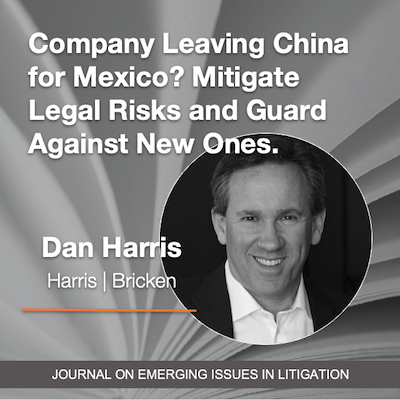
    How Companies Seeking to Leave China for Mexico Can Mitigate Their Legal Risks and Protect Against New Ones

    “Chinese manufacturers commonly seek retaliation against foreign buyers that cease buying product from them. For this reason, it is critical that you line up your new suppliers (preferably in a country other than China) and have them ready to go before you even hint to anyone in China that you might cease or reduce production with an existing China supplier.”

    Abstract: The author, one of the leading authorities on the legal issues related to international manufacturing, discusses the risks companies will face if they move their manufacturing out of China, what they should do to mitigate those risks, and what new risks they will face in a new country, such as Mexico. He comments on a variety of concepts, including manufacturing agreements, protection of intellectual property, strategies for a safe departure, potential retaliation tactics, and even personal security matters.

    Download the article now!

  • Climate Change, Property Rights, and Conservation: Highlights from a Decade of Environmental Law (2013–2023)

    Climate Change, Property Rights, and Conservation: Highlights from a Decade of Environmental Law (2013–2023)

    The Author

    Victoria Kline

    Victoria Kline2023 J.D. and Incoming Associate at Reed Smith

    Victoria Kline (linkedin.com/in/victoria-kline) just graduated from the University of Miami School of Law, and is an incoming associate at Jones Day. She focused her studies on environmental law, which also will be her area of practice. (Congratulations to Victoria on her graduation and getting her start at Reed Smith!)

    The Journal on Emerging Issues in Litigation

    Emerging Litigation Podcast

    Emerging Litigation PodcastProduced by HB Litigation and Law Street Media

    Interviews with leading attorneys and other subject matter experts on new twists in the law and how the law is responding to new twists in the world.

    Climate Change, Property Rights, and Conservation:
    Highlights from a Decade of Environmental Law (2013–2023)

    Abstract: The author discusses nine recent decisions—all but one handed down by the Supreme Court—that demonstrate the ongoing debate over responsibility for the effects of climate change, how the courts are essentially asked to strike a balance between environmental protection and economic development, the intersection of property rights and conservation, and how litigants fared with their arguments over different aspects of this important and, many would say, existential dilemma. The author concludes with an update from the United Nations Framework Convention on Climate Change and the establishment of a loss and damage fund for countries harmed by climate change.

    “The past decade has seen numerous legal challenges and landmark rulings in environmental law, reflecting the growing recognition of the critical importance of protecting the environment for current and future generations. From the Supreme Court’s decision in Michigan v. EPA to the recent Juliana v. United States case, the judicial branch has dramatically changed the way litigation can be used to protect the interests of the earth and its inhabitants.”

    Download the article now!

  • Procedural Challenges to the IRS’s Compliance With the APA and Its Impact on Tax Litigation

    Procedural Challenges to the IRS’s Compliance With the APA and Its Impact on Tax Litigation

    The Author

    Jeffrey S. Luechtefeld

    Jeffrey S. LuechtefeldChamberlain | Hrdlicka

    Jeffrey S. Luechtefeld (jeff.luechtefeld@chamberlainlaw.com) is a tax controversy and litigation attorney with Chamberlain, Hrdlicka, White, Williams, and Aughtry (Atlanta, Georgia) where he focuses his practice on resolving tax disputes with the Internal Revenue Service, administratively or through litigation. Jeff previously was a Special Trial Attorney for the IRS Office of Chief Counsel as well as a director in the tax controversy practice of a big four accounting firm.

    The Journal on Emerging Issues in Litigation

    Emerging Litigation Podcast

    Emerging Litigation PodcastProduced by HB Litigation and Law Street Media

    Interviews with leading attorneys and other subject matter experts on new twists in the law and how the law is responding to new twists in the world.
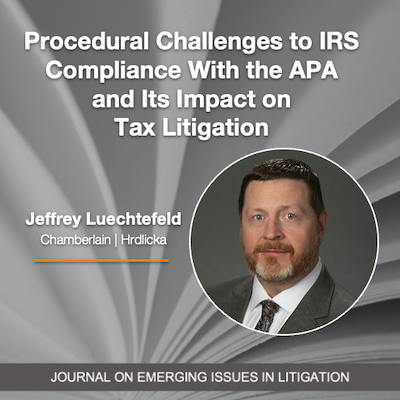
    Procedural Challenges to IRS Compliance With the APA and Its Impact on Tax Litigation

    Abstract: The Administrative Procedure Act (APA) places specific requirements on agencies of the federal government when engaged in a “rule making” that has the force and effect  of law. Recently, the APA has become a focal point in tax litigation, due in large part to the IRS’s history of refusing to comply with the process mandated by the APA. This article focuses on procedural challenges to the IRS’s compliance with the APA based on the IRS’s history of non-compliance with the APA’s notice-and-comment requirement. It highlights recent trends in tax litigation and considers the future of APA challenges in this area.

    “IRS’s level of APA non-compliance matters significantly …

    “APA challenges predicated on the IRS’s failure to adequately follow the APA’s notice-and-comment process are inherently fact-intensive endeavors …

    “The challenging party should gauge the usefulness of the relief requested and balance that against the cost required to prevail …

    “Ultimately, APA challenges are important, and may be necessary for a taxpayer to get to argue the merits of their case, but they do not often end the dispute with the IRS.”

    Download the article now!

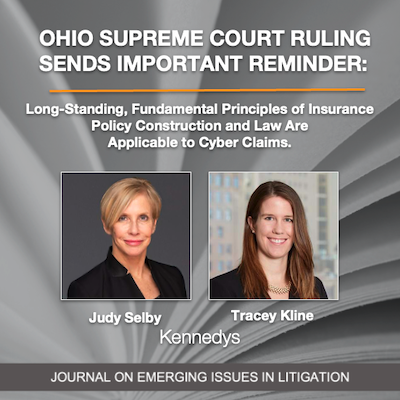
  • Ohio Supreme Court Ruling Sends Important Reminder: Long-Standing, Fundamental Principles of Insurance Policy Construction and Law Are Applicable to Cyber Claims

    Ohio Supreme Court Ruling Sends Important Reminder: Long-Standing, Fundamental Principles of Insurance Policy Construction and Law Are Applicable to Cyber Claims

    The Authors

    Judy Selby

    Judy SelbyKennedys

    Judy Selby (judy.selby@kennedyslaw.com) is a Partner at Kennedys (New York) where she focuses her practice primarily on insurance coverage matters with a concentration in coverage for exposures arising out of emerging technology, digital, and compliance risks.

    Tracey Kline

    Tracey KlineKennedys

    Tracey M.Kline (tracey.kline@kennedyslaw.com) is an Associate at Kennedys (Philadelphia) where she focuses her practice primarily on insurance coverage litigation and cyber matters.

    The Journal on Emerging Issues in Litigation

    Emerging Litigation Podcast

    Emerging Litigation PodcastProduced by HB Litigation and Law Street Media

    Interviews with leading attorneys and other subject matter experts on new twists in the law and how the law is responding to new twists in the world.

    Ohio Supreme Court Ruling Sends Important Reminder:

    Long-Standing, Fundamental Principles of Insurance Policy Construction and Law Are Applicable to Cyber Claims

    Abstract: On December 27, 2022, the Ohio Supreme Court unanimously ruled that a business owner’s property insurance policy issued by Owners Insurance Co. to EMOI Services, LLC did not afford coverage for losses sustained in a ransomware attack because computer software is “entirely intangible” and “cannot experience ‘direct physical loss or physical damage.’” EMOI Servs., LLC. v. Owners Ins. Co., 2022-Ohio-4649 (Ohio 2022). In doing so, the court reversed an attention-getting split decision by the lower appellate court. This article takes an in-depth look at the case and discusses its significant implications.

    The Ohio Supreme Court’s decision was based on its commonsense conclusions that software (as intangible property) cannot suffer physical damage, and that coverage for restoration of information under the Electronic Equipment Endorsement could not be triggered absent the threshold requirement of “direct physical loss or damage” to the media on which the information was stored. Although claims involving cyber events may be relatively new, this decision is an important reminder that long-standing, fundamental principles of insurance policy construction and law are applicable to cyber claims.

    Download the article now!