Blog

  • A.I. Best Practices: Rules and Policies for Using Artificial Intelligence in Your Business

    Explore how cybersecurity breaches impact insurance, risk management, and data privacy with evolving legal and compliance challenges.

    [one-third-first]

    DATE: Sept. 27, 2018

    TIME: 2 p.m. EDT; 1 p.m. CDT; 12 p.m. MDT; 11 a.m. PDT

    PLACE: Your computer or mobile device

    PRICE: $197* per dial-in site
    *Price is good through Aug. 16. After that it’s $247.

    GROUPS ARE GOOD: Registering qualifies you to multiple attendees at your location.

    CLE: 1 credit
    Please send CLE questions to
    CLE@LitigationConferences.com

    SPEAKER:
    John Frank Weaver
    Attorney
    McLane Middleton

    Your registration includes:

    •  A site license to attend this webinar (invite as many people in one location as you can fit around your computer at no extra charge).

    • Downloadable PowerPoint presentations from our speakers.

    •  The opportunity to connect directly with speakers during the audience Q&A session.

    •  At least one-hour of CLE credit.

    Produced in collaboration with
    and their new
    Journal of Robotics, Artificial
    Intelligence & Law
    [/one-third-first] [two-thirds]

    Nearly every industry is adopting or preparing to adopt artificial intelligence applications into their business practices.

    That’s exciting. However, there are almost no government regulations for their use and few resources providing best practices that anticipate ethical considerations and forthcoming legal requirements.

    This lack of direction poses a serious problem as A.I. applications become more widespread. Businesses are creating their own ad hoc practices without considering the eventual government oversight and ethical consensus, which will result in costs and potential liability later when those companies have to change their practices.

    This webinar looks at how your company should approach its A.I. rules and policies in order to minimize the impact of expected government action and cultural norms.

    Register now and join our speaker as he explores existing laws addressing privacy and data security, pending A.I. legislation at the state and federal levels, and the recommendations of federal agencies that are most likely to be codified.

    The webinar will provide practical guidance for attendees to use when developing internal rules, policies, practices, contracts, and public facing documents. The speaker will rely on relevant existing laws, proposed legislation, and reports from federal agencies that advocate certain public policies for the governance of AI.

    What you will learn:

    1.     The requirements of privacy laws – including GDPR, Canada’s PIPEDA, and the new California privacy statute – that have special application to A.I.

    2.     Best practices for drafting a public facing privacy policy that addresses your use of A.I.

    3.     Best practices for preparing internal rules and policies governing your employees’ use of A.I.

    4.     Best practices for bots and other forms of A.I. that interact with consumers.

    5.     Best practices for A.I.-specific terms of use and consents.

    6.     Best practices for addressing A.I. in employee contracts and handbooks.

    7.     Best practices for addressing A.I. in vendor contracts, including assignment of liability and indemnification obligations.

    And more!

    Attendees will be able to go back to their companies and review their current A.I. practices, policies, and rules to determine how appropriate they are in light of expected regulations and expectations. The ultimate goal is to avoid costly revisions in response to evolving consumer expectations and government requirements. A little investment now could potentially save a lot of money in revisions changes, PR, and remediation later. — John Weaver, speaker


    Speaker

    The webinar speaker, John Frank Weaver, is an attorney with McClane Middleton whose practice focuses on A.I. and autonomous technology. He is the author of Robots Are People Too: How Siri, Google Car, and Artificial Intelligence Will Force Us to Change Our Laws, a contributing writer at Slate focusing on legal issues implicated by AI and autonomous devices, and a columnist for and member of the board of editors of The Journal of Robotics, Artificial Intelligence & Law.

    REGISTER NOW

    [/two-thirds]

  • McLoughlin on Artificial Intelligence in Banking

    “Capital adequacy requirements are not the only kind of regulation that AI is helping banks to meet. An even bigger area is monitoring of trading activities for misconduct and abuse. The Bank of England estimates that misconduct by traders has cost banks a global cumulative of $320 billion to date. For this very large reason, banks are aggressively deploying machine learning to monitor the behavior of their traders and detect unusual behavior.”

    Read Michael McLoughlin’s post on LinkedIn.

    Michael McLoughlin is Global Digital Transformation Partner & Advocate with Microsoft.

  • Joshua Gold on Cyber Crime and Insurance

    With the amount of trickery going into thefts and embezzlements these days, crime insurance companies too often use the many steps involved in a fraudulent scheme to argue that losses are indirect and otherwise uncovered.

    The recent decisions of the Second Circuit and Sixth Circuit on the “direct loss” argument and the scope of computer fraud coverage are important victories for policyholders generally, making clear that where the predominant step in the chain is some type of covered fraudulent misconduct involving a computer, a court is not going to entertain a direct loss defense to excuse the insurance company from paying.

    As such, policyholders should be familiar with their crime coverage and promptly notify all potentially implicated lines of insurance coverage when a cybercriminal is afoot. — Joshua Gold, Anderson Kill 

    Read Josh’s complete article. 

    Joshua Gold is Chair of Anderson Kill’s Cyber Insurance Recovery Practice and was amicus counsel for United Policyholders in the Medidata Solutions, Inc. v. Federal Insurance Company case before the Second Circuit.

  • Halligan, Weyland on Cybersecurity, Trade Secret Asset Management and the Defend Trade Secret Act of 2016

    “Cybersecurity protection against outsider theft has largely succeeded, if competently crafted business methods are strictly followed. The more intractable problem of insider theft is now the major concern, and traditional cybersecurity methods are unavailing. The ever-higher digital barriers placed around the corporation and its sensitive data are no defense against data theft by people allowed inside the digital walls in the normal course of business.”

    Read their complete post on LinkedIn.

    R. Mark Halligan is a Partner and Trial Lawyer at FisherBroyles, LLP. Mr. Halligan has taught Advanced Trade Secrets Law in the John Marshall Law School LLM program for 24 years.

    Richard F. Weyand is the President of the Trade Secret Office, Inc. www.thetso.com

    See R. Mark Halligan and Richard F. Weyand Trade Secret Asset Management 2018: A Guide to Information and Asset Management Including RICO and Blockchainavailable on Amazon. https://www.amazon.com/dp/0997070986

  • Willis Towers Watson: Cyber Risk Top D&O Concern

    Based on their survey, Willis Towers Watson says cyber risk continues to top the list of concerns for directors and officers (right up there with employee claims). As for coverage, while they care about price, things like their relationship with the carriers and how well they handle claims are critical elements.

    And, maybe one key reason cyber events keep happening: “Only 13% of board members feel that their organizations learn from past cyber mistakes.”

    Read the results of the Willis Towers Watson survey. 

  • RSA’s Zulfikar Ramzan on Blockchain

    Is blockchain as impenetrable as people think? Or as necessary?

    It’s not predicated on the same type of cryptographic security that we’ve seen historically, but if someone has enough money and enough motivation — like a nation state — couldn’t they severely compromise a system? Is blockchain the only way transactional protections can become so secure, or could traditional technologies be employed and with less effort?

    RSA Security’s Chief Technology Officer Zulfikar Ramzan, Ph.D., spoke at our Cyber Sector Risk: Blockchain Security in April 2018 in New York. Hear what he had to say about this much-heralded technology.


    Related content

    https://hb.worryfreeweb.com/www-litigationconferences-comprivacysecurity-forum-2018-2/

    International Cyber Risk Management Conference | Dec. 6-7, 2018 | Bermuda

    The Urgency of Cyber Threats to U.S. and Global Critical Infrastructures | Video Session

  • Right to Try Act: Commentary Roundup


    A Life Saver, Political Grandstand, or Harmful Scam?

    Depends on Who You Ask. And When.

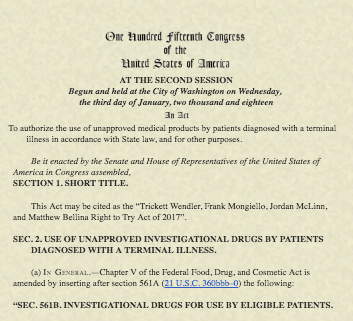
    It’s been two months since President Donald J. Trump signed into law the Right to Try Act which allows terminally ill patients access to experimental drugs not yet approved by the FDA. Like many things in America in 2018, opinions on the efficacy of this new law vary along party or ideological lines. Will it give hope and precious life-extending solutions for patients fighting terminal disease? Or is it a money-driven scheme intended to enrich corporations and the super rich? Signed into law on May 24, 2018, is it something that can be implemented effectively? Here are a few quotes that explain the controversy.

    Additional commentary or insights welcome.
    Send yours to Editor@LitigationConferences.com.

    “Timely access to promising treatments in … devastating circumstances.”

    “This new law amends the Federal Food, Drug, and Cosmetic Act to establish a new pathway aimed at increasing access to unapproved, investigational treatments for patients diagnosed with life-threatening diseases or conditions who have exhausted approved treatment options and who are unable to participate in a clinical trial. Our implementation of the Right to Try Act will build on our long-standing efforts to help patients and families who are facing life-threatening diseases or conditions, in a way that seeks to protect their autonomy, their safety, and the safety of others following in their paths.”

    “The decisions we reach related to products that can serve as an effective treatment for a terminal illness, or that can arrest a devastating and debilitating condition, are among the most important and carefully considered judgments that we make. We recognize the important balance between making sure patients have the assurances Congress intends, while enabling timely access to promising treatments in these devastating circumstances. And we’ll implement this new law consistent with these longstanding values.”

    FDA Commissioner Scott Gottlieb

    “GOP senator reveals the truth: Right-to-try bill was a scam tailored to harm public health”

    “Anyone with a smidgen of knowledge about healthcare understood that the right-to-try legislation signed by President Trump on Wednesday was a scam, perpetrated by the Koch brothers and their henchmen.”

    “Masquerading as a “compassionate” measure aimed at providing victims of terminal diseases with a last bit of hope that an experimental treatment might save them, it really was aimed at undermining the authority of the Food and Drug Administration to make sure our drugs are safe and effective.”

    Read the full article in the Los Angeles Times.

    “We remain skeptical about whether right-to-try statutes actually help anyone …

    … as opposed to being political grandstanding.  That said, from the perspective of attorneys representing pharmaceutical companies, this bill is about as good as it could be, and – to the extent that it extends preemption to the compassionate use program – it even marginally improves current law.”

    Read the full commentary written by James M. Beck of Reed Smith on the Drug & Device Law Blog. 

    Note: Beck’s commentary was written in March 2018.

    “Very little change for most patients …”

    “Despite these state gains and the policy’s growing popularity among states, ethical questions remain about the tangible impact of a federal right to try law on Americans with terminal illnesses. Most notably, a growing body of evidence from policy analysts argues that the legislation would unfortunately accomplish very little change for most patients, and it could actually make it harder to get new drugs approved in the future.”

    Written for CBS.com by Morten Wendelbo, a lecturer at the Bush School of Government and Public Service and a research fellow at the Scowcroft Institute of International Affairs at Texas A&M University, and Timothy Callaghan, assistant professor at Texas A&M University Health Science Center. Read the complete commentary. 


    Additional commentary or insights welcome.

    Send yours to Editor@LitigationConferences.com.

    This controversial topic will be on the agenda at the Drug & Device Defense Forum in New York Oct. 15, 2018.

  • Judy Selby on Improving Cyber and Privacy Board Reporting


    “While general awareness of cyber risks among corporate boards is increasing, even the most motivated and knowledgeable directors cannot effectively fulfill their duties without receiving appropriate data about the organization’s risk profile. Unfortunately, however, there appears to be a disconnect between management and boards when it comes to cyber risk reporting . . .  In order for directors to effectively discharge their duty of active, informed, and engaged oversight, the information they receive must be relevant, understandable, reliable, and objective.”

    Judy Selby, JD

    Judy Selby Consulting

    Read the full article and Judy’s tips for improving board reporting. 


    Judy Selby of Judy Selby Consulting

  • BitSight Releases eBook on Use of A.I. & Big Data in Continuous Cyber Risk Monitoring

    “With every reported data breach or cyberattack, the cyber risk landscape gets a little more complex. Cyber criminals create new attack vectors, cybersecurity professionals develop new controls to protect their systems, the criminals get to work circumventing the controls, and so on.The result of this back and forth is that cyber risk professionals have a huge variety of risk factors to worry about. In response, risk managers and security specialists need to develop extremely complex cybersecurity programs to make sure all of their bases are covered.

    “With so many cybersecurity risks to consider, it’s inevitable that some will receive less attention than they deserve. Unfortunately, these overlooked risk factors could play a role in your next cyberattack, and if your financial services firm isn’t prepared, that could be extremely costly.” Read more. 


    We’re looking forward to seeing the BitSight team in Bermuda Dec. 6-7, 2018, at the International Cyber Risk Management Conference.

  • Crowell & Moring on Insurance for Autonomous Vehicles Accidents

    “As responsibility for accidents shifts away from drivers and towards the companies that design, manufacture, and maintain autonomous vehicles, the pool of companies potentially liable for accidents will deepen.Companies need to consider potential liability risk when designing autonomous vehicle-related systems and partnering with other companies.”

    Another good piece from the team Crowell & Moring LLP