Category: Journal

  • Tanks and Banks: What Fintechs Must Know About Sanctions on Russia

    Tanks and Banks: What Fintechs Must Know About Sanctions on Russia

    The Guest

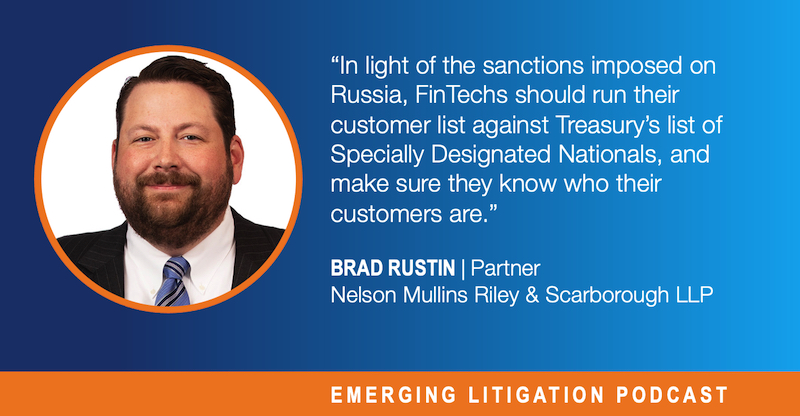
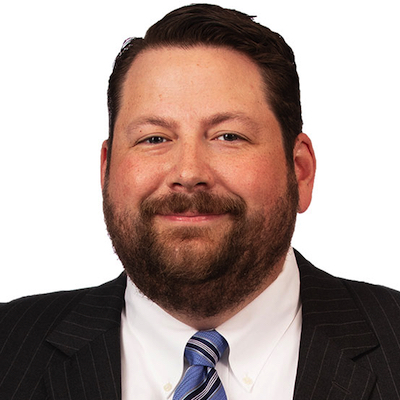
    Brad Rustin

    Brad RustinPartner | Nelson Mullins Riley & Scarborough

    A highly regarded attorney and much-sought-after speaker for his expertise on the laws and operations of the technology-driven global financial system. Also a member of the Editorial Board of Advisors for the Journal on Emerging Issues in Litigation.

    Emerging Litigation Podcast

    Emerging Litigation PodcastProduced by HB Litigation and Law Street Media

    Interviews with leading attorneys and other subject matter experts on new twists in the law and how the law is responding to new twists in the world.

    The Journal on Emerging Issues in Litigation

    Tanks and Banks: What Fintechs Must Know About Sanctions on Russia

    Tom Hagy Interviews Brad Rustin of Nelson, Mullins, Riley & Scarborough

    Click below to get the complete article.

    Tanks and Banks: an interview with Brad Rustin on Russian Sanctions and Fintechs

  • Cybersecurity and Data Privacy Year in Review 2021

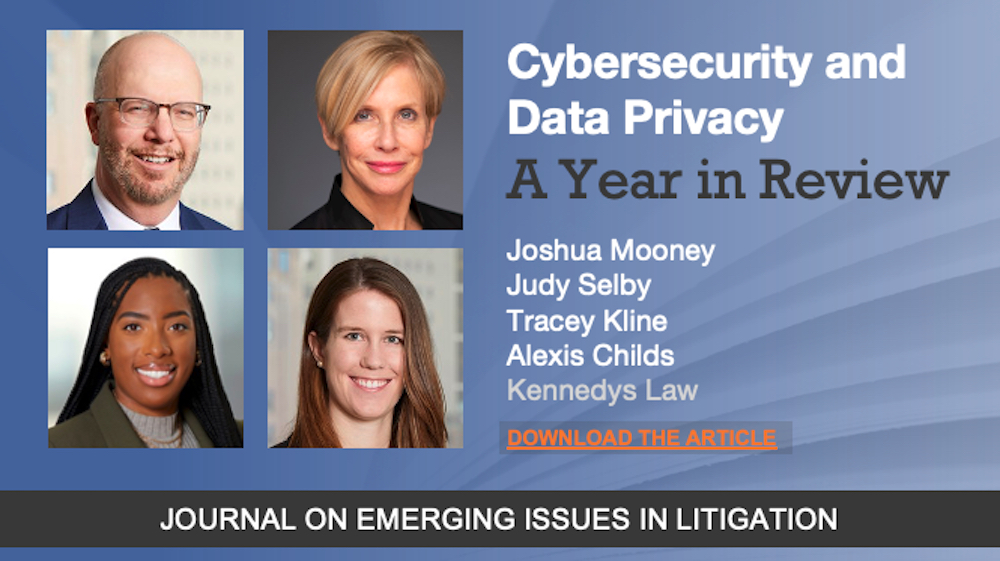
    Cybersecurity and Data Privacy Year in Review 2021

    The Authors

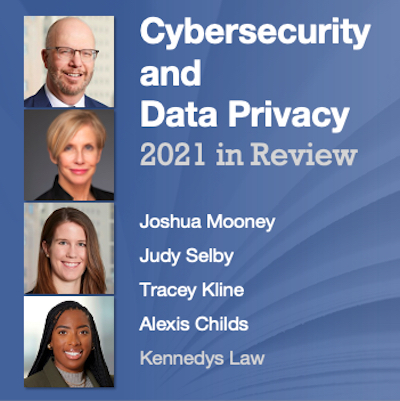
    The authors are all attorneys with the Kennedys law firm (kennedyslaw.com). Joshua Mooney (joshua.mooney@kennedyslaw) and Judy Selby (judy.selby@kennedyslaw.com) are partners. Tracey Kline (tracey.kline@kennedyslaw.com) and Alexis Childs (alexis.childs@kennedyslaw.com) are associates. Bridget Mead, associate, and Javier Vijil, senior associate, also contributed to this article.

    Judy Selby is also a member of the Editorial Board of Advisors for the Journal on Emerging Issues in Litigation.

    The Journal on Emerging Issues in Litigation

    Cybersecurity and Data Privacy 2021 in Review

    By Joshua Mooney, Judy Selby, Tracey Kline, and Alexis Childs

    Abstract:

    As the world emerged from lockdown, it should come as no surprise that cybersecurity and data privacy remained dominant topics in the media and legal industry. Some of 2021 was much like 2020—ransomware attacks continued to fill the headlines, and in the aggregate, constituted significant loss paid under cyber insurance policies. OFAC reminded victim companies and incident response firms (and cyber carriers) that it remains unlawful to pay ransom payments to designated organizations. Comprehensive federal legislation addressing cyber defenses and notification requirements never materialized. Yet in 2021, we saw new and significant developments. U.S. law continued its drift toward comprehensive privacy regulation with two new significant pieces of privacy legislation and California’s enforcement of the California Consumer Privacy Act. In the absence of federal legislation, federal agencies either stepped up enforcement actions or signaled that they intend to do so within their realms of governance. Litigation under the Illinois Biometric Information Privacy Act continued its surge while the Illinois high courts rendered two impactful decisions and a circuit court punted to Illinois’s highest court. This review provides a brief synopsis of many events and developments that made the authors’ list.  

    Perhaps one of the most significant developments in U.S. privacy law for 2021 was the enactment of comprehensive data privacy laws in Virginia and Colorado. Both pieces of legislation, which go into effect in 2023, adopt frameworks resembling those in the EU General Data Protection Regulation 2016/679 (GDPR) and the California Consumer Privacy Act (CCPA). Both laws also grant consumers significant rights with respect to their personal data, but neither contains a private right of action. 

    Get the article now!

  • Climate Change, ESG, and D&O Insurance: Collision or Cooperation?

    Climate Change, ESG, and D&O Insurance: Collision or Cooperation?

    The Authors

    Robert D. Chesler (rchesler@andersonkill.com) is a shareholder in Anderson Kill’s New Jersey office and is a member of the firm’s Cyber Insurance Recovery Group. Bob represents policyholders in a broad variety of coverage claims against their insurers and advises companies with respect to their insurance programs. Dennis J. Artese (dartese@andersonkill.com) is a shareholder in Anderson Kill’s New York office and chairs the firm’s Climate Change and Disaster Recovery Group. Joseph Vila (jvila@andersonkill.com) is an insurance recovery attorney in Anderson Kill’s New Jersey office.

    Journal on Emerging Issues in Litigation

    Climate Change, ESG, and D&O Insurance: Collision or Cooperation?

    By Robert D. Chesler, Dennis J. Artese, and Joseph Villa

    Abstract:
    Climate change has been tied to the recent increase in catastrophic weather events. Insurance coverage for often billions of dollars in damage becomes a source of argument between insurers, who want to limit their exposure, and policyholders, who want the coverage they argue the carriers are contractually obligated to pay. The authors discuss the nature of the underlying suits and the potential coverage issues; the types of policies implicated; cases that have addressed these issues; the rising societal concern over climate change that have played a role in the new corporate emphasis on environmental, social, and governance, or ESG, and the insurance industry’s response to this trend.

    Excerpts:
    Directors and Officers (D&O) policies [are] directly affected by climate change. Two types of suits are already happening. First, there are at least 1,375 climate change–related suits pending in the United States, about two dozen of which have been filed by local municipalities and states seeking damages because of climate change. For example, the attorneys general of New York, Massachusetts, and the U.S. Virgin Islands launched investigations to determine whether Exxon Mobil Corporation misrepresented to investors the risks of how climate change might impact its business. Although the U.S. Virgin Islands attorney general terminated its investigation, the New York and Massachusetts attorneys general filed separate suits against Exxon.

    In the seminal case People of the State of New York, By Letitia James v. Exxon Mobil Corporation, 119 N.Y.S.3d 829 (N.Y. Sup. Ct. 2019), the State of New York sued Exxon, alleging that it violated the state’s securities act by making materially false and misleading statements to the public and investors about how the company manages risks of climate change and the cost of carbon in assessing demand for its products. The state dropped its common law fraud claims prior to trial, but proceeded with a claim under New York’s Martin Act, which permits the attorney general to sue for fraud in connection with the marketing of securities without requiring proof of scienter, reliance, and damages, as well as under New York’s Executive Law, which prohibits persistent fraudulent acts. After a trial, the New York Supreme Court held that the state failed to demonstrate by a preponderance of the evidence that Exxon made any material misrepresentations to investors ….

    As regulatory activity and private litigation activity surrounding climate change issues continue to increase, liabilities likely will follow. D&O insurance companies will be called on to address those liabilities with increasing frequency.

    Those claims will present complex coverage issues of first impression, and policyholders can expect a fight. Policyholders also should be on the lookout for more restrictive coverage terms on D&O renewals. Policyholders should work with their brokers to obtain the broadest coverage available, and consult with sophisticated coverage counsel in the event that they are faced with climate change–related claims. 

    Get the article now!

    Explore more from Bob Chesler and contributing specialists!

    Journal on Emerging Issues, Editorial Board of Advisors

    The Use and Abuse of the Pollution Exclusion. By Dennis Artese, Jamie O’Neil, Robert Chesler

    The Environmental, Social, and Governance Police Have Arrived: Is your Insurance Ready. Authors: Dennis Artese, Bob Chesler.

    PFAS Insurance Coverage with Jaana Pietari and Jim Fenstermacher and Litigation with Bob Chesler: Part 1 of 2 Podcasts

    PFAS Insurance Coverage with Robert D. Chesler of Anderson Kill. Part 2 of 2 Podcasts

    How Insurance Companies Defraud Their Policyholders, and What Courts and Legislators Should Do About It

    Climate Change, ESG, D&O Insurance: Collision or Cooperation? By Robert D. Chesler, Dennis J. Artese and Joseph Villa

    Remediating, Insuring, and Litigating PFAS Claims. By Dr. Jaana Pietari, PhD, MBA, PE, Jim Fenstermacher, PE, Dr. Michael Bock, PhD, MS, Robert D. Chesler and Nicholas M. Insua, Sheila Mulrennan, Robin Kelliher, Jason R. Waters

  • Robojudges: If Machines Could Make Judicial Decisions, Should They?

    Robojudges: If Machines Could Make Judicial Decisions, Should They?

    The Author

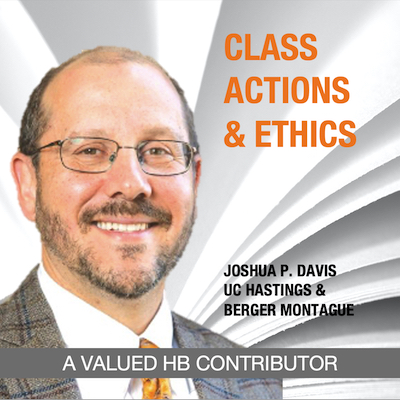
    Joshua P. Davis

    Joshua P. DavisProfessor & Practicing Attorney

    A leading academic and practitioner, Joshua P. Davis (davisj@usfca.edu) is a nationally recognized expert on legal ethics and class actions, as well as on artificial intelligence in the law, antitrust, civil procedure, free speech, and jurisprudence. He has published more than 30 scholarly articles and book chapters on these subjects and is currently writing a book on AI titled Unnatural Law, which will be published by Cambridge University Press. He is Research Professor of Law at the University of California Hastings College of Law, and a Shareholder of the Berger Montague PC law firm and Manager of its new San Francisco Bay Area Office. Before taking these posts, for more than 20 years Davis was a tenured Professor of Law at University of San Francisco Law School, where he also served as the Director of the Center for Law and Ethics.

    Davis is also a member of the Editorial Board of Advisors for the Journal on Emerging Issues in Litigation, published by Fastcase Full Court Press. Tom Hagy, Editor in Chief.

    You can also listen to Josh on the Emerging Litigation Podcast!

    Robojudges: If Machines Could Make Judicial Decisions, Should They?

    By Joshua P. Davis

    Abstract: As artificial intelligence makes its way into every aspect of our daily lives—including the practice of law—humans have some decisions to make. Do we wish for AI to replace human judges? What are the risks and how might they be mitigated? What breakthroughs need to occur? How might robotic judges, or “robojudges,” perform better than human jurists? What surprises might be in store? Read on for the author’s perspectives on these important questions. After all, as he points out, AI is already being used by the judiciary, albeit to a limited extent. 

    Some of the most exciting, vexing, and terrifying issues at the intersection of artificial intelligence (AI) and law involve robojudges. Can we build a robojudiciary that replaces human judiciaries? Should we? These are no small questions given such a shift would massively disrupt how our legal systems operate and transform democratic self-government. 

    Part of the challenge in thinking about robojudges is technical. There are all sorts of practical technological advances that would be necessary to build an effective robojudge. We are not there yet and we likely won’t be for a while. Some of the steps would likely require increasing the power of computers, designing programs for natural language, and possibly mastering quantum computing. 

    More general and accessible, however, are a series of conceptual issues. We might frame them as questions. 

    1. What breakthroughs are necessary for AI to think the way we do? 
    2. Will AI be able to simulate human instrumental reasoning; that is, reasoning about how best to achieve prescribed objectives? 
    3. Will AI be able to simulate human purposive reasoning; that is, reasoning about which objectives to pursue? 
    4. What role does consciousness play in answering these questions? 
    5. Could we program AI to have conscious experiences similar enough to ours for it to make reliable instrumental and purposive judgments? 
    6. Do human judges engage in instrumental or purposive reasoning?

    Answering these questions can serve a few major purposes.

    First, it can help us deal with the present and immediate future. Reliance on AI in judging may soon be commonplace. To some extent, it already occurs. AI has become a judicial tool in setting bail and deciding which children should be removed from their families to protect their well-being.

    Second, the answers can help us prepare for far greater disruptions in the future. We should think carefully now about the outer limits of AI, lest we are caught off guard and allow changes that we regret and cannot undo. In times of great and rapid change, foresight is necessary to steer societies toward improvements and away from pitfalls.

    Third, AI offers a grand experiment that may tell us a great deal about ourselves. It may shed light on how our brains and minds work, how the two relate, how the law works, and what role consciousness plays in it all. With these purposes in mind, below is an analysis that offers some preliminary and admittedly speculative answers to the above questions. 

    See what else the author has to say about robojudges and get the complete article. 

    Get the article now!

  • Going Viral or Going Nuclear: Social Inflation’s Impact on Jury Verdicts …

    Going Viral or Going Nuclear: Social Inflation’s Impact on Jury Verdicts …

    The Authors

    All three authors are with the law firm of Hall Booth Smith, P.C., and concentrate on various aspects of healthcare defense.  Lindsay A. Nishan (lnishan@hallboothsmith.com) is an Associate in the HBS Charleston office. Samantha Bowen Myers (smyers@hallboothsmith.com) is an Associate in their West Palm Beach, Florida, office. Sandra Mekita Cianflone (scianflone@hallboothsmith.com) is a Partner in the firm’s Atlanta office. She is also a member of the Editorial Board of Advisors for the Journal on Emerging Issues in Litigation, and a frequent contributor to the Emerging Litigation Podcast.

    Going Viral or Going Nuclear:

    Social Inflation’s Impact on Jury Verdicts and How to Safeguard Against It

    By Lindsay A. Nishan, Samantha B. Myers
    and Sandra M. Cianflone

    A juror’s perception of companies and healthcare providers is increasingly colored by TV and social media. The same is true for their understanding of the practice law or medicine, which may be as wrong as it is immovable. “Social inflation” refers to rising litigation costs and the resulting higher insurance payouts which drive up the cost of insurance. In this article the authors, each of whom represents parties in the healthcare industry, discuss the evolving social trends that lead jurors to render “nuclear verdicts,” and what attorneys should consider in mitigating the effects of this phenomenon.

    Social media feeds today are crammed with flashy advertisements from lawyers promising big-dollar settlements against “rich insurance companies.” The number of these commercials has spiked since the 1970s as the phenomenon known as “social inflation” has taken root in the legal system.

    Social inflation is a term of art that refers to rising litigation costs, the impact those costs have on insurance claim payouts, and how much the average policyholder is expected to pay for basic coverage. Recently, the term social inflation has taken on a new meaning as it has become more widely used in the general press. The phrase has come to be associated with tort reform rollbacks, litigation funding, and is most seen in references to so-called “nuclear” jury verdicts, i.e., a jury award that exceeds $10 million.

    But the question remains: What factors contribute to these exorbitantly high jury verdicts?  These outsize awards are often driven by myriad factors including sympathetic jurors, societal conceptions about income and wealth of corporations, the use of emotion-driven “Reptile Theory” tactics by plaintiff attorneys, the media spotlight on “bad apple” physicians, and numerous other social factors. A new factor that influences elevated jury verdicts is the increasing volume of information—whether true or false—that is exchanged on social media platforms.

    One of the lines most affected by this form of social inflation is the healthcare industry and the soaring costs of medical malpractice litigation. This includes lawsuits involving hospital systems, pharmaceutical companies, and their insurers.

    See what the authors have to say about mitigating the impact of social inflation. 

    Get the article now!

  • Strategies for Maximizing Insurance Recovery for Climate Change–Related Loss and Damage

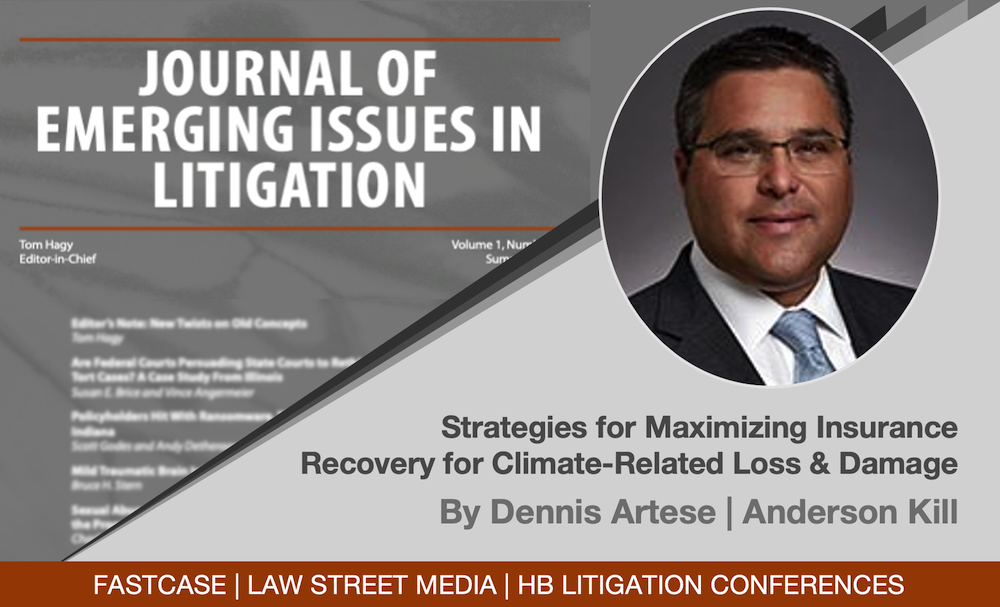
    Strategies for Maximizing Insurance Recovery for Climate Change–Related Loss and Damage

    Strategies for Maximizing  Insurance Recovery for Climate Change–Related Loss and Damage

    Abstract

    Losses from natural catastrophes are costing many tens of billions as year, from hurricanes and tornadoes to record-breaking rainfall and floods. Whether the insurance industry will or can provide coverage for all of the devastating effects of climate change (or, as some might put it, a new and calamitous phase in our earth’s existence) only time will tell. In the meantime, policyholders must cross their Ts if they expect coverage. In this article the author shares insights on the complex but essential task of documenting and valuing post-storm losses.

    Author

    Dennis J. Artese (dartese@andersonkill.com) is a shareholder in the New York office of Anderson Kill P.C. His practice concentrates on insurance recovery litigation, with an emphasis on securing insurance coverage for first-party property losses, construction accidents, and third-party liability claims.

    About
    The Journal on Emerging Issues in Litigation is a co-production of HB, Fastcase, and Law Street Media. You can also hear the complementary (and complimentary) Emerging Litigation Podcast wherever podcasts appear. For questions, contact Tom Hagy, Editor in Chief, at Editor@LitigationConferences.com.

    Loading Viewer…

  • Biotech Patent Wars: If at First You Don’t Succeed . . . University of California v. The Broad Institute

    Biotech Patent Wars: If at First You Don’t Succeed . . . University of California v. The Broad Institute

    Biotech Patent Wars: If at First You Don’t Succeed . . . University of California v. The Broad Institute

    Abstract

    This case discussed in this article is about two methods of editing DNA: one that has infinitely more lucrative applications because it can edit human DNA (plus all animals and plants), another that works in cell-free environments. Whether inventions are separate or part of the same innovation is an important factor in patent interference disputes; if there are two patentably distinct inventions there cannot be interference. One party in this case lost its argument that there was only one invention at issue, but returned with a second interference claim, arguing that it was the first inventor to constructively reduce to practice the animal and plant DNA editor. In this article, the author examines the nuances and intricacies of the patent process in the world of biology, and how patent lawyers must possess a level of knowledge in disciplines related to the inventions they seek to protect. This is necessary, for example, in understanding whether an invention is a significant improvement over prior innovations. The author also shares the importance of confidentiality especially when potentially groundbreaking (and lucrative) inventions are in development.

    Author

    Adrienne B. Naumann (adriennebnaumann@uchicago.edu) practices intellectual property law at the Law Office of Adrienne B. Naumann in Skokie, Illinois. She has held leadership positions relating to patents, science, and technology law with the Chicago Bar Association and the Converging Technologies Association. She currently serves as Secretary on the Board of the University of Chicago Women’s Alliance. Ms. Naumann has also written numerous articles on intellectual 56 Journal of Emerging Issues in Litigation property law and her book United States Federal Intellectual Property Developments includes discussion of decisions under the Defend Trade Secrets Act as well as those by the Supreme Court and was published by Pincus Professional Education.

    About
    The Journal on Emerging Issues in Litigation is a co-production of HB, Fastcase, and Law Street Media. You can also hear the complementary (and complimentary) Emerging Litigation Podcast wherever podcasts appear. For questions, contact Tom Hagy, Editor in Chief, at Editor@LitigationConferences.com.

    Loading Viewer…

  • Mega Verdict Threat: Tackling Damages Early Can Mitigate Outsized Jury Awards

    Mega Verdict Threat: Tackling Damages Early Can Mitigate Outsized Jury Awards

    Mega Verdict Threat: Tackling Damages Early Can Mitigate Outsized Jury Awards

    Abstract

    Why have medical malpractice verdicts in recent years reached such astronomical new heights? In this article the author addresses several of the factors that drive juries to return such punishing awards, discussing the unexpected impact of tort reform, the role of life-care planners and economists in determining damages, the ramifications of litigation financing, plaintiff attorneys’ utilization of the so-called reptile theory, and the influence of how the media reports on these verdicts. The author offers practical methods for defense attorneys involved in this litigation and insights that will benefit attorneys in any type of tort matter.

    Author

    Sandra M. Cianflone (scianflone@hallboothsmith.com) is an attorney at law firm Hall Booth Smith, P.C., whose practice primarily focuses on medical malpractice.

    About
    The Journal on Emerging Issues in Litigation is a co-production of HB, Fastcase, and Law Street Media. You can also hear the complementary (and complimentary) Emerging Litigation Podcast wherever podcasts appear. For questions, contact Tom Hagy, Editor in Chief, at Editor@LitigationConferences.com.

    Loading Viewer…

  • Remediating, Insuring, and Litigating PFAS Claims

    Remediating, Insuring, and Litigating PFAS Claims

    Remediating, Insuring, and Litigating PFAS Claims

    Abstract
    PFAS are a group of chemicals found in a variety of products (e.g., Teflon®) and have been used widely in industrial and environmental processes (e.g., oil recovery, firefighting). They do not break down, and over time can accumulate in the body and the environment. While largely no longer used in the United States, they continue to be used internationally. Studies have shown they have adverse health effects on humans and animals.
    In this article the authors discuss the history and impact of PFAS, insurance coverage for claims relating to PFAS contamination, the practice of “insurance archaeology,” maximizing insurance coverage, and, finally, existing and anticipated litigation arising from environmental damage and bodily harm from PFAS.

    Authors

    Dr. Jaana Pietari, PhD, MBA, PE (jpietari@ramboll.com), Senior Managing Consultant with Ramboll Group, has more than twenty years of professional and academic experience in the fate and transport of contaminants, the reconstruction of environmental releases to groundwater and sediments, and environmental forensics.

    Jim Fenstermacher, PE (jim.fenstermacher@ramboll.com), is a Subject Matter Expert on PFAS environmental fate, transport, and regularly interfaces with academia, provides branding, and supports business development efforts regarding PFAS issues.

    Dr. Michael Bock, PhD, MS (mbock@intell-group.com), Managing Director at The Intelligence Group, has more than twenty-five years of experience in environmental consulting with a specialization in environmental forensics and the investigation and assessment of contaminated soils, groundwater, and marine and freshwater sediments.

    Robert D. Chesler (rchesler@andersonkill.com) is a shareholder in Anderson Kill’s Newark office. Bob represents policyholders in a broad variety of coverage claims against their insurers and advises companies with respect to their insurance programs. Bob is also a member of Anderson Kill’s Cyber Insurance Recovery group.

    Nicholas M. Insua (ninsua@andersonkill.com) is a shareholder in the New Jersey and Philadelphia offices of Anderson Kill who focuses his practice on insurance recovery litigation and counseling. Nick also represents clients in business disputes outside the insurance coverage context. He is a member of the firm’s COVID Task Group.

    Sheila Mulrennan (smulrennan@iagltd.com) is the President of Insurance Archaeology Group (IAG) which she founded in 1985. Featured in a survey of “One Hundred Leading Women” in Business Insurance, Sheila is one of the nation’s foremost specialists in historic insurance reconstruction. Under her direction, IAG has pioneered the methods to research missing policies.

    Robin Kelliher (robin.kelliher@willistowerswatson.com) is the National Director for Environmental Claims with the Environmental Practice at WillisTowersWatson. As National Director of the Environmental Claims Practice, Robin leads a team of claim professionals responsible for delivery of technical and strategic consulting services designed to assist clients in managing environmental loss and claims.

    Jason R. Waters (jason.waters@wilsonelser.com) is the Regional Managing Partner of Wilson Elser’s McLean, Virginia office. He also co-chairs the firm’s national Toxic Tort & Environmental Practice Team. Jason has more than 20 years of experience litigating complex claims involving a wide variety of alleged exposures.

    About
    The Journal on Emerging Issues in Litigation is a co-production of HB, Fastcase, and Law Street Media. You can also hear the complementary (and complimentary) Emerging Litigation Podcast wherever podcasts appear. For questions, contact Tom Hagy, Editor in Chief, at Editor@LitigationConferences.com.

    Loading Viewer…

    via GIPHY

    Listen Now

    Explore more from Bob Chesler and Anderson Kill

    Journal on Emerging Issues, Editorial Board of Advisors

    The Use and Abuse of the Pollution Exclusion. By Dennis Artese, Jamie O’Neil, Robert Chesler

    The Environmental, Social, and Governance Police Have Arrived: Is your Insurance Ready. Authors: Dennis Artese, Bob Chesler.

    PFAS Insurance Coverage with Jaana Pietari and Jim Fenstermacher and Litigation with Bob Chesler: Part 1 of 2 Podcasts

    PFAS Insurance Coverage with Robert D. Chesler of Anderson Kill. Part 2 of 2 Podcasts

    How Insurance Companies Defraud Their Policyholders, and What Courts and Legislators Should Do About It. By Robert Chesler and Amy Weiss 

    Climate Change, ESG, D&O Insurance: Collision or Cooperation? By Robert D. Chesler, Dennis J. Artese and Joseph Villa

    Remediating, Insuring, and Litigating PFAS Claims. Authors: Dr. Jaana Pietari, PhD, MBA, PE, Jim Fenstermacher, PE, Dr. Michael Bock, PhD, MS, Robert D. Chesler and Nicholas M. Insua, Sheila Mulrennan, Robin Kelliher, Jason R. Waters

  • Surfside Condo Collapse: A 360-Degree Insurance Coverage Analysis

    Surfside Condo Collapse: A 360-Degree Insurance Coverage Analysis

    Surfside Condo Collapse: A 360-Degree Insurance Coverage Analysis

    Abstract

    The horrific and fatal collapse of Champlain Towers South in the summer of 2021 not only shook the ground in Surfside, Florida, but it brought into question the integrity of structures everywhere. If professionals in the construction, real estate, and building management industries were relaxed about signs of structural decay before, they are not anymore. The insurance industry also has reasons to worry, as potentially responsible players turn to their policies to defend or indemnify them for claims for accidents causing losses including from property damage, personal injury, or death. In this article the authors evaluate the factors that are addressed when coverage determinations are made, as well as the various types of policies that come into play.

    Authors

    Allen R. Wolff (awolff@andersonkill.com) is a shareholder in Anderson Kill’s New York office, where he concentrates on the intersection of construction litigation and insurance recovery. Allen is co-chair of the firm’s Construction Industry Practice group and Corporate and Commercial Litigation Practice group. He advises and represents policyholders—building owners, developers, contractors, retailers, municipalities, financial institutions, hospitality businesses, condominium associations, and tenants’ associations—in a range of insurance coverage disputes. Allen’s colleagues, Ethan W. Middlebrooks (emiddlebrooks@andersonkill.com) and Jason Kosek (jkosek@andersonkill.com), are also attorneys in Anderson Kill’s New York office. They also concentrate on insurance recovery for policyholders and other complex matters.

    About
    The Journal on Emerging Issues in Litigation is a co-production of HB, Fastcase, and Law Street Media. You can also hear the complementary (and complimentary) Emerging Litigation Podcast wherever podcasts appear. For questions, contact Tom Hagy, Editor in Chief, at Editor@LitigationConferences.com.

    Loading Viewer…