Author: Tom Hagy

  • Conservationists Try Again to Block Drilling in Alaska’s Western Arctic

    Conservationists Try Again to Block Drilling in Alaska’s Western Arctic

    Willow II:
    Conservation Groups Sue Again to Stop Oil Project in Alaska’s Western Arctic

    mountains clouds water

    Photo by Yuval Zukerman on Unsplash

    Several conservation groups filed a lawsuit in the U.S. District Court for the District of Alaska against the federal government in another effort to halt the Willow Master Development Plan (Willow Oil Project), a proposed oil and gas development in Alaska’s Western Arctic. Spearheading the development is ConocoPhillips Alaska Incorporated. The project was approved for a second time by the Biden Administration only a day before the filing of the plaintiffs’ complaint.

    The Willow Oil Project

    The Willow Oil Project is a multi-billion dollar project that would involve the construction of drilling pads, pipelines, and other infrastructure in the National Petroleum Reserve-Alaska (Reserve). The project involves drilling up to 250 wells for the purpose of generating 586 million barrels of oil within its 30-year lifespan. As a direct result of the activity, roughly 258 million metric tons of greenhouse gas emissions would be released into the atmosphere. The project has been controversial due to concerns over its potential impacts on the environment and wildlife in the area.

    Willow II Case History

    ConocoPhillips first proposed the Willow Oil Project to the Bureau of Land Management (BoLM) in May of 2018. After determining that the project was a major federally-involved action that would significantly affect the quality of the human environment, the BoLM knew it had to prepare an Environmental Impact Statement (EIS) pursuant to the National Environmental Policy Act (NEPA).

    After studying the Willow Oil Project and comparing it to three action-alternatives and one no-action alternative, as well as seeking public comment, the BLM published a final EIS for the Willow Oil Project on Aug. 14, 2020. The BLM’s approval was immediately contested in the Alaskan District Court by conservation and Alaska-native groups.

    About a year later, on August 18, 2021, the plaintiffs were successful in obtaining a court order vacating the first project approval due to NEPA and Endangered Species Act (ESA) violations. Regarding the NEPA, the BLM “fail[ed] to adequately disclose and analyze the project’s downstream greenhouse gas emissions and by restricting the project alternatives it considered based on the mistaken view that ConocoPhillips had a right to extract all of the oil and gas on its leases.” And, the U.S. Fish and Wildlife Service (FWS) “violated the ESA by relying on unspecified Marine Mammal Protection Act . . . mitigation measures to support the no jeopardy and adverse modification determinations in its biological opinion for the polar bear, and by issuing an arbitrary and capricious incidental take statement for the bear.” The court then remanded to the BoLM for actions not inconsistent with its ruling.

    On remand, the BoLM prepared a draft Supplemental EIS (SEIS) in July of 2022. The draft SEIS contained the same three alternative actions and one non-action alternative from the initial EIS, plus a new action alternative. After receiving public comment, including from the instant plaintiffs, the BoLM published its final SEIS for the Willow Oil Project on Feb. 3, 2023. Subsequently, the BoLM published a record of decision approving the Willow Project on March 13, 2023.
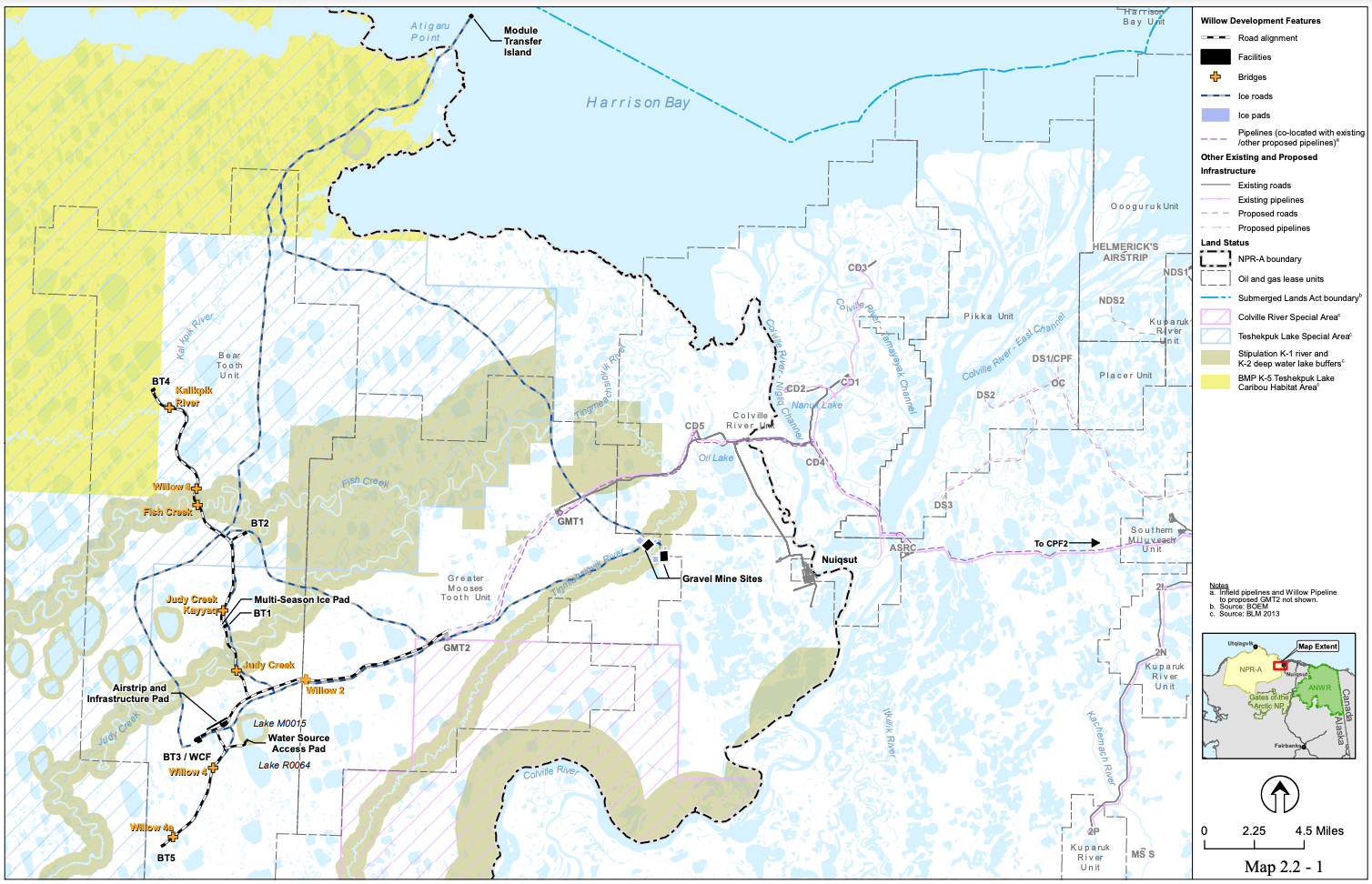
    image1

    Plaintiffs’ Complaint

    On March 14, 2023, Earthjustice, a non-profit environmental law organization, filed a complaint on behalf of several plaintiffs. Included in the group of plaintiffs are the Natural Resources Defense Council, Center for Biological Diversity, Defenders of Wildlife, Friends of the Earth, and Greenpeace, Inc.

    In their complaint, the plaintiffs allege that the BoLM failed to adequately assess the Willow Oil Project’s impacts on the region’s wildlife and its contributions to climate change before issuing its ROD, allowing the project to move forward, thus violating the NEPA, ESA, and Administrative Procedure Act (APA). The complaint consists of five claims for relief.

    Count I: NEPA

    In the first count, plaintiffs assert that the BoLM’s final SEIS violated the NEPA by failing to consider any project-alternative “that would meaningfully reduce the climate impacts of the Willow Project by reducing total downstream greenhouse gas emissions, or any alternative that would prohibit infrastructure in the Teshekpuk Lake Special Area and the Colville River Special Area.” Plaintiffs take issue with the fact that although BLM considered action alternatives as required by NEPA, all of the alternatives were based on BoLM fully developing the entirety of its oil and gas leases. Plaintiffs disagree with the BLM’s assertion that this was proper and necessary to avoid “strand[ing] an economically viable quantity of recoverable oil.”

    Count II: NEPA

    Plaintiffs’ second count alleges that the BLM committed another violation of NEPA by failing to take a “hard look” at the reasonably foreseeable risk of oil spills and potential discoveries of oil production prospects resulting from the project. Thus, the agency fell short of its NEPA duties to disclose and analyze the indirect and cumulative impacts of the Willow Oil Project.

    Count III: Reserves Act (APA)

    The third count in the plaintiffs’ complaint alleges that the BoLM violated the APA’s arbitrary and capricious decision-making standard by failing to act in accordance with the Reserves Act. The Reserves Act requires that the Secretary of the Department of the Interior “protect[] the ‘environmental, fish and wildlife, and historical or scenic values’ within the Reserve.” Plaintiffs believe that the BoLM’s evaluation of only “full lease development” project alternatives contradicts its protection duties under the Reserves Act “to condition, restrict, or prohibit activity as it determines necessary to protect surface resources.”

    Count IV: ESA – Unlawful NMFS Letter of Concurrence

    Plaintiffs’ fourth claim is that the BoLM biological assessment to the National Marine Fisheries Service (NMFS) and the NMFS Willow Letter of Concurrence failed to analyze the possible taking of ringed and bearded seals, along with other listed species. Plaintiffs fear that the taking of these ESA-listed seals would occur as a result of the project’s greenhouse gas emissions affecting their critical habitats. The complaint is silent on the nexus between the emissions and the habitat effects. Still, it asserts that the NMFS conclusions failed to properly engage in ESA Section 7 formal consultation to determine the project’s effects on the listed seals and prepare the necessary incidental take statements. Thus, the letter’s analysis of the affected threatened species and their critical habitats was arbitrary and capricious.

    Count V: ESA – Unlawful FWS Biological Opinion

    The fifth and final claim in the complaint argues that the FWS’s biological opinion was arbitrary and capricious due to its failure to properly consider in view of the best available science the threats to polar bears brought on by climate change exacerbated by the Willow Oil Project’s greenhouse gas emissions. Polar bears, like the seals above, are a listed species under the ESA. Plaintiffs allege that the potential greenhouse gas emissions would increase sea ice melting, which will decrease the availability of ice seal prey in the polar bear’s critical hunting habitat. The agency did not prepare the necessary incidental take statement for polar bears either.

    Requested Remedy

    To remedy the violations asserted, plaintiffs request that the court vacate the BoLM’s project approval and supporting documents on the ground that the approval decision was arbitrary and capricious. Plaintiffs also seek a reward of costs and attorneys fees related to the action.

    Defendants have not yet responded to the federal complaint, filed March 14, 2023. 
    Victoria Kline

    Victoria KlineGuest Writer

    Victoria is a third-year student at the University of Miami School of Law, Juris Doctorate Candidate 2023, Law Review Staff Editor, and soon-to-be associate at Jones Day.

  • Government Involvement in Medical Decisions During Outbreaks with Bryce McColskey and Sandra Cianflone

    Government Involvement in Medical Decisions During Outbreaks with Bryce McColskey and Sandra Cianflone

    Government Involvement in Medical Decisions During Outbreaks 

    It’s apparently (and hopefully) on its last legs. The Covid-19 pandemic was the most recent health issue to raise questions around government’s involvement (or interference) in an individual’s control over their own medical treatment.

    In their article – Government Involvement in Medical Care Decisions During Outbreaks of Disease: How Far is Too Far? – our guests wrote about the intersection of law and medicine. They reviewed medical mandates, implications brought about by the impact of advances in science and medicine, and where role of government to protect public health intersects (or collides) with personal healthcare choices. They focused is on governmental responses to the pandemic, that is, what the government can mandate in the spirit of public health, and not on the separate issue of abortion, which is a “choice” subject for another day.

    How much authority do government agencies or even the courts have over a person’s healthcare decisions? People often assume the practice of medicine and the enactment and enforcement of laws are separate and independent enterprises; that they remain fixed in their respective corners. However, they wrote, after a deeper  dive  into  history and precedent, it’s evident that the tension between individual rights and health-related mandates has existed for some time.

    Listen to my interview with the authors, Bryce McCloskey and  Sandra M. Cianflone with Hall Booth Smith, P.C. Bryce is based in Jacksonville, Fla., where he focuses on medical malpractice and professional liability law. Sandie is a partner in the firm’s Atlanta office where she concentrates on a variety of aspects of healthcare defense She chairs the firm’s Coronavirus Task Force and is a member of the firm’s National Trial Counsel team. She is also a valued member of the Editorial Board of Advisors of the Journal on Emerging Issues in Litigation.

    ***********

    This podcast is the audio companion to the Journal on Emerging Issues in Litigation. The Journal is a collaborative project between HB Litigation Conferences and the Fastcase legal research family, which includes Full Court Press, Law Street Media, and Docket Alarm. The podcast itself is a joint effort between HB and our friends at Law Street Media. If you have comments or wish to participate in one our projects please drop me a note at Editor@LitigationConferences.com.

    Tom Hagy

    (actual size)

    Tom Hagy
    Litigation Enthusiast and
    Host of the Emerging Litigation Podcast
    Home Page
    LinkedIn

    Bryce McColskey

    Bryce McColskeyHall Booth Smith P.C.

    Bryce McColskey focuses his practice on medical malpractice, professional liability, and general liability matters.

    Prior to joining Hall Booth Smith, Bryce was an Associate with another firm in Jacksonville where he focused his practice on workers’ compensation defense. Earlier in his career, he worked as a summer clerk for the University of North Florida’s Office of General Counsel and a local firm in Jacksonville.

    Bryce earned a Juris Doctorate from the University of Florida Levin College of Law where he was a member of the University of Florida Association of Law and Business and the Chester Bedell Inn of Court. Bryce earned his Bachelor of Science degree in Business Administration from the University of North Florida.

    Sandra Cianflone

    Sandra CianfloneHall Booth Smith P.C.

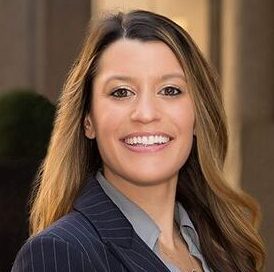
    Sandra Cianflone is a Partner in the Atlanta office of Hall Booth Smith. Her practice primarily focuses on medical malpractice on defending hospitals, healthcare institutions, physicians, nurses and institutional employees in medical malpractice actions from inception through trial. She is part of Hall Booth Smith’s National Trial Counsel team and has litigated cases across the country.

    Sandra also provides national risk management and crisis management services across the healthcare industry. These services have guided clients through tumultuous regulatory and statutory schemes by providing efficient approaches which assist with public/community relations, litigation preparation, defense alternatives, and effective case management. Ms. Cianflone is also the Chair of our Coronavirus Taskforce.

    Sandra received her Juris Doctorate from Pace University School of Law and her undergraduate degree from Fairleigh Dickinson University.

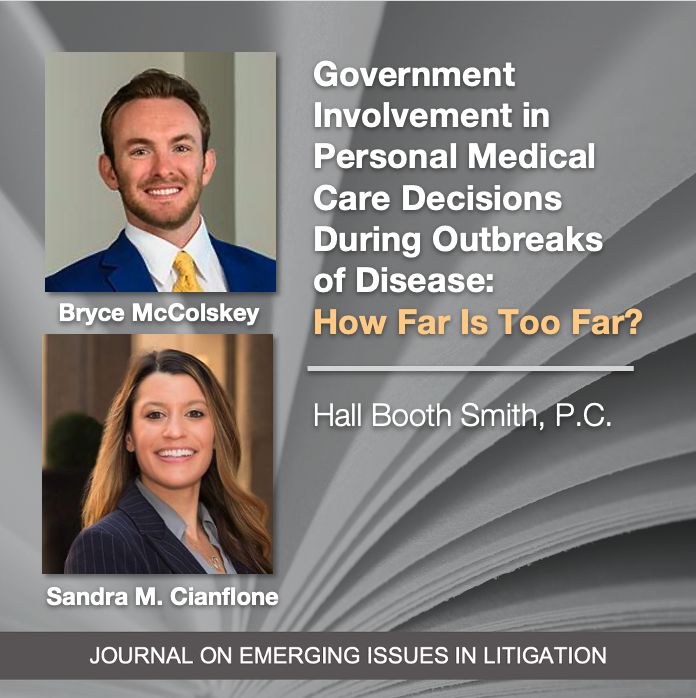
  • Government Involvement in Personal Medical Care Decisions During Outbreaks of Disease: How Far Is Too Far? by Bryce McColskey and Sandra M. Cianflone

    Government Involvement in Personal Medical Care Decisions During Outbreaks of Disease: How Far Is Too Far? by Bryce McColskey and Sandra M. Cianflone

    The Authors

    Bryce McColskey

    Bryce McColskeyHall Booth Smith

    Bryce McColskey (bmccolskey@hallboothsmith.com) is an attorney with Hall Booth Smith, P.C., based in Jacksonville, Florida, where he focuses on medical malpractice and professional liability law.

    Sandra Cianflone

    Sandra CianfloneHall Booth Smith

    Sandra M. Cianflone (scianflone@hallboothsmith.com) is a partner in the Atlanta office of Hall Booth Smith, where she concentrates on a variety of aspects of healthcare defense and chairs the firm’s Coronavirus Task Force. She is also a member of the Editorial Board of Advisors of the Journal of Emerging Issues in Litigation.

    The Journal on Emerging Issues in Litigation

    Emerging Litigation Podcast

    Emerging Litigation PodcastProduced by HB Litigation and Law Street Media

    Interviews with leading attorneys and other subject matter experts on new twists in the law and how the law is responding to new twists in the world.

    Government Involvement in Personal Medical Care Decisions During Outbreaks of Disease: 

    How Far Is Too Far?

    “Breakthroughs in technologies, our knowledge of diseases and mutations, and advances in treatment options have been remarkable and have drastically reduced fatality rates from disease outbreaks. However, regardless of medical achievements, rapid changes in any field open the door to renewed debates over different laws and individual rights.”

    Abstract: The coronavirus pandemic is the latest health issue to raise the question of government’s involvement (or interference) with an individual’s control over their own healthcare and medical treatment. In this article, the authors, two health care and professional liability attorneys, discuss the intersection of law and medicine with a review of medical mandates, the impact of advances in science and medicine, and where role of government to protect public health intersects (or collides) with personal healthcare choices. Their focus is on governmental response to the coronavirus pandemic, and not the recent landmark case dealing with choice. But add to the equation the Supreme Court’s ruling on abortion in Dobbs v. Jackson Women’s Health, the “government as healthcare decision maker” is an issue that will be on the front burner for courts, policymakers, healthcare providers, patients, and attorneys for years to come.

    How much authority do government agencies or even the judiciary have over the healthcare decisions of individuals? This question has been hotly contested in recent years, specifically with the emergence of COVID-19. Individuals often assume the practice of medicine and the enactment and enforcement of laws are separate and independent enterprises; that they remain fixed in their respective corners.

    However, when we dive deeper into this issue and look at history and precedent, it is evident that the rights of individuals versus mandates of government in respect to healthcare has been going on for some time, and will continue for years to come.

    Download the article now!

  • The Cannabis Employment Law Patchwork with Keya Denner

    The Cannabis Employment Law Patchwork with Keya Denner

    The Cannabis Employment Law Patchwork with Keya Denner

    Maryland and Missouri are the latest states to legalize recreational cannabis for people 21 and older. Voters came out in favor of legalization in the November 2022 midterms, bringing the total recreational jurisdictions to 22 states and the District of Columbia. Voters in North Dakota, South Dakota, and Arkansas, however, decided against recreational marijuana. It remains legal for medical reasons in all five states. 

    In the employment context, both recreational and medicinal uses raise questions about protections for employees who use the drug legally.

    • Which states are enacting those protections?
    • What do multi-state employers need to do?
    • What about drug testing? As a requirement to get a job and as a requirement to keep your job?
    • What about this: who is going to say whether a worker is impaired? Will there really be hall monitors trained in spotting your high?

    For answers to these questions and more, listen to my interview with Keya Denner, a partner at Constangy, Brooks, Smith & Prophete LLP. Keya is an experienced litigator who has been practicing labor and employment law for almost 20 years. Few attorneys nationwide match Keya’s expertise in the area of legal cannabis and its impact on the workplace. He has counseled Fortune 500 companies in the retail, hospitality, and global logistics spaces to create compliant policies and better understand the ever-changing legal landscape brought about by the legalization of cannabis across the United States.  Most recently, Keya was named co-chair along with this colleague Ashley Orler of the firm’s new practice group focused on cannabis and employee substance abuse law. Keya received his J.D., cum laude, from Seton Hall University School of Law, J.D., cum laude, and his B.A., also cum laude, from Boston University.

    This podcast is the audio companion to the Journal on Emerging Issues in Litigation. The Journal is a collaborative project between HB Litigation Conferences and the Fastcase legal research family, which includes Full Court Press, Law Street Media, and Docket Alarm. The podcast itself is a joint effort between HB and our friends at Law Street Media. If you have comments or wish to participate in one our projects please drop me a note at Editor@LitigationConferences.com.

    Tom Hagy

    (actual size)

    Tom Hagy
    Litigation Enthusiast and
    Host of the Emerging Litigation Podcast
    Home Page
    LinkedIn

    Keya Denner

    Keya DennerConstangy, Brooks, Smith & Prophete, LLP

    Keya is an experienced litigator who has been practicing labor and employment law for almost 20 years. He has handled every type of labor and employment matter for his clients, ranging from discrimination, disability, non-compete and trade secret protections, to wage and hour class actions. Keya also has extensive experience counseling employers on matters relating to the Family and Medical Leave Act and the Americans with Disabilities Act.

    Most recently, Keya was named co-chair along with this colleague Ashley Orler of the firm’s new practice group focused on cannabis and employee substance abuse law. Keya received his J.D., cum laude, from Seton Hall University School of Law, J.D., cum laude, and his B.A., also cum laude, from Boston University.

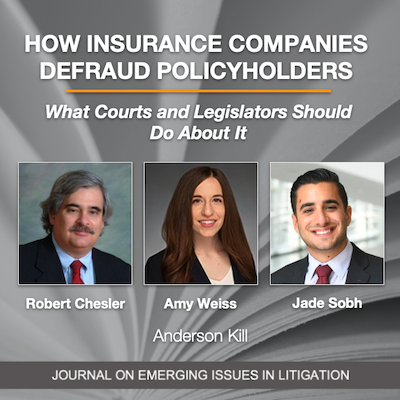
  • How Insurance Companies Defraud Their Policyholders, and What Courts and Legislators Should Do About It

    How Insurance Companies Defraud Their Policyholders, and What Courts and Legislators Should Do About It

    The Authors

    Robert D. Chesler

    Robert D. CheslerAnderson Kill

    Robert D. Chesler (rchesler@andersonkill.com) is a shareholder in Anderson Kill’s Newark office. Bob represents policyholders in a broad variety of coverage claims against their insurers and advises companies with respect to their insurance programs. Bob is also a member of Anderson Kill’s Cyber Insurance Recovery group.

    Bob has served as the attorney of record in more than 30 reported insurance decisions, representing clients including General Electric, Ingersoll-Rand, Westinghouse, Schering, Chrysler, and Unilever, as well as many small businesses including gas stations and dry cleaners. He has received numerous professional accolades, including a top-tier ranking for Insurance Litigation: New Jersey in Chambers USA: American’s Leading Lawyers for Business, which dubs him a “dominant force in coverage disputes” and cites a client who calls him “a dean of the insurance Bar; one of the brightest in writing about and analyzing insurance coverage.”

    Amy Weiss

    Amy WeissAnderson Kill

    Amy Weiss (aweiss@andersonkill.com) is a law clerk pending admission in Anderson Kill’s New York office. She focuses her practice on insurance recovery, exclusively on behalf of policyholders.

    While attending the Benjamin N. Cardozo School of Law, Amy worked as a Summer Associate at Anderson Kill and a Judicial Intern for the Honorable Nicholas G. Garaufis at the United States District Court for the Eastern District of New York.

    She served as Senior Articles Editor for the Cardozo Arts and Entertainment Law Journal, participated in the Cardozo Visual & Performing Arts Law Field Clinic, was a teaching assistant for the Lawyering & Legal writing course, and was a research assistant for Professor Stewart E. Sterk. Amy received the Dean’s Merit Scholarship and graduated with Honors.

    Jade Sobh

    Jade SobhAnderson Kill

    Jade W. Sobh (jsobh@andersonkill.com) is an attorney in Anderson Kill’s New York office. Jade focuses his practice on both insurance recovery, exclusively on behalf of policyholders, as well as Government Enforcement, Internal Investigations, and White Collar Defense. Jade’s practice also encompasses regulatory and complex commercial litigation matters.

    Prior to joining Anderson Kill, Jade was an associate at a leading New Jersey law firm, where he concentrated his practice in commercial litigation and criminal defense. His work there focused on corporate disputes, complex commercial litigation, real estate litigation, and appellate litigation. In his previous role, Jade also assisted in representing clients facing federal drug possession charges, and healthcare fraud allegations, among other criminal matters.

    Previously, Jade was a law clerk to The Honorable Robert C. Wilson in the Superior Court of New Jersey, Civil Division. Jade worked with Judge Wilson on cases in Bergen County’s Complex Business Litigation Program including insurance recovery disputes, construction litigation, corporate ownership issues, breach of contract, arbitration agreements, and franchise agreements.

    The Journal on Emerging Issues in Litigation

    Emerging Litigation Podcast

    Emerging Litigation PodcastProduced by HB Litigation and Law Street Media

    Interviews with leading attorneys and other subject matter experts on new twists in the law and how the law is responding to new twists in the world.

    How Insurance Companies Defraud Their Policyholders 

    What Courts and Legislators Should Do About It

    “By its very nature, fraud involves concealment and is difficult to detect. The overwhelming majority of victims of fraud do not even know that they have been defrauded when an insurance company denies their claim or cancels their policy, and have no recourse.”

    Abstract: Insurance companies have legitimate reasons for denying claims, but sometimes denials or significant delays are the result of unfair practices or even fraud. Such actions may be systemic or undertaken by an individual. What rights do policyholders have? What can they do to combat illegitimate denials? What are the barriers individuals face when they are wrongfully denied coverage? Should there be a private right of action under the Unfair Trade Practices Act? Should policyholders’ attorneys’ fees be covered? What should courts and legislatures do to protect insurance consumers? In this article the authors answer these questions and more.

    Download the article now!

    Explore More from Anderson Kill!

    Journal on Emerging Issues, Editorial Board of Advisors

    The Use and Abuse of the Pollution Exclusion. By Dennis Artese, Jamie O’Neil, Robert Chesler

    The Environmental, Social, and Governance Police Have Arrived: Is your Insurance Ready. Authors: Dennis Artese, Bob Chesler.

    Podcast 1 of 2 series: PFAS Insurance Coverage with Jaana Pietari and Jim Fenstermacher and Litigation with Bob Chesler

    Poscast 2 of 2 series: Insurance Coverage for PFAS Claims

    How Insurance Companies Defraud Their Policyholders, and What Courts and Legislators Should Do About It. Authors: Robert Chesler, Amy Weiss, and Jade Sobh

    Climate Change, ESG, D&O Insurance: Collision or Cooperation? By Robert D. Chesler, Dennis J. Artese and Joseph Villa

    Remediating, Insuring, and Litigating PFAS Claims. By Dr. Jaana Pietari, PhD, MBA, PE, Jim Fenstermacher, PE, Dr. Michael Bock, PhD, MS, Robert D. Chesler and Nicholas M. Insua, Sheila Mulrennan, Robin Kelliher, Jason R. Waters

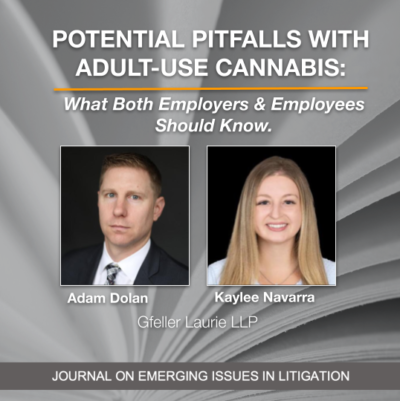
  • Potential Pitfalls with Adult-Use Cannabis: What Both Employers and Employees Should Know

    Potential Pitfalls with Adult-Use Cannabis: What Both Employers and Employees Should Know

    The Authors

    Adam R. Dolan

    Adam R. DolanGfeller Laurie LLP

    Adam R. Dolan (adolan@gllawgroup.com) is a partner with Gfeller Laurie LLP, a tested litigator with a multifaceted practice, he has extensive experience handling catastrophic transportation, general liability, and products liability matters. He is a frequent writer and speaker on topics related to the cannabis industry.

    Kaylee Navarra

    Kaylee NavarraGfeller Laurie LLP

    Kaylee E. Navarra (knavarra@gllawgroup.com) is an associate with Gfeller Laurie LLP where she works on matters involving commercial disputes, bad faith/
    extracontractual liability, and insurance coverage.

    The Journal on Emerging Issues in Litigation

    Emerging Litigation Podcast

    Emerging Litigation PodcastProduced by HB Litigation and Law Street Media

    Interviews with leading attorneys and other subject matter experts on new twists in the law and how the law is responding to new twists in the world.

    Potential Pitfalls with Adult-Use Cannabis:
    What Both Employers and Employees Should Know

    “Employers may also take action when the employee, while working, manifests specific articulable symptoms of cannabis impairment that decrease or lessen the employee’s performance of the employee’s tasks or duties and/or the employee, while working, manifests specific articulable symptoms of cannabis impairment that interfere with the employer’s obligation to provide a safe and healthy workplace as required by state and federal workplace safety laws.”

    Abstract: Recreational cannabis use for adults is legal in 21 states, having made its way eastward from Western jurisdictions that first addressed the issue. But these laws govern personal use during personal time. While they generally prohibit discrimination based on such use, these laws do not greenlight consumption at work or going to work under the influence. But with so many jurisdictions and job types, and variance among state laws, there aren’t simple answers. This is especially true for employers who conduct business nationwide, and because cannabis continues to be a Schedule I substance on the federal Controlled Substances Act. What rights and remedies do companies and workers have to resolve disputes? Are employers permitted to conduct drug tests? What about low-THC products and CBD? In this article the authors will address these and several other important questions.

    Download the article now!

  • The New European Unified Patent Court with Marianne Schaffner and Thierry Lautier

    The New European Unified Patent Court with Marianne Schaffner and Thierry Lautier

    What’s the new European patent court mean to global innovators?

    The European Union’s new Unified Patent Court is an international body set up by participating EU Member States to deal with the infringement and validity of both Unitary Patents and European patents. The court’s objective is “putting an end to costly parallel litigation and enhancing legal certainty.”

    Unitary patents are intended to make it possible to get patent protection in up to 25 EU Member States by submitting a single request to the European Patent Office, making the procedure simpler and more cost effective for applicants. The new system goes live on June 1, 2023.

    What must U.S. and multi-national U.S.-based companies understand about the court?

    Why should inventors and their organizations factor it in to any existing or new patent strategy they may be developing?

    For answers to these questions and more listen to my interview with attorneys Marianne Schaffner and Thierry Lautier who practice out of the Paris office of Reed Smith. Marianne heads the intellectual Property team in Paris and the patent practice in Europe. She manages complex national and transnational patent, trade secrets and trademark disputes in the healthcare, chemistry, technology and telecommunications sectors. Thierry is part of the firm’s global Intellectual Property Group. With a dual legal and engineering/scientific background, Thierry uses his understanding, knowledge, and experience to provide clients with creative, technically robust, and business-oriented patent strategies.

    This podcast is the audio companion to the Journal on Emerging Issues in Litigation. The Journal is a collaborative project between HB Litigation Conferences and the Fastcase legal research family, which includes Full Court Press, Law Street Media, and Docket Alarm. The podcast itself is a joint effort between HB and our friends at Law Street Media. If you have comments or wish to participate in one our projects please drop me a note at Editor@LitigationConferences.com.

    Tom Hagy

    (actual size)

    Tom Hagy
    Litigation Enthusiast and
    Host of the Emerging Litigation Podcast
    Home Page
    LinkedIn

    Marianne Schaffner

    Marianne SchaffnerReed Smith

    Marianne Schaffner is a partner in our Paris office. She heads the Intellectual Property team in Paris and the Patent practice in Europe.

    Marianne is a well-known intellectual property litigation lawyer. She is recognized for coordinating and managing complex national and transnational patent, trade secrets and trademark disputes in the healthcare, chemistry, technology and telecommunications sectors.

    Having studied and worked in the UK, Germany, the Netherlands and the United States, she has extensive knowledge of both the European and American judicial systems.

    Marianne Schaffner is repeatedly ranked by Chambers Global and Chambers Europe and is regularly ranked in Legal 500 EMEA, Décideurs, Stratégie Finance Droit among the Top Leaders.

    Thierry Lautier

    Thierry LautierReed Smith

    Thierry Lautier is part of the firm’s global Intellectual Property Group.

    Thanks to his dual legal and engineering/scientific background, Thierry is unique in being one of very few French patent litigators, qualified as both an attorney-at-law and a European patent attorney. As an optics and electronics engineer by background, Thierry uses his understanding, knowledge, and experience to provide clients with creative, technically robust, and business-oriented patent strategies.

    In addition to patents, Thierry counsels his clients on trade secrets. Thierry’s practice includes the building up of corporate trade secrets programs (the so-called “reasonable steps” to protect trade secrets), as well as the protection of trade secrets during court litigation (regarding confidential evidence). Thierry is the author of many articles in France on trade secrets and on their interplay with intellectual property.

  • Reimagining the Administration of Justice with Qudsiya Naqui of Pew Charitable Trust

    Reimagining the Administration of Justice with Qudsiya Naqui of Pew Charitable Trust

    Before COVID-19 came to America in early 2020, “going to court” literally meant putting on your shoes and walking into a courthouse, typically a large building with courtrooms inside, and people in robes and business suits and, in some cases, more restrictive attire. 

    Stoked by necessity, courts sprinted toward solutions for keeping the wheels of justice spinning while also keeping everyone away from each other. Until then it didn’t seem possible that attorneys could or would appear before judges via digital screens, like George Jetson getting yelled at by Mr. Spacely over some hilarious mishap at the sprocket factory.

    Pew Charitable Trust concluded an in-depth study of the courts with the 2021 release of a report,  “How Courts Embraced Technology, Met the Pandemic Challenge, and Revolutionized Their Operations.” After examining emergency orders from all 50 states and Washington, D.C., and court approaches to virtual hearings, e-filing, and digital notarization, the researchers wrote that it was a time for “reimagining how to administer justice.”

    Was the adoption of technology effective? Were there any hiccups? Was technology widely embraced? Were the effects of new efficiencies enjoyed evenly across the socio-economic spectrum? Do we think courts will continue to reimagine how they administer justice without the crushing pressure of widespread disease?

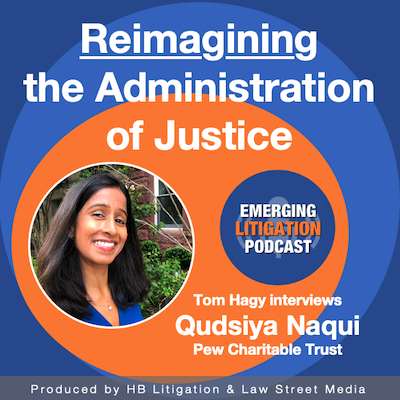
    Listen to my interview with Qudsiya Naqui who leads Pew’s research at the intersection of technology and civil legal system reform. In this role, she evaluates and tests new technologies to ensure that they further efficiency, equity, and transparency in the legal process. This work is part of Pew’s Civil Justice Modernization Project.

    Before joining Pew, Qudsiya designed and implemented immigration, housing, and disaster recovery legal services programs at Equal Justice Works and the Vera Institute of Justice. She began her legal career representing immigrant women and girls seeking relief from deportation.

    Qudsiya holds a bachelor’s degree in political science and human rights from Barnard College and a Juris Doctor from Temple University.

    For more information about their work and the research, contact them at media@pewtrusts.org.

    This podcast is the audio companion to the Journal on Emerging Issues in Litigation. The Journal is a collaborative project between HB Litigation Conferences and the Fastcase legal research family, which includes Full Court Press, Law Street Media, and Docket Alarm. The podcast itself is a joint effort between HB and our friends at Law Street Media. If you have comments or wish to participate in one our projects please drop me a note at Editor@LitigationConferences.com.

    Tom Hagy

    (actual size)

    Tom Hagy
    Litigation Enthusiast and
    Host of the Emerging Litigation Podcast
    Home Page
    LinkedIn

    Qudsiya Naqui

    Qudsiya NaquiPew Charitable Trust

    Qudsiya Naqui leads Pew’s research at the intersection of technology and civil legal system reform. In this role, she evaluates and tests new technologies to ensure that they further efficiency, equity, and transparency in the legal process. This work is part of Pew’s Civil Justice Modernization Project.

    Before joining Pew, Qudsiya designed and implemented immigration, housing, and disaster recovery legal services programs at Equal Justice Works and the Vera Institute of Justice. She began her legal career representing immigrant women and girls seeking relief from deportation.

    Qudsiya holds a bachelor’s degree in political science and human rights from Barnard College and a Juris Doctor from Temple University.

  • New Year, New Rules: FTC Proposes Sweeping Ban on Noncompete Agreements

    New Year, New Rules: FTC Proposes Sweeping Ban on Noncompete Agreements

    The Author

    Andreya DiMarco

    Andreya DiMarcoHatfield Schwartz Law Group LLC

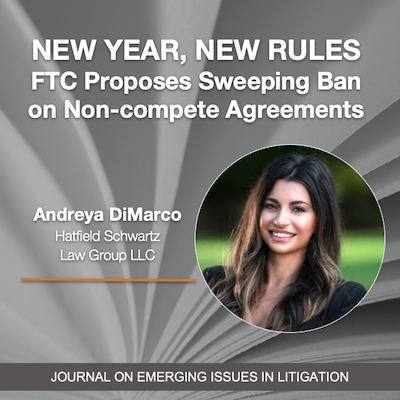
    Andreya DiMarco (adimarco@hatfieldschwartzlaw.com) is counsel with Hatfield Schwartz Law Group LLC where she focuses on employment law and transactional matters.

    She has defended clients in state and federal courts and before administrative agencies, including the EEOC and DCR.

    The Journal on Emerging Issues in Litigation

    Emerging Litigation Podcast

    Emerging Litigation PodcastProduced by HB Litigation and Law Street Media

    Interviews with leading attorneys and other subject matter experts on new twists in the law and how the law is responding to new twists in the world.

    New Year, New Rules:
    FTC Proposes Sweeping Ban on Noncompetes

    “This is the FTC’s first attempt to ban non-compete agreements and strong opposition to the Proposed Rule as well as challenges regarding the scope of the FTC’s rule-making authority are likely to arise especially given the tremendous impact a retroactive and absolute non-compete ban would have.  …. [P]otential litigation over the FTC’s authority to issue and enforce such a rule may cause further delays…. Moreover, the Proposed Rule is full of ambiguity which will likely be challenged.”

    Abstract: On January 5, 2023, the Federal Trade Commission published a Notice of Proposed Rulemaking that would ban the use of noncompete agreements between employers and workers and would create an affirmative obligation for employers to void existing noncompete agreements. The Proposed Rule would also prohibit contractual clauses in other agreements or employment policies that have a similar effect. The Proposed Rule applies categorically to all workers, including independent contractors, without regard to a worker’s earnings or job function. This article discusses the nuances of the Proposed Rule as well as the legal and practical impact it will have if it is adopted.

    Download the article now!

  • Supplier Beware: The DOJ & FTC Investigating Manufacturing & Supply Chains

    Supplier Beware: The DOJ & FTC Investigating Manufacturing & Supply Chains

    The Author

    Jennifer Driscoll

    Jennifer DriscollRobinson + Cole

    Jennifer M. Driscoll (jdriscoll@rc.com) is counsel with Robinson+Cole in New York where she focuses on investigations, litigation, arbitration, mergers, and counseling. She has extensive experience in the medical devices, pharmaceuticals, electronics, and automotive industries.

    The Journal on Emerging Issues in Litigation

    Emerging Litigation Podcast

    Emerging Litigation PodcastProduced by HB Litigation and Law Street Media

    Interviews with leading attorneys and other subject matter experts on new twists in the law and how the law is responding to new twists in the world.

    Supplier Beware:
    DOJ & FTC Investigating Manufacturing & Supply Chain Issues

    “Although competitors may attend trade association meetings, the company representative in attendance should be well versed on the line between lawful discussions and ruses to disguise unlawful collusion in violation of the Sherman Act.”

    Abstract: Challenged by the pandemic, the global supply chain has generated a heightened amount of scrutiny for its impact on the economy, the labor market, the delivery of goods and services, and national security. Attention from the Biden administration portends an era when the federal government will shine a spotlight on the supply chain to root out misconduct. In this article, the author reviews recent supply chain disruptions and reactions from the DOJ and FTC, as well as the government’s efforts to support competition in the labor markets by eliminating noncompete agreements in employment contracts. Finally, she discusses proactive steps companies can take to mitigate the risk that they will find themselves the subject of a government investigation.

    Download the article now!