Tag: Wage and Hour

  • Unraveling “Reverse Discrimination” with Employment Attorney Leah Stiegler on the Emerging Litigation Podcast

    Unraveling “Reverse Discrimination” with Employment Attorney Leah Stiegler on the Emerging Litigation Podcast

    Unraveling “Reverse Discrimination” with Leah Stiegler

    Concepts: Discrimination ; Employment Law

    What happens when the traditional understanding of workplace discrimination is turned on its head? Will the Supreme Court’s unanimous ruling in Ames v. Ohio Department of Youth Services change how discrimination cases are evaluated when brought by members of majority groups?

    Attorney Leah Stiegler of Woods Rogers joins us to examine this decision that rejected the “background circumstances rule” — a standard that previously imposed a heightened evidentiary burden on white, heterosexual, or male plaintiffs claiming discrimination. As Leah explains, “There’s no such thing as reverse discrimination. It’s just discrimination.” This simple yet insightful statement captures the essence of the Court’s reasoning that Title VII protections apply equally to all employees, regardless of their demographic status.

    Leah shares results from mock trials conducted with identical facts in different Virginia jurisdictions. A conservative Lynchburg jury awarded a white male plaintiff $600,000, while a more liberal Richmond jury found no discrimination whatsoever with the exact same evidence. This highlights how geography and community values dramatically influence discrimination case outcomes, sometimes more than the legal standards themselves.

    We also explore the McDonnell Douglas burden-shifting framework that remains the analytical backbone of discrimination cases, the emerging concept of intersectional discrimination, and recent executive orders concerning religious expression in the workplace. Throughout our discussion, Leah offers practical insights for employers navigating these evolving issues, emphasizing that while the political discourse around DEI initiatives may be contentious, the fundamental prohibition against discrimination remains unchanged.

    Whether you’re an employer developing workplace policies, an HR professional conducting training, or an employee trying to understand your rights, this episode provides essential context for understanding how discrimination law is evolving in unexpected ways. Subscribe to the Emerging Litigation Podcast for more in-depth analysis of the legal issues shaping our workplaces and society.

    This is Leah’s second appearance on the podcast and I appreciate it!

    I hope you enjoy the conversation! If so, give us a rating!

    If you have comments, ideas, or wish to participate, please drop me a note at Editor@LitigationConferences.com.

    Tom Hagy
    Litigation Enthusiast and
    Host of the Emerging Litigation Podcast
    Home Page
    LinkedIn

    podcast logo face


    Want to appear on the Emerging Litigation Podcast?


    Send us your idea! 

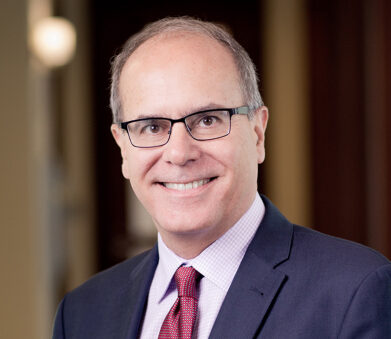
    It’s possible it could make this man smile. But let’s not get ahead of ourselves.

    Leah Stiegler

    Leah StieglerWoodsRogers

    Leah can walk employers through any workplace situation. From complex personnel matters, to implementing client-specific performance management practices, Leah advises employers to navigate these issues to keep them out of court. Her counseling covers the entire employment spectrum: recruitment, onboarding, workplace culture, pay equity audits, RIFs, terminations and severance packages.

    Leah handles workplace investigations and defends actions before administrative agencies such as the EEOC, DOL, and NLRB. Leah has extensive litigation experience, defending employers in state and federal court.

    Leah also represents employers navigating union issues, labor relations arbitrations and collective bargaining. Every workforce loves Leah’s dynamic public speaking style. Having traveled the Mid-Atlantic to train front-line employees, upper management, HR and other industry professionals, Leah creates custom workforce training programs with her team and has fun doing it!

    Leah earned her J.D. from the University of Richmond School of Law, cum laude, Order of the Coif.

  • Trends and Strategies in Wage & Hour Class and Collective Actions

    Trends and Strategies in Wage & Hour Class and Collective Actions

    Trends and Strategies in Wage & Hour Class and Collective Actions

    The lower half of large stone pillars outside a courthouse, symbolizing strength and justice.

    Gain a better understanding of the Fair Labor Standards Act (FLSA) and wage and hour collective actions, get up to date on significant trends and recent key settlements in this area of law, and grasp the main considerations for conditional class certification and decertification and the key collective action rulings handed down in 2023.  

    Developed and presented by three practicing attorneys with expertise in employment law and complex litigation, this webinar is designed for attorneys and other professionals who wish to a) better understand the Fair Labor Standards Act (FLSA) and wage and hour class and collective actions, b) get up to date on significant trends and recent key settlements in this area of law, and c) grasp the main considerations for conditional class certification and decertification and the key collective action rulings handed down in 2023. This course’s core objectives are to give you an overview of FLSA, wage and hour class and collective actions, background on Rule 23 class actions, and insight into notable trends and leading settlements. We will address points of deliberation for conditional certification and decertification of class and collective actions, looking at widely used certification methods and certification rates, then close with key rulings in this area of law issued in 2023. 

    Join experienced class action defense litigators Gerald L. Maatman, Jr., Jennifer A. Riley, and Greg Tsonis for a high-level breakdown of trends and strategies in wage & hour class and collective actions. Sign up today!

    Learning Objectives

    Gain a working understanding of the Fair Labor Standards Act. 

    Get a clear picture of the wage and hour class and collective actions landscape. 

    Understand the background of Rule 23 class actions. 

    Get current on significant trends in the law.  

    Learn the details and significance of recent settlements.  

    Know what factors are considered for conditional certification and decertification. 

    Come away with a solid grasp of recent wage and hour rulings.   

    Other Class Action Podcasts Worth a Listen:

    Hair Relaxer Injury Litigation with Jennifer Hoekstra

    TAKE IT NOW

    Available now to CeriFi LegalEdge subscribers. Don’t subscribe? Don’t despair. Use code HB20 for 20% off. Or, HBSub20 for 20% off a full solo subscription. While supplies last.

    Speakers

    Gerald L. Maatman, Jr.

    Gerald L. Maatman, Jr.Partner, Duane Morris LLP

    A widely recognized workplace class action defense litigator, Jerry is a Partner at Duane Morris LLP, where he chairs the firm’s Class Action Defense Group. He is a graduate of Washington & Lee University and the Northwestern University School of Law, where he has served as an adjunct professor for 34 years. The author of eight books on the law, Jerry is a sought-after legal commentator by major news organizations. He works out of the Duane Morris offices in Chicago and New York.

    Jennifer A. Riley

    Jennifer A. RileyPartner, Duane Morris LLP

    A partner in the Duane Morris Chicago office, Jennifer is vice-chair of the firm’s Class Action Defense Group. She regularly defends companies facing class actions, collective actions, pattern or practice lawsuits, and other types of representative proceedings, ranging in size from dozens to tens of thousands of claims. Jennifer also helps employers navigate thorny issues, including investigations, compliance, and terminations. She earned her J.D. from the University of California, Berkeley School of Law, and her B.A. from Vanderbilt University, magna cum laude.

    Gregory Tsonis

    Gregory TsonisPartner, Duane Morris LLP

    Gregory “Greg” Tsonis is an integral member of the Workplace Class Action Group at Duane Morris. With a practice that encompasses defending companies in a wide spectrum of employment law cases, Mr. Tsonis adeptly handles everything from complex, high-stakes class actions asserting wage & hour and discrimination claims to intense individual plaintiff cases and government agency investigations. His knowledge extends to a broad spectrum of federal and state statutes, including the Fair Labor Standards Act, state wage & hour laws, the Civil Rights Act, the Americans with Disabilities Act, the Biometric Information Privacy Act, and state consumer protection laws, among others. Mr. Tsonis received his Bachelor of Arts degree from the University of Chicago and his law degree, with honors, from the University of Chicago Law School.

  • Humans at Work with Leah Stiegler

    Humans at Work with Leah Stiegler

    Humans at Work with Leah Stiegler

    Concepts: Workplace Culture, Employment Law, Employment Compliance, Workplace Romance, Workplace Disputes, Pregnancy at Work, Harassment at Work, Working Overtime, Implicit Biases, Microaggressions

    People. We’re complicated creatures. We can be compassionate. We can fall in love. Sometimes we don’t care for each other, but here we are. 

    Also, some people cross the lines of propriety, causing emotional or even physical harm to others on our teams, whether we work with them, for them, or whether we supervise them. And sometimes we work more than regular hours, either because we’re directed to or because we’re willing to do what it takes to help our teams succeed. The workplace can be a labyrinth of tricky situations, and employers need to know how to make sure workers are able to navigate them smoothly, appropriately, and within changing laws and regulations.

    Our guest is Leah M. Stiegler, aprincipal attorney at Woods Rogers, who comes to the podcast with extensive experience across a broad spectrum of employment law matters. Leah is a trusted advisor to employers, providing guidance on complex personnel issues, performance management challenges, and fostering a positive work culture. Leah earned her J.D. from University of Richmond School of Law, cum laude, Order of the Coif, and her B.A. and B.S. degrees from Virginia Tech, summa cum laude.

    Listen as Leah shares practical solutions for a variety of challenges, like love at work, pregnancy at work, discord at work, harassment at work, and working overtime. She talks about gender identity protections, implicit biases, and microaggressions, plus conducting administrative investigations, and ideas to mitigate risk, stay out of court, and maintain a positive work environment.

    Thanks to Leah for sharing her insights on issues that arise where many of us spend most of our waking hours – at work! Her enthusiasm and passion for this work will be obvious to anyone who listens. I hope you enjoy it as much as I did producing it.

    I hope you enjoy the conversation! If so, give us a rating!

    This podcast is the audio companion to the Journal on Emerging Issues in Litigation. The Journal is a collaborative project between HB Litigation Conferences and the vLex Fastcase legal research family, which includes Full Court Press, Law Street Media, and Docket Alarm.

    If you have comments, ideas, or wish to participate, please drop me a note at Editor@LitigationConferences.com.

    Tom Hagy
    Litigation Enthusiast and
    Host of the Emerging Litigation Podcast
    Home Page
    LinkedIn

    podcast logo face


    Want to appear on the Emerging Litigation Podcast?


    Send us your idea! 

    It’s possible it could make this man smile. But let’s not get ahead of ourselves.

    Leah Stiegler

    Leah StieglerWoodsRogers

    Leah can walk employers through any workplace situation. From complex personnel matters, to implementing client-specific performance management practices, Leah advises employers to navigate these issues to keep them out of court. Her counseling covers the entire employment spectrum: recruitment, onboarding, workplace culture, pay equity audits, RIFs, terminations and severance packages.

    Leah handles workplace investigations and defends actions before administrative agencies such as the EEOC, DOL, and NLRB. Leah has extensive litigation experience, defending employers in state and federal court.

    Leah also represents employers navigating union issues, labor relations arbitrations and collective bargaining. Every workforce loves Leah’s dynamic public speaking style. Having traveled the Mid-Atlantic to train front-line employees, upper management, HR and other industry professionals, Leah creates custom workforce training programs with her team and has fun doing it!

    Leah earned her J.D. from the University of Richmond School of Law, cum laude, Order of the Coif.

  • Discovery Strategies in Wage and Hour Class and Collective Actions Before and After Certification of Putative Class

    Discovery Strategies in Wage and Hour Class and Collective Actions Before and After Certification of Putative Class

    Discovery Strategies in Wage and Hour Class and Collective Actions Before and After Certification of Putative Class

    Strategically Limiting Discovery, Resolving Discovery Disputes

    Wage and hour class and collective actions are complex and discovery intensive. Discovery requests are often burdensome, seeking information concerning a broad swath of workers. This causes the discovery process to sometimes linger for years and creates a significant expense for employers.In recent years, courts have emphasized that parties must rein in extensive and expensive discovery requests. Employment litigators are increasingly raising proportionality arguments as a basis for objecting to opposing counsel’s discovery requests.

    Drafters are responding by tailoring requests to anticipate such challenges. Drafting discovery requests that are likely to withstand burden and proportionality challenges and objections to broad discovery requests is critical for litigators representing employers in wage and hour class and collective actions. Employment litigators must develop and implement effective discovery strategies both before and, as applicable, after certification of the putative class. These strategies often must anticipate the possibility of a future summary judgment motion, further certification practice, and trial on the merits.

    Listen as our authoritative panel of employment law attorneys explains effective strategies for pursuing or objecting to discovery requests in wage and hour collective and class actions and resolving discovery disputes that arise during litigation.

    Questions Addressed:

    • What are the most common discovery challenges counsel face when litigating wage and hour collective and class actions–from initiation through resolution of the case?
    • What strategies have been effective in wage and hour collective and class actions for obtaining essential information with the least expense?
    • What is the scope of discoverable evidence before and after certification of the putative class, and how can you limit or best manage discovery?
    • When drafting discovery requests in wage and hour class and collective actions, what should employment counsel consider to ensure that the requests align with the proportionality standard?

    Interested in More CLE OnDemand? Click Here.

    Interested in this program? Click here to send us a note.

    On Demand CLE Webinar

    Interested in this program? Click here to send us a note.

    Speakers

    Gerald Maatman Jr.
    Partner
    Duane Morris
    GMaatman@duanemorris.com

    Noel P. Tripp
    Principal
    Jackson Lewis
    Noel.Tripp@jacksonlewis.com

    Outline

    1. Pursuing or objecting to discovery requests in wage and hour collective and class actions
      1. Before conditional collective or class certification
      2. After conditional certification of a collective action
      3. After class certification
    2. Discovery considerations for summary judgment
    3. Discovery considerations for trial
    4. Resolving discovery disputes

    Explore more from Duane Morris LLP!

    Journal (JEIL) Artificial Intelligence Litigation Risks in the Employment Discrimination Context. By Gerald Maatman Jr., Alex Karasik, and George Schaller

    CLE OnDemand Webinar: AI Nuts & Bolts Survival Guide: Artificial Intelligence – Discrimination in Employment Context. Gerald Maatman Jr., Alex Karasik, and George Schaller

    CLE OnDemand Webinar: Discovery Strategies in Wage and Hour Class and Collective Actions Before and After Certification of Putative Class. Gerald Maatman Jr., Noel P. Tripp

    CLE OnDemand Webinar: Rule 23(c)(4) Issue Certification: Reconciling the Conflict With the Predominance Requirement. Gerald Maatman Jr., Timothy Congrove, Jennifer Mesko and James Muehlberger

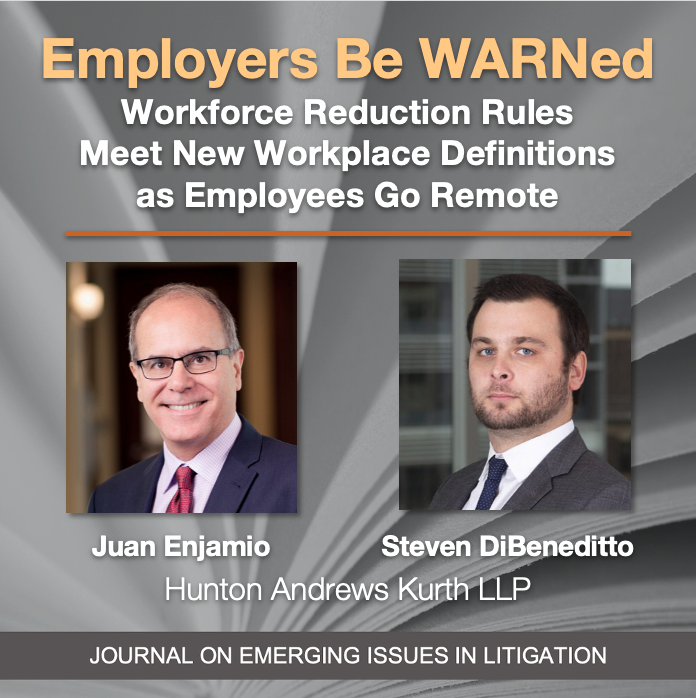
  • Employers Be WARNed: Workforce Reduction Rules Meet New Workplace Definitions as Employees Go Remote by Juan Enjamio and Steven DiBeneditto

    Employers Be WARNed: Workforce Reduction Rules Meet New Workplace Definitions as Employees Go Remote by Juan Enjamio and Steven DiBeneditto

    The Authors:

    Juan Enjamio

    Juan EnjamioHunton Andrews Kurth

    Juan C. Enjamio (jenjamio@huntonak.com) is managing parter of the Miami office of Hunton Andrews Kurth where he dedicates his practice to complex domestic and international employment law matters.

    Steven DiBeneditto Jr.

    Steven DiBeneditto Jr.Hunton Andrews Kurth

    Steven J. DiBeneditto Jr. (sdibeneditto@huntonak.com) is a Washington, DC-based associate in the firm’s employment and labor group.

    The Journal on Emerging Issues in Litigation

    Emerging Litigation Podcast

    Emerging Litigation PodcastProduced by HB Litigation and Law Street Media

    Interviews with leading attorneys and other subject matter experts on new twists in the law and how the law is responding to new twists in the world.

    Employers Be WARNed

    Workforce Reduction Rules Meet New Workplace Definitions as Employees Go Remote

    “Numerous courts have opined that a “home base” is a place in which the employee has some sort of physical connection. But this connection must be more than a “notional” base, whereby the employee has a menial relationship.”

    Introduction

    A common sentiment during the Covid-19 pandemic was that a different society would emerge from its ashes. While overstated in many cases, one segment of society that appears to have changed for good is the white collar workplace. Indeed, after enjoying the flexibility of working from home for more than 2 years, many white collar workers are demanding that a remote work option remain a permanent fixture at their place of employment. And with seemingly no negotiating leverage due to worker shortages across the country, employers have mostly acceded to these demands, with many opting to implement a “hybrid” workforce where employees work from home for part of the work week and transit to the physical workplace for the rest of the week. Other employers have opted to have employees work entirely from home in what is now generally known as a “remote” employee.

    But widespread adoption of a Hybrid Workforce presents a complex set of legal challenges for employers. These challenges are especially prevalent when making employment decisions using laws that were drafted decades ago to a new workplace that was never considered during the laws’ enactment. Nowhere is this problem more apparent than with the Worker Adjustment and Retraining Notification (“WARN”) Act, a statute adopted almost four decades ago in 1988. Simply put, the WARN Act sets forth notice requirements for employers who plan to close a plant or implement a reduction in force. Yet the WARN Act’s reduction in force provisions apply only to “single sites of employment,” which has been traditionally understood to mean a physical building or a group of buildings in contiguous locations. This  single site of employment definition makes the WARN Act ill-suited to address the emerging (but ubiquitous) issue of workers who are dispersed, e.g. Remote and Hybrid Workplaces.

    With that in mind, this article seeks to highlight the issues with the WARN Act and Remote and Hybrid Workplaces and package them into a guide for employers. The article begins by summarizing the WARN Act and the regulations for single sites of employment. It then shifts to a recent district court case analyzing the issue of Remote Work under the WARN Act for purposes of Rule 23(b)(3)’s predominance requirement for class certification. The article concludes by offering some suggestions to help prevent WARN Act liability.

    Download the article now!

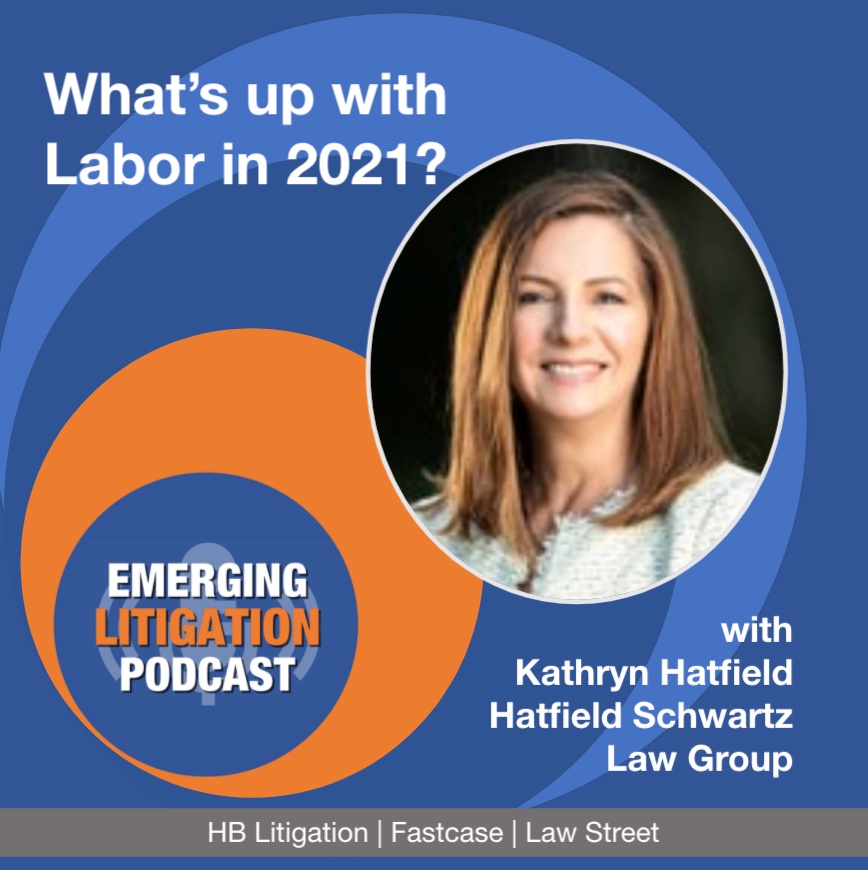
  • Labor Law in 2021 with Kathryn Hatfield

    Labor Law in 2021 with Kathryn Hatfield

    Labor Law in 2021 with Kathryn Hatfield

    Participation in labor unions is less than half of what it was 40 years ago. It has seen an uptick in the service sector, but a sharp decline in manufacturing. According to economist Heidi Shierholz decline in union rolls is partly responsible for today’s yawning income inequality gap. Recently we’ve seen the formation of a modest union at Google and a movement among Amazon workers. We’ve also seen how the pandemic has shone a bright light on the fragility of our nation’s workforce struggling to survive at the bottom rungs of the pay scale.

    Joining me to speak about these issues is Kathryn Van Deusen Hatfield, a senior managing partner at Hatfield Schwartz Law Group in New Jersey.  Kathy represents private and public sector employers in all aspects of labor and employment law, with expertise in litigating state and federal cases on behalf of employers involving Title VII, the ADA, the ADEA and the New Jersey Law Against Discrimination, and providing legal opinions and advice on personnel, employment and labor issues.  Kathy shares her insights on recent developments in the labor movement, some of the causes of its decline, how unions get a bad rap, and how, even though she represents management, she believes unions can be a good thing for everyone — employees and companies alike.

    This podcast is the audio companion to the Journal on Emerging Issues in Litigation, a collaborative project between HB Litigation Conferences and the Fastcase legal research family, which includes Full Court Press, Law Street Media, Docket Alarm and, most recently, Judicata. If you have comments or wish to participate in one our projects, or want to tell me how insightful and informative David and Dan are, please drop me a note at Editor@LitigationConferences.com.

    I hope you enjoy the interview, and how I managed to demonstrate how little I know about sports. I feel made up for it by learning something about baseball Hall of Famer Jim Rice, who did something really cool and heroic in 1982.

  • Kathryn Hatfield on Labor Law in 2021
    Kathryn Hatfield on Labor Law in 2021

    Kathryn Hatfield on Labor Law in 2021

    Participation in labor unions is less than half of what it was 40 years ago. It has seen an uptick in the service sector, but a sharp decline in manufacturing. According to Heidi Shierholz — former chief economist at the Department of Labor, now senior economist and policy director at the Economic Policy Institute — decline in union rolls is partly responsible for today’s yawning income inequality gap. Recently we’ve seen the formation of a modest union at Google and a movement among Amazon workers. We’ve also seen how the pandemic has shone a bright light on the fragility of our nation’s workforce struggling to survive at the bottom rungs of the pay scale.

    Joining me to speak about these issues is Kathryn Van Deusen Hatfield, a senior managing partner at Hatfield Schwartz Law Group in New Jersey.  Kathy represents private and public sector employers in all aspects of labor and employment law, with expertise in litigating state and federal cases on behalf of employers involving Title VII, the ADA, the ADEA and the New Jersey Law Against Discrimination, and providing legal opinions and advice on personnel, employment and labor issues.  Kathy shares her insights on recent developments in the labor movement, some of the causes of its decline, how unions get a bad rap, and how, even though she represents management, she believes unions can be a good thing for everyone — employees and companies alike.

    This podcast is the audio companion to the Journal on Emerging Issues in Litigation, a collaborative project between HB Litigation Conferences and the Fastcase legal research family, which includes Full Court Press, Law Street Media, Docket Alarm and, most recently, Judicata. If you have comments or wish to participate in one our projects, or want to tell me how insightful and informative Kathy is, please drop me a note at Editor@LitigationConferences.com.

    I hope you enjoy the interview, and how I managed to demonstrate how little I know about sports. I feel made up for it by learning something about baseball Hall of Famer Jim Rice, who did something really cool and heroic in 1982.

    Safeguarding Against Financial Exploitation

    An on-demand CLE-eligible webinar Safeguarding Against Financial Exploitation   America’s senior population is growing. Nearly one in five U.S. residents will be 65 or older in 2030. Which means the average age of U.S. investors is climbing too. With that comes the risk that they will be exploited by people with access – or gain access through nefarious methods – to their investment portfolio. Seniors and vulnerable persons lose billions of dollars each year. Remarkably, 90% of the people to take advantage of senior investors are members of their own family. Attorneys who represent senior clients need to know the signs of vulnerability, red flags that their clients are being exploited, what laws apply, and rules lawyers must follow in these matters.   Questions our speakers answer: What is senior / vulnerable investor exploitation?   Who is protected by state and federal laws?   How prevalent is senior financial exploitation? What do the numbers tell us?  What is the pace of financial abuse SAR filings by securities firms?  What are the most popular scams?   What is diminished capacity?  What are the red flags indicating possible exploitation?  What are the laws, rules, and regulations governing law firms?  What are some best practices for law firms?  How can firms best protect their senior clients?   On Demand CLE Webinar What You Get PowerPoint and supplemental materials. Complete recording for later review. Answers to your questions via email. Invitation to contact speakers. 1.5 CLE credits (for licensed attorneys). CLE assistance.* *Subject to state bar rules. For licensed attorneys.  Register Meet the Speakers Joseph Calabrese Bressler, Amery & Ross, P.C. A 1991 Graduate of St. John’s University Law School, Mr. Calabrese brings 30 years of practice and 18 years of Securities Litigation/Regulatory experience to his role as principal in the New York office of  Bressler, Amery & Ross’s Financial Institutions Group. He began his career as a Wall Street litigator as an associate general counsel for Citigroup’s Smith Barney and […]

    Lien Resolution: Government & Private Plans Get Aggressive (Against Attorneys)

    Includes Nearly 75 minutes of insights from experienced professionals. CLE credit: 1+ (subject to bar rules). For CLE questions: CLE@LitigationConference.com The complete Power Point presentation. Continued access to the complete recording for later use. Answers to your questions via email to the presenters or write to HB and we will be sure to contact the speakers. What can you do to settle personal injury suits cleanly and avoid costly litigation and penalties? What recent cases can inform you about protecting your settlements and, as attorneys, yourselves, from post-settlement federal lawsuits? How can your firm set itself up to meet government expectations? What role might experts play in navigating these pitfalls? Medicare Advantage (42 USC § 1395w-22) Federal Medical Care Recovery Act (FMCRA) (42 USC § 2651) Armed Forces Act (10 USC §1095) Veterans’ Benefits (38 USC §1729) Third-Party Collection Rules (32 CFR 537.24; 38 CFR 17.101, etc.) Set-Asides under the Medicare Secondary Payer Act (42 USC § 1395y(b)(2)] On Demand Registration Lien Resolution Government & Private Plans Get Aggressive (Against Attorneys!) On Demand | Recorded September 2020 It is increasingly common these days. Personal injury attorneys settle a case, only to find themselves sued by a U.S. Attorney for failing to reimburse Medicare for conditional payments as required by the Medicare Secondary Payer Act. In some cases the attorney may be required to pay fines in addition to the reimbursements and interest, a costly proposition. Are you up to speed on issues surrounding Medicare Advantage, TRICARE, veterans’ claims, and Medicare set-asides? Join nationally recognized healthcare lien and resolution expert Franklin P. Solomon and go-to lien resolution provider Brett Newman as they offer a practical, in-depth CLE presentation. Franklin P. Solomon, Esq. Attorney & Founder, Solomon Law Firm  A graduate of Rutgers University School of Law at Camden, Franklin Solomon is based in Cherry Hill, NJ, with a practice focused on evaluation, litigation and resolution of healthcare “liens” and reimbursement claims. Mr. Solomon represents personal injury victims and their attorneys […]

    Telepsychiatry: Mitigating the Risks

    REGISTER Registration Includes Nearly 90 minutes of insights from experienced professionals. CLE credit: 1+ (subject to bar rules). For CLE questions: CLE@LitigationConference.com The complete Power Point presentation. Continued access to the complete recording for later use. Answers to your questions via email to the presenters or write to HB and we will be sure to contact the speakers. Understand the risks associated with telepsychiatry and how to manage them.  Telemedicine has emerged as an important solution for healthcare in general and psychiatric medicine specifically during the current global pandemic. Remote access for sub-practices including addiction counseling have been commonly used. Our panel of psychiatric professionals who have served as expert witnesses and attorneys who counsel and represent physicians have prepared a 90-minute session to share insights with attorneys, physicians, healthcare providers, risk professionals, and more. Agenda Examining procedures and best practices that exist for ensuring confidentiality in a telemedicine practice How do you draft a telepsychiatric consent form? What is the emerging standard of care for telemedicine? Will the standard of care for telemedicine become a national standard? (Should it?) Review the case law addressing telemedicine or telepsychiatry How do the HIPAA regulations and HITECH privacy laws impact telemedicine? How have the HIPAA regulations and HITECH privacy laws been relaxed during the pandemic? Will the relaxed HIPAA and HITECH regulations impacting telemedicine continue past the pandemic? Which technical platforms are preferred? Which ones to avoid? Panelists Mark Levy, M.D., Medical Director at fpamed David Kan, M.D., UCSF Psychiatry Department and the California Society for Substance Abuse Medicine Ayesha Ashai, M.D., associated with fpamed Stephen M. Fatum, J.D., Partner, Barnes & Thornburg LLP Angela W. Russell, J.D., Partner, Wilson Elser Moskowitz Edelman & Dicker LLP Meet our physician and attorney panelists. Mark Levy MD Medical Director fpamed Dr. Levy is a graduate of Columbia College (A.B. 1967) and the Columbia University College of Physicians and Surgeons (M.D. 1971) in New York. He is a Physician […]

    The Commercial Drone Industry: Privacy, Security, Threats, and Mitigation of Risk

    HB presents a CLE-eligible webinar Now on-demand at the West LegalEdcenter THE COMMERCIAL DRONE INDUSTRY Privacy, Security, Threats, and Mitigation of Risk Drones have become an increasingly valuable tool for businesses of all types and sizes. Drones are already being used in many applications, but more will certainly arise as the technology advances. This means that certain risks, like cyber threats, will also continue to present themselves. Protecting the transmission and storage of data collected through drones is critical. Unfortunately, security usually comes as an afterthought. The drone industry is part of the aviation industry, which, based on its knowledge, keeps safety as a number one concern. Part of that safety is having proper protection for your systems, including security as a fundamental design principle. Take this webinar to gain insights on the topics listed below, and shared by an attorney who practices on the cutting-edge of this evolving technology. Topics: Defining drones. Current and future applications. FAA Modernization and Reform Act of 2012. FAA Part 107 Regulations and waivers. Resources, e.g. the FAA Drone Zone and LAANC Portal. Penalties for violations. Privacy implications. Drones as weapons. Vulnerability to cyber attacks. Take it now! What you get: 1+ CLE credits (subject to bar rules). Insights from an experienced professional who specializes in this area of the law. The complete PowerPoint presentation. Continued access to the complete recording for later use. Answers to your questions. Fee: No additional charge to subscribers to the West LegalEdcenter. Non-subscribers may take the course for $170. Meet the Speaker Kathryn Rattigan Robinson & Cole LLP Kathryn Rattigan is a member of the firm’s Business Litigation Group and Data Privacy + Cybersecurity Team. She advises clients on data privacy and security, cybersecurity, and compliance with related state and federal laws. She assists clients in assessing risks related to technology and software contracts, as well as with compliance-related issues with outsourcing and […]

    The Intersection of Privacy and Antitrust Webinar Now Available On-Demand on the West LegalEdcenter

    Available as part of your subscription to The Thomson Reuters West LegalEdcenter®. Don’t subscribe to the West LegalEdcenter? This webinar is still available directly from HB. Take it now! Questions for speakers Questions@LitigationConferences.com CLE questions CLE@LitigationConferences.com Check out the MoginRubin blog for more insights on antitrust and privacy law. What attorneys and companies need to know about the increasing interplay between these critical areas of the law.  Highly publicized cases and investigations in the U.S. and Europe of big technology, e-commerce, and social media companies demonstrate how anti-competition laws are being used to scrutinize and challenge not only how these corporations conduct themselves in the marketplace, but the very core of their colossal success: the mass collection and utilization of user data. Are the privacy and antitrust worlds beginning to cross over? Or do they simply run parallel while addressing entirely different types of conduct? Whatever the answer, data is the raw material that drives the likes of Google, Facebook, Apple and Amazon, so how it is handled is a critical question when counseling clients on mergers and acquisitions. Moderator Daniel J.  Mogin | Managing Partner, MoginRubin LLP Speakers Jennifer M. Oliver, CIPP/US | Partner, MoginRubin LLP Thomas N. Dahdouh | Director, Western Region, Federal Trade Commission Franklin M. Rubinstein | Partner, Wilson Sonsini Goodrich & Rosati Randi W. Singer, CIPP/US, CIPT | Partner, Weil, Gotshal & Manges Contributor Dina Srinivasan | Independent Researcher & Author of The Antitrust Case Against Facebook Dina was unable to present but we thank her for her content contributions.  Agenda Who should regulate privacy violations in the U.S.? Which antitrust issues implicate privacy concerns? What role does machine learning play on the competitive landscape? What is big data really? How is it different from “data”? What are the elements of effective merger reviews? What are the appropriate remedies? What are “notice-and-choice” versus “harms-based” approaches? Plus answers to your questions. Send them to Questions@LitigationConferences.com.

  • Employment Law in the COVID-19 Era with Stefani Schwartz

    Employment Law in the COVID-19 Era with Stefani Schwartz

    Employment Law in the COVID-19 Era with Stefani Schwartz

    Joining me to discuss this important subject is Stefani Schwartz, co-founder of the woman-owned employment-and-labor boutique Hatfield Schwartz in New Jersey. Stefani has devoted her legal career to representing employers in all aspects of employment law, including discrimination, harassment, retaliation, and wrongful termination matters.

    Stefani will be featured in the next issue of the Journal on Emerging Issues in Litigation, a collaborative project between HB and the Fastcase legal research family, which includes Full Court Press, Law Street Media, Docket Alarm and, most recently, Judicata. If you have comments or wish to participate in one our projects, or want to tell me how awesome Stefani is, drop me a note at Editor@LitigationConferences.com.

    We hope you enjoy the interview, and a guest appearance by Benny, her Portuguese Water Dog, you know, because she’s working from home. Stefani also shares one retail customer’s quick fix for forgetting her face mask.

    More of us are working from home and, given it often has advantages, it’s an arrangement that is likely to continue for many of us. 

    This raised the general question: Is your home officially “the office,” with all the attendant rules and norms?

    What new risks do employers face? What new ways can employees find themselves in trouble?

    We’re also getting vaccinated. But many are not. Can companies required employees to get the shot?

    Studies reveal that we’re not all bearing the burden of remote working evenly. Who is carrying more of the load? 

    Given these dramatic changes, should employers adjust their policies?  

  • Women in Law

    Western Alliance Bank presents a CLE-eligible webinar
    Women in Law
    Becoming the Master of Your Career

    According to the National Association of Women Lawyers, there has been a “sustained (albeit small) improvement for women amongst equity partners since the survey’s inception in 2006 (15% compared to 19% – 21% in recent years).”
    “This is a positive trend toward a more representative legal profession, but change at this glacial pace will continue to result in future generations of lawyers entering a profession where women and diverse attorneys are underrepresented in positions of power and influence. A continued, rigorous examination of and changes to existing practices – a movement from talk to action – is needed to speed progress in a meaningful way for women and other underrepresented groups.”
    As women work to advance their careers amid these market and social realities, there is much they can do on their own initiative to navigate their career in a manner that — over time — will meet or exceed their professional and personal objectives.
    We are fortunate two extraordinary women professionals have agreed to share a wealth of insights, tactics and strategies they employed to steadily rise through the ranks of their respective professions.
    Mary Beth Foley is General Counsel of Ohio Police and Fire Fund, and President of the National Association of Public Pension Attorneys. Joining her is Barbara Hart, Director and Executive Committee Member at the law firm Grant & Eisenhofer. Barbara is also a member of the Thirty Percent Coalition which advocates for diversity on Fortune 500 boards.
    Join us for an engaging format in which Mary Beth and Barbara take turns interviewing one another about proven strategies they recommend other women in the profession consider as they chart their careers. Review the topics they will cover, their brief biographies, and register for this complimentary program, underwritten by Western Alliance Bank Settlement Services.

    NOW ON DEMAND!

    take it now!

    What you get:

    • 1+ CLE credits (subject to bar rules).
    • 75 minutes of insights from experienced professionals.
    • The complete PowerPoint presentation.
    • Additional reading materials.
    • Ability to watch multiple times.
    • Answers to your questions by writing to the speakers.

    What they cover:

    • Setting career goals and objectives
    • Understanding the phases of your career
    • Knowing when to acquire new skills
    • Building, nurturing, and leveraging your network
    • Developing and executing your own business and strategic plan
    • Understanding the importance of risk
    • Exercising caution effectively
    • Building and maintaining resilience
    • Recognizing allies to your long-term success
    • Becoming “the master of your career” — a personal and professional growth imperative
    • Getting in the room and securing your seat at the table

    CLE Assistance

    Meet the Speakers

    Barbara Hart
    Director
    Grant & 
    Eisenhofer

    Barbara Hart is a director at Grant & Eisenhofer and serves on the firm’s Executive Committee. She has nearly three decades of experience as a leader in plaintiffs’ litigation. She has represented institutional investors, including many public pension funds, in securities and antitrust litigation and served as lead counsel in 4 of the top 100 securities class action settlements. Barbara has also achieved substantive antitrust and False Claims Act/Qui Tam settlements on behalf of her clients. In addition, she represents approximately 45 adult survivors of sexual abuse who are bringing claims against the Roman Catholic Archdiocese of New York, Rockefeller University and the Boy Scouts of America. Barbara is pioneering these claims in light of a change in New York law known as The Child Victim Act. Prior to joining G&E, she was President and CEO of a firm focusing on securities and antitrust litigation, and before that, she spent 17 years representing plaintiffs at the New York office of a complex financial litigation firm.

    Email

    Mary Beth Foley
    Interim Executive Director & General Counsel
    Ohio Police and Fire Pension Fund

    Mary Beth was appointed General Counsel to OP&F in 2008 and recently was named Interim Executive Director. She began her career with the Ohio Attorney General and spent eleven years as a trial attorney defending federal litigation brought against the State of Ohio. During that time she became a managing attorney in litigation and Assistant Chief of the Employment law division. Mary Beth later served as Fiduciary and Labor Counsel to the Attorney General and Auditor of State of Ohio. She was the Auditor’s advisor on the five Ohio Pension Systems as well as the Auditor’s board designee on the State Teachers Retirement System, the Ohio State Highway Patrol Retirement System and the School Employees Retirement System. Mary Beth is currently the President of the National Association of Pubic Pension Attorneys and Board liaison for the Public Safety Affinity Group. She is a member of the American Bar Association, the Ohio State Bar Association, Columbus Bar Association and a Mediator for the United States District Court for the Southern District of Ohio.

    Email