Public Justice Discusses Hardeman v. Monsanto in First Episode of Justice Pod

By Tom Hagy
 Facebook can be great fun. How else would I have seen a video of an eight-year-old drummer-girl utterly thrashing Led Zeppelin’s Good Times Bad Times? Or a dog running away with a lit skyrocket as his human friends run, duck and ditch for their lives? Or what your cat looks like in a tuxedo?
Facebook can also be a source of horror. Some of the most distressful commentary and images you wish you could un-see. And that’s just from my family.
Imagine your entire job is to monitor Facebook discussions and remove its graphic content. Day in and day out. That’s literally all you did.
A group of Facebook employees says that was their job, and their exposure to an “unmitigated barrage of horrifying content” and “toxic images” has caused them to suffer “debilitating trauma-related injuries.”
In September 2018 they filed suit in California Superior Court in San Mateo seeking an order requiring Facebook to implement safety guidelines for content moderators which, they say, the company has admitted are “necessary and appropriate.” They also want the company to fund a medical monitoring program for the diagnosis and treatment of psychological injuries including post-traumatic stress disorder, or PTSD. The plaintiffs quote Chris Harrison, whom they characterize as a Facebook executive in charge of the company’s “global resiliency team” as saying “of course” the company should offer content moderators post-employment counseling.
The plaintiffs filed the suit as a proposed class action, and relied on state laws including the California Unfair Competition Law alleging Facebook’s conduct was negligent, and negligence forms the basis of a UCL claim.
Facebook moved for a judgment on the pleadings, saying the facts are insufficient to constitute a community of interest required for class actions and that there is no ascertainable class. The company said the plaintiffs haven’t supported a claim for negligent provision of unsafe equipment or violation of the UCL, either.
The issue was set for a hearing on Aug. 9 but the parties agreed to take the case to ADR and stay the litigation until Oct. 7. If they don’t come to an agreement by then they will submit a new case schedule to the court (Selena Scola, et al. v. Facebook, Inc., Civil Case No. 18CIV05135, Calif. Super. Ct., San Mateo Co.).
What Lawyers Should Know
Coincidentally — and this has nothing whatsoever to do with the Facebook case — in preparing for our Aug. 21 webinar — PTSD in Mass Tort & Multi-Plaintiff Cases — Mark I. Levy, M.D., DLFAPA (who is in no way involved in that case) told me that “a majority of people who experience a traumatic and stressful event do not develop PTSD.” He said that multiple studies revealed that even in the extreme case of rape, 40-50% of victims do not develop PTSD. Of course, the flip side of that is that more than half do.
People have different levels of resiliency and vulnerability, he said, so what may cause PTSD in one person may not cause it in another. This isn’t to diminish anyone’s traumatic experience. The question is how these experiences impact the individual, not whether their experience was horrible or not, or illegal or not, which are separate questions. “The probability of an event causing PTSD in any particular individual is only partially related to the severity of the stressor,” Dr. Levy said. I asked him if there were degrees of PTSD, or whether someone can have “a touch of PTSD.” Dr. Levy explained that PTSD is a specific diagnosis with specific conditions. In other words, despite how the term may be used in common parlance, you can’t have “a little PTSD,” at least not in the clinical sense of the word.
In his presentation materials, Dr. Levy gives two examples of bad experiences that resulted in litigation but were found not to cause PTSD. “After a board meeting a secretary ate a left-over pastry contaminated with rat feces. She alleged she had PTSD because she could never work in that office again. Hers was a truly disgusting experience, but it did not cause PTSD,” Dr. Levy said. In another case a woman who endured unwelcome and explicit sexual overtures from her boss were, while clearly offensive and even unlawful, did not result in the woman’s PTSD. Dr. Levy discusses examples where individuals developed PTSD, such as battle experiences, train crashes, and others.
Here is a summary of the PTSD diagnostic criteria in the Diagnostic and Statistical Manual of Mental Disorders, or DSM-5:
A. Exposure to actual or threatened death, serious injury, or sexual violence.
B. Presence of one (or more) intrusive symptoms associated with the traumatic event(s).
C. Persistent avoidance of stimuli associated with the traumatic event(s), beginning after the traumatic event(s) occurred.
D. Negative alterations in cognitions and mood associated with the traumatic event(s), beginning or worsening after the traumatic event(s).
E. Marked alterations in arousal and reactivity associated with the traumatic event(s).
F. Duration of the disturbance (Criteria B, C, D, and E) is more than 1 month.
G. Functional Impairment: The disturbance causes clinically significant distress or impairment in social, occupational, or other important areas of functioning.
H. The disturbance is not attributable to the physiological effects of a substance (e.g., medication, alcohol) or another medical condition.
In the majority of cases, PTSD is accompanied by other psychiatric diagnoses (co-morbidity): Major Depression and/or Anxiety Disorder and/or Substance Abuse.
Dr. Levy — who is Medical Director at Forensic Psychiatric Associates Medical Corporation — cautions attorneys and others about the forensic use of DSM-5: “It is important to note that the definition of mental disorder included in DSM-5 was developed to meet the needs of clinicians, public health professionals, and research investigators rather than all of the technical needs of the courts and legal professionals.”
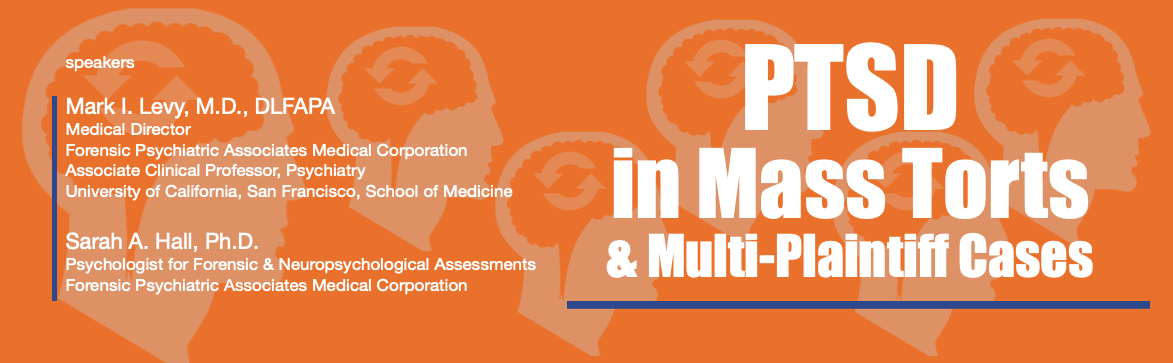
For attorneys interested in hearing more from Dr. Levy, and his colleague, Sarah A. Hall, PhD., Clinical Psychologist Specializing in Forensic & Neuropsychological Assessments, click the banner below and learn more about the webinar.
[one-half-first] [/one-half-first] [one-half]
“Jurors credited claims from Susan McFarland that the negligent design of a mesh implant she received in 2008 caused the product to saw through the soft tissue in her pelvis and become exposed in her vagina. She was eventually forced to undergo a second surgery to remove a portion of the implant.
“The pain she’s been left with as a result of the complications, she says, has prevented her from having sex with her husband for the last 10 years.
“This is the second time jurors have been asked to determine whether McFarland and her husband should be awarded damages for injuries she attributes to alleged defects in a so-called TVT-O implant she received to treat urinary stress incontinence.”
Read the complete article on Law360 here. [/one-half]
 [/one-half-first] [one-half]There have been numerous lawsuits filed alleging injuries caused by the shingles vaccine Zostavax. Cases have stated they were not warned of the adverse side effects of the vaccine alleging it caused the diseases it is meant to prevent, among other things.
Read more: https://www.cdc.gov/vaccines/vpd/shingles/public/zostavax/index.html
The vaccine is produced by Merck & Co. Their product information can be found here: https://www.merckvaccines.com/Products/Zostavax
“A North Carolina husband and wife recently filed a new Zostavax shingles vaccine lawsuit against pharmaceutical giant Merck & Co., alleging the vaccine caused serious side effects.
“The plaintiff, Cecilia S., says she was inoculated with the Zostavax vaccine on March 5, 2017, in order to prevent shingles (or herpes zoster). Unfortunately, the day after receiving this vaccine, Cecilia alleges she suffered from a number of problems, including herpes zoster, cellulitis, and postherpetic neuralgia.”
“West Virginia patient has filed a Zostavax lawsuit claiming the shingles vaccine gave her shingles instead of preventing her from getting it.
“Shingles is a rash caused by a virus, and can have lasting effects, according to Science News. Shingles is more common in older people, and recently, Pharmacy Times reported that there has been a push to increase vaccination rates.”
“Some patients have come forward with reports of major complications after treatment with Zostavax, a popular shingles vaccine—and some have even filed a shingles vaccine lawsuit over these Zostavax side effects.”
“A couple from Illinois alleges they are suffering from severe reactions to shingles vaccine, complications that pharmaceutical company Merck allegedly failed to warn about.
“The couple filed legal action after discovering other patients had reported similar adverse vaccine reactions soon after getting the Zostavax shot.
“Plaintiffs Victoria and Earl V. filed this Zostavax lawsuit alleging Victoria developed shingles, or herpes zoster, despite having been vaccinated against it.”
“Plaintiff Kim M. is the latest to lodge a lawsuit against Zostavax maker Merck and Company, arguing that the shingles vaccine causes preventable and dangerous Zostavax side effects such as hearing loss. She argues that she might have made a different decision about getting the shot if she had known about the risks.
“The plaintiff alleges that she received the Zostavax vaccine for regular health purposes and prevention of shingles in February 2016 while a resident of California.”
“A couple has filed a lawsuit alleging they suffer from shingles vaccine adverse effects.
“Plaintiffs Kathleen H. and Joseph W. say Kathleen received the Zostavax vaccine in 2017 for the prevention of shingles, medically known as herpes zoster.
“They allege she suffered severe side effects from the inoculation, including a stroke, physical limitations, mental and emotional distress and severe, permanent personal injuries.”
“The Zostavax shingles vaccine emerged on to the market as a new option for people at risk for developing shingles to guard against it. The CDC recommends that individuals aged 60 and older get the shingles vaccine whether or not they remember having had chicken pox previously in their life. According to research studies, more than 99 percent of Americans 40 and beyond have gotten chickenpox even if they don’t remember getting the disease.”
“Merck & Co. is facing a growing multidistrict litigation (MDL) consisting of similar claims alleging patients developed serious side effects from the company’s Zostavax shingles vaccine.
“One of the most recent Zostavax shingles lawsuits was filed by a woman from Tennessee, who alleges Merck failed to disclose the full scope of potential vaccine reactions.”
“This Zostavax lawsuit is joining a growing multidistrict litigation (MDL), which consists of similar claims alleging Merck failed to warn them against the full severity of the potential side effects associated with their shingles vaccine.
“Plaintiff couple Terrance and Brenda O. conjointly filed this Zostavax lawsuit, stating the side effects of the shingles has permanently impacted their marriage and their quality of life. Like numerous other patients in the United States, Terrance says he was prescribed the Zostavax injection to prevent shingles soon after he turned 60.”
“Many consumers have already come forward to allege a connection between the Zostavax shingles vaccine and the development of shingles itself.
“However, more patients are now arguing that the shingles vaccine and eye problems is another troubling connection about which the public is not aware.”
 “Doctors treated two plaintiffs for severe psychological problems, ultimately employing defendant’s Thymatron System IV to perform electroconvulsive therapy. Plaintiffs claimed that, as a result, they suffered brain trauma, memory loss and other brain-related injuries. They filed product liability claims based, in the main, on the manufacturer’s alleged failure to report adverse events. The decision in Riera addressed summary judgment motions, ones filed by both the plaintiffs and the defendant. You don’t ordinarily see summary judgment motions by plaintiffs, and Riera is an example of why.”