MoginRubin LLP
By Dan Mogin, Jonathan Rubin, Jennifer M. Oliver, and Timothy Z. LaComb

Explore more from MoginRubin LLP!
Podcast: Algorithmic Software Facilitated Price Fixing with Jonathan Rubin
OnDemand CLE Webinar: The Antitrust Case Against Google. Speakers Dan Mogin, Jonathan Rubin, Jennifer Oliver, Timothy LaComb, John Newman, Dr. Alan Grant
OnDemand CLE Webinar: Class Certification After Olean v. Bumble Bee, Jonathan Rubin, James Bogan, Jonathan Cohn, Bradley Hamburger
Interested in More CLE OnDemand? Click Here.
Interested in this program? Click here to send us a note.
Emboldened by New Resources and Expanded Authority, Feds Continue 10-Year Look Back at Chinese Investment
At a conference earlier this year on the Committee on Foreign Investment in the United States, or CFIUS, Assistant Treasury Secretary Thomas P. Feddo spoke with pride of the Committee’s increased funding, jurisdiction, expenditures, and more aggressive review activities.
Feddo began the speech by detailing how CFIUS has implemented the 2018 Foreign Investment Risk Review Modernization Act, or FIRMMA, which expanded its jurisdiction and increased its funding. The Committee has invested in new IT infrastructure and personnel, and since May of this year, the Treasury Department has been collecting filing fees for voluntary filers, a new policy which creates a funding mechanism to supplement its budget.
Feddo went on to discuss new rulemaking around foreign investment, including a proposed rule that would force any transaction to be filed with the Committee “if the foreign acquirer would need export control authorization to transfer the U.S. business’s products or technology to its home country.”1
Another topic was the Committee’s increased vigilance when it comes to monitoring and enforcement, noting an “unprecedented civil monetary penalty of $1,000,000 for repeated breaches of a 2016 CFIUS mitigation agreement, including failure to establish requisite security policies and failure to provide adequate reports to CFIUS.”
This fits with a recent trend in screening older cases that has been noted by journalist Jeanne Whalen of The Washington Post. In her Sept. 29, 2020, article, Whalen quoted Stephen Heifetz, a lawyer at Wilson Sonsini, as saying: “We’ve heard about matters going back almost 10 years. Historically, it was unusual for [CFIUS] to reach back more than three years. But there is in theory no time limitation, and we are increasingly hearing about long reach-back periods.”
CFIUS and national security figured prominently in President Trump’s order demanding that China’s ByteDance unwind its acquisition of TikTok. “While this executive order is one of a few seen under CFIUS, and only the fourth to unwind a completed transaction, it may be a harbinger,” we wrote in our Aug. 18, 2020 post. “Parties and counsel working on international deals must be acutely aware: this committee considers personal data a serious national security issue. It can and will block or unwind tech deals that give foreign access to Americans’ personal information.” See POTUS Uses CFIUS to Unwind TikTok Deal, Fears Chinese Government Will Get Americans’ Private Data by Dan Mogin and Jennifer M. Oliver.
As the headline of The Washington Post article said, “TikTok was just the beginning …”
But this isn’t the only corner of the federal government expanding its merger review program. Read more on the MoginRubin Blog.

Safeguarding Against Financial Exploitation
An on-demand CLE-eligible webinar Safeguarding Against Financial Exploitation America’s senior population is growing. Nearly one in five U.S. residents will be 65 or older in 2030. Which means the average age of U.S. investors is climbing too. With that comes the risk that they will be exploited by people with access – or gain access through nefarious methods – to their investment portfolio. Seniors and vulnerable persons lose billions of dollars each year. Remarkably, 90% of the people to take advantage of senior investors are members of their own family. Attorneys who represent senior clients need to know the signs of vulnerability, red flags that their clients are being exploited, what laws apply, and rules lawyers must follow in these matters. Questions our speakers answer: What is senior / vulnerable investor exploitation? Who is protected by state and federal laws? How prevalent is senior financial exploitation? What do the numbers tell us? What is the pace of financial abuse SAR filings by securities firms? What are the most popular scams? What is diminished capacity? What are the red flags indicating possible exploitation? What are the laws, rules, and regulations governing law firms? What are some best practices for law firms? How can firms best protect their senior clients? On Demand CLE Webinar What You Get PowerPoint and supplemental materials. Complete recording for later review. Answers to your questions via email. Invitation to contact speakers. 1.5 CLE credits (for licensed attorneys). CLE assistance.* *Subject to state bar rules. For licensed attorneys. Register Meet the Speakers Joseph Calabrese Bressler, Amery & Ross, P.C. A 1991 Graduate of St. John’s University Law School, Mr. Calabrese brings 30 years of practice and 18 years of Securities Litigation/Regulatory experience to his role as principal in the New York office of Bressler, Amery & Ross’s Financial Institutions Group. He began his career as a Wall Street litigator as an associate general counsel for Citigroup’s Smith Barney and […]
-
Lien Resolution: Government & Private Plans Get Aggressive (Against Attorneys)
Lien Resolution: Government & Private Plans Get Aggressive (Against Attorneys)
Lien Resolution: Government & Private Plans Get Aggressive (Against Attorneys)
Includes Nearly 75 minutes of insights from experienced professionals. CLE credit: 1+ (subject to bar rules). For CLE questions: CLE@LitigationConference.com The complete Power Point presentation. Continued access to the complete recording for later use. Answers to your questions via email to the presenters or write to HB and we will be sure to contact the speakers. What can you do to settle personal injury suits cleanly and avoid costly litigation and penalties? What recent cases can inform you about protecting your settlements and, as attorneys, yourselves, from post-settlement federal lawsuits? How can your firm set itself up to meet government expectations? What role might experts play in navigating these pitfalls? Medicare Advantage (42 USC § 1395w-22) Federal Medical Care Recovery Act (FMCRA) (42 USC § 2651) Armed Forces Act (10 USC §1095) Veterans’ Benefits (38 USC §1729) Third-Party Collection Rules (32 CFR 537.24; 38 CFR 17.101, etc.) Set-Asides under the Medicare Secondary Payer Act (42 USC § 1395y(b)(2)] On Demand Registration Lien Resolution Government & Private Plans Get Aggressive (Against Attorneys!) On Demand | Recorded September 2020 It is increasingly common these days. Personal injury attorneys settle a case, only to find themselves sued by a U.S. Attorney for failing to reimburse Medicare for conditional payments as required by the Medicare Secondary Payer Act. In some cases the attorney may be required to pay fines in addition to the reimbursements and interest, a costly proposition. Are you up to speed on issues surrounding Medicare Advantage, TRICARE, veterans’ claims, and Medicare set-asides? Join nationally recognized healthcare lien and resolution expert Franklin P. Solomon and go-to lien resolution provider Brett Newman as they offer a practical, in-depth CLE presentation. Franklin P. Solomon, Esq. Attorney & Founder, Solomon Law Firm A graduate of Rutgers University School of Law at Camden, Franklin Solomon is based in Cherry Hill, NJ, with a practice focused on evaluation, litigation and resolution of healthcare “liens” and reimbursement claims. Mr. Solomon represents personal injury victims and their attorneys […]

Telepsychiatry: Mitigating the Risks
REGISTER Registration Includes Nearly 90 minutes of insights from experienced professionals. CLE credit: 1+ (subject to bar rules). For CLE questions: CLE@LitigationConference.com The complete Power Point presentation. Continued access to the complete recording for later use. Answers to your questions via email to the presenters or write to HB and we will be sure to contact the speakers. Understand the risks associated with telepsychiatry and how to manage them. Telemedicine has emerged as an important solution for healthcare in general and psychiatric medicine specifically during the current global pandemic. Remote access for sub-practices including addiction counseling have been commonly used. Our panel of psychiatric professionals who have served as expert witnesses and attorneys who counsel and represent physicians have prepared a 90-minute session to share insights with attorneys, physicians, healthcare providers, risk professionals, and more. Agenda Examining procedures and best practices that exist for ensuring confidentiality in a telemedicine practice How do you draft a telepsychiatric consent form? What is the emerging standard of care for telemedicine? Will the standard of care for telemedicine become a national standard? (Should it?) Review the case law addressing telemedicine or telepsychiatry How do the HIPAA regulations and HITECH privacy laws impact telemedicine? How have the HIPAA regulations and HITECH privacy laws been relaxed during the pandemic? Will the relaxed HIPAA and HITECH regulations impacting telemedicine continue past the pandemic? Which technical platforms are preferred? Which ones to avoid? Panelists Mark Levy, M.D., Medical Director at fpamed David Kan, M.D., UCSF Psychiatry Department and the California Society for Substance Abuse Medicine Ayesha Ashai, M.D., associated with fpamed Stephen M. Fatum, J.D., Partner, Barnes & Thornburg LLP Angela W. Russell, J.D., Partner, Wilson Elser Moskowitz Edelman & Dicker LLP Meet our physician and attorney panelists. Mark Levy MD Medical Director fpamed Dr. Levy is a graduate of Columbia College (A.B. 1967) and the Columbia University College of Physicians and Surgeons (M.D. 1971) in New York. He is a Physician […]
-

The Commercial Drone Industry: Privacy, Security, Threats, and Mitigation of Risk
The Commercial Drone Industry: Privacy, Security, Threats, and Mitigation of Risk
-
The Commercial Drone Industry: Privacy, Security, Threats, and Mitigation of Risk
HB presents a CLE-eligible webinar Now on-demand at the West LegalEdcenter THE COMMERCIAL DRONE INDUSTRY Privacy, Security, Threats, and Mitigation of Risk Drones have become an increasingly valuable tool for businesses of all types and sizes. Drones are already being used in many applications, but more will certainly arise as the technology advances. This means that certain risks, like cyber threats, will also continue to present themselves. Protecting the transmission and storage of data collected through drones is critical. Unfortunately, security usually comes as an afterthought. The drone industry is part of the aviation industry, which, based on its knowledge, keeps safety as a number one concern. Part of that safety is having proper protection for your systems, including security as a fundamental design principle. Take this webinar to gain insights on the topics listed below, and shared by an attorney who practices on the cutting-edge of this evolving technology. Topics: Defining drones. Current and future applications. FAA Modernization and Reform Act of 2012. FAA Part 107 Regulations and waivers. Resources, e.g. the FAA Drone Zone and LAANC Portal. Penalties for violations. Privacy implications. Drones as weapons. Vulnerability to cyber attacks. Take it now! What you get: 1+ CLE credits (subject to bar rules). Insights from an experienced professional who specializes in this area of the law. The complete PowerPoint presentation. Continued access to the complete recording for later use. Answers to your questions. Fee: No additional charge to subscribers to the West LegalEdcenter. Non-subscribers may take the course for $170. Meet the Speaker Kathryn Rattigan Robinson & Cole LLP Kathryn Rattigan is a member of the firm’s Business Litigation Group and Data Privacy + Cybersecurity Team. She advises clients on data privacy and security, cybersecurity, and compliance with related state and federal laws. She assists clients in assessing risks related to technology and software contracts, as well as with compliance-related issues with outsourcing and […]
-
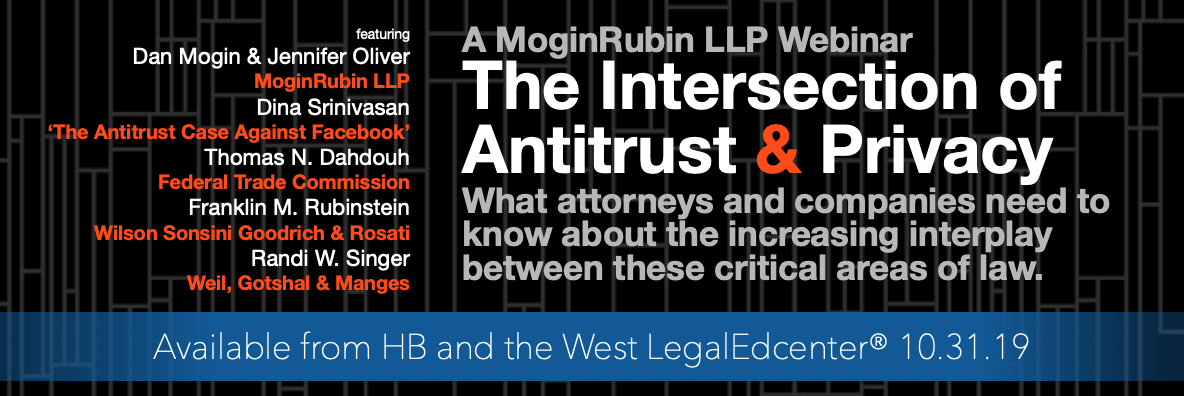
The Intersection of Privacy and Antitrust Webinar Now Available On-Demand on the West LegalEdcenter
The Intersection of Privacy and Antitrust Webinar Now Available On-Demand on the West LegalEdcenter
The Intersection of Privacy and Antitrust Webinar Now Available On-Demand on the West LegalEdcenter
Available as part of your subscription to The Thomson Reuters West LegalEdcenter®. Don’t subscribe to the West LegalEdcenter? This webinar is still available directly from HB. Take it now! Questions for speakers Questions@LitigationConferences.com CLE questions CLE@LitigationConferences.com Check out the MoginRubin blog for more insights on antitrust and privacy law. What attorneys and companies need to know about the increasing interplay between these critical areas of the law. Highly publicized cases and investigations in the U.S. and Europe of big technology, e-commerce, and social media companies demonstrate how anti-competition laws are being used to scrutinize and challenge not only how these corporations conduct themselves in the marketplace, but the very core of their colossal success: the mass collection and utilization of user data. Are the privacy and antitrust worlds beginning to cross over? Or do they simply run parallel while addressing entirely different types of conduct? Whatever the answer, data is the raw material that drives the likes of Google, Facebook, Apple and Amazon, so how it is handled is a critical question when counseling clients on mergers and acquisitions. Moderator Daniel J. Mogin | Managing Partner, MoginRubin LLP Speakers Jennifer M. Oliver, CIPP/US | Partner, MoginRubin LLP Thomas N. Dahdouh | Director, Western Region, Federal Trade Commission Franklin M. Rubinstein | Partner, Wilson Sonsini Goodrich & Rosati Randi W. Singer, CIPP/US, CIPT | Partner, Weil, Gotshal & Manges Contributor Dina Srinivasan | Independent Researcher & Author of The Antitrust Case Against Facebook Dina was unable to present but we thank her for her content contributions. Agenda Who should regulate privacy violations in the U.S.? Which antitrust issues implicate privacy concerns? What role does machine learning play on the competitive landscape? What is big data really? How is it different from “data”? What are the elements of effective merger reviews? What are the appropriate remedies? What are “notice-and-choice” versus “harms-based” approaches? Plus answers to your questions. Send them to Questions@LitigationConferences.com.