Tag: Advertising & Marketing

  • Authentic Business Development for Litigators: Stop Chasing Cases and Start Building Clients with John Reed on the Emerging Litigation Podcast

    Authentic Business Development for Litigators: Stop Chasing Cases and Start Building Clients with John Reed on the Emerging Litigation Podcast

    Authentic Business Development for Litigators: Stop Chasing Cases and Start Building Clients with John Reed

    Concepts: Law Practice Management

    Waiting for lawsuits to present themselves is the worst growth strategy a litigator can have.

    In this episode, I get to speak with John Reed, founder and chief relationship builder at Rain BDM and host of Sticky Lawyers, to rethink business development from the ground up. His most popular episodes was about Bob Mionske, an Olympic road racing cyclist turned “bicycle lawyer.” Give it a listen.  

    With a background spanning law, marketing, and sales, John helps attorneys translate the language of business development into practical strategies that work even within law firm cultures. Can you imagine? Known for blending creativity, emotional intelligence, and big-picture thinking, he brings a unique perspective on how lawyers can stand out authentically and effectively in a crowded market.

    John shares how traditional litigator traits—decisive, fast, commanding—can win in court but backfire with clients who value collaboration and reflection. He outlines a practical model for defining your professional brand through role, skill, context, and style—and explains why style may be your strongest differentiator.

    We also dig into how introverted lawyers can grow client relationships through substance, not small talk, and how remote mentoring can actually strengthen early-career development with the right habits and feedback.

    Whether you’re an associate building visibility or a partner looking to expand trusted relationships, this conversation will help you make your practice more resilient, referral-ready, and strategically aligned with how clients actually buy legal services.

    Thanks to Johnfor sharing his insight, humor, and practical wisdom on how to turn authentic connection into lasting business growth.

    As always, if you have comments or wish to participate in one our projects please drop me a note at Editor@LitigationConferences.com.

    Tom Hagy
    Litigation Enthusiast and
    Host of the Emerging Litigation Podcast
    Home Page
    LinkedIn

    John Reed

    John ReedFounder and Chief Relationship Officer, Rain BDM

    John Reed is the founder and Chief Relationship Builder at Rain BDM, where he helps law firms and lawyers stand out through authentic business development strategies. With a unique background spanning law, marketing, and sales, John bridges the gap between legal expertise and client connection—translating the language of marketing and human behavior for attorneys, and the language of law for their audiences. A frequent speaker and writer on legal marketing and client development, he also hosts the Sticky Lawyers podcast. John earned his J.D., cum laude, from Michigan State University College of Law.
    podcast logo face


    Want to appear on the Emerging Litigation Podcast?


    Send us your idea! 

    It might even make this man smile. “But I am smiling here.”

    No. No he’s not.

  • The Shifting Gun Liability Landscape: Plaintiffs Say Companies are Marketing Illegally, Insurers End Up Paying

    The Shifting Gun Liability Landscape: Plaintiffs Say Companies are Marketing Illegally, Insurers End Up Paying

    The Author

    Charlie Kingdollar

    Charlie KingdollarInsurance Industry Expert

    Charlie spent more than four decades with General Reinsurance, three-quarters of which as the company’s Emerging Issues Officer. One colleague described him as “one of the most prescient and gifted industry futurists I have met in my 36 year professional career within the insurance industry. Entertaining and insightful, his ability to digest and communicate complex issues, many before they are readily apparent, is both a gift and a talent.” Charlie is also a member of the Editorial Board of Advisors for the Journal on Emerging Issues in Litigation.

    The Shifting Gun Liability Landscape: Plaintiffs Say Companies are Marketing Illegally, Insurers End Up Paying

    By Charlie Kingdollar

    On Feb. 15, 2022, Remington Arms, manufacturer of the Bushmaster AR15-style rifle agreed to pay $73 million to settle a lawsuit filed by the families of nine of the victims of the Dec. 14, 2012, Sandy Hook Elementary School shooting. The $73 million will be paid by four of Remington’s insurers (and likely their reinsurers).[i]

    Why is this a big deal? Insurers and reinsurers providing liability coverage for gun manufacturers did so believing that federal law protected gun manufacturers from liability arising from shootings under the federal Protection of Lawful Commerce in Arms Act (PLCAA). It seems likely that policy terms and conditions as well as pricing of the risk reflected that perceived liability protection.

    Things have changed. The Connecticut plaintiffs filed their suit under the Connecticut Fair Trade Practices Act. The plaintiffs alleged that the Bushmaster was a combat weapon and that Remington improperly marketed it to civilians – particularly trying to reach young men. In 2019, the Connecticut Supreme Court ruled that the federal PLCAA did have some carve-outs for state laws and subsequently declined Remington’s request to dismiss the lawsuit. It seems a safe bet that the families of other Connecticut gun violence victims will file similar suits over past and/or future incidents.

    Okay, so this is Connecticut. But it seems likely that this lawsuit will be used as a template by plaintiffs in other states that have similar statutes – and many do. This lawsuit and settlement could result in burgeoning litigation against gun manufacturers.

    Presumably, even a single victim shot with a Bushmaster, or any gun that could be argued is a combat weapon, could file a similar suit under a state’s Fair Trade Practices Act.

    Which other guns could be deemed “combat weapons” and therefore unfit for civilian populations? Only time and future litigation will tell. One possible example is the WEE1 Tactical, the manufacturer of the AR-15, which is similar to the Bushmaster, may find itself facing litigation. A look at AR-15-style guns on Wikipedia results in a list of 27 guns by 26 manufacturers – and I doubt this is a comprehensive list.[ii] Would a machine pistol be considered a “combat weapon”? How many other types of firearms might be deemed “combat weapons”?

    WEE1 Tactical has recently begun advertising the JR-15 – a smaller, lighter version of the AR-15 that fires smaller .22 caliber rounds for use by children. WEE1’s website states: “The JR-15 is the first in a line of shooting platforms that will safely help adults introduce children to the shooting sports.”[iii] Given that the plaintiffs in the Sandy hook case stressed the firm was specifically marketing the Bushmaster to young men it will be interesting to see how this marketing strategy will play out in any future similar litigation.

    There’s been another crack in the perceived liability protection afforded to gun manufacturers in the U.S.  Last year the State of New York enacted a law that “would classify the illegal or improper marketing or sale of guns as a nuisance…that supporters said would bolster litigation against gun companies.”[iv]

    Will other states follow? If even a few enact similar statutes, the defense and indemnity costs could be significant to the gun manufacturers and their insurers and reinsurers.

    Bushmaster has settled once before with the families of victims shot by one of its guns. In 2004, the company agreed to pay $2.5 million to settle with the families of victims shot by the D.C. sniper.[v] Not much changed after that settlement. It may be different this time.

    What about other entities in the gun liability chain? If the gun manufacturer can be held libel for marketing a combat weapon to civilians, can wholesalers and retailers also be found liable?  Could courts find that these companies also played a role in putting “combat weapons” into the hands of civilians?  If so, the costs to the Property/Casualty insurance industry will be greater.

    Unfortunately, mass shootings and gun violence are on the rise in the United States. The number of mass shootings (defined as 4 or more people shot – killed or wounded) have increased every year except one from 2014 to 2021. In 2014 there were 269 mass shootings in the U.S.  By 2021, this increased to 691 mass shootings. There have been 2,402 mass shootings in the U.S. in the past five years. And we’ve only mentioned mass shootings incidents.[vi]

    Gun violence generally continues to rise. “Guns were involved in 75% of all homicides and 91% of homicides involving youths between 2018 and 2019 … those new numbers represent a significant and troubling uptick from a decade before.”[vii]

    I suspect insurers and reinsurers providing liability for companies that manufacture and sell guns find themselves as defendants in an increasing number of lawsuits.

    [i] https://www.washingtonpost.com/nation/2022/02/15/remington-sandy-hook-settlement/

    [ii] https://en.wikipedia.org/wiki/AR-15_style_rifle

    [iii] https://en.wikipedia.org/wiki/AR-15_style_rifle

    [iv] https://www.nytimes.com/2022/02/15/nyregion/sandy-hook-families-settlement.html?referringSource=articleShare

    [v] https://www.washingtonpost.com/nation/2022/02/15/remington-sandy-hook-settlement/

    [vi]   https://www.gunviolencearchive.org/

    [vii]   “Gun Deaths Continue to Rise In American Cities,” U.S. News, 1/10/22

  • Cannabis, CBD: Advertising and Drug Test Problems

    Cannabis, CBD: Advertising and Drug Test Problems

    COVID-19 vs Cannabis: Are Closures Legal?

    In the category of “damned if you do; damned if you don’t,” Massachusetts Governor Charlie Baker shut down recreational cannabis shops, citing concerns over the spread of COVID-19. The dispensaries say the shutdown could seriously damage the industry. But, the governor said, the spread of disease will continue to damage the health of his constituents, especially as residents of states where recreational marijuana is illegal, come to Massachusetts to do their cannabis shopping. Citizens of the state may still obtain medical cannabis, as reported by WBUR.

    Too Much TCH: Can CBD Use Cost You Your Job?

    A New York truck driver has sued a CBD company for allegedly making a product, which he says he uses for pain relief, with too much THC, more than the label indicates. A Pennsylvania woman filed a similar case and a Missouri school bus monitor had a similar experience. Another Missourian blames the store where he purchased his CBD, saying he was assured the product contained minimal THC. All claim they were told they could pass drug tests. All failed their test. And all lost their jobs, according to a post on the Huffs & Puffs website.

    “Courtesy of a dearth of strict standards of testing, many companies tend to list lower values of THC on the product label,” writes Huffs & Puffs. “The quantities of THC will never be ‘as high to make you high’ but they may be enough for you to fail a drug test, conducted via not the most of the sophisticated equipment out there.”

    “For entrepreneurs in the cannabis niche, this is a topic of huge concern as the number of such lawsuits are only going to increase as people keep failing drug tests after consuming CBD.

    Not Enough THC: No Golden Ticket

    Californians have proposed a class action against the owners of a CBD-infused-chocolate factory for selling candy with far less CBD and THC than advertised. For consumers these ingredients justified the premium prices they were paying. And yet, as shareholders, executive officers and managers allegedly knew, the levels were below what the labels had them believe, says Law360.

    No Proof of Health Claims

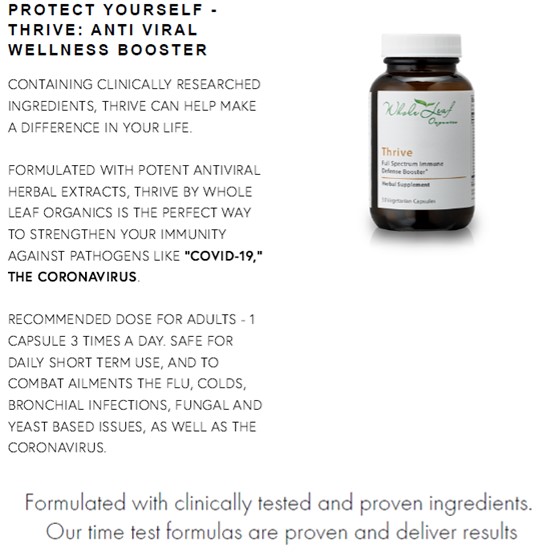
    The FTC has sued Whole Leaf Organics over the company’s claims that their CBD products effectively treat cancer and prevent or reduce COVID-19 risk. The Bureau of Consumer Protection says that there is “no proof that any product will prevent or treat COVID-19 or that any CBD product will treat cancer.” We can only hope.

    The California marketer and founder of Whole Leaf, Marc Ching, agreed to a preliminary order that prohibits him from making those claims. Pending the resolution of a parallel FTC administrative action, the proposed order also bars the defendant from representing that three CBD-based products he sells are effective cancer treatments.

    According to the FTC: Since December 2018, defendant Marc Ching, also doing business as Whole Leaf Organics, has sold Thrive – a tablet consisting primarily of Vitamin C and herbal extracts. But beginning in March 2020, Thrive underwent something of a marketing make-over. The defendant began pitching the product as a way for consumers to ward off coronavirus. His website claimed, “Formulated with potent antiviral herbal extracts, Thrive by Whole Leaf Organics is the perfect way to strengthen your immunity against pathogens like ‘COVID-19,’ the coronavirus.” The defendant also represented that the product is indicated to “combat” a list of ailments, “as well as the coronavirus.” In addition, the defendant claimed Thrive is “formulated with clinically tested and proven ingredients” and that “our time test formulas are proven and deliver results.”

    Photo by Matthew Brodeur on Unsplash