Tag: Information Technology Law

  • Law Firm Technology Directors? Yes.

    Law Firm Technology Directors? Yes.

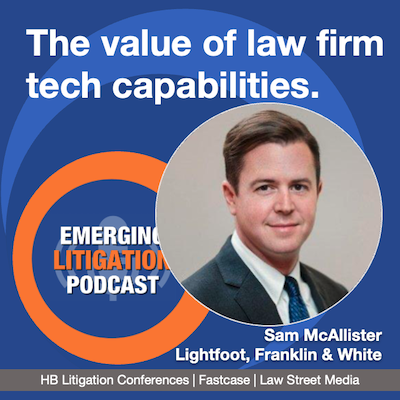
    The Value of Law Firm Technology Directors with Sam McAllister

    In this episode we talk about the advantages of having technology and software development capabilities inside your law firm. Can you imagine? And we’re not just talking about someone who is adept at unjamming the printer.  

    While the legal tech industry offers myriad high-quality solutions (some of my best friends are technology solutions), there are times when a litigator just wants that one thing that the tech doesn’t do. Or, working with the tech has such a long learning curve that the attorney won’t embrace it, that is, if he or she even tries it.

    There are also service enhancements attorneys would like to offer clients – capabilities that set the firm apart, that demonstrate the firm has the client’s best interests at heart and that the firm is even (gasp!) innovative.

    Litigators want to get an edge at trial. They want to be able to collaborate smoothly with clients. They want clients to get answers to important questions quickly. Focusing on customer experience is not just for retailers anymore.

    Joining me to talk about how one law firm benefits from having its own in-house technology developer is Sam McAllister, Director of Litigation Technology at Lightfoot Franklin & White in Birmingham, Alabama.

    Sam works on creative solutions for the firm’s litigation defense teams in the categories of communications, workflows, automation, multimedia, task efficiency, jury selection, information organization, and courtroom visualization, and more. The results come in the form of proprietary software, custom platforms, and apps. Many make the firm more efficient, cost-effective, and better equipped to collaborate with clients. Some have the effect of wowing clients, too.

    It’s no wonder Sam found himself on the Fastcase 50, a unique award that celebrates innovative professionals in the legal field. Sam, they said, exemplifies the “build-your-own spirit” of the award.

    He is the leader of the firm’s Case Clarity Group, which provides “highly-developed technology to clients throughout the duration of a case, e-discovery collaboration with Lightfoot lawyers, and adaptive evidence models to make complex ideas simple.” And – I like this part – “ask any lawyer who knows him – Sam does what it takes to help you win a case and is known for bringing calm to the most intense of trials.” (I can think of some work groups that would benefit from a position I just made up – Director of Calm. I mean, a cat can only do so much.) Sam received his B.S. in computer science from Auburn University. Speaking of cats – Go Tigers!

    I hope you enjoy the episode. If so, give us a rating!

    *******

    This podcast is the audio companion to the Journal on Emerging Issues in Litigation. The Journal is a collaborative project between HB Litigation Conferences and the Fastcase legal research family, which includes Full Court Press, Law Street Media, and Docket Alarm. The podcast itself is a joint effort between HB and our friends at Law Street Media. If you have comments or wish to participate in one our projects please drop me a note at Editor@LitigationConferences.com.

    Tom Hagy

    (actual size)

    Tom Hagy
    Litigation Enthusiast and
    Host of the Emerging Litigation Podcast
    Home Page
    LinkedIn

    Sam McAllister

    Sam McAllisterLightfoot Franklin & White

    Sam works on creative solutions for the firm’s litigation defense teams in the categories of communications, workflows, automation, multimedia, task efficiency, jury selection, information organization, and courtroom visualization, and more.

    The results come in the form of proprietary software, custom platforms, and apps. Many make the firm more efficient, cost-effective, and better equipped to collaborate with clients. Some have the effect of wowing clients, too.

  • European Union’s Top Court Strikes Down EU-US Privacy Shield

    European Union’s Top Court Strikes Down EU-US Privacy Shield

    European Union’s Top Court Strikes Down EU-US Privacy Shield

    The Court of Justice for the European Union has invalidated the EU-US Privacy Shield as an approved mechanism for transferring personal data from the European Union to the United States. The Privacy Shield had been in place since October 2015, and enabled U.S. companies to more easily receive personal data from EU entities. The decision by the court “leaves many companies scrambling to implement alternative mechanisms to safeguard personal data transfers to the U.S.,” says Sten-Erik Hoidal of Frederikson & Byron, P.A. With the invalidation of the privacy shield, companies are essentially left to decide on their own how data will be lawfully transferred. Attorneys from Perkins Coie recommend companies “consider amending any data processing addenda (DPAs) which companies have signed with vendors or customers to incorporate the EU Standard Contract Clauses.” Moving forward, U.S. and European companies will now attempt to create a new deal that complies with the privacy standards for transferring digital information. The first large company to weigh in on the decision, Microsoft tells customers that they “can continue to use Microsoft services in full compliance with European law” and that the ruling “does not change the data flows of our services to Consumers.”  

    Photo by Tabrez Syed on Unsplash

    Send Us Your News

  • Spotify Tells EU Apple is Hampering Competitors as Apple Music Surpasses Spotify in U.S. — MoginRubin

    [one-half-first][/one-half-first] [one-half]

    “Apple Music recently surpassed Spotify in the U.S. market, according to the Wall Street Journal, signing up 28 million subscribers compared to Spotify’s 26 million. Spotify continues to have more total subscribers, however.

    “Spotify Founder and CEO Daniel Elk took to the company blog to make his case, saying, “Apple operates a platform that, for over a billion people around the world, is the gateway to the internet. Apple is both the owner of the iOS platform and the App Store—and a competitor to services like Spotify. In theory, this is fine. But in Apple’s case, they continue to give themselves an unfair advantage at every turn.”

    “In a recent statement, Apple says it revolutionized the distribution of music with iTunes, and did the same thing with the App Store, something that has created “many millions of jobs” and, it says, generated more than $120 billion for developers and new industries.”

    Read the complete post on the MoginRubin Blog here!

    [/one-half]

  • Product Liability in the Internet of Things — Schiff Hardin Product Liability & Mass Torts Blog


    [one-half-first]

    Photo by Markus Spiske on Unsplash [/one-half-first] [one-half]”Combining a physical object and an intangible technology also creates a novel issue when it comes to strict product liability principles, which typically hold that a product manufacturer may be strictly liable for a product’s defect. The first task in a strict product liability case is to identify the product. In the context of a device that has no internet connectivity, the answer is straightforward. If a ladder is defective and causes an injury, the ladder’s manufacturer may be held strictly liable because a ladder is the product. But when it comes to IoT devices, the line may be blurred. Almost always, the software part of the IoT device is ‘manufactured’ by a separate entity from the entity that manufactures the physical object. If the IoT device proves to be defective, the question becomes which entity may be held strictly liable.”

    Read the complete post by Schiff Hardin’s  Gregory Dickinson & Jeffrey D. Skinner  here. [/one-half]

  • South Korea, EU Having ‘Adequacy’ Discussions

    Because of its robust network connectedness, its advanced use of mobile devices and its rich collection of intellectual property, South Korea is a leading target for hackers.

    Discussions are under way between the EU and South Korea to determine, as a non-EU country, whether its data protections are adequate. Also, South Korea has joined the APEC Cross-Border Privacy Rules system. Significant caselaw is developing regarding this country’s 2011 data protection statute as well as its sector-specific laws.

    Daniel Solove and Paul Schwartz have selected Professor Haksoo Ko from the Law School at Seoul National University to speak at the International #PrivacySecurity Forum April 3-5, 2019. Ko will co-present to provide an up-to-date account of developments in South Korea and analyze the most important compliance hurdles.

    Learn more: http://bit.ly/IPSF-2019

  • RSA’s Zulfikar Ramzan on Blockchain

    Is blockchain as impenetrable as people think? Or as necessary?

    It’s not predicated on the same type of cryptographic security that we’ve seen historically, but if someone has enough money and enough motivation — like a nation state — couldn’t they severely compromise a system? Is blockchain the only way transactional protections can become so secure, or could traditional technologies be employed and with less effort?

    RSA Security’s Chief Technology Officer Zulfikar Ramzan, Ph.D., spoke at our Cyber Sector Risk: Blockchain Security in April 2018 in New York. Hear what he had to say about this much-heralded technology.


    Related content

    https://hb.worryfreeweb.com/www-litigationconferences-comprivacysecurity-forum-2018-2/

    International Cyber Risk Management Conference | Dec. 6-7, 2018 | Bermuda

    The Urgency of Cyber Threats to U.S. and Global Critical Infrastructures | Video Session

  • Judy Selby on Improving Cyber and Privacy Board Reporting


    “While general awareness of cyber risks among corporate boards is increasing, even the most motivated and knowledgeable directors cannot effectively fulfill their duties without receiving appropriate data about the organization’s risk profile. Unfortunately, however, there appears to be a disconnect between management and boards when it comes to cyber risk reporting . . .  In order for directors to effectively discharge their duty of active, informed, and engaged oversight, the information they receive must be relevant, understandable, reliable, and objective.”

    Judy Selby, JD

    Judy Selby Consulting

    Read the full article and Judy’s tips for improving board reporting. 


    Judy Selby of Judy Selby Consulting