Tag: Emerging Litigation & Risk

  • Product Liability in the Internet of Things — Schiff Hardin Product Liability & Mass Torts Blog


    [one-half-first]

    Photo by Markus Spiske on Unsplash [/one-half-first] [one-half]”Combining a physical object and an intangible technology also creates a novel issue when it comes to strict product liability principles, which typically hold that a product manufacturer may be strictly liable for a product’s defect. The first task in a strict product liability case is to identify the product. In the context of a device that has no internet connectivity, the answer is straightforward. If a ladder is defective and causes an injury, the ladder’s manufacturer may be held strictly liable because a ladder is the product. But when it comes to IoT devices, the line may be blurred. Almost always, the software part of the IoT device is ‘manufactured’ by a separate entity from the entity that manufactures the physical object. If the IoT device proves to be defective, the question becomes which entity may be held strictly liable.”

    Read the complete post by Schiff Hardin’s  Gregory Dickinson & Jeffrey D. Skinner  here. [/one-half]

  • A Generic Drug Failure to Warn Claim? –Michelle Hart Yeary


    [one-half-first][/one-half-first] [one-half] “Rather than focusing on what plaintiff’s off-label marketing claim really was – a claim that defendant’s label should have contained different information or warnings about off-label uses – an impliedly preempted claim, the court got distracted trying to fit the case in under Bausch and started talking about parallel violation claims.

    “The court found that because plaintiff was alleging a violation of federal regulations, his claims “run parallel to [defendant’s] state law duties,” and thus were not preempted. The problem with this is that Mensing is not an express preemption case.  It was an implied preemption case, and the district court had no business applying ‘parallel claim’ analysis to implied preemption, where a ‘parallel claim’ exception does not exist.  It makes no difference whether plaintiff’s off-label promotion claim is ‘parallel’ to federal regulations, defendant could not have offered any different warning so any claim that the warning or information it provided was inadequate is preempted under Mensing.  The court was trying to fit a square peg into a round whole – and the only way that works is to cut off the corners.”

    Read the complete post by Dechert’s Michelle Hart Yeary here!

    [/one-half]

  • One Stock for the Coming Marijuana Boom, Says The Motley Fool


    “This legal pot stock could be like buying Amazon for $3.19.”


    “Cannabis legalization is sweeping over North America – 10 states plus Washington, D.C., have all legalized recreational marijuana over the last few years, and full legalization arrived in Canada in October 2018. Legal marijuana is worth an estimated $50 billion for the U.S. today. And since experts have projected the U.S. industry to skyrocket to $80 billion by 2030, it’s time for investors to start paying attention. Because whether or not you’re planning on ingesting any THC, you can’t deny the monumental investing opportunity that a potentially $80 billion industry represents.” –Grace Phillips, in an article for The Motley Fool

  • Private Calif. Plaintiffs Seemingly Enforcing FDCA, Drug & Device Law Blog Says

    “Doctors treated two plaintiffs for severe psychological problems, ultimately employing defendant’s Thymatron System IV to perform electroconvulsive therapy. Plaintiffs claimed that, as a result, they suffered brain trauma, memory loss and other brain-related injuries. They filed product liability claims based, in the main, on the manufacturer’s alleged failure to report adverse events. The decision in Riera addressed summary judgment motions, ones filed by both the plaintiffs and the defendant. You don’t ordinarily see summary judgment motions by plaintiffs, and Riera is an example of why.”

    Read the complete post by John J. Sullivan of Cozen O’Connor.

  • Two Judges Find Florida Medical Marijuana Law Unconstitutional

    The Program is ‘Absolutely Broken’ — Now What?

    Edited by Tom Hagy

    Florida Circuit Judge Karen Gievers just held that the Florida medical marijuana law is unconstitutional. Reporting on the judge’s Trulieve decision for the Florida Politics news service, journalist Jim Rosica called it “a rebuke to lawmakers and the Rick Scott Administration” that was “stunning even for” Judge Gievers. “In the spirit of boxing legend Muhammad Ali, known for his pre-fight rhymes, Gievers opined that in Florida ‘the medical marijuana system was broken. Now, in the Constitution, the people have spoken.’”

    Rosica reported that while Gov. Scott is appealing the major marijuana decisions against the state Department of Health, the transition team of Republican Governor-elect Ron DeSantis, including Lt. Gov.-elect  Jeanette Nuñez, has suggested that he will not continue to defend the law in court.

    Rosica continued: “Gievers, who retires in April, said her decision striking down the law ‘includ(ed), but (is) not limited to, replacement of the voter-selected registry plan with an arbitrary, inconsistent licensing scheme … throttling access of qualifying patients to … safe use of medical marijuana from (providers that) the Department has a clear, undisputed duty to register.’ In fact, just passing the law was itself unconstitutional, Gievers suggested: ‘Voters made clear in 2016 that the Legislature was to have no role in implementing access to and availability of medical marijuana.’” Read Rosica’s full article.

    ‘It is incumbent on the Legislature to fix this’

    Today I spoke with attorney Jonathan Robbins, who is actively litigating the matter on behalf of Tampa-based Florigrown. Robbins, chair of the cannabis practice at Akerman LLP , pointed to a similar holding in the Florigrown case, commenting that, yes, “yet another judge has found that the statute implementing the amendment is unconstitutional because of the arbitrary cap on the number of dispensaries that would qualify for licensing.”

    “This further illustrates,” Robbins told me, “that the Florida medical marijuana program is absolutely broken and needs to be fixed. But rather than the courts repairing it piecemeal, the Legislature needs to get something done. It is incumbent on the Legislature to fix this.”

    In the Florigrown case, Leon County Circuit Judge Charles Dodson granted an injunction and ordered DOH to issue licenses. Once DOH appealed that triggered an automatic stay. “We went back to Judge Dodson to lift the stay because people need their meds,” Robbins said. “The judge lifted the stay, but the DOH appealed to the 1st District to reimpose the stay, which the court did.” Briefing is under way.

    “Our client wants to operate but is restricted because the statute unconstitutionally creates special classes of companies entitled to licensing. Not only does it arbitrarily cap the number of licenses, it requires that licensees must be fully vertically integrated, meaning companies must cultivate, process and sell medical marijuana. This is inconsistent with what the citizens voted for,” Robbins said. He said this prohibits a company from merely dispensing the product, for example, effectively and unfairly shutting out many businesses.

    “The Legislature was charged with providing safe and affordable medical marijuana to patients who need it. All of this was to be in place in 2017. Here we are in 2019 and we still don’t have it,” Robbins said.

    While there are 14 companies operating and people can get marijuana, many more potential competitors are blocked from operating.

    Clearly, implementation of the law, overwhelmingly approved by Florida voters, has been less than smooth and requires quite a bit more ironing out. The lack of competition hurts businesses and patients alike, critics say. In the meantime there is plenty of confusion for companies ready to provide medical marijuana services in Florida.


    Join our webinar on Jan. 25,  when attorneys in the thick of the issue –  Akerman LLP  partners Jonathan S. Robbins  and  Ari H. Gerstin  — will share background, insights and practical guidance.

    What we will cover:

    • Background: Federal vs. State Law Conflict
    • History of Medical Marijuana in Florida
    • The 2016 Amendment to the Florida Constitution
    • Implementation of the State Medical Marijuana Program
    • Litigation Over the Constitutionality of the Implementation
    • Practical Considerations When Operating in This Industry
    • Banking and Insurance Issues
    • Ethical Considerations for Attorneys

    What you will get:

    • Up-to-the-minute insights from attorneys active in the litigation.
    • Thorough course materials for later reference.
    • Real-time answers to your questions via our moderated chat.
    • The ability to send questions in advance.
    • Continuing legal education credit (CLE)
    • Access for your entire team with a feed into your conference room.
    • No scheduling risk: Suddenly can’t make it? We will send you the recording.

    Register by Jan. 18 and save $50. 

  • Cognitive Shortcuts: Assessing Case Value & Litigation Risk with Homer Simpson and Spock

    By Jeff Trueman, Esq.
    Mediator

    The central question on the minds of counsel, their clients, and insurance professionals in civil litigation is, of course, “What’s the case worth?” Although lead paint litigation may be going through some changes, it remains a mature tort where enough historical settlement and verdict data exist for counsel to argue why a particular case should or should not fit within a certain settlement range. In the midst of these discussions, the human brain plays tricks on us. For example, litigators sometimes assume that their trial experience can determine how jurors will negotiate with one another and resolve factual discrepancies after closing arguments. This assumption is a “heuristic” – a cognitive shortcut called attributional error or illusion of control.

    Underneath the games of litigation “chicken” that are the hallmark of settlement negotiation, heuristics lead to erroneous valuations and assessments of risk.

    Although more than one hundred heuristics exist, approximately 15-20 occur commonly in the context of settlement negotiations. It is easy for potential clients to employ a heuristic similar to the illusion of control by imagining a connection between something they desire, such as a favorable case outcome, and the past successes of their prospective lawyer. Representative and confirmation biases influence how we connect “model” to “outcome.” When differences over case value intensify, litigators return to threats of relinquishing control: “Maybe we have to try this case;” or “We feel good about our chances in front of a jury.” Underneath the games of litigation “chicken” that are the hallmark of settlement negotiation, heuristics lead to erroneous valuations and assessments of risk.

    Borrowing from Daniel Kahneman’s book, “Thinking Fast and Slow,” cognitive shortcuts live in our “System One” brain where we react to circumstances intuitively without giving much thought about the way in which we perceive problems or how to calculate probabilities and manage risk. “System Two” thinking is slower, more deliberate, logical, and usually more accurate. Think of the difference between Homer Simpson and Star Trek’s Spock and you get the picture.

    Although we like to think that we are System Two negotiators who act analytically and rationally, we usually operate within System One. We negotiate emotionally. For example, in terms of perceiving and managing financial risk, we prefer to avoid loss rather than experience an equivalent gain. It feels better not to lose five dollars rather than find five dollars. Whether we consider something a loss or a gain depends on a reference point (our expectations, for example) which is usually based on perceived surroundings, desires, or what we think happened to others. Loss and fear of loss carry significant psychological power when we think about the future.

    Many lawyers default to their role as advocates for legal rights without considering the quality of counsel they give to clients regarding risk management. This plays right into the endowment bias that potential clients carry, valuing property or experiences merely because they have them. When thinking about future risk, many lawyers exhibit an overconfidence and self-serving bias in favor of past success. Unfortunately, competitive bargainers are disinclined to compromise even when it would benefit their bottom lines. Of course, it goes without saying that clients are often better served by lawyers who have some experience in a courtroom. But prior success does not guarantee future results.

    Granted, it’s hard to know whether a particular settlement number is “good” since it’s impossible to compare trial verdicts to settlement results in the same case. Although most law suits settle on terms that are good enough, practically speaking, lawyers will emphasize trial advocacy and “justice” over risk management. Few potential clients want to hear about “cognitive heuristics” and risk management when they seek a fighter for a “just” cause. Even so, litigants who are aware of the well-worn chutes and ladders of emotion that commandeer their thinking can tune out Homer Simpson in favor of Spock to make better decisions about valuation and risk.


    Jeff Trueman, Esq., ADR Services, Sole Practitioner, Baltimore, MD. Private mediator of litigated civil disputes, including personal injury, premises liability, toxic and environmental torts, wrongful death, professional malpractice, partnership dissolution, employment, domestic, and guardianship petitions. Public speaker and presenter of mediation and negotiation-related dynamics at law schools, law firms, and litigation conferences. Author of ADR column that appears semi-regularly in the Maryland Daily Record.


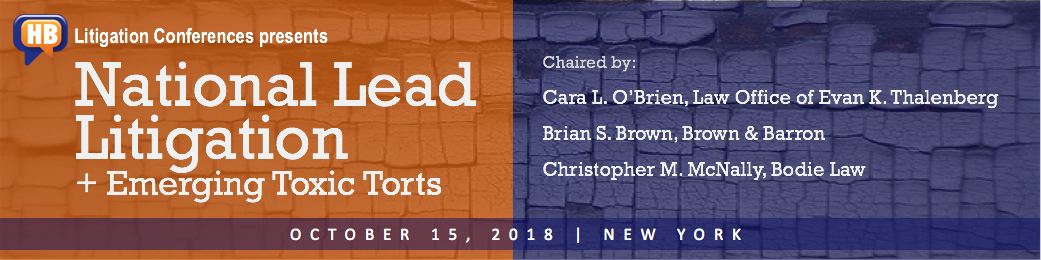
    Jeff is one of the featured presenters at this year’s National Lead Litigation + Emerging Toxic Torts Conference, Oct. 15 in New York.

    The event is being held at the same time and in the same location as our Drug & Defense Forum.

  • HB Announces Alliance with Alliance of Women Trial Lawyers

    We are proud to announce our latest alliance with a new trial attorneys group just for women on the plaintiff side of tort litigation.

    Founded by plaintiff law conference veteran Nancy Holston, the Alliance of Women Trial Lawyers is committed to empowering these professionals, helping them to overcome “systematic obstacles and to realize greater self-sufficiency and wholeness through support, acknowledgement and utilization of dormant, yet innate strengths.” Before founding the Alliance in July 2018, Nancy was a principal at 360 Advocacy and before that the first Executive Director of Mass Torts Made Perfect.  Nancy is well-connected in the plaintiff bar and is excited by the initial reaction to her new venture.

    Nancy is equally inspired by the feedback she is getting for the Alliance’s first national conference which will be held from Saturday, Oct. 27th through Monday, Oct. 29 at the Ritz-Carlton in New Orleans. The program features many of the leading women trial attorneys in the country and a range of topics on practice development, litigation strategy, preparing witnesses, jury selection, deposition skills, direct examination, opening arguments and ethical issues involved in settlements. 

    “I admire anyone who takes a risk to do something they believe in, and Nancy has demonstrated both enthusiasm and commitment to improving the professional lives — and personal lives, for that matter — of women who represent plaintiffs in mass torts,” said Tom Hagy of HB Litigation Conferences. “It’s an important mission and we’re excited to lend our support.”

    “We look forward to working together to grow our respective portfolios and educate attorneys on important and emerging legal issues. There is an outside chance we will also have some fun along the way,” Tom added.

    Click here for more information about the AWTL’s 2018 Fall Conference. 

  • Artificial Intelligence in the Drug and Device Industries

    Are Data Divers and Miners Going to Lead Innovation?

    The big tech companies are into it. Apple, IBM and Google. Roche is into it. Medtronic, as well. Artificial intelligence has been a big part of innovation in the healthcare space for several years, and its impact is only going to get bigger.

    “Artificial intelligence-based healthcare technologies have contributed to improved drug discoveries, tumor identification, diagnosis, risk assessments, electronic health records (EHR), and mental health tools, among others,” writes Blank Rome attorney Brian Higgins in his Artificial Intelligence and the Law Blog (it’s excellent, by the way).  [1]

    Daniel Faggella of TechEmergence.com writes that machine learning healthcare applications are getting a lot of attention in the press and from the investment community. He adds to the list of machine learning’s impact things like treatment queries and suggestions, and even robotic surgery.

    But optimism for AI’s application to drug discovery seems greater than that inspired by other healthcare sectors. One reason for that, Faggella writes, is that compared to other segments where various laws and stakeholder incentives may not align, “drug discovery stands out as a relatively straightforward economic value for machine learning healthcare application creators.” He adds that this application also involves “one relatively clear customer who happens to generally have deep pockets: drug companies.” [2]

    Also writing for TechEmergence.com, Kumba Sennaa says doctors may feel threatened at the idea of competing with artificial intelligence tools. Not so in the case of drug makers.  “Unlike doctors, pharma companies have every reason in the world to adopt the most cutting-edge technologies in the expensive and lengthy process of drug discovery,” Sennaa writes. “Unlike other applications within healthcare facilities, drug discovery seems to have a clearer path to adoption.” [3]

    AI-fueled innovation is, in turn, fueled by data. Lots and lots of data. “And there is no better place to find big data sets than in the healthcare sector,” Higgins says. “According to an article last year in the New England Journal of Medicine, by 2012 as much as 30% of the world’s stored data was being generated in the healthcare industry.”

    “Thanks in large part to AI and the availability of health-related data,” Higgins says, “health tech is one of the fastest growing segments of healthcare and one of the reasons why the sector ranks highest on many lists.”

    “To be successful,” Higgins predicts, “tomorrow’s healthcare leaders may be those who have access to data that drives innovation in the health tech segment. This may explain why, according to a recent survey, healthcare CIOs whose companies plan spending increases in 2018 indicated that their investments will likely be directed first toward AI and related technologies.”


    Related

    Given the investment and tremendous opportunity AI provides for the drug and device industries, the chairs of our Fifth Annual Drug & Device Forum are developing a session on the subject. Join us for this and discussion of other important topics on Oct. 15, 2018 in New York.

    If you have ideas please reach out to one of our chairs directly or via Ideas@LitigationConferences.com. They are Megan Grossman of Segal McCambridge Singer & Mahoney, Michelle Hart Yeary of Dechert, and Jim Frederick of Goodell DeVries Leech & Dann. Learn more. 

    Also, on Sept. 27 we are co-producing a webinar titled A.I. Best Practices: Rules and Policies for Using Artificial Intelligence in Your Business. The webinar features John Weaver of the McClane Middleton law firm and contributing author to the Journal of Robotics, Artificial Intelligence & Law. We are producing this in collaboration with growing legal research company Fastcase. Learn more.


    Links to the articles cited in this post:

    #1. http://aitechnologylaw.com/2018/03/data-driven-health-tech-innovation/

    #2.  https://www.techemergence.com/machine-learning-healthcare-applications/

    #3. https://www.techemergence.com/ai-in-pharma-and-biomedicine/

  • Crowell & Moring on Insurance for Autonomous Vehicles Accidents

    “As responsibility for accidents shifts away from drivers and towards the companies that design, manufacture, and maintain autonomous vehicles, the pool of companies potentially liable for accidents will deepen.Companies need to consider potential liability risk when designing autonomous vehicle-related systems and partnering with other companies.”

    Another good piece from the team Crowell & Moring LLP 

  • Congressional Cannabis Proposal Would Can Criminalization

    Could this be the thing that brings the parties together?

    Here is a quote from an article written for Forbes.com by freelance writer Janet Burns.

    [Jolene Forman, staff attorney at the nonprofit Drug Policy Alliance] called the bill a “first step,” and noted, “This bipartisan proposal clears the way for states to develop their own marijuana policies without fear of federal intervention. This will give states more opportunity to restore communities that have borne the brunt of the drug war and mass criminalization.”

    So far, 30 states, Washington, DC and the U.S. territories of Guam and Puerto Rico have enacted medical marijuana legislation, while estimates suggest that 63 million Americans reside in areas where anyone over 21 may now legally possess the plant.