Tag: Discrimination

  • Hair Relaxer Injury Litigation

    Hair Relaxer Injury Litigation

    Hair Relaxer Injury Litigation with Jennifer Hoekstra

    Last year the Aylstock, Witkin, Kreis & Overholtz law firm filed the first class action against L’Oréal and Softsheen-Carson for injuries, primarily to Black women, allegedly caused by hair relaxers and straighteners.  Now there are more than 60 cases consolidated in multidistrict litigation. 

    Recent studies cited in the litigation show that Black women who use these products develop cancers at a rate disproportionate to that experienced by white women. The plaintiffs say the products are marketed not only to women but to girls as well. The companies challenge the accuracy of the study methods and say, in the case of a key NIH study, that all of women had sisters who were diagnosed with cancer.

    Listen to my interview with veteran mass tort plaintiff attorney Jennifer M. Hoekstra, a partner with Aylstock, Witkin, Kreis & Overholtz. Jennifer boasts an impressive academic and professional record, including graduation from two of the nation’s top schools.  She earned her Bachelor of Arts in Environmental Science from Columbia College, Columbia University in the City of New York. She relocated to Louisiana to attend Tulane Law School, where she earned her J.D. while also completing a certificate in Environmental Law.  During her law school career, she spent a semester studying at the University of Wisconsin School of Law and visited on their International Law Journal as a Junior Member during her Hurricane Katrina evacuation semester.

    This is Jennifer’s second appearance on the podcast. She also was my guest on Greatly Exaggerated: The Impact of Bankruptcy on Mass Tort Litigation.

    *******

    This podcast is the audio companion to the Journal on Emerging Issues in Litigation. The Journal is a collaborative project between HB Litigation Conferences and the Fastcase legal research family, which includes Full Court Press, Law Street Media, and Docket Alarm. The podcast itself is a joint effort between HB and our friends at Law Street Media. If you have comments or wish to participate in one our projects please drop me a note at Editor@LitigationConferences.com.

    Tom Hagy

    (actual size)

    Tom Hagy
    Litigation Enthusiast and
    Host of the Emerging Litigation Podcast
    Home Page
    LinkedIn

    Jennifer Hoekstra

    Jennifer HoekstraAlystock Witkin Kreis & Overholtz

    Jennifer M. Hoekstra is a partner with Aylstock, Witkin, Kreis & Overholtz, PLLC. A native of Saint Paul, Minnesota, Ms. Hoekstra boasts an impressive academic and professional record, including graduation from two of the nation’s top schools. She earned her Bachelor of Arts in Environmental Science from Columbia College, Columbia University in the City of New York.

    She is licensed to practice before all Louisiana state and federal courts and the U.S. District Courts for the Northern District of Texas and Eastern District of Missouri as well as the 5th and 8th Circuit Courts.

  • Antiracism and Antitrust with Eric Cramer

    Antiracism and Antitrust with Eric Cramer

    Our Guest

    Eric L. Cramer

    Eric L. CramerBerger | Montague

    Eric Cramer is Chairman of the Firm and Co-Chair of the Firm’s antitrust department. He has a national practice in the field of complex litigation, primarily in the area of antitrust class actions. He is currently co-lead counsel in multiple significant antitrust class actions across the country in a variety of industries and is responsible for winning numerous significant settlements for his clients totaling well over $3 billion.

    Mr. Cramer is also a frequent speaker at antitrust and litigation related conferences and a leader of multiple non-profit advocacy groups. He was the only Plaintiffs’ lawyer selected to serve on the American Bar Association’s Antitrust Section Transition Report Task Force delivered to the incoming Obama Administration in 2012.

    Antiracism and Antitrust with Eric Cramer

    Among the legal and regulatory avenues one might follow to mitigate the impact of racism, most of us would look to various manifestations of discrimination law in  employment, lending, real estate, education, healthcare, voting rights, and other categories. When presented in those contexts, the anti-racism objectives are clear. 

    There are several federal laws and many state laws that prohibit anticompetitive behavior.  At the top of the heap is the Sherman Antirust Act of 1890, which outlaws illegal monopolies and anticompetitive tactics, conspiracies to restrain trade, cartels and syndicates.  But what do wages, including those paid to minorities, have to do with antitrust? What about no-poach agreements, whereby groups of companies agree not to hire employees away from each other?  The answer is “quite a lot.”

    Listen to my interview with Eric Cramer, Chairman of Berger Montague and co-chair of the firm’s antitrust department, a team that handles antitrust class actions across the country involving a variety of industries.  Eric and the firm are responsible for winning numerous significant settlements for clients — a total value that now exceeds $3 billion. His recent focus has been representing workers who allege their employers’ anticompetitive practices  suppressed their pay. Recipient of numerous accolades and awards that include terms like titan, elite, thought leader, visionary, and lawyer of the year, Eric is a summa cum laude graduate of Princeton University where he earned membership in Phi Beta Kappa, and a cum laude graduate of Harvard Law School. Listen to what he had to say about this important subject.

    This podcast is the audio companion to the Journal on Emerging Issues in Litigation. The Journal is a collaborative project between HB Litigation Conferences and the Fastcase legal research family, which includes Full Court Press, Law Street Media, and Docket Alarm. The podcast itself is a joint effort between HB and our friends at Law Street Media. If you have comments or wish to participate in one our projects please drop me a note at Editor@LitigationConferences.com.

    Tom Hagy
    Litigation Enthusiast and
    Host of the Emerging Litigation Podcast

  • Episode Three: Karla Gilbride Tells Her Story Behind the Unanimous Pro-Employee Win at the Supreme Court

    Episode Three: Karla Gilbride Tells Her Story Behind the Unanimous Pro-Employee Win at the Supreme Court

    DietaFit: Lose weight and stay fit – Page 6 | Diet, Fitness and Wellbeing | Page 6 dianabol pills gina fitness nude hentai clips

    Karla Gilbride Tells Her Story Behind the Unanimous Pro-Employee Win at the Supreme Court

    The Federal Arbitration Act is clear, Supreme Court Justice Elena Kagan wrote: “[C]ourts are not to create arbitration-specific procedural rules …. Or put conversely, it is a bar on using custom-made rules, to tilt the playing field in favor of (or against) arbitration.”

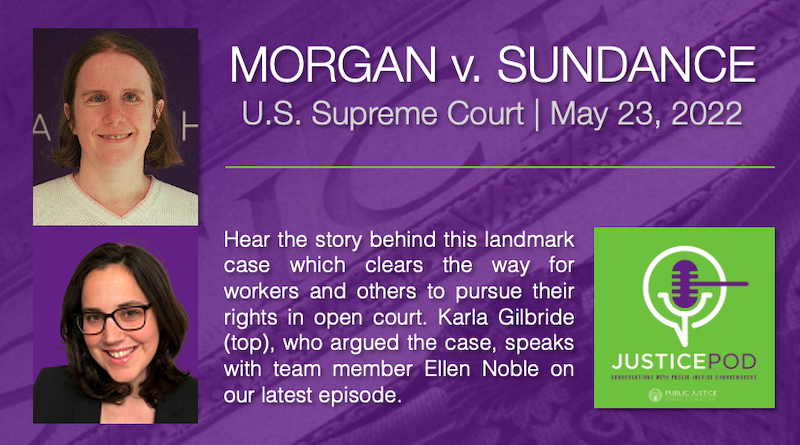
    With the support of all eight of her colleagues, Justice Kagan’s opinion in Morgan v. Sundance  put an end to the long-running tilt of justice toward employers in the form of  judge-made rules that favor arbitration. This important holding clears the way for more workers, consumers, and other individuals harmed by corporate misconduct to pursue their rights in open court.

    Karla Gilbride, Senior Attorney at Public Justice, argued the case to the high court on behalf of the plaintiff, Robyn Morgan, an hourly employee at a Taco Bell franchise owned by Sundance, Inc.  It was not only Gilbride’s first Supreme Court argument, but she was the first blind attorney to do so in the court’s history.

    Listen to Public Justice’s Ellen Noble — who assisted in the case — as she interviews Gilbride about her remarkable experience. This is a must listen not only for attorneys who represent workers, but for anyone interested in Supreme Court history, or the ongoing need for accommodations for the disabled, or anyone preparing for oral arguments at any level. Gilbride shares the thrill of arguing in the same spot — and directly in front of! — some of her heroes and inspirations. She also shares that, like a music fan who camps out in front of a box office to get tickets for their favorite band, a young Gilbride did just that in order to secure a seat to observe her first Supreme Court argument.

    After you listen to the podcast, you can hear Gilbride’s argument and read the complete transcript of the hearing. You can also read and watch more about the case on the Public Justice Blog.

    I hope you find this the episode inspiring and informative! We are all so very proud of Karla, Ellen and the whole team, and are thrilled with the important, decisive, and unanimous outcome they achieved.

    Susan Gombert
    Host
    Justice Pod: Conversations with Public Justice Change Makers

    Listen Now!

    The Supreme Court has finally “put an end to the arbitration exceptionalism that many corporations have been seeking, and that many courts have been giving them.”

    Karla Gilbride

  • Workplace Investigations: Proactive Assessments Mitigate the Risk of Costly Litigation in a Newly Remote Environment

    Workplace Investigations: Proactive Assessments Mitigate the Risk of Costly Litigation in a Newly Remote Environment

    The Author

    Stefani Schwartz

    Stefani SchwartzHatfield Schwartz Law Group

    Stefani C Schwartz is Senior Managing Partner at the Hatfield Schwartz Law Group LLC. She has devoted her career to representing and advising employers in the complete spectrum of employment law, including discrimination, harassment, retaliation, and wrongful termination. Stefani is a member of the Editorial Advisory Board of the Journal of Emerging Issues in Litigation.

    The Journal on Emerging Issues in Litigation

    Emerging Litigation Podcast

    Emerging Litigation PodcastProduced by HB Litigation and Law Street Media

    Interviews with leading attorneys and other subject matter experts on new twists in the law and how the law is responding to new twists in the world.

    Workplace Investigations: 

    Proactive Assessments Mitigate the Risk of Costly Litigation in a Newly Remote Environment

    “Investigations are a straightforward, efficient, and effective way to combat the risk of litigation because they reflect the best aspects of the employer–employee relationship: understanding, respect, communication, and shared goals.”

    Abstract: “Bullying, discrimination, sexual harassment and other forms of workplace misconduct can create a crisis for any company—and trying to ignore or cover it up will make a bad situation worse.” That’s the warning from a December 2021 article for Forbes, which goes on to say that in addition the damage to an employer’s reputation, a study by workplace misconduct reporting service Vault Platform found that workplace misconduct cost U.S. businesses more than $20 billion in 2021. In this article, the author discusses how proactively conducting workplace investigations can reduce an employer’s risk of winding up in court and paying the considerable tangible and intangible costs of misconduct, a risk further complicated by an increasingly home-based workforce. 

    Excerpt: During the past two years, the COVID-19 pandemic has introduced new factors in the ever-shifting area of employer liability: large-scale layoffs and furloughs, the introduction and/or expansion of possibilities for remote work, the drive for a safe return to the physical workplace, and the dual needs for vaccination and accommodation of religious objectors to vaccines to name a few. These issues predate the current public health crisis but have been pushed to the forefront of employer concerns as a result of the virus. Yet this new arena provides opportunities for cultural, scientific, and legal progress. Many employers may benefit from the familiarity their employees now have with remote work, and the development of successful mRNA vaccines has wide-ranging implications. The changing legal landscape, however, introduces uncertainty for employers concerned about the risks associated with any particular action.

    Consider, for instance, the decisions many employers have had to make about transitioning to a remote work environment, later transitioning back to in-person operations, and possibly having t revert to remote work as the COVID-19 situation changes. Those decisions are loaded with legal questions beyond the expected skillset of a business owner: Are you liable if one of your employees catches COVID-19 at your workplace? How do you deal with employees who do not want to be vaccinated? How are employees with different family situations, commuting concerns, and medical histories going to respond to your decision?

    Download the article now!