Tag: Cybersecurity

  • The Cyber Insurance Market Has Problems: A Conversation With Tom Johansmeyer

    The Cyber Insurance Market Has Problems: A Conversation With Tom Johansmeyer

    The Cyber Insurance Market Has Problems: A Conversation With Tom Johansmeyer

    The author of the piece is my guest on our latest episode. He is Tom Johansmeyer, ARM, is head of PCS, a Verisk business. PCS investigates and provide, independent loss estimates on catastrophes and large individual losses to the benefit of the global risk and capital supply chain. Tom has focused on the broad and rapid expansion of PCS, leading the team into Japan, New Zealand, and other APAC regions in 2019 – as well as Mexico. Tom is the architect of the PCS entry into global specialty lines, most recently adding large risk loss reporting to the group’s portfolio. Previously, Tom held insurance industry roles at Guy Carpenter (where he launched the first corporate blog in the reinsurance sector) and Deloitte. Personally, I like his LinkedIn description: “Aspiring cyclist and distance swimmer, former soldier. Leading the global charge at PCS. Haven’t driven anything with a motor since 2007.” Excellent.

    This podcast is the audio companion to the Journal on Emerging Issues in Litigation, a collaborative project between HB Litigation Conferences and the legal news folks at Law Street Media, and the Fastcase legal research family, which includes Docket Alarm and Judicata. If you have comments or wish to participate in one our projects, or want to tell me how insightful our guests are, please drop me a note at Editor@LitigationConferences.com.

    You might notice that I misused a commonly used term, one specifically common in the world of insurance, or maybe you weren’t paying that much attention. That would make two of us. Also, Tom J. was just a fun interview and I hope to get him back! I like the way he explained his candor at the end. He suffers from an infliction that I wish were a pandemic. I hope you enjoy it.

    Tom Hagy
    Host of the Emerging Litigation Podcast

    “Facing the prospect of major financial fallout from an attack, C-suites around the world have turned to cyber insurance. Insurers are issuing more policies, and the amounts of protection available are increasing.

    “In 2020, according to data proprietary to the team I lead, the global insurance community saw the first cyber insurance program to exceed $1 billion — and the second. However, the momentum that has propelled the sector this far may be running out. The cyber insurance sector may still be in its infancy, but there are signs that it’s hit a (hopefully temporary) plateau.”

    From a Jan. 11, 2021, article in the Harvard Business Review titled “Cybersecurity Insurance Has a Big Problem.”

  • To Pay or Not to Pay: Does Your Insurance Policy Cover Ransomware Losses? | By Pamela Hans | Anderson Kill

    To Pay or Not to Pay: Does Your Insurance Policy Cover Ransomware Losses? | By Pamela Hans | Anderson Kill

    To Pay or Not to Pay: Does Your Insurance Policy Cover Ransomware Losses?

    Abstract

    Ransomware attacks are a rapidly growing threat against organizations. Paying ransom demands is a risky proposition and may even lead to sanctions against the targeted company. Either way, the damage to a company’s operation and integrity can be cripplingly severe. Should a company suffer losses from cyber extortion, its insurance company will be one of the resources it turns to for relief. But with cyber
    coverage increasingly out of reach for some, policyholders may find coverage in more traditional coverages. In this article, the author evaluates the potential for coverage under several policy types, and underscores the importance of understanding policy language, the relevant law, and the potential regulatory ramifications of meeting ransom demands.

    Author

    Pamela D. Hans (phans@andersonkill.com) is the managing shareholder of Anderson Kill’s Philadelphia office. Her practice concentrates on insurance coverage exclusively on behalf of policyholders. Pam is also a member of the firm’s COVID Task Group and Cyber Recovery Group.

    About
    The Journal on Emerging Issues in Litigation is a co-production of HB, Fastcase, and Law Street Media. You can also hear the complementary (and complimentary) Emerging Litigation Podcast wherever podcasts appear. For questions, contact Tom Hagy, Editor in Chief, at Editor@LitigationConferences.com.

    Loading Viewer…

  • Drone Law with Kathryn Rattigan

    Drone Law with Kathryn Rattigan

    Drone Law with Kathryn Rattigan

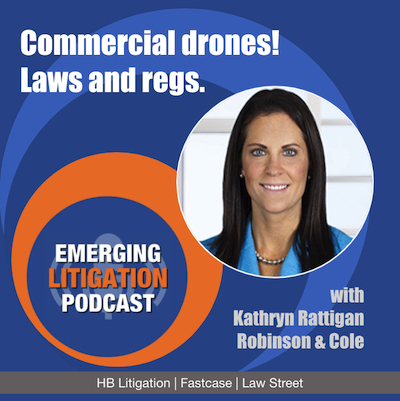
    Joining me to discuss this emerging area of law is Kathryn M. Rattigan, a member of the Business Litigation Group, the Data Privacy + Cybersecurity Team, and the Drone Compliance Team in the Rhode Island office of Robinson Cole.  Kathryn advises clients on these matters with expertise in the relevant Federal Aviation Administration regulations. She and her colleagues also advise clients on employee and subcontractor contracts, insurance policies, privacy regulations, state and local laws, and best practices as recommended by the National Telecommunications and Information Administration.  She handles product defect, personal injury, and property damage litigation, too.  Kathryn is a frequent contributor to the excellent Robinson Cole Data Privacy + Cybersecurity Insider blog.  She holds a J.D. from the Roger Williams University School of Law and a B.A. (magna cum laude) from Stonehill College.

    This podcast is the audio companion to the Journal on Emerging Issues in Litigation, a collaborative project between HB Litigation Conferences and the Fastcase legal research family, which includes Full Court Press, Law Street Media, Docket Alarm and, most recently, Judicata. If you have comments or wish to participate in one our projects, or want to tell me how insightful and informative Kathryn is, please drop me a note at Editor@LitigationConferences.com. This podcast is based on an article she wrote for the Journal.

    Just to clarify. Kathryn does own a drone, but not a “sheep drone.” I regret the error, and I wouldn’t have it any other way.  Thanks to Kathryn for speaking with me about this fascinating area of the law.

    Tom Hagy
    Host and Litigation Enthusiast

    via GIPHY

    The sky will be speckled with commercial drones, carrying our precious products and pills, or performing risky work, like inspecting bridges and buildings, monitoring crops and livestock, and keeping an eye on pipelines and oil rigs.

    It’s not “if,” but “when.”

    What must companies know about deploying a drone fleet?

    What industries are leading the way?

    What are the potential legal liabilities?

    How does one begin to navigate the regulatory labyrinth?

    If one is flying over my swimming pool taking photos, may I shoot it down?

    And who in their right minds would ever allow a teenage boy to operate one?

    via GIPHY

  • Data Security for Small Law Firms with Ondrej Krehel and Gaspare Marturano

    Data Security for Small Law Firms with Ondrej Krehel and Gaspare Marturano

    Data Security for Small Law Firms with Ondrej Krehel and Gaspare Marturano

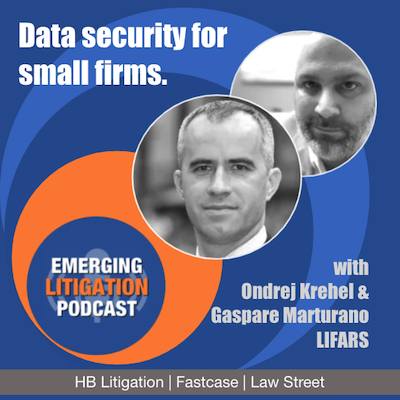
    Joining me to discuss this important issue is Ondrej Krehel, CEO & Founder of LIFARS, a New York-based incident response and digital forensics firm specializing in cybersecurity protection.
    Ondrej is recognized for his digital forensic expertise and ethical hacking skills. He participates in high-profile engagements around the world using his proprietary methodology to achieve the most rapid root-cause analysis and remediation. He is a former lecturer at FBI Training Academy who has led forensic investigations and cybersecurity involving the U.S. government, including military cyber special operations. He holds a Ph.D. in Computer Forensics from Police Academy in Bratislava, Slovakia, an M.S. degree in Mathematical Physics from Comenius University in Bratislava, and an Engineering Diploma from Technical University in Zvolen, Slovakia.
    Joining Ondrej and me is Gaspare J. Marturano, Chief Marketing Officer at LIFARS. Gaspare is a former Director of Information Systems for a large Connecticut law firm and has consulted on these issues with a number of other law firms.
    This podcast is the audio companion to the Journal on Emerging Issues in Litigation, a collaborative project between HB Litigation Conferences and the Fastcase legal research family, which includes Full Court Press, Law Street Media, and Docket Alarm. If you have comments or wish to participate in one our projects, or want to tell me how insightful and informative Ondrej and Gaspare are, please drop me a note at Editor@LitigationConferences.com.
    I particularly enjoyed hearing about what one kid was doing at 17, an age when I was certain I would be sought out for my rock drumming artistry. Of course, that kid was operating a criminal enterprise. I was just trying to impress girls.
    Tom Hagy

    Law firms are sweet targets for hackers given the rich data they store, from intellectual property to confidential merger details to personal and health information.

    The last decade is rife with headlines about data hacks and ransomware attacks at even the most sophisticated global law firms.

    Yet, according to the 2020 Legal Technology Survey Report conducted by the American Bar Association’s Legal Technology Resource Center fewer than half of the firms polled employ some of the most basic security measures, such as email and file encryption.

    What can smaller firms do to protect their data and that of their clients?

  • Cryptocurrency with Stephen Palley

    Cryptocurrency with Stephen Palley

    Cryptocurrency with Stephen Palley

    Joining me to discuss this paradigm-shattering model is Anderson Kill Partner Stephen D. Palley, a seasoned trial lawyer and litigator with extensive experience in complex commercial disputes like insurance recovery, securities litigation, and corporate governance.  Stephen has significant hands-on software development and design experience. Based in the firm’s D.C. office, he is co-chair of its cross-disciplinary blockchain and virtual currency group. At several points during our conversation I referred to an article co-written by Stephen and his New York colleague Joshua Gold, titled Protecting Cryptocurrency Assets. Stephen earned his J.D. from Washington University, his M.A. from the University of Delaware, and his B.A. (cum laude) from Tufts University (Go Jumbos!).
    This podcast is the audio companion to the Journal on Emerging Issues in Litigation, a collaborative project between HB Litigation Conferences and the Fastcase legal research family, which includes Full Court Press, Law Street Media, Docket Alarm and, most recently, Judicata. If you have comments or wish to participate in one our projects, or want to tell me how insightful and informative Stephen is, please drop me a note at Editor@LitigationConferences.com.
    I hope you enjoy the interview, especially when Leo, my cat, knocked over my microphone and when Stephen educated me on the existence of the Weird Beard Festival and other whisker-based celebrations. –Tom Hagy

    Cryptocurrency assets now exceed $1.5 trillion globally.

    What a great innovation, as is the magic that makes these transactions possible. Of course, I’m talking about blockchain. The possibilities are endless on both counts. No central authority. No regulators.

    But (there’s always a but), thanks to the world’s miscreants, desperados and other baddies there is escalating potential for theft of these assets whether they are held in Bitcoin or other forms of digital currency.

    What should businesses consider if they plan to invest in virtual assets?

    How might they mitigate risk? What security measures should they have in place?

    Is the theft of digital currency covered by insurance?

  • Policyholders Hit With Ransomware, Then Strike Insurance Coverage Oil in Indiana

    Policyholders Hit With Ransomware, Then Strike Insurance Coverage Oil in Indiana

    Policyholders Hit With Ransomware, Then Strike Insurance Coverage Oil in Indiana

    Abstract

    The cost of ransomware to businesses is estimated to have doubled since 2019 to $20 billion, according to Coveware. Policyholders turn to their insurance policies to recover losses that average more than $230,000 per incident. In the case discussed, the carrier denied a policyholder’s claim as being outside the computer fraud provisions of the commercial crime portion of the policy. Two lower courts sided with the carrier, but the

    Indiana Supreme Court ruled in favor of coverage. This is a significant win for policyholders seeking coverage for losses under policies not sold as “cyber insurance.” The article discusses the decision and the precedents cited in an area of litigation that only promises to expand as ransomware and similar digital crimes proliferate.

    Author

    Scott Godes and Andy Detherage were counsel to United Policy-holders, which submitted an amicus brief in favor of granting transfer and reversing the lower court decision, in the Indiana Supreme Court decision referenced in this article. Messrs. Godes and Detherage are partners in Barnes & Thornburg LLP.

    About
    The Journal on Emerging Issues in Litigation is a co-production of HB, Fastcase, and Law Street Media. You can also hear the complementary (and complimentary) Emerging Litigation Podcast wherever podcasts appear. For questions, contact Tom Hagy, Editor in Chief, at Editor@LitigationConferences.com.

    Loading Viewer…

  • Facial Recognition: How It Works and How It Doesn’t

    Authors

    Debbie Reynolds
    Founder, CEO & CDPO
    Debbie Reynolds Consulting
    Website

    Martin T. Tully
    Founding Partner
    Actuate Law
    Website

    Facial Recognition: Benefits & Risks

    Editor’s Note:

    Imagine how great technology would be if it weren’t for people. Since the beginning of time man has developed remarkable solutions to common problems. But leave it to nefarious, despicable, criminal or just plain dumb people to ruin them for the rest of us. You know, like gun powder, nuclear power, and the internet. Facial recognition programs and collection of biometric data would appear to have more benefits than risks, but those risks are there. As use of the technology proliferates we can expect more litigation as additional states follow Illinois — the first to enact a state Biometric Information Privacy Act. Martin T. Tully of Actuate Law LLC and Debbie Reynolds of Debbie Reynolds Consulting LLC, outline these risks and how regulation and litigation is responding in their article: Facial Recognition Proliferation: Litigation and Legal Implications of Biometric Technologies. Below are a couple excerpts from their article, published in the January 2021 edition of the Journal on Emerging Issues in Litigation. —Tom Hagy

    Some FR technologies use a scanner to identify 4,500 different points of facial geometry to create a map of a person’s face. The application doesn’t necessarily store photos of faces; it generates and stores a unique, algorithmic representation of faces. Think of it as a hash value for that individual. The hash value can then recognize that person when they return to a facility after initially registering. “Ah, you’re Mary, the FedEx driver. You are authorized to go to Suite 501 and deliver this package to Acme Corporation because you previously registered yourself here in that capacity.” Notably, the hash value in this example is encrypted and is not personally identifiable information by itself; it is useless outside the visitor management system. In this situation, if there was unauthorized access to or disclosure of the hashed representations of facial geometry, they could not be used to identify any individuals unless the unauthorized recipient also had access to both the registration system and the registered individual. It is vital to understand how the particular FR technology works when considering its privacy implications.

    …

    For all its applications, the technology is not without its drawbacks. Erroneous identification using FR, especially when paired with bias in the use of artificial intelligence (AI), has raised legitimate red flags. Newsweek reported in July 2020 that Amazon’s FR technology falsely identified 28 members of Congress as people who had been arrested for crimes. Similarly, in late 2017, the iPhone X in China was criticized for its inability to distinguish between Chinese faces. Thus, there can be real risk of inaccuracies and bias with the current state of both FR technology and the AI that often powers it.

    …

    The Illinois BIPA came to the forefront in 2015 when some enterprising lawyers realized a statute could be used to challenge companies such as Facebook and Google. The statute is pretty broad and punitive in its application. It has led to numerous class action lawsuits not only in Illinois, but across the country.  A case against Facebook was filed in federal court in California, ultimately settling for $550 million (Patel, et al. v. Facebook, No. 3:15-cv-03747-JD, N.D. Calif.). Facebook previously settled a case with the FTC over its use of facial recognition technology for $5 billion.

    In many BIPA lawsuits, standing has been an issue of contention. For some time, there was a split in the Illinois appellate courts about whether a claimant needed to show an actual concrete injury in order to sue under the statute. For example, just because I didn’t give you the written policy, or, I didn’t get your consent before I collected your information, do you have to show some other harm to have standing?

    Essentially, if nothing’s happened to you, nobody has sold your information, nobody has stolen your identity and if you haven’t been harmed, do you have the standing to sue? That was a big question until early 2019 when the Illinois Supreme Court, in Rosenbach v. Six Flags Entertainment Corp., held that the answer was “no.” The Court found that the Illinois General Assembly clarified that as a public policy matter, violating the statute alone, without any further showing of actual harm, or concrete or tangible harm, is sufficient to confer standing upon somebody to sue under BIPA. Once that issue was resolved, it fanned the flames of additional BIPA class actions (Rosenbach v. Six Flags Entm’t Corp., 2019 IL 123186, 432 Ill. Dec. 654, 129 N.E.3d 1197).

    Get the entire article by contacting the authors directly, or purchasing the January issue which has other insightful articles like this one.

    Also, check out their webinar.
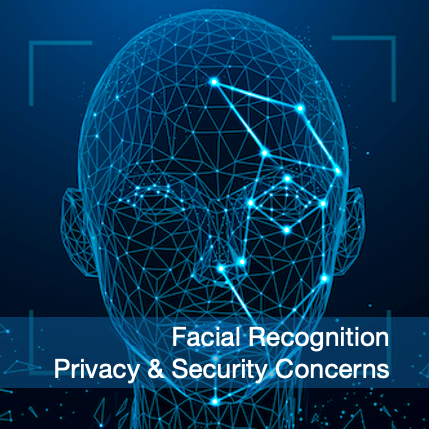
    Facial Recognition Privacy and Security Concerns

    Safeguarding Against Financial Exploitation

    An on-demand CLE-eligible webinar Safeguarding Against Financial Exploitation   America’s senior population is growing. Nearly one in five U.S. residents will be 65 or older in 2030. Which means the average age of U.S. investors is climbing too. With that comes the risk that they will be exploited by people with access – or gain access through nefarious methods – to their investment portfolio. Seniors and vulnerable persons lose billions of dollars each year. Remarkably, 90% of the people to take advantage of senior investors are members of their own family. Attorneys who represent senior clients need to know the signs of vulnerability, red flags that their clients are being exploited, what laws apply, and rules lawyers must follow in these matters.   Questions our speakers answer: What is senior / vulnerable investor exploitation?   Who is protected by state and federal laws?   How prevalent is senior financial exploitation? What do the numbers tell us?  What is the pace of financial abuse SAR filings by securities firms?  What are the most popular scams?   What is diminished capacity?  What are the red flags indicating possible exploitation?  What are the laws, rules, and regulations governing law firms?  What are some best practices for law firms?  How can firms best protect their senior clients?   On Demand CLE Webinar What You Get PowerPoint and supplemental materials. Complete recording for later review. Answers to your questions via email. Invitation to contact speakers. 1.5 CLE credits (for licensed attorneys). CLE assistance.* *Subject to state bar rules. For licensed attorneys.  Register Meet the Speakers Joseph Calabrese Bressler, Amery & Ross, P.C. A 1991 Graduate of St. John’s University Law School, Mr. Calabrese brings 30 years of practice and 18 years of Securities Litigation/Regulatory experience to his role as principal in the New York office of  Bressler, Amery & Ross’s Financial Institutions Group. He began his career as a Wall Street litigator as an associate general counsel for Citigroup’s Smith Barney and […]

    Lien Resolution: Government & Private Plans Get Aggressive (Against Attorneys)

    Includes Nearly 75 minutes of insights from experienced professionals. CLE credit: 1+ (subject to bar rules). For CLE questions: CLE@LitigationConference.com The complete Power Point presentation. Continued access to the complete recording for later use. Answers to your questions via email to the presenters or write to HB and we will be sure to contact the speakers. What can you do to settle personal injury suits cleanly and avoid costly litigation and penalties? What recent cases can inform you about protecting your settlements and, as attorneys, yourselves, from post-settlement federal lawsuits? How can your firm set itself up to meet government expectations? What role might experts play in navigating these pitfalls? Medicare Advantage (42 USC § 1395w-22) Federal Medical Care Recovery Act (FMCRA) (42 USC § 2651) Armed Forces Act (10 USC §1095) Veterans’ Benefits (38 USC §1729) Third-Party Collection Rules (32 CFR 537.24; 38 CFR 17.101, etc.) Set-Asides under the Medicare Secondary Payer Act (42 USC § 1395y(b)(2)] On Demand Registration Lien Resolution Government & Private Plans Get Aggressive (Against Attorneys!) On Demand | Recorded September 2020 It is increasingly common these days. Personal injury attorneys settle a case, only to find themselves sued by a U.S. Attorney for failing to reimburse Medicare for conditional payments as required by the Medicare Secondary Payer Act. In some cases the attorney may be required to pay fines in addition to the reimbursements and interest, a costly proposition. Are you up to speed on issues surrounding Medicare Advantage, TRICARE, veterans’ claims, and Medicare set-asides? Join nationally recognized healthcare lien and resolution expert Franklin P. Solomon and go-to lien resolution provider Brett Newman as they offer a practical, in-depth CLE presentation. Franklin P. Solomon, Esq. Attorney & Founder, Solomon Law Firm  A graduate of Rutgers University School of Law at Camden, Franklin Solomon is based in Cherry Hill, NJ, with a practice focused on evaluation, litigation and resolution of healthcare “liens” and reimbursement claims. Mr. Solomon represents personal injury victims and their attorneys […]

    Telepsychiatry: Mitigating the Risks

    REGISTER Registration Includes Nearly 90 minutes of insights from experienced professionals. CLE credit: 1+ (subject to bar rules). For CLE questions: CLE@LitigationConference.com The complete Power Point presentation. Continued access to the complete recording for later use. Answers to your questions via email to the presenters or write to HB and we will be sure to contact the speakers. Understand the risks associated with telepsychiatry and how to manage them.  Telemedicine has emerged as an important solution for healthcare in general and psychiatric medicine specifically during the current global pandemic. Remote access for sub-practices including addiction counseling have been commonly used. Our panel of psychiatric professionals who have served as expert witnesses and attorneys who counsel and represent physicians have prepared a 90-minute session to share insights with attorneys, physicians, healthcare providers, risk professionals, and more. Agenda Examining procedures and best practices that exist for ensuring confidentiality in a telemedicine practice How do you draft a telepsychiatric consent form? What is the emerging standard of care for telemedicine? Will the standard of care for telemedicine become a national standard? (Should it?) Review the case law addressing telemedicine or telepsychiatry How do the HIPAA regulations and HITECH privacy laws impact telemedicine? How have the HIPAA regulations and HITECH privacy laws been relaxed during the pandemic? Will the relaxed HIPAA and HITECH regulations impacting telemedicine continue past the pandemic? Which technical platforms are preferred? Which ones to avoid? Panelists Mark Levy, M.D., Medical Director at fpamed David Kan, M.D., UCSF Psychiatry Department and the California Society for Substance Abuse Medicine Ayesha Ashai, M.D., associated with fpamed Stephen M. Fatum, J.D., Partner, Barnes & Thornburg LLP Angela W. Russell, J.D., Partner, Wilson Elser Moskowitz Edelman & Dicker LLP Meet our physician and attorney panelists. Mark Levy MD Medical Director fpamed Dr. Levy is a graduate of Columbia College (A.B. 1967) and the Columbia University College of Physicians and Surgeons (M.D. 1971) in New York. He is a Physician […]

    The Commercial Drone Industry: Privacy, Security, Threats, and Mitigation of Risk

    HB presents a CLE-eligible webinar Now on-demand at the West LegalEdcenter THE COMMERCIAL DRONE INDUSTRY Privacy, Security, Threats, and Mitigation of Risk Drones have become an increasingly valuable tool for businesses of all types and sizes. Drones are already being used in many applications, but more will certainly arise as the technology advances. This means that certain risks, like cyber threats, will also continue to present themselves. Protecting the transmission and storage of data collected through drones is critical. Unfortunately, security usually comes as an afterthought. The drone industry is part of the aviation industry, which, based on its knowledge, keeps safety as a number one concern. Part of that safety is having proper protection for your systems, including security as a fundamental design principle. Take this webinar to gain insights on the topics listed below, and shared by an attorney who practices on the cutting-edge of this evolving technology. Topics: Defining drones. Current and future applications. FAA Modernization and Reform Act of 2012. FAA Part 107 Regulations and waivers. Resources, e.g. the FAA Drone Zone and LAANC Portal. Penalties for violations. Privacy implications. Drones as weapons. Vulnerability to cyber attacks. Take it now! What you get: 1+ CLE credits (subject to bar rules). Insights from an experienced professional who specializes in this area of the law. The complete PowerPoint presentation. Continued access to the complete recording for later use. Answers to your questions. Fee: No additional charge to subscribers to the West LegalEdcenter. Non-subscribers may take the course for $170. Meet the Speaker Kathryn Rattigan Robinson & Cole LLP Kathryn Rattigan is a member of the firm’s Business Litigation Group and Data Privacy + Cybersecurity Team. She advises clients on data privacy and security, cybersecurity, and compliance with related state and federal laws. She assists clients in assessing risks related to technology and software contracts, as well as with compliance-related issues with outsourcing and […]

    The Intersection of Privacy and Antitrust Webinar Now Available On-Demand on the West LegalEdcenter

    Available as part of your subscription to The Thomson Reuters West LegalEdcenter®. Don’t subscribe to the West LegalEdcenter? This webinar is still available directly from HB. Take it now! Questions for speakers Questions@LitigationConferences.com CLE questions CLE@LitigationConferences.com Check out the MoginRubin blog for more insights on antitrust and privacy law. What attorneys and companies need to know about the increasing interplay between these critical areas of the law.  Highly publicized cases and investigations in the U.S. and Europe of big technology, e-commerce, and social media companies demonstrate how anti-competition laws are being used to scrutinize and challenge not only how these corporations conduct themselves in the marketplace, but the very core of their colossal success: the mass collection and utilization of user data. Are the privacy and antitrust worlds beginning to cross over? Or do they simply run parallel while addressing entirely different types of conduct? Whatever the answer, data is the raw material that drives the likes of Google, Facebook, Apple and Amazon, so how it is handled is a critical question when counseling clients on mergers and acquisitions. Moderator Daniel J.  Mogin | Managing Partner, MoginRubin LLP Speakers Jennifer M. Oliver, CIPP/US | Partner, MoginRubin LLP Thomas N. Dahdouh | Director, Western Region, Federal Trade Commission Franklin M. Rubinstein | Partner, Wilson Sonsini Goodrich & Rosati Randi W. Singer, CIPP/US, CIPT | Partner, Weil, Gotshal & Manges Contributor Dina Srinivasan | Independent Researcher & Author of The Antitrust Case Against Facebook Dina was unable to present but we thank her for her content contributions.  Agenda Who should regulate privacy violations in the U.S.? Which antitrust issues implicate privacy concerns? What role does machine learning play on the competitive landscape? What is big data really? How is it different from “data”? What are the elements of effective merger reviews? What are the appropriate remedies? What are “notice-and-choice” versus “harms-based” approaches? Plus answers to your questions. Send them to Questions@LitigationConferences.com.
  • Does Data Sharing and Zoombombing Cause Actual Harm?

    Does Data Sharing and Zoombombing Cause Actual Harm?

    By Kirsten Errick

    Legal Writer
    Law Street Media

    Zoom Says Data Sharing, Zoombombing Doesn’t Cause Personal Harm

    Zoom is a good name for this company. It seems to have come out of nowhere to become the new verb for web meetings, robbing that distinction from many more established competitors like WebEx and GoToMeeting, maybe because they don’t have cool web-sounding names, although people don’t seem to be saying “let’s Skype later,” as much as they used to. Sure, we still “Facetime,” but Zoom really shot to the top when it comes to name recognition. According to CNBC’s Ari Levy, Zoom reported fiscal third-quarter revenue growth of more than 300% after seeing 355% expansion in the prior period. The company’s stock was up almost seven-fold this year but “pulled back in November on positive news surrounding a coronavirus vaccine,” Levy reported. And with success comes risk, especially when dealing with private data.  Here is an excerpt of a post shared with the permission of Fastcase and Law Street Media. –Tom Hagy, HB Litigation Conferences

    Dec. 4, 2020 (San Francisco) — On Wednesday [Dec. 2], in the Northern District of California, Zoom Video Communications filed a motion to dismiss the plaintiffs’ first amended consolidated class action complaint (FAC) on the grounds that the FAC failed to state a claim for which relief may be granted.

    The consolidated complaint alleged that Zoom engaged in unauthorized data sharing with third parties, such as Facebook, LinkedIn, and Google. Additional complaints included an alleged failure to prevent unwanted meeting disruptions by outside parties, called Zoombombing; and misrepresentation of its encryption protocols claiming it used end-to-end encryption when it purportedly did not provide such encryption.

    Zoom stated that it faced unprecedented growth resulting from the COVID-19 pandemic, as people began using Zoom for teleconferences and to communicate with friends and family, but it “worked tirelessly since the pandemic’s onset to keep its services operational and secure, while developing and deploying extensive privacy and security enhancements to address new challenges caused by the massive uptick in non-corporate usage.”

    In its motion to dismiss, Zoom stated “(i)n an effort to capitalize on Zoom’s explosive growth during the COVID-19 pandemic, Plaintiffs seek to hold Zoom liable on behalf of a nationwide class under a scattershot array of loosely related factual and legal theories, largely drawn from sensationalist news reports.” Zoom claimed that in the latest attempt, the plaintiffs still failed to state claims upon which relief may be granted; instead, the plaintiffs’ FAC supposedly “recycles the same flawed claims as Plaintiffs’ original consolidated complaint (CAC) … with a few minor additional factual allegations.”

    Zoom averred that all of the plaintiffs’ claims fail because they do not allege that they were harmed by the company. Zoom contended that the plaintiffs failed to claim personal harm from the purported data sharing, meeting disruptions, and alleged misrepresentations and omissions about encryption.

    Read this and more at LawStreetMedia.com.

    Safeguarding Against Financial Exploitation

    An on-demand CLE-eligible webinar Safeguarding Against Financial Exploitation   America’s senior population is growing. Nearly one in five U.S. residents will be 65 or older in 2030. Which means the average age of U.S. investors is climbing too. With that comes the risk that they will be exploited by people with access – or gain access through nefarious methods – to their investment portfolio. Seniors and vulnerable persons lose billions of dollars each year. Remarkably, 90% of the people to take advantage of senior investors are members of their own family. Attorneys who represent senior clients need to know the signs of vulnerability, red flags that their clients are being exploited, what laws apply, and rules lawyers must follow in these matters.   Questions our speakers answer: What is senior / vulnerable investor exploitation?   Who is protected by state and federal laws?   How prevalent is senior financial exploitation? What do the numbers tell us?  What is the pace of financial abuse SAR filings by securities firms?  What are the most popular scams?   What is diminished capacity?  What are the red flags indicating possible exploitation?  What are the laws, rules, and regulations governing law firms?  What are some best practices for law firms?  How can firms best protect their senior clients?   On Demand CLE Webinar What You Get PowerPoint and supplemental materials. Complete recording for later review. Answers to your questions via email. Invitation to contact speakers. 1.5 CLE credits (for licensed attorneys). CLE assistance.* *Subject to state bar rules. For licensed attorneys.  Register Meet the Speakers Joseph Calabrese Bressler, Amery & Ross, P.C. A 1991 Graduate of St. John’s University Law School, Mr. Calabrese brings 30 years of practice and 18 years of Securities Litigation/Regulatory experience to his role as principal in the New York office of  Bressler, Amery & Ross’s Financial Institutions Group. He began his career as a Wall Street litigator as an associate general counsel for Citigroup’s Smith Barney and […]

    Lien Resolution: Government & Private Plans Get Aggressive (Against Attorneys)

    Includes Nearly 75 minutes of insights from experienced professionals. CLE credit: 1+ (subject to bar rules). For CLE questions: CLE@LitigationConference.com The complete Power Point presentation. Continued access to the complete recording for later use. Answers to your questions via email to the presenters or write to HB and we will be sure to contact the speakers. What can you do to settle personal injury suits cleanly and avoid costly litigation and penalties? What recent cases can inform you about protecting your settlements and, as attorneys, yourselves, from post-settlement federal lawsuits? How can your firm set itself up to meet government expectations? What role might experts play in navigating these pitfalls? Medicare Advantage (42 USC § 1395w-22) Federal Medical Care Recovery Act (FMCRA) (42 USC § 2651) Armed Forces Act (10 USC §1095) Veterans’ Benefits (38 USC §1729) Third-Party Collection Rules (32 CFR 537.24; 38 CFR 17.101, etc.) Set-Asides under the Medicare Secondary Payer Act (42 USC § 1395y(b)(2)] On Demand Registration Lien Resolution Government & Private Plans Get Aggressive (Against Attorneys!) On Demand | Recorded September 2020 It is increasingly common these days. Personal injury attorneys settle a case, only to find themselves sued by a U.S. Attorney for failing to reimburse Medicare for conditional payments as required by the Medicare Secondary Payer Act. In some cases the attorney may be required to pay fines in addition to the reimbursements and interest, a costly proposition. Are you up to speed on issues surrounding Medicare Advantage, TRICARE, veterans’ claims, and Medicare set-asides? Join nationally recognized healthcare lien and resolution expert Franklin P. Solomon and go-to lien resolution provider Brett Newman as they offer a practical, in-depth CLE presentation. Franklin P. Solomon, Esq. Attorney & Founder, Solomon Law Firm  A graduate of Rutgers University School of Law at Camden, Franklin Solomon is based in Cherry Hill, NJ, with a practice focused on evaluation, litigation and resolution of healthcare “liens” and reimbursement claims. Mr. Solomon represents personal injury victims and their attorneys […]

    Telepsychiatry: Mitigating the Risks

    REGISTER Registration Includes Nearly 90 minutes of insights from experienced professionals. CLE credit: 1+ (subject to bar rules). For CLE questions: CLE@LitigationConference.com The complete Power Point presentation. Continued access to the complete recording for later use. Answers to your questions via email to the presenters or write to HB and we will be sure to contact the speakers. Understand the risks associated with telepsychiatry and how to manage them.  Telemedicine has emerged as an important solution for healthcare in general and psychiatric medicine specifically during the current global pandemic. Remote access for sub-practices including addiction counseling have been commonly used. Our panel of psychiatric professionals who have served as expert witnesses and attorneys who counsel and represent physicians have prepared a 90-minute session to share insights with attorneys, physicians, healthcare providers, risk professionals, and more. Agenda Examining procedures and best practices that exist for ensuring confidentiality in a telemedicine practice How do you draft a telepsychiatric consent form? What is the emerging standard of care for telemedicine? Will the standard of care for telemedicine become a national standard? (Should it?) Review the case law addressing telemedicine or telepsychiatry How do the HIPAA regulations and HITECH privacy laws impact telemedicine? How have the HIPAA regulations and HITECH privacy laws been relaxed during the pandemic? Will the relaxed HIPAA and HITECH regulations impacting telemedicine continue past the pandemic? Which technical platforms are preferred? Which ones to avoid? Panelists Mark Levy, M.D., Medical Director at fpamed David Kan, M.D., UCSF Psychiatry Department and the California Society for Substance Abuse Medicine Ayesha Ashai, M.D., associated with fpamed Stephen M. Fatum, J.D., Partner, Barnes & Thornburg LLP Angela W. Russell, J.D., Partner, Wilson Elser Moskowitz Edelman & Dicker LLP Meet our physician and attorney panelists. Mark Levy MD Medical Director fpamed Dr. Levy is a graduate of Columbia College (A.B. 1967) and the Columbia University College of Physicians and Surgeons (M.D. 1971) in New York. He is a Physician […]

    The Commercial Drone Industry: Privacy, Security, Threats, and Mitigation of Risk

    HB presents a CLE-eligible webinar Now on-demand at the West LegalEdcenter THE COMMERCIAL DRONE INDUSTRY Privacy, Security, Threats, and Mitigation of Risk Drones have become an increasingly valuable tool for businesses of all types and sizes. Drones are already being used in many applications, but more will certainly arise as the technology advances. This means that certain risks, like cyber threats, will also continue to present themselves. Protecting the transmission and storage of data collected through drones is critical. Unfortunately, security usually comes as an afterthought. The drone industry is part of the aviation industry, which, based on its knowledge, keeps safety as a number one concern. Part of that safety is having proper protection for your systems, including security as a fundamental design principle. Take this webinar to gain insights on the topics listed below, and shared by an attorney who practices on the cutting-edge of this evolving technology. Topics: Defining drones. Current and future applications. FAA Modernization and Reform Act of 2012. FAA Part 107 Regulations and waivers. Resources, e.g. the FAA Drone Zone and LAANC Portal. Penalties for violations. Privacy implications. Drones as weapons. Vulnerability to cyber attacks. Take it now! What you get: 1+ CLE credits (subject to bar rules). Insights from an experienced professional who specializes in this area of the law. The complete PowerPoint presentation. Continued access to the complete recording for later use. Answers to your questions. Fee: No additional charge to subscribers to the West LegalEdcenter. Non-subscribers may take the course for $170. Meet the Speaker Kathryn Rattigan Robinson & Cole LLP Kathryn Rattigan is a member of the firm’s Business Litigation Group and Data Privacy + Cybersecurity Team. She advises clients on data privacy and security, cybersecurity, and compliance with related state and federal laws. She assists clients in assessing risks related to technology and software contracts, as well as with compliance-related issues with outsourcing and […]

    The Intersection of Privacy and Antitrust Webinar Now Available On-Demand on the West LegalEdcenter

    Available as part of your subscription to The Thomson Reuters West LegalEdcenter®. Don’t subscribe to the West LegalEdcenter? This webinar is still available directly from HB. Take it now! Questions for speakers Questions@LitigationConferences.com CLE questions CLE@LitigationConferences.com Check out the MoginRubin blog for more insights on antitrust and privacy law. What attorneys and companies need to know about the increasing interplay between these critical areas of the law.  Highly publicized cases and investigations in the U.S. and Europe of big technology, e-commerce, and social media companies demonstrate how anti-competition laws are being used to scrutinize and challenge not only how these corporations conduct themselves in the marketplace, but the very core of their colossal success: the mass collection and utilization of user data. Are the privacy and antitrust worlds beginning to cross over? Or do they simply run parallel while addressing entirely different types of conduct? Whatever the answer, data is the raw material that drives the likes of Google, Facebook, Apple and Amazon, so how it is handled is a critical question when counseling clients on mergers and acquisitions. Moderator Daniel J.  Mogin | Managing Partner, MoginRubin LLP Speakers Jennifer M. Oliver, CIPP/US | Partner, MoginRubin LLP Thomas N. Dahdouh | Director, Western Region, Federal Trade Commission Franklin M. Rubinstein | Partner, Wilson Sonsini Goodrich & Rosati Randi W. Singer, CIPP/US, CIPT | Partner, Weil, Gotshal & Manges Contributor Dina Srinivasan | Independent Researcher & Author of The Antitrust Case Against Facebook Dina was unable to present but we thank her for her content contributions.  Agenda Who should regulate privacy violations in the U.S.? Which antitrust issues implicate privacy concerns? What role does machine learning play on the competitive landscape? What is big data really? How is it different from “data”? What are the elements of effective merger reviews? What are the appropriate remedies? What are “notice-and-choice” versus “harms-based” approaches? Plus answers to your questions. Send them to Questions@LitigationConferences.com.
  • Cryptocurrency Article and Webinar

    Cryptocurrency:

    The Good, The Bad, and the Tricky

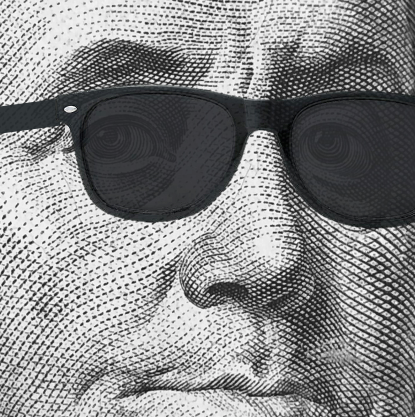
    Ben Franklin poses in sunglasses for cryptocurrency webinar. According to a recent Visual Capitalist article, there are now more than 5,000 cryptocurrencies in circulation, fueling an exploding $200 billion industry. Clearly it is a boom time for virtual asset service providers, or VASPs, like cryptocurrency exchanges and wallet providers. Despite its notoriety, mystique still surrounds cryptocurrency, from its use of blockchain technology, to the benefits and weaknesses of trading decentralized money, to national security implications. With crypto’s rise comes global implications. Its use often makes its way into headlines about criminal activity, such as the recent arrest of a 19-year-old and his friends for their alleged roles in a highly publicized Twitter hack. Forensic tools are in a constant state of development. For example, blockchain analysis tools assisted investigators in quickly identifying the young Twitter hackers, according to a post on the CipherTrace blog.

    Two Sides of the Digital Coin.

    There are many upsides to cryptocurrency. Transactions are secure without bank oversight. They can be processed at any time, not just during business hours. It has purchase power anywhere. Finally, cryptocurrency may provide greater benefit to developing countries where the local currency may swing due to exchange rate instability. In such countries, and where many citizens may be unbanked, supplanting traditional coinage with cryptocurrency could stabilize finance and open its doors to many.

    With crypto’s rise comes global implications. Shortcomings generally are human ones; intermediaries, like unregulated exchanges, create vulnerabilities. The ability to use pseudonyms in executing crypto transactions makes it ideal for bad actors, criminal syndicates, and terrorists. According to the international Financial Action Task Force, the risk of money laundering and terrorism financing is increased through “chain-hopping,” or “quick exchanges between different virtual assets,” which “allows the multiple layering of illicit funds within a short timeframe, allowing money laundering networks to disguise the origins of funds and launder illicit proceeds.” Some countries, like Venezuela, have even tried to use cryptocurrency to circumvent sanctions.

    Financial losses from criminal activity in this space are climbing. According to the CipherTrace Crytocurrency Crime & Anti-Money Laundering Report, Spring 2020, “In the first five months of 2020, crypto thefts, hacks, and frauds totaled $1.36 billion, suggesting 2020 could see the second-highest value in crypto crimes ever recorded. In a trend that continues from last year, fraud and misappropriation still make up most of the year’s stolen crypto compared to hacks and thefts. Of the $1.36 billion stolen, fraud and misappropriation account for 98% of the total value—nearly $1.3 billion.”

    This fast-changing technology is sometimes outpacing law enforcement agencies and the intelligence community, challenging their ability to detect, monitor, and stop cybercrime. But criminals have no reason to rest easy. A former stockbroker recently learned that the hard way. Following a multi-agency federal investigation, he quickly pleaded guilty to running a $33 million cryptocurrency scam.

    Watch the AccessData Webinar on Cryptocurrency

    This excellent program features blockchain expert Dina Mainville with CipherTrace, plus attorneys and former federal prosecutors David Haas of Haas Law PLLC, and Dan Eckhart with Dan Eckhart Law. The webinar is hosted by Sarah Hargreaves, who directs training internationally for AccessData, provider of digital forensics software solutions for law enforcement and government agencies.

  • Facial Recognition Update July 2020

    Facial Recognition Update July 2020

    Facial Recognition Technology — Emerging After Decades of Development — Draws Lawsuits and Proposed Bans 

    We sometimes forget that not all of the technical wizards who transformed our world were young “geniuses” jacked up on Starbucks, their shirttails hanging out in the ping-pong section of their open concept offices. Woody Bledsoe was born 99 years ago. As a young son of a sharecropper he demonstrated exceptional mathematical capabilities. Early in his career he had a dream: A machine that could think like a human, converse like one, and even recognize faces. This was as far back as the 1950s. This mathematician and computer scientist would go on to teach for decades at the University of Austin where he worked to advance automated reasoning and artificial intelligence.

    But what was his role in the development of the technology exactly? Did he perform work for a CIA front? And why, in his old age and suffering from the cruelty of ALS that would ultimately kill him in 1995, did he ask his son to set fire to a stack of old papers? Take a look at “The Secret History of Facial Recognition” written by Shaun Raviv for Wired Magazine, which explores why, among other things, “the record of [Blesdoe’s] role all but vanished.” If there isn’t a movie script in the works there probably will be soon.  

    Today facial recognition is used in such innocent and handy ways as pointing out your friends in a photograph on Facebook to infinitely more serious and controversial applications as identifying people who may or may not be of interest to law enforcement.   

    We’re in what should be an expected phase with something so disruptive and, let’s face it, lucrative. That’s the phase where lawyers and lawmakers dive in to grapple with how to square the disruption with the laws and norms of society. Facebook has been on the blunt end of this recently, as has the company Clearview AI and even the New York Department of Education, which uses facial recognition programs in his schools. Civil rights groups have been increasingly critical of law enforcement use of facial recognition software, as the technology has proven to be inaccurate at times, especially among ethnic groups, women and young people. 

    Tom Hagy
    Managing Director

    FacebookSettlesClass Action for $550 million 

    Facebook faces considerable legal challenges on many fronts and on multiple continents. It recently agreed to put at least one challenge behind it by paying $550 million to settle a class-action lawsuit over its use of facial recognition technology in Illinois, home of the much-heralded 2008 Illinois Biometric Information Privacy Act. This is widely considered to be a major victory for those who have repeatedly raised questions about what they say are the social media company’s questionable data-mining practices. The suit argued that Facebook’s “Tag Suggestions” feature, which allows users to “tag” other uses in their photos using a face-matching software, therefore allowing Facebook to harvest facial data from millions of users, violates privacy rights. Facebook said the settlement as it was in the best interest of the community and its shareholders. Plaintiff attorney Jay Edelson, whose firm represented the Facebook users, told the New York Times, “From people who are passionate about gun rights to those who care about women’s reproductive issues, the right to participate in society anonymously is something we cannot afford to lose.” The Times piece referenced an Illinois Supreme Court ruling which upheld consumers’ right to sue companies for collecting biometric data (fingerprints, iris scans) without informing consumers about the intended use of the data. That was in a case filed against Six Flags Entertainment Corp. For collecting a teenager’s fingerprints when he purchased a season pass at a Six Flags park. Rosenbach v. Six Flags Entertainment Corp., 2019 IL 123186. 

    More from the Illinois Supreme Court, New York Times, Consumer Reports, and Chicago Tribune: 

    Clearview AI Facial Recognition Company Faces Another Lawsuit 

    Clearview AI, a controversial facial recognition app that is used by U.S. law enforcement to identify suspects and other people, is facing a lawsuit, also under the Illinois Biometric Information Privacy Act. The action was filed in Cook County Superior Court by the ACLU and others which seeks class-action status and $5 million in damages for what it calls “willful, reckless or negligent violations of biometrics laws.” The plaintiffs are fighting Clearview’s collection, storage and use of biometric information without written consent. “Clearview has amassed a database of more than 3 billion photographs that it scraped from sources including Instagram, Twitter, YouTube, Facebook, Venmo and millions of other websites,” the plaintiffs charge. “Users can take a picture of a stranger on the street, upload it to Clearview’s tool and instantly see photos of that person on various social media platforms and websites, along with the person’s name, address and other identifying information.” The Chicago Police Department reportedly paid nearly $50,000 for a two-year contract to use the facial recognition software. Joining the national and Illinois ACLU organizations, are the Chicago Alliance Against Sexual Exploitation, the Sex Workers Outreach Project Chicago, the Illinois State Public Interest Research Group, Inc., and Mujeres Latinas en Acción.  

    Morefrom the ACLU and CNET:  

    Facial Recognition Lawsuit Targets NY Schools Over Student Privacy 

     A lawsuit against the New York State Education Department is looking to dismantle a $3 million facial recognition system in schools, citing student privacy concerns and the technology’s issues with racial and gender bias. The Lockport School District is one of the first US public school systems to use the technology on students and staff. They began using the technology in January of this year. The lawsuit, filed by the New York Civil Liberties Union on behalf of Lockport parents, argues that the use of facial recognition technology violates the state’s privacy protections under New York’s Education Law. The NYCLU is seeking to have the technology removed from schools. The state originally granted the use of funds for the facial recognition software to the Lockport School District because they claimed that the technology would protect student privacy.  

    More from CNET and EdWeek: 

    Federal Legislators Want to Address Privacy, Wrongful Arrest Concerns 

    Meanwhile, a bicameral proposal from the Senate and House seeks to bring a halt to law enforcement’s use of facial recognition not only to protect privacy but, as they said, to prevent physical harm to people, especially people of color, who are wrongfully identified as criminal suspects.  

    On June 25, 2020, Senator Edward J. Markey (D-Mass.), along with Senator Jeff Merkley (D-Ore.), Congresswoman Pramila Jayapal (WA-07) and Congresswoman Ayanna Pressley (MA-07) announced they would introduce a ban on governmental use of biometric technology, including facial recognition tools. “The Facial Recognition and Biometric Technology Moratorium Act responds to reports that federal and local law enforcement entities have engaged with facial recognition companies and follows recent pledges by leading technology companies to pause their sale of facial recognition tools to law enforcement,” according to the senators’ statement.  

    “A growing body of research points to systematic inaccuracy and bias issues in biometric technologies, which pose disproportionate risks to non-white individuals,” the senators said.

    “A recent report by the National Institute of Standards and Technology on facial recognition tools found that Black, Brown, and Asian individuals were up to 100 times more likely to be misidentified than white male faces.  Yesterday, the American Civil Liberties Union (ACLU) amplified the story of Robert Williams, a Black man from the Detroit area who was wrongfully arrested after facial recognition technology misidentified him as the man who was seen allegedly committing a crime on a store’s surveillance camera feed.”    

    “Facial recognition technology doesn’t just pose a grave threat to our privacy, it physically endangers Black Americans and other minority populations in our country,” said Senator Markey. 

    “As we work to dismantle the systematic racism that permeates every part of our society, we can’t ignore the harms that these technologies present. I’ve spent years pushing back against the proliferation of facial recognition surveillance systems because the implications for our civil liberties are chilling and the disproportionate burden on communities of color is unacceptable. In this moment, the only responsible thing to do is to prohibit government and law enforcement from using these surveillance mechanisms.”      

    “At a time when Americans are demanding that we address systemic racism in law enforcement, the use of facial recognition technology is a step in the wrong direction,” Markey said.  

    Congresswoman Jayapal opposes retail sales of facial recognition products. “For years, I have called on companies like Amazon to stop selling facial recognition technology that has not only been invasive, inaccurate and unregulated but has also been unapologetically weaponized by law enforcement against Black people across this country for far too long. Introduced on the same day that the House is set to pass the George Floyd Justice in Policing Act, our legislation will not only protect civil liberties but it will aggressively fight back against racial injustice by stopping federal entities from using facial recognition tools and stripping support for state and local law enforcement departments that use biometric technology.”  

    The Justice in Policing Act, would, among other things, disallow uniformed officers from using dashcams and bodycams that utilize facial recognition software. It also specifies that police departments using federal grants to buy or rent bodycams must adopt policies on the use of facial recognition on the footage from the devices, including securing a judge’s approval and only deploying it in cases of “imminent threats or serious crimes.” However, many civil rights groups, including the ACLU, feel that these provisions don’t go nearly far enough to protect people from possible discrimination and wrongful arrest, which they describe as “incredibly biased technology.” “IBM, Amazon, and Microsoft all said they would halt sales of facial recognition to U.S. police and called on Congress to impose rules on use of the technology,” Wired Magazine reported. 

    Congresswoman Pressley called the technology “fundamentally flawed, systemically biased, and has no place in our society,” adding that “Black and brown people are already over-surveilled and over-policed, and it’s critical that we prevent government agencies from using this faulty technology to surveil communities of color even further.” 

    See articles and copies of the bills from CNET, Wired, NPR, Sen. Markey, and NBC: 

    Chicago-based privacy law expert Debbie Reynolds summed it up this way: “Use of Facial Recognition will cause an unprecedented need for collaboration between law and technologies to preserve and further support the rights of individuals around the world.”

    Propose an Article

    “For years, I have called on companies like Amazon to stop selling facial recognition technology that has not only been invasive, inaccurate and unregulated but has also been unapologetically weaponized by law enforcement against Black people across this country for far too long.” — Rep. Ayanna Pressley (MA-07). Photo by Nicholas Green on Unsplash

    Propose an Article

    “Use of Facial Recognition will cause an unprecedented need for collaboration between law and technologies to preserve and further support the rights of individuals around the world.”

    Debbie Reynolds
    Debbie Reynolds Consulting, LLC
    Founder, CEO, and Chief Data Privacy Officer