Tag: Crypto

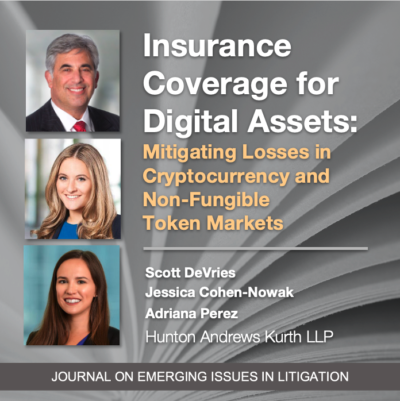
  • Insurance Coverage for Digital Assets: Mitigating Losses in Cryptocurrency and Non‐Fungible Token Markets by Scott DeVries, Jessica Cohen-Nowak and Adriana Perez of Hunton Andrews Kurth

    Insurance Coverage for Digital Assets: Mitigating Losses in Cryptocurrency and Non‐Fungible Token Markets by Scott DeVries, Jessica Cohen-Nowak and Adriana Perez of Hunton Andrews Kurth

    Journal on Emerging Issues in LitigationCompanies and individuals are riding the ups and downs of cryptocurrency and NFTs—with losses and swings in the billions of dollars—but digital assets are not going away.

    Abstract: The risk of loss in certain categories may be mitigated by insurance, whether provided by tailored policies and/or under policies designed specifically for digital asset owners. Those with exposure to the digital asset sector should be attuned to the emerging marketplace for such insurance products. While it is early days for NFT-specific coverage, the rise of cryptocurrency has created a substantial marketplace for crypto coverage. Insurers are becoming increasingly able to model and assess risk, so more products are coming to market. That said, digital asset holders need to be able to select coverage that best suits their needs. In this article, the authors discuss the history and status of coverage for digital assets to assist readers in exploring how they might use insurance to mitigate risk in this emerging and rocky sector of global finance.

    “Over the course of a decade, the marketplace for cryptocurrency has increased from zero to an estimated $250 billion. However, only $6 billion in insurance coverage is currently available. It would be a gross understatement to say that there is a truly remarkable imbalance between market value and insurance capacity.”

    Introduction

    Crypto markets are experiencing the greatest crash in their history to date.  The value of a Bitcoin (BTC) has plummeted 70% from its peak and Ethereum (ETH) has fallen 77%.  Since last November, the value of cryptocurrency tokens has lost $2 billion in value. As noted financial publication Barron’s put it: “Crypto is having a ‘Lehman moment,’ a shattering of confidence triggered by plunging asset prices, liquidity freezing up, and billions of dollars wiped out in a few scary weeks.” Cryptocurrency companies are halting withdrawals and transfers, platforms are seizing up, and regulators are circling.

    Nor has the devastation been limited to the coins themselves.  Non-fungible token (NFT) sales have reduced by 90% since September 2021.  The New York Times reported that Opensea.io (OpenSea) an NFT marketplace that receives 2.5% share of the proceeds for each NFT sale, has been plagued by “a surge of plagiarism, as sellers convert traditional artwork into NFTs and then list the images for sale without compensating the original creator.”  For example, DeviantArt, an artist collective that scans OpenSea for copyright infringement of the work of its artists, found 290,000 instances of unauthorized NFTs copying its artists’ works. While infringing listings can be deleted in response to take down requests filed by the artist, buyers of counterfeit NFTs are rarely given a refund.

    Against this backdrop, the issue of whether there may be claims associated with cryptocurrency and NFTs is far from a theoretical or esoteric thought exercise.  It is very real.  And when there are claims, businesses and investors doubtless will look to their insurers.

    A business or home is devastated by a wildfire.  Property insurance is available up to limits.  A home is broken into, and art and jewelry are stolen.  Crime/specie insurance is available.

    But what about new age assets?  What about cryptocurrency?  What about NFTs?  These obviously are not immune from theft by hackers.  In 2021, hackers stole at least $3.2 billion in cryptocurrency with schemes short of outright theft accounting for another $7.8 billion. In the first four months of 2022, NFT hacks accounted for $52 million in losses, an almost eight-fold increase from 2021.

    There typically is a significant time lag between the development of a product and the availability of product-specific insurance.  This general proposition applies with equal force here.  Over the course of a decade, the marketplace for cryptocurrency has increased from zero to an estimated $250 billion.  However, only $6 billion in insurance coverage is currently available.  It would be a gross understatement to say that there is a truly remarkable imbalance between market value and insurance capacity.

    Although NFTs have been around for the better part of a decade, it was only during the last two years that the marketplace has grown to upwards of $41 billion. In addition to its newness, NFTs pose additional risks for insurers, including questions of ownership, authenticity and the valuation of a truly “unique” asset.  Consequently, availability of insurance coverage for NFTs is even further behind.

    Given the rapid rate at which the digital asset field is developing, and claims are emerging, and the insurance industry’s attempts to specifically address coverage for these losses and claims, anything written on this topic will, at least in part, be outdated by the time it is published.  The objective of this article is to educate the reader on the history and status of the field, enabling them to ask the questions they need to ask, and to procure the coverage they need if available now or in coming months. 

    Download the article now!

    Insurance Coverage for Digital Assets:

    Mitigating Losses in Crypto and NFT Markets

    Scott DeVries

    Scott DeVriesHunton Andrews Kurth

    Scott DeVries (sdevries@huntonak.com) is Special Counsel at Hunton Andrews Kurth and long-time insurance coverage attorney for policyholders in a range of complex disputes as well as mass torts, class action, product liability, and complex business litigation.

    Jessica Cohen-Nowak

    Jessica Cohen-NowakHunton Andrews Kurth

    Jessica Cohen-Nowak (jcohen-nowak@huntonak.com) is an associate in Hunton Andrew Kurth LLP’s Intellectual Property group in the firm’s New York office. Jessica focuses her counseling and litigation practice on intellectual property matters in the fashion, fitness, entertainment, hospitality, and gaming industries as well as in technology and digital assets.

    Adriana Perez

    Adriana PerezHunton Andrews Kurth

    Adriana Perez (pereza@huntonak.com) is an associate in the firm’s Miami office where she focuses on insurance, reinsurance, and other business litigation.

  • Cryptocurrency with Stephen Palley

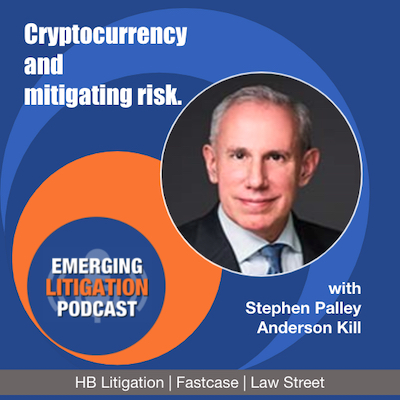
    Cryptocurrency with Stephen Palley

    Cryptocurrency with Stephen Palley

    Joining me to discuss this paradigm-shattering model is Anderson Kill Partner Stephen D. Palley, a seasoned trial lawyer and litigator with extensive experience in complex commercial disputes like insurance recovery, securities litigation, and corporate governance.  Stephen has significant hands-on software development and design experience. Based in the firm’s D.C. office, he is co-chair of its cross-disciplinary blockchain and virtual currency group. At several points during our conversation I referred to an article co-written by Stephen and his New York colleague Joshua Gold, titled Protecting Cryptocurrency Assets. Stephen earned his J.D. from Washington University, his M.A. from the University of Delaware, and his B.A. (cum laude) from Tufts University (Go Jumbos!).
    This podcast is the audio companion to the Journal on Emerging Issues in Litigation, a collaborative project between HB Litigation Conferences and the Fastcase legal research family, which includes Full Court Press, Law Street Media, Docket Alarm and, most recently, Judicata. If you have comments or wish to participate in one our projects, or want to tell me how insightful and informative Stephen is, please drop me a note at Editor@LitigationConferences.com.
    I hope you enjoy the interview, especially when Leo, my cat, knocked over my microphone and when Stephen educated me on the existence of the Weird Beard Festival and other whisker-based celebrations. –Tom Hagy

    Cryptocurrency assets now exceed $1.5 trillion globally.

    What a great innovation, as is the magic that makes these transactions possible. Of course, I’m talking about blockchain. The possibilities are endless on both counts. No central authority. No regulators.

    But (there’s always a but), thanks to the world’s miscreants, desperados and other baddies there is escalating potential for theft of these assets whether they are held in Bitcoin or other forms of digital currency.

    What should businesses consider if they plan to invest in virtual assets?

    How might they mitigate risk? What security measures should they have in place?

    Is the theft of digital currency covered by insurance?

  • Cryptocurrency Article and Webinar

    Cryptocurrency:

    The Good, The Bad, and the Tricky

    Ben Franklin poses in sunglasses for cryptocurrency webinar. According to a recent Visual Capitalist article, there are now more than 5,000 cryptocurrencies in circulation, fueling an exploding $200 billion industry. Clearly it is a boom time for virtual asset service providers, or VASPs, like cryptocurrency exchanges and wallet providers. Despite its notoriety, mystique still surrounds cryptocurrency, from its use of blockchain technology, to the benefits and weaknesses of trading decentralized money, to national security implications. With crypto’s rise comes global implications. Its use often makes its way into headlines about criminal activity, such as the recent arrest of a 19-year-old and his friends for their alleged roles in a highly publicized Twitter hack. Forensic tools are in a constant state of development. For example, blockchain analysis tools assisted investigators in quickly identifying the young Twitter hackers, according to a post on the CipherTrace blog.

    Two Sides of the Digital Coin.

    There are many upsides to cryptocurrency. Transactions are secure without bank oversight. They can be processed at any time, not just during business hours. It has purchase power anywhere. Finally, cryptocurrency may provide greater benefit to developing countries where the local currency may swing due to exchange rate instability. In such countries, and where many citizens may be unbanked, supplanting traditional coinage with cryptocurrency could stabilize finance and open its doors to many.

    With crypto’s rise comes global implications. Shortcomings generally are human ones; intermediaries, like unregulated exchanges, create vulnerabilities. The ability to use pseudonyms in executing crypto transactions makes it ideal for bad actors, criminal syndicates, and terrorists. According to the international Financial Action Task Force, the risk of money laundering and terrorism financing is increased through “chain-hopping,” or “quick exchanges between different virtual assets,” which “allows the multiple layering of illicit funds within a short timeframe, allowing money laundering networks to disguise the origins of funds and launder illicit proceeds.” Some countries, like Venezuela, have even tried to use cryptocurrency to circumvent sanctions.

    Financial losses from criminal activity in this space are climbing. According to the CipherTrace Crytocurrency Crime & Anti-Money Laundering Report, Spring 2020, “In the first five months of 2020, crypto thefts, hacks, and frauds totaled $1.36 billion, suggesting 2020 could see the second-highest value in crypto crimes ever recorded. In a trend that continues from last year, fraud and misappropriation still make up most of the year’s stolen crypto compared to hacks and thefts. Of the $1.36 billion stolen, fraud and misappropriation account for 98% of the total value—nearly $1.3 billion.”

    This fast-changing technology is sometimes outpacing law enforcement agencies and the intelligence community, challenging their ability to detect, monitor, and stop cybercrime. But criminals have no reason to rest easy. A former stockbroker recently learned that the hard way. Following a multi-agency federal investigation, he quickly pleaded guilty to running a $33 million cryptocurrency scam.

    Watch the AccessData Webinar on Cryptocurrency

    This excellent program features blockchain expert Dina Mainville with CipherTrace, plus attorneys and former federal prosecutors David Haas of Haas Law PLLC, and Dan Eckhart with Dan Eckhart Law. The webinar is hosted by Sarah Hargreaves, who directs training internationally for AccessData, provider of digital forensics software solutions for law enforcement and government agencies.

  • RSA’s Zulfikar Ramzan on Blockchain

    Is blockchain as impenetrable as people think? Or as necessary?

    It’s not predicated on the same type of cryptographic security that we’ve seen historically, but if someone has enough money and enough motivation — like a nation state — couldn’t they severely compromise a system? Is blockchain the only way transactional protections can become so secure, or could traditional technologies be employed and with less effort?

    RSA Security’s Chief Technology Officer Zulfikar Ramzan, Ph.D., spoke at our Cyber Sector Risk: Blockchain Security in April 2018 in New York. Hear what he had to say about this much-heralded technology.


    Related content

    https://hb.worryfreeweb.com/www-litigationconferences-comprivacysecurity-forum-2018-2/

    International Cyber Risk Management Conference | Dec. 6-7, 2018 | Bermuda

    The Urgency of Cyber Threats to U.S. and Global Critical Infrastructures | Video Session