Tag: Civil Litigation

  • Summary Judgment and Sham Affidavits: Protecting Your Motion from Contradictory Testimony

    Summary Judgment and Sham Affidavits: Protecting Your Motion from Contradictory Testimony

    Summary Judgment and Sham Affidavits: Protecting Your Motion from Contradictory Testimony

    By Cat Gavrilidis

    Summary judgment depends not just on strong legal arguments, but on a clear and consistent record.

    Summary judgment: two words that can make even the most enthusiastic brief-writer groan. For many litigators, the term signals not just a procedural milestone but the onset of a demanding writing process. Imagine having to write your way out of quicksand with strict rules and clear deadlines. The likelihood of success depends not only on the strength of your legal arguments but also on having a clear and consistent record. So what happens when you realize that your client has contradicted their own statements or when the testimony you counted on – the clear and powerful statements you heard during a deposition – doesn’t convert well into the written word and now reads back as confusing or ambiguous in the transcript?

    This article examines the practical and tactical benefits of summary judgment motions, addresses jurisdictional differences in how courts manage a party’s self-contradictory statements, and offers guidance for avoiding inconsistent testimony that may otherwise defeat a well-founded motion or response. It will also offer possible ways to correct the record for the inevitable times when inconsistencies do arise.

    Using Summary Judgment Strategically to Reshape a Case

    Summary judgment motions are most often appreciated for their potential to reduce case expenses and, ideally, avoid the substantial costs of trial. Their value exceeds just the economic advantage, though, as even a loss can be beneficial in the long run.

    Motions for summary judgment can take power away from the notorious unpredictability of juries and place the responsibility on an even-handed judge. Though it depends on the type of case at hand, the ability to have a judge review complex cases with technical legal questions means a decision is (hopefully) more likely to be made by an unbiased, knowledgeable and experienced individual. Jurors may be sympathetic to relatable and emotional fact patterns that can significantly influence how they consider the law. When addressing causation issues, a plaintiff may want to take advantage of that “human factor” whereas a defendant would likely prefer to have a judge assess the merits of the legal arguments.

    Summary judgment can also provide valuable clarity as to the issues and factual disputes going into trial. Parties get a preview of their opponent’s evidence and arguments ahead of trial. In state courts with pleading requirements that are more lenient than those at the federal level, having a comprehensive understanding of the specific theories and allegations at issue helps in preparing for trial. If an early motion for summary judgment is filed, the information received may reveal potential areas to explore during discovery. And even a summary judgment loss on one or two issues may provide some benefit in the form of reducing the overall issues, thereby reducing trial costs and allowing the parties to focus their efforts on stronger arguments.

    Finally, obtaining summary judgment on an issue or surviving the opposing party’s motion can significantly affect settlement value. For example, in employer-friendly jurisdictions, a plaintiff who can present evidence sufficient to overcome summary judgment on discrimination claims shows the strength of their case and can increase the value of their claims. For that reason, the mere filing of a persuasive brief can add leverage or shift power between parties, creating an environment for settlement discussions that take into consideration the case’s merits, as well as the parties’ negotiating strategies.

    It is worth noting that while a motion for summary judgment is more economically efficient than trial, preparing and filing such a motion is not inexpensive. The higher cost of summary judgment serves as a self-regulating mechanism, deterring those parties with questionable positions from seeking that relief. The result is that summary judgment motions are generally reserved for cases where the arguments are strong enough to warrant the expense.

    Jurisdiction Determines Which Statement Counts

    It is well-established that at summary judgment, “[c]redibility determinations, the weighing of the evidence, and the drawing of legitimate inferences from the facts are jury functions, not those of a judge.” Federal and state courts have long recognized the principle that at summary judgment, facts and all inferences drawn therefrom must be viewed by the court in the light most favorable to the nonmovant. Summary judgment is appropriate where “there is no genuine issue as to any material fact and that the moving party is entitled to a judgment as a matter of law.”

    These basic principles leave room, however, for opposing parties to survive summary judgment by manufacturing a sham issue of material fact via an affidavit that contradicts their prior deposition testimony.

    “Sham Affidavit” Rule

    Courts across the United States have adopted some version of the “sham affidavit” rule, which precludes a party from submitting an affidavit to create a sham issue. These jurisdictions generally allow their courts to disregard the affidavit or declaration unless the affiant can provide a sufficient explanation for the contradiction.

    Application in Federal Courts

    Federal courts use varying analytical frameworks to address the sham affidavit rule. This rule is limited to only those rare situations where “a party has given clear answers to unambiguous questions [at deposition] which negate the existence of any genuine issue of material fact” and then tries to manufacture an issue of fact “with an affidavit that merely contradicts, without explanation, previously given clear testimony.”

    The doctrine is believed to have originated in the Second Circuit Court of Appeals in Perma Research & Development Co. v. Singer Co. In that case, the president of a company first testified that he could not remember any instances of the defendant’s fraudulent intent to enter into a contract with no intention of performing on it. After the defendant moved for summary judgment, the president submitted an affidavit in which he alleged that a representative of the defendant told him that it had no intent to perform on the contract. The court reasoned that allowing such contradictions would undermine summary judgment by permitting “sham issues of fact.” “If a party who has been examined at length on deposition could raise an issue of fact simply by submitting an affidavit contradicting his own prior testimony, this would greatly diminish the utility of summary judgment as a procedure for screening out sham issues of fact.”

    The Tenth Circuit built upon the sham affidavit rule and developed a three-part test to determine whether an affidavit creates a sham issue: “(1) the affiant was cross-examined during his earlier testimony; (2) the affiant had access to the pertinent evidence at the time of his earlier testimony or whether the affidavit was based on newly discovered evidence; and (3) the earlier testimony reflects confusion which the affidavit attempts to explain.”

    The Seventh Circuit has a similar analysis, recognizing three exceptions to the sham affidavit rule. First, courts allow affidavits to contradict prior testimony if there is newly discovered evidence. Second, courts allow affidavits contradicting prior testimony if “the statement is demonstrably mistaken.” Finally, courts allow the submission of supplemental affidavits clarifying ambiguous or confusing deposition testimony.

    Application in State Courts

    A number of state supreme courts have also adopted the sham affidavit rule. In adopting the rule, the Supreme Courts of Texas and Nevada, like the federal courts, reasoned that the rule applies because it is not an exception to the general principle that the trial court should not weigh the evidence or make credibility determinations. Rather, the rule “exists in service of the procedural rule’s textual requirement that trial courts allow only genuine fact issues to survive summary judgment.”

    Though the sham affidavit rule is generally based on affidavits submitted at summary judgment to contradict statements made during a deposition, a few states, like Georgia, have expanded the rule to include any form of sworn testimony. Because Georgia courts have long recognized that at summary judgment, plaintiffs can succumb to the “temptations to perjury” and “by the simple device of filing conflicting affidavits” may attempt get the motion denied, the Georgia Supreme Court developed the rule set forth in Prophecy Corp. v. Charles Rossignol, Inc.

    In Prophecy, the Supreme Court of Georgia established a three-part analytical framework. First, the judge reviews the testimony and determines whether contradictions exist. If the statements are contradictory, the burden then shifts to the party-witness to provide a reasonable excuse for the contradiction. If the party-witness fails to meet this burden, the Prophecy rule requires that the judge eliminate the portions of testimony that are favorable to the party-witness and/or were left unexplained and then decide whether the remaining evidence is sufficient to survive summary judgment. A reasonable explanation, on the other hand, permits the favorable portion of the contradictory testimony to remain as evidence to be considered by the factfinder. It does not eliminate the unfavorable testimony.

    Other state courts, however, take a completely different approach. Tennessee courts, for instance, treat inconsistent statements as having no value. Unless the party can provide a reasonable expectation or offer other evidence to support one of the positions, the statements “cancel each other out.” State courts in Vermont and Alaska do not apply the sham affidavit rule at all. Inconsistent statements “merely create an issue of fact as to credibility.” Self-contradictory statements and equivocations are not considered evidence “reasonably tending to dispute or contradict authentic documentation.” Thus, summary judgment is improper, and the contradictions are sent to the factfinder to be weighed against other evidence and credibility determinations.

    Prepare for Summary Judgment with the Sham Affidavit Rule in Mind

    With so much at stake at summary judgment and the significant role that sworn statements play in litigation, parties should be aware of their court’s approach to the sham affidavit rule when preparing clients for deposition, reviewing evidence, and determining whether to move for summary judgment. There are four key phases during which attorneys can protect against Prophecy pitfalls.

    (1) Pre-deposition: Prepare, Prepare, Prepare

    Deposition preparation should be standard practice for attorneys, and not just because it helps clients feel less nervous. A party’s words become evidence in depositions – so even without the threat of the variations of the sham affidavit rules looming, clients should receive guidance. Clear and consistent testimony can improve the course of a case, just as thoughtless, aimless or contradictory testimony can cause a case to unravel.

    Strong deposition testimony helps establish the party’s credibility and can communicate a clear narrative to the opposing party, despite the natural pull to remember events in a way that benefits the present case. Emphasize that the best answers are honest and clear, and direct them to steer clear of absolutes, speculation, and hypotheticals. Remind clients that deposition testimony should refer only to what they know, not what they assume. Make clear that “I don’t know” is a perfectly acceptable response, and tell them to be clear on what the question is prior to responding. There is no shame in asking for the question to be rephrased or for a specific word to be defined.

    Review with the client their prior statements, verified discovery responses, pleadings and affidavits. Reserve a portion of time allotted for preparation for mock questions. Reviewing the facts with the client beforehand will help refresh their memory as to the order of events and actors and can help highlight facts that should be mentioned or problem areas to try to avoid. The client can work on their tone and pace and can get comfortable with silence.

    If inconsistent statements already exist, a deposition is an opportunity to clean up the record. Reasonable explanations can reconcile inconsistent statements. Communicating with the client and preparing them for potential obstacles or opportunities can be more cost-effective than a summary judgment motion. Putting the time and effort into preparing defendants for their depositions could be the difference between a win, a minimal loss and a runaway verdict.

    (2) At Deposition: Stay Vigilant

    During the deposition, the attorney should pay close attention to the questions and their client’s responses. Object to vague or misleading questions. A client is often told to listen to their attorney’s objections as they may provide a warning for a potential pitfall. Attorneys would likewise benefit from listening to their client’s testimony for the same reason, making sure to object when the client appears to be confused and ensuring the client can complete their thought or explanation. And when the client shows signs of fatigue, call for a recess and have them move around.

    Finally, if the client makes contradicting statements based on confusion or misunderstanding, use the ability to cross-examine them to provide an opportunity to explain away any contradiction. Keep this as limited as possible, however, as the goal is to dig the client out of the hole and not deeper into it.

    (3) After Deposition: Review All Sworn Statements for Contradictions

    Despite best efforts, even the strongest party-witness can contradict their prior statements during a deposition. Attorneys can manage client self-contradictions in four steps: Review the record, identify problem statements, provide a reasonable explanation and correct the record.

    The first step is the most time-consuming, requiring a full analysis of all statements made under oath. Most often the contradiction occurs during a deposition. Depositions can be long and exhausting. The pressure to avoid saying the wrong thing can be intense, and when questions are phrased poorly or are intended to draw a specific response, the most prepared client can still become confused.

    The easiest way to approach the review is to break down the elements of your case, find the facts that would support or deny those elements, and ensure that your client’s statements are consistent as to those facts. The rule applies to material facts, so pay particular attention to statements that go to timelines, actors and witnesses. And note that the rule is not limited to negligence cases. For example, with contract cases, sworn statements that pertain to facts your client relied on when entering a contract could be material.

    In reviewing, make sure that statements are actually contradictory. One definition states that a statement is contradictory “if one part of the testimony asserts or expresses the opposite of another part of the testimony.”

    Whether a contradiction was intentional or not may be irrelevant. For instance, the Prophecy court expressly stated that the error in the original statement may not have been intentional, but correction of the mistake requires intentional contradiction by explanation. In this statement, the court also addressed the occasion where a party may have forgotten his original testimony and tailored his second statement to meet the needs of the case. “He may have no intent to contradict the first statement, but surely the law will construe this contradiction against him.”

    When a potential contradiction appears and there is no room to argue that the statements don’t contradict each other, figure out the cause. Discuss it with the client and identify what caused them to misspeak. The only way to correct inconsistent testimony is to provide a reasonable excuse for why it occurred in the first place. To be reasonable, the explanation must show that “an honest mistake has been made in the first statement.”

    (4) If Necessary, Correct the Record Using an Errata Sheet or Explanatory Affidavit

    Finally, make sure to correct the record. If the contradiction is detected soon after a deposition, submit an errata sheet. Importantly, while an errata sheet will put the corrected statement on the record, it does not remove the original statement from the record, and therefore the need to explain the contradiction may still exist. In doing so, the attorney should check if the jurisdiction might require that the deposition be reopened if changes are deemed “substantive.” For instance, citing Prophecy, the Georgia Court of Appeals has held that corrections may be so substantive that they make the original deposition “useless,” such that reopening the deposition might be necessary. This would then require that the client be prepared to provide an explanation for the correction through testimony.

    If the window to submit an errata sheet has passed or the contradiction appears while responding to a motion for summary judgment, draw up an affidavit with the correct information, provide the reasonable explanation and attach any evidence you may have to support the explanation.

    Conclusion

    Summary judgment provides a key opportunity for ending a case economically or establishing facts and narrowing issues before trial. In moving cases toward summary judgment, attorneys should be aware that uncorrected contradictory statements can carry the harsh penalty of exclusion on summary judgment. By anticipating contradictions, addressing them head-on and guiding clients through deposition with care, attorneys can transform summary judgment from a procedural risk into a tactical advantage. Summary judgment motions may be demanding – but for those who approach it strategically, it can reshape the case long before a jury is ever seated.
    podcast logo face


    Want to appear on the Emerging Litigation Podcast?


    Send us your idea! 

    It’s possible it could make this man smile. But let’s not get ahead of ourselves.

    Cat Gavrilidis

    Cat GavrilidisAssociate, Swift Currie

    Catherine “Cat” A. Gavrilidis is an associate in Swift Currie’s coverage and commercial litigation group, where she focuses on automobile litigation, premises liability, and employment matters.

    Before entering the legal profession, Cat worked in franchise operations and management, and after law school she represented employees in discrimination cases at a plaintiff-side employment firm.

    Cat helps clients navigate complex legal challenges with an emphasis on clear communication and practical solutions.

    She earned her J.D., magna cum laude, from Georgia State University College of Law. She also holds an M.A. and B.A. from Georgia State University.

  • Habeas Corpus in Real Time: Minnesota’s Detention Docket Dusts Off Ancient But Foundational Remedy

    Habeas Corpus in Real Time: Minnesota’s Detention Docket Dusts Off Ancient But Foundational Remedy

    Habeas Corpus in Real Time

    Minnesota’s Detention Docket Dusts Off Ancient But Foundational Remedy

    Minnesota’s habeas docket shows courts using emergency procedures to keep custody disputes from dissolving into bureaucratic quicksand.

    Habeas corpus litigation is not a phrase typically seen in headlines. It hummed in the background, outside a narrow band of practitioners. But this year in Minnesota has not been like most years. Federal judges are fielding a rapid rush of emergency petitions challenging immigration detention, often on compressed briefing schedules and with an additional, urgent overlay: keep detainees from being moved out of the district before the court can decide whether custody is lawful.

    E. Michelle Drake of Berger Montague is in the thick of it, repeatedly appearing in Minnesota habeas matters. The pattern has been consistent: a petitioner is detained, counsel files immediately, the court orders an expedited response and frequently bars transfer, and the government is required to name the statute that supposedly authorizes continued custody—right now, not later.

    Hassan v. Bondi and the limits of “detain first, inspect later”

    On January 15, 2026, a habeas petition was filed in the District of Minnesota in Hassan v. Bondi, naming federal officials and the St. Paul Field Office leadership of ICE. The petitioner, a Somali national lawfully admitted as a refugee in 2024, argued that he could not be detained while he maintained legal refugee status and had not received the process required to terminate that status.

    The court’s response was decisive. In a written order dated February 2, 2026, Judge Laura M. Provinzino granted the habeas petition and imposed a concrete timeline: the government was ordered to complete any adjustment-related “inspection” under 8 U.S.C. § 1159(a)(1) by a stated deadline, and the order made clear that continued detention beyond that point was not authorized under the government’s cited statutory authority.

    For lawyers who don’t practice in this area, the significance is less about the specific refugee provision than about the posture. The court treated detention as something that must be justified with specificity—not with general assertions of enforcement authority, and not with open-ended references to future administrative steps. The order’s structure—deadline, consequence, and required status report—reflected a district court trying to keep custody disputes from dissolving into bureaucratic quicksand.

    Minnesota judges repeatedly block transfers to preserve jurisdiction

    One reason these cases feel like emergency litigation is that transfer can turn the “right to review” into a mere concept. If a detainee is moved out of the district, lawyers can lose access, and courts can be forced into threshold fights over jurisdiction and the identity of the proper custodian. Minnesota judges have responded by issuing early, explicit transfer restraints.

    A separate District of Minnesota habeas docket—also captioned Hassan v. Bondi— illustrates this approach. The court enjoined the government from moving the petitioner outside the state while the petition was pending and ordered the government to return the petitioner if a transfer had already occurred, expressly to avoid the risk that removal from the district would deprive the court of jurisdiction and to preserve attorney consultation.

    This reflects a judicial recognition that, in a fast-moving detention system, “where” can be as outcome-determinative as “why,” and that habeas review becomes fragile if geography can be manipulated before a judge rules.

    The docket fills: Astudillo Laica and the bond-hearing pathway

    Not every Minnesota petition turns on refugee law. Some turn on a classic immigration-detention question: is detention mandatory under 8 U.S.C. § 1225, or discretionary under 8 U.S.C. § 1226, which generally carries the possibility of a bond hearing?

    In Astudillo Laica v. Bondi, filed January 9, 2026, the petitioner sought relief under 28 U.S.C. § 2241 after being detained the day before. The government argued detention was mandatory under § 1225(b). The court disagreed, concluding § 1225(b) did not apply on the record presented and ordering the government to provide a bond hearing under § 1226(a) by a date certain, with release required if the government failed to do so. Drake was among Berger Montague counsel listed for the petitioner.

    By ordering a bond hearing rather than simply issuing an unconditional release order, the court steered the dispute into a more structured procedural channel—one that forces the government to justify detention under the statutory scheme that contemplates individualized custody determinations.

    Ahmed Omar and the consequences of non-response

    Another telling Minnesota decision came in Ahmed Omar v. Bondi. There, Judge Donovan W. Frank granted the habeas petition and ordered immediate release after respondents missed the court’s deadline. The opinion explicitly declared the detention unlawful and directed the government to confirm release within three days.

    Even without taking a position on the merits of the underlying enforcement initiative, the decision underscores a practical reality of the moment: courts are demanding prompt, documented justification for custody, and missed deadlines are not being treated as harmless in a context where each day of detention is itself the claimed injury.

    Operation PARRIS: the move from individual writs to systemic challenge

    The Minnesota litigation story widened into a broader, headline-driving case: U.H.A. v. Bondi, a putative class action challenging what plaintiffs describe as DHS/USCIS “Operation PARRIS”—an initiative focused on “reverification” of refugees in Minnesota who have not yet adjusted to lawful permanent resident status. Public summaries describe a campaign leading to arrests, detention, coercive interrogation, and transfers, including families, and a government claim in multiple cases that refugees past the one-year mark must be detained.

    In U.H.A., the district court issued a temporary restraining order that, as described in the court’s order and related public summaries, enjoined further arrests/detentions of certain refugees in Minnesota on the theory that they had not yet adjusted status, and required releases of detained individuals.

    The case also placed lawyers in the role of explaining, publicly, why this cluster of petitions is not simply about immigration discretion but about legal process and constitutional boundaries. A February 19 IRAP press release quotes Drake calling the arrests and detention of lawful refugees “cruel, wasteful, and illegal,” urging the court to convert temporary relief into a longer-lasting injunction.

    More Minnesota habeas matters show the pace and scope

    To appreciate the “volume” problem—why this is being discussed as a surge rather than a handful of isolated cases—it helps to point to additional Minnesota petitions that illustrate how rapidly these matters are being filed and decided.

    Morales Ortiz v. Bondi (0:26-cv-00369): an emergency petition filed January 16, 2026, with the court ordering a rapid government response and temporarily restraining transfer out of the District of Minnesota.

    Lopez de Rodriguez v. Bondi (0:26-cv-00905): petition filed January 30, 2026, with an expedited briefing schedule and a no-transfer order; later resolved through a stipulation of dismissal without prejudice.

    Morales v. Bondi (0:26-cv-01069): petition filed February 5, 2026, docket activity suggests rapid briefing and termination within days—another example of how quickly courts are moving in this lane.

    Caal v. Bondi (0:26-cv-01235): on February 17, 2026, Judge Provinzino granted habeas relief, declaring the petitioner not subject to mandatory detention under § 1225(b)(2) and ordering a bond redetermination hearing by a date certain, with release required if the government failed to provide the hearing.

    Stepping back, this cluster suggests a court system trying to keep up with custody disputes that have become frequent, fact-sensitive, and extremely time-bound.

    Berger Montague’s additional habeas work in Minnesota

    Drake’s filings are also part of a broader footprint by Berger Montague in Minnesota habeas litigation. A public listing of the firm’s involvement in District of Minnesota habeas cases includes matters such as Vechar v. Bondi, Gumirov v. Bondi, Coque Tutasi v. Bondi, Yussuf v. Bondi, Medshel v. Bondi, Hashimi v. Bondi, Delgado Granado v. Bondi, Lapin v. Bondi, Mohamed v. Bondi, and Mejia-Medina v. Easterwood, among others.

    The firm is not treating these petitions as one-off emergencies; it is participating in what looks like sustained, resource-intensive habeas practice in a district that has become an epicenter for immigration detention challenges.

    Why this docket matters beyond immigration

    The Minnesota habeas surge is notable not only because of the underlying policy disputes, but because it makes procedure the story, that is, beyond the heinous cruelty of this administration’s policy, which includes terrorizing citizens and non-citizens, violating several aspects of the constitution, brutality, and even death – not to put too fine a point on it. Three litigation trends stand out.

    1) Habeas is operating like emergency injunctive practice

    The repeated use of expedited response schedules, deadline-driven remedies, and no-transfer orders resembles the cadence of TRO litigation. In Astudillo Laica, the remedy was a bond hearing by a hard deadline; in Caal, it was a bond redetermination hearing by a set date, with release as the consequence of noncompliance; and in multiple dockets, courts restrain transfers to preserve jurisdiction and counsel access.

    2) The statutory “hook” fight is back at center stage

    Many of these petitions rise or fall on whether the government can correctly place the detainee under the right statute—mandatory detention provisions versus discretionary detention provisions that require individualized process. Minnesota opinions repeatedly turn on those classifications, with courts ordering bond hearings where the government’s “mandatory” theory does not fit.

    3) Jurisdiction preservation is becoming a front-line tactic

    The explicit concern that transfers could defeat meaningful review appears directly in Minnesota orders. Courts are no longer assuming that jurisdiction will “take care of itself” once a petition is filed; they are actively freezing the geography of detention to keep habeas review real rather than theoretical.

    Finally, Minnesota’s experience is part of a national pattern. ProPublica’s habeas tracker describes a historic nationwide rise in immigration-related habeas petitions and identifies Minnesota as one of the places where filings have surged, reinforcing the view that what is happening in Minnesota is part of a broader enforcement-and-litigation cycle rather than a local anomaly.

    What to watch: Whether U.H.A. converts temporary relief into a longer injunction and how compliance disputes play out; whether the government seeks appellate consolidation of recurring statutory questions; and whether this emergency-habeas posture spreads further as other districts confront similar detention surges.

    Also, whether more firms step up and use their unique capabilities and resources to peacefully restore sanity and constitutionally mandated rights to the people who live here? Many are. And to them we ALL must be grateful.

    In a fast-moving detention system, where a detainee is held can be as outcome-determinative as why they are held.

    podcast logo face


    Want to appear on the Emerging Litigation Podcast?


    Send us your idea! 

    It’s possible it could make this man smile. But let’s not get ahead of ourselves.

    Tom Hagy

    Tom HagyEditor-in-Chief

    Tom is a legal content provider with more than four decades’ experience as a writer, editor, publisher, podcaster, and legal education provider — always producing information and services on emerging areas of litigation. He founded HB in 2008 and CLC in 2012, to provide content for small firms and providers in the litigation space. If you have comments or wish to collaborate, write to him at Editor@LitigationConferences.com.

  • CEO Depositions and the Apex Doctrine with Rachel Lary on the Emerging Litigation Podcast

    CEO Depositions and the Apex Doctrine with Rachel Lary on the Emerging Litigation Podcast

    CEO Depositions and the Apex Doctrine with Rachel Lary

    Concepts: Depositions ; Executive Testimony

    You say you want a deposition?

    Plaintiff attorneys often request and are sometimes successful in deposing corporate CEOs and other chief executives. But there are many times when defense attorneys want to spare the C-suite from what can be high-risk and time-consuming exercises for someone whose knowledge or expertise may have little or nothing to do with the facts and issues in a case. 

    In this episode, I talk with Rachel M. Lary, a litigator with a nationwide practice at Lightfoot, Franklin & White, about the Apex Doctrine—a legal principle that protects high-ranking executives from being deposed unless certain conditions are met. Rachel explains how courts weigh an executive’s actual knowledge of a case, the availability of less intrusive discovery, and how judges have ruled on the doctrine around the country. (Her firm’s technologist, Sam McAllister, created an interactive map showing state-by-state treatment of the Apex Doctrine. We interviewed Sam in 2023.)

    Listen in and you will see why Fortune 500 companies rely on Rachel to represent them as national litigation counsel. I appreciate her sharing her insights on the podcast. I also appreciate that Rachel agreed to give a video tour of her remarkably neat office, which is what she thought I requested. I have a degree in communication, and maybe I should brush up. Rachel is both knowledgeable and a good sport.

    As always, if you have comments or wish to participate in one our projects please drop me a note at Editor@LitigationConferences.com.

    Tom Hagy
    Litigation Enthusiast and
    Host of the Emerging Litigation Podcast
    Home Page
    LinkedIn

    Rachel M. Lary

    Rachel M. LaryNational Litigator

    Rachel M. Lary is a national trial lawyer trusted by Fortune 500 companies to lead high-stakes litigation in product liability, medical malpractice, and business disputes. Known for her sharp strategy and persuasive advocacy, she has secured major wins in courts across the country.

    A partner at Lightfoot, Franklin & White, Rachel chairs the firm’s Marketing and Business Development Committee and has been recognized by Best Lawyers, Benchmark Litigation, and the Birmingham Business Journal. She also serves as Board Chair of Girls Inc. of Central Alabama and is active in her hometown of Homewood, Alabama.

    podcast logo face


    Want to appear on the Emerging Litigation Podcast?


    Send us your idea! 

    It might even make this man smile. “But I am smiling here.”

    No. No he’s not.

  • CEO Depositions and the Apex Doctrine with Rachel Lary on the Emerging Litigation Podcast

    CEO Depositions and the Apex Doctrine with Rachel Lary on the Emerging Litigation Podcast

    CEO Depositions and the Apex Doctrine with Rachel Lary

    Concepts: Depositions ; Executive Testimony

    You say you want a deposition?

    Plaintiff attorneys often request and are sometimes successful in deposing corporate CEOs and other chief executives. But there are many times when defense attorneys want to spare the C-suite from what can be high-risk and time-consuming exercises for someone whose knowledge or expertise may have little or nothing to do with the facts and issues in a case. 

    In this episode, I talk with Rachel M. Lary, a litigator with a nationwide practice at Lightfoot, Franklin & White, about the Apex Doctrine—a legal principle that protects high-ranking executives from being deposed unless certain conditions are met. Rachel explains how courts weigh an executive’s actual knowledge of a case, the availability of less intrusive discovery, and how judges have ruled on the doctrine around the country. (Her firm’s technologist, Sam McAllister, created an interactive map showing state-by-state treatment of the Apex Doctrine. We interviewed Sam in 2023.)

    Listen in and you will see why Fortune 500 companies rely on Rachel to represent them as national litigation counsel. I appreciate her sharing her insights on the podcast. I also appreciate that Rachel agreed to give a video tour of her remarkably neat office, which is what she thought I requested. I have a degree in communication, and maybe I should brush up. Rachel is both knowledgeable and a good sport.

    As always, if you have comments or wish to participate in one our projects please drop me a note at Editor@LitigationConferences.com.

    Tom Hagy
    Litigation Enthusiast and
    Host of the Emerging Litigation Podcast
    Home Page
    LinkedIn

    Rachel M. Lary

    Rachel M. LaryNational Litigator

    Rachel M. Lary is a national trial lawyer trusted by Fortune 500 companies to lead high-stakes litigation in product liability, medical malpractice, and business disputes. Known for her sharp strategy and persuasive advocacy, she has secured major wins in courts across the country.

    A partner at Lightfoot, Franklin & White, Rachel chairs the firm’s Marketing and Business Development Committee and has been recognized by Best Lawyers, Benchmark Litigation, and the Birmingham Business Journal. She also serves as Board Chair of Girls Inc. of Central Alabama and is active in her hometown of Homewood, Alabama.

    podcast logo face


    Want to appear on the Emerging Litigation Podcast?


    Send us your idea! 

    It might even make this man smile. “But I am smiling here.”

    No. No he’s not.

  • The Rise of Multi-Claimant Litigation in England and How Companies Can Manage Potential Exposure

    The Rise of Multi-Claimant Litigation in England and How Companies Can Manage Potential Exposure

    The Authors

    Sheila L. Birnbaum

    Mark S. Cheffo

    Dorothy Cory-Wright

    Evan Flowers

    Jacqueline Harrington

    Will Sachse

    Stephen Surgeoner

    Rachel Leary

    Caroline Power

    Julie Witham

    The Journal on Emerging Issues in Litigation

    Emerging Litigation Podcast

    Emerging Litigation PodcastProduced by HB Litigation and Law Street Media

    Interviews with leading attorneys and other subject matter experts on new twists in the law and how the law is responding to new twists in the world.

    The Rise of Multi-Claimant Litigation in England and How Companies Can Manage
    Potential Exposure

    “With the growth in US/English partnerships for bringing multi-claimant actions in England, there may be an increased interest in leveraging US discovery for copycat English claims. The larger mass torts become in the United States, the more likely they are to feed into related multi-claimant actions in England.”

    Abstract: Recent court decisions have signaled the English courts’ willingness to embrace multi-claimant litigation and to broaden the types of questions decided on a collective basis. These developments have led UK-based plaintiffs’ lawyers to expand mass tort filings, including doing so in partnership with US plaintiffs’ lawyers who are actively advertising in England. This article provides an overview of multi-claimant litigation in England, highlights some of the factors that may lead to its increase, and discusses steps that companies operating in the English market can take now to manage potential exposure.

    Three primary mechanisms for bringing collective actions before an English court:

    1) Representative actions, group litigation orders (GLOs), and collective actions before the Competition Appeal Tribunal (CAT).

    2) Representative actions, in their current form, and GLOs are products of the general Civil Procedure Rules (CPR).

    3) Representative actions originated in the common law and permit a representative claimant or defendant with the “same interest” in a claim to represent that interest on behalf of a class.

    Download the article now!

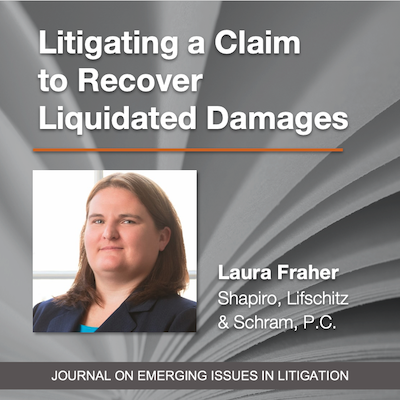
  • Litigating a Claim to Recover Liquidated Damages by Laura Fraher

    Litigating a Claim to Recover Liquidated Damages by Laura Fraher

    The Author

    Laura C. Fraher

    Laura C. FraherShapiro, Lifschitz and Schram

    Laura C. Fraher (fraher@slslaw.com) is a senior attorney in the trial and construction group at Shapiro, Lifschitz & Schram in Washington, D.C. She has extensive experience in civil litigation at both the trial court and appellate level. Competitive by nature, Laura played rugby for nearly 20 years. She puts this competitive spirit to work through her passion for the law and her clients.

    Education: St. John’s University School of Law, J.D., 2001, magna cum laude; SUNY College at Geneseo, B.A., Political Science, 1998.

    The Journal on Emerging Issues in Litigation

    Emerging Litigation Podcast

    Emerging Litigation PodcastProduced by HB Litigation and Law Street Media

    Interviews with leading attorneys and other subject matter experts on new twists in the law and how the law is responding to new twists in the world.

    Litigating a Claim to Recover Liquidated Damages:

    Enforceability Depends on Evidence of Good Faith Expectations

    “The tests and standards that courts apply to evaluate whether a particular liquidated damage provision is enforceable vary from state to state and it is imperative that litigants research and fully appreciate the particular standards that will be applied by the court in which they are litigating.”

    Abstract: The liquidated damages provision in a contract is a useful mechanism for mitigating risk in the event one of the parties to an agreement breaches the contract, costing the aggrieved party sometimes significant difficulty and substantial expense. Unfortunately, these provisions are often challenged, allowing the party responsible for the beach to exacerbate the burdens on the other party. In this article, the author discusses concepts of enforceability, proof, and avoiding litigation over liquidated damage provisions.

    A liquidated damage provision is an advance agreement of the damages that a party will be entitled to recover in the event of a future breach by the other party to a contract. These provisions can be an important tool for risk allocation and mitigation between parties when entering into a contract; both because the provision allows the parties to predict with certainty the financial ramifications of a future breach and because the liquidated damage provision should protect the aggrieved party against the difficulty and expense associated with proving actual damages in the event of a breach.

    In reality, however, when a breach occurs, liquidated damage provisions are frequently challenged and become the subject of costly litigation.  At the outset, it should be noted that the enforceability of a liquidated damage provision is generally considered an issue of law to be determined by the court, not an issue of fact to be presented to a fact finder. Thus, the key threshold issue of enforceability is likely to be determined on a pretrial motion rather than at trial and you should be prepared with both evidence and argument in order to sustain your claim.

    If you are faced with a challenge to dismiss your claim to recover liquidated damages based on unenforceability, it is important to remember that the law is in your favor.

    Liquidated damage provisions are viewed favorably by courts across the country and will generally be enforced so long as a court is satisfied that a liquidated damage provision is a stipulated agreement based on anticipated actual damages and not a penalty. A liquidated damages provision will be considered a penalty, and therefore unenforceable, if the court determines that the provision is designed to induce or secure performance by one party; conversely, a liquidated damage provision will not be viewed as a penalty, and will therefore be enforced if the court is satisfied that the provision is designed not to punish, but to provide a sum certain as compensation for a breach.

    Download the article now!