
Tag: Civil Authority

  • TVPRA, State Statutes Open Door for Civil Damage Claims by Human-Trafficking Victims

    TVPRA, State Statutes Open Door for Civil Damage Claims by Human-Trafficking Victims

    The Authors

    Coryne Leyendecker

    Coryne Leyendecker Swift, Currie, McGhee & Hiers LLP

    Coryne Leyendecker is an attorney practicing in Swift Currie’s litigation section, defending businesses and insurers against claims related to commercial litigation, sexual abuse, governmental liability, premises liability, automobile litigation and construction law.

    Pamela Lee

    Pamela LeeSwift, Currie, McGhee & Hiers LLP

    Pamela N. Lee is a partner at Swift Currie with more than 15 years of experience practicing in the firm’s litigation section. Pamela devotes her entire practice to litigation, including various tort liability litigation, insurance coverage disputes and the defense of insurance bad faith matters. Her liability practice is wide and varied, encompassing premises liability, product liability, escalator and elevator liability, automobile liability and general personal injury law. She represents companies in the food, automobile and retail industries.

    The Journal on Emerging Issues in Litigation

    Emerging Litigation Podcast

    Emerging Litigation PodcastProduced by HB Litigation and Law Street Media

    Interviews with leading attorneys and other subject matter experts on new twists in the law and how the law is responding to new twists in the world.

    TVPRA, State Statutes Open Door for Civil Damage Claims by Human-Trafficking Victims

    “A plethora of nonprofit organizations and government agencies have collectively produced hundreds of available resources on how to help prevent human trafficking. Overwhelmingly, groups across the board agree that bringing awareness to human trafficking is the most foundational method to stopping human trafficking. By implementing intentional training and internal policies, businesses can not only insulate themselves from third-party claims but they can be a force for good in the fight against human trafficking. “

    Abstract: There is not a person alive with a soul that would believe sex trafficking and other variants of modern slavery is a good thing. The individuals that perpetrate those heinous acts should be punished accordingly. In 2003, Congress opened the door for human-trafficking victims to sue for civil damages under the Trafficking Victims Protection Act of 2000 (TVPRA). Since then the TVPRA and similarly drafted state statutes have allowed for human-trafficking victims to seek civil damages against any party that has benefited from their trafficking. Given this expansive inclusion of third-party liability, more and more businesses, especially those in the hospitality industry, are ultimately the ones left to pay for the criminal acts of human traffickers. This article discusses the evolving litigation around human-trafficking claims, beginning with a broad overview of human trafficking, followed by a discussion of the legal standard behind human-trafficking civil suits and recent guidance from U.S. courts on these types of claims. The article concludes with guidance of its own on how businesses can build a foundation for their own defense while simultaneously helping prevent human-trafficking crimes from ever occurring.

    Download the article now!

    Have an idea for an article?

    If you would like to propose an article for publication in the Journal on Emerging Issues in Litigation please review our specifications and benefits, then send us a summary, outline, or draft. If you also would like to discuss the topic on the Emerging Litigation Podcast, please note that.
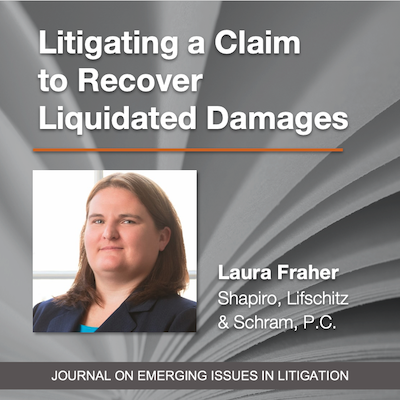

  • Litigating a Claim to Recover Liquidated Damages by Laura Fraher

    Litigating a Claim to Recover Liquidated Damages by Laura Fraher

    The Author

    Laura C. Fraher

    Laura C. FraherShapiro, Lifschitz and Schram

    Laura C. Fraher (fraher@slslaw.com) is a senior attorney in the trial and construction group at Shapiro, Lifschitz & Schram in Washington, D.C. She has extensive experience in civil litigation at both the trial court and appellate level. Competitive by nature, Laura played rugby for nearly 20 years. She puts this competitive spirit to work through her passion for the law and her clients.

    Education: St. John’s University School of Law, J.D., 2001, magna cum laude; SUNY College at Geneseo, B.A., Political Science, 1998.

    The Journal on Emerging Issues in Litigation

    Emerging Litigation Podcast

    Emerging Litigation PodcastProduced by HB Litigation and Law Street Media

    Interviews with leading attorneys and other subject matter experts on new twists in the law and how the law is responding to new twists in the world.

    Litigating a Claim to Recover Liquidated Damages:

    Enforceability Depends on Evidence of Good Faith Expectations

    “The tests and standards that courts apply to evaluate whether a particular liquidated damage provision is enforceable vary from state to state and it is imperative that litigants research and fully appreciate the particular standards that will be applied by the court in which they are litigating.”

    Abstract: The liquidated damages provision in a contract is a useful mechanism for mitigating risk in the event one of the parties to an agreement breaches the contract, costing the aggrieved party sometimes significant difficulty and substantial expense. Unfortunately, these provisions are often challenged, allowing the party responsible for the beach to exacerbate the burdens on the other party. In this article, the author discusses concepts of enforceability, proof, and avoiding litigation over liquidated damage provisions.

    A liquidated damage provision is an advance agreement of the damages that a party will be entitled to recover in the event of a future breach by the other party to a contract. These provisions can be an important tool for risk allocation and mitigation between parties when entering into a contract; both because the provision allows the parties to predict with certainty the financial ramifications of a future breach and because the liquidated damage provision should protect the aggrieved party against the difficulty and expense associated with proving actual damages in the event of a breach.

    In reality, however, when a breach occurs, liquidated damage provisions are frequently challenged and become the subject of costly litigation.  At the outset, it should be noted that the enforceability of a liquidated damage provision is generally considered an issue of law to be determined by the court, not an issue of fact to be presented to a fact finder. Thus, the key threshold issue of enforceability is likely to be determined on a pretrial motion rather than at trial and you should be prepared with both evidence and argument in order to sustain your claim.

    If you are faced with a challenge to dismiss your claim to recover liquidated damages based on unenforceability, it is important to remember that the law is in your favor.

    Liquidated damage provisions are viewed favorably by courts across the country and will generally be enforced so long as a court is satisfied that a liquidated damage provision is a stipulated agreement based on anticipated actual damages and not a penalty. A liquidated damages provision will be considered a penalty, and therefore unenforceable, if the court determines that the provision is designed to induce or secure performance by one party; conversely, a liquidated damage provision will not be viewed as a penalty, and will therefore be enforced if the court is satisfied that the provision is designed not to punish, but to provide a sum certain as compensation for a breach.

    Download the article now!